
Smart Retinal Implants Market 2026-2034 | Growth & Forecast
Coverage: By Product Type (Epiretinal Implants, Subretinal Implants, Suprachoroidal Implants); Technology (Wireless Systems, Wired Systems, AI Integration); End-Use Industry (Hospitals & Specialty Clinics, Ambulatory Surgical Centers); and Geography
- Status : Data Released
- Report Code : TIPRE00042215
- Category : Life Sciences
- No. of Pages : 150
- Available Report Formats :


- Last update date : January 14, 2026


2025 Market Size
US$ 201.20 Mn
Base year value
2034 Forecast
US$ 635.22 Bn
Projected by 2034
CAGR 2026-2034
13.63 %
Growth rate
Addressable Market
US$ 3,620.04 Mn
(2026-2034)
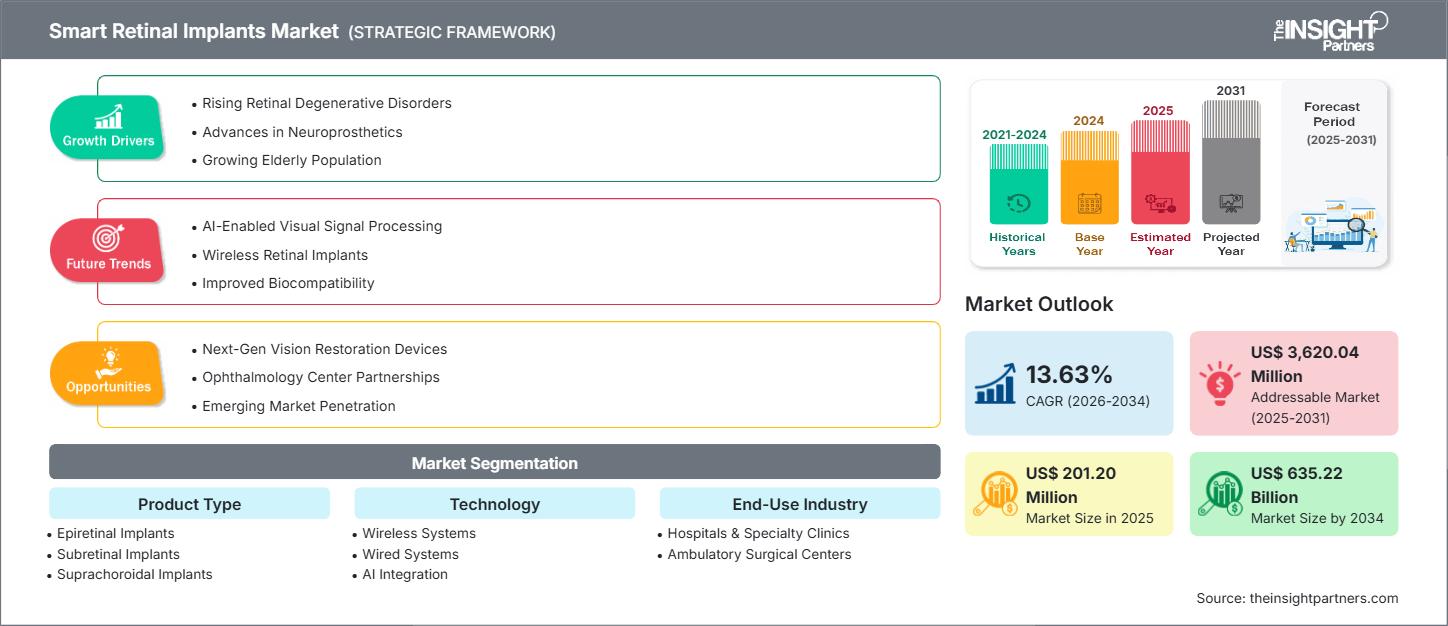
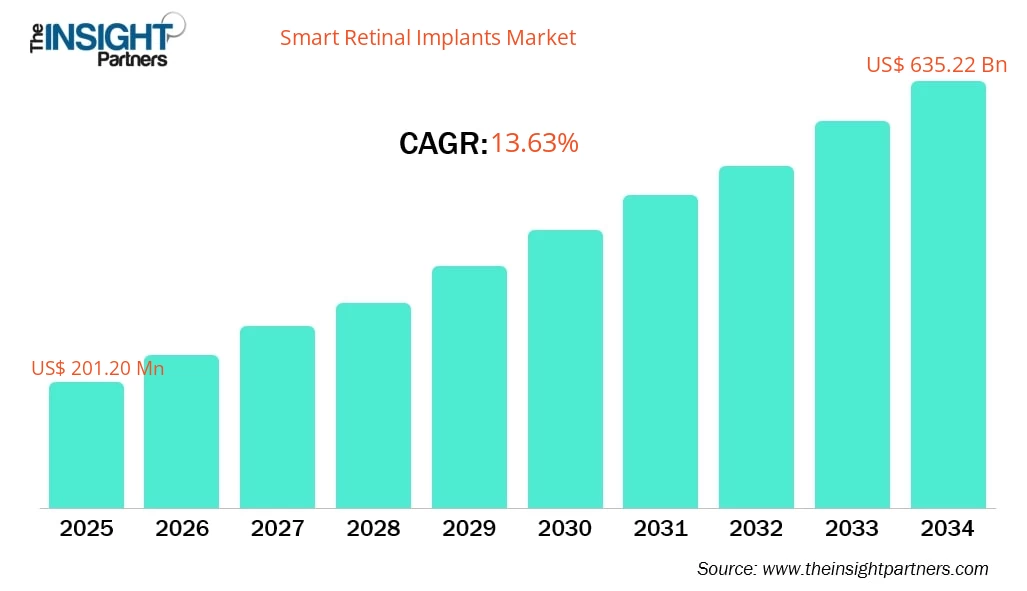
The smart retinal implants market size is projected to reach USD 635.22 billion by 2034, up from USD 201.20 million in 2025, growing at a CAGR of 13.63% during the forecast period 2026–2034.
Smart Retinal Implants Market Analysis
The smart retinal implants market forecast indicates robust growth, owing to the increasing prevalence of degenerative retinal diseases such as age-related macular degeneration and retinitis pigmentosa, supported by technologically advanced AI-integrated microelectrode arrays and wireless bioelectronics. The market expansion is facilitated by the integration of smart glasses and retinal chips, such as the PRIMA system, which is revolutionizing vision restoration by enabling patients to regain partial central vision. Additionally, the proliferation of photovoltaic implants and the focus on personalized patient outcomes boost the market growth.
Smart Retinal Implants Market Overview
Smart retinal implants are bioelectronic prosthetic devices that simplify and automate the restoration of visual function in individuals suffering from retinal degeneration. The system makes efficient visual perception possible by using a microelectronic array surgically placed under or on the retina, paired with external smart glasses that transmit visual data. Smart retinal implant solutions make sure that patients can regain a degree of visual independence by stimulating surviving retinal neurons, cutting down on the effects of irreversible blindness, and thus facilitating partial sight restoration, while ensuring compatibility with complex biological systems. These implants are the backbone of future ophthalmological care as they facilitate the delivery of hope to patients with previously irreversible blindness.
Market Assessment and Insights
- Global market for Smart Retinal Implants was valued at US$ 201.20 Million in 2025
- Annual market size is expected to reach US$ 635.22 Million by 2034
- Total addressable market (TAM) during 2026-2034 is projected to reach approximately US$ 3,620.04 Million
- Market is anticipated to register a CAGR of 13.63% during the forecast period
- The United States represents a key market, supported by Rising Retinal Degenerative Disorders, Advances in Neuroprosthetics, Growing Elderly Population, as well as evolving industry dynamics
- Market analysis covers North America, Europe, Asia-Pacific, South and Central America, Middle East and Africa, with growth evaluated across the forecast period
- Market opportunities such as Next-Gen Vision Restoration Devices, Ophthalmology Center Partnerships, Emerging Market Penetration are expected to influence market dynamics and addressable market
- Report profiles industry participants, including Second Sight Medical Products, Pixium Vision, Science Corporation, Nano Retina, Retina Implant AG, Bionic Vision Technologies, Boston Scientific, Medtronic plc, Carl Zeiss Meditec, Alcon Inc., while analyzing competitive strategies and innovation developments
-
Source: The Insight Partners' analysis based on proprietary research, government publications, company annual reports, investor presentations, industry databases, and expert interviews.
● REPORT CUSTOMIZATION
Tailor This Report To Align With Your Specific Business Requirements
This report can be customized to align precisely with your business objectives, scope, and target markets. Customization options include tailored segmentation, geography, competitive analysis, and strategic insights to support informed decision-making.
Customize This Report →WHAT YOU CAN ADJUST
- ● Segmentations
- ● Geography
- ● Competitive Analysis
- ● Language Preferences
Smart Retinal Implants Market: Strategic Insights
-
Get Top Key Market Trends of this report.This FREE sample will include data analysis, ranging from market trends to estimates and forecasts.
Smart Retinal Implants Market Drivers and Opportunities
Market Drivers:
- Rising Global Burden of Vision Loss: Healthcare organizations are seeing a mass inflow of patients, millions of people who have moderate-to-severe vision impairment globally, which complicates treatment, and quality-of-life challenges are major drivers. While dealing with this challenge, the demand for retinal implants has increased to restore functional vision.
- Technological Innovations in Neuroprosthetics: The global shift towards sophisticated devices around the world has greatly enhanced the scope of retina implants. Technology in vision restoration is shifting from a specialist service to a standard model of care, and AI-powered image processing is advancing to underpin this transformation further.
- Favorable Regulatory Pathways: Retinal implants are among a variety of medical devices whose widespread implementation is actively supported by governments worldwide. Starting from the new health tech programs, such as the FDA's Breakthrough Device Program and EMA's Advanced Therapy Medicinal Product channel, manufacturers are being incentivized to move away from slow clinical trials and adopt accelerated market entry paths.
Market Opportunities:
- Expansion in Emerging Markets: Emerging markets such as the Asia-Pacific are witnessing an increased adoption of retinal implants due to rising diabetic retinopathy and aging populations. Wireless, low-power offerings provide scalable, effective solutions to meet growing demand in these regions.
- AI-Enhanced Implants: Integration of AI will provide seamless neural data management, adaptive stimulation, enhancement of images, and on-the-spot personalized vision. Machine learning algorithms can allow customization of therapy, patient outcomes, and system efficiency by intelligent signal processing.
- Strategic Acquisitions: The trend for digitalization in specialty healthcare and intelligent medical infrastructure is the main driver of strategic M&A. Science Corporation's acquisition of Pixium Vision signals growing investor confidence in BCI (Brain-Computer Interface) technology. Such moves enable innovation consolidation, cut down the R&D burden, and set the efficient utilization of resources, thus contributing to the improvement of vision restoration technology.
Smart Retinal Implants Market Report Segmentation Analysis
The smart retinal implants market share is analyzed across various segments to provide a clearer understanding of its structure, growth potential, and emerging trends. Below is the standard segmentation approach used in most industry reports:
By Product Type:
- Epiretinal Implants: Epiretinal implants are the combination of surgical accessibility and established clinical outcomes, which are brought together seamlessly to enable the providers of ophthalmic care to streamline their operations, upgrade patient care, and make the therapy process efficient.
- Subretinal Implants: Subretinal implants are tailored to the specific needs of the retinal environment, offering improved contrast and proximity to bipolar cells without extending into vitreous surgery complexities.
- Suprachoroidal Implants: Suprachoroidal implants are the base that supports the entire market ecosystem. A range of surgical approaches helps healthcare practices automate and simplify the implant procedure with lower surgical risks.
By Technology:
- Wireless Systems
- Wired Systems
- AI Integration
By End-Use Industry:
- Hospitals & Specialty Clinics
- Ambulatory Surgical Centers
Each sector has specific implant requirements. It influences surgical setup and post-operative management.
By Geography:
- North America
- Asia Pacific
- Europe
- South & Central America
- Middle East & Africa
The smart retinal implants market in the Asia Pacific is expected to witness the fastest growth during the forecast period, driven by rising diabetic populations and strong government backing in the region.
Smart Retinal Implants Market Report Scope
| Report Attribute | Details |
|---|---|
| Market size in 2025 | US$ 201.20 Million |
| Market Size by 2034 | US$ 635.22 Billion |
| Global CAGR (2026 - 2034) | 13.63% |
| Historical Data | 2021-2024 |
| Forecast period | 2026-2034 |
| Segments Covered |
By Product Type
|
| Regions and Countries Covered |
North America
|
| Market leaders and key company profiles |
|
Smart Retinal Implants Market Players Density: Understanding Its Impact on Business Dynamics
The Smart Retinal Implants Market is growing rapidly, driven by increasing end-user demand due to factors such as evolving consumer preferences, technological advancements, and greater awareness of the product's benefits. As demand rises, businesses are expanding their offerings, innovating to meet consumer needs, and capitalizing on emerging trends, which further fuels market growth.
Smart Retinal Implants Market Share Analysis by Geography
Asia Pacific is expected to grow fastest in the coming years. Emerging markets in South & Central America, the Middle East, and Africa also have many untapped opportunities for retinal implant providers to expand. The smart retinal implants market shows a different growth trajectory in each region due to factors such as healthcare infrastructure, regulatory environment, and advanced technology adoption. Below is a summary of market share and trends by region:
North America
- Market Share: Holds the largest market share due to advanced ophthalmology infrastructure and early digital adoption.
- Key Drivers: Widespread Medicare support for devices, strong clinical research ecosystem, and high demand for specialized care.
- Trends: Shift toward AI-integrated systems, and the USA is leading with a higher CAGR through 2034.
Europe
- Market Share: Significant share driven by national reimbursement programs and stringent medical device standards.
- Key Drivers: Public funding for R&D, national reimbursement programs, and innovation in Germany and France.
- Trends: Increasing use of specialized retinal centers and adoption of advanced surgical techniques for subretinal implants.
Asia Pacific
- Market Share: Fastest-growing region owing to rapid healthcare digitalization and expanding medical tourism.
- Key Drivers: Government-supported health technology initiatives, surge in aging populations and diabetic patients, and growth in ophthalmic care.
- Trends: Adoption of portable, low-power implant solutions and rising investment in countries such as Japan and South Korea.
South and Central America
- Market Share: Emerging market with growing digital health adoption.
- Key Drivers: Expansion of private clinics and specialist centers, public-private health partnerships, and the need for advanced medical technology in Brazil.
- Trends: Cloud-based, cost-effective training and post-operative monitoring solutions are gaining traction.
Middle East and Africa
- Market Share: Developing market with strong growth potential due to rising healthcare investments.
- Key Drivers: National health strategies, healthcare infrastructure expansion, and rising demand for complex medical device procedures.
- Trends: Implementation of advanced ophthalmic technology in integrated hospital models in the UAE and Saudi Arabia.
Smart Retinal Implants Market Players Density: Understanding Its Impact on Business Dynamics
High Market Density and Innovation Race
Competition is intensifying due to the presence of major vendors such as Second Sight Medical Products, Pixium Vision, and Nano Retina. Established medical device companies such as Abbott Laboratories and Medtronic plc also contribute to the market landscape.
This competitive environment pushes vendors to differentiate through:
- AI-powered image processing and adaptive stimulation for better functional vision.
- Wireless implant systems with minimal external hardware for patient comfort.
- Scalable, cloud-based data systems for remote monitoring and follow-up.
- Strategic partnerships with ophthalmology networks and research institutions for clinical trials.
Opportunities and Strategic Moves
- Partner with technology firms to support the digital transformation of post-operative care and visual training.
- Incorporate AI/ML for personalized neurostimulation protocols and operational forecasting.
Major Companies operating in the Smart Retinal Implants Market are:
- Second Sight Medical Products
- Pixium Vision
- Science Corporation
- Nano Retina
- Retina Implant AG
- Bionic Vision Technologies
- Boston Scientific
- Medtronic plc
- Carl Zeiss Meditec
- Alcon Inc.
Disclaimer: The companies listed above are not ranked in any particular order.
Smart Retinal Implants Market News and Recent Developments
- Pixium Vision announced successful activation of its PRIMA retinal implant system in a patient with dry age-related macular degeneration (AMD) : Pixium Vision announced the successful activation of its PRIMA retinal implant system in a patient with dry AMD. The patient was able to perceive light signals, marking a major milestone in bionic vision technology and validating the implant’s potential to restore central vision in patients with retinal degeneration.
- Boston Scientific (NYSE: BSX) reported strong Q3 2025 financial results and expanded its neuromodulation portfolio through the acquisition of Nalu Medical : Boston Scientific announced net sales for Q3 2025 of $5.065 billion, representing a 20.3% increase year-over-year. The company further bolstered its neuromodulation portfolio with the acquisition of Nalu Medical to support chronic pain management. Boston Scientific also emphasized the role of AI in shaping the future of cardiology and product development, driving precise care and actionable insights.
Smart Retinal Implants Market Report Coverage and Deliverables
The "Smart Retinal Implants Market Size and Forecast (2026–2034)" report provides a detailed analysis of the market covering below areas:
- Smart Retinal Implants Market size and forecast at global, regional, and country levels for all the key market segments covered under the scope
- Smart Retinal Implants Market trends, as well as market dynamics such as drivers, restraints, and key opportunities
- Detailed PEST and SWOT analysis
- Smart Retinal Implants Market analysis covering key market trends, global and regional framework, major players, regulations, and recent market developments
- Industry landscape and competition analysis covering market concentration, heat map analysis, prominent players, and recent developments in the Smart Retinal Implants Market
- Detailed company profiles
Frequently Asked Questions

- Comprehensive Market Sizing and Forecast Analysis
- Detailed Segmentation Analysis
- In-Depth Market Dynamics Assessment
- Regional and Country-Level Insights
- Competitive Landscape and Company Benchmarking
- Strategic Business Intelligence
Recent Reports
Testimonials

The Insight Partners provided valuable market intelligence that supported our global go-to-market strategy. Their team was professional, responsive, and attentive to our feedback, providing thoughtful analysis and helpful methodological clarifications throughout the project.
Junmo Kim Chief Financial Officer (CFO), Enertech Co., Ltd.
The Insight Partners' SCADA System Market report is comprehensive, with valuable insights on current trends and future forecasts. The team was highly professional, responsive, and supportive throughout. We are very satisfied and highly recommend their services.
RAN KEDEM Partner, Reali Technologies LTDs
I requested a report on a very specific software market and the team produced the report in a few days. The information was very relevant and well presented. I then requested some changes and additions to the report. The team was again very responsive and I got the final report in less than a week.
JEAN-HERVE JENN Chairman, Future Analytica
We worked with The Insight Partners for an important market study and forecast. They gave us clear insights into opportunities and risks, which helped shape our plans. Their research was easy to use and based on solid data. It helped us make smart, confident decisions. We highly recommend them.
PIYUSH NAGPAL Sr. Vice President, High Beam Global
The Insight Partners delivered insightful, well-structured market research with strong domain expertise. Their team was professional and responsive throughout. The user-friendly website made accessing industry reports seamless. We highly recommend them for reliable, high-quality research services
YUKIHIKO ADACHI CEO, Deep Blue, LLC.
This is the first time I have purchased a market report from The Insight Partners.While I was unsure at first, I visited their web site and felt more comfortable to take the risk and purchase a market report.I am completely satisfied with the quality of the report and customer service. I had several questions and comments with the initial report, but after a couple of dialogs over email with their analyst I believe I have a report that I can use as input to our strategic planning process.Thank you so much for taking the extra time and making this a positive experience.I will definitely recommend your service to others and you will be my first call when we need further market data.
JOHN SUZUKI President and Chief Executive Officer, Board Director, BK Technologies
I wish to appreciate your support and the professionalism you displayed in the course of attending to my request for information regarding to infectious disease IVD market in Nigeria. I appreciate your patience, your guidance, and the fact that you were willing to offer a discount, which eventually made it possible for us to close a deal. I look forward to engaging The Insight Partners in the future, all thanks to the impression you have created in me as a result of this first encounter.
DR CHIJIOKE ONYIA MANAGING DIRECTOR, PineCrest Healthcare Ltd.Reason to Buy
- Informed Decision-Making
- Understanding Market Dynamics
- Competitive Analysis
- Identifying Emerging Markets
- Customer Insights
- Market Forecasts
- Risk Mitigation
- Boosting Operational Efficiency
- Strategic Planning
- Investment Justification
- Tracking Industry Innovations
- Aligning with Regulatory Trends





 Get Free Sample for