
Continuous Thread Caps Market Share, Size & Demand by 2034
Coverage: By Material Type (Polypropylene, Polyethylene, Others); End Use (Food and Beverages, Chemical Industry, Personal Care and Cosmetics, Homecare, Others) , and Geography (North America, Europe, Asia Pacific, and South and Central America)
- Status : Data Released
- Report Code : TIPRE00028395
- Category : Chemicals and Materials
- No. of Pages : 150
- Available Report Formats :


- Last update date : September 01, 2026


2025 Market Size
US$ 1.6 Bn
Base year value
2034 Forecast
US$ 2.33 Bn
Projected by 2034
CAGR 2026-2034
4.26 %
Growth rate
Addressable Market
US$ 17.84 Bn
(2026-2034)
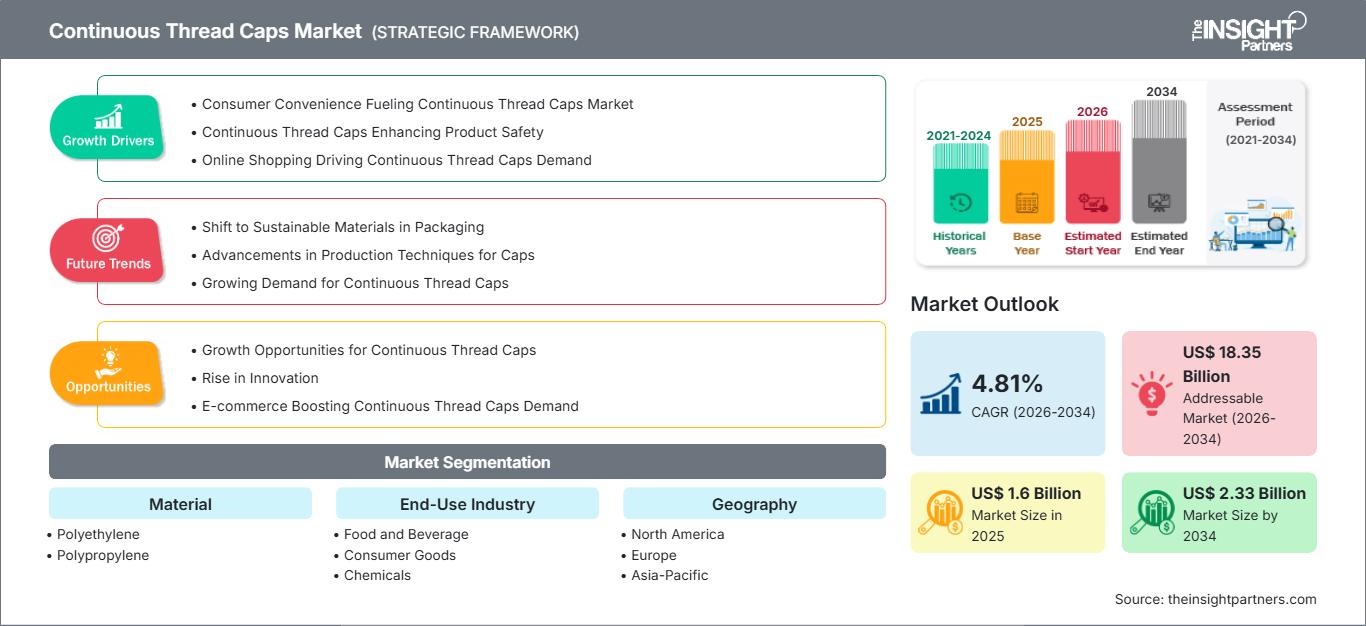
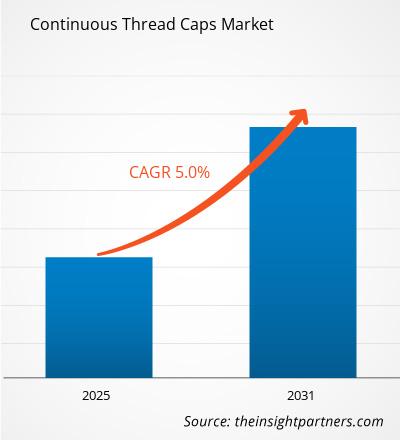
The Continuous Thread Caps market was valued at US$ 1.6 billion in 2025 and is expected to reach US$ 2.33 billion by 2034; it is estimated to record a CAGR of 4.26% during 2026-2034.
Continuous Thread Caps Market Assessment and Insights
- North America: North America is estimated to represent 26–30% Continuous Thread Caps Market share in 2025 and is expected to grow at a 3.8–4.4% CAGR between 2026–2034, supported by packaged beverages, food products, household chemicals, and established closure manufacturing.
- US: The US is estimated to account for 74–78% of North America's 2025 share and is projected to grow at a 3.7–4.3% CAGR between 2026–2034, driven by high-volume consumer packaging.
- Europe: Europe is estimated to hold 21–25% share in 2025 and is expected to register a 4.1–4.7% CAGR between 2026–2034, led by Germany, the UK, France, Italy, and Spain, where recyclability and lightweighting are increasingly important.
- Asia Pacific: Asia Pacific is estimated at 30–34% share in 2025 and is forecast to expand at a 5.4–6.1% CAGR between 2026–2034, led by China, India, Japan, South Korea, and Australia through expanding packaged-goods production.
- Largest Segment: Food and Beverage is estimated to hold a 41–46% market share in 2025, with a 4.8–5.4% CAGR from 2026–2034, reflecting high closure volumes across bottles, jars, sauces, and beverages.
- High Growth Segment: Polypropylene represents approximately 52–57% market share in 2025 and is expected to achieve a 5.0–5.7% CAGR from 2026–2034, supported by lightweighting and recyclability.
- Key companies analyzed in detail: Continental Crowns and Closures, Berlin Packaging, Berry Global Group, Inc., Airlite Plastics Corp., All American Containers, Inc., Cincinnati Container Co., Crown Holdings, Inc., Siddhi Industries, Glass Vials Inc., and Shri Plasto Packers.
Source: The Insight Partners' analysis based on proprietary research, government publications, company annual reports, investor presentations, industry databases, and expert interviews.
Continuous Thread Caps Market trends include the shift from traditional screw caps to high-tech ones that are light and capable of delivering high performance with respect to sealing while offering consumer convenience. Injection molding is crucial for mass production, but material engineering helps cut back on resin while maintaining the functionality of threads and torquing performance. Closures for mono-material packaging and recycled polymers are under development for food, beverages, personal care, and homecare applications.
Continuous Thread Caps Market report indicates that future demand is projected to rise owing to growth in demand for packaged foods in developing countries and increased penetration of modern retailing. Asia Pacific is critical to future growth due to the expansion in beverage, processed food, and consumer goods manufacturing, which generates the need for closures. In addition, European regulation is impacting products design through regulations on beverage closures that remain tethered to the container.
Continuous Thread Caps Market Report Scope
| Report Attribute | Details |
|---|---|
| Market size in 2025 | US$ 1.6 Billion |
| Market Size by 2034 | US$ 2.33 Billion |
| Global CAGR (2026 - 2034) | 4.26% |
| Historical Data | 2021-2024 |
| Forecast period | 2026-2034 |
Continuous Thread Caps Market Analysis
Demand in the Continuous Thread Caps Market is directly associated with the volume of production of package goods since every packed product needs a seal. In this regard, the development of the Market depends on the use of beverages, foodstuffs, household products, cosmetic and chemical products. Continuous threads have multiple openings and closing abilities that allow their use in the packaging of sauces, condiments, nutraceuticals, cosmetics, detergents, and industrial products where both protection and convenience are needed.
The value chain in the Continuous Thread Caps Market consists of raw material producers, compounders, closure makers, mold producers, packaging converters, fillers, brand owners, distributors, and recyclers. Polyethylene allows high toughness and chemical resistance properties, while polypropylene allows stiffness and heat resistance. Closure makers have to meet the demands of resin choice, thread geometry, liner compatibility, application torque, leak proofing, tampering, and cycle time.
Competition in the Continuous Thread Caps Market is becoming more influenced by lightweighting, use of recycled material, application engineering, and manufacturing worldwide. Berlin Packaging offers an extensive caps and closures line that includes threaded, tamper evident, flip top, dispensing, and specialty closures. Berry Global Group, Inc. has invented lightweight and circular closures and Crown Holdings, Inc. operates in closure and packaging systems space. Such capabilities will allow well-known manufacturers to satisfy several customer requirements at once.
Strategic positioning also becomes affected by mergers and acquisitions and investments in sustainable operations. Amcor has already finished the merger with Berry Global in April 2025, having created a bigger packaging company, which has greater material, manufacturing, and innovation potential. The deal showed the magnitude of synergy generation that packaging companies strive for. Small specialized firms are able to compete through customizing their products, having shorter development time, better service on a regional level, and unique closure design.
● REPORT CUSTOMIZATION
Tailor This Report To Align With Your Specific Business Requirements
This report can be customized to align precisely with your business objectives, scope, and target markets. Customization options include tailored segmentation, geography, competitive analysis, and strategic insights to support informed decision-making.
Customize This Report →WHAT YOU CAN ADJUST
- ● Segmentations
- ● Geography
- ● Competitive Analysis
- ● Language Preferences
Continuous Thread Caps Market: Strategic Insights
Regional Insights
North America Continuous Thread Caps Market
North America is estimated to account for 26–30% share in 2025 and is projected to grow at a 3.8–4.4% CAGR through 2034. The United States leads in regional demand, whereas Canada adds consumption needs in food, beverages, personal care, household chemicals, and industrial packagings. High penetration of packaged goods results in stable closure demands, whereas trends toward lightweighting and recycled content are inspiring designs for existing packaging formats. Large-scale filling plants prefer closures that have uniform closure torque, tight sealing, and automation potential.
Increasing demands in the Continuous Thread Caps Market combine the aspects of convenience and sustainability. Food producers need proper sealing capabilities for sauces, spreads, and condiments, whereas beverage producers prefer good sealing and ergonomic design for consumers. Also, personal and household brands utilize lightweight polymer closures to decrease the weight of packaging. Proximity to leading consumer goods producers gives advantages to local manufacturers; however, changes in the price of resins and recycled polymers cannot be ignored.
U.S. Continuous Thread Caps Market
The US represents approximately 74–78% of North America's 2025 share and is expected to expand at a 3.7–4.3% CAGR through 2034. The demand is varied in terms of food products, beverages, consumer products, chemicals, personal care, and homecare. There is well-established packaging infrastructure that enables efficient closure manufacturing on a large scale, while there is a trend towards lightweight and recyclable closures among the brand owners.
Among packaging and closure companies relevant to this market are Berlin Packaging, Berry Global Group, Inc., Airlite Plastics Corp., All American Containers, Inc., and Cincinnati Container Co. Food and beverage sector will continue being important due to the ability of threaded caps to provide resealability and protect the content.
Europe Continuous Thread Caps Market
Europe is estimated to represent 21–25% share in 2025 and is forecast to grow at a 4.1–4.7% CAGR through 2034. Germany is the leading regional market, followed by the UK, France, Italy, and Spain. Regulatory pressure on packaging waste, recycled content, and closure attachment is accelerating development of lighter and more recyclable closure formats.
The UK has great demand from food manufacturers, beverage manufacturers, personal care product manufacturers, and home care product manufacturers. Closure designs with tether compatibility and lightweighting continue to be a growing trend for suppliers with consumer acceptance being equally important. Brand owners also have requirements for packaging formats that will enable ease of filling and distribution in European markets.
Germany has great potential with its extensive food processing industry, beverages, chemical industry, and industrial manufacturing capabilities. Dimensional consistency is very important for German packaging manufacturers as the closure has to be compatible with automated filling and capping machines. Lightweighting and recycling are some of the criteria that have been added to procurement requirements.
The demand for closure systems comes from France, Italy, and Spain through food, beverages, cosmetics, and household products segments. France has great sustainability focused packaging programs, Italy has diverse food and beverages manufacturing capabilities, and Spain has beverage and processed food manufacturing capabilities.
APAC Continuous Thread Caps Market
APAC is estimated to hold 30–34% share in 2025 and is expected to grow at a 5.4–6.1% CAGR, making it the leading growth region. China is the largest market, while India, Japan, South Korea, and Australia contribute through packaged food, beverages, personal care, chemicals, and homecare production.
Industrial expansion, modern retail penetration, and packaging localization support regional demand. China and India provide the strongest volume opportunities, while Japan and South Korea emphasize precision, quality, and material efficiency. Australia has mature beverage and food applications, with sustainability policy increasingly influencing polymer selection and closure design.
Middle East & Africa Continuous Thread Caps Market
Middle East & Africa is expected to expand at approximately 3.9–4.5% CAGR through 2034, with Saudi Arabia representing the leading market, followed by the UAE and South Africa. Food processing, beverages, personal care, homecare, and chemicals support recurring demand for secure polymer closures.
Saudi Arabia and the UAE benefit from industrial diversification and investment in consumer-goods manufacturing, while South Africa provides a developed packaging base. Rest of MEA demand remains linked to food imports, local filling capacity, and infrastructure development. Hot climates also increase the importance of closure integrity, material stability, and reliable sealing.
Segmentation Analysis
Material
The Material segment is expected to expand at a 4.9–5.5% CAGR from 2026–2034. Polypropylene and polyethylene address complementary performance requirements, with polypropylene favored where stiffness, heat resistance, and lightweighting are priorities. Polyethylene remains valuable where toughness, flexibility, and chemical resistance are more important. The Continuous Thread Caps Market scope is consequently influenced by resin availability, recycled-content compatibility, molding efficiency, and application-specific performance.
- Polyethylene: Polyethylene is widely used where toughness, flexibility, chemical resistance, and reliable sealing are required. It is strategically important for household, chemical, personal-care, and selected food applications where impact resistance matters.
- Polypropylene: Polypropylene holds a leading position because its stiffness, thermal resistance, low density, and molding flexibility support lightweight threaded closures. It is particularly relevant to food, beverage, personal-care, and homecare packaging.
End-Use Industry
The End-Use Industry segment is projected to grow at a 4.8–5.4% CAGR from 2026–2034. Demand is supported by recurring packaging consumption across consumer-facing industries, with food and beverage generating the largest requirement. Personal care and homecare applications increasingly emphasize dispensing convenience and aesthetics, while chemical packaging prioritizes resistance and secure sealing.
- Food and Beverage: Food and Beverage is the principal demand center because bottles, jars, sauces, spreads, beverages, and nutritional products require secure and frequently resealable closures. Product safety and consumer convenience remain strategic priorities.
- Consumer Goods: Consumer Goods applications include household products, nutritional products, and general packaged merchandise. Closures must balance usability, visual appeal, sealing performance, and efficient compatibility with high-speed filling and capping operations.
- Chemicals: Chemicals require closures that withstand aggressive formulations, leakage risks, and transportation conditions. Material selection and thread design are therefore critical for maintaining package integrity across industrial and consumer chemical products.
- Personal Care and Cosmetics: Personal Care and Cosmetics applications favor aesthetically consistent closures that support dispensing, resealing, and premium presentation. Lightweight designs and mono-material compatibility increasingly influence packaging development and sourcing decisions.
- Homecare: Homecare products require secure, durable closures capable of handling detergents, cleaners, and concentrated formulations. Chemical resistance, controlled dispensing, leak prevention, and ergonomic opening are important purchasing criteria.
Opportunity Snapshot
| End-Use Industry | Revenue Contribution | Trend Tag | Adoption Stage |
| Food and Beverage | High | Resealable Packs | Mature |
| Consumer Goods | Medium | Lightweight Closures | Mature |
| Chemicals | Medium | Chemical Resistance | Scaling |
| Personal Care and Cosmetics | Medium | Premium Dispensing | Scaling |
| Homecare | Medium | Leak Control | Scaling |
Continuous Thread Caps Market Growth Drivers and Impact Analysis
Increasing consumption of packaged food and beverages
Rising packaged-food and beverage production directly expands the number of containers requiring secure, resealable closures. Threaded closures have been used in bottled water, sauces, condiments, nutritional products, dairy drinks, and ready-to-drink products since such closures have to be opened and closed many times after purchase by consumers. There has been an increase in demand for convenience-based consumption, which makes it necessary to provide ergonomically designed closures that will be able to be closed many times without compromising the seal. Therefore, closure companies gain advantage from repeat orders from large volumes. The phenomenon is especially true for emerging markets where the development of retail and packaged foods takes place from relatively low starting positions. Companies that are able to combine high-speed molding, uniform size, light-weight construction, and proper application torque are in a position to mass-produce while minimizing materials usage.
Lightweighting and circular packaging requirements
The sustainability initiatives in packaging are making brands decrease their material usage while keeping package integrity intact. Closures have been made with the help of thinning walls, optimal thread geometry, smaller skirts, and designs using less resin without compromising on seal integrity. More importance is being given to recycled polypropylene and polyethylene wherever food contact, visual, and technical requirements are fulfilled. The process of lightweighting helps in decreasing material and weight usage as well as packaging impacts, which results in economic and environmental benefits. The problem is of sustaining torque, leakage prevention, tampering prevention, and user-friendliness after reducing materials. Therefore, those manufacturers who have the capability to do molding simulations, tooling, and quality control would be able to capitalize on such specification changes.
Expansion of convenience-oriented and functional closure designs
Consumer expectations are shifting from basic sealing toward closures that improve opening, pouring, dispensing, and resealing. Food products such as sauces and spreads require controlled dispensing, while personal-care and homecare products benefit from flip-top or dispensing mechanisms integrated into threaded formats. Child-resistant and tamper-evident functions also create additional technical requirements for selected products. This functionality increases the value of closure engineering because performance depends on precise interaction between cap, thread, neck finish, liner, and container. Brand owners increasingly use closure design to differentiate packaging while maintaining compatibility with automated capping equipment. Suppliers able to offer multiple formats and customization options can therefore address broader customer requirements. The result is greater demand for engineered continuous-thread systems rather than standardized commodity caps.
Continuous Thread Caps Market Future Trends
Transition toward mono-material and recycled-content closures
Closure development is expected to increasingly prioritize mono-material compatibility and verified recycled content. Packaging designers are seeking combinations in which the closure and container can enter compatible recycling streams without complicated separation requirements. Polypropylene closures paired with compatible packaging structures can support this direction, while recycled polyethylene remains relevant for applications where flexibility and chemical resistance are important. Future designs will likely combine reduced resin consumption with stronger thread geometry, improved tamper evidence, and better consumer ergonomics. Recycled-resin consistency will remain a technical consideration because color, odor, mechanical properties, and food-contact requirements can affect qualification. Suppliers are therefore likely to invest in material characterization, processing controls, and closed-loop sourcing. The resulting innovation should shift competition toward verified circularity performance rather than recycled-content claims alone.
Smart closure specifications and advanced customization
Future closure development will increasingly use digital design tools, rapid prototyping, and application-specific simulation to shorten qualification cycles. Packaging customers are seeking closures optimized for individual neck finishes, torque requirements, dispensing behavior, and filling-line speeds rather than relying solely on standardized dimensions. Digital engineering can help manufacturers identify stress concentrations, improve thread engagement, and reduce material without compromising performance. Customization is especially relevant to personal care, cosmetics, specialty food, and chemical applications where packaging functionality influences consumer experience or product safety. At the same time, automated inspection and process monitoring can improve dimensional consistency during high-volume molding. These capabilities should support shorter development cycles and more precise specifications, allowing suppliers to compete through engineering value while maintaining the cost efficiency required for large-volume closure production.
Continuous Thread Caps Market Opportunities
Localized manufacturing capacity in Asia Pacific
Expansion of packaged-food, beverage, personal-care, and household-product production in Asia Pacific creates opportunities for regional closure manufacturing and tooling investment. China and India are particularly attractive because large consumer populations, expanding modern retail, and increasing domestic production can support substantial recurring demand. Local manufacturing can reduce transportation distances, improve response times, and allow suppliers to tailor resin formulations and closure dimensions to regional filling equipment. Investment opportunities include injection-molding capacity, compression systems, mold-making facilities, recycled-resin integration, and automated inspection. Suppliers can also develop technical centers close to major packaging clusters to accelerate qualification and troubleshoot application issues. The Continuous Thread Caps Market Forecasts therefore indicate that localization can become an important competitive strategy where customers increasingly expect shorter lead times, regional supply resilience, and application-specific engineering support.
Premium closures for personal care, homecare, and specialty foods
Higher-value opportunities exist in applications where closure performance directly influences product usability or brand positioning. Personal-care products can require premium aesthetics and controlled dispensing, while homecare products need chemical resistance and leak prevention. Specialty foods, sauces, spreads, and nutritional products increasingly use closures that support clean dispensing, resealing, and convenient handling. Suppliers can capture additional value by combining lightweight construction with integrated dispensing mechanisms, tamper evidence, and improved ergonomics. Product development should focus on specific viscosity ranges, container neck finishes, filling-line requirements, and consumer-use patterns rather than offering generic designs. Partnerships with brand owners during packaging development can secure longer-term specifications and reduce substitution risk. This strategy can improve margins while broadening closure applications beyond high-volume commodity beverage and food containers.
Recent Developments
- March 2026: Origin Materials entered a distribution agreement with HP Embalagens to supply polyethylene terephthalate (PET) bottle caps made from recycled materials. HP Embalagens intends to deliver Origin PET caps to its clients across South America, especially in the Brazilian market. The company serves multinational brands such as Nestlé, Ferrero Rocher, Johnson & Johnson, and Natura.
- June 2025: In a strategic move to bolster its injection-molding capabilities, the Alpla Group acquired KM Packaging, expanding its global footprint in high-quality closures for tubes, bottles, and jars.
Frequently Asked Questions

- Comprehensive Market Sizing and Forecast Analysis
- Detailed Segmentation Analysis
- In-Depth Market Dynamics Assessment
- Regional and Country-Level Insights
- Competitive Landscape and Company Benchmarking
- Strategic Business Intelligence
Recent Reports
Testimonials

The Insight Partners provided valuable market intelligence that supported our global go-to-market strategy. Their team was professional, responsive, and attentive to our feedback, providing thoughtful analysis and helpful methodological clarifications throughout the project.
Junmo Kim Chief Financial Officer (CFO), Enertech Co., Ltd.
The Insight Partners' SCADA System Market report is comprehensive, with valuable insights on current trends and future forecasts. The team was highly professional, responsive, and supportive throughout. We are very satisfied and highly recommend their services.
RAN KEDEM Partner, Reali Technologies LTDs
I requested a report on a very specific software market and the team produced the report in a few days. The information was very relevant and well presented. I then requested some changes and additions to the report. The team was again very responsive and I got the final report in less than a week.
JEAN-HERVE JENN Chairman, Future Analytica
We worked with The Insight Partners for an important market study and forecast. They gave us clear insights into opportunities and risks, which helped shape our plans. Their research was easy to use and based on solid data. It helped us make smart, confident decisions. We highly recommend them.
PIYUSH NAGPAL Sr. Vice President, High Beam Global
The Insight Partners delivered insightful, well-structured market research with strong domain expertise. Their team was professional and responsive throughout. The user-friendly website made accessing industry reports seamless. We highly recommend them for reliable, high-quality research services
YUKIHIKO ADACHI CEO, Deep Blue, LLC.
This is the first time I have purchased a market report from The Insight Partners.While I was unsure at first, I visited their web site and felt more comfortable to take the risk and purchase a market report.I am completely satisfied with the quality of the report and customer service. I had several questions and comments with the initial report, but after a couple of dialogs over email with their analyst I believe I have a report that I can use as input to our strategic planning process.Thank you so much for taking the extra time and making this a positive experience.I will definitely recommend your service to others and you will be my first call when we need further market data.
JOHN SUZUKI President and Chief Executive Officer, Board Director, BK Technologies
I wish to appreciate your support and the professionalism you displayed in the course of attending to my request for information regarding to infectious disease IVD market in Nigeria. I appreciate your patience, your guidance, and the fact that you were willing to offer a discount, which eventually made it possible for us to close a deal. I look forward to engaging The Insight Partners in the future, all thanks to the impression you have created in me as a result of this first encounter.
DR CHIJIOKE ONYIA MANAGING DIRECTOR, PineCrest Healthcare Ltd.Reason to Buy
- Informed Decision-Making
- Understanding Market Dynamics
- Competitive Analysis
- Identifying Emerging Markets
- Customer Insights
- Market Forecasts
- Risk Mitigation
- Boosting Operational Efficiency
- Strategic Planning
- Investment Justification
- Tracking Industry Innovations
- Aligning with Regulatory Trends





 Get Free Sample for