
Copper Cathode Market Demand, Share & Growth by 2034
Coverage: By Type (Standard Quality Level, High Quality Level); Application (Conductor, Electronic Products, Others), and Geography (North America, Europe, Asia Pacific, and South and Central America)
- Status : Data Released
- Report Code : TIPRE00014521
- Category : Electronics and Semiconductor
- No. of Pages : 150
- Available Report Formats :


- Last update date : July 29, 2026


2025 Market Size
US$ 28.84 Bn
Base year value
2034 Forecast
US$ 55.33 Bn
Projected by 2034
CAGR 2026-2034
7.51 %
Growth rate
Addressable Market
US$ 379.36 Bn
(2026-2034)
The Copper Cathode Market was valued at US$ 28.84 Billion in 2025 and is expected to grow at a CAGR of 7.51% to reach US$ 55.33 Billion by 2034. The growth in the market is attributed to rising demand for refined copper in conductors, electronics, power generation, and industrial applications.
In North America, there will be a forecasted increase in demand with a CAGR ranging between 6.6 and 7.4% due to increasing demand from grid modernization, semiconductor packaging, manufacture of electrical equipment, and data center build-out. The Copper Cathode Market size will be driven by domestic production initiatives, renewable power generation with copper-intensive connections, and purchasing practices of reliable refined copper.
Copper Cathode Market Assessment and Insights
- North America held 15–18% share in 2025 and is growing at a CAGR of 6.6–7.4% during 2026–2034, supported by grid upgrades, electronics investment, and conductor manufacturing.
- US represented 72–76% of North America in 2025 and is growing at a CAGR of 6.8–7.6%, led by power cable, semiconductor, and industrial equipment demand.
- Europe accounted for 18–21% share in 2025 and is advancing at a CAGR of 6.2–7.0%, with Germany, France, Italy, Spain, and the UK leading demand.
- Asia Pacific captured 55–59% share in 2025 and is expanding at a CAGR of 7.9–8.7%, led by China, Japan, South Korea, India, and Australia.
- Largest Segment Standard Quality Level held 61–65% market share in 2025 and is growing at a CAGR of 6.8–7.6%, supported by wire rod and conductor applications.
- High Growth Segment High Quality Level held 35–39% market share in 2025 and is growing at a CAGR of 8.1–8.9%, driven by electronics and precision components.
- Key companies analyzed in detail: Aurubis AG, BHP Group Limited, Corporación Nacional del Cobre de Chile, Freeport-McMoRan Inc., Glencore plc, Jiangxi Copper Company Limited, Southern Copper Corporation, Sumitomo Metal Mining Co., Ltd., Tongling Nonferrous Metals Group Co., Ltd., and Hindalco Industries Limited.
Source: The Insight Partners' analysis based on proprietary research, government publications, company annual reports, investor presentations, industry databases, and expert interviews.
The production of copper cathodes has moved from a focus on capacity growth to a focus on quality, efficiency, and feedstock security. Copper producers have learned how to balance mining concentrate, scrap copper, solvent extraction-electro-winning, and electrorefining capacity to produce products of higher purity. The market mirrors this operational shift since consumers need copper cathodes to conduct better, contain lower impurities, be delivered regularly, and prove proven origins in internationally integrated fabrication networks.
Future demand will be fueled by electrification, renewable energy, construction of urban infrastructure, and localizing the electronics industry. Demand from new geographies will arise from industrial hubs and improvements to the power grid, whereas existing markets will demand recycling, carbon-free production, and security of supply. Investors will be looking to back cathode suppliers that are big, secure their concentrates, guarantee quality, and have relationships with wire and cable makers.
Copper Cathode Market Report Scope
| Report Attribute | Details |
|---|---|
| Market size in 2025 | US$ 28.84 Billion |
| Market Size by 2034 | US$ 55.33 Billion |
| Global CAGR (2026 - 2034) | 7.51% |
| Historical Data | 2021-2024 |
| Forecast period | 2026-2034 |
Copper Cathode Market Analysis
The growth of the Copper Cathode Market is mainly attributed to rising demand for electricity, grid modernization, integration of renewable sources of energy, and industrial automation of copper-based sectors. Statistics from the International Copper Study Group show that refined copper usage has been 27.4 million tonnes in 2024, where 58% of the consumption has come from China alone. These kinds of demands lay a very good ground for the necessity of producing copper cathodes.
The industry comprises of mine operators, smelters, refineries, recyclers, cathode traders, wire rod producers, cable makers, and electronics producers. Supply factors include grade of ores, costs of concentrate processing, energy costs, permit issuance for environmentally responsible production, and exchange stock. Purchasing agents focus on cathodes meeting the conductivity standards and delivered through reliable logistics networks since the further production process requires high metal quality.
The Copper Cathode Market report shows competition among integrated miners, regional refiners, and metals diversifiers. Competitors like Aurubis AG, Jiangxi Copper Company Limited, Tongling Nonferrous Metals Group Co., Ltd., and Hindalco Industries Limited are competing using capabilities for refining and downstream production, while suppliers like BHP Group Limited, Corporación Nacional del Cobre de Chile, Freeport-McMoRan Inc., Glencore plc, Southern Copper Corporation, and Sumitomo Metal Mining Co., Ltd. are providing the raw materials through mining and refining operations.
The strategic positioning is moving toward secure feedstock, low carbon emissions from refining processes, recycling capability, and tailor-made cathodes for specific clients. The companies are developing technologies related to energy efficiency, digital process controls, and material traceability to comply with procurement criteria from the electronics, automotive, and infrastructure industry clients.
● REPORT CUSTOMIZATION
Tailor This Report To Align With Your Specific Business Requirements
This report can be customized to align precisely with your business objectives, scope, and target markets. Customization options include tailored segmentation, geography, competitive analysis, and strategic insights to support informed decision-making.
Customize This Report →WHAT YOU CAN ADJUST
- ● Segmentations
- ● Geography
- ● Competitive Analysis
- ● Language Preferences
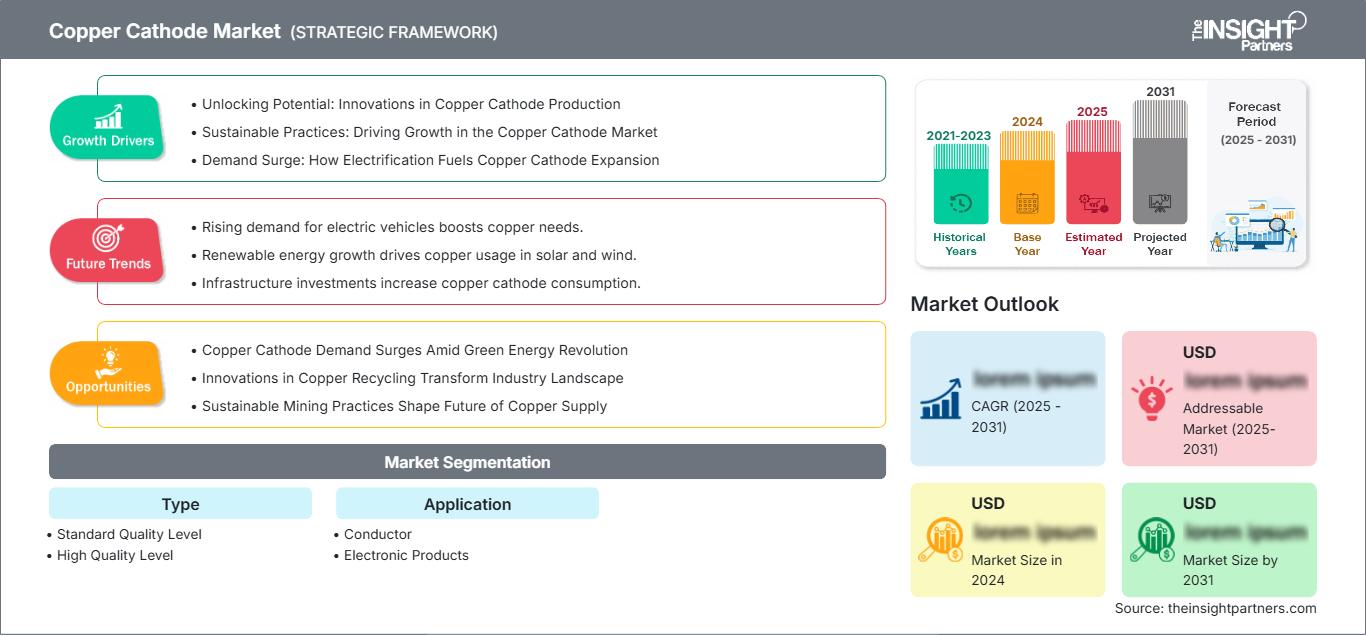
Copper Cathode Market: Strategic Insights
Regional Insights
North America Copper Cathode Market
North America was estimated to be holding 15–18% market share in 2025 and will likely record a CAGR of 6.6–7.4% from 2025 to 2034. This is attributed to factors such as power grid replacement, data center electricity infrastructure, electric vehicle charging station construction, and conductor production in the region. North American purchasers are increasingly looking for security in sourcing from existing producers and distributors.
The demand is mainly from conductors in transmission and distribution, building wire, and industrial machinery; the other factor influencing demand is electronic devices requiring copper with high purity. The incentives in U.S. manufacturing industries and the linkage between mining and refining industries in Canada help enhance regional stability.
U.S. Copper Cathode Market
In 2025, the U.S. was estimated to account for 72-76% of the region, while its compound annual growth rate would be 6.8-7.6%. The primary applications are wire and cable, electric machinery, semiconductor supply chain applications, renewable interconnections, and military electronic products. Freeport-McMoRan Inc. and Southern Copper Corporation remain significant players in the region; other global firms provide cathode import.
Applications indicate that conductors use the majority of cathode output in power cables, building wires, electric machines, transformers, and bus bars. Applications in electronics need high purity levels for connectors, printed circuits, and precision parts. Consumers prefer cathodes of known grade, origin, and logistic reliability since any production problems can disrupt downstream fabrication processes.
Europe Copper Cathode Market
Europe had a market share of 18–21% in 2025, with a forecasted compound annual growth rate of 6.2–7.0%. The dominance of Germany comes from the fact that it is a leader in automotive electrification, industrial equipment, and cables production. The demand from France stems from power systems infrastructure and aerospace electronics, with Italy and Spain making contributions through building wire, renewable energy, and manufacturing.
European consumers give great importance to traceability, recycling routes, and lower carbon footprint of refining due to growing influence of regulatory environment and customers' requirements on metals purchases. Aurubis AG serves as a key company in local refining capability, and imports become indispensable. Growth is more stable compared to APAC due to development of mature industrial capacity through electrification and replacement.
APAC Copper Cathode Market
The Asia Pacific region has a share ranging from 55–59% in 2025 and is expected to register a CAGR of 7.9–8.7%. China dominates with electronics, construction and grid investments, and copper usage in refineries. Japan and South Korea provide demand from their electronics industry and automobiles, whereas India and Australia drive consumption through infrastructural growth, renewable energy, and industries
Demand in conductors and electronics will be spurred by industrial policies, localization of manufacturing, and development in electric grid systems. Jiangxi Copper Company Limited and Tongling Nonferrous Metals Group Co., Ltd. will assist in the improvement of supply in the region, while Sumitomo Metal Mining Co., Ltd. assists in the provision of quality cathodes. Consumers in APAC are conservative on concentrates, treatments, and ports.
Middle East & Africa Copper Cathode Market
Middle East & Africa is projected to grow at a CAGR of 6.0–6.8% as Saudi Arabia, the UAE, South Africa, and the rest of MEA invest in grid reinforcement, industrial zones, mining value addition, and transport infrastructure. The UAE leads trade-linked demand through re-export, logistics, and electrical equipment distribution.
The need for energy diversification and pipeline construction is linked to conductor requirements, and South Africa’s involvement comes via mining, rehabilitation of electrical power generation, and industry maintenance. The widespread use of conductors is dependent on reliable supply of the product, fabrications in the region, and funds for infrastructure development.
Segmentation Analysis
Type
Type is expected to grow at a CAGR of 7.2–8.0% from 2026 to 2034 as the Copper Cathode Market scope spans standard and high-quality refined copper grades. Standard quality remains essential for wire rod and broad conductor use, while high-quality material gains traction where electronics, precision components, and strict conductivity requirements demand lower impurity tolerance and tighter process control.
- Standard Quality Level cathodes hold the larger position because conductor manufacturers require dependable volumes for cable, building wire, transformers, and industrial equipment. Strategic value rests on cost efficiency and stable supply.
- High Quality Level cathodes serve demanding electronic products, connectors, precision copper components, and high-performance conductors. Demand rises where purity, surface quality, and conductivity consistency directly influence product reliability.
Application
Application is projected to grow at a CAGR of 7.0–7.8% during 2026–2034 as conductor demand remains broad and electronic products become more quality-sensitive. Conductors absorb large cathode volumes through energy, construction, mobility, and industrial systems, while electronic products create higher-margin requirements linked to miniaturization, data processing, semiconductor packaging, and clean energy controls.
- Conductor applications dominate consumption because copper cathodes are converted into rods, wires, busbars, and cables for power networks, buildings, motors, transformers, and renewable connections.
- Electronic Products applications require consistent purity for connectors, components, circuit-related uses, and thermal management. Strategic importance increases as electronics manufacturing expands across Asia, North America, and Europe.
Opportunity Snapshot
| Application | Revenue Contribution | Trend Tag | Adoption Stage |
| Conductor | High | Grid Buildout | Mature |
| Electronic Products | Medium | Precision Purity | Scaling |
Copper Cathode Market Growth Drivers and Impact Analysis
Grid Modernization Raises Refined Copper Pull
Electricity networks are absorbing more copper as utilities add transmission capacity, reinforce distribution systems, and connect renewable generation. Copper cathodes are the starting feedstock for rods, wires, busbars, and conductors that enable these upgrades. The market impact is a more durable demand base than traditional construction cycles because grid investment is tied to reliability, electrification, and energy security. Producers with consistent cathode quality and dependable logistics gain stronger relationships with wire rod mills and cable manufacturers. Buyers also favor long-term offtake structures to reduce exposure to exchange volatility, especially when project schedules require predictable metal availability.
Electronics Manufacturing Requires Higher Purity Inputs
Electronic products increasingly rely on refined copper with tighter impurity control, better surface consistency, and reliable conductivity. Connectors, thermal components, circuit-related uses, and precision assemblies cannot tolerate variable input quality. This creates a premium channel for high quality level cathodes and encourages refiners to invest in process monitoring, electrolyte control, and customer-specific certification. The real-world impact is a shift from commodity-only procurement toward technical qualification. Suppliers that can document purity, traceability, and batch consistency are better positioned with electronics manufacturers and component fabricators. Demand growth is reinforced by semiconductor expansion, data infrastructure, electric mobility, and industrial automation.
Supply Security Becomes a Procurement Priority
Refined copper supply is exposed to mine disruptions, concentrate shortages, smelter maintenance, energy costs, and transport bottlenecks. When cathode availability tightens, downstream manufacturers face production delays and higher working-capital requirements. This risk is pushing buyers to diversify sourcing, negotiate longer contracts, and qualify multiple suppliers across regions. The market benefits when producers combine mining access, refining flexibility, recycling streams, and logistics reliability. Integrated groups can reduce supply interruption risk, while specialist refiners create value through consistent quality and customer service. Procurement decisions increasingly assess resilience, not only price, especially for conductor and electronics supply chains.
Copper Cathode Market Future Trends
Low-Carbon Refining and Verified Sourcing Expand
Copper Cathode Market trends will increasingly favor cathodes supported by lower-carbon energy, recycled feedstock integration, and auditable origin data. Buyers in electronics, automotive, and infrastructure sectors are building emissions and sourcing criteria into procurement. Future competition will therefore include carbon intensity, responsible mining assurance, and documentation quality alongside purity and price. Producers that invest in renewable power, efficient electrorefining, scrap loops, and traceability platforms will be better positioned for strategic accounts. This trend will not remove commodity pricing, but it will segment demand toward certified supply.
Regional Refining and Fabrication Linkages Deepen
Future supply chains will place greater emphasis on regional cathode availability connected to wire rod mills, cable plants, and electronics clusters. Governments and manufacturers want shorter supply lines for critical materials used in power, mobility, and digital infrastructure. This will support refinery modernization, recycling capacity, and local offtake agreements in North America, Europe, India, and selected Middle Eastern markets. Companies that can pair refined copper supply with downstream customer proximity will reduce lead times and improve service reliability. Regionalization will complement global trade rather than replace it.
Copper Cathode Market Opportunities
High-Purity Cathodes for Electronics Localization
Copper Cathode Market Forecasts support targeted investment in high-quality cathodes for electronics manufacturing clusters. As semiconductor packaging, connectors, precision components, and data infrastructure expand, customers will require cathodes with tight impurity limits and reliable batch performance. Refiners can capture value by creating qualification programs with electronic product manufacturers and by offering technical documentation that shortens approval cycles. The opportunity is strongest where governments support domestic electronics production and where buyers want resilient supply outside single-country dependence. Partnerships with rolling, foil, and component producers can convert refined metal supply into higher-value industrial relationships.
Recycling-Integrated Cathode Supply Models
Recycling-integrated cathode supply offers a practical opportunity as fabricators, utilities, and electronics producers seek circular material pathways. Refiners can combine scrap collection, secondary refining, and certified cathode output to serve customers with sustainability goals and supply-risk concerns. The model is attractive because secondary copper can reduce dependence on mined concentrates while supporting lower-carbon procurement narratives. Successful execution requires quality control, scrap segregation, metallurgical capability, and transparent certification. Producers that build closed-loop arrangements with cable manufacturers and electronics processors can secure feedstock and create differentiated supply contracts.
Recent Developments
- June 2026: Kutch Copper Secures London Metal Exchange Registration For 'Adani Copper' Grade A CathodesThe certification is a key milestone for Kutch Copper, a wholly owned subsidiary of Adani Enterprises, as it seeks to establish itself in the global refined copper market.
- May 2026: BHP Group Limited reported quarterly copper production leadership, with 490.5 kilotonnes in Q4 2025, reinforcing its scale position in global copper supply and supporting cathode-linked downstream availability for conductor and infrastructure demand.
- Decmeber 2025: Rio Tinto successfully produced the first copper from the Johnson Camp mine in Arizona using its Nuton Technology, marking a pivotal step forward in the development of this innovative copper processing technology.
Frequently Asked Questions

- Comprehensive Market Sizing and Forecast Analysis
- Detailed Segmentation Analysis
- In-Depth Market Dynamics Assessment
- Regional and Country-Level Insights
- Competitive Landscape and Company Benchmarking
- Strategic Business Intelligence
Recent Reports
Testimonials

The Insight Partners provided valuable market intelligence that supported our global go-to-market strategy. Their team was professional, responsive, and attentive to our feedback, providing thoughtful analysis and helpful methodological clarifications throughout the project.
Junmo Kim Chief Financial Officer (CFO), Enertech Co., Ltd.
The Insight Partners' SCADA System Market report is comprehensive, with valuable insights on current trends and future forecasts. The team was highly professional, responsive, and supportive throughout. We are very satisfied and highly recommend their services.
RAN KEDEM Partner, Reali Technologies LTDs
I requested a report on a very specific software market and the team produced the report in a few days. The information was very relevant and well presented. I then requested some changes and additions to the report. The team was again very responsive and I got the final report in less than a week.
JEAN-HERVE JENN Chairman, Future Analytica
We worked with The Insight Partners for an important market study and forecast. They gave us clear insights into opportunities and risks, which helped shape our plans. Their research was easy to use and based on solid data. It helped us make smart, confident decisions. We highly recommend them.
PIYUSH NAGPAL Sr. Vice President, High Beam Global
The Insight Partners delivered insightful, well-structured market research with strong domain expertise. Their team was professional and responsive throughout. The user-friendly website made accessing industry reports seamless. We highly recommend them for reliable, high-quality research services
YUKIHIKO ADACHI CEO, Deep Blue, LLC.
This is the first time I have purchased a market report from The Insight Partners.While I was unsure at first, I visited their web site and felt more comfortable to take the risk and purchase a market report.I am completely satisfied with the quality of the report and customer service. I had several questions and comments with the initial report, but after a couple of dialogs over email with their analyst I believe I have a report that I can use as input to our strategic planning process.Thank you so much for taking the extra time and making this a positive experience.I will definitely recommend your service to others and you will be my first call when we need further market data.
JOHN SUZUKI President and Chief Executive Officer, Board Director, BK Technologies
I wish to appreciate your support and the professionalism you displayed in the course of attending to my request for information regarding to infectious disease IVD market in Nigeria. I appreciate your patience, your guidance, and the fact that you were willing to offer a discount, which eventually made it possible for us to close a deal. I look forward to engaging The Insight Partners in the future, all thanks to the impression you have created in me as a result of this first encounter.
DR CHIJIOKE ONYIA MANAGING DIRECTOR, PineCrest Healthcare Ltd.Reason to Buy
- Informed Decision-Making
- Understanding Market Dynamics
- Competitive Analysis
- Identifying Emerging Markets
- Customer Insights
- Market Forecasts
- Risk Mitigation
- Boosting Operational Efficiency
- Strategic Planning
- Investment Justification
- Tracking Industry Innovations
- Aligning with Regulatory Trends





 Get Free Sample for