
Copper Clad Laminate Market Demand, Trends & Forecast by 2034
Coverage: By Form (Rigid, Flexible); Reinforcement Fiber (Glass Fiber Base, Paper Base, Composite Base); Application (Consumer Electronics, Vehicle Electronics, Healthcare Devices); and Geography (North America, Europe, Asia Pacific, and South and Central America)
- Status : Data Released
- Report Code : TIPRE00009439
- Category : Chemicals and Materials
- No. of Pages : 150
- Available Report Formats :


- Last update date : September 01, 2026


2025 Market Size
US$ 18.09 Bn
Base year value
2034 Forecast
US$ 34.05 Bn
Projected by 2034
CAGR 2026-2034
7.28 %
Growth rate
Addressable Market
US$ 235.18 Bn
(2026-2034)
The Copper Clad Laminate Market is positioned at the intersection of PCB manufacturing, advanced electronics, automotive electrification, and high-speed computing. The market is valued at US$ 18.09 Billion in 2025 and is projected to reach US$ 34.05 Billion by 2034, expanding at a 7.28% CAGR from 2026 to 2034. Demand is increasingly shaped by higher PCB layer counts, signal-integrity requirements, thermal management, miniaturization, and the migration toward advanced electronic architectures.
North American demand is expected to expand at approximately 6.0–7.0% CAGR during 2026–2034, supported by semiconductor manufacturing investments, data-center infrastructure, defense electronics, and automotive technology. The Copper Clad Laminate Market size in the region is also influenced by supply-chain localization, PCB manufacturing incentives, and increasing procurement of high-performance materials for AI servers, networking equipment, electric vehicles, and medical electronics.
Copper Clad Laminate Market Assessment and Insights
- North America: North America is estimated to account for 9–11% Copper Clad Laminate Market share in 2025, with the market growing at a 6.0–7.0% CAGR between 2026–2034. Data centers, defense electronics, semiconductor localization, and automotive electronics support sustained material demand.
- US: The US represents approximately 78–82% of North America's 2025 share, expanding at a 6.1–7.1% CAGR between 2026–2034, supported by AI infrastructure, PCB reshoring, and advanced electronics production.
- Europe: Europe is estimated at 7–9% share in 2025, growing at a 5.5–6.5% CAGR between 2026–2034. Germany, the UK, France, Italy, and Spain support demand through automotive electronics, industrial automation, telecommunications, and medical-device manufacturing.
- Asia Pacific: Asia Pacific represents approximately 70–74% share in 2025, advancing at a 7.5–8.5% CAGR between 2026–2034. China, Taiwan, Japan, South Korea, and India benefit from concentrated PCB, semiconductor, consumer electronics, and automotive manufacturing ecosystems.
- Largest Segment: Rigid form is the largest segment, representing approximately 76–80% market share in 2025 and growing at a 6.8–7.3% CAGR from 2026–2034, reflecting broad PCB adoption.
- High Growth Segment: Flexible form represents approximately 20–24% market share in 2025 and is projected to grow at a 8.0–8.6% CAGR from 2026–2034, supported by compact electronics and vehicle applications.
- Key companies analyzed in detail: Elite Material Co., Ltd., Goldenmax International Technology Ltd., Shengyi Technology Co., Ltd., Guangdong Chaohua Technology Co., Ltd., Taiwan Union Technology Corporation, Cipel Italia S.r.l., Shandong Jinbao Electronics Co., Ltd., Sytech Technology Co., Ltd., AGC Inc., and DuPont de Nemours, Inc.
Source: The Insight Partners' analysis based on proprietary research, government publications, company annual reports, investor presentations, industry databases, and expert interviews.
The copper clad laminate market has changed from the production of standard printed circuit board substrates to the creation of specialized materials that deliver on the aspects of electrical, thermal, and mechanical performance. Standard laminates with glass reinforcement continue to be used, but low-loss, high-frequency, halogen-free, flexible, and high thermal capability laminates are also becoming significant. The production is becoming increasingly centralized around the ecosystem of electronics and PCBS in Asia.
The Copper Clad Laminate Market forecast shows that future growth is going to increasingly be driven by geographic diversification and not just by capacity expansions. While Southeast Asia and India attract investments in electronics and PCBs, North America and Europe focus on building domestic supply chains. Requirements of regulations that relate to hazardous substances, emissions, traceability of materials, and energy efficiency are pushing the manufacturers to enhance their formulas and processes. Thus, investment is now focused on specialty laminates, regional capacity, automation, and qualifications for advanced electronics.
Copper Clad Laminate Market Report Scope
| Report Attribute | Details |
|---|---|
| Market size in 2025 | US$ 18.09 Billion |
| Market Size by 2034 | US$ 34.05 Billion |
| Global CAGR (2026 - 2034) | 7.28% |
| Historical Data | 2021-2024 |
| Forecast period | 2026-2034 |
Copper Clad Laminate Market Analysis
The growth demand for the Copper Clad Laminate Market depends on the manufacturing of PCBs used in consumer electronics, computers, telecommunications, automobiles, and medical devices. The supply chain starts with the use of copper foils, glass fibers or paper reinforcements, resin systems, and additives to produce prepreg and laminate before PCBs. The complexity of the PCBs leads to higher usage of materials, whereas high-speed application increases the value of specialized laminates.
The Copper Clad Laminate Market report shows that factors influencing the supply of copper clad laminates include copper foil supply, electronic-grade glass fiber supply, resin technology, energy prices, and qualification cycle. Manufacturers based in Asia still maintain their scale advantage as their suppliers both upstream and downstream are geographically clustered. However, there is an increasing trend where customers are looking at dual sourcing or regional supply of copper clad laminates.
Positioning in the Copper Clad Laminate Market is becoming more dependent upon the properties of the material than upon the size of the sheet alone. Elite Material Co., Ltd. has built up a strong position in high-speed laminates, while Shengyi Technology Co., Ltd. and Taiwan Union Technology Corporation have diversified capabilities with high-performance PCB materials. AGC Inc. focuses on high-speed communication and advanced automotive uses of PCB materials, and DuPont de Nemours, Inc. continues to enjoy an excellent specialty niche in flexible laminates.
Investment focus has shifted to low-loss materials, new glass types, thermal management capabilities, and flexible construction techniques. Goldenmax International Technology Ltd., Guangdong Chaohua Technology Co., Ltd., Shandong Jinbao Electronics Co., Ltd., Sytech Technology Co., Ltd., and Cipel Italia S.r.l. compete in varying combinations of scale, specialization, and breadth. Competitive advantage is based on qualification with large PCB fabricators and ability to maintain dielectric, thermal, dimensional, and adhesive characteristics.
● REPORT CUSTOMIZATION
Tailor This Report To Align With Your Specific Business Requirements
This report can be customized to align precisely with your business objectives, scope, and target markets. Customization options include tailored segmentation, geography, competitive analysis, and strategic insights to support informed decision-making.
Customize This Report →WHAT YOU CAN ADJUST
- ● Segmentations
- ● Geography
- ● Competitive Analysis
- ● Language Preferences
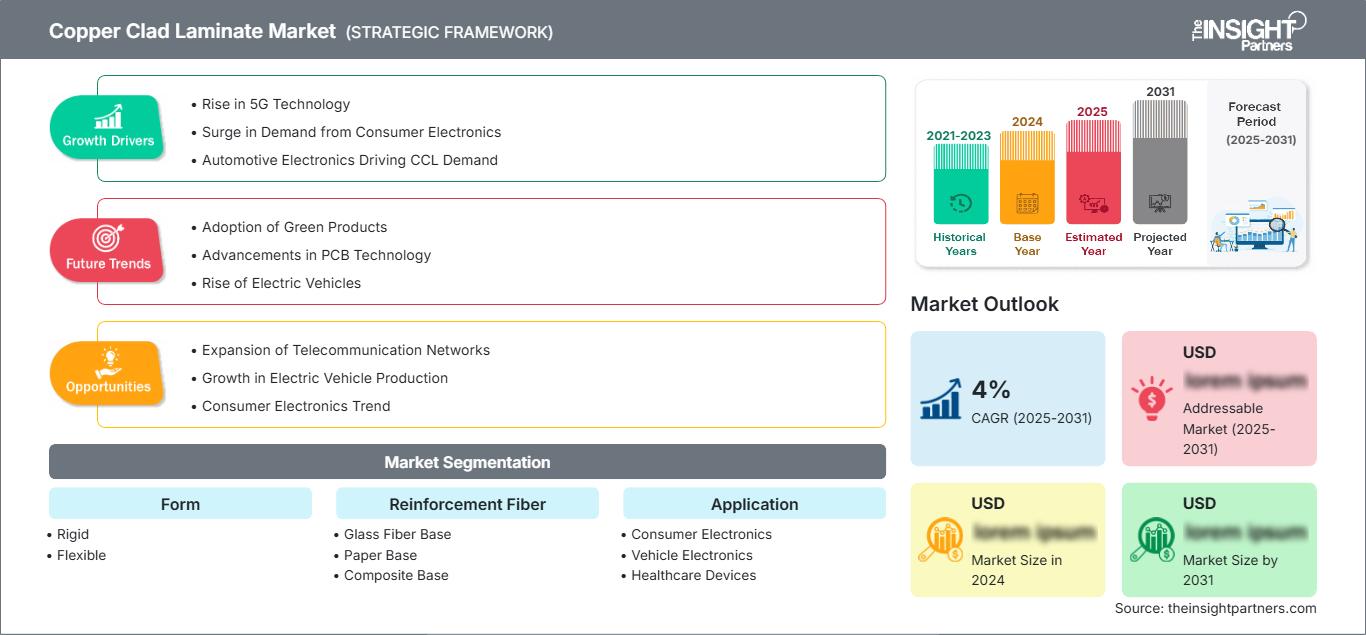
Copper Clad Laminate Market: Strategic Insights
Regional Insights
North America Copper Clad Laminate Market
North America is estimated to hold 9–11% share in 2025 and is projected to expand at a 6.0–7.0% CAGR during 2026–2034. The US is a leading consumer in the region due to its data centers, aerospace and defense electronics, semiconductor investments, telecommunication networks, and advanced automotive electronics. The region sees an increasing demand in high-end laminates rather than standard ones.
The region is also witnessing changes in purchasing decisions in the context of supply chain resilience strategies. There is an increased need for PCB manufacturers and electronic firms to explore shorter logistics chains and capable domestic/nearshore suppliers. High layer counts and lossless materials are needed for AI servers, thus offering potential for premium offerings. Also, there is demand for thermally stable laminates in automotive electronics.
U.S. Copper Clad Laminate Market
The US represents approximately 78–82% of North America's 2025 share and is expected to grow at a 6.1–7.1% CAGR through 2034. The demand for the material exists in advanced computing, aerospace, defense, telecom, healthcare equipment, and automotive electronics. The increasing domestic investment in electronics industry makes the sourcing of PCB material increasingly significant from a strategic perspective.
In particular, the infrastructure related to AI requires high-performance server that needs multilayer PCB with higher signal integrity requirements. Meanwhile, the flexible laminates have potential applications in medical devices, automotive electronics, and specific communication equipment. AGC Inc. and DuPont de Nemours, Inc. are capable of producing material suitable for high-performance electronics, and the investments in PCB and semiconductors within the region could drive more local sourcing.
Europe Copper Clad Laminate Market
Europe is estimated to account for 7–9% share in 2025 and is expected to grow at a 5.5–6.5% CAGR during 2026–2034. Germany continues to be the dominant market due to automotive and industrial electronics, whereas the UK, France, Italy, and Spain make their contribution via aerospace, telecoms, medtech, automation, and transportation electronics.
The UK market is driven by aerospace, defense, telecoms, and specialty electronics production. The demand is for high reliability laminates that can perform consistently in challenging operating environments. Germany also has automotive exposure, which sees greater PCB complexity thanks to EV power electronics, ADAS, infotainment, and vehicle connectivity. France has aerospace, defense, and medtech applications, whereas Italy and Spain derive their contributions from industrial machinery, automotive parts, renewable energy equipment, and electronics manufacturing.
APAC Copper Clad Laminate Market
APAC is estimated at 70–74% share in 2025 and is projected to grow at a 7.5–8.5% CAGR during 2026–2034. China remains the leading market, followed by Taiwan, Japan, South Korea, India, and Australia. Dense PCB and electronics manufacturing ecosystems provide strong regional advantages.
China and Taiwan anchor large-scale laminate and PCB production, while Japan and South Korea emphasize advanced electronics and specialty materials. India is expanding electronics manufacturing capacity, creating additional demand for domestic PCB inputs. Australia remains smaller but supports industrial and communications applications. Regional policy initiatives encouraging semiconductor, electronics, and manufacturing localization are stimulating investment, while Southeast Asian production diversification provides additional capacity and supply-chain flexibility.
Middle East & Africa Copper Clad Laminate Market
Middle East and Africa represent a smaller demand base but provide emerging opportunities as electronics assembly, telecommunications, healthcare infrastructure, and industrial automation develop. The region is expected to grow at approximately 5.0–6.0% CAGR through 2034, with the UAE and Saudi Arabia serving as leading Gulf markets.
Saudi Arabia and the UAE are investing in industrial diversification, digital infrastructure, and advanced manufacturing, supporting future PCB consumption. South Africa remains the principal African market for industrial electronics, telecommunications, automotive systems, and healthcare devices. The rest of MEA is comparatively fragmented. Data-center construction, smart infrastructure, renewable-energy systems, and localized electronics assembly can increase demand, although limited upstream material production keeps the region dependent on imports.
Segmentation Analysis
Form
Rigid laminates remain the principal product category, while flexible laminates gain importance as electronic systems become thinner, lighter, and more integrated. The segment is projected to expand at approximately 6.8–7.3% CAGR for rigid and 8.0–8.6% for flexible products. The Copper Clad Laminate Market scope increasingly includes high-performance constructions designed around signal integrity, thermal stability, and mechanical reliability.
- Rigid: Rigid CCLs remain dominant because multilayer printed circuit boards require dimensional stability, mechanical strength, controlled dielectric performance, and scalable manufacturing. Consumer electronics, computing, automotive control units, and industrial equipment sustain broad demand.
- Flexible: Flexible CCLs support compact, lightweight circuits requiring bending, folding, or three-dimensional routing. Smartphones, wearable devices, automotive electronics, medical equipment, and high-density interconnects create opportunities for thinner polyimide-based constructions.
Reinforcement Fiber
Reinforcement selection influences dimensional stability, dielectric behavior, thermal expansion, mechanical strength, and cost. Glass fiber remains the principal reinforcement because of its established manufacturing infrastructure, while composite materials gain importance where designers require differentiated electrical or thermal characteristics. The segment is expected to maintain steady expansion as PCB complexity increases.
- Glass Fiber Base: Glass fiber base materials remain the mainstream reinforcement choice because they provide mechanical strength, dimensional stability, and established processing compatibility across conventional and advanced multilayer PCB fabrication.
- Paper Base: Paper base laminates remain relevant in cost-sensitive electronic products where electrical insulation, processability, and affordability outweigh advanced high-frequency performance requirements.
- Composite Base: Composite bases provide design flexibility where electrical, thermal, mechanical, or weight characteristics need to be balanced. Their strategic relevance increases as boards move toward specialized performance requirements.
Application
Application demand is shaped by PCB complexity, device miniaturization, operating temperatures, signal frequency, and reliability requirements. Consumer electronics remains the largest application, while vehicle electronics is positioned for faster expansion as EVs, ADAS, connectivity, and electronic control systems increase PCB content. Healthcare applications provide a smaller but technically demanding demand base.
- Consumer Electronics: Smartphones, computers, tablets, networking devices, and connected products generate extensive CCL consumption. High-density designs increasingly require low-loss, thin, reliable materials compatible with compact multilayer PCB architectures.
- Vehicle Electronics: EV power systems, ADAS, infotainment, battery management, connectivity, and sensing increase PCB content per vehicle. Higher thermal and reliability requirements support adoption of specialized laminate constructions.
- Healthcare Devices: Diagnostic systems, patient-monitoring equipment, imaging devices, wearable medical electronics, and laboratory instruments require reliable PCB materials with controlled electrical and mechanical properties.
Opportunity Snapshot
| Application | Revenue Contribution (High/Medium/Low) | Trend Tag | Adoption Stage |
|---|---|---|---|
| Consumer Electronics | High | HDI Boards | Mature |
| Vehicle Electronics | High | EV Electronics | Scaling |
| Healthcare Devices | Medium | Medical PCB | Scaling |
Copper Clad Laminate Market Growth Drivers and Impact Analysis
Rising AI, data-center, and high-speed computing requirements
Increased PCB layer counts, transmission rates, and signal integrity are associated with the rise of AI server and HPC systems. It leads to a switch from low-end products to low-loss, high-frequency laminates, which provide the ability to minimize signal attenuation and maintain consistent electrical properties. However, the commercial implication is not limited to AI servers as networking switches, storage solutions, power management boards, and accelerators also need to possess such features. Thus, those suppliers that are qualified by leading PCB producers for advanced grades can benefit from increased value of sales despite fluctuations in PCB volumes. It also impacts the utilization of capacity as manufacturers focus on special laminates, which have more technological advantages.
Automotive electrification increases PCB content and reliability requirements
Vehicle electrification is increasing the number and complexity of electronic control systems installed in passenger and commercial vehicles. Battery management systems, power inverters, charging systems, ADAS, connectivity modules, displays, and thermal-management controls all require PCB assemblies. In comparison to traditional automotive electronics, most of these components function in more severe environments with thermal, mechanical, and electrical stresses, making laminate reliability a priority in the industry. Such requirement provides an advantage for suppliers who produce laminates that have controllable thermal expansion, resistance to high temperatures, reliable dielectric properties, and adhesive layers. The process of qualification of automotive electronics will also provide long-term relationships for the supplier, since manufacturers pay attention to reliability and traceability. In addition, more material will be required per car as software becomes the platform.
Electronics localization is reshaping regional supply-chain investment
The production of electronic products has diversified across many nations in order to mitigate the risks of geopolitical challenges, logistic challenges, and sourcing risks. This has led to an increased focus on PCBs and CCLs from India, Thailand, Malaysia, Vietnam, North America, and some specific regions in Europe. While diversification will help in the reduction of lead times and supply chain disruptions, local plants need to meet stringent quality and qualification requirements before serving as viable alternatives to the existing Asian producers. Therefore, this challenge will only be significant to firms which have technical expertise and manufacturing capability in the region. Supply chain diversification also promotes the creation of close links between laminate producers, PCB makers, copper foil makers, and electronic makers.
Copper Clad Laminate Market Future Trends
Ultra-low-loss laminates will become central to next-generation computing
The Copper Clad Laminate Market trends indicate that dielectrics will receive even greater attention as the next generation of electronics evolves due to the requirement for high-speed signaling of processor, memory, network and accelerators. Standard materials will continue to be used in standard boards, but advanced computing platforms will demand highly engineered dielectrics, which include ultra-low loss constructions, high-performance glass fabrics, advanced resin chemistry and smooth copper interface. Qualification will become stricter as companies need to prove consistent performance of their products at multilayer construction level rather than just sample material level. Companies will probably develop computational material design, special reinforcement structures and more strict production control in order to maximize yields. It will result in more sophisticated material mix and greater importance of cooperation between material suppliers, board makers and system architects in early stages of product development.
Regional manufacturing will evolve toward multi-location capacity networks
CCL production is likely to become more geographically distributed as electronics companies seek resilient sourcing without abandoning established Asian manufacturing clusters. Thailand, Malaysia, India, and other Southeast Asian markets can attract capacity associated with China-plus-one strategies, while North American investments support localized supply for strategic electronics. Rather than replacing China or Taiwan, these locations are expected to complement existing production networks and provide redundancy. Manufacturers will increasingly evaluate plants based on customer proximity, utility reliability, logistics, technical labor, environmental compliance, and access to copper foil and reinforcement materials. This trend should also increase regional qualification activity because electronics manufacturers need approved alternatives before shifting volumes. Producers with multi-country manufacturing footprints may therefore achieve stronger customer retention and supply flexibility.
Copper Clad Laminate Market Opportunities
Developing localized CCL ecosystems in India and Southeast Asia
Investors can target emerging PCB manufacturing ecosystems where electronics assembly is expanding faster than local material production. India, Thailand, Malaysia, and neighboring markets offer opportunities for laminate manufacturers to establish regional capacity close to PCB fabricators and electronics assembly plants. The opportunity extends beyond sheet production because successful localization requires prepreg, copper foil, reinforcement, testing, engineering, and technical-service capabilities. Companies entering these markets can initially prioritize established rigid products before progressively introducing high-performance grades as local PCB manufacturers achieve higher technological maturity. Partnerships with fabricators can accelerate qualification and reduce market-entry risk. Regional facilities can also provide supply-chain redundancy for multinational customers seeking alternatives to concentrated manufacturing bases, creating a commercial rationale for investments that combine capacity expansion with customer-specific technical support.
Premium specialty materials can improve portfolio economics
The most attractive investment opportunities increasingly sit in differentiated materials rather than undifferentiated commodity capacity. Suppliers can prioritize low-loss, high-frequency, high-Tg, thermally conductive, flexible, and advanced automotive laminates where qualification requirements create stronger barriers to entry. Product development should focus on measurable performance characteristics, including dielectric loss, thermal expansion, dimensional stability, copper adhesion, and processing reliability. Manufacturers can also strengthen economics by designing products around specific PCB architectures rather than offering broad but shallow portfolios. Strategic partnerships with glass-fiber, resin, copper-foil, and PCB companies can accelerate development while reducing technical risk. As AI, advanced networking, EVs, and medical electronics require increasingly specialized boards, suppliers with credible qualification records and scalable specialty production can capture a greater share of value.
Recent Developments
- June 2026: Lane42 Investment Partners ("Lane42" or the "Firm") provided a senior secured term loan to Principal Mineral (the "Company") in support of its acquisition of Isola Group ("Isola"), a leading manufacturer of copper-clad laminates (CCLs) and dielectric prepreg materials used in the production of advanced multilayer printed circuit boards. Financial terms of the transaction were not disclosed. The acquisition will strengthen Principal Mineral's ability to serve customers across the electronics value chain while enhancing manufacturing capabilities and supply-chain resilience for critical industries.
- February 2025: Resonac Corporation developed low thermal expansion copper-clad laminates designated for use in next-generation semiconductor packages that suppress warpage, one of the challenges associated with the increasing size of semiconductor packages. This product has demonstrated a durability improvement of four times compared to conventional products in temperature cycle testing, making the product suitable for semiconductor packages exceeding 100mm x 100mm.
Frequently Asked Questions

- Comprehensive Market Sizing and Forecast Analysis
- Detailed Segmentation Analysis
- In-Depth Market Dynamics Assessment
- Regional and Country-Level Insights
- Competitive Landscape and Company Benchmarking
- Strategic Business Intelligence
Recent Reports
Testimonials

The Insight Partners provided valuable market intelligence that supported our global go-to-market strategy. Their team was professional, responsive, and attentive to our feedback, providing thoughtful analysis and helpful methodological clarifications throughout the project.
Junmo Kim Chief Financial Officer (CFO), Enertech Co., Ltd.
The Insight Partners' SCADA System Market report is comprehensive, with valuable insights on current trends and future forecasts. The team was highly professional, responsive, and supportive throughout. We are very satisfied and highly recommend their services.
RAN KEDEM Partner, Reali Technologies LTDs
I requested a report on a very specific software market and the team produced the report in a few days. The information was very relevant and well presented. I then requested some changes and additions to the report. The team was again very responsive and I got the final report in less than a week.
JEAN-HERVE JENN Chairman, Future Analytica
We worked with The Insight Partners for an important market study and forecast. They gave us clear insights into opportunities and risks, which helped shape our plans. Their research was easy to use and based on solid data. It helped us make smart, confident decisions. We highly recommend them.
PIYUSH NAGPAL Sr. Vice President, High Beam Global
The Insight Partners delivered insightful, well-structured market research with strong domain expertise. Their team was professional and responsive throughout. The user-friendly website made accessing industry reports seamless. We highly recommend them for reliable, high-quality research services
YUKIHIKO ADACHI CEO, Deep Blue, LLC.
This is the first time I have purchased a market report from The Insight Partners.While I was unsure at first, I visited their web site and felt more comfortable to take the risk and purchase a market report.I am completely satisfied with the quality of the report and customer service. I had several questions and comments with the initial report, but after a couple of dialogs over email with their analyst I believe I have a report that I can use as input to our strategic planning process.Thank you so much for taking the extra time and making this a positive experience.I will definitely recommend your service to others and you will be my first call when we need further market data.
JOHN SUZUKI President and Chief Executive Officer, Board Director, BK Technologies
I wish to appreciate your support and the professionalism you displayed in the course of attending to my request for information regarding to infectious disease IVD market in Nigeria. I appreciate your patience, your guidance, and the fact that you were willing to offer a discount, which eventually made it possible for us to close a deal. I look forward to engaging The Insight Partners in the future, all thanks to the impression you have created in me as a result of this first encounter.
DR CHIJIOKE ONYIA MANAGING DIRECTOR, PineCrest Healthcare Ltd.Reason to Buy
- Informed Decision-Making
- Understanding Market Dynamics
- Competitive Analysis
- Identifying Emerging Markets
- Customer Insights
- Market Forecasts
- Risk Mitigation
- Boosting Operational Efficiency
- Strategic Planning
- Investment Justification
- Tracking Industry Innovations
- Aligning with Regulatory Trends





 Get Free Sample for