
Cranial Plating System Market Demand, Share & Growth by 2034
Coverage: By Product (Thickness- 0.3mm, Thickness- 0.4mm, Thickness- 0.5mm, Others); Application (Reconstructive Neurosurgical Procedures, Orthopedic Surgical Procedures, Others); End User (Hospitals, Clinics, Others) , and Geography (North America, Europe, Asia Pacific, and South and Central America)
- Status : Data Released
- Report Code : TIPRE00017806
- Category : Life Sciences
- No. of Pages : 150
- Available Report Formats :


- Last update date : August 06, 2026


2025 Market Size
US$ 2.36 Bn
Base year value
2034 Forecast
US$ 4.13 Bn
Projected by 2034
CAGR 2026-2034
6.38 %
Growth rate
Addressable Market
US$ 29.31 Bn
(2026-2034)
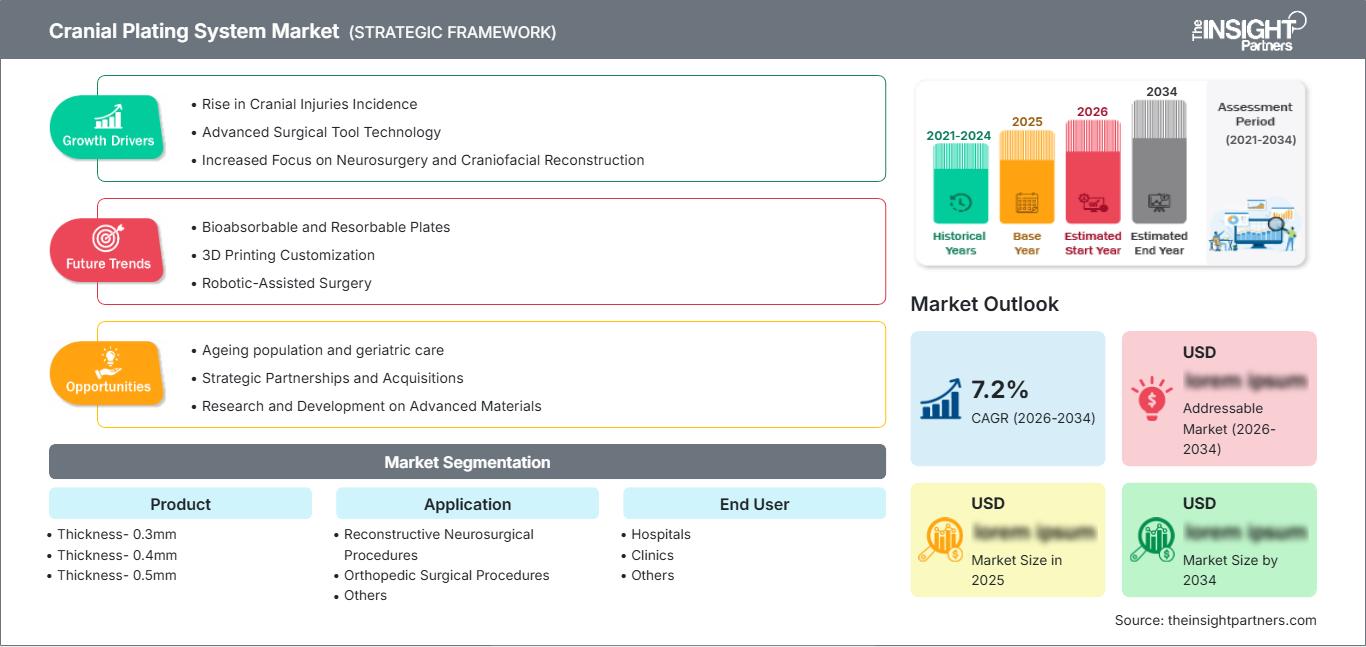
The Cranial Plating System Market is projected to grow from US$ 2.36 Billion in 2025 to US$ 4.13 Billion by 2034, registering a CAGR of 6.38% during 2026–2034. The market reflects increasing adoption of cranial implants in neurosurgical reconstruction, advancements in biomaterials, and rising demand for patient-specific solutions. Technological improvements in implant design, manufacturing precision, and surgical planning are shaping the competitive landscape.
North America represents a significant regional contributor, supported by advanced healthcare infrastructure, higher volumes of cranial reconstruction procedures, and strong adoption of customized implants. The Cranial Plating System size is influenced by growing neurosurgical capabilities, favorable reimbursement structures, and investments in medical device innovation. The region is estimated to expand at a CAGR range of 6.2–6.8% between 2026 and 2034, supported by hospital modernization and increasing clinical utilization
Cranial Plating System Market Assessment and Insights
- North America holds a leading position with an estimated share of 38–42% in 2025. The region benefits from advanced neurosurgical facilities, established medical device manufacturers, and adoption of customized cranial solutions, growing at a CAGR range of 6.2–6.8% from 2026–2034.
- US represents the largest contributor within North America, accounting for an estimated 30–34% share in 2025. Strong hospital networks, surgical expertise, and technology adoption support expansion at a CAGR range of 6.3–6.9% during 2026–2034.
- Europe contributes an estimated 27–31% share in 2025, supported by Germany, the UK, France, Italy, and Spain. Regulatory focus on implant safety and advanced surgical approaches drives growth at a CAGR range of 5.8–6.4% through 2034.
- Asia Pacific accounts for approximately 20–24% share in 2025, with China, Japan, India, and South Korea emerging as important markets. Improving healthcare access, surgical infrastructure expansion, and medical technology adoption support a CAGR range of 7.0–7.6%.
- Largest Segment The hospitals' end-user segment leads with a market share range of 55–60% in 2025, supported by complex cranial procedures and specialized surgical environments, expanding at a CAGR range of 6.4–6.9%.
- High Growth Segment The Thickness- 0.3mm product segment demonstrates strong potential with a market share range of 24–28% in 2025, driven by lightweight implant preferences and design innovation, growing at a CAGR range of 7.0–7.5%.
- Key companies analyzed in detail: Johnson & Johnson Services, Inc., CMF MEDICON Surgical Inc., Aesculap, Inc. (B. Braun company), Bioplate, Inc., OsteoMed, Zimmer Biomet, Ortho Baltic, KLS Martin Group, Medartis AG, GPC Medical Ltd.
Source: The Insight Partners' analysis based on proprietary research, government publications, company annual reports, investor presentations, industry databases, and expert interviews.
Cranial Plating System development has evolved through improvements in implant materials, fixation mechanisms, and digital surgical workflows. Titanium-based solutions remain widely adopted because of their biocompatibility, strength, and clinical reliability. Manufacturers are increasingly integrating computer-aided design, three-dimensional imaging, and patient-specific planning methods to improve reconstruction accuracy. The Cranial Plating System Market size continues to expand alongside these technological advancements. Production capabilities have shifted toward precision machining, additive manufacturing, and customized implant fabrication, allowing suppliers to address complex cranial defects. The competitive environment includes established orthopedic and neurosurgical device companies alongside specialized implant manufacturers developing application-focused solutions. These advances are strengthening procedural outcomes while expanding the adoption of modern cranial reconstruction technologies across healthcare systems.
Future growth will be influenced by expanding neurosurgical infrastructure in emerging economies, rising investments in specialized healthcare facilities, and increasing demand for advanced reconstruction procedures. Regulatory pathways emphasizing implant safety, quality control, and traceability are encouraging manufacturers to improve product development processes. Healthcare providers are also evaluating cost-effective implant solutions that balance clinical performance with accessibility. The Cranial Plating System Market share distribution is expected to gradually shift as Asia Pacific markets improve surgical capabilities and adoption rates. Strategic collaborations between medical device companies and healthcare institutions may accelerate innovation in implant design, manufacturing efficiency, and surgical applications over the forecast period.
Cranial Plating System Market Report Scope
| Report Attribute | Details |
|---|---|
| Market size in 2025 | US$ 2.36 Billion |
| Market Size by 2034 | US$ 4.13 Billion |
| Global CAGR (2026 - 2034) | 6.38% |
| Historical Data | 2021-2024 |
| Forecast period | 2026-2034 |
Cranial Plating System Market Analysis
Demand for Cranial Plating System solutions is increasing due to rising incidences of traumatic brain injuries, congenital cranial abnormalities, and surgical reconstruction requirements. The Cranial Plating System Market report highlights that growth is supported by expanding neurosurgical procedures and greater acceptance of advanced fixation technologies among healthcare providers. The value chain includes raw material suppliers, implant manufacturers, distributors, hospitals, and specialized surgical centers. Titanium alloys, polymers, and innovative manufacturing methods have an effect on the quality and supply of products. It is important for suppliers to concentrate on producing products precisely, meeting regulations and using effective networks for delivery in order to satisfy changing clinical demands. New growth areas include personalized implants and advancements in surgical planning systems.
Modern healthcare organizations seek to implement implants that ensure high structural reliability and predictable surgery results. Research and development efforts of manufacturers are directed at material improvement, better fixation and patient-specific uses. Implants are being improved through cooperation between surgeons, engineers and device companies. Dynamics of the supply chain depend on regulations, manufacturing processes and the presence of specific manufacturing technologies. Innovations in digital design and manufacturing help companies to increase the effectiveness of their operations. This helps to broaden the use of implants in hospitals and specialty clinics as well as to enhance cranial reconstruction surgeries.
The Cranial Plating System Market highlights a competitive environment characterized by established medical device organizations and specialized manufacturers focusing on innovation and clinical applications. Johnson & Johnson Services, Inc., Zimmer Biomet, Aesculap, Inc. (a B. Braun company), KLS Martin Group, and Medartis AG are some of the companies that keep on increasing their influence due to implant ranges and surgical techniques. Focused companies like CMF MEDICON Surgical Inc., Bioplate, Inc., OsteoMed, Ortho Baltic, and GPC Medical Ltd. add value due to the development and customization of products. Competitive positioning is influenced by technology, regulations, manufacturing, and healthcare provider relations.
The investment is now being focused on customized implants, digital surgery techniques, and improvements in manufacturing processes. Companies are looking for better ways of manufacturing implants to minimize the time taken and increase the precision of implants. Strategic positioning can be achieved through widening of product ranges, improvement of distribution channels, and meeting healthcare needs in different regions. Research efforts on lightweight materials, better fixation devices, and customized surgeries are anticipated to shape future market competition. With the adoption of advanced techniques by healthcare providers, companies with good innovation and supply capabilities will benefit.
● REPORT CUSTOMIZATION
Tailor This Report To Align With Your Specific Business Requirements
This report can be customized to align precisely with your business objectives, scope, and target markets. Customization options include tailored segmentation, geography, competitive analysis, and strategic insights to support informed decision-making.
Customize This Report →WHAT YOU CAN ADJUST
- ● Segmentations
- ● Geography
- ● Competitive Analysis
- ● Language Preferences
Cranial Plating System Market: Strategic Insights
Regional Insights
North America Cranial Plating System Market
North America accounted for an estimated 38–42% share in 2025, supported by advanced healthcare infrastructure, high neurosurgical procedure volumes, and the strong presence of leading medical device manufacturers. The region is projected to expand at a CAGR range of 6.2–6.8% from 2026–2034. The US remains the primary contributor due to established hospital networks, favorable reimbursement conditions, and continuous adoption of advanced cranial reconstruction technologies. The Cranial Plating System Market forecast indicates sustained regional growth driven by ongoing technological advancements, increasing surgical volumes, and continued investments in specialized neurosurgical care.
Healthcare providers across Canada and the US are increasingly incorporating patient-specific implants, digital planning platforms, and precision manufacturing approaches into surgical workflows. Demand is also supported by investments in trauma care facilities and specialized neurosurgical centers. The presence of companies including Johnson & Johnson Services, Inc., Zimmer Biomet, and KLS Martin Group strengthens the regional availability of advanced solutions. Growing focus on clinical outcomes and implant safety is expected to sustain regional expansion.
U.S. Cranial Plating System Market
The U.S. Cranial Plating System Market represented approximately 30–34% of the North American market in 2025 and is expected to grow at a CAGR range of 6.3–6.9% during 2026–2034. The country benefits from a mature healthcare system, extensive neurosurgical expertise, and high adoption of advanced cranial fixation technologies across hospitals and specialty centers.
Leading medical device companies maintain significant operations in the country, supporting product accessibility and innovation. Hospitals increasingly utilize cranial plating solutions for reconstructive neurosurgical procedures involving trauma, tumor removal, and complex cranial defects. Growth is further influenced by improvements in surgical imaging, computer-assisted planning, and customized implant development. The increasing emphasis on reducing procedure complications and improving patient outcomes continues to support demand across academic medical centers and private healthcare facilities.
Europe Cranial Plating System Market
Europe accounted for an estimated 27–31% share in 2025 and is expected to expand at a CAGR range of 5.8–6.4% between 2026–2034. Germany leads regional adoption due to strong medical device manufacturing capabilities, advanced surgical infrastructure, and established healthcare systems. The UK also demonstrates steady demand supported by specialized neurosurgical centers and an increasing focus on reconstruction procedures. Key Cranial Plating System Market trends include the increasing adoption of patient-specific implants, integration of 3D printing technologies, advancements in biomaterials, and growing emphasis on precision surgical planning to improve clinical outcomes and reconstruction effectiveness.
Germany’s market benefits from domestic innovation, regulatory compliance expertise, and the presence of companies offering advanced implant technologies. Hospitals increasingly adopt precision-engineered cranial fixation systems to improve surgical efficiency and patient outcomes. The UK, France, Italy, and Spain are witnessing gradual adoption due to healthcare modernization, increased trauma care requirements, and investments in specialized surgical facilities. Regional growth is supported by regulatory frameworks emphasizing implant quality, clinical safety, and technological advancement.
APAC Cranial Plating System Market
Asia Pacific accounted for an estimated 20–24% share in 2025 and is projected to grow at a CAGR range of 7.0–7.6% during 2026–2034. China represents a leading market due to expanding healthcare infrastructure, increasing surgical capabilities, and rising demand for advanced medical devices. The Cranial Plating System Market in the region continues to benefit from growing healthcare investments, improving access to specialized neurosurgical procedures, and increasing adoption of advanced cranial reconstruction technologies across both public and private healthcare facilities.
Japan, South Korea, India, and Australia are also contributing to regional development through improvements in neurosurgical services and healthcare accessibility. Government investments in hospital modernization and medical technology adoption are supporting market expansion. Local manufacturing capabilities and increasing partnerships with international device companies are improving product availability. The region’s growth potential is supported by rising awareness of reconstructive procedures and increasing availability of specialized surgical expertise.
Middle East & Africa Cranial Plating System Market
The Middle East & Africa region accounted for a smaller market contribution in 2025 and is expected to expand at a CAGR range of 5.0–5.6% during 2026–2034. Saudi Arabia leads regional development due to healthcare infrastructure investments and the expansion of specialized medical facilities. The UAE is also strengthening adoption through advanced hospital networks. The Cranial Plating System Market in the region is benefiting from increasing healthcare modernization initiatives, growing surgical capabilities, and rising investment in specialized neurological care services.
South Africa and other MEA countries are gradually improving access to neurosurgical procedures through healthcare investments and specialized treatment centers. Infrastructure development, government healthcare initiatives, and increasing focus on advanced surgical care are supporting demand. Regional adoption remains influenced by healthcare expenditure patterns, availability of skilled surgeons, and access to imported medical technologies.
Segmentation Analysis
Product
The product segment is expected to grow at a CAGR range of 6.0–6.6% from 2026–2034. The Cranial Plating System Market trends within product categories are influenced by demand for implants with optimized thickness, strength, and compatibility. Manufacturers are focusing on developing lightweight yet durable solutions to improve surgical performance and patient outcomes. Product innovation is centered on precision manufacturing, material advancement, and customization capabilities.
- Thickness- 0.3mm solutions are increasingly considered for applications requiring lightweight fixation and flexibility. Their adoption is supported by improved manufacturing precision and demand for minimally invasive reconstruction approaches.
- Thickness- 0.4mm implants maintain broad clinical acceptance due to balanced mechanical stability and adaptability across various cranial reconstruction procedures performed in hospitals.
- Thickness- 0.5mm products are preferred in procedures requiring enhanced structural support. Their usage remains relevant for complex cranial defects where additional fixation strength is required.
Application
The application segment is projected to register a CAGR range of 6.3–6.9% between 2026–2034. Reconstructive neurosurgical procedures represent a major application area due to increasing requirements for restoring cranial structures after trauma, tumor removal, and congenital conditions. Growing surgical expertise and improved imaging technologies are supporting broader adoption across healthcare facilities. The Cranial Plating System Market continues to benefit from these advancements and expanding clinical applications across neurosurgical settings.
- Reconstructive Neurosurgical Procedures represent a significant demand area, driven by trauma cases, cranial defect repairs, and increasing utilization of advanced fixation solutions in specialized surgical centers.
- Orthopedic Surgical Procedures utilize cranial plating technologies in selected reconstruction applications where structural restoration and implant stability are essential for successful outcomes.
End User
The end user segment is expected to expand at a CAGR range of 6.4–6.9% during 2026–2034. Hospitals remain central users due to their ability to perform complex procedures requiring specialized equipment, trained surgeons, and comprehensive postoperative care. The Cranial Plating System adoption pattern is influenced by healthcare infrastructure development and increasing surgical capacity.
- Hospitals represent the primary adoption environment, supported by advanced operating facilities, multidisciplinary surgical teams, and increasing demand for cranial reconstruction procedures.
- Clinics are gradually adopting specialized solutions for selected procedures, supported by improvements in outpatient surgical capabilities and access to advanced implant technologies.
Opportunity Snapshot
| Application | Revenue Contribution | Trend Tag | Adoption Stage |
| Reconstructive Neurosurgical Procedures | High | Trauma Repair | Mature |
| Orthopedic Surgical Procedures | Medium | Structural Repair | Scaling |
| Others | Low | Specialized Use | Emerging |
Cranial Plating System Market Growth Drivers and Impact Analysis
Increasing Volume of Complex Neurosurgical Reconstruction Procedures
An increasing number of patients suffering from brain injuries, brain defects, and the need for post-operative reconstruction surgeries is contributing to an increased demand for better fixation devices. In the current scenario, medical practitioners have started using plating systems to make restoration surgery procedures more efficient. The effect has spread into different healthcare facilities like hospitals and surgical centers through the enhancement of treatment options for difficult cases. Diagnostic advancements and planning for surgery are helping medical practitioners in identifying good options for reconstruction. Medical device companies are coming up with advanced implants that provide better fixation, biocompatibility, and customization.
Advancements in Implant Materials and Manufacturing Technologies
Innovations in biomaterials, precision machining, and digital fabrication have resulted in an increase in the performance qualities of cranial implants. It is being seen that there is an increasing use of more advanced production techniques to ensure accuracy, consistency, and customization. This has been impacting the buying practices of healthcare providers who seek reliable implants. With the aid of computer-aided design and manufacturing, it is possible to have implants that are more closely aligned with the specific anatomy of the patients. Improved production processes allow producers to meet different clinical demands while ensuring quality.
Expansion of Healthcare Infrastructure in Emerging Economies
Healthcare infrastructure investments in developing countries are paving the way for the use of advanced technologies in surgery. Investments in hospitals, specialized healthcare facilities, and training in medical practice are contributing to greater accessibility of neurosurgery procedures. Modernization and healthcare technology adoption is contributing to better capacity building in countries within the Asia Pacific, Middle East, and Latin American regions. Such developments are fostering increased access to cranial reconstruction procedures outside traditional healthcare markets. Manufacturers are adopting their strategies through expanding their distribution networks and making devices that are suited to various healthcare settings.
Cranial Plating System Market Future Trends
Integration of Patient-Specific Implant Design Technologies
The future adoption of the procedure will be oriented towards the creation of patient-specific implants using advanced imaging, digital models, and a custom manufacturing process. With the help of such innovations, the surgeon will have an opportunity to prepare for the surgery in a more anatomically accurate manner. The trends in the development of the Cranial Plating System demonstrate that personalization of the procedure is needed for patients having complicated defects that need a specific configuration of implants. It is expected that the manufacturers of such devices will develop their digital technology by combining imaging data with design automation.
Growth of Lightweight and Biocompatible Implant Solutions
The evolution of materials that are lightweight and more biocompatible will impact future strategies related to these products. There is an increasing emphasis on developing implants that are lighter in weight without compromising on their mechanical capabilities and durability. Research efforts are being concentrated on improving the quality of the materials used, the surface properties, and the fixing process. Such developments will help increase the comfort of the patients and the range of usability of cranial reconstructions in different procedures. Healthcare institutions are likely to judge the products based on their durability and ease of use during surgery.
Cranial Plating System Market Opportunities
Expansion Through Customized Cranial Implant Solutions
The opportunities presented by the creation of customized implants are substantial in light of the trend towards more individualized surgery procedures. Companies could spend their efforts on building up the capabilities in terms of digital design, manufacturing, and collaboration between surgeons in order to offer an advantage. The forecast for the future of the Cranial Plating System states that there might be a rise in the demand for such approaches due to the usage of new technologies by hospitals, which could enhance the precision and outcome of the surgery. It would also help manufacturers to cover more complex demands and be more efficient at the same time.
Strengthening Distribution Networks in Emerging Healthcare Markets
The growing economies are providing opportunities to companies looking for increased market penetration through better distribution and servicing. The healthcare reforms are enabling easier access to specific surgeries, which are driving demand for innovative surgical products. Regional presence can be enhanced by making deals with hospitals and conducting training and other support activities. According to the Cranial Plating System Forecasts, those regions with the development of their surgery infrastructure have further possibilities for growth. The investments in regional logistics, regulatory capacity, and healthcare partnerships will make access easier. Companies that understand regional clinical needs and develop flexible strategies will be able to expand successfully.
Recent Developments
- March 2026: Zimmer Biomet expanded its focus on advanced surgical technologies and orthopedic reconstruction solutions through continued product development initiatives supporting complex clinical applications. The organization continues investing in innovation platforms designed to improve surgical outcomes and strengthen its global medical technology portfolio.
- September 2025: Johnson & Johnson Services, Inc. continued advancing its medical technology portfolio through innovation activities focused on surgical solutions and healthcare technologies. Its ongoing investments support development approaches aimed at improving procedural efficiency, precision, and clinical performance across specialized healthcare applications.
- February 2025: KLS Martin Group introduced continued advancements in cranio-maxillofacial surgical solutions, emphasizing precision manufacturing and specialized implant technologies. Its product development activities support surgeons managing complex reconstructive procedures through improved fixation systems and optimized surgical workflows.
Frequently Asked Questions

- Comprehensive Market Sizing and Forecast Analysis
- Detailed Segmentation Analysis
- In-Depth Market Dynamics Assessment
- Regional and Country-Level Insights
- Competitive Landscape and Company Benchmarking
- Strategic Business Intelligence
Recent Reports
Testimonials

The Insight Partners' SCADA System Market report is comprehensive, with valuable insights on current trends and future forecasts. The team was highly professional, responsive, and supportive throughout. We are very satisfied and highly recommend their services.
RAN KEDEM Partner, Reali Technologies LTDs
I requested a report on a very specific software market and the team produced the report in a few days. The information was very relevant and well presented. I then requested some changes and additions to the report. The team was again very responsive and I got the final report in less than a week.
JEAN-HERVE JENN Chairman, Future Analytica
We worked with The Insight Partners for an important market study and forecast. They gave us clear insights into opportunities and risks, which helped shape our plans. Their research was easy to use and based on solid data. It helped us make smart, confident decisions. We highly recommend them.
PIYUSH NAGPAL Sr. Vice President, High Beam Global
The Insight Partners delivered insightful, well-structured market research with strong domain expertise. Their team was professional and responsive throughout. The user-friendly website made accessing industry reports seamless. We highly recommend them for reliable, high-quality research services
YUKIHIKO ADACHI CEO, Deep Blue, LLC.
This is the first time I have purchased a market report from The Insight Partners.While I was unsure at first, I visited their web site and felt more comfortable to take the risk and purchase a market report.I am completely satisfied with the quality of the report and customer service. I had several questions and comments with the initial report, but after a couple of dialogs over email with their analyst I believe I have a report that I can use as input to our strategic planning process.Thank you so much for taking the extra time and making this a positive experience.I will definitely recommend your service to others and you will be my first call when we need further market data.
JOHN SUZUKI President and Chief Executive Officer, Board Director, BK Technologies
I wish to appreciate your support and the professionalism you displayed in the course of attending to my request for information regarding to infectious disease IVD market in Nigeria. I appreciate your patience, your guidance, and the fact that you were willing to offer a discount, which eventually made it possible for us to close a deal. I look forward to engaging The Insight Partners in the future, all thanks to the impression you have created in me as a result of this first encounter.
DR CHIJIOKE ONYIA MANAGING DIRECTOR, PineCrest Healthcare Ltd.Reason to Buy
- Informed Decision-Making
- Understanding Market Dynamics
- Competitive Analysis
- Identifying Emerging Markets
- Customer Insights
- Market Forecasts
- Risk Mitigation
- Boosting Operational Efficiency
- Strategic Planning
- Investment Justification
- Tracking Industry Innovations
- Aligning with Regulatory Trends





 Get Free Sample for