
Current Sensor Market Trends, Demand & Growth by 2034
Coverage: By Type1 (Open Loop, Closed Loop); Type2 (Isolated Current Sensors, Non-Isolated Current Sensors); End User (Automotive, Consumer Electronics, Telecom and Networking, Healthcare, Industrial, Energy) , and Geography (North America, Europe, Asia Pacific, and South and Central America)
- Status : Data Released
- Report Code : TIPRE00004129
- Category : Electronics and Semiconductor
- No. of Pages : 150
- Available Report Formats :


- Last update date : August 05, 2026


2025 Market Size
US$ 3.81 Bn
Base year value
2034 Forecast
US$ 8.75 Bn
Projected by 2034
CAGR 2026-2034
9.67 %
Growth rate
Addressable Market
US$ 55.96 Bn
(2026-2034)
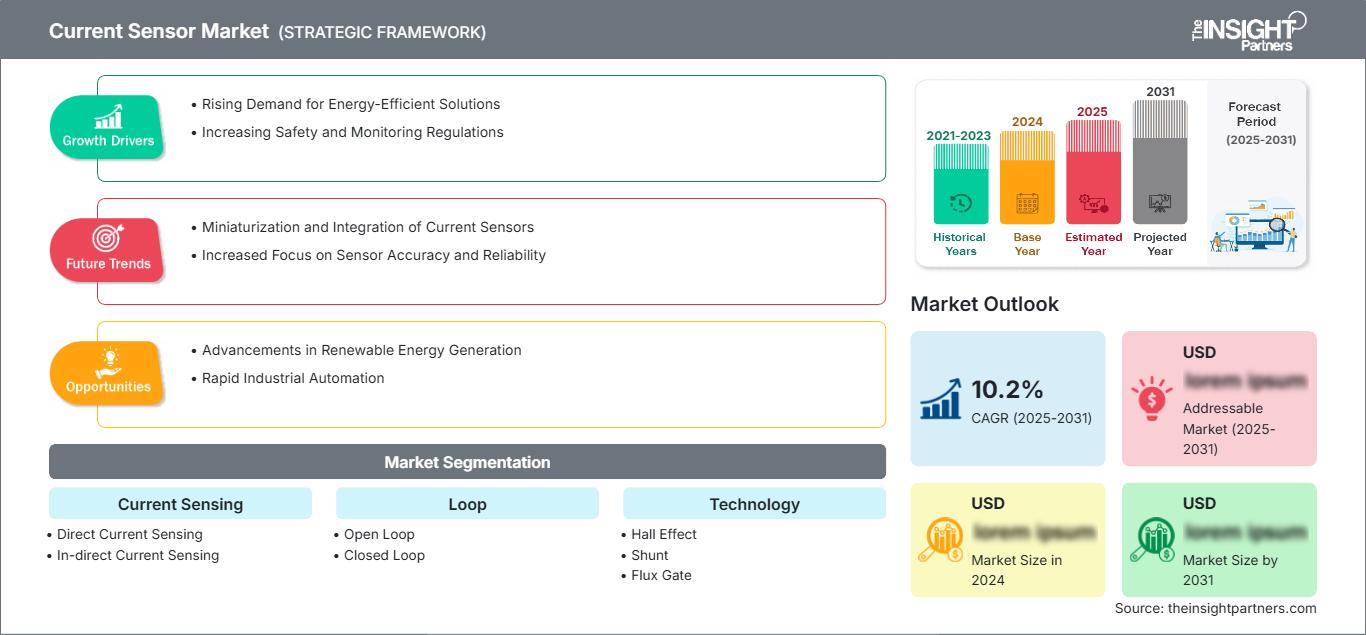
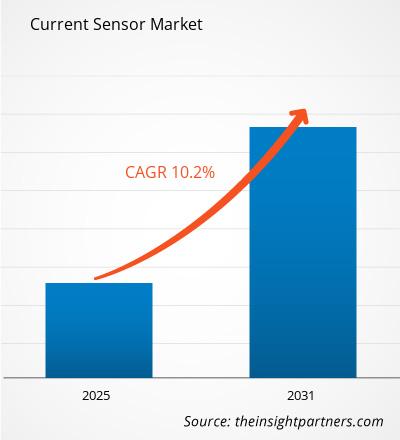
The Current Sensor Market size is anticipated to rise from US$ 3.81 Billion in 2025 to US$ 8.75 Billion in 2034 at a CAGR of 9.67%. The growth is attributed to electrification of mobility solutions, industrial automation, renewable energy conversion systems, battery management systems, and miniature power electronic systems, wherein current measurement increases efficiency and safety.
North America continues to be a high-potential regional market, with growth driven by EV charging station deployment, industrial automation upgrade, grid modernization, and defense electronics. The North American market size will experience growth in the 8.8% to 9.4% CAGR band through 2034, thanks to incentives for U.S. semiconductors manufacturing and clean-energy projects in Canada.
Current Sensor Market Assessment and Insights
- North America accounted for 27–29% Current Sensor Market share in 2025 and is expected to grow at an 8.8–9.4% CAGR between 2026–2034, led by EV powertrain electronics, grid automation, and industrial motor monitoring.
- US represented 76–79% of North America in 2025 and is projected to grow at an 8.9–9.5% CAGR between 2026–2034, supported by EV, aerospace, and data center power systems.
- Europe held 22–24% share in 2025 and is expected to expand at an 8.6–9.2% CAGR between 2026–2034, with Germany, France, the UK, Italy, and Spain leading adoption.
- Asia Pacific captured 39–42% share in 2025 and is forecast to grow at a 10.2–10.9% CAGR between 2026–2034, driven by China, Japan, South Korea, India, and Australia.
- Largest Segment Closed Loop held 56–59% market share in 2025 and is expected to advance at a 9.3–9.9% CAGR between 2026–2034 as precision requirements rise.
- High Growth Segment Digital Output held 41–44% market share in 2025 and is projected to grow at a 10.4–11.1% CAGR between 2026–2034 with smart power architectures.
- Key companies analyzed in detail: ACEINNA Inc., Asahi Kasei Microdevices Corporation, Digi-Key Electronics, Electrohms Private Limited, Honeywell International Inc., Infineon Technologies AG, Kohshin Electric Corporation, OMRON Corporation, Pewatron AG, and Silicon Laboratories Inc.
Source: The Insight Partners' analysis based on proprietary research, government publications, company annual reports, investor presentations, industry databases, and expert interviews.
The Technology Migration trend will bring about changes in production economics as the manufacturers shift from individual magnetic devices to IC-based sensors, coreless packaging, and calibration-heavy modules. The market has advanced from overcurrent protection to a precision sensing capability that provides value in applications such as traction inverters, servo drives, energy storage solutions, and high density chargers. Companies now differentiate themselves through speed, level of isolation, temperature dependence, and functional safety documentation, rather than device pricing.
Future growth opportunities will arise from the new generation of electric vehicle manufacturing centers, battery gigafactories, digital substations, and industrial electrification efforts in the Asia, North American, and selected Middle Eastern economies. The drive for energy efficiency and CO2 emissions is motivating OEMs to measure currents precisely at board, module, and system levels.
Current Sensor Market Report Scope
| Report Attribute | Details |
|---|---|
| Market size in 2025 | US$ 3.81 Billion |
| Market Size by 2034 | US$ 8.75 Billion |
| Global CAGR (2026 - 2034) | 9.67% |
| Historical Data | 2021-2024 |
| Forecast period | 2026-2034 |
Current Sensor Market Analysis
The market growth is mainly associated with the level of electrification density. Batteries of electric vehicles, onboard chargers, solar inverters, motor drives, robots, and telecommunications power supplies need measuring to avoid overheating, minimize conversion losses, and ensure safe operation. Supply chain includes magnetic materials, semiconductor wafers, packaging, calibration tools, distributors, and system integrators, making lead time management a crucial aspect for the implementation.
Also, demand is shifting towards application-specific sensors. Automotive segment requires documentation according to ISO 26262, industrial buyers demand sturdy housings and high repeatability, while suppliers of energy storage solutions are more interested in isolation and low offset drift. Such combination works best for manufacturers that can provide catalog products and designed systems through analog and digital interfaces.
Competitive Analysis highlights the competitive scenario based on semiconductor technology, distribution, and engineering. The companies such as Infineon Technologies AG, Honeywell International Inc., Asahi Kasei Microdevices Corporation, and Silicon Laboratories Inc. differentiate themselves on the basis of IC efficiency, while Electrohms Private Limited, Kohshin Electric Corporation, ACEINNA Inc., OMRON Corporation, Pewatron AG, and Digi-Key Electronics focus on module availability and channel access.
Strategic investments will be made in isolated sensors, coreless Hall ICs, high current modules, and smaller devices that can be used in conjunction with SiC and GaN switching. Strategic positioning will also be based on qualification for EV platforms, renewable inverter projects, and factory automation OEMs due to the lock-in of decision-making in product lifecycles.
● REPORT CUSTOMIZATION
Tailor This Report To Align With Your Specific Business Requirements
This report can be customized to align precisely with your business objectives, scope, and target markets. Customization options include tailored segmentation, geography, competitive analysis, and strategic insights to support informed decision-making.
Customize This Report →WHAT YOU CAN ADJUST
- ● Segmentations
- ● Geography
- ● Competitive Analysis
- ● Language Preferences
Current Sensor Market: Strategic Insights
Regional Insights
North America Current Sensor Market
North America is estimated to make up 27–29% of the 2025 revenue and will grow at an 8.8–9.4% CAGR. North America’s market includes the share of U.S. electric vehicles platform, industrial automation upgrade, aerospace electronics, and grid reliability initiatives that need highly accurate current sensing under extreme environmental conditions.
Applications will include battery management, charging stations, motor drives, and renewable energy conversions. Incentives offered to semiconductors in the local market, reshoring of power electronics, and utilities’ spending on monitoring devices should drive demand for closed-loop and digital output sensors in applications influenced by safety certifications and thermal stability.
U.S. Current Sensor Market
United States contributed 76%–79% of North America market revenues in 2025 and is expected to grow at a CAGR of 8.9%–9.5%. The growth in demand is further driven by electric vehicle assemblies, high-power charging infrastructure, defense electronics, data centers, and industrial electrification programs, which need precise sensing in compact power modules.
There is widespread presence of companies like Honeywell International Inc., ACEINNA Inc., Silicon Laboratories Inc., Infineon Technologies AG, and Digi-Key Electronics for OEM design cycle support and embedded power monitoring solutions. Growth in applications is expected in isolated sensing for fast switching applications and digital interfaces for predictive maintenance.
Europe Current Sensor Market
The share of Europe in 2025 was 22-24% and it will continue to grow at a rate of 8.6-9.2% CAGR owing to automotive power electronics, machine tools, and renewables. UK has benefited from aerospace and charging infrastructures, while France focuses on grid upgrading and energy efficiency in industries.
The growth in Italy and Spain comes from solar inverters, railway electrification, and industrial automation. European customers prefer documents for safety, electromagnetic compatibility, and supply reliability. Infineon Technologies AG and Pewatron AG continue to be key references in the region backed by power component distributors and module manufacturers.
APAC Current Sensor Market
Asia-Pacific held the 39–42% market share in 2025 and is projected to register a CAGR of 10.2–10.9%. China will dominate due to its strong presence in EVs, solar inverters, and electronics production, while Japan and South Korea will offer an advanced ecosystem of components for automotive and industrial sensing.
India and Australia will drive growth in terms of renewable energy, rail electrification, and industrial automation. It is anticipated that policy push for electronics production locally, batteries, and grid energy storage will lead to higher adoption of Hall effect, shunt, and magneto-resistive sensors.
Middle East & Africa Current Sensor Market
Middle East and Africa is expected to grow at an 8.1–8.8% CAGR, with Saudi Arabia leading regional demand. Utility-scale solar, hydrogen projects, oilfield electrification, and smart infrastructure create requirements for robust current measurement in converters, protection systems, and power distribution assets.
The UAE is investing in grid resilience and data centers, South Africa requires monitoring for distributed energy resources, and the Rest of MEA adds demand through industrial power quality projects. Harsh ambient conditions favor insulated, calibrated, and thermally stable sensor modules.
Segmentation Analysis
Type1
The Type1 segment is expected to grow at a CAGR of 9.0–10.5% during 2026–2034. This segment defines operational mechanisms of sensors and plays a crucial role in determining accuracy, response time, and application suitability across industries.
- Open Loop sensors are widely used due to cost efficiency and simplicity, making them suitable for consumer electronics and basic industrial applications where ultra-high precision is not mandatory.
- Closed Loop sensors offer superior accuracy and stability, making them ideal for automotive and industrial applications requiring precise current measurement and high reliability.
Type2
The Type2 segment, reflecting the Current Sensor Market scope, is projected to grow at a CAGR of 9.5–11.0%. It differentiates sensors based on electrical isolation, which is critical for safety and performance in high-voltage applications.
- Isolated Current Sensors are preferred in automotive and energy sectors due to enhanced safety and noise immunity, enabling accurate measurement in high-voltage environments.
- Non-Isolated Current Sensors are commonly used in low-voltage applications such as consumer electronics, offering cost advantages and compact designs.
End User
The End User segment is anticipated to expand at a CAGR of 9.5–11.5% during the forecast period, driven by diversified application areas and increasing electrification across industries.
- Automotive remains the largest contributor due to EV growth, battery management systems, and advanced driver assistance systems requiring accurate current monitoring.
- Consumer Electronics demand is driven by compact devices and increasing functionality, requiring efficient power management.
- Telecom and Networking applications are expanding with 5G infrastructure and data center growth.
- Healthcare adoption is driven by precision medical devices and diagnostic equipment.
- Industrial segment benefits from automation and robotics deployment.
- Energy sector demand is rising due to renewable energy integration and grid modernization.
Opportunity Snapshot
| End User | Revenue Contribution | Trend Tag | Adoption Stage |
|---|---|---|---|
| Automotive | High | EV Systems | Mature |
| Consumer Electronics | High | Mini Sensors | Mature |
| Telecom and Networking | Medium | 5G Infra | Scaling |
| Healthcare | Medium | Med Devices | Scaling |
| Industrial | High | Automation | Mature |
| Energy | Medium | Smart Grid | Scaling |
Current Sensor Market Growth Drivers and Impact Analysis
Electrified Mobility Raises Precision Requirements
Several current sensing points are necessary in EV architectures from batteries, traction inverters, DC-DC converters, on-board charging systems, to thermal management systems. According to the International Energy Agency (IEA), there were more than 17 million units of electric cars sold in 2024 and a projection of over 20 million units in 2025, thereby leading to direct market demand for increased automotive current sensing. The Current Sensor Market gains from the need of manufacturers to identify problems faster, ensure good battery performance, and improve the efficiency of the inverters under changing conditions.
Renewable Power Conversion Needs Safer Monitoring
Solar, wind, and energy storage technologies rely on conversion devices such as converters, inverters, and control circuits that need to continuously sense current to avoid overloading and ensure grid synchronization. The increased use of renewable energy technologies leads to an increased number of power nodes that have to be sensed at different levels, such as string level, module level, inverter level, and even at the battery level. The Current Sensor Market relies therefore more on the density of power electronics rather than on the capacity of generation technologies.
Factory Automation Expands Real-Time Diagnostics
Industrial users are adding current sensors to motors, drives, robots, pumps, compressors, and power distribution cabinets to identify abnormal load behavior before equipment failure. Predictive maintenance programs depend on stable measurement signals that can be analyzed by controllers and plant software. The Current Sensor Market gains from this shift because sensors become embedded in connected automation systems rather than being treated as standalone protection components. Demand is strongest where downtime costs are high, energy optimization targets are measurable, and retrofits can be justified through reduced unplanned maintenance.
Current Sensor Market Future Trends
Coreless and Integrated Current Sensing
Current Sensor Market trends point toward coreless, package-integrated, and module-level solutions that reduce size while improving response in high-frequency power electronics. As SiC and GaN devices switch faster, conventional bulky magnetic assemblies can limit layout flexibility and thermal performance. Integrated current sensing enables shorter signal paths, improved noise behavior, and lighter inverter designs. Suppliers are expected to differentiate through calibration algorithms, embedded diagnostics, and packaging that withstands automotive and industrial temperature cycles.
Digital Sensing for Software-Defined Power
Digital output sensors are likely to gain share as power systems become more software controlled. Instead of sending only analog signals, next-generation devices can provide calibrated measurements, diagnostics, and fault information directly to controllers. This trend supports EV battery analytics, smart chargers, data center power shelves, and industrial monitoring platforms. Vendors that combine sensing hardware with firmware support and reference designs should improve adoption speed among OEMs seeking lower engineering risk.
Current Sensor Market Opportunities
Design Wins in EV Power Modules
Automotive power modules offer attractive Current Sensor Market Forecasts because a single platform can generate recurring demand across battery electric, hybrid, and commercial vehicle programs. Suppliers should target early-stage inverter, charger, and battery management designs with compact isolated devices, functional safety documentation, and proven thermal performance. Partnerships with module makers and Tier 1 suppliers can shorten validation cycles. The opportunity is strongest where OEMs are replacing discrete assemblies with integrated sensing to reduce weight, improve efficiency, and simplify manufacturing.
Industrial Retrofit and Energy Efficiency Programs
Factories, warehouses, and process plants are upgrading drives, compressors, pumps, and electrical panels to reduce energy losses and improve uptime. Current sensors can be bundled with monitoring gateways, variable-frequency drives, and predictive maintenance software, creating opportunities beyond component sales. Suppliers should prioritize rugged modules, retrofit kits, and distribution partnerships that simplify installation for maintenance teams. This route can expand demand among mid-sized industrial users that need measurable energy savings without replacing entire production lines.
Recent Developments
- February 2025: Allegro MicroSystems has expanded its current sensing portfolio with the launch of the ACS37017, a Hall-effect current sensor designed to deliver highly accurate current measurements for modern power electronics. The new sensor is aimed at applications such as AI data centers, electric vehicles, and clean energy systems, where precise current monitoring is essential for improving efficiency and system performance.
- March 2026: Infineon expanded its current sensor portfolio with the launch of the XENSIV TLE4978 family, a new range of coreless, isolated magnetic current sensors designed for next-generation power systems. The sensors combine Hall-effect and coil-based sensing technology to deliver ultra-low noise, high bandwidth, and accurate current measurements, making them suitable for electric vehicle charging systems, AI data centers, renewable energy applications, and other high-performance power conversion systems. The TLE4978 family also includes fast overcurrent detection, integrated zero-crossing detection, reinforced isolation, and automotive-grade reliability to improve efficiency, simplify system design, and enhance power management in advanced silicon carbide (SiC) and gallium nitride (GaN) platforms.
- May 2026: Asahi Kasei Microdevices developed the CZ3K series of current sensors for electric vehicle power systems, offering a wide measurement range of up to ±300A. The new sensors are designed to support the downsizing and improved efficiency of high-power bidirectional on-board chargers and DC/DC converters used in electric vehicles. The CZ3K series provides accurate current measurement while supporting compact system designs, helping manufacturers address the growing demand for smaller and more efficient EV power electronics solutions.
Frequently Asked Questions

- Comprehensive Market Sizing and Forecast Analysis
- Detailed Segmentation Analysis
- In-Depth Market Dynamics Assessment
- Regional and Country-Level Insights
- Competitive Landscape and Company Benchmarking
- Strategic Business Intelligence
Recent Reports
Testimonials

The Insight Partners' SCADA System Market report is comprehensive, with valuable insights on current trends and future forecasts. The team was highly professional, responsive, and supportive throughout. We are very satisfied and highly recommend their services.
RAN KEDEM Partner, Reali Technologies LTDs
I requested a report on a very specific software market and the team produced the report in a few days. The information was very relevant and well presented. I then requested some changes and additions to the report. The team was again very responsive and I got the final report in less than a week.
JEAN-HERVE JENN Chairman, Future Analytica
We worked with The Insight Partners for an important market study and forecast. They gave us clear insights into opportunities and risks, which helped shape our plans. Their research was easy to use and based on solid data. It helped us make smart, confident decisions. We highly recommend them.
PIYUSH NAGPAL Sr. Vice President, High Beam Global
The Insight Partners delivered insightful, well-structured market research with strong domain expertise. Their team was professional and responsive throughout. The user-friendly website made accessing industry reports seamless. We highly recommend them for reliable, high-quality research services
YUKIHIKO ADACHI CEO, Deep Blue, LLC.
This is the first time I have purchased a market report from The Insight Partners.While I was unsure at first, I visited their web site and felt more comfortable to take the risk and purchase a market report.I am completely satisfied with the quality of the report and customer service. I had several questions and comments with the initial report, but after a couple of dialogs over email with their analyst I believe I have a report that I can use as input to our strategic planning process.Thank you so much for taking the extra time and making this a positive experience.I will definitely recommend your service to others and you will be my first call when we need further market data.
JOHN SUZUKI President and Chief Executive Officer, Board Director, BK Technologies
I wish to appreciate your support and the professionalism you displayed in the course of attending to my request for information regarding to infectious disease IVD market in Nigeria. I appreciate your patience, your guidance, and the fact that you were willing to offer a discount, which eventually made it possible for us to close a deal. I look forward to engaging The Insight Partners in the future, all thanks to the impression you have created in me as a result of this first encounter.
DR CHIJIOKE ONYIA MANAGING DIRECTOR, PineCrest Healthcare Ltd.Reason to Buy
- Informed Decision-Making
- Understanding Market Dynamics
- Competitive Analysis
- Identifying Emerging Markets
- Customer Insights
- Market Forecasts
- Risk Mitigation
- Boosting Operational Efficiency
- Strategic Planning
- Investment Justification
- Tracking Industry Innovations
- Aligning with Regulatory Trends





 Get Free Sample for