
Decking Market Size, Growth & Demand by 2034
Coverage: by Type (Plastic Decking, Aluminum Decking, Timber Decking, and Composite Decking); and Applications (Residential and Non-Residential), and Geography (North America, Europe, Asia Pacific, and South and Central America)
- Status : Data Released
- Report Code : TIPTE100001094
- Category : Chemicals and Materials
- No. of Pages : 150
- Available Report Formats :


- Last update date : July 15, 2026


2025 Market Size
US$ 15.18 Bn
Base year value
2034 Forecast
US$ 26.7 Bn
Projected by 2034
CAGR 2026-2034
6.47 %
Growth rate
Addressable Market
US$ 189.38 Bn
(2026-2034)
The Decking Market size stood at US$ 15.18 Billion in 2025 and is estimated to grow up to US$ 26.7 Billion by 2034, witnessing a CAGR of 6.47% during the 2026-2034 period. This is driven by investments made in outdoor living spaces, renovations taking place in the housing sector, as well as a rising number of people opting for durable products as opposed to regular wood-based building materials. Innovative product developments in terms of composite, bamboo, aluminum, and recycled decking options are impacting customer choices as well.
In North America, remodeling expenditures for the outdoors continue to provide a conducive environment for both manufacturing and distribution companies. The outlook for the decking market in the region is bolstered by rising demand for patio decks, outdoor recreational spaces, and landscaping projects. In addition to this, people's preference for materials that require low maintenance, higher lifecycle cost considerations, and recycled building products have contributed to demand generation.
Decking Market Assessment and Insights
- North America: Share in 2025 of 38–42% and CAGR between 5.8–6.8%. A mature renovation ecosystem, high consumer spending on outdoor upgrades, and extensive penetration of composite materials support regional leadership.
- US: Share in 2025 of 78–82% of North America and CAGR between 5.9–6.9%. Strong remodeling activity and widespread interest in outdoor recreational spaces continue to support stable demand.
- Europe: Share in 2025 of 26–30% and CAGR between 5.5–6.5%. Germany, the UK, and France remain principal markets due to renovation projects and sustainability-focused construction practices.
- Asia Pacific: Share in 2025 of 22–26% and CAGR between 7.2–8.2%. China, India, Japan, and Australia lead regional demand through urban development and outdoor infrastructure investment.
- Largest Segment: Residential application with decking market share of 68–72% in 2025 and CAGR of 6.2–7.0% during 2026–2034. Home improvement activity remains the primary growth engine.
- High Growth Segment: Composite Decking with market share of 34–38% in 2025 and CAGR of 7.5–8.5% during 2026–2034, benefiting from durability and low maintenance requirements.
- Key companies analyzed in detail: UPM Biocomposites, Advanced Environmental Recycling Technologies, Inc., Fiberon, LLC, The AZEK Company Inc. (TimberTech), Advantage Trim & Lumber Co., Timber Holdings USA, Inc., Trex Company, Inc., Cali Bamboo, LLC, MOSO International B.V., Dasso Industrial Group Co., Ltd.
Source: The Insight Partners' analysis based on proprietary research, government publications, company annual reports, investor presentations, industry databases, and expert interviews.
Increasing consumer demand for aesthetics, sustainability, and durability has changed material selection criteria. There are emerging material innovations involving recycled plastics, engineered wood fibers, and natural materials that manufacturers are utilizing. Improved protection against weather elements, higher heat resistance, color retention, and maintenance-free features are opening up avenues for product differentiation. These advancements are only enhancing the benefits that consumers can derive from modern decking materials in different climate and usage settings.
According to the decking market report, companies in the industry are investing in automation, circular sourcing of materials, and resilient supply chains. The developing markets offer a number of promising prospects due to urbanization and rising incomes in these regions. This, coupled with government support for promoting sustainable building materials, is likely to drive the deck systems market.
Decking Market Report Scope
| Report Attribute | Details |
|---|---|
| Market size in 2025 | US$ 15.18 Billion |
| Market Size by 2034 | US$ 26.7 Billion |
| Global CAGR (2026 - 2034) | 6.47% |
| Historical Data | 2021-2024 |
| Forecast period | 2026-2034 |
Decking Market Analysis
Decking market trends have recently been associated with lifestyle changes and home improvements as well. Nowadays, people tend to consider their outdoor areas as an extension of the interior rooms of their houses. People invest in building decks, patios, outdoor kitchens, and recreational areas. This trend has contributed to the continuous growth in the construction and renovation markets. Consumers are offered more durable options that could withstand weather effects and require minimal maintenance.
The process of developing materials for the market is a key feature of the market ecosystem. Companies have moved on from using only timber to producing composites, bamboo, plastics, and aluminum materials. There is an integration of recycled plastics, wood fibers, and engineered products that enhance structural capabilities and meet environmental requirements. Suppliers benefit from technological developments in the industry, as they become able to offer more consistent, better-looking, and UV resistant products.
Recent analysis of the decking market shows that competition is increasingly focused on product differentiation, sustainability attributes, and future value addition. Key players like Trex Company, Inc., The AZEK Company Inc. (TimberTech), Fiberon, LLC, and UPM Biocomposites are continuously investing in research and development activities geared towards increased durability and sustainability of the product. Firms are also working to develop distribution channels and partnerships with contractors to enhance their market reach.
Specialty players such as MOSO International B.V., Dasso Industrial Group Co., Ltd., and Cali Bamboo, LLC have benefited from increased awareness of sustainable, eco-friendly alternative materials. The specialty firms emphasize sustainability and a natural look and are increasing their use in both domestic and commercial settings.
● REPORT CUSTOMIZATION
Tailor This Report To Align With Your Specific Business Requirements
This report can be customized to align precisely with your business objectives, scope, and target markets. Customization options include tailored segmentation, geography, competitive analysis, and strategic insights to support informed decision-making.
Customize This Report →WHAT YOU CAN ADJUST
- ● Segmentations
- ● Geography
- ● Competitive Analysis
- ● Language Preferences
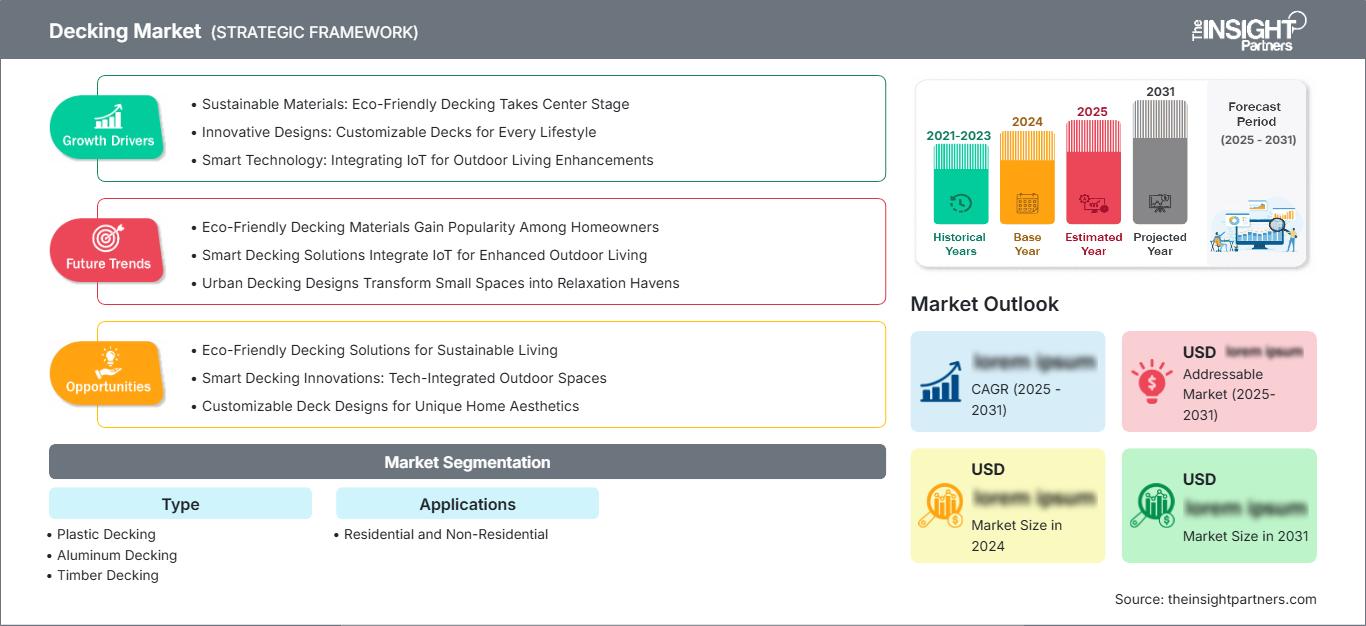
Decking Market: Strategic Insights
Regional Insights
North America Decking Market
North America held a 38-42% share of worldwide market revenue in 2025 and is projected to grow at a 5.8-6.8% CAGR through 2034. Some of the key factors responsible for the region's success include its developed home improvement industry, the availability of knowledgeable contractors, and high consumer spending on outdoor remodeling projects. In addition, deck installation is becoming part of property upgrades that add value, which constantly drives demand.
Another important factor contributing to growth is the ongoing shift from traditional wood to engineered materials, driven by their lower maintenance requirements. Composite products are becoming increasingly popular among consumers who look for products that perform well in different weather conditions. Manufacturers have well-developed production and distribution networks in the region.
U.S. Decking Market
The U.S. decking market accounted for 78%-82% of North American revenue in 2025 and is expected to grow at a CAGR of 5.9%-6.9% during the forecast period. Home remodeling continues to be the main driver of demand, driven by ongoing investment in home improvements and lifestyle-oriented outdoor modifications.
The country also serves as a major innovation hub for the industry. Leading manufacturers including Trex Company, Inc., Fiberon, LLC, and The AZEK Company Inc. (TimberTech) continue introducing new product technologies and recycled-content solutions. Demand is particularly strong for high-performance composite systems offering durability, appearance retention, and resistance to environmental degradation. Builder and contractor awareness continues to support broad adoption across residential applications.
Europe Decking Market
In 2025, Europe held a share of 26–30% of global revenue and is expected to grow at a CAGR of 5.5–6.5% up until 2034. Germany is the market leader in Europe because of its high levels of landscaping activity, housing projects, and residents' preference for quality outdoor products. Sustainable policies and environmental consciousness have continued to influence decisions about material choices in Europe.
The United Kingdom is benefiting from renovations and increased demand for outdoor leisure spaces. France, Italy, and Spain are responsible for generating considerable demand through improvements in residential buildings and investments in tourism facilities. More sustainable composites and bamboo materials have prompted suppliers to expand their regional product portfolios.
APAC Decking Market
Asia Pacific represented 22–26% of global market revenue in 2025 and is expected to expand at a 7.2–8.2% CAGR through 2034. Among all major regions, Asia Pacific demonstrates the strongest growth potential due to rapid urbanization, expanding middle-class populations, and increasing investments in residential communities. China remains the largest market within the region, supported by large-scale urban development projects and growing demand for premium outdoor infrastructure.
Both Japan and South Korea continue to focus on materials that not only last long but also look good. In India, there is an increase in the adoption of the modern-day concept of living outdoors as incomes rise and housing communities are created. Australians represent another major customer segment because of their tradition of outdoor living and use of weather resistant materials. Governmental programs for sustainable construction are likely to aid regional expansion in the coming years.
Middle East & Africa Decking Market
The Middle East & Africa market is projected to register a 6.0–7.0% CAGR through 2034. Regional demand is supported by investments in tourism, hospitality, mixed-use real estate developments, and premium residential projects. Saudi Arabia continues to lead growth due to large-scale infrastructure programs and destination development initiatives designed to attract international visitors and encourage lifestyle-oriented construction.
The United Arab Emirates remains a major market for outdoor recreational and hospitality applications. South Africa contributes demand through residential construction and commercial landscaping activity, while the rest of the region benefits from selected infrastructure and tourism investments. Increasing interest in durable, low-maintenance outdoor materials is encouraging the adoption of composite and engineered decking products across a wider range of applications.
Segmentation Analysis
Type
The Type segment is forecast to grow at a 6.5–7.3% CAGR during the forecast period. Material innovation continues to reshape purchasing behavior as developers, contractors, and homeowners prioritize performance, sustainability, and long-term maintenance savings. The decking market scope continues to expand beyond traditional timber solutions, creating opportunities for engineered materials that offer improved durability and weather resistance.
- Plastic Decking: Plastic-based products provide strong resistance to moisture, insects, and environmental degradation. These solutions are widely used in residential projects where ease of maintenance and long service life are important decision-making factors.
- Aluminum Decking: Aluminum products maintain a specialized position within commercial and premium residential environments. Their fire resistance, structural strength, recyclability, and ability to withstand harsh environmental conditions support continued adoption.
- Timber Decking: Timber remains valued for its natural appearance and traditional design appeal. High-end residential developments and luxury landscaping projects continue to utilize premium wood products despite increasing competition from alternatives.
- Composite Decking: Composite materials represent the fastest-growing material category due to their combination of visual appeal, performance consistency, durability, and reduced maintenance requirements. Growing utilization of recycled inputs further strengthens market acceptance.
Application
The Applications segment is projected to achieve a 6.3–7.1% CAGR through 2034. Demand patterns are shaped by housing renovation trends, recreational infrastructure investment, and growing preference for outdoor gathering environments. Both residential and commercial users increasingly recognize the value of durable exterior living spaces.
- Residential: The residential segment remains the largest contributor to market revenue. Homeowners continue investing in decks, patios, poolside areas, and backyard entertainment zones to enhance property value and improve lifestyle experiences.
- Non-Residential: Commercial applications include hospitality facilities, educational campuses, public parks, retail environments, recreational complexes, and tourism-oriented developments. Growth is supported by long-term infrastructure and property modernization programs.
Opportunity Snapshot
| Segment Name | Revenue Contribution | Trend Tag | Adoption Stage |
| Residential | High | Backyard Living | Mature |
| Non-Residential | Medium | Resort Spaces | Scaling |
Decking Market Growth Drivers and Impact Analysis
Expansion of Residential Remodeling and Home Improvement
Residential renovation expenditure continues to influence purchasing decisions across developed and emerging economies. Homeowners are increasingly allocating budgets toward outdoor living spaces that support entertainment, relaxation, and property enhancement objectives. Deck installations provide a practical solution for extending usable living areas without major structural modifications to existing homes. As housing stock ages, replacement demand also creates recurring opportunities for suppliers. Furthermore, increasing homeownership aspirations in several countries support demand for aesthetically attractive outdoor environments. Manufacturers benefit from this trend through premium product sales, added-value accessories, and long-term replacement cycles. Continued investment in property modernization is expected to remain one of the strongest contributors to market expansion over the next decade.
Growing Adoption of Composite and Engineered Materials
The industry continues to experience a steady transition away from conventional wood toward advanced composite and engineered materials. Consumers increasingly seek products that minimize maintenance requirements while providing reliable performance under varying climatic conditions. Composite systems offer resistance to moisture, insects, fading, and structural deterioration, reducing long-term ownership costs. These benefits are particularly attractive for residential users who prefer low-maintenance outdoor installations. Commercial operators also value lifecycle efficiency because maintenance interruptions can affect operating performance and customer experiences. As manufacturing technologies improve and aesthetic options become more sophisticated, advanced materials are gaining acceptance across a broader range of applications. This transition is expected to remain a key catalyst for sustained market development.
Sustainability Requirements and Circular-Economy Practices
Environmental considerations are becoming increasingly important across construction and building-material industries. Regulatory frameworks, consumer awareness, and corporate sustainability commitments are encouraging the use of recycled-content products and renewable raw materials. Manufacturers are investing in material recovery systems, waste reduction initiatives, and resource-efficient production processes to strengthen environmental performance. Products incorporating recycled plastics and responsibly sourced fibers are gaining traction among environmentally conscious purchasers. Sustainability credentials are also becoming an important differentiator in commercial procurement processes, particularly for large projects that prioritize environmental objectives. As circular-economy principles become more widely adopted, suppliers with strong sustainability capabilities are expected to benefit from enhanced market opportunities and stronger customer engagement.
Decking Market Future Trends
Increased Integration of Recycled and Renewable Feedstocks
Emerging decking market trends indicate that manufacturers will increasingly adopt recycled polymers, reclaimed fibers, and renewable plant-based materials within production processes. Sustainability objectives are expected to influence procurement decisions across residential and commercial sectors. As product performance improves, consumers are likely to place greater emphasis on environmental attributes. Companies that successfully integrate circular-material strategies while maintaining performance standards may secure stronger market positions. Future product development efforts are expected to focus on reducing environmental footprints, increasing recycled-content percentages, and improving resource efficiency. These developments will likely influence both competitive dynamics and long-term purchasing preferences throughout the industry.
Premium Outdoor Living Design and Smart Product Features
Future market activity is expected to emphasize premium aesthetics and enhanced user experiences. Manufacturers are developing products with improved heat mitigation, advanced surface textures, superior fade resistance, and integrated accessories. Smart lighting, modular layouts, concealed fastening systems, and customized design options are becoming more attractive to homeowners and commercial developers. Outdoor environments are increasingly viewed as multi-functional lifestyle spaces rather than basic structural additions. This shift is expected to encourage further innovation across materials, installation approaches, and design features. Suppliers capable of delivering premium functionality and design flexibility may benefit significantly during the forecast period.
Decking Market Opportunities
Urban Residential Development and Multifamily Housing Projects
Urban residential expansion presents substantial opportunities for manufacturers and suppliers. Developers are increasingly incorporating shared outdoor amenities, rooftop terraces, recreation areas, and landscaped communal spaces into multifamily housing projects. These developments require durable and visually appealing materials capable of delivering long-term performance under intensive usage conditions. Investment strategies aligned with long-term the decking market Forecasts increasingly focus on scalable solutions that simplify installation and reduce maintenance costs. Companies offering modular systems, sustainable materials, and architect-focused design support may secure competitive advantages. Strong collaboration with developers and construction firms can further enhance penetration within this rapidly evolving opportunity area.
Expansion of Hospitality and Tourism Infrastructure
Global investment in tourism and hospitality infrastructure continues creating attractive growth opportunities. Hotels, resorts, waterfront developments, restaurants, and entertainment venues increasingly prioritize outdoor guest experiences. These applications require products capable of combining aesthetics, durability, safety, and weather resistance. Suppliers that develop specialized solutions for high-traffic environments can benefit from recurring renovation and replacement cycles. Growth prospects are particularly strong in regions investing heavily in tourism diversification and destination development. Strategic relationships with architects, landscape designers, and hospitality operators may provide access to long-term project pipelines while supporting brand visibility across premium commercial applications.
Recent Developments
- January 2026: TimberTech, a leading brand in composite and PVC decking, has launched a marketing campaign titled “The Future of Decking.” Created by the James Hardie creative team, the campaign will be promoted through digital and social media, streaming TV, and select print publications.
- January 2026: Trex Company, the largest manufacturer of wood-alternative decking, has announced a limited launch of Trex® Refuge™ Decking. This new ignition-resistant PVC decking is engineered for areas with strict fire-safety codes, combining enhanced fire performance with the durable and low-maintenance qualities synonymous with the Trex brand.
- April 2026: BETCO, a leader in self-storage construction, has announced an expansion of its decking product line. This new range of custom metal decking systems caters to the structural and architectural needs of self-storage projects in North America, combining advanced engineering with high-quality manufacturing for design flexibility and customization.
Frequently Asked Questions

- Comprehensive Market Sizing and Forecast Analysis
- Detailed Segmentation Analysis
- In-Depth Market Dynamics Assessment
- Regional and Country-Level Insights
- Competitive Landscape and Company Benchmarking
- Strategic Business Intelligence
Recent Reports
Testimonials

The Insight Partners' SCADA System Market report is comprehensive, with valuable insights on current trends and future forecasts. The team was highly professional, responsive, and supportive throughout. We are very satisfied and highly recommend their services.
RAN KEDEM Partner, Reali Technologies LTDs
I requested a report on a very specific software market and the team produced the report in a few days. The information was very relevant and well presented. I then requested some changes and additions to the report. The team was again very responsive and I got the final report in less than a week.
JEAN-HERVE JENN Chairman, Future Analytica
We worked with The Insight Partners for an important market study and forecast. They gave us clear insights into opportunities and risks, which helped shape our plans. Their research was easy to use and based on solid data. It helped us make smart, confident decisions. We highly recommend them.
PIYUSH NAGPAL Sr. Vice President, High Beam Global
The Insight Partners delivered insightful, well-structured market research with strong domain expertise. Their team was professional and responsive throughout. The user-friendly website made accessing industry reports seamless. We highly recommend them for reliable, high-quality research services
YUKIHIKO ADACHI CEO, Deep Blue, LLC.
This is the first time I have purchased a market report from The Insight Partners.While I was unsure at first, I visited their web site and felt more comfortable to take the risk and purchase a market report.I am completely satisfied with the quality of the report and customer service. I had several questions and comments with the initial report, but after a couple of dialogs over email with their analyst I believe I have a report that I can use as input to our strategic planning process.Thank you so much for taking the extra time and making this a positive experience.I will definitely recommend your service to others and you will be my first call when we need further market data.
JOHN SUZUKI President and Chief Executive Officer, Board Director, BK Technologies
I wish to appreciate your support and the professionalism you displayed in the course of attending to my request for information regarding to infectious disease IVD market in Nigeria. I appreciate your patience, your guidance, and the fact that you were willing to offer a discount, which eventually made it possible for us to close a deal. I look forward to engaging The Insight Partners in the future, all thanks to the impression you have created in me as a result of this first encounter.
DR CHIJIOKE ONYIA MANAGING DIRECTOR, PineCrest Healthcare Ltd.Reason to Buy
- Informed Decision-Making
- Understanding Market Dynamics
- Competitive Analysis
- Identifying Emerging Markets
- Customer Insights
- Market Forecasts
- Risk Mitigation
- Boosting Operational Efficiency
- Strategic Planning
- Investment Justification
- Tracking Industry Innovations
- Aligning with Regulatory Trends





 Get Free Sample for