
Decorative Concrete Market Growth, Size & Forecast by 2034
Coverage: By Type (Stamped Concrete, Polished Concrete, Colored Concrete, and Stained Concrete); Application (Floors, Walls, and Sidewalks); End-User (Residential and Non-residential), and Geography (North America, Europe, Asia Pacific, and South and Central America)
- Status : Data Released
- Report Code : TIPMC00002702
- Category : Chemicals and Materials
- No. of Pages : 150
- Available Report Formats :


- Last update date : July 16, 2026


2025 Market Size
US$ 20.60 Bn
Base year value
2034 Forecast
US$ 31.97 Bn
Projected by 2034
CAGR 2026-2034
5.01 %
Growth rate
Addressable Market
US$ 238.63 Bn
(2026-2034)
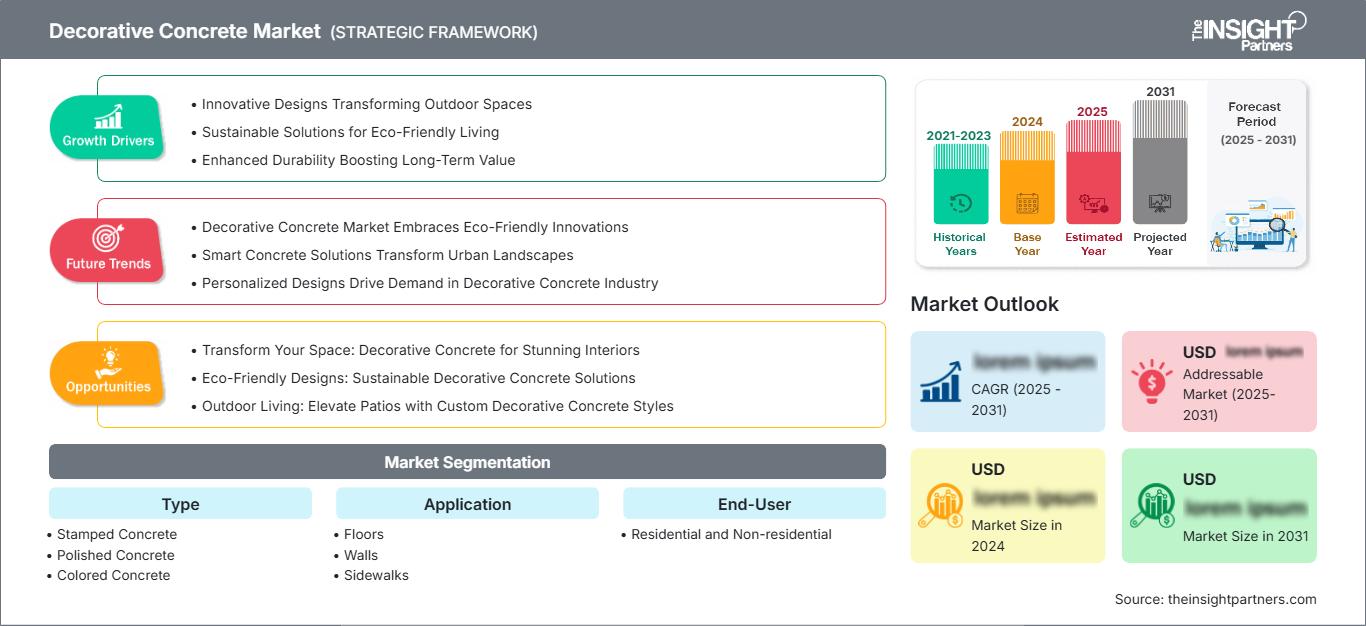
The decorative concrete market was worth US$ 20.60 Billion in 2025 and is expected to witness a growth of US$ 31.97 Billion by 2034, exhibiting a CAGR of 5.01% during the forecast period. Increased spending on residential renovation, modernization of commercial structures, and creation of aesthetically pleasing public places will help to drive up the demand for decorative concrete products. Advancements in decorative concrete technology, including color, surface treatment, and durable finishes, have aided their adoption in new constructions and refurbishments.
In North America, the market is set to grow due to continued spending on home remodeling projects, redevelopment of commercial sites, and upgrading of infrastructure with a focus not only on aesthetics but durability. The Decorative Concrete Market size will be growing continuously as more and more architects choose to apply decorative finishes to institutional and mixed-use buildings. Demand in the region is estimated to grow at a CAGR of 4.7% to 5.2% until 2034.
Decorative Concrete Market Assessment and Insights
- North America: North America accounted for an estimated 33–36% Decorative Concrete Market share in 2025 and is anticipated to grow at a CAGR of 4.7%–5.2% during 2026–2034. Strong renovation spending, commercial construction activity, and adoption of premium flooring systems continue to reinforce regional demand.
- U.S.: The U.S. represented approximately 74–78% of the North American market in 2025 and is projected to expand at a CAGR of 4.8%–5.3% through 2034, supported by institutional renovation, urban redevelopment, and decorative pavement applications.
- Europe: Europe held an estimated 27–30% share in 2025 and is forecast to record a CAGR of 4.6%–5.1%. Germany, the UK, France, Italy, and Spain remain leading markets owing to renovation initiatives, sustainable construction policies, and architectural restoration activities.
- Asia Pacific: Asia Pacific accounted for approximately 25–28% of the global market in 2025 and is expected to register the fastest regional CAGR of 5.8%–6.3% through 2034. China, India, Japan, South Korea, and Australia continue to benefit from rapid urbanization and infrastructure investments.
- Largest Segment: Floors represented the largest application, accounting for approximately 47–51% market share in 2025, and is projected to grow at a CAGR of 4.9%–5.4% owing to extensive deployment in residential, commercial, and industrial buildings.
- High Growth Segment: Polished Concrete is expected to remain the fastest-growing type, representing 25–29% market share in 2025 while advancing at a CAGR of 5.8%–6.4%, driven by demand for low-maintenance, durable, and sustainable flooring solutions.
- Key companies analyzed in detail: BASF SE, RPM International Inc., Sika AG, CEMEX, S.A.B. de C.V., UltraTech Cement Limited, 3M Company, Huntsman International LLC, PPG Industries, Inc., Holcim Ltd., Heidelberg Materials AG.
Source: The Insight Partners' analysis based on proprietary research, government publications, company annual reports, investor presentations, industry databases, and expert interviews.
Decorative concrete has advanced significantly as a result of advances in pigments, sealers, texturing processes, and installation methods. With digital software and sophisticated stamping equipment, custom finishes are made possible. There continues to be investment in environmentally friendly products that emit low levels of volatile organic compounds, as manufacturers and contractors use mechanized polishing and finishing equipment that enhances process efficiency, reduces maintenance costs, and ensures the longevity of the structure.
The decorative concrete market will be driven by greater investment into urban revitalization, transportation, hospitality and upscale residential projects. Governments that promote sustainable buildings and long-life construction materials create an enabling environment for the use of decorative concrete. Countries developing their smart cities and public infrastructure remain committed to using decorative concrete. The continued preference for custom finishes and cost benefits throughout the structure's lifecycle will drive demand.
Decorative Concrete Market Report Scope
| Report Attribute | Details |
|---|---|
| Market size in 2025 | US$ 20.60 Billion |
| Market Size by 2034 | US$ 31.97 Billion |
| Global CAGR (2026 - 2034) | 5.01% |
| Historical Data | 2021-2024 |
| Forecast period | 2026-2034 |
Decorative Concrete Market Analysis
Continuous investment into upgrading of urban infrastructure, refurbishment of commercial properties, and development of premium residences continues fueling Decorative Concrete Market growth in construction industries worldwide. Decorative concrete products continue to gain popularity over traditional flooring and paving materials due to improved longevity, ease of maintenance, and architectural versatility. Sustainable construction trends also drive rapid adoption of polished and stained concrete products, as these enable saving material through refurbishment rather than replacement. The growing needs of universities, hospitals, hotels, and retail developments also contribute to increased market penetration by driving demand for durable, aesthetically pleasing surfaces.
Value chain improvements and advancements in technology continue supporting the industry. Collaboration among raw materials suppliers, admixture producers, pigment makers, machinery companies, contractors, and architectural consultants enables the development of custom products to meet varying construction demands. Increased access to automatic polishing machines, sealers, and other surface preparation technologies improves the quality of the installation process, reducing its duration. Sustainable approaches focused on recycled aggregates and other green products make decorative concrete solutions even more competitive as environmental regulations gain importance in the construction procurement process.
The Decorative Concrete Market trends indicate that differentiation through competition is increasingly becoming a factor in technology, portfolio, sustainability, and contractor programs, rather than price alone. Companies like BASF SE, Sika AG, Holcim Ltd., Heidelberg Materials AG, RPM International Inc., and PPG Industries, Inc. continue to expand their product ranges through innovation and strategic alliances. CEMEX, S.A.B. de C.V., UltraTech Cement Limited, 3M Company, and Huntsman International LLC are also increasing their market dominance by incorporating high-performance additives, coatings, sealers, and concrete enhancers into their broader construction product portfolios.
According to the Decorative Concrete Market report, investments will shift from the traditional to the adoption of digital project planning tools, surface-finishing machines, sustainable materials, and localized production, enabling faster adaptation to changing needs across regions. The companies will also continue expanding training programs for contractors to ensure that the installations meet the desired quality and performance in the long run. Acquisitions, capacity building, and research on durability, abrasion resistance, and low emissions will continue to dominate competition during the forecast period.
● REPORT CUSTOMIZATION
Tailor This Report To Align With Your Specific Business Requirements
This report can be customized to align precisely with your business objectives, scope, and target markets. Customization options include tailored segmentation, geography, competitive analysis, and strategic insights to support informed decision-making.
Customize This Report →WHAT YOU CAN ADJUST
- ● Segmentations
- ● Geography
- ● Competitive Analysis
- ● Language Preferences
Decorative Concrete Market: Strategic Insights
Regional Insights
North America Decorative Concrete Market
North America maintained a leading position in the Decorative Concrete Market, supported by strong renovation activity, commercial redevelopment, and increasing preference for visually enhanced construction surfaces. The region accounted for an estimated 33–36% share in 2025 and is expected to register a CAGR of 4.7%–5.2% during 2026–2034. Demand remains concentrated in the US and Canada, where residential remodeling and institutional construction projects continue adopting decorative flooring and architectural concrete solutions.
The regional ecosystem can leverage existing contractors, sophisticated installation services, and a wide range of concrete products. Sustainable construction practices, advancements in coatings, and growth in demand for custom finishes have been affecting project specifications. The USA is the biggest contributor in the region, whereas Canada has been growing thanks to infrastructure renovation initiatives and commercial developments. Growth in the use of polished and stamped concrete systems will help drive the regional growth.
U.S. Decorative Concrete Market
The US Decorative Concrete Market represents approximately 74–78% of North America's market in 2025 and is projected to grow at a CAGR of 4.8%–5.3% through 2034. Growth is supported by residential renovation spending, hospitality developments, retail upgrades, and demand for premium flooring solutions across commercial facilities.
The nation benefits from an excellent supply of construction materials, specialist contractors, and technology providers offering the latest decorative concrete systems. Examples of applications of this type include polished floors, decorative patios, and architectural finishes. Sustainability considerations, ease of maintenance, and custom aesthetics remain key factors influencing purchasing decisions. Local companies and multinational corporations are expanding their product ranges in response to changing architectural tastes and demands.
Europe Decorative Concrete Market
Europe held an estimated 27–30% share of the Decorative Concrete Market in 2025 and is expected to expand at a CAGR of 4.6%–5.1% during 2026–2034. The region benefits from renovation activities, heritage restoration projects, and sustainable construction initiatives across leading markets. The UK is witnessing increased adoption in residential refurbishment, commercial interiors, and hospitality projects due to demand for durable decorative surfaces.
Germany remains an important market owing to its high construction standards and focus on upgrading buildings to make them more energy-efficient. Countries such as France, Italy, and Spain are contributing to the market through architectural and tourist infrastructure renovations, as well as urban redevelopment projects. Rising demand for customized concrete finishes and eco-friendly materials is driving the growth of the market.
APAC Decorative Concrete Market
The decorative concrete market in Asia Pacific accounted for approximately 25–28% of the Decorative Concrete Market in 2025 and is forecast to achieve a CAGR of 5.8%–6.3% through 2034. China leads regional demand, supported by urban expansion, infrastructure development, and commercial construction.
Residential and infrastructure developments in India, Japan, South Korea, and Australia are other sources contributing to the uptake. Government-led urban development efforts, rising disposable income, and growing awareness of long-lasting architectural coatings are fueling adoption. Growth in the construction industry and installation service providers will boost market penetration in the region.
Middle East & Africa Decorative Concrete Market
The decorative concrete market in Middle East & Africa is forecast to witness a CAGR of 4.5% to 5.0% from 2026 to 2034, owing to investments in infrastructure, development in the hospitality sector, and urbanization. Saudi Arabia and the UAE continue to be the primary contributors, owing to massive construction activity and the need for architectural improvements.
African nations, including South Africa, have begun adopting decorative concrete for commercial structures, housing, and infrastructure development. The diversification of energy sources and investments in tourism, transportation, and urbanization have created further opportunities. There is an increasing demand for durable and aesthetically pleasing construction materials that can endure tough environments.
Segmentation Analysis
Type
The Type segment of the Decorative Concrete Market includes stamped concrete, polished concrete, colored concrete, and stained concrete solutions. The segment is expected to grow at a CAGR of 5.0%–5.5% during 2026–2034 as construction stakeholders increasingly prioritize customized surfaces, improved durability, and visually appealing finishes. Advancements in pigments, sealers, and surface treatment technologies are enabling broader adoption across residential and commercial developments.
- Stamped Concrete: Stamped concrete remains widely adopted for outdoor spaces, walkways, patios, and driveways because it replicates premium materials such as stone and brick while offering improved cost efficiency. Its design flexibility supports demand among residential developers and landscape contractors.
- Polished Concrete: Polished concrete is gaining preference in commercial interiors, retail spaces, and industrial facilities due to its low maintenance requirements, durability, and reflective appearance. Growing demand for sustainable flooring alternatives continues strengthening its adoption.
- Colored Concrete: Colored concrete solutions are increasingly used in architectural applications requiring customized aesthetics and branding elements. Availability of diverse pigment technologies enables designers to achieve consistent colors across large-scale construction projects.
- Stained Concrete: Stained concrete maintains demand in renovation projects and decorative flooring applications because it provides unique visual effects and enhances existing concrete surfaces. Its ability to transform conventional flooring supports continued usage in residential and hospitality projects.
Application
The Application segment includes floors, walls, and sidewalks, with the segment projected to register a CAGR of 4.9%–5.4% during 2026–2034. Growing construction activity, increasing renovation projects, and demand for attractive architectural finishes are influencing application selection. Decorative concrete applications are expanding beyond traditional flooring into exterior landscapes and vertical surfaces, creating opportunities for specialized products and installation techniques.
- Floors: Floors represent the largest application area due to extensive use in residential, commercial, industrial, and institutional buildings. Demand is supported by durability requirements, aesthetic preferences, and increasing acceptance of polished and finished concrete surfaces.
- Walls: Decorative concrete walls are gaining attention in modern architectural designs, hospitality spaces, and commercial interiors. Designers increasingly use textured and colored concrete finishes to create distinctive visual environments with long-lasting performance.
- Sidewalks: Sidewalk applications continue expanding through municipal projects, landscaping developments, and urban beautification initiatives. Decorative finishes improve pedestrian areas by combining functionality with enhanced appearance in public and private spaces.
End-User
The End-User segment comprises residential and non-residential sectors and is expected to achieve a CAGR of 5.1%–5.6% during 2026–2034. Rising construction activity, remodeling investments, and demand for customized building aesthetics are driving adoption across both segments. Developers and property owners increasingly consider decorative concrete as a durable solution that balances design requirements with lifecycle cost advantages.
- Residential: Residential adoption is increasing due to renovation activities, outdoor living space development, and demand for customized flooring and landscaping solutions. Homeowners increasingly select decorative concrete for patios, driveways, interiors, and entertainment areas.
- Non-residential: Non-residential applications continue expanding across offices, retail centers, hotels, healthcare facilities, and public infrastructure. The segment benefits from requirements for durable surfaces, attractive designs, and reduced maintenance expenses in high-traffic environments.
Opportunity Snapshot
| Segment Name | Revenue Contribution (High/Medium/Low) | Trend Tag | Adoption Stage |
| Residential | High | Home Renovation | Scaling |
| Non-residential | High | Commercial Interiors | Mature |
Decorative Concrete Market Growth Drivers and Impact Analysis
Rising Residential Renovation and Remodeling Activities
There are various ways trends in residential building renovations are impacting the demand for decorative concrete products for designing and refurbishing the outdoors, flooring, and architecture. There is an increasing preference for customized designs, durability, and low-maintenance materials, which is driving the use of decorative concrete over traditional materials for flooring construction. The advantage of using decorative concrete is the range of textures, colors, and finishes available, as well as the material's functionality. Higher spending on home improvements, especially in mature economies, will drive demand for installations among contractors. The effects of renovating activities affect all players, from the manufacturers, distributors, and installers, in having a wider customer base.
Expansion of Commercial and Public Infrastructure Projects
The development of commercial structures and infrastructure projects in urban areas is opening new possibilities for decorative concrete use in office buildings, retail stores, hospitality establishments, and transport terminals. The demand for surfaces that look attractive yet are durable and efficient to operate is rising. The use of decorative concrete systems can minimize long-term maintenance needs compared to other finishes. The investment in improving urban areas through various regeneration and beautification projects is leading to increased use of decorative sidewalks, plazas, and architectural concrete elements.
Advancements in Sustainable Concrete Technologies
The development of sustainable concrete technology is affecting the selection of materials for construction projects. Companies are now working on low-emission, high-durability, and resource-efficient production processes to cater to environmental requirements. The development of sustainable concrete technology also helps with concrete decoration, as the material's longevity and resistance to frequent replacements increase. It also goes well with the sustainable approach to construction. Greater focus on material longevity is helping architects and contractors consider not only cost but also the durability and sustainability of materials.
Decorative Concrete Market Future Trends
Integration of Digital Design and Automated Finishing Technologies
Digital design tools and automated finishing technologies are expected to reshape decorative concrete installation practices during the forecast period. Advanced visualization platforms allow architects, contractors, and customers to evaluate customized surface patterns before project execution. Automated polishing equipment and precision application technologies are improving consistency, reducing installation time, and minimizing material waste. These advancements are likely to increase adoption among large-scale commercial developers seeking predictable outcomes and efficient project management. Technology integration will also support greater customization by enabling complex textures, patterns, and finishes. As construction companies increasingly adopt digital workflows, decorative concrete solutions are expected to become more accessible for projects requiring detailed architectural specifications and enhanced surface performance.
Growing Adoption of Eco-Friendly Decorative Concrete Solutions
Sustainability-focused construction practices are expected to drive increased adoption of environmentally responsible decorative concrete solutions. Future product development is likely to emphasize recycled content, lower-carbon formulations, and improved energy efficiency throughout manufacturing and installation processes. Developers and architects are increasingly considering environmental performance alongside aesthetics and durability when selecting construction materials. Decorative concrete’s ability to extend existing surface life through renovation applications aligns with resource conservation objectives. Manufacturers are expected to invest in innovative formulations that reduce environmental impact while maintaining visual quality and structural reliability. This trend will create opportunities for companies developing sustainable additives, coatings, pigments, and surface treatments designed for next-generation construction requirements.
Decorative Concrete Market Opportunities
Expansion in Emerging Urban Construction Markets
Emerging urban markets present significant opportunities as infrastructure development, residential construction, and commercial expansion continue accelerating. Countries experiencing rapid urbanization are investing in modern buildings, public spaces, and improved urban environments, increasing demand for visually appealing construction materials. Companies can capitalize on these opportunities by strengthening distribution networks, developing region-specific solutions, and partnering with local contractors. Growing awareness of decorative concrete benefits among developers and architects can further improve market penetration. Strategic investments in manufacturing capacity and technical support services will help companies address regional requirements. The expansion of smart city initiatives and urban redevelopment programs provides additional avenues for decorative concrete suppliers to participate in long-term construction growth.
Development of Premium Customized Concrete Solutions
Increasing demand for customized architectural designs creates opportunities for manufacturers to develop premium decorative concrete solutions with enhanced performance characteristics. Customers are seeking distinctive finishes, improved durability, and environmentally responsible materials for residential and commercial projects. Companies investing in advanced pigments, specialty coatings, and design-oriented products can differentiate themselves in competitive markets. Customization capabilities enable suppliers to address diverse applications ranging from luxury interiors to public infrastructure projects. The Decorative Concrete Market Forecasts indicate that companies focusing on innovation, contractor engagement, and application-specific solutions can strengthen their positioning. Expansion of product portfolios and investment in research activities will remain important strategies for capturing emerging demand patterns.
Recent Developments
- March 2026: Amrize introduced its EVERtect high-performance concrete range at the CONEXPO-CON/AGG in Las Vegas. This concrete offers builders customized strength and reliability for various applications, setting new standards in the US and Canada with precision-engineered mixes that meet demanding performance needs..
- January 2026: Nuvoco Vistas Corp. Ltd. has launched the Nuvoco Artiste Elite Collection, a premium range of decorative concrete designed for modern construction and landscaping. This collection features four aesthetic, application-ready finishes that combine artistic sensibility with technical precision, suitable for walkways, driveways, and premium outdoor spaces..
- July 2025: Saint-Gobain Group has acquired the business assets of Interstar Materials Inc., enhancing its presence in North America's Construction Chemicals sector. This acquisition will solidify Saint-Gobain's position in the market and allows entry into granular pigments for concrete. It follows prior acquisitions in the sector, including Chryso in 2021 and GCP Applied Technologies in 2022.
Frequently Asked Questions

- Comprehensive Market Sizing and Forecast Analysis
- Detailed Segmentation Analysis
- In-Depth Market Dynamics Assessment
- Regional and Country-Level Insights
- Competitive Landscape and Company Benchmarking
- Strategic Business Intelligence
Recent Reports
Testimonials

The Insight Partners provided valuable market intelligence that supported our global go-to-market strategy. Their team was professional, responsive, and attentive to our feedback, providing thoughtful analysis and helpful methodological clarifications throughout the project.
Junmo Kim Chief Financial Officer (CFO), Enertech Co., Ltd.
The Insight Partners' SCADA System Market report is comprehensive, with valuable insights on current trends and future forecasts. The team was highly professional, responsive, and supportive throughout. We are very satisfied and highly recommend their services.
RAN KEDEM Partner, Reali Technologies LTDs
I requested a report on a very specific software market and the team produced the report in a few days. The information was very relevant and well presented. I then requested some changes and additions to the report. The team was again very responsive and I got the final report in less than a week.
JEAN-HERVE JENN Chairman, Future Analytica
We worked with The Insight Partners for an important market study and forecast. They gave us clear insights into opportunities and risks, which helped shape our plans. Their research was easy to use and based on solid data. It helped us make smart, confident decisions. We highly recommend them.
PIYUSH NAGPAL Sr. Vice President, High Beam Global
The Insight Partners delivered insightful, well-structured market research with strong domain expertise. Their team was professional and responsive throughout. The user-friendly website made accessing industry reports seamless. We highly recommend them for reliable, high-quality research services
YUKIHIKO ADACHI CEO, Deep Blue, LLC.
This is the first time I have purchased a market report from The Insight Partners.While I was unsure at first, I visited their web site and felt more comfortable to take the risk and purchase a market report.I am completely satisfied with the quality of the report and customer service. I had several questions and comments with the initial report, but after a couple of dialogs over email with their analyst I believe I have a report that I can use as input to our strategic planning process.Thank you so much for taking the extra time and making this a positive experience.I will definitely recommend your service to others and you will be my first call when we need further market data.
JOHN SUZUKI President and Chief Executive Officer, Board Director, BK Technologies
I wish to appreciate your support and the professionalism you displayed in the course of attending to my request for information regarding to infectious disease IVD market in Nigeria. I appreciate your patience, your guidance, and the fact that you were willing to offer a discount, which eventually made it possible for us to close a deal. I look forward to engaging The Insight Partners in the future, all thanks to the impression you have created in me as a result of this first encounter.
DR CHIJIOKE ONYIA MANAGING DIRECTOR, PineCrest Healthcare Ltd.Reason to Buy
- Informed Decision-Making
- Understanding Market Dynamics
- Competitive Analysis
- Identifying Emerging Markets
- Customer Insights
- Market Forecasts
- Risk Mitigation
- Boosting Operational Efficiency
- Strategic Planning
- Investment Justification
- Tracking Industry Innovations
- Aligning with Regulatory Trends





 Get Free Sample for