
Defoaming Coating Additives Market Growth, Trends & Forecast by 2034
Defoaming Coating Additives Market Size and Forecasts (2021–2034), Global and Regional Share, Trends, and Growth Opportunity Analysis Report Coverage : by Type (Silicone, Polymer, Mineral Oil, Vegetable Oil, Water-Based); Function (Foam Breaking, Foam Suppressing, Deaerating); Application (Automotive, Construction, Industrial, Building and Construction, Wood and Furniture); and Geography (North America, Europe, Asia Pacific, and South and Central America)
- Status : Data Released
- Report Code : TIPRE00040371
- Category : Chemicals and Materials
- No. of Pages : 150
- Available Report Formats :


- Last update date : July 15, 2026


2025 Market Size
US$ 1.67 Bn
Base year value
2034 Forecast
US$ 2.95 Bn
Projected by 2034
CAGR 2026-2034
7.37 %
Growth rate
Addressable Market
US$ 21.81 Bn
(2026-2034)
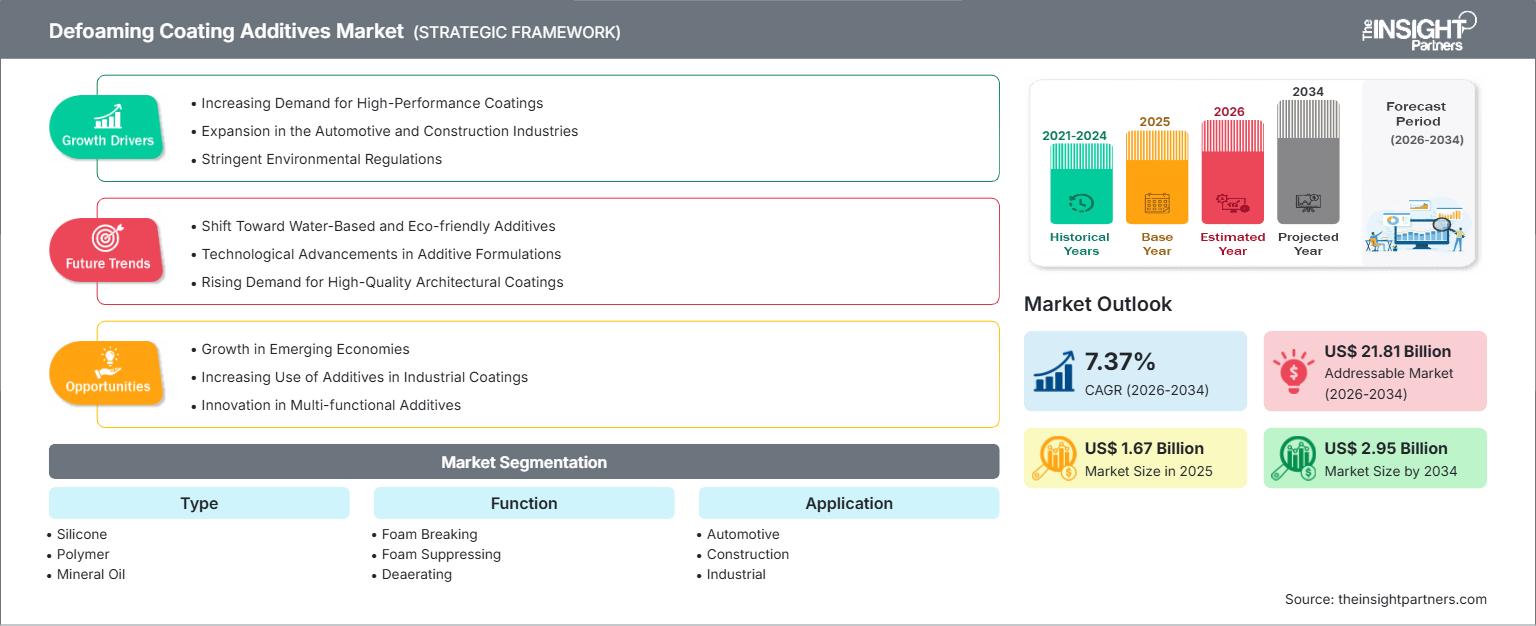
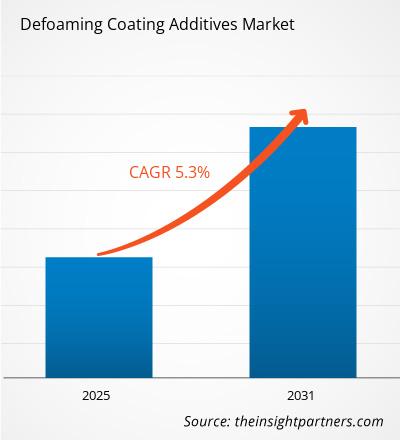
The Defoaming Coating Additives Market was valued at US$ 1.67 Billion in 2025 and is projected to reach US$ 2.95 Billion by 2034, expanding at a CAGR of 7.37% during 2026–2034. The market is expected to see rising demand for efficient coating formulations in the industry, automobile, architecture, and wood coating sectors. Increasing attention towards coating performance, efficiency, and prevention of defects keeps propelling the use of sophisticated defoaming technology in various manufacturing sectors.
The North American Defoaming Coating Additives Market size outlook will be driven by rising production of coatings, technology advancements, and rising usage of water-based coating systems. The regional market is forecast to witness a 6.8% -7.8% CAGR between 2026 and 2034. Construction activities along with demand for premium coatings in automobiles continue to urge manufacturers to include defoamers that help in improving film properties.
Defoaming Coating Additives Market Assessment and Insights
- North America: Held a 28%–32% share in 2025 and is expected to grow at a 6.8%–7.8% CAGR between 2026–2034, supported by mature coatings manufacturing, technological innovation, and rising adoption of environmentally compliant formulations across industrial and architectural applications.
- US: Accounted for 80%–84% of North American demand in 2025 and is forecast to expand at a 6.9%–7.9% CAGR between 2026–2034, driven by demand from automotive refinish coatings, industrial coatings, and construction-related applications.
- Europe: Represented 24%–28% share in 2025 and is projected to record a 6.6%–7.6% CAGR between 2026–2034, led by Germany, France, the UK, Italy, and Spain, supported by advanced coatings manufacturing and sustainability initiatives.
- Asia Pacific: Captured 34%–38% share in 2025 and is anticipated to grow at a 7.8%–8.8% CAGR between 2026–2034, led by China, India, Japan, South Korea, and Southeast Asian countries with expanding industrial production and infrastructure investments.
- Largest Segment: Silicone accounted for a 37%–41% market share in 2025 and is projected to advance at a 7.5%–8.5% CAGR during 2026–2034, owing to excellent compatibility, efficiency, and broad coating application suitability.
- High Growth Segment: Water-Based represented a 14%–18% market share in 2025 and is expected to register a 8.3%–9.3% CAGR during 2026–2034, supported by environmental regulations and increasing adoption of low-VOC coating technologies.
- Key companies analyzed in detail: BASF SE, Evonik Industries AG, Dow Inc., ALTANA AG, Allnex Netherlands B.V., Arkema S.A., Momentive Performance Materials Inc., Münzing Chemie GmbH, Elementis plc, Clariant AG, Ashland Inc.
Source: The Insight Partners' analysis based on proprietary research, government publications, company annual reports, investor presentations, industry databases, and expert interviews.
The advent of new coating technology has revolutionized the need for various additives across the industrial value chain. Defoamer additives which provide fast air release, prevent surface defects, and stabilize the coating are gaining prominence with the growing need for additives which do not affect the gloss and appearance of the coating. There is an increasing trend toward the use of high-solid, water-borne, and special coating formulations driving innovations in silicones and polymers. These trends are shaping the purchasing decisions of coating manufacturers around the globe while stimulating innovation in additive products for specific applications.
Infrastructure development, upgrading of manufacturing facilities, and the increased use of eco-friendly coating systems will shape future market dynamics. The emerging markets continue to invest heavily in their automotive sector, commercial construction, and industrial development providing more opportunities to additive companies. Initiatives aimed at promoting low-emission coatings are likely to drive innovations in foam control technology as well.
Defoaming Coating Additives Market Report Scope
| Report Attribute | Details |
|---|---|
| Market size in 2025 | US$ 1.67 Billion |
| Market Size by 2034 | US$ 2.95 Billion |
| Global CAGR (2026 - 2034) | 7.37% |
| Historical Data | 2021-2024 |
| Forecast period | 2026-2034 |
Defoaming Coating Additives Market Analysis
Factors driving the growth of the Defoaming Coating Additives Market include rising demand for premium quality coating finishes used in automotive, industrial, architectural and furniture sectors. Foam formation during the manufacturing and application processes results in defects in the form of pinholes, craters, and inferior film formation. In this case, manufacturers are increasingly using additives to guarantee consistent quality of the coating finish as well as efficient operations. The defoaming coating additives value chain comprises suppliers of raw materials, producers of additives, manufacturers of coatings, distributors and end-use industries.
On the supply side, trends include developments in silicone chemistry, technology of water compatibility and multifunctionality. Manufacturers are constantly working on new formulations offering improved performances in more coating systems. There is also increasing demand for environmentally friendly coatings that impact product development priorities.
According to the Defoaming Coating Additives Market report, the competition in the market is driven by the technical know-how, performance, and ability to customize formulations for specific applications. The participants are becoming more innovative, compliant, and compatible with coatings rather than competing on price alone. Investment is targeted on growing the range of specialties offered and improving support services in growth segments of applications.
Some of the main companies in the industry such as BASF SE, Evonik Industries AG, Dow Inc., and Clariant AG have continued to stress their focus on developing coating additives in order to improve their market positions. On the other hand, ALTANA AG, Allnex Netherlands B.V., Arkema S.A., Momentive Performance Materials Inc., Münzing Chemie GmbH, Elementis plc, and Ashland Inc. have been diversifying their portfolio of products using specialized technology.
● REPORT CUSTOMIZATION
Tailor This Report To Align With Your Specific Business Requirements
This report can be customized to align precisely with your business objectives, scope, and target markets. Customization options include tailored segmentation, geography, competitive analysis, and strategic insights to support informed decision-making.
Customize This Report →WHAT YOU CAN ADJUST
- ● Segmentations
- ● Geography
- ● Competitive Analysis
- ● Language Preferences
Defoaming Coating Additives Market: Strategic Insights
Regional Insights
North America Defoaming Coating Additives Market
North America accounted for 28%–32% of the global market share in 2025 and is projected to expand at a 6.8%–7.8% CAGR during 2026–2034. These aspects include the existence of an experienced coatings industry, the availability of effective research work and a good application of modern additive technology in the region. Continued increase in the manufacture of industrial, protective and automotive coatings is continually creating demand for advanced foam control agents. The Defoaming Coating Additives Market share is highly concentrated among coatings companies which focus on top quality of surface coatings and processes.
The change towards the use of water based and low VOC coatings also drives growth in this market. Renovation works in construction sector and improvements in infrastructure and manufacturing facilities have led to increased consumption of coatings in many industries.
U.S. Defoaming Coating Additives Market
The United States represented 80%–84% of North American demand in 2025 and is expected to record a 6.9%–7.9% CAGR through 2034. The country remains a major center for coatings innovation, specialty chemical production, and automotive manufacturing. Strong demand from wood coatings, architectural coatings, industrial equipment coatings, and automotive refinish applications continues to create opportunities for additive suppliers.
The major players such as Dow Inc., BASF SE, Elementis plc, and Ashland Inc. are actively engaged in business and technology-related activities within the nation. The demand has started shifting towards those formulations which have the ability to provide better air release and prevent any sort of defects while also being compatible with modern-day coatings.
Europe Defoaming Coating Additives Market
Europe held 24%–28% market share in 2025 and is projected to register a 6.6%–7.6% CAGR during 2026–2034. Germany is still the leading market in the region, owing to the strength of the country’s automotive, industrial coatings, and specialty chemicals industries. There are also numerous research activities going on in the region in the field of sustainable coating solutions and advanced additives.
The UK sustains demand due to the need for maintenance of infrastructures, architectural coatings, and production of industrial coatings. In the case of France, there is demand for automotive coatings and specialty manufacturing products. As far as Italy and Spain are concerned, these regions contribute to the market in terms of furniture coatings and decorative paints.
APAC Defoaming Coating Additives Market
Asia Pacific captured 34%–38% share in 2025 and is anticipated to grow at a 7.8%–8.8% CAGR during 2026–2034, representing the fastest-expanding regional market. China leads regional demand due to its extensive manufacturing sector, construction activity, and coatings production capacity. India is emerging as a key growth market supported by infrastructure expansion and industrial development investments.
Japan and South Korea are still innovation hubs of specialty coatings, whereas Southeast Asia keeps enjoying the benefits of industrialization through manufacturing migration. Government assistance in infrastructure and industrialization projects leads to the increase of consumption of high-tech coating additives in the region.
Middle East & Africa Defoaming Coating Additives Market
The Middle East & Africa market is expected to expand at a 6.2%–7.2% CAGR during 2026–2034. Regional demand is supported by commercial construction, infrastructure development, and industrial coatings applications. Saudi Arabia and the United Arab Emirates continue leading consumption through large-scale development projects and diversification initiatives.
South Africa still presents an important market because of existing manufacturing operations and construction needs. Generally, with rising investments in industrial plants, transport facilities, and commercial properties in the entire area, more use of advanced coating techniques that require effective foam inhibitors can be anticipated.
Segmentation Analysis
Type
The type segment is forecast to register a 7.4%–8.4% CAGR during 2026–2034. The Defoaming Coating Additives Market scope within this segment continues to broaden as coating manufacturers seek technologies capable of improving surface quality while ensuring compatibility with increasingly complex coating formulations. Product selection is influenced by substrate requirements, regulatory considerations, and desired coating performance characteristics.
- Silicone: Recognized for high efficiency, rapid foam elimination, and broad compatibility across solvent-borne and waterborne coating systems. Its strong performance profile supports widespread use in industrial and decorative coatings.
- Polymer: Frequently utilized where balanced defoaming performance and formulation flexibility are required. These products are particularly valuable in specialty applications demanding controlled surface characteristics and stability.
- Mineral Oil: Maintains relevance in conventional coating formulations where cost efficiency and reliable foam suppression remain key purchasing considerations. Adoption remains significant in several industrial coating applications.
- Vegetable Oil: Increasingly considered in environmentally focused coating systems due to renewable sourcing advantages. Demand is gradually expanding in markets prioritizing sustainability and reduced environmental impact.
- Water-Based: Gaining momentum as waterborne coating technologies become more widely adopted. Strong regulatory support and growing sustainability objectives continue driving investment into this product category.
Function
The function segment is expected to expand at a 7.2%–8.2% CAGR during 2026–2034. Manufacturers increasingly select additives based on specific coating process requirements and desired production outcomes. Functional performance has become an important differentiating factor as coating formulations become more advanced and application-specific.
- Foam Breaking: Essential for rapid elimination of existing foam during manufacturing and application processes. These products help maintain production efficiency and coating consistency.
- Foam Suppressing: Supports long-term prevention of foam formation, particularly in high-shear production environments where persistent foam can negatively affect coating performance.
- Deaerating: Helps remove entrapped air and improve film integrity. The function is especially important in premium coatings where visual appearance and surface smoothness are critical.
Application
The application segment is projected to grow at a 7.6%–8.6% CAGR during 2026–2034. Expanding coating consumption across industrial and consumer sectors continues to create opportunities for specialized additive solutions. End users increasingly prioritize coating durability, appearance consistency, and production efficiency.
- Automotive: Requires high-performance additives capable of supporting premium finishes, surface quality, and sophisticated coating systems used in vehicle manufacturing and refinishing.
- Construction: Demand is driven by protective coatings, architectural paints, and infrastructure maintenance activities requiring reliable foam-control performance.
- Industrial: Represents a major application area where coatings protect equipment, machinery, and industrial assets while maintaining productivity and operational performance.
- Building and Construction: Supports utilization across commercial, residential, and public infrastructure projects where coating quality and cost efficiency are important considerations.
- Wood and Furniture: Requires additives that enhance coating appearance, smoothness, and consistency for decorative and protective finishing applications.
Opportunity Snapshot
| Segment Name | Revenue Contribution | Trend Tag | Adoption Stage |
| Automotive | High | EV Coatings | Mature |
| Construction | High | Infrastructure Paints | Scaling |
| Industrial | High | Protective Films | Mature |
| Building and Construction | Medium | Green Buildings | Scaling |
| Wood and Furniture | Medium | Premium Finishes | Scaling |
Defoaming Coating Additives Market Growth Drivers and Impact Analysis
Rising Adoption of Waterborne and Low-VOC Coating Technologies
An increase in commercial construction, housing, transportation networks, and industries has resulted in increased demand for decorative and protective coatings globally. The manufacturers of coatings need advanced defoaming techniques in order to ensure flawless coatings. There are huge quantities of coating used in the construction of infrastructure projects, where cost-effectiveness of production becomes a major factor. Defoamers prevent craters, pinholes, and other entrapped air defects, which could affect the performance of the coating. Developing economies are spending a lot on urbanization and infrastructures, whereas the developed economies spend on the maintenance work.
Growing Performance Requirements in Automotive and Industrial Coatings
This sector is continually witnessing a gradual move from traditional wood to Advanced coating technologies play a key role in ensuring that the manufacturing process maintains production efficiency while meeting the demands of the clients. The problems caused by foam in the coatings may affect the appearance and efficiency of protection of the product. Therefore, choosing appropriate additives will be one of the formulation considerations. The increasing sophistication of automotive coatings, including those for electric cars, is driving innovation in this sector. The same trend is witnessed in the industrial coatings because of their performance consistency requirements.
Expansion of Global Construction and Infrastructure Activities
Increase in commercial construction, housing construction, infrastructure development, and industrial structures is driving demand for decorative as well as protective coatings. Foam control solutions are essential for coating producers as they allow smooth application and prevent defects such as craters, pinholes, and bubbles in the finished product. Large quantities of coatings are often used in infrastructure construction projects, and hence economic efficiency in manufacturing is an important aspect. Emerging economies are making huge investments into urban infrastructure construction, while developed countries continue to engage in renovations.
Defoaming Coating Additives Market Future Trends
Growing Focus on Sustainable Product Innovation
Developments in Defoaming Coating Additives Market trends now seem to be more geared towards producing environmentally sustainable additives that will enable the manufacture of sustainable coatings. Companies are increasingly investing in the use of renewable resources and low emission chemistry as well as technology specifically tailored for water-based coatings. Research and development is being conducted in order to create defoaming additives that will have the lowest possible environmental effect while maintaining their effectiveness in suppressing foaming. Development in the future will definitely be aligned with the requirements set out by coating manufacturers.
Increasing Customization for Application-Specific Performance
Market development in the future will have the following characteristics – increased specialization and customization in formulating the additives. The demand from coating formulators is growing for additives customized for particular substrates, production conditions, and applications. In addition to standardized solutions, customized formulations will start emerging to achieve certain desired properties. Improved knowledge in formulating and digital technologies will make possible an increase in customization of additive performance. The above mentioned trends will have high relevance in markets such as automotive, industrial and specialty coatings, which depend on product differentiation.
Defoaming Coating Additives Market Opportunities
Expansion Opportunities in Emerging Coatings Manufacturing Hubs
Industrialization and the development of manufacturing operations in Asia Pacific, Latin America, and some regions of the Middle East present exciting prospects for suppliers of additives. Coating production capacities are being raised in several developing nations to meet the demands of the expanding automobile, construction, and consumer goods sectors. Regional manufacturing operations and technical services could aid suppliers in building relationships and improving their ability to meet supply needs. According to Defoaming Coating Additives Market Forecasts, newly developing centers of production could be major contributors to demand in the future.
Innovation Potential in High-Performance Specialty Coatings
There is an immense potential in specialty coatings utilized in innovative industrial applications. Protective infrastructure coatings, superior wood finishes, durable coatings for automobiles, and advanced industrial systems have become markets that demand advanced additives technology. These producers are looking for products that will allow foam control without affecting important features of the coating like durability, aesthetics, and chemical resistance. Further development in research and development will facilitate the differentiation and premium pricing. Suppliers that are successful in meeting changing technical requirements will gain by increased use of high performance specialty coatings.
Recent Developments
- May 2026: Ashland Inc. will present its expanded solutions for industrial coatings at the American Coatings Show (ACS) from May 5–7, 2026, in Indianapolis, booth #1248. The showcased innovations focus on sustainable and high-performing coating formulations for a variety of applications, including metal, wood, and general industrial uses. Ashland emphasizes its role as a key partner in addressing performance, regulatory, and sustainability requirements in the architectural coatings sector.
- Febuary 2026: hubergroup Chemicals is launching a new brand of high-performance additives called ELARA, marking a pivotal transition from being a supplier of printing ink raw materials to a comprehensive partner in the coatings, inks, and adhesives sectors. ELARA will debut at PAINT INDIA 2026 in Mumbai, featuring a structured additive portfolio aimed at assisting formulators with contemporary technical and regulatory challenges.
- March 2025: Evonik Coating Additives is launching TEGO Foamex 8420, a siloxane-based defoamer concentrate aimed at addressing challenging foaming issues in waterborne formulations. This product is essential in manufacturing printing inks and overprint varnishes, as foaming can disrupt processes and diminish print quality. Many waterborne inks and varnishes, especially overprint varnishes, contain high levels of foam-stabilizing surfactants, such as DOSS, complicating defoaming efforts.
Frequently Asked Questions

- Comprehensive Market Sizing and Forecast Analysis
- Detailed Segmentation Analysis
- In-Depth Market Dynamics Assessment
- Regional and Country-Level Insights
- Competitive Landscape and Company Benchmarking
- Strategic Business Intelligence
Recent Reports
Testimonials

The Insight Partners' SCADA System Market report is comprehensive, with valuable insights on current trends and future forecasts. The team was highly professional, responsive, and supportive throughout. We are very satisfied and highly recommend their services.
RAN KEDEM Partner, Reali Technologies LTDs
I requested a report on a very specific software market and the team produced the report in a few days. The information was very relevant and well presented. I then requested some changes and additions to the report. The team was again very responsive and I got the final report in less than a week.
JEAN-HERVE JENN Chairman, Future Analytica
We worked with The Insight Partners for an important market study and forecast. They gave us clear insights into opportunities and risks, which helped shape our plans. Their research was easy to use and based on solid data. It helped us make smart, confident decisions. We highly recommend them.
PIYUSH NAGPAL Sr. Vice President, High Beam Global
The Insight Partners delivered insightful, well-structured market research with strong domain expertise. Their team was professional and responsive throughout. The user-friendly website made accessing industry reports seamless. We highly recommend them for reliable, high-quality research services
YUKIHIKO ADACHI CEO, Deep Blue, LLC.
This is the first time I have purchased a market report from The Insight Partners.While I was unsure at first, I visited their web site and felt more comfortable to take the risk and purchase a market report.I am completely satisfied with the quality of the report and customer service. I had several questions and comments with the initial report, but after a couple of dialogs over email with their analyst I believe I have a report that I can use as input to our strategic planning process.Thank you so much for taking the extra time and making this a positive experience.I will definitely recommend your service to others and you will be my first call when we need further market data.
JOHN SUZUKI President and Chief Executive Officer, Board Director, BK Technologies
I wish to appreciate your support and the professionalism you displayed in the course of attending to my request for information regarding to infectious disease IVD market in Nigeria. I appreciate your patience, your guidance, and the fact that you were willing to offer a discount, which eventually made it possible for us to close a deal. I look forward to engaging The Insight Partners in the future, all thanks to the impression you have created in me as a result of this first encounter.
DR CHIJIOKE ONYIA MANAGING DIRECTOR, PineCrest Healthcare Ltd.Reason to Buy
- Informed Decision-Making
- Understanding Market Dynamics
- Competitive Analysis
- Identifying Emerging Markets
- Customer Insights
- Market Forecasts
- Risk Mitigation
- Boosting Operational Efficiency
- Strategic Planning
- Investment Justification
- Tracking Industry Innovations
- Aligning with Regulatory Trends





 Get Free Sample for