
Dental Pain Management Market Trends, Size & Forecast by 2034
Coverage: By Product (Topical Anesthetics and Injectable Local Anesthetics), Procedure (Endodontic, Orthodontist, Periodontic, General Dentistry, and Other), End User (Independent Dental Clinics, Hospitals with Dental Departments, Ambulatory Surgical Centers, and Other End Users), and Geography
- Status : Published
- Report Code : TIPRE00044062
- Category : Life Sciences
- No. of Pages : 296
- Available Report Formats :


- Last update date : September 07, 2026


2025 Market Size
US$ 1,752.62 Mn
Base year value
2034 Forecast
US$ 2,644.80 Mn
Projected by 2034
CAGR 2026-2034
4.7 %
Growth rate
Addressable Market
US$ 19,985.41 Mn
(2026-2034)
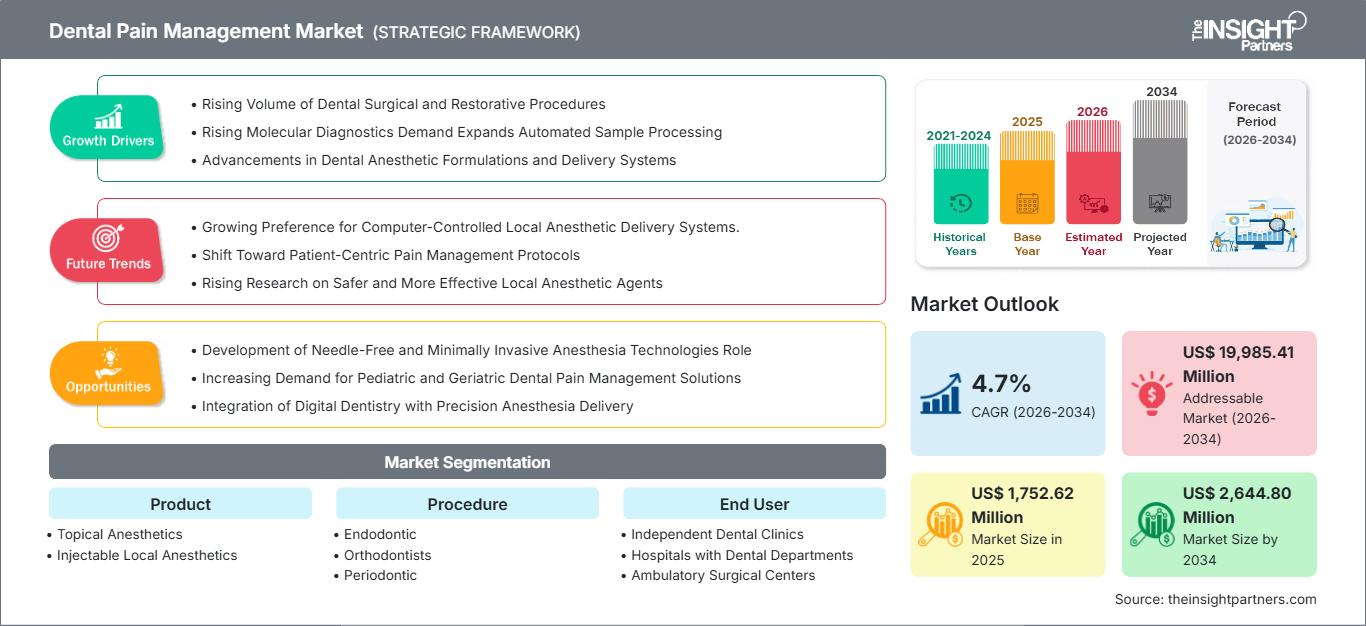
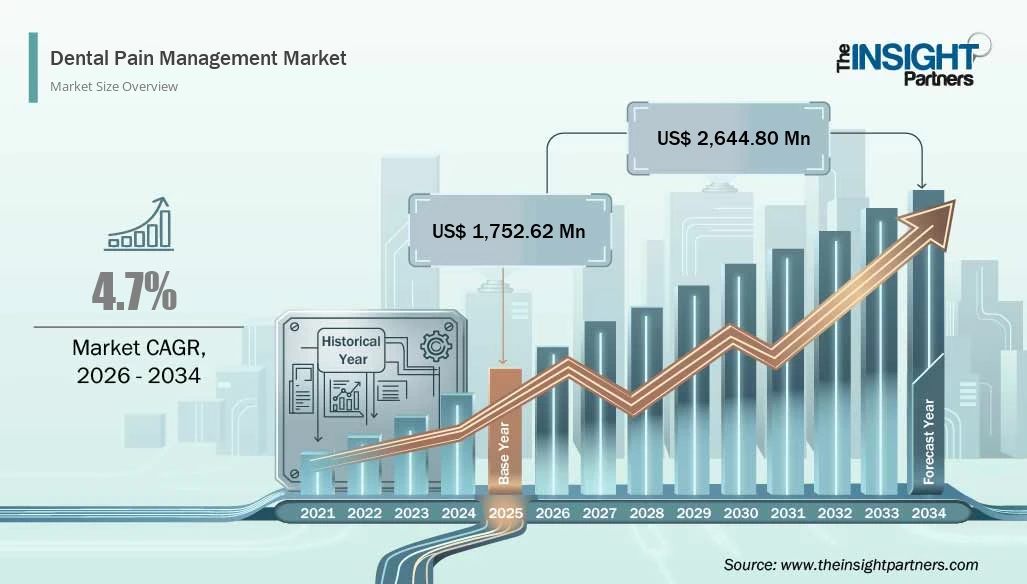
The Dental Pain Management Market was valued at US$ 1752.62 Million in 2025 and is projected to reach US$ 2644.80 Million by 2034, expanding at a CAGR of 4.7% from 2026 to 2034. The market includes products such as topical anesthetics and injectable local anesthetics used in endodontic orthodontic periodontic procedures, general dentistry as well as other related dental procedures, with a high number of purchases from independent clinics hospitals ambulatory surgical centers, and any other dental care providers.
The North America will continue to be a very attractive regional market with a CAGR of 4.5- 4.9% through 2034. Growth of the Dental Pain Management Market is driven by increased spending on dental services, widespread dental insurance, specialist procedure volumes, and steady anesthetic protocol adherence through standardization. In the US, dental expenditure was US$189 billion in 2024 and dental practice consolidation and dental technology investments are continuing to influence purchasing patterns.
Dental Pain Management Market Assessment and Insights
- North America commands an estimated 38–42% share in 2025 and is projected to grow at a 4.5–4.9% CAGR between 2026–2034, supported by established dental infrastructure, specialist care, reimbursement depth, and high procedure intensity.
- US represents approximately 78–82% of North America in 2025 and is expected to grow at a 4.4–4.8% CAGR between 2026–2034, reflecting high dental spending and extensive clinic networks.
- Europe accounts for an estimated 25–29% share in 2025 and is projected to expand at a 4.1–4.5% CAGR between 2026–2034, led by Germany, the UK, France, Italy, and Spain, where established dental systems support recurring anesthetic consumption.
- Asia Pacific holds approximately 22–26% share in 2025 and is forecast to grow at a 5.4–5.8% CAGR between 2026–2034, led by China, Japan, South Korea, India, and Australia, supported by expanding access and rising procedural capacity.
- Largest Segment is injectable local anesthetics, estimated at 60–64% market share in 2025, with a 4.8–5.2% CAGR between 2026–2034, reflecting broad procedural applicability and established clinical workflows.
- High Growth Segment is ambulatory surgical centers, estimated at 8–12% market share in 2025, with a 5.6–6.0% CAGR between 2026–2034, supported by outpatient procedure migration and efficiency-focused care delivery.
- Key companies analyzed in detail: Septodont Holding, DENTSPLY SIRONA Inc., Henry Schein, Inc., Kulzer GmbH, Ultradent Products, Inc., Laboratorios Inibsa, S.A., Pierrel S.p.A., Laboratorios Zeyco, S.A. de C.V., New Stetic S.A., and DFL Indústria e Comércio S.A.
Source: The Insight Partners' analysis based on proprietary research, government publications, company annual reports, investor presentations, industry databases, and expert interviews.
The market has evolved from standard cartridge-based anesthetics to formulations tailored to specific dental procedures, safety-oriented delivery systems, and procedure-specific products. Companies are focusing more on the consistency and predictability of drug onset and action, ease of handling, and package efficiency, besides their compatibility with clinical practices. Supply chains have also become more integrated, as the companies combine formulation, production of cartridges, distribution, and also clinical education that help boost product availability and minimize the operational friction among dental clinics.
Future demand is expected to be mainly driven by the expansion of pharmaceutical markets in Asia, the development of dental care as an outpatient procedure, and the investments in modernization of dental practices. Also, it is going to be supported by policies that will promote and expand the provision of oral healthcare. In this sense, the Dental Pain Management Market growth outlook will remain fairly robust, even where dental treatments that are less necessary will reduce because a local anesthetic is required to perform the invasive dental treatment. The importance of regulatory authorities on the quality of products and pharmacovigilance, product labeling, including patient-specific contraindications, should also give a boost to established suppliers.
Dental Pain Management Market Report Scope
| Report Attribute | Details |
|---|---|
| Market size in 2025 | US$ 1,752.62 Million |
| Market Size by 2034 | US$ 2,644.80 Million |
| Global CAGR (2026 - 2034) | 4.7% |
| Historical Data | 2021-2024 |
| Forecast period | 2026-2034 |
Dental Pain Management Market Analysis
Expansion of the pain management market for dental procedures mostly depends on the constant demand for managing patients' discomfort during such procedures, such as restorative endodontic periodontal, and various surgical dental treatments. The market consists of a wide range of suppliers of active pharmaceutical ingredients, formulation experts, producers of cartridge and packaging distributors dental professionals, hospitals plus specialty care providers. Based on WHO, more than 3.7 billion populations suffer from oral diseases. That definitely highlights one of the major drivers of the industry's treatment burden and, the necessity and accessibility of pain relief products.
Purchase of a pain relief product is not an isolated or occasional choice but part of the general treatment schedule for most dental cases. When it comes to deeply-invasive treatments, such as root canals or extractions, local anesthesia is the gold standard, whereas in other minor cases, topical pain relievers are used for comfort of needles and selected periodontal procedures. On the supplier side, the main factors are pharmaceutical-grade raw materials, sterile production, cartridge supply availability, compliance with regulators, and the extent of distributor coverage. Manufacturers who can consistently supply their customers with reliable top-quality products have a clear advantage as regards maintaining the practice-network and institutional buyer base.
The competitive landscape combines large dental technology groups, specialized anesthetic manufacturers, regional pharmaceutical suppliers, and distributors. Septodont Holding maintains a strong anesthesia-centered position, while DENTSPLY SIRONA Inc. integrates anesthetic products with a broad professional dentistry portfolio. Henry Schein, Inc. adds scale through distribution and practice solutions, whereas Kulzer GmbH, Ultradent Products, Inc., and Laboratorios Inibsa, S.A. extend specialist capabilities across clinical materials and dental care.
Strategic positioning increasingly depends on portfolio breadth, manufacturing resilience, regulatory expertise, and access to dentists. Investment is also moving toward workflow integration and adjacent technologies. Recent company activity indicates stronger emphasis on digital distribution, clinical education, product development, and selective acquisitions. This favors suppliers that can combine dependable anesthetic supply with broader clinical relationships rather than competing on formulation alone.
● REPORT CUSTOMIZATION
Tailor This Report To Align With Your Specific Business Requirements
This report can be customized to align precisely with your business objectives, scope, and target markets. Customization options include tailored segmentation, geography, competitive analysis, and strategic insights to support informed decision-making.
Customize This Report →WHAT YOU CAN ADJUST
- ● Segmentations
- ● Geography
- ● Competitive Analysis
- ● Language Preferences
Dental Pain Management Market: Strategic Insights
Regional Insights
North America Dental Pain Management Market
North America is estimated to represent 38–42% share in 2025, with a 4.5–4.9% CAGR through 2034. The region benefits from mature infrastructure for dental care, established reimbursement channels, high specialist utilization, and extensive independent and group-practice networks. US dental expenditure reached US$189 billion in 2024, providing a significant clinical spending base.
The regional opportunity is also supported by practice consolidation and increasing investment in operational efficiency. Dental offices are increasingly organized into larger networks, while outpatient care remains important for procedures requiring local anesthesia. Canada contributes through established dental services and specialist practices, although the United States remains the principal regional demand center because of its substantially larger treatment and expenditure base.
US Dental Pain Management Market
The US accounts for approximately 78–82% of North America in 2025, with a 4.4–4.8% CAGR through 2034. Dental spending totalled US$189 billion in 2024, while private insurance and out-of-pocket payments remained important financing channels.
Company presence is extensive, spanning Septodont Holding, DENTSPLY SIRONA Inc., Henry Schein, Inc., and Ultradent Products, Inc. Application demand remains strongest in general dentistry and endodontic care, with periodontic and oral surgical procedures supporting additional consumption. CDC data show that dental-visit utilization remains a measurable component of adult healthcare use, while provider shortages and affordability barriers can influence procedure frequency.
Europe Dental Pain Management Market
Europe is estimated at 25–29% share in 2025, with a 4.1–4.5% CAGR through 2034. Germany is the leading country, supported by a large professional dental base, established reimbursement mechanisms, and sophisticated dental manufacturing capabilities. The UK and France also contribute substantial recurring demand through established clinical networks and public-private care structures.
The UK, Germany, France, Italy, and Spain collectively provide a diversified demand base. Germany combines strong dental manufacturing and clinical infrastructure, while the UK benefits from a broad professional network. France, Italy, and Spain provide steady procedure volumes supported by aging populations and specialist dentistry. Eurostat reported that 6.3% of EU residents requiring dental care experienced unmet needs in 2024, indicating continuing access gaps that can influence treatment timing and regional demand.
APAC Dental Pain Management Market
APAC represents approximately 22–26% share in 2025 and is projected to expand at a 5.4–5.8% CAGR, making it the fastest-growing major region. China leads regional scale, followed by Japan, South Korea, India, and Australia. Expansion is supported by urban dental infrastructure and increasing specialist capacity.
Industrial localization, healthcare investment, and oral-health policy initiatives are strengthening treatment access. Japan reported that more than 60% of surveyed people had undergone dental checkups during the previous year, demonstrating the role of preventive and routine dental engagement. India and China offer substantial longer-term potential as organized dentistry expands, while Australia combines established service capacity with national oral-health planning.
Middle East & Africa Dental Pain Management Market
MEA is expected to expand at a 4.8–5.2% CAGR through 2034, with Saudi Arabia and the UAE representing leading demand centers because of healthcare infrastructure investment and private-sector dental capacity. South Africa remains an important regional hub for organized dental services and specialist treatment.
Infrastructure development, medical tourism, and healthcare diversification support procedure capacity in Gulf markets. Saudi Arabia benefits from healthcare transformation investment, while the UAE combines private dental networks with international patient flows. South Africa provides established clinical capabilities, whereas the rest of MEA remains more fragmented, with access constraints and uneven healthcare infrastructure limiting near-term penetration despite substantial unmet oral-health needs.
Segmentation Analysis
Product
Product demand is divided between Topical Anesthetics and Injectable Local Anesthetics, with the latter representing the largest product category. The segment is projected to grow at a 4.8–5.2% CAGR from 2026–2034. Product selection depends on procedure invasiveness, duration, patient characteristics, clinician preference, onset requirements, and safety considerations. DENTSPLY SIRONA Inc. maintains portfolios covering both injectable and topical applications, reflecting the breadth of clinical requirements.
- Topical Anesthetics support localized surface anesthesia and needle-comfort protocols, with particular relevance in periodontal treatment, scaling, root-planing, pediatric care, and selected minor procedures. Their strategic importance is linked to patient comfort and non-invasive application options.
- Injectable Local Anesthetics remain central to invasive dentistry because infiltration and nerve-block techniques provide dependable anesthesia for restorative, endodontic, periodontal, and surgical procedures. Cartridge-based formats support standardized dosing, handling, and chairside workflow integration.
Procedure
Procedure demand is segmented into Endodontic, Orthodontists, Periodontic, General Dentistry, Others, with a 4.6–5.0% CAGR from 2026–2034. General dentistry provides broad recurring consumption, while endodontic and periodontal procedures typically require dependable localized anesthesia. The segment is influenced by treatment mix, dentist specialization, patient comfort expectations, and the complexity of procedures performed in each setting.
- Endodontic procedures require reliable pulpal and periapical anesthesia because treatment frequently involves inflamed tissue and extended chair time. Product selection therefore emphasizes predictable onset, adequate duration, and clinical flexibility.
- Orthodontists use pain-control products around procedures involving attachments, adjustments, extractions, and selected surgical interventions. Demand is influenced by patient mix, treatment complexity, and the growing integration of specialist services.
- Periodontic applications benefit from localized anesthesia for scaling, root planing, periodontal surgery, and tissue management. Topical and localized delivery options can improve procedural comfort while supporting efficient treatment of targeted areas.
- General Dentistry represents the broadest clinical application because routine restorative, extraction, crown, and other procedures frequently require anesthesia. Its scale provides stable baseline demand across independent and organized practices.
End User
End-user demand includes Independent Dental Clinics, Hospitals with Dental Departments, Ambulatory Surgical Centers, Other End Users, with a 4.9–5.3% CAGR from 2026–2034. Independent clinics remain important, while larger organizations increasingly value standardized procurement, supply continuity, and predictable product performance. Ambulatory settings are positioned for faster expansion as appropriate dental procedures migrate toward efficient outpatient models.
- Independent Dental Clinics remain a core purchasing channel because they conduct high volumes of routine restorative, endodontic, and extraction procedures. Buying decisions emphasize availability, clinician familiarity, product reliability, and distributor relationships.
- Hospitals with Dental Departments require anesthetic products for multidisciplinary care, medically complex patients, oral surgery, and specialist treatment. Procurement tends to prioritize regulatory compliance, dependable supply, standardized products, and institutional purchasing agreements.
- Ambulatory Surgical Centers are positioned for increasing adoption as outpatient dentistry expands and procedure pathways become more operationally streamlined. Their strategic importance reflects demand for efficient anesthesia management and predictable turnaround.
- Other End Users include academic institutions, specialty facilities, public dental programs, and selected community-care providers. These organizations support training, outreach, and targeted treatment, creating diversified but comparatively fragmented procurement requirements.
Opportunity Snapshot
| Segment Name | Revenue Contribution | Trend Tag | Adoption Stage |
|---|---|---|---|
| Independent Dental Clinics | High | Clinic Standardization | Mature |
| Hospitals with Dental Departments | Medium | Institutional Procurement | Mature |
| Ambulatory Surgical Centers | Medium | Outpatient Migration | Scaling |
| Other End Users | Low | Community Access | Emerging |
Dental Pain Management Market Growth Drivers and Impact Analysis
Rising burden of untreated oral disease
According to WHO, around 3.7 billion people suffer from one or another oral disease worldwide, with untreated dental caries being the most prevalent oral health issue within the Global Burden of Disease system. This burden means that treatment episodes are often necessary, and pain management is an essential clinical requirement. The commercial opportunity is big in markets where the range of restorative, periodontal, and endodontic care products and services is broadening and becoming more accessible to the population. As the balance of treatment changes from emergency situations to the more deliberate planning of interventions, hospitals as well as clinics could expect to have regular demand for the services. The resulting opening extends beyond the richest countries - markets classified as lower and middle-income ones, that can scale dental infrastructure, are the ones that will drive the rise in demand, when affordability and the availability of the staff go up in these places. A supplier with the ability to do large- volume manufacturing and a distribution network spread widely has more chances of getting the structural treatment needs of healthcare facilities.
Expansion of organized dental care delivery
The shift towards large practices, dental service organizations, hospital dental units, and coordinated outpatient dental clinics modifies the purchasing behaviour. These big organizations can standardize the type of anesthetic they use, reduce the number of vendors they work with, and make sure their supplies remain stable at multiple locations. Dentistry research in the US shows that dentists keep moving towards larger practice models and dental service organizations. This transformation raises the relative importance of supplier reliability, contract execution, training and technical support, and product variety. If manufacturers are able to secure multi-site accounts, they can generate continuous demand on multiple treatment rooms, but at the same time, they will face pressure not only in documentation but in the other areas too, e. g. regulatory compliance, availability of the stocked items, and product consistency. The end outcome of all of these is a slow change from purchase transaction model to longer-term institutional relationships model.
Improving access through oral-health policy
Recent government and professional collaboration efforts are indicative of the growing prioritization of oral health within healthcare planning. The World Health Organisation's Global Oral Health Action Plan, offering 2030 goal-of-deliverables, is part of a policy setup for better prevention, treatment and control. Australia's forthcoming 2025-2034 National Oral Health Plan spreads this policy focus on designing access to structured oral care. These efforts indirectly project an increased patient base for use of dental-related anesthesia would improve capacity for screening and referrals, both preventive and restorative, affecting the market through increasing rates of treatment, on a requirement basis, to better utilize increased capacity, and on a marketed basis to address the remaining need by increased expenditure for pain management products. The market impact will be greater where policy impacts are underpinned by a growth in the workforce and improved financing, as extra clinical capacity will turn a requirement into an actual time value of treatment.
Dental Pain Management Market Future Trends
Procedure-specific anesthesia optimization
Future product development is expected to focus strongly on matching anesthetic characteristics with specific procedures, patient profiles, and chairside requirements. Instead of treating anesthesia as a standardized commodity, manufacturers can differentiate through onset, duration, formulation tolerance, delivery precision, packaging, and compatibility with specific clinical workflows. This trend should encourage more granular product portfolios for endodontics, periodontics, pediatric care, and outpatient surgery. Clinical decision support may also become more prominent as digital patient records allow contraindications, medication histories, and treatment plans to be reviewed before administration. The commercial consequence will be greater emphasis on evidence, usability, and workflow fit rather than price alone. Suppliers that exhibit clinically meaningful advantages without increasing operational complexity can gain stronger adoption among organized practices and specialist providers.
Integrated digital procurement and inventory control
Digital procurement will increasingly connect dental practice-management systems, distributor platforms, inventory records, and supplier ordering. For anesthesia products, this can reduce stockouts, improve reorder timing, and support standardized purchasing across multi-location practices. Automated inventory thresholds can become particularly valuable for clinics that maintain several anesthetic formulations according to procedure type and patient requirements. Integration may also strengthen traceability by linking product batches, expiration information, and purchasing records with clinical workflows. This trend creates opportunities for manufacturers and distributors to differentiate through service infrastructure rather than formulation changes alone. Over time, digital procurement could favor suppliers with reliable electronic catalogs, transparent availability, rapid fulfillment, and data interoperability, particularly as dental groups expand geographically and seek centralized control over recurring consumables.
Dental Pain Management Market Opportunities
Targeted expansion in high-growth Asian markets
Asia Pacific offers a strategic opportunity because its growth rate of 5.4–5.8% exceeds that of North America and Europe. China, India, South Korea, and selected Southeast Asian markets are developing larger private dental networks, specialist centers, and urban healthcare infrastructure. Investors and manufacturers can target these markets through localized distribution, regulatory partnerships, clinician education, and regionally appropriate product portfolios. Localization of packaging and supply chains can also reduce lead times and improve resilience. India presents a particularly attractive combination of population scale, expanding organized dentistry, and increasing private healthcare investment. China offers substantial volume potential but requires careful regulatory and channel management. Successful strategies should prioritize dependable supply, local clinical relationships, and differentiated products rather than relying exclusively on broad geographic expansion.
Institutional and ambulatory care partnerships
Ambulatory surgical centers and hospital-linked dental departments provide an avenue for suppliers seeking more concentrated purchasing opportunities. These organizations can adopt standardized anesthetic protocols across multiple clinicians, making successful qualification potentially more valuable than individual clinic sales. Suppliers can strengthen this opportunity by offering dependable cartridge availability, documentation, staff education, and procurement support alongside products. Partnership models can also incorporate inventory planning and product rationalization, reducing the administrative burden associated with multiple formulations. The opportunity is particularly relevant where outpatient procedures are becoming more common and healthcare providers are under pressure to improve throughput without compromising patient safety. Strategic account development, rather than broad promotional activity, is therefore likely to produce stronger returns from institutional demand.
Recent Developments
- June 2026: Ultradent Products, Inc. announced an agreement under which Mitsui Chemicals intends to acquire the company, creating a broader dental-materials platform with Kulzer and combining materials science, clinical expertise, manufacturing capabilities, and global distribution. The transaction is positioned to support expanded product development and international reach across professional oral care.
- May 2026: DENTSPLY SIRONA Inc. announced an expanded U.S. distribution relationship with Nashville Dental, Inc., extending access to its connected technology portfolio across a nine-state territory. The initiative strengthens regional distribution coverage and reflects the company's broader strategy of using established dental distributors to improve access to professional products and technology.
- May 2026: Henry Schein, Inc. reported first-quarter 2026 results, including 9.0% growth in global dental distribution merchandise sales and 8.1% growth in global specialty products. The company also reaffirmed its 2026 outlook and highlighted value-creation initiatives, technology investment, acquisitions, and operational improvements supporting its dental platform.
Frequently Asked Questions

- Comprehensive Market Sizing and Forecast Analysis
- Detailed Segmentation Analysis
- In-Depth Market Dynamics Assessment
- Regional and Country-Level Insights
- Competitive Landscape and Company Benchmarking
- Strategic Business Intelligence
Recent Reports
Testimonials

The Insight Partners provided valuable market intelligence that supported our global go-to-market strategy. Their team was professional, responsive, and attentive to our feedback, providing thoughtful analysis and helpful methodological clarifications throughout the project.
Junmo Kim Chief Financial Officer (CFO), Enertech Co., Ltd.
The Insight Partners' SCADA System Market report is comprehensive, with valuable insights on current trends and future forecasts. The team was highly professional, responsive, and supportive throughout. We are very satisfied and highly recommend their services.
RAN KEDEM Partner, Reali Technologies LTDs
I requested a report on a very specific software market and the team produced the report in a few days. The information was very relevant and well presented. I then requested some changes and additions to the report. The team was again very responsive and I got the final report in less than a week.
JEAN-HERVE JENN Chairman, Future Analytica
We worked with The Insight Partners for an important market study and forecast. They gave us clear insights into opportunities and risks, which helped shape our plans. Their research was easy to use and based on solid data. It helped us make smart, confident decisions. We highly recommend them.
PIYUSH NAGPAL Sr. Vice President, High Beam Global
The Insight Partners delivered insightful, well-structured market research with strong domain expertise. Their team was professional and responsive throughout. The user-friendly website made accessing industry reports seamless. We highly recommend them for reliable, high-quality research services
YUKIHIKO ADACHI CEO, Deep Blue, LLC.
This is the first time I have purchased a market report from The Insight Partners.While I was unsure at first, I visited their web site and felt more comfortable to take the risk and purchase a market report.I am completely satisfied with the quality of the report and customer service. I had several questions and comments with the initial report, but after a couple of dialogs over email with their analyst I believe I have a report that I can use as input to our strategic planning process.Thank you so much for taking the extra time and making this a positive experience.I will definitely recommend your service to others and you will be my first call when we need further market data.
JOHN SUZUKI President and Chief Executive Officer, Board Director, BK Technologies
I wish to appreciate your support and the professionalism you displayed in the course of attending to my request for information regarding to infectious disease IVD market in Nigeria. I appreciate your patience, your guidance, and the fact that you were willing to offer a discount, which eventually made it possible for us to close a deal. I look forward to engaging The Insight Partners in the future, all thanks to the impression you have created in me as a result of this first encounter.
DR CHIJIOKE ONYIA MANAGING DIRECTOR, PineCrest Healthcare Ltd.Reason to Buy
- Informed Decision-Making
- Understanding Market Dynamics
- Competitive Analysis
- Identifying Emerging Markets
- Customer Insights
- Market Forecasts
- Risk Mitigation
- Boosting Operational Efficiency
- Strategic Planning
- Investment Justification
- Tracking Industry Innovations
- Aligning with Regulatory Trends





 Get Free Sample for