
Dental Syringes Market Demand, Trends & Forecast by 2034
Coverage: By Product (Nondisposable Dental Syringes, Disposable Dental Syringes, Safety Dental Syringes); Type (Aspirating Dental Syringes, Non-Aspirating Dental Syringes); Material (Metallic Dental Syringes, Plastic Dental Syringes), and Geography (North America, Europe, Asia Pacific, and South and Central America)
- Status : Data Released
- Report Code : TIPRE00007431
- Category : Life Sciences
- No. of Pages : 150
- Available Report Formats :


- Last update date : September 08, 2026


2025 Market Size
US$ 187.35 Mn
Base year value
2034 Forecast
US$ 295.92 Mn
Projected by 2034
CAGR 2026-2034
5.21 %
Growth rate
Addressable Market
US$ 2,192.34 Mn
(2026-2034)
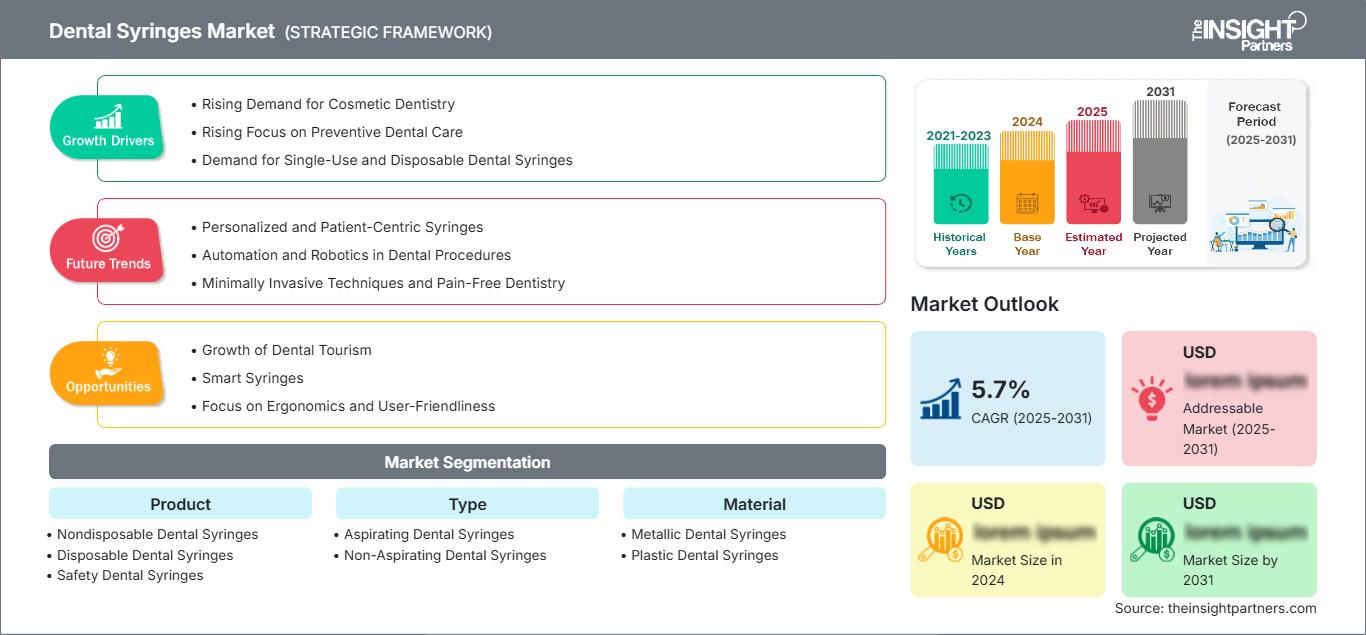
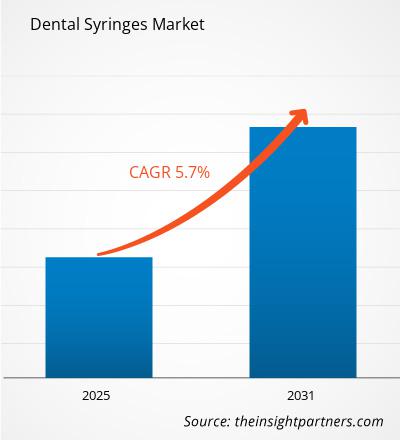
The Dental Syringes Market was valued at US$ 187.35 Million in 2025 and is projected to reach US$ 295.92 Million by 2034, registering a CAGR of 5.21% during 2026–2034. This market is made up of reusable as well as disposable delivery systems, aspirating and non-aspirating models, as well as metal and plastic constructions, and where buying decisions have become increasingly influenced by concerns around infection control, ergonomics, procedure accuracy, sterilization, and cost of ownership within dental care settings.
North America still retains structural significance as a market owing to the strong presence of dental care infrastructure, large number of procedures performed, and infection control practices in the region. The Dental Syringes Market Size in North America is forecasted to grow at a modeled CAGR of 4.6–5.1% between 2026–2034.
Dental Syringes Market Assessment and Insights
- North America: The region represented a 42–45% share in 2025 and is projected to grow at a CAGR of 4.6–5.1% between 2026–2034, supported by mature dental infrastructure, recurring replacement demand, infection-control requirements, and established distribution networks.
- US: The US accounted for 82–86% of North American demand in 2025, with growth of 4.5–5.0% CAGR between 2026–2034, reflecting high dental utilization and purchasing sophistication.
- Europe: Europe held a 24–27% share in 2025 and is forecast to grow at 4.4–4.9% CAGR between 2026–2034. Germany, the UK, France, Italy, and Spain remain important markets, with procurement increasingly emphasizing durability, sterilization efficiency, and documented device performance.
- Asia Pacific: Asia Pacific represented an estimated 18–21% share in 2025 and is expected to expand at 5.8–6.4% CAGR between 2026–2034. China, Japan, India, South Korea, and Australia provide the principal demand base as dental capacity and organized clinics expand.
- Largest Segment: Aspirating Dental Syringes held a modeled 59–63% market share in 2025 and are expected to register a 4.8–5.3% CAGR during 2026–2034, supported by procedural familiarity and aspiration-based injection protocols.
- High Growth Segment: Disposable Dental Syringes represented 16–20% market share in 2025 and are projected to grow at 6.0–6.6% CAGR during 2026–2034 as infection-control priorities strengthen.
- Key companies analyzed in detail: 4TEK S.R.L., A. Titan Instrument Inc., ACTEON, Delmaks Surgico, Dentsply Sirona Inc., Integra LifeSciences Corporation, Power Dental USA, Inc., Septodont, Vista Dental Products, and Ultradent Products, Inc.
Source: The Insight Partners' analysis based on proprietary research, government publications, company annual reports, investor presentations, industry databases, and expert interviews.
The market of dental syringes has progressed from being dominated by reusable metal tools into becoming a balanced portfolio made up of high-quality reusable products, disposables, and safety devices. Important aspects of production currently include corrosion resistance, cartridge compatibility, proper grip design, controlled plunger mechanism, and sterilizability. Plastic material is becoming significant in applications where lightweight and disposability become more important than durability of metal.
Future demand will most probably come from those regions where dental practice expands faster than the existing stock of instruments. In India, China, Southeast Asia, and some countries in the Middle East, there will be chances to supply the product through local distribution channels and produce cost-effective variants, whereas Europe and North America will present relatively stable replacement demand. Traceability, safety and sterilizability of the device will be among the key issues for regulation.
Dental Syringes Market Report Scope
| Report Attribute | Details |
|---|---|
| Market size in 2025 | US$ 187.35 Million |
| Market Size by 2034 | US$ 295.92 Million |
| Global CAGR (2026 - 2034) | 5.21% |
| Historical Data | 2021-2024 |
| Forecast period | 2026-2034 |
Dental Syringes Market Analysis
Growth drivers for the Dental Syringes Market include recurring use of local anesthetic procedures, restoration processes, endodontic work, and surgeries involving controlled delivery of substances. The value chain includes precision metal forming, polymers molding, cartridges interfaces, assembly process, sterilization process, packaging process, distributors, and dental practices. Infection control concerns also affect purchase decisions since reusable cartridge syringes have to be sterilized after each use, while disposable cartridge syringes need to be disposed of in a controlled manner. The CDC also gives instructions on how to sterilize dental cartridge syringes.
Supply dynamics differ depending on material used and type of the product. While metallic syringes rely on good-quality metal working, surface treatment, and corrosion protection, plastic syringes are reliant on medical grade polymers and their molding. Therefore, manufacturers have to carefully balance component sourcing locally and globally. Growing demand for small clinics, group practices, and institutional purchase leads to growing importance of standardized cartridges interface, good packaging, and supply chain management.
The Dental Syringes market Report reveals moderate fragmentation due to competition between specialist dental suppliers and diversified healthcare firms. Septodont is known for its focus on anesthetic delivery and ergonomic aspirating syringes, whereas Dentsply Sirona Inc. enjoys the benefit of having a diversified portfolio and distribution channels. On the other hand, competitors such as A. Titan Instrument Inc., Vista Dental Products, Power Dental USA, Inc., and 4TEK S.R.L. compete with their instrument portfolios, while ACTEON and Integra LifeSciences Corporation provide diversified clinical devices.
Positioning is now more based on portfolio strength, documentation, manufacturing capabilities, and channel reach rather than price only. For example, Dentsply Sirona disclosed its revenue projection in 2025 for equipment, instruments, critical dental solutions, implants, and CAD/CAM. It proves the importance of cross-portfolio relationships commercially. Other suppliers can use ergonomics, customization, regionalization, and cost-effective configuration as differentiation points. Thus, investment is more focused on manufacturing flexibility, quality management, inventory management, and product extension.
● REPORT CUSTOMIZATION
Tailor This Report To Align With Your Specific Business Requirements
This report can be customized to align precisely with your business objectives, scope, and target markets. Customization options include tailored segmentation, geography, competitive analysis, and strategic insights to support informed decision-making.
Customize This Report →WHAT YOU CAN ADJUST
- ● Segmentations
- ● Geography
- ● Competitive Analysis
- ● Language Preferences
Dental Syringes Market: Strategic Insights
Regional Insights
North America Dental Syringes Market
North America is responsible for a Dental Syringes Market Share of 42-45% in 2025 and is expected to expand at a CAGR of 4.6-5.1% until 2034. The United States is the primary consumer base with an established dental equipment base, private dental practitioners, dental service organizations, and higher usage rates of restorative and surgical procedures. Canada provides a stable demand base while procurement increasingly focuses on sterilization compatibility, ergonomics, and continuity of supply.
Replacement will continue to be important owing to the requirement of validation of cleaning and inspection and heat sterilization after each use in case of reusable devices. Both disposable and safety devices get a boost owing to the focus on infection control in clinics and desire to simplify turnaround times. The regional competition consists of companies like Septodont, A. Titan Instrument Inc., Dentsply Sirona Inc., Vista Dental Products, and Power Dental USA, Inc. Increasingly buyers prefer companies with quality system certification, reliable cartridge availability, and wide distributor network to support replacement-driven growth over new clinic construction-driven demand.
U.S. Dental Syringes Market
The US accounted for 82%-86% of North America's Dental Syringes Market Share requirement in 2025 and is projected to grow at 4.5%-5.0% CAGR until 2034. Dental Service Organizations, solo practices, hospitals, and speciality centers create regular demand in restorative dentistry, endodontics, oral surgery, and local anesthetic treatment. Product choice now also considers workflow efficiency and infection prevention.
Septodont, Dentsply Sirona Inc., Vista Dental Products, A. Titan Instrument Inc., Power Dental USA, Inc. and Integra LifeSciences Corporation are some companies which already have visibility in the market. The preference is towards products that ease handling, ease sterilization processes, or provide more control without reducing their compatibility with cartridges. According to the CDC guidelines, dental cartridge syringes must be disinfected and heat-sterilized between uses.
Europe Dental Syringes Market
Europe accounts for 24-27% in 2025 and is expected to report a CAGR of 4.4-4.9% during 2034. Countries in Europe with the highest market presence include Germany, the United Kingdom, France, Italy, and Spain. Purchase considerations are centered on device longevity, capability to be reprocessed, safety, and total cost throughout the device's lifecycle. Established dental devices ensure reliable repeat purchasing within clinics and hospitals.
The United Kingdom sustains its demands through organized dentistry and infection control measures. Germany is characterized by an extensive installed base along with its robust manufacturing capabilities in medical devices. In France, there are well-established dental supply chains as well as domestic experts whereas in Italy and Spain, there are private dental practices. There is increasing emphasis on documentation and sustainability in the selection of suppliers in Europe. Companies that offer material traceability, cleaning validation and packaging assurance stand a good chance at getting selected.
APAC Dental Syringes Market
In 2025, APAC has a 18–21% share and is projected to grow at a CAGR of 5.8–6.4% up to 2034, becoming the most rapidly growing large regional segment. Established demand is driven by China and Japan, while India and South Korea provide significant growth prospects. Australia makes the contribution of mature, regulation-driven consumption.
The development of industry, increased dental capacity among private practices, and the population's interest in oral health care foster adoption of the instruments. According to WHO, there are about 3.5 billion people worldwide suffering from oral diseases, pointing to the extent of unmet need in oral health treatment facilities. The most promising markets in terms of local distribution and efficient product design are India, China, and South Korea.
Middle East & Africa Dental Syringes Market
MEA & Africa instrument demand is expected to rise at a CAGR of 4.9-5.5% up until 2034. The leading consumers will be Saudi Arabia, the UAE, and South Africa, whereas other markets within MEA remain fragmented. The increase in dental tourism, growth of private clinics, and modernization of the healthcare infrastructure drive the consumption of standardized instruments.
Saudi Arabia and the UAE have strong investment in their healthcare infrastructure and specialized dentistry, but the most developed private dental network in the region belongs to South Africa. The MEA demand outside of the three countries mentioned depends on efficient distribution and currency situation in the region. The energy resources revenues may help in capital investments in the healthcare infrastructure development in the Gulf markets.
Segmentation Analysis
Product
Product segmentation in the Dental Syringes Market reflects the balance between reusable economics, infection-control priorities, and clinician preference. The segment is projected to grow at a 5.0–5.5% CAGR during 2026–2034. Nondisposable devices remain important where sterilization infrastructure is established, while disposable and safety formats gain relevance as practices prioritize simplified turnover and sharps management.
- Nondisposable Dental Syringes: Reusable instruments maintain a strong installed base because durable metallic construction supports repeated clinical use. Their position depends on sterilization infrastructure, maintenance practices, and lifecycle economics.
- Disposable Dental Syringes: Single-use configurations appeal to practices seeking simplified handling and reduced reprocessing requirements. Their strategic importance rises where infection-control workflows and high patient turnover make rapid instrument availability valuable.
- Safety Dental Syringes: Safety designs address occupational exposure concerns by incorporating mechanisms intended to reduce sharps-related risk. Adoption depends on usability, procedural compatibility, training requirements, and incremental procurement cost.
Type
Type segmentation is influenced by injection technique, clinician familiarity, and procedural requirements. The segment is forecast to expand at a 5.0–5.4% CAGR during 2026–2034. Aspirating designs retain broad adoption because they support established injection protocols, while non-aspirating alternatives can simplify routine procedures.
- Aspirating Dental Syringes: These devices remain central to local-anesthesia workflows because aspiration functionality supports clinician assessment before injection. Demand benefits from familiarity, established training practices, and broad cartridge compatibility.
- Non-Aspirating Dental Syringes: Non-aspirating configurations provide simpler mechanical operation for selected routine applications. Their strategic position depends on procedural suitability, clinician preference, ergonomic handling, and acceptance of alternative injection workflows.
Material
Material selection affects durability, weight, sterilization performance, cost, and environmental considerations. The segment is projected to advance at a 4.9–5.3% CAGR during 2026–2034. Metallic devices retain strong clinical relevance, while plastic construction benefits from lightweight designs and single-use applications.
- Metallic Dental Syringes: Metallic instruments retain a substantial installed base because stainless steel and aluminum support durability, precision machining, and repeated sterilization. They remain strategically important in high-utilization clinical environments.
- Plastic Dental Syringes: Plastic formats support lightweight construction and disposable workflows. Their adoption is influenced by polymer performance, molding consistency, packaging requirements, waste-management considerations, and demand for simplified infection-control procedures.
Opportunity Snapshot
| Product | Revenue Contribution (High/Medium/Low) | Trend Tag | Adoption Stage |
| Nondisposable Dental Syringes | High | Sterile Reuse | Mature |
| Disposable Dental Syringes | Medium | Single Use | Scaling |
| Safety Dental Syringes | Low | Sharps Control | Emerging |
Dental Syringes Market Growth Drivers and Impact Analysis
Expansion of Organized Dental Care Networks
The expansion of organized dental practices is changing purchasing behavior from fragmented, clinician-led buying toward standardized procurement. Dental service organizations and multi-site clinics can negotiate broader product contracts, establish preferred instrument specifications, and reduce variation across locations. This favors manufacturers capable of supplying consistent batches, documentation, training materials, and dependable replenishment. Emerging economies add another layer because new clinics often establish standardized instrument inventories rather than inheriting legacy devices. As networks expand, suppliers can gain share by integrating reusable syringes with sterilization protocols or pairing disposable formats with broader consumables programs. The impact is therefore not limited to unit growth. Standardization can increase average order sizes, strengthen distributor relationships, and reduce switching where clinicians become accustomed to a defined instrument platform.
Stronger Emphasis on Sharps Safety and Infection Prevention
Sharps safety is becoming a more explicit purchasing criterion as dental practices seek to reduce avoidable occupational exposure and improve compliance. CDC recommendations call for appropriate handling of used disposable syringes and needles, puncture-resistant disposal containers, and safe recapping practices when clinically necessary. These requirements create commercial space for safety-oriented syringe designs and packaging systems that support controlled disposal. The effect is strongest in larger clinics where standardized protocols can be implemented across multiple operators. Suppliers that combine intuitive safety features with minimal disruption to established injection technique can address a practical adoption barrier. Over time, documented safety performance, user training, and compatibility with existing cartridges may become more influential in purchasing decisions than basic acquisition price.
Growth of Procedure-Specific Dental Instrumentation
Increasing specialization within dentistry is creating demand for instruments tailored to specific procedures rather than universal configurations. Endodontics, oral surgery, pediatric dentistry, implantology, and restorative care can impose different requirements for grip, aspiration, needle positioning, cartridge compatibility, and delivery control. This encourages manufacturers to expand beyond standard barrel-and-plunger designs into differentiated configurations. Specialist suppliers can benefit because focused portfolios allow closer alignment with clinical workflows and practitioner preferences. Larger companies can address the same opportunity by combining syringes with anesthetic, endodontic, restorative, or surgical products. The resulting market impact is a broader product architecture in which ergonomics, procedure compatibility, and workflow integration support premium positioning. Product specialization also creates opportunities for distributors to build targeted assortments rather than relying on one universal instrument.
Dental Syringes Market Future Trends
Digital Traceability and Smarter Instrument Management
Future purchasing decisions in the Dental Syringes Market Trends are likely to incorporate more detailed instrument traceability, particularly in larger dental groups and institutional settings. Digital inventory platforms can connect product identifiers with sterilization cycles, maintenance records, replacement schedules, and procurement histories. Although a fully connected syringe remains a niche concept, surrounding workflow technologies can make conventional instruments more measurable and accountable. Suppliers may increasingly provide serialized packaging, digital instructions, and instrument-level documentation that integrates with practice-management systems. This could reduce inventory uncertainty and help clinics determine when reusable instruments should be replaced rather than maintained indefinitely. The commercial opportunity extends beyond the physical syringe because software-enabled tracking can create recurring service relationships, improve forecasting, and strengthen customer retention without materially changing the basic clinical mechanism.
Lower-Impact Materials and Packaging Architectures
Environmental considerations are likely to influence future product development through material selection, packaging reduction, and end-of-life planning. Reusable metallic syringes can support long service lives, while disposable formats face increasing pressure to minimize material intensity without compromising safety or performance. Manufacturers may therefore explore lower-weight polymers, recyclable packaging components, optimized blister formats, and more efficient shipping configurations. The challenge will be balancing environmental attributes with sterilization compatibility, shelf stability, mechanical strength, and regulatory requirements. Buyers are unlikely to accept sustainability claims that compromise clinical performance. Instead, procurement teams may favor products supported by measurable material reductions, packaging redesign, and documented lifecycle improvements. This trend could encourage suppliers to redesign entire product systems rather than simply substitute one material for another.
Dental Syringes Market Opportunities
Localized Manufacturing and Distribution in High-Growth Economies
Investment opportunities are emerging in countries where dental clinic capacity is expanding but specialized instrument supply remains dependent on imports. Local assembly, contract manufacturing, regional warehousing, and distributor partnerships can shorten lead times and improve price competitiveness without requiring complete vertical integration. India, China, Southeast Asia, and selected Gulf markets offer different combinations of manufacturing capability and clinical demand. Investors should prioritize facilities able to meet medical-device quality requirements while maintaining flexibility across metallic and polymer configurations. Regionalization can also reduce exposure to international freight disruptions and improve service for smaller practices that cannot maintain large inventories. The strongest models are likely to combine localized final assembly with globally validated components, allowing suppliers to preserve quality consistency while adapting packaging, product mix, and commercial channels to local requirements.
Specialized Safety Platforms for Large Dental Networks
Large dental networks represent an attractive target for suppliers developing differentiated safety syringe platforms because procurement decisions can be standardized across many locations. Investment should focus on products that improve sharps handling without creating substantial changes to established injection technique. A successful platform could combine ergonomic design, controlled safety activation, cartridge compatibility, clear visual indicators, and training support. Commercial models in the Dental Syringes Market Forecast could include multi-year supply agreements, centralized inventory programs, and clinician education rather than transactional instrument sales. Such strategies create opportunities to move from individual product purchasing toward account-level relationships. Suppliers should validate usability with multiple clinician groups before scaling because safety mechanisms that slow procedures or require excessive force may face resistance. The opportunity is therefore strongest where design engineering and implementation support are developed together.
Recent Developments
- February 2026: Dentsply Sirona Inc. reported fourth-quarter and full-year 2025 results and announced a 2026 restructuring initiative intended to redirect approximately US$120 million annually toward its Return-to-Growth Action Plan, including innovation, clinical education, and sales education focused on connected dentistry.
- November 2025: ACTEON updated technical and regulatory documentation for multiple dental device families, including new documentation for dental tips and instruments during 2025. The updates demonstrate continued emphasis on maintaining current device instructions and regulatory documentation across international markets.
- May 2024: Laboratorios Inibsa, a Spain-based dental solutions company associated with Septodont, launched the Prestoject dental syringe range. The stainless-steel syringe family was designed for 1.8 mL dental cartridges and metric-thread needles, with ergonomic construction and configurations supporting manual and self-aspiration techniques.
Frequently Asked Questions

- Comprehensive Market Sizing and Forecast Analysis
- Detailed Segmentation Analysis
- In-Depth Market Dynamics Assessment
- Regional and Country-Level Insights
- Competitive Landscape and Company Benchmarking
- Strategic Business Intelligence
Recent Reports
Testimonials

The Insight Partners' SCADA System Market report is comprehensive, with valuable insights on current trends and future forecasts. The team was highly professional, responsive, and supportive throughout. We are very satisfied and highly recommend their services.
RAN KEDEM Partner, Reali Technologies LTDs
I requested a report on a very specific software market and the team produced the report in a few days. The information was very relevant and well presented. I then requested some changes and additions to the report. The team was again very responsive and I got the final report in less than a week.
JEAN-HERVE JENN Chairman, Future Analytica
We worked with The Insight Partners for an important market study and forecast. They gave us clear insights into opportunities and risks, which helped shape our plans. Their research was easy to use and based on solid data. It helped us make smart, confident decisions. We highly recommend them.
PIYUSH NAGPAL Sr. Vice President, High Beam Global
The Insight Partners delivered insightful, well-structured market research with strong domain expertise. Their team was professional and responsive throughout. The user-friendly website made accessing industry reports seamless. We highly recommend them for reliable, high-quality research services
YUKIHIKO ADACHI CEO, Deep Blue, LLC.
This is the first time I have purchased a market report from The Insight Partners.While I was unsure at first, I visited their web site and felt more comfortable to take the risk and purchase a market report.I am completely satisfied with the quality of the report and customer service. I had several questions and comments with the initial report, but after a couple of dialogs over email with their analyst I believe I have a report that I can use as input to our strategic planning process.Thank you so much for taking the extra time and making this a positive experience.I will definitely recommend your service to others and you will be my first call when we need further market data.
JOHN SUZUKI President and Chief Executive Officer, Board Director, BK Technologies
I wish to appreciate your support and the professionalism you displayed in the course of attending to my request for information regarding to infectious disease IVD market in Nigeria. I appreciate your patience, your guidance, and the fact that you were willing to offer a discount, which eventually made it possible for us to close a deal. I look forward to engaging The Insight Partners in the future, all thanks to the impression you have created in me as a result of this first encounter.
DR CHIJIOKE ONYIA MANAGING DIRECTOR, PineCrest Healthcare Ltd.Reason to Buy
- Informed Decision-Making
- Understanding Market Dynamics
- Competitive Analysis
- Identifying Emerging Markets
- Customer Insights
- Market Forecasts
- Risk Mitigation
- Boosting Operational Efficiency
- Strategic Planning
- Investment Justification
- Tracking Industry Innovations
- Aligning with Regulatory Trends





 Get Free Sample for