
Depth Sensing Market Share, Demand & Growth by 2034
Coverage: by Component (Camera/Lens Module, Sensor, Illuminator); Type (Active, Passive); Technology (Stereo Vision, Structured Light, Time-of-Flight); Vertical (Automotive, Building Automation, Consumer Electronics, Industrial, Medical, Others) , and Geography (North America, Europe, Asia Pacific, and South and Central America)
- Status : Data Released
- Report Code : TIPRE00011659
- Category : Electronics and Semiconductor
- No. of Pages : 150
- Available Report Formats :


- Last update date : July 28, 2026


2025 Market Size
US$ 9.32 Bn
Base year value
2034 Forecast
US$ 15.56 Bn
Projected by 2034
CAGR 2026-2034
6.62 %
Growth rate
Addressable Market
US$ 117.16 Bn
(2026-2034)
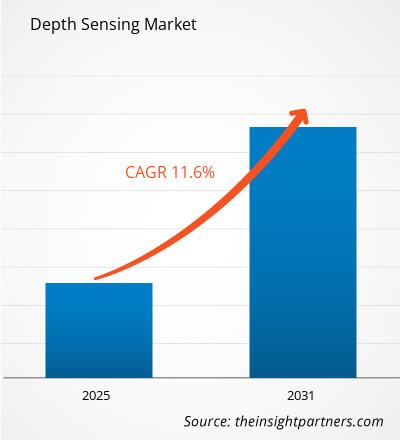
The Depth Sensing Market was valued at US$ 9.32 Billion in 2025 and is projected to reach US$ 15.56 Billion by 2034, registering a CAGR of 6.62% during 2026–2034. The market includes camera and lens modules, sensors, and illuminators used across active and passive systems based on stereo vision, structured light, and time-of-flight technologies.
North America Depth Sensing Market size is expected to expand at a CAGR of 5.9–6.7% during 2026–2034, supported by ADAS adoption, robotics pilots, and industrial automation investments. Regional buyers prioritize validated 3D perception, reliable component supply, and software integration for automotive interiors, smart buildings, machine vision, and medical imaging workflows.
Depth Sensing Market Assessment and Insights
- North America held 31–35% share in 2025 and is growing at a CAGR of 5.9–6.7% during 2026–2034, led by automotive safety, industrial robotics, and advanced consumer electronics integration.
- US represented 78–82% of North American revenue in 2025 and is growing at a CAGR of 6.0–6.8% during 2026–2034, supported by semiconductor design, ADAS programs, and automation demand.
- Europe accounted for 24–28% share in 2025 and is growing at a CAGR of 5.5–6.3% during 2026–2034, with Germany, the UK, France, Italy, and Spain leading automotive and industrial adoption.
- Asia Pacific held 29–33% of the Depth Sensing Market share in 2025 and is growing at a CAGR of 7.1–7.9% during 2026–2034, led by China, Japan, South Korea, India, and Taiwan electronics supply chains.
- Largest Segment Camera/Lens Module held 38–42% market share in 2025 and is growing at a CAGR of 5.8–6.6% during 2026–2034 due to module integration demand.
- High Growth Segment Time-of-Flight represented 30–34% market share in 2025 and is growing at a CAGR of 7.4–8.2% during 2026–2034, supported by compact 3D sensing designs.
- Key companies analyzed in detail: Creative Technology Ltd.; Infineon Technologies AG; Intel Corporation; LIPS Corporation; Melexis NV; Nerian Vision GmbH; pmdtechnologies ag; Sony Depthsensing Solutions SA/NV; Stereolabs Inc.; Texas Instruments Incorporated.
Source: The Insight Partners' analysis based on proprietary research, government publications, company annual reports, investor presentations, industry databases, and expert interviews.
Depth sensing has evolved from specialized 3D imaging technology to platform-based perception for vehicles, robots, smartphones, entry control devices, and industrial equipment. Trends in production are becoming more favorable for modular optical assemblies, VCSEL lighting, SPAD sensors, embedded microprocessors, and calibration software. The Depth Sensing Market is driven by trends in component miniaturization, better thermal design, higher sunlight immunity, and the need for reliable depth maps in indoor, outdoor, and mobile conditions.
Future growth will be determined by vehicle safety initiatives, automated logistics centers, healthcare patient monitoring, spatial computing, and building automation systems. Capital investments are forecast to favor component manufacturers that provide optics, sensors, illuminators, and software reference designs. Positive regulatory support with regard to in-cabin monitoring, functional safety standards, and privacy-preserving automation will drive adoption in developing regions with growing electronics and industrial automation markets.
Depth Sensing Market Report Scope
| Report Attribute | Details |
|---|---|
| Market size in 2025 | US$ 9.32 Billion |
| Market Size by 2034 | US$ 15.56 Billion |
| Global CAGR (2026 - 2034) | 6.62% |
| Historical Data | 2021-2024 |
| Forecast period | 2026-2034 |
Depth Sensing Market Analysis
Drivers of Depth Sensing Market include demands for accurate 3D perception in ADAS, autonomous mobile robots, facial recognition, gesture recognition, occupancy sensing, and medical guidance. Participants in this market ecosystem consist of companies manufacturing CMOS sensors, optical modules, suppliers of VCSEL and LED illumination systems, developers of algorithms, camera original equipment manufacturers, Tier 1 suppliers for the automotive industry, and integrators of industrial systems.
The supply conditions include wafer capacity, optics accuracy, eye safety, power usage, and software calibration. The time-of-flight method is gaining in popularity owing to the compact nature of its implementation as well as its real-time depth calculations, while the stereo vision method is still preferable due to its benefits for use with outdoor robotics. The structured light method is still relevant for uses indoors requiring short range accuracy, but is unaffected by sunlight.
The Depth Sensing Market report demonstrates the presence of two segments among key players – semiconductor companies and providers of 3D camera solutions. Infineon Technologies AG, Melexis NV, Sony Depthsensing Solutions SA/NV, and Texas Instruments Incorporated target development of sensing and illumination electronics, whereas LIPS Corporation, Stereolabs Inc., Nerian Vision GmbH, and Creative Technology Ltd. develop camera solutions.
The reasons for relevancy to Intel Corporation are their background in depth cameras and edge computing ecosystem while for pmdtechnologies ag it is their experience in time-of-flight technology available in their small modules. Areas of investment include automotive qualification, reduced cost of modules, AI-based depth reconstruction, and software development kits. The positioning factors are accurate depth detection, low latency, long distance, sun-resistant operation, privacy handling, and easy integration.
● REPORT CUSTOMIZATION
Tailor This Report To Align With Your Specific Business Requirements
This report can be customized to align precisely with your business objectives, scope, and target markets. Customization options include tailored segmentation, geography, competitive analysis, and strategic insights to support informed decision-making.
Customize This Report →WHAT YOU CAN ADJUST
- ● Segmentations
- ● Geography
- ● Competitive Analysis
- ● Language Preferences
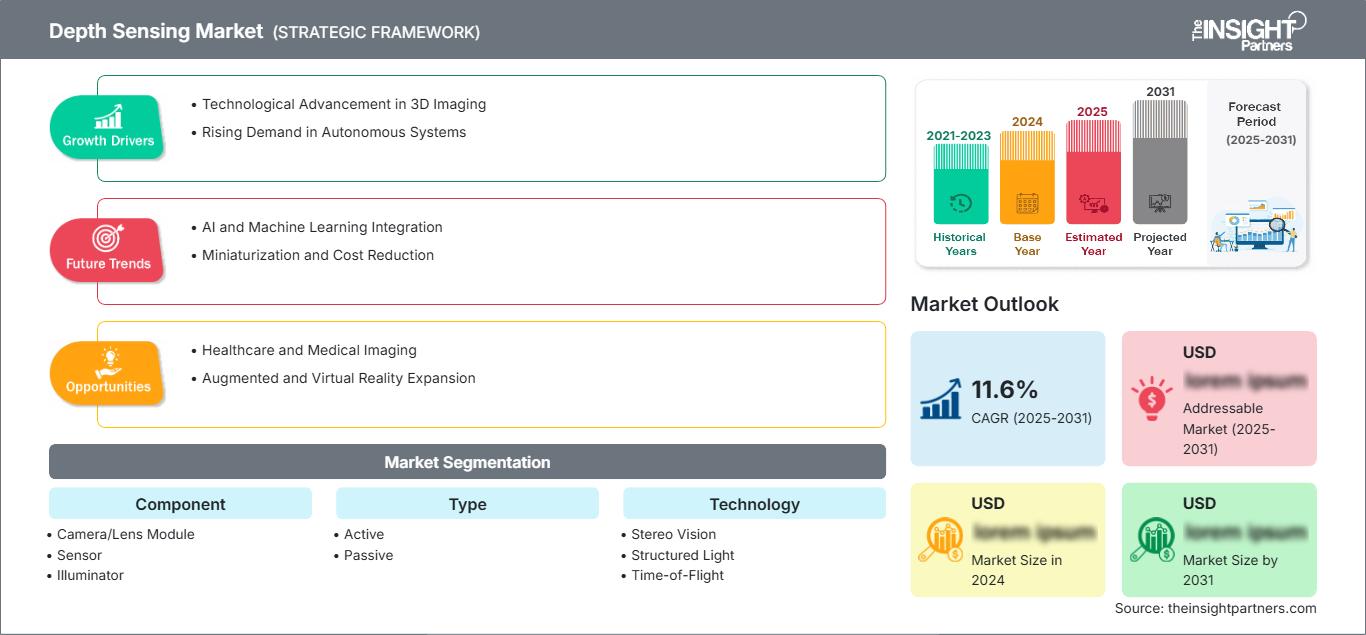
Depth Sensing Market: Strategic Insights
Regional Insights
North America Depth Sensing Market
North America accounted for 31–35% of market share in 2025 and is projected to grow at a CAGR of 5.9–6.7% during 2026–2034. Demand is supported by automotive safety electronics, warehouse automation, access control, medical devices, and building analytics.
The region benefits from semiconductor design depth, robotics investment, and early deployment of 3D cameras in industrial inspection. Buyers emphasize safety certification, data security, and integration support. The market adoption is strongest where perception accuracy reduces labor cost, improves machine autonomy, or enables regulatory compliance.
U.S. Depth Sensing Market
The U.S. represented 78–82% of North American revenue in 2025 and is expected to grow at a CAGR of 6.0–6.8% during 2026–2034. Application trends include in-cabin monitoring, robot navigation, AR peripherals, smart access, and high-throughput inspection.
Texas Instruments Incorporated, Intel Corporation, Stereolabs Inc., and specialist integrators support local design activity through reference platforms, processors, and camera ecosystems. The U.S. market favors time-of-flight and stereo vision where latency, software toolchains, and developer support influence deployment decisions.
Europe Depth Sensing Market
The Europe region has the share of 24-28% in 2025 and is expected to grow at the CAGR of 5.5-6.3% during 2026-2034. Germany has the lead due to the presence of automotive electronics, industrial automation, and machine vision sectors. The UK supports with robotics, medical devices, and building analytics applications.
France, Italy, and Spain also drive the market by providing adoption opportunities in smart infrastructure, traffic management, consumer electronics, and healthcare imaging segments. The European consumers prioritize privacy, safety certifications, and energy-efficient components. The market penetration increases with increased automotive regulations, industrial inspection, and robotics investment.
APAC Depth Sensing Market
The Asia Pacific region held the share of 29–33% in 2025 and is estimated to witness a growth rate of CAGR 7.1–7.9% between 2026 and 2034. China dominates this region by means of electronics assembly, robotics, and automotive applications, whereas Japan and South Korea add their contribution via sensors.
India, Taiwan, and Australia make a contribution to the demand due to automation, security, healthcare, and infrastructure monitoring applications. Domestic policy support for semiconductor ecosystem and smart manufacturing further boosts the depth camera penetration in this region, even though cost control still matters for end-user applications.
Middle East & Africa Depth Sensing Market
The Middle East & Africa market is projected to grow at a CAGR of 5.2–6.0% during 2026–2034. Saudi Arabia leads as smart city, energy, airport, and logistics projects require automated people counting, access control, and robotics perception.
The UAE supports adoption in airports, retail analytics, and data centers, while South Africa and Rest of MEA use 3D sensing for security, mining automation, and healthcare pilots. Harsh lighting conditions increase demand for robust ToF and stereo systems.
Segmentation Analysis
Component
Component is projected to grow at a CAGR of 6.1–6.9% during 2026–2034. The Depth Sensing Market scope covers camera/lens modules, sensors, and illuminators that together determine range, resolution, power efficiency, and eye-safety performance. Module-level integration is increasingly important because OEMs want faster qualification, smaller footprints, and predictable depth quality.
- Camera/Lens Module leads adoption where OEMs need calibrated optics, compact packaging, and dependable mechanical alignment for consumer, automotive, medical, and industrial 3D imaging designs.
- Sensor demand is tied to CMOS, SPAD, and ToF architectures that improve depth accuracy, dynamic range, latency, and operation in mixed lighting environments.
- Illuminator components remain strategically important because VCSEL and LED design affects power use, eye safety, range, thermal behavior, and outdoor performance.
Type
Type is forecast to grow at a CAGR of 6.0–6.8% during 2026–2034. Active sensing dominates controlled and short-to-mid-range applications because dedicated illumination improves repeatability. Passive sensing remains valuable in stereo cameras and outdoor systems where ambient-light operation, lower power, and simpler illumination hardware support cost-sensitive or long-duration deployments.
- Active systems use projected light to generate reliable depth maps, making them important for face authentication, gesture control, in-cabin monitoring, robotics, and medical navigation.
- Passive systems rely on scene texture and camera geometry, supporting outdoor robotics, surveillance, industrial inspection, and applications where illumination power or eye-safety limits matter.
Technology
Technology is expected to grow at a CAGR of 6.5–7.3% during 2026–2034. Time-of-flight is expanding because compact sensors provide real-time depth and easier mechanical design. Stereo vision remains important in robotics and industrial settings, while structured light continues to serve high-accuracy short-range applications.
- Stereo Vision supports robots, drones, industrial inspection, and outdoor systems where passive depth, wide field of view, and software flexibility are valued.
- Structured Light remains important for facial recognition, scanning, and controlled indoor measurement because projected patterns deliver high short-range accuracy and repeatable geometry.
- Time-of-Flight is strategically central for compact devices, in-cabin sensing, robots, and smart spaces because it provides direct distance measurement with low latency.
Vertical
Vertical is projected to grow at a CAGR of 6.3–7.1% during 2026–2034. Consumer electronics and automotive remain major demand pools, while industrial, medical, and building automation applications create resilient adoption. Buyers evaluate accuracy, latency, privacy, operating range, and integration effort before moving from pilot projects to volume deployment.
- Automotive uses depth sensing for ADAS, driver monitoring, occupant detection, parking support, gesture control, and future automated driving perception stacks.
- Building Automation applies 3D sensing to occupancy analytics, access control, elevator safety, energy optimization, and privacy-aware people counting.
- Consumer Electronics demand is tied to face authentication, AR, photography effects, hand tracking, gaming, and spatial interfaces in compact devices.
- Industrial adoption centers on robots, bin picking, quality inspection, pallet detection, and worker-safety systems that need dependable 3D perception.
- Medical applications include patient positioning, surgical navigation, rehabilitation monitoring, and contactless measurement where accuracy and safety validation are essential.
Opportunity Snapshot
| Vertical | Revenue Contribution | Trend Tag | Adoption Stage |
| Automotive | High | In-Cabin | Scaling |
| Building Automation | Medium | Occupancy Sensing | Scaling |
| Consumer Electronics | High | Spatial UX | Mature |
| Industrial | Medium | Robot Vision | Scaling |
| Medical | Medium | Patient Positioning | Emerging |
Depth Sensing Market Growth Drivers and Impact Analysis
Vehicle safety platforms require reliable 3D perception
Vehicles are integrating more camera, radar, and LiDAR systems to provide better driver assistance, occupant monitoring, and automatic parking functionality. Depth cameras will enable child presence sensing, smart airbags, gesture-based control, and object recognition both within and outside vehicles. The implications of this trend on the market are increased need for automotive-grade sensors, illuminators, and platforms that can operate reliably under all required environmental conditions.
Robotics and automation increase spatial intelligence needs
There is an increasing need for robotics in warehousing, manufacturing, laboratories, and service settings that have to sense objects, recognize obstacles, measure volume, and navigate around people. The need for depth sensing lies in offering machine-readable geometry information, which 2D cameras fail to offer on their own. This driver increases the need for stereo and time-of-flight cameras with robust enclosures, SDKs, and low-latency output. Companies that make calibrating easier and integrate edge AI will benefit from it.
Spatial computing and access control widen device integration
From consumer electronics to smart locks, kiosks, game consoles, and AR devices, more systems use depth data for authentication, hand tracking, scene analysis, and immersive UIs. The benefit is an expanded target market for miniature depth-sensing systems and low-power sensors. Market implications include a move to small camera/optics, eye-safe lighting sources, and embedded algorithms capable of performing accurately in different light conditions. Suppliers of components will have an advantage as reference designs reduce OEM time-to-market and user experience.
Depth Sensing Market Future Trends
Hybrid depth architectures improve robustness
Depth Sensing Market trends point toward hybrid architectures that combine time-of-flight, stereo vision, RGB imaging, and AI reconstruction. Future systems will use sensor fusion to reduce flying pixels, improve low-texture performance, and maintain stable depth outdoors. This trend will matter in robots, vehicles, drones, and smart buildings where a single sensing mode can fail under glare, motion, reflective surfaces, or complex backgrounds.
Software-defined calibration becomes a differentiator
From consumer electronics to smart locks, kiosks, game consoles, and AR devices, more systems use depth data for authentication, hand tracking, scene analysis, and immersive UIs. The benefit is an expanded target market for miniature depth-sensing systems and low-power sensors. Market implications include a move to small camera/optics, eye-safe lighting sources, and embedded algorithms capable of performing accurately in different light conditions. Suppliers of components will have an advantage as reference designs reduce OEM time-to-market and user experience.
Depth Sensing Market Opportunities
Automotive in-cabin sensing platforms
Depth Sensing Market Forecasts support investment in in-cabin sensing platforms that combine ToF sensors, VCSEL drivers, processors, and software for driver monitoring, child presence detection, occupant classification, and gesture interfaces. Suppliers can target OEMs and Tier 1 integrators with automotive-qualified reference designs, eye-safety documentation, and lifecycle support. The opportunity is attractive because safety ratings and comfort features are moving from premium models toward higher-volume vehicle platforms.
Industrial robot vision bundles
This gives rise to the opportunity for packaged depth cameras, SDKs, mounting devices, and application templates for bin picking, pallet recognition, inspection, and obstacle avoidance. The solution provider can minimize the deployment obstacles by providing pre-calibrated solutions and edge AI capabilities. The opportunity is action-oriented as the manufacturing companies want quicker deployments, predictability in performance, and productivity increases. The specialized camera companies have the opportunity to succeed in this domain through their robustness and software compatibility.
Recent Developments
- June 2026: RealSense is unveiling the RealSense D585 Pro, a new AI-native depth camera that combines advanced depth sensing, edge AI acceleration and a software-defined platform designed to improve over time through SDK-delivered capabilities. Powered by a proprietary Gen 5 system-on-chip (SoC), the D585 Pro delivers over 2x better depth quality than the previous generation of RealSense cameras and 2.5x better close-range performance than competing solutions, enabling more precise navigation, manipulation, inspection and human-robot interaction. With on-device AI processing, the camera delivers full depth and image processing pipeline, reducing reliance on host computing resources while opening the door to a new generation of intelligent robotic applications.
- August 2025: VoxelSensors, a company developing novel intelligent sensing and data insights technology for Physical AI, today announced a collaboration with Qualcomm Technologies, Inc. to jointly optimize VoxelSensors’ sensing technology with Snapdragon XR Platforms.
- March 2025: onsemi released the Hyperlux ID family, the industry’s first real-time, indirect time-of-flight (iToF) sensor that offers high precision long distance measurements and 3D imaging of fast-moving objects. By using onsemi’s new proprietary global shutter pixel architecture and on-board storage, the Hyperlux ID family can capture an entire scene and simultaneously process depth measurement in real-time. This innovative approach addresses the limitations of standard iToF sensors and enables depth sensing up to 30 meters or four times further than standard iToF sensors, all within a smaller form factor. Additionally, the sensor family is capable of producing both monochrome (black and white) images and depth information at the same time. By combining these two outputs, the sensor can provide a comprehensive view of the environment without requiring separate sensors for visual and depth data.
Frequently Asked Questions

- Comprehensive Market Sizing and Forecast Analysis
- Detailed Segmentation Analysis
- In-Depth Market Dynamics Assessment
- Regional and Country-Level Insights
- Competitive Landscape and Company Benchmarking
- Strategic Business Intelligence
Recent Reports
Testimonials

The Insight Partners' SCADA System Market report is comprehensive, with valuable insights on current trends and future forecasts. The team was highly professional, responsive, and supportive throughout. We are very satisfied and highly recommend their services.
RAN KEDEM Partner, Reali Technologies LTDs
I requested a report on a very specific software market and the team produced the report in a few days. The information was very relevant and well presented. I then requested some changes and additions to the report. The team was again very responsive and I got the final report in less than a week.
JEAN-HERVE JENN Chairman, Future Analytica
We worked with The Insight Partners for an important market study and forecast. They gave us clear insights into opportunities and risks, which helped shape our plans. Their research was easy to use and based on solid data. It helped us make smart, confident decisions. We highly recommend them.
PIYUSH NAGPAL Sr. Vice President, High Beam Global
The Insight Partners delivered insightful, well-structured market research with strong domain expertise. Their team was professional and responsive throughout. The user-friendly website made accessing industry reports seamless. We highly recommend them for reliable, high-quality research services
YUKIHIKO ADACHI CEO, Deep Blue, LLC.
This is the first time I have purchased a market report from The Insight Partners.While I was unsure at first, I visited their web site and felt more comfortable to take the risk and purchase a market report.I am completely satisfied with the quality of the report and customer service. I had several questions and comments with the initial report, but after a couple of dialogs over email with their analyst I believe I have a report that I can use as input to our strategic planning process.Thank you so much for taking the extra time and making this a positive experience.I will definitely recommend your service to others and you will be my first call when we need further market data.
JOHN SUZUKI President and Chief Executive Officer, Board Director, BK Technologies
I wish to appreciate your support and the professionalism you displayed in the course of attending to my request for information regarding to infectious disease IVD market in Nigeria. I appreciate your patience, your guidance, and the fact that you were willing to offer a discount, which eventually made it possible for us to close a deal. I look forward to engaging The Insight Partners in the future, all thanks to the impression you have created in me as a result of this first encounter.
DR CHIJIOKE ONYIA MANAGING DIRECTOR, PineCrest Healthcare Ltd.Reason to Buy
- Informed Decision-Making
- Understanding Market Dynamics
- Competitive Analysis
- Identifying Emerging Markets
- Customer Insights
- Market Forecasts
- Risk Mitigation
- Boosting Operational Efficiency
- Strategic Planning
- Investment Justification
- Tracking Industry Innovations
- Aligning with Regulatory Trends





 Get Free Sample for