
Die-cut Lids Market Size, Share & Forecast by 2034
Coverage: By Product Type (Embossed, Unembossed, Printed, Non-Printed); Material (PET, Aluminum, Paper); Application (Food and Beverages, Pharmaceuticals, Others) , and Geography (North America, Europe, Asia Pacific, and South and Central America)
- Status : Data Released
- Report Code : TIPRE00023883
- Category : Chemicals and Materials
- No. of Pages : 150
- Available Report Formats :


- Last update date : July 20, 2026


2025 Market Size
US$ 1.01 Bn
Base year value
2034 Forecast
US$ 1.87 Bn
Projected by 2034
CAGR 2026-2034
7.02 %
Growth rate
Addressable Market
US$ 12.96 Bn
(2026-2034)
The Die-Cut Lids Market size stood at US$ 1.01 Billion in 2025 and is forecasted to have a market valuation of US$ 1.87 Billion by 2034, growing at a CAGR of 7.02% between 2026 and 2034. The growth can be attributed to increasing use of single serving dairy products, meals, beverages, and sterile healthcare packages, which require peelable and tamper-proof high barrier seals.
In North America, the market will grow at a 6.4–7.4% CAGR owing to adoption of new lidding solutions for foodservice, yogurt, dessert, and nutraceutical manufacturers for line efficiency and seal integrity requirements. Increasing demand from FDA regulations for food contact materials, chilled chain distribution channels, and recycling aluminum and fiber lidding are some factors driving growth.
Die-cut Lids Market Assessment and Insights
- North America: Share in 2025 of 31–35% and CAGR between 6.4–7.4%. Food safety compliance, chilled dairy penetration, and advanced converting capacity support a resilient regional outlook.
- US: Share in 2025 of 78–82% of North America and CAGR between 6.5–7.5%. High single-serve dairy, coffee, and medical packaging volumes sustain demand.
- Europe: Share in 2025 of 27–31% and CAGR between 6.0–7.0%. Germany, France, the UK, Italy, and Spain lead adoption through dairy, convenience meals, and plastic-reduction regulation.
- Asia Pacific: Share in 2025 of 25–29% and CAGR between 7.8–8.8%. China, India, Japan, South Korea, and Australia benefit from expanding packaged food, beverage, and pharmaceutical manufacturing.
- Largest Segment: Food and Beverages application with market share of 82–86% in 2025 and CAGR of 6.8–7.6% during 2026–2034.
- High Growth Segment: Paper material with market share of 10–14% in 2025 and CAGR of 8.2–9.2% during 2026–2034, supported by recyclable and fiber-based formats.
- Key companies analyzed in detail: Amcor plc, Clondalkin Group Holdings B.V., Constantia Flexibles Group GmbH, Derschlag GmbH & Co. KG, ETIMARK AG, Formika Sp. z o.o., Quantum Packaging Ltd., Swan Packaging Ltd., Watershed Packaging Ltd., Winpak Ltd.
Source: The Insight Partners' analysis based on proprietary research, government publications, company annual reports, investor presentations, industry databases, and expert interviews.
Manufacturing process has progressed from simple foil sealing to advanced lid constructions suitable for fast-filling, oxygen barrier, peel control and graphics excellence. Manufacturers are fine-tuning aluminum thicknesses, PET films, paper substrates, coatings, embossing and print register to save material usage and ensure product integrity for dairy, desserts, sauces, beverages and medical products. Hence, the market will grow based on barrier science, regulatory needs and converting excellence.
Future demand for die-cut lids would come from Asia-Pacific, the Middle East, and selected Latin American regions due to increasing penetration in packaged foods and healthcare production. Investments would be made into low carbon emitting aluminum, sustainable paper-based lids, solvent free coating and digital technologies. The regulation against avoidable plastic packaging and the sustainability performance scorecard of retailers are likely to drive mono-material lid usage.
Die-cut Lids Market Report Scope
| Report Attribute | Details |
|---|---|
| Market size in 2025 | US$ 1.01 Billion |
| Market Size by 2034 | US$ 1.87 Billion |
| Global CAGR (2026 - 2034) | 7.02% |
| Historical Data | 2021-2024 |
| Forecast period | 2026-2034 |
Die-cut Lids Market Analysis
Market drivers include convenience, packaging, hygiene, product protection, and branding. Packaging of dairy cups, desserts in portions, ready-to-eat meals, sauces, coffee pods, nutraceuticals, and medical supplies needs lids that offer clean tearability along with consistent heat sealability properties. There is a growing demand for products that are easy to open, have tamper-proofing properties, and provide protection against freshness deterioration even when they travel longer distances.
Factors affecting the supply include availability of aluminum foil, price of PET films, quality of paperboards, coating technology, and speed of die cutting. High-speed packagers need dimensional stability and heat sealability on polypropylene, PET, glass, and coated paper packs. Value chain partners include substrate providers, converters, coating specialists, equipment manufacturers, brands, and contract packagers.
The Die-Cut Lids market analysis reveals competition among flexible packaging companies with food and medical certifications. Among those are Amcor plc, Constantia Flexibles Group GmbH, Winpak Ltd., and Clondalkin Group Holdings B.V. These companies compete based on barrier functionality, sustainability, printing quality, and access to multinational customers. Specialty converters including Formika Sp. z o.o. and Quantum Packaging Ltd. provide geographic proximity.
Investment trends include recyclability, cleanroom facilities, down-gauging, fast customization options, and automated testing. Derschlag GmbH & Co. KG, ETIMARK AG, Swan Packaging Ltd., Watershed Packaging Ltd., and other similar converters have an opportunity to cater to flexible brands. The strategic advantage is increasingly defined by pack validation, a lower the carbon footprint, and the complexity of materials.
● REPORT CUSTOMIZATION
Tailor This Report To Align With Your Specific Business Requirements
This report can be customized to align precisely with your business objectives, scope, and target markets. Customization options include tailored segmentation, geography, competitive analysis, and strategic insights to support informed decision-making.
Customize This Report →WHAT YOU CAN ADJUST
- ● Segmentations
- ● Geography
- ● Competitive Analysis
- ● Language Preferences
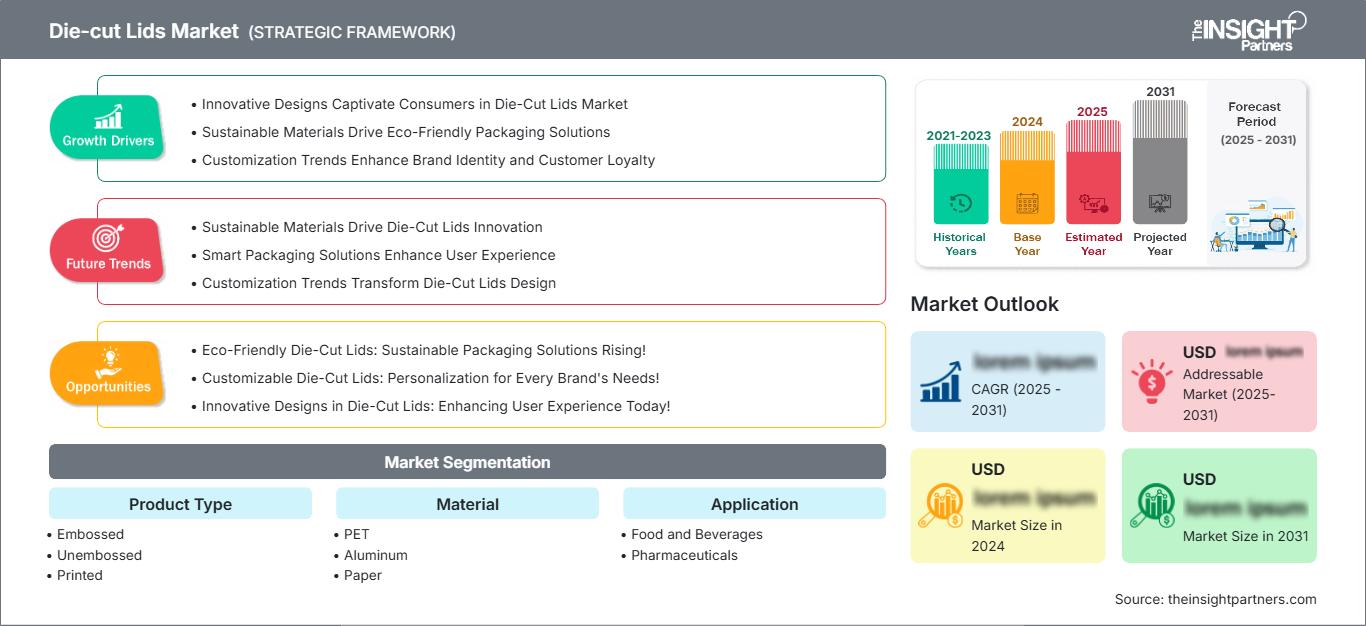
Die-cut Lids Market: Strategic Insights
Regional Insights
North America Die-Cut Lids Market
North America had 31–35% market share in 2025 and is anticipated to have a 6.4–7.4% CAGR between 2025 and 2034. North America’s Die-Cut Lids Market share is driven by dairy processors, chilled desserts, ready-to-drink drinks, and healthcare packagers that need reliable sealers. Converting competencies and food-contact compliance systems support the certification process for suppliers. Increasing demands for good peel properties, leakage prevention, and quality print on the lids have been observed among retailers and food packers. Aluminum continues to be a preferred material for barrier applications, while paper and PET are gaining significance due to their recyclable nature and reduced packaging weight. Single-serving, multiple packs, and nutraceutical/diagnostic packaging needs drive market demand.
U.S. Die-Cut Lids Market Market
The US accounted for 78-82% of North American revenues in 2025 and is forecasted to experience a 6.5-7.5% CAGR. The main drivers of demand include yogurt, portion desserts, coffee and beverage cups, sauces, meal trays, and medical packaging. Brand owners value the ability to use lids that can preserve product’s freshness, withstand transportation process, and ensure high-quality graphics. Amcor plc and Winpak Ltd. have remained significant players in North America owing to their product lines of flexible packaging for food and healthcare industry. In the USA, increasing automation of filling facilities results in greater importance of proper lid curl, accurate cut and seal window. Pharmaceutical and diagnostic packaging brings an additional quality-oriented revenue source to the market.
Europe Die-Cut Lids Market Market
Europe accounted for 27–31% of global revenues in 2025 and is projected to grow at a CAGR of 6.0–7.0%. Germany is the dominant market owing to dairy processing volume, packaging machines technology, and adoption of lower carbon aluminum and plastics reduction packaging. The UK enjoys the advantage of chilled meals and own-label dairy products, whereas France has strong demand for desserts and food packaging. Italy and Spain play their roles through yogurt, confectionery, sauces, and export-oriented food processing. Companies such as Constantia Flexibles Group GmbH, Clondalkin Group Holdings B.V., Derschlag GmbH & Co. KG, ETIMARK AG, and Formika Sp. z o.o. add supply chain diversity to the region. EU packaging waste regulations and sustainability policies of retailers are speeding up recyclable, down-gauged, and paper lids innovations.
APAC Die-Cut Lids Market Market
Asia Pacific contributed 25–29% to global revenues in 2025 and is expected to grow at a CAGR of 7.8–8.8%, thereby becoming the fastest growing region. China dominates in the production of packaged dairy, beverages, and pharmaceuticals, whereas India benefits from its developing urban retail sector and increased consumption of chilled products. Japan and South Korea focus on providing quality print lidding, portion packs, and quality convenience food products. Australia continues to play an important role due to dairy, coffee, and ready meal product lines. The industrial policy for food processing, healthcare, and local packaging is promoting investment in speed die cut and barrier constructions.
Middle East & Africa Die-Cut Lids Market Market
Middle East & Africa is forecasted to see 6.3-7.3% CAGR until 2034. Saudi Arabia is driving regional growth by increasing demand in dairy, beverages, and food service segments amid economic diversification efforts. UAE will drive demand in hospitality, airline catering, and imported chilled foods applications that require lidding. Packaged dairy, sauces, and pharmaceuticals will be the main South African drivers, with the rest of the region driven by urban retail infrastructure investments. The energy-intensive aluminum-based production processes make weight reduction and low-carbon aluminum source essential. Regional food manufacturing investments and import substitution will eventually drive technical lids demand in the region.
Segmentation Analysis
Product Type
The Product Type segment is expected to grow at a 6.7–7.5% CAGR during 2026–2034. The Die-Cut Lids Market scope spans functional and decorative formats, with embossed and printed variants supporting brand visibility while unembossed and non-printed lids serve cost-sensitive, high-volume applications. Selection depends on sealing substrate, shelf-life needs, run length, and pack positioning.
- Embossed: Embossed lids improve tactile feel, stacking behavior, and premium appearance, especially in dairy desserts and portioned foods where visual differentiation supports brand recognition and perceived quality.
- Unembossed: Unembossed lids remain important for high-speed, cost-efficient production, offering reliable sealing and simple decoration where pack functionality and price discipline outweigh premium texture requirements.
- Printed: Printed lids carry branding, product information, promotional graphics, and traceability codes, making them strategically valuable for chilled shelves, multipacks, quick-service beverages, and private-label differentiation.
- Non-Printed: Non-printed lids serve institutional, pharmaceutical, bulk, and secondary-pack applications where identification is managed elsewhere and clean appearance, hygiene, and sealing performance are the primary requirements.
Material
The Material segment is projected to expand at a 7.0–7.8% CAGR through 2034. Material choice balances barrier protection, recyclability, stiffness, heat-seal compatibility, printability, and cost. Aluminum dominates demanding oxygen and light-barrier applications, PET supports transparent or flexible structures, and paper is gaining momentum where brands pursue fiber-forward packaging strategies.
- PET: PET lids provide good clarity, dimensional stability, and compatibility with selected cup and tray structures, supporting beverages, desserts, and healthcare packs that need flexible performance.
- Aluminum: Aluminum remains the leading material for barrier-sensitive products because it protects against oxygen, moisture, aroma loss, and light while supporting reliable heat sealing and premium printing.
- Paper: Paper-based lids are gaining strategic attention as brands reduce plastic content, test recyclable structures, and align packaging portfolios with retailer and regulatory sustainability expectations.
Application
The Application segment is forecast to grow at a 6.9–7.7% CAGR during 2026–2034. Food and beverages account for the largest use base because portion cups, tubs, and trays need convenient opening and shelf-life protection. Pharmaceuticals provide a smaller but technically demanding field where clean manufacturing, seal validation, and contamination control are decisive.
- Food and Beverages: Food and beverage users rely on lids for yogurt, cheese, desserts, sauces, coffee, juices, and ready meals, making seal integrity central to quality and distribution.
- Pharmaceuticals: Pharmaceutical applications require controlled production, validated peel strength, and sterile-barrier reliability, creating opportunities for suppliers with healthcare-grade materials and documentation capabilities.
Opportunity Snapshot
| Segment Name | Revenue Contribution | Trend Tag | Adoption Stage |
| Food and Beverages | High | Portion Packs | Mature |
| Pharmaceuticals | Medium | Sterile Seals | Scaling |
Die-cut Lids Market Growth Drivers and Impact Analysis
Expansion of Single-Serve Food and Beverage Packaging
Consumption in single portions is increasing demand for packs that require good peeling, no spills, and beautiful decorations, such as portion cups, beverages, desserts, sauces, and meal trays. The market receives a positive boost due to the usage of such packs by means of correctly cut lids that provide consistent sealing in high speed lines. Lidding in food processing provides protection, reduces the risk of contamination, and increases shelf presentation. The effect can be seen in the growth of demand for printed aluminum, PET, and paper lids for branding purposes.
Regulatory Focus on Food Safety and Pack Integrity
As a result of food safety and healthcare packaging regulations, brand owners are requiring increased levels of documentation, seal-strength validation, and traceability of input materials. Increasing regulatory requirements set by organizations like the US FDA and food-contact regulations in Europe underscore the importance of seals that protect products from leaks, contamination, oxygen exposure, and microbial exposure. This factor supports converters who can provide production facilities with clean production environments, constant coating weight, and accurate die cutting. The market effect will be a longer selection process of suppliers but higher loyalty of selected suppliers.
Shift Toward Recyclable and Lower-Carbon Lidding Materials
Sustainability requirements are changing purchasing decisions as retailers, food companies, and healthcare brands reduce packaging weight and improve recyclability. Aluminum downgauging, low-carbon foil, recyclable PET combinations, solvent-free coatings, and paper-based lids are becoming practical routes to lower environmental impact. The market gains from this transition because lidding is highly visible to consumers and often targeted in packaging redesign programs. The commercial impact is twofold: converters can charge for technical development, while customers can reduce material use without redesigning the full container. Suppliers that prove performance parity and regulatory compliance are best positioned.
Die-cut Lids Market Future Trends
Low-Carbon Aluminum and Fiber-Based Substitution
Emerging Die-Cut Lids Market trends point toward broader use of low-carbon aluminum, downgauged foil, recyclable coatings, and fiber-based structures. Future product launches will likely focus on reducing plastic snap-on components, lowering foil thickness, and maintaining easy-peel performance. This trend will be shaped by retailer packaging scorecards, extended producer responsibility costs, and consumer preference for visible sustainability improvements. Converters will need to validate machinability across existing filling lines, because brand owners prefer sustainability upgrades that avoid capital-intensive equipment changes. Successful suppliers will combine materials expertise with lifecycle data, enabling customers to document emissions reductions and recyclability claims while preserving shelf life, tamper evidence, and pack appearance.
Digital Decoration, Traceability, and Short-Run Customization
Digital printing and workflow automation are expected to reshape how brands use lidding as a communication surface. Shorter product cycles, promotional packs, multilingual labeling, and QR-enabled traceability will increase demand for flexible print setups with tight color control. The market will benefit as lids become carriers of branding, authentication, recycling instructions, and consumer engagement content. This shift will require converters to integrate artwork management, inspection systems, variable data printing, and faster changeovers. Food and pharmaceutical customers will favor partners that can manage compliance-sensitive information while delivering smaller batch sizes without sacrificing cost efficiency, seal performance, or delivery reliability.
Die-cut Lids Market Opportunities
Healthcare-Grade Lids for Diagnostics and Sterile Consumables
Healthcare packaging offers an attractive opportunity because diagnostics, procedure kits, medical trays, and pharmaceutical containers require validated peelability, sterility assurance, and documented material control. Investment aligned with long-term Die-Cut Lids Market Forecasts should prioritize clean manufacturing, coated paper and Tyvek-compatible structures, and technical service for regulatory submissions. Suppliers can differentiate by offering test data on seal strength, microbial barrier performance, and compatibility with sterilization methods. This opportunity is less price-sensitive than commodity food lidding, but qualification requirements are demanding. Converters that build healthcare-specific quality systems can deepen customer relationships and diversify revenue beyond cyclical foodservice demand.
Localized Supply for Emerging Food Processing Hubs
Emerging food processing hubs in India, Southeast Asia, the Gulf, and parts of Africa create opportunities for regional converting capacity. Local dairy, beverage, and ready-meal producers increasingly need shorter lead times, smaller minimum orders, and application-specific technical support. The Die-Cut Lids Market can capture this demand through partnerships with cup suppliers, filling-line integrators, and packaging distributors. Investment should focus on scalable die-cutting equipment, quality laboratories, and substrate sourcing flexibility. Suppliers that localize production can reduce freight exposure, improve responsiveness, and support customers shifting from imported packaged foods to domestic manufacturing. This approach also helps align with government industrialization and food-security priorities.
Recent Developments
- January 2026: Constantia Flexibles won two WorldStar Awards for its ComforLid aluminum lidding solution in “Packaging Materials and Components” and “Non-Alcoholic Beverages.” These awards, from the World Packaging Organisation, acknowledge innovative packaging. This recognition comes after the Green Packaging Star Award, emphasizing the company's advancements in recyclability, resource efficiency, and carbon footprint reduction.
- August 2025: Constantia Flexibles, the third-largest global producer of flexible packaging, enters FACHPACK 2025 after significant strategic investments and technological advancements. The recent acquisition of Aluflexpack bolsters its presence in high-value market segments like food and pharmaceuticals, enhancing both technological capabilities and regional production capacity.
Frequently Asked Questions

- Comprehensive Market Sizing and Forecast Analysis
- Detailed Segmentation Analysis
- In-Depth Market Dynamics Assessment
- Regional and Country-Level Insights
- Competitive Landscape and Company Benchmarking
- Strategic Business Intelligence
Recent Reports
Testimonials

The Insight Partners' SCADA System Market report is comprehensive, with valuable insights on current trends and future forecasts. The team was highly professional, responsive, and supportive throughout. We are very satisfied and highly recommend their services.
RAN KEDEM Partner, Reali Technologies LTDs
I requested a report on a very specific software market and the team produced the report in a few days. The information was very relevant and well presented. I then requested some changes and additions to the report. The team was again very responsive and I got the final report in less than a week.
JEAN-HERVE JENN Chairman, Future Analytica
We worked with The Insight Partners for an important market study and forecast. They gave us clear insights into opportunities and risks, which helped shape our plans. Their research was easy to use and based on solid data. It helped us make smart, confident decisions. We highly recommend them.
PIYUSH NAGPAL Sr. Vice President, High Beam Global
The Insight Partners delivered insightful, well-structured market research with strong domain expertise. Their team was professional and responsive throughout. The user-friendly website made accessing industry reports seamless. We highly recommend them for reliable, high-quality research services
YUKIHIKO ADACHI CEO, Deep Blue, LLC.
This is the first time I have purchased a market report from The Insight Partners.While I was unsure at first, I visited their web site and felt more comfortable to take the risk and purchase a market report.I am completely satisfied with the quality of the report and customer service. I had several questions and comments with the initial report, but after a couple of dialogs over email with their analyst I believe I have a report that I can use as input to our strategic planning process.Thank you so much for taking the extra time and making this a positive experience.I will definitely recommend your service to others and you will be my first call when we need further market data.
JOHN SUZUKI President and Chief Executive Officer, Board Director, BK Technologies
I wish to appreciate your support and the professionalism you displayed in the course of attending to my request for information regarding to infectious disease IVD market in Nigeria. I appreciate your patience, your guidance, and the fact that you were willing to offer a discount, which eventually made it possible for us to close a deal. I look forward to engaging The Insight Partners in the future, all thanks to the impression you have created in me as a result of this first encounter.
DR CHIJIOKE ONYIA MANAGING DIRECTOR, PineCrest Healthcare Ltd.Reason to Buy
- Informed Decision-Making
- Understanding Market Dynamics
- Competitive Analysis
- Identifying Emerging Markets
- Customer Insights
- Market Forecasts
- Risk Mitigation
- Boosting Operational Efficiency
- Strategic Planning
- Investment Justification
- Tracking Industry Innovations
- Aligning with Regulatory Trends





 Get Free Sample for