
Diffuse Mode Sensors Market Share, Growth & Demand by 2034
Coverage: By Type (Diffused With Background Suppression, Diffused With Foreground Suppression, Diffused With Background Evaluation, Others); Application (Contrast Sensors, Luminescence Sensors, Color Sensors, Others) , and Geography (North America, Europe, Asia Pacific, and South and Central America)
- Status : Data Released
- Report Code : TIPRE00026573
- Category : Electronics and Semiconductor
- No. of Pages : 150
- Available Report Formats :


- Last update date : August 06, 2026


2025 Market Size
US$ 2.77 Bn
Base year value
2034 Forecast
US$ 5.69 Bn
Projected by 2034
CAGR 2026-2034
8.33 %
Growth rate
Addressable Market
US$ 37.99 Bn
(2026-2034)
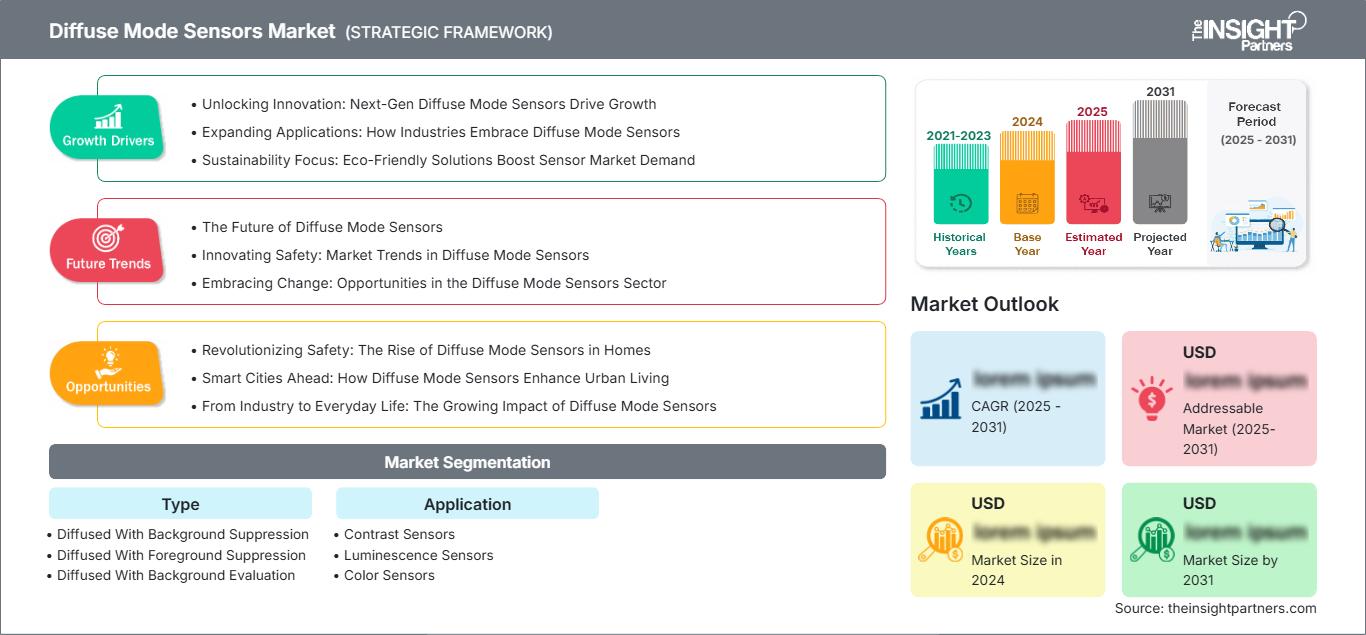
The Diffuse Mode Sensors market was valued at US$ 2.77 billion in 2025 and is expected to reach US$ 5.69 billion by 2034; it is estimated to record a CAGR of 8.33% during 2026-2034.
Diffuse Mode Sensors Market Assessment and Insights
- North America accounted for 30–33% share in 2025 and is growing at a CAGR range of 8.6–9.1% during 2026–2034, led by automated logistics, food processing, automotive assembly, and safety-driven sensing upgrades.
- US represented 72–76% of North America in 2025 and is growing at a CAGR range of 8.7–9.2% during 2026–2034, driven by robotics, conveyors, and smart factory retrofits.
- Europe held 25–28% share in 2025 and is growing at a CAGR range of 8.2–8.8% during 2026–2034, with Germany, the UK, France, Italy, and Spain leading adoption.
- Asia Pacific captured 32–35% share in 2025 and is growing at a CAGR range of 10.1–10.8% during 2026–2034, supported by China, Japan, South Korea, India, and Australia.
- Largest Segment Diffused With Background Suppression held 45–49% market share in 2025 and is growing at a CAGR range of 9.4–9.9% during 2026–2034.
- High Growth Segment Color Sensors held 22–25% market share in 2025 and is growing at a CAGR range of 10.4–11.1% during 2026–2034.
- Key companies analyzed in detail: Senasys, Pepperl+Fuchs SE, Hans Turck GmbH & Co. KG, MISUMI Group Inc., TRI-TRONICS Company, Inc., Shenzhen Dokai Technology Co., Ltd., Shenzhen Bo Chuangxin Electric Co., Ltd., Autonics Corporation, SMC Corporation, SAI TECH CONTROLS.
Source: The Insight Partners' analysis based on proprietary research, government publications, company annual reports, investor presentations, industry databases, and expert interviews.
Sensor designs are evolving away from basic diffuse reflective sensors towards more advanced sensor designs such as suppression and evaluation methods that eliminate false triggering due to shiny backgrounds, black surfaces, or unpredictable geometry of objects. Moreover, production trends are shifting in accordance with the buyer's preferences towards miniature sensors, rapid response rate, IP protection, and digital diagnostics. According to Pepperl+Fuchs, there are three kinds of diffuse sensing: background suppression, foreground suppression, and background evaluation.
Forward demand is anticipated to be driven by China, India, Southeast Asia, Mexico, and Eastern Europe as companies will invest in local automation equipment and upgrading the conveyor sensing systems in warehouses. Machine safety and traceability requirements have indirect positive influence on the market as the detection method eliminates mechanical wear and increases the repeatability of measurements.
Diffuse Mode Sensors Market Report Scope
| Report Attribute | Details |
|---|---|
| Market size in 2025 | US$ 2.77 Billion |
| Market Size by 2034 | US$ 5.69 Billion |
| Global CAGR (2026 - 2034) | 8.33% |
| Historical Data | 2021-2024 |
| Forecast period | 2026-2034 |
Diffuse Mode Sensors Market Analysis
The Diffuse Mode Sensors market growth will be driven by the need for sensing where the use of reflector or receiver cannot take place. Packaging lines, automated guided conveyor systems, and electronics assembly cells need sensors which will be capable of detecting different colors, textures, and object contours. Growth in demand will also be fueled by increasing industrial automation density, where the number of sensing points per line will increase to verify presence, count, position, and avoid jams.
Market supply dynamics will be based on the availability of optics, emitter performance, package size reduction, and electronic integration. Market vendors will differentiate themselves in terms of background suppression, teach-in capability, fast switch times, IO-Link communications, and tough sealing. Value chain consists of LED and photodiode suppliers, ASIC suppliers, housing suppliers, sensor manufacturers, distributors, and system integrators.
Competitive intensity is moderate to high due to the fact that there are both automation brands and sensor companies that apply in the same fields. In the Diffuse Mode Sensors Market, companies such as Pepperl+Fuchs SE, Hans Turck GmbH & Co. KG, Autonics Corporation, SMC Corporation, MISUMI Group Inc., and TRI-TRONICS Company, Inc. are competing on reliability of sensors, wide catalogs, applicability, and distribution across the regions.
Funding is being moved away from low cost products and towards sensors that can be configured, are small in size, and have diagnostics features. Companies such as Senasys, Shenzhen Dokai Technology Co., Ltd., Shenzhen Bo Chuangxin Electric Co., Ltd., and SAI TECH CONTROLS focus on price-sensitive and customized sensors. Large companies focus more on integration into the platform. Strategic positioning becomes more focused on servicing machine builders with ready-to-use sensors, quick deliveries, and support on the application level.
● REPORT CUSTOMIZATION
Tailor This Report To Align With Your Specific Business Requirements
This report can be customized to align precisely with your business objectives, scope, and target markets. Customization options include tailored segmentation, geography, competitive analysis, and strategic insights to support informed decision-making.
Customize This Report →WHAT YOU CAN ADJUST
- ● Segmentations
- ● Geography
- ● Competitive Analysis
- ● Language Preferences
Diffuse Mode Sensors Market: Strategic Insights
Regional Insights
North America Diffuse Mode Sensors Market
In 2025, North America held 30-33% of the Diffuse Mode Sensors Market share and is projected to experience a CAGR growth rate of 8.6-9.1% during 2026 to 2034. The acceptance is backed by automated warehouses, food & beverages packaging, automotive manufacturing facilities, and pharmaceuticals manufacturing lines requiring sensors that function under reflective films, labels, cartons, and diverse materials.
Higher investments in conveyor system upgrades and machine vision related sensing applications are driving the market demand. The area is also aided by the presence of an established network of distributors and robust installed base of PLC-based automation. Background Suppression is favored when there is a requirement for reliable detection around metallic structures, glossy packages, and different colored products without additional reflector devices.
U.S. Diffuse Mode Sensors Market
U.S. constituted 72-76% of North American region in 2025 and estimated to witness a CAGR of 8.7%-9.2% from 2026 to 2034. The largest growth in terms of applications is expected from e-commerce logistics, automotive assembly plants, packaging machinery and semiconductors automation applications where repetitive detection prevents downtime and increase throughput.
The presence of companies is widespread and includes Pepperl+Fuchs SE, Hans Turck GmbH & Co. KG, Autonics Corporation, TRI-TRONICS Company, Inc. and SMC Corporation among OEMs, integrators and maintenance organizations. The demand will be growing for sensors which can be taught-in, have IP rated enclosure and have communication capabilities to standardize the spares across multiple production lines.
Europe Diffuse Mode Sensors Market
Europe had a market share of 25–28% in 2025 and is projected to increase with a CAGR of 8.2–8.8% in 2026-2034. Germany dominates regional demand owing to its advanced machinery, automotive automation, and electronics equipment manufacturing. UK drives the market by offering solutions for packaging, logistics, and food processing improvements, and maintenance-driven retrofit helps maintain consistent replacement demand.
The other key European countries include France, Italy, and Spain through their industrial machinery, pharmaceutical packaging, beverage lines, and intralogistics improvement. In Europe, machine purchasing decisions usually revolve around reliability, safety, and proven performance in tough production environments. This is an area where companies having application engineering and local distribution capabilities are preferred.
APAC Diffuse Mode Sensors Market
APAC accounted for 32–35% share in 2025 and is forecast to grow at a CAGR range of 10.1–10.8% through 2034. China is the leading country, supported by electronics, packaging, battery production, and high-volume factory automation. Japan and South Korea add demand from precision manufacturing and robotics.
India and Australia are scaling adoption through food processing, logistics, mining support systems, and broader factory modernization. Policy support for manufacturing localization and export competitiveness strengthens sensor deployment. Cost-effective models are gaining traction, but premium background suppression remains important in electronics and automotive lines.
Middle East & Africa Diffuse Mode Sensors Market
Middle East & Africa is projected to grow at a CAGR range of 7.4–8.1% during 2026–2034, with Saudi Arabia leading regional investment. Energy, utilities, packaging, airport logistics, and infrastructure-linked automation create opportunities for durable non-contact sensors that can operate in dusty or high-temperature environments.
The UAE contributes through logistics hubs, food processing, and smart infrastructure, while South Africa supports demand in mining, packaging, and manufacturing maintenance. Rest of MEA adoption remains project-led, but sensor retrofits are expanding where operators seek safer material handling and lower unplanned downtime.
Segmentation Analysis
Type
The Type segment is expected to grow at a CAGR range of 9.1–9.7% during 2026–2034. Diffuse Mode Sensors Market scope by type is shaped by target reflectivity, background distance, mounting constraints, and tolerance for false switching. Buyers increasingly select suppression or evaluation designs to stabilize detection without adding separate receivers.
- Diffused With Background Suppression remains the dominant type because it detects dark or reflective targets near complex backgrounds, making it strategically important for packaging, electronics, and automated handling lines.
- Diffused With Foreground Suppression serves applications where objects close to the sensor must be ignored, supporting controlled detection windows in conveyors, bins, and constrained machine spaces.
- Diffused With Background Evaluation is relevant where target shapes are irregular and the sensor monitors background visibility, helping operators detect object presence even when reflections are inconsistent.
Application
The Application segment is projected to grow at a CAGR range of 9.6–10.2% during 2026–2034. Adoption is expanding as factories combine diffuse detection with color, contrast, and luminescence functions for product verification. Growth is strongest where inspection and positioning requirements rise faster than machine footprints.
- Contrast Sensors support mark detection, label positioning, and print registration, making them important for packaging lines that require repeatable switching at high conveyor speeds.
- Luminescence Sensors are used where invisible marks, adhesives, or fluorescent materials must be verified, supporting quality control in packaging, pharmaceuticals, and specialty manufacturing.
- Color Sensors are becoming more strategic as manufacturers require shade, component, or product variant recognition within automated sorting, assembly, and inspection workflows.
Opportunity Snapshot
| Application | Revenue Contribution | Trend Tag | Adoption Stage |
| Contrast Sensors | High | Print Marks | Mature |
| Luminescence Sensors | Medium | UV Verification | Scaling |
| Color Sensors | Medium | Variant Sorting | Scaling |
Diffuse Mode Sensors Market Growth Drivers and Impact Analysis
Automation Density in Packaging and Logistics
Packaging and logistics lines are adding more sensing points per meter of conveyor to reduce jams, verify cartons, and maintain traceability. Diffuse sensors are favored because they can detect objects without reflectors, reducing installation time on dense equipment layouts. In high-speed fulfillment, missed detection can stop sorters or misroute parcels, so operators value fast response and stable switching. The impact is visible in broader adoption of compact background suppression models, especially where mixed packaging colors and glossy surfaces create detection uncertainty. This driver increases replacement sales and new-build demand simultaneously.
Shift Toward Flexible Manufacturing Cells
Manufacturers are reconfiguring production cells to handle shorter runs, more product variants, and faster changeovers. Diffuse mode sensing fits this shift because sensors can be repositioned or taught to new targets with limited mechanical changes. Background suppression improves repeatability when parts differ in color or reflectivity, which is critical in electronics, automotive components, and consumer goods assembly. The commercial impact is a move away from basic low-cost presence sensors toward configurable models with diagnostics, teach-in settings, and rugged housings. Suppliers that support application tuning are gaining advantage.
Rising Need for Non-Contact Quality Control
Quality systems increasingly rely on non-contact sensing to avoid product damage, mechanical wear, and contamination. Diffuse sensors support verification of labels, caps, parts, trays, and packages before downstream operations proceed. This matters in pharmaceuticals and food processing where line stoppages, rejected batches, or mislabeling can create compliance and cost risks. The impact is stronger adoption of contrast, color, and luminescence-enabled sensing around inspection stations. As plants integrate sensor signals into PLCs and monitoring systems, suppliers with stable optics and communication-ready products can capture higher-value opportunities.
Diffuse Mode Sensors Market Future Trends
Sensor Intelligence Moving to the Edge
Diffuse Mode Sensors Market trends are moving toward embedded intelligence, where sensors process signal quality, contamination status, and switching stability before data reaches controllers. This reduces commissioning time and helps maintenance teams identify marginal detection before failures occur. Over the forecast period, more devices are expected to combine IO-Link diagnostics, self-adjustment, and simplified parameter cloning. These features will be valuable in global plants that run similar equipment across multiple countries. Edge intelligence should also help vendors defend margins by shifting value from hardware alone to application reliability.
Miniaturization for Dense Machine Designs
Machine builders are designing smaller equipment footprints, especially in electronics assembly, packaging modules, and laboratory automation. This will increase demand for ultra-compact diffuse sensors with narrow beams, short response times, and robust mounting options. Miniaturization is not only about size; it also requires thermal stability, noise resistance, and cable or connector flexibility. Suppliers able to maintain performance in smaller housings will be better positioned with OEMs. The trend should accelerate as factories pursue higher output from limited floor space.
Diffuse Mode Sensors Market Opportunities
Localized Automation in Emerging Manufacturing Hubs
Diffuse Mode Sensors Market Forecasts point to stronger opportunity in India, Vietnam, Mexico, and Eastern Europe as manufacturers diversify production and automate mid-tier factories. Suppliers can capture this demand by offering modular product ranges, local distribution, and application support for packaging, automotive parts, and electronics. Price sensitivity remains important, but downtime costs are pushing buyers toward reliable background suppression and diagnostics. Companies that combine competitive pricing with fast availability and training for integrators can convert first-time automation users into repeat customers across multiple production lines.
Application-Specific Sensor Bundles for OEMs
Machine builders increasingly prefer pre-qualified sensor bundles that reduce engineering time and simplify global procurement. Vendors can create opportunity by packaging diffuse sensors with brackets, connectors, IO-Link masters, and commissioning guidance for conveyors, labeling machines, filling lines, and robotic cells. This approach improves design repeatability and reduces qualification risk for OEMs selling equipment internationally. It also allows suppliers to move from component selling to solution-based accounts. The most attractive opportunities will be with OEMs that standardize platforms across several end-user industries.
Recent Developments
- July 2026: Autonics launched the BTS and BTF compact photoelectric sensor series for precision object detection in industrial automation applications. The sensors support through-beam, diffuse reflection, and background suppression modes, detecting objects as small as 0.1 mm. Featuring slim designs, IP67 protection, and interference-resistant operation, the sensors enable reliable inspection, quality control, and component detection in space-constrained environments.
- May 2025: Wenglor introduced the P1PH9 diffuse reflection sensor featuring time-of-flight technology and visible red LED light for reliable object detection over distances up to 2,500 mm. The sensor provides enhanced detection of various shapes, colors, and surfaces, including dark objects, while offering high resistance to ambient light, reflections, and contamination for packaging and industrial automation applications.
- November 2024: L-com introduced a new line of diffuse reflection photoelectric proximity sensors designed for industrial automation, robotics, manufacturing, automotive, and food processing applications. The sensors provide reliable object detection using light-based technology, feature IP67 protection, multiple detection ranges, flexible output options, and rugged construction to support demanding industrial environments and IoT-enabled automation systems.
Frequently Asked Questions

- Comprehensive Market Sizing and Forecast Analysis
- Detailed Segmentation Analysis
- In-Depth Market Dynamics Assessment
- Regional and Country-Level Insights
- Competitive Landscape and Company Benchmarking
- Strategic Business Intelligence
Recent Reports
Testimonials

The Insight Partners provided valuable market intelligence that supported our global go-to-market strategy. Their team was professional, responsive, and attentive to our feedback, providing thoughtful analysis and helpful methodological clarifications throughout the project.
Junmo Kim Chief Financial Officer (CFO), Enertech Co., Ltd.
The Insight Partners' SCADA System Market report is comprehensive, with valuable insights on current trends and future forecasts. The team was highly professional, responsive, and supportive throughout. We are very satisfied and highly recommend their services.
RAN KEDEM Partner, Reali Technologies LTDs
I requested a report on a very specific software market and the team produced the report in a few days. The information was very relevant and well presented. I then requested some changes and additions to the report. The team was again very responsive and I got the final report in less than a week.
JEAN-HERVE JENN Chairman, Future Analytica
We worked with The Insight Partners for an important market study and forecast. They gave us clear insights into opportunities and risks, which helped shape our plans. Their research was easy to use and based on solid data. It helped us make smart, confident decisions. We highly recommend them.
PIYUSH NAGPAL Sr. Vice President, High Beam Global
The Insight Partners delivered insightful, well-structured market research with strong domain expertise. Their team was professional and responsive throughout. The user-friendly website made accessing industry reports seamless. We highly recommend them for reliable, high-quality research services
YUKIHIKO ADACHI CEO, Deep Blue, LLC.
This is the first time I have purchased a market report from The Insight Partners.While I was unsure at first, I visited their web site and felt more comfortable to take the risk and purchase a market report.I am completely satisfied with the quality of the report and customer service. I had several questions and comments with the initial report, but after a couple of dialogs over email with their analyst I believe I have a report that I can use as input to our strategic planning process.Thank you so much for taking the extra time and making this a positive experience.I will definitely recommend your service to others and you will be my first call when we need further market data.
JOHN SUZUKI President and Chief Executive Officer, Board Director, BK Technologies
I wish to appreciate your support and the professionalism you displayed in the course of attending to my request for information regarding to infectious disease IVD market in Nigeria. I appreciate your patience, your guidance, and the fact that you were willing to offer a discount, which eventually made it possible for us to close a deal. I look forward to engaging The Insight Partners in the future, all thanks to the impression you have created in me as a result of this first encounter.
DR CHIJIOKE ONYIA MANAGING DIRECTOR, PineCrest Healthcare Ltd.Reason to Buy
- Informed Decision-Making
- Understanding Market Dynamics
- Competitive Analysis
- Identifying Emerging Markets
- Customer Insights
- Market Forecasts
- Risk Mitigation
- Boosting Operational Efficiency
- Strategic Planning
- Investment Justification
- Tracking Industry Innovations
- Aligning with Regulatory Trends





 Get Free Sample for