
Digital Neurotherapeutics Market Growth, Trends & Forecast by 2034
Digital Neurotherapeutics Market Size and Forecasts (2021–2034), Global and Regional Share, Trends, and Growth Opportunity Analysis Report Coverage : by Component (Software, Hardware, Services); Indication (Alzheimer
- Status : Data Released
- Report Code : TIPRE00040626
- Category : Life Sciences
- No. of Pages : 150
- Available Report Formats :


- Last update date : July 03, 2026


2025 Market Size
US$ 3.01 Bn
Base year value
2034 Forecast
US$ 16.61 Bn
Projected by 2034
CAGR 2026-2034
20.9 %
Growth rate
Addressable Market
US$ 78.68 Bn
(2026-2034)
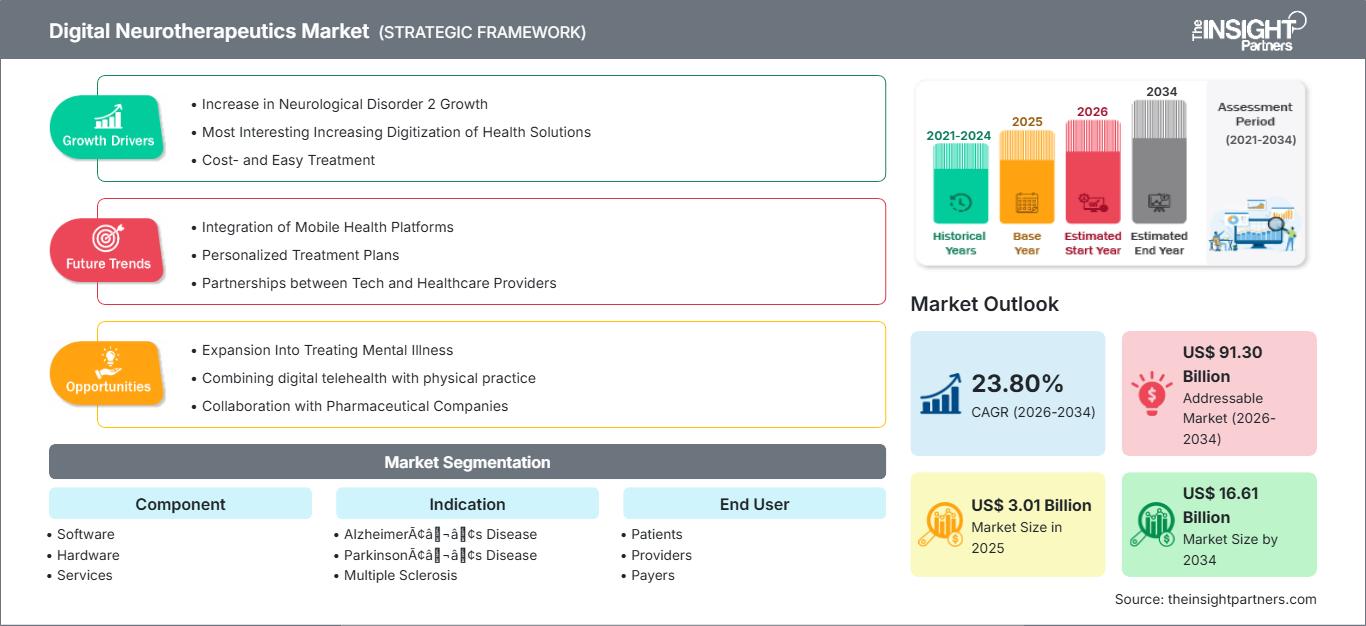
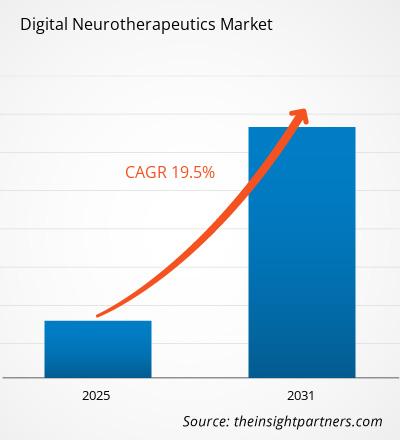
The Digital Neurotherapeutics market was valued at US$ 3.01 billion in 2025 and is expected to reach US$ 16.61 billion by 2034; it is estimated to record a CAGR of 20.9% during 2026-2034.
Digital Neurotherapeutics Market Assessment and Insights
- North America: North America accounted for 39–43% of the digital neurotherapeutics market share in 2025 and is anticipated to expand at a CAGR of 22.5%–24.5% during 2026–2034. Favorable reimbursement expansion, advanced digital healthcare infrastructure, and the rising prevalence of neurological disorders continue to strengthen the region’s market leadership.
- U.S.: The U.S. represented 84–88% of the North American market in 2025 and is projected to register a CAGR of 22.8%–24.8% during 2026–2034, supported by broader reimbursement coverage, increasing adoption of digital therapeutics, and growing demand for innovative neurological disease management solutions.
- Europe: Europe held 27–31% market share in 2025 and is expected to grow at a CAGR of 22.0%–24.0% during 2026–2034. The United Kingdom, Germany, and France remain the leading regional markets due to digital healthcare modernization, growing neurological research initiatives, and increasing adoption of software-based therapeutic interventions.
- Asia Pacific: Asia Pacific accounted for 21–25% share in 2025 and is forecast to expand at a CAGR of 25.0%–27.0% during 2026–2034. China, Japan, and India continue to drive regional growth through healthcare digitalization, expanding patient populations, and increasing investments in digital medicine infrastructure.
- Largest Segment: Component – Software represented the largest market segment and is expected to record a CAGR of 24.0%–26.0% during 2026–2034, reflecting the scalability of digital therapeutic platforms, cloud-based deployment, and continuous software updates that enable personalized neurological care.
- High Growth Segment: Component – Services is projected to grow at a CAGR of 26.0%–28.0% during 2026–2034, driven by increasing demand for implementation support, remote patient management, clinical integration, and digital therapeutic monitoring services.
- Key companies analyzed in detail: Akili Interactive Labs, Inc.; AdvancedMD, Inc.; AppliedVR, Inc.; Big Health Ltd.; Blackrock Neurotech; Cognivive, Inc.; Neofect Co., Ltd.; Omada Health, Inc.; Neurotech International Limited; and MindMaze SA.
Source: The Insight Partners' analysis based on proprietary research, government publications, company annual reports, investor presentations, industry databases, and expert interviews.
The digital neurotherapeutics report discusses how the shift is being made from the brain training apps that promote wellness to digital interventions backed by scientific research and aimed at rehabilitating the patients cognitively, motorically, behaviorally, and neurologically. These platforms use neuropsychology, adaptive software, connectivity, and supervision of the healthcare providers in order to provide therapy without having to go through the clinic while ensuring the results can be measured.
This market will be driven by the coming together of digital therapeutics, neurorehabilitation, remote patient monitoring, and payer-driven value-based care. Factors such as clinical evidence, ease of use, payment issues, and integration with neurologists, rehabilitation clinics, and behavioral health companies will determine the success of adoption of this technology. These include companies such as Akili Inc., AppliedVR Inc., BigHealth, Blackrock Neurotech, Mindmaze, Omada Health Inc., Neofect Co. Ltd, and Cognivive Inc.
Digital Neurotherapeutics Market Report Scope
| Report Attribute | Details |
|---|---|
| Market size in 2025 | US$ 3.01 Billion |
| Market Size by 2034 | US$ 16.61 Billion |
| Global CAGR (2026 - 2034) | 20.9% |
| Historical Data | 2021-2024 |
| Forecast period | 2026-2034 |
Digital Neurotherapeutics Market Analysis
Demand for digital neurotherapeutics is driven by three major factors. First, there is an increase in neurological disease prevalence rates. Second, there is a lack of specialized personnel to manage all cases of such diseases. And third, there is a need to provide cheaper management of patients' chronic care. Digital technologies allow increasing the intensity of therapy treatment outside the clinic and gathering necessary behavioral or functional data. These factors continue to support the expansion of the digital neurotherapeutics market size across diverse care environments.
Software developers, device manufacturers, clinical research partners, neurologists, rehabilitation providers, payers, and patient engagement tools make up the ecosystem of the market. Hardware enhances the value proposition in areas that involve motion capture, brain-computer interface technologies, wearable devices, and VR headsets in the delivery of treatments, whereas services help with onboarding, monitoring, and integration into the providers' workflows.
Market competition among prescription digital therapies, immersive therapies, neurotechnologies, chronic disease care platforms, and rehabilitation organizations is fragmented. For example, Akili Inc. has improved the prominence of game-based cognitive treatments, while AppliedVR Inc. has progressed the field of immersive therapies. Mindmaze is linked with digitally supported neurorehabilitation solutions, and Blackrock Neurotech is positioned at the more technology-focused end of the spectrum. BigHealth and Omada Health Inc. illustrate how platforms can be scaled via payer and employer routes.
Strategic priorities have moved towards demonstrating clinical efficacy, ease of reimbursement, artificial intelligence-driven personalization, and patient retention. Being competitive now means more than offering an application for consumers; evidence of neurological improvement needs to be offered, along with safety measures, data privacy practices, and care team adoption. Partnerships with care providers, insurance companies, pharma organizations, and rehabilitation networks will be critical to which platforms are successfully scaled within neurological practice.
● REPORT CUSTOMIZATION
Tailor This Report To Align With Your Specific Business Requirements
This report can be customized to align precisely with your business objectives, scope, and target markets. Customization options include tailored segmentation, geography, competitive analysis, and strategic insights to support informed decision-making.
Customize This Report →WHAT YOU CAN ADJUST
- ● Segmentations
- ● Geography
- ● Competitive Analysis
- ● Language Preferences
Digital Neurotherapeutics Market: Strategic Insights
Regional Insights
North America Digital Neurotherapeutics Market
North America is expected to lead the Digital Neurotherapeutics Market, expanding at an estimated CAGR of 22%–24%. Growth is supported by advanced digital health infrastructure, strong clinical trial activity, and growing willingness among payers to evaluate non-drug neurological interventions. The region also benefits from experienced regulatory pathways for software-based medical products.
High disease prevalence, scarcity of specialists, corporate interests in cognitive wellness, and increased adoption of telemedicine approaches constitute some of the structural factors. Companies that have had commercial experience in the U.S. market are employing clinical validation, digital engagement, and payor pilots to drive scalable adoption. Adoption is highest where digital technologies address gaps in accessing therapies outside the hospital setting.
U.S. Digital Neurotherapeutics Market
The U.S. Digital Neurotherapeutics Market is projected to record a CAGR of approximately 23%–25% and account for about 80%–85% of North American revenue. The positive digital neurotherapeutics market forecast is supported by FDA-authorized digital therapeutic precedents, strong venture capital participation, payer experimentation, and healthcare systems seeking scalable solutions for neurological rehabilitation and cognitive support.
The companies' operations are varied, with contributions from Akili Inc., AppliedVR Inc., AdvancedMD Inc., Omada Health Inc., Blackrock Neurotech, and Neurotherapeutic Pediatric Therapies Inc. Some of the applications include cognitive training, neurobehavioral treatment for pain, stroke recovery treatment, support for Parkinson's disease, pediatric therapy processes, and remote monitoring for neurological disorders.
Europe Digital Neurotherapeutics Market
Europe holds an estimated 23%–27% share of the Digital Neurotherapeutics Market and is likely to grow at a CAGR of 21%–23%. Germany is the leading country, supported by structured digital health reimbursement pathways and strong rehabilitation capacity. Regional demand is shaped by aging populations, neurodegenerative disease management, and public healthcare interest in cost-efficient therapy extension.
Advantages in the UK market are associated with the use of digital health assessments, providers' interest in remote rehabilitation, and the reduction of waiting lists for neurological services. The current digital neurotherapeutics market trends in Europe are characterized by greater uptake in settings that complement the NHS-provided health care processes, offering at-home therapy and functional improvements.
The leading European country is Germany, driven by payers' interest in digital therapeutics and an advanced medtech landscape. France, Italy, and Spain are moving forward with their innovation projects in hospitals, rehabilitation centers, and neurological diseases, but slow reimbursement hampers their progress.
APAC Digital Neurotherapeutics Market
APAC is the fastest-growing region in the Digital Neurotherapeutics Market, with an estimated CAGR of 25%–27% and a global share range of 18%–22%. China is the leading country, driven by digital hospital expansion, large neurological patient pools, and policy support for technology-enabled healthcare. Japan and South Korea add demand through aging demographics and strong device ecosystems.
China's size enables the rapid adoption of digitization efforts, whereas Japan focuses on continuity of rehabilitation for older patients. South Korea's technological skills in the use of connected devices help develop immersive and sensor-based therapeutic approaches. In India, digitization is growing owing to the development of telemedicine, the lack of specialists, and affordable digital healthcare.
In Australia, the areas of contribution are in digital health policies, the need for remote care, and neurological rehabilitation for dispersed communities. The industrial contributors are mobile-first health solutions, medical device manufacturing, and artificial intelligence-based analytics. The APAC region needs more policy-driven approaches in aging care, chronic diseases, and digital public health systems to transition from experimental to structured adoption.
Middle East & Africa Digital Neurotherapeutics Market
The Middle East & Africa Digital Neurotherapeutics Market is projected to grow at a CAGR of 18%–20%, with the UAE emerging as the leading country due to digital health investment and advanced private healthcare infrastructure. Saudi Arabia is also expanding opportunity through healthcare transformation programs and hospital modernization.
Gulf countries with energy-rich economies have invested in connected hospitals, cloud-based health services, and specialized care facilities, thus providing a conducive environment for the adoption of digital neurotherapy technology. Infrastructural changes enable remote rehabilitation, neurological assessment, and chronic care. Adoption will begin from premium hospitals rather than through a payer-led adoption process.
In South Africa and the rest of the MEA region, adoption will be slow and characterized by challenges related to access to facilities, uneven distribution of specialists, and the need for scalable neurology treatment. Technology could help overcome the challenges of rehabilitation in areas where facilities are scarce.
Segmentation Analysis
Component
- Software: Software leads adoption by delivering adaptive cognitive training, neurorehabilitation workflows, symptom tracking, engagement analytics, and clinician dashboards that can scale across patients without heavy facility-based infrastructure.
- Hardware: Hardware supports immersive and sensor-enabled therapy through VR headsets, wearables, motion trackers, and neurotechnology devices, particularly where motor recovery, feedback loops, or physiological measurement are essential.
- Services: Services include onboarding, clinical support, training, monitoring, and integration assistance, helping providers deploy digital neurotherapeutics safely while improving adherence, workflow fit, and payer reporting.
Indication
- Alzheimer’s Disease: Digital tools support cognitive stimulation, behavioral monitoring, caregiver engagement, and adherence routines, offering structured assistance where pharmacological options remain limited and long-term management needs are complex.
- Parkinson’s Disease: Parkinson’s applications focus on movement training, gait support, symptom logging, medication adherence, and home-based rehabilitation, helping clinicians track functional changes between appointments.
- Multiple Sclerosis: Multiple sclerosis solutions address fatigue management, cognitive support, mobility exercises, and patient-reported monitoring, enabling personalized care adjustments during fluctuating disease activity.
- Epilepsy: Epilepsy-focused digital platforms emphasize seizure tracking, trigger identification, medication adherence, and remote care coordination, improving visibility into episodic events that are difficult to capture clinically.
End User
- Patients: Patients represent the central adoption group as home-based neurotherapeutics improve therapy access, engagement, self-management, and continuity for chronic neurological conditions requiring frequent interaction.
- Providers: Providers use digital neurotherapeutics to extend rehabilitation capacity, monitor progress remotely, personalize therapy intensity, and manage neurological care pathways with richer functional data.
- Payers: Payers evaluate digital neurotherapeutics for potential cost reduction, reduced avoidable visits, improved adherence, and measurable outcomes that align with value-based neurological care strategies.
Opportunity Snapshot
| End User | Revenue Contribution | Trend Tag | Adoption Stage |
| Patients | High | Home Therapy | Scaling |
| Providers | High | Clinical Workflow | Scaling |
| Payers | Medium | Value Care | Emerging |
| Other End ) Users | Low | Care Support | Emerging |
Digital Neurotherapeutics Market Growth Drivers and Impact Analysis
Neurological Disease Burden Driving Scalable Therapy Models
The increase in the incidence of Alzheimer's disease, Parkinson's disease, multiple sclerosis, epilepsy, and post-acute brain injury is putting consistent strain on care systems driven by specialists. Existing therapy frameworks typically require frequent clinic appointments, limited rehab opportunities, and caregiver availability, limiting the intensity of the therapy that can be provided. The benefit of digital neurotherapeutics in this case is to expand the scope of intervention beyond the hospital setting to include repetitive practice, symptom monitoring, and adjustments based on feedback, without requiring all patient interactions to occur in a hospital. The practical outcome of this is an expanded care funnel, wherein patients are supported more often, providers have longitudinal data, and payers have insight into whether digital therapies are preventing unnecessary utilization.
Clinical Validation and Reimbursement Pathways Improving Adoption
Digital neurotherapeutics are gaining credibility as companies invest in randomized studies, regulatory submissions, real-world evidence, and payer-facing outcomes data. Neurology and rehabilitation buyers increasingly require proof that software or connected devices can influence measurable endpoints such as attention, mobility, symptom control, pain interference, or treatment adherence. As evidence deepens, provider confidence improves and payer conversations become more practical. The market impact is a shift from pilot-heavy experimentation toward structured procurement and reimbursement evaluation. This does not remove commercialization risk, but it changes the basis of competition: clinically validated products with workflow integration and measurable economic value are better positioned than engagement-only apps. Companies that can translate clinical evidence into reimbursement narratives will have stronger access to health systems, employers, and specialty care networks.
AI Personalization Enhancing Neurotherapy Precision
AI-enabled personalization is becoming a critical driver because neurological symptoms vary widely by disease stage, patient behavior, medication status, and functional capacity. Adaptive algorithms can adjust therapy difficulty, recommend engagement schedules, detect adherence risks, and highlight clinical changes for care teams. In neurorehabilitation, AI-supported feedback can help patients repeat targeted movements or cognitive tasks at the right intensity, while providers monitor progress remotely. The impact is improved treatment relevance and stronger long-term engagement, both of which are essential for chronic neurological care. For companies, AI also creates differentiation through proprietary datasets, predictive models, and outcome optimization. However, adoption will depend on explainability, privacy safeguards, and clinical oversight, particularly where automated recommendations influence patient care decisions.
Digital Neurotherapeutics Market Future Trends
Convergence of Digital Therapeutics and Neurotechnology Devices
A defining future trend in the Digital Neurotherapeutics Market is the convergence of software interventions with wearables, immersive hardware, motion sensors, and brain-computer interface technologies. This convergence allows platforms to move beyond self-reported engagement and capture objective signals related to movement, attention, response time, or physiological status. In practical terms, therapy can become more measurable, adaptive, and clinically interpretable. The forward-looking opportunity is the emergence of hybrid neurotherapeutic ecosystems that combine digital coaching, sensor feedback, clinician dashboards, and device-assisted therapy in one care pathway. This trend will favor companies that can manage hardware usability, data quality, regulatory complexity, and reimbursement alignment without making the patient experience burdensome.
Expansion from Clinic-Based Programs to Home-Centered Care
Digital neurotherapeutics are expected to become increasingly home-centered as health systems seek to extend therapy duration without expanding physical capacity at the same rate. Home-based models can support neurological rehabilitation after discharge, cognitive support between specialist visits, and symptom tracking for chronic disease management. This trend is not simply about convenience; it reflects a structural shift toward continuous neurological care. Forward-looking adoption will depend on remote supervision, safety protocols, caregiver usability, and integration with electronic health records. Platforms that help clinicians triage risk, personalize therapy, and maintain patient engagement outside the clinic will be positioned to capture demand from providers and payers pursuing lower-cost, higher-frequency care delivery.
Digital Neurotherapeutics Market Opportunities
Payer Partnerships for Value-Based Neurological Care
Payer partnerships represent one of the most attractive opportunities because neurological conditions generate sustained costs through specialist visits, hospitalizations, medication management, disability support, and long rehabilitation timelines. Digital neurotherapeutics can offer payers a measurable intervention layer if products demonstrate improved adherence, symptom control, functional progress, or reduced utilization. Companies should prioritize outcomes studies that translate clinical benefits into economic value, including fewer avoidable visits, better therapy completion, and improved patient-reported function. Action-oriented strategies include risk-sharing pilots, employer health programs, Medicare-focused evidence generation, and integration with chronic care management vendors. The strongest commercial models will combine clinical credibility with payer-ready reporting, enabling digital neurotherapeutics to move from optional wellness tools into covered neurological care assets.
Localized Platforms for Underserved Neurology Access Markets
Underserved neurology access markets create a significant opportunity for digital neurotherapeutics, particularly in regions where specialist density, rehabilitation infrastructure, and travel access remain limited. Localized platforms can support language-specific engagement, culturally appropriate coaching, low-bandwidth functionality, and caregiver-assisted use. Investors and operators should focus on scalable deployment models that combine mobile software with provider oversight, regional clinical partnerships, and affordable service tiers. The opportunity is not limited to emerging economies; rural areas in developed markets also face neurological care gaps. Companies that design for accessibility from the beginning can capture adoption where conventional care delivery is constrained. Success will require regulatory localization, clinical validation across populations, and partnerships with hospitals, public health programs, and insurers.
Recent Developments
- December, 2025: MindMaze Therapeutics Holding SA announced completion of its business combination with NeuroX Group SA, forming a commercial-stage company focused on evidence-based precision digital treatments for neurological diseases. The company said the combined platform brings together digital neurotherapeutics, pharmacological assets, devices, data, and AI-enabled capabilities for neurological care.
- December, 2025: MindMaze Therapeutics Holding SA outlined a global reimbursement strategy for next-generation neurotherapeutics, including U.S. deployment through a CMS Category III reimbursement pathway for home-based digital neurorehabilitation and evidence-generation initiatives in Switzerland and the UK. The update reinforces reimbursement as a strategic lever for scaling clinician-supervised neurological therapy.
- December, 2024: AppliedVR Inc. announced results from a secondary analysis of a large randomized, placebo-controlled study showing that its FDA-authorized RelieVRx device delivered clinically meaningful improvements for high-impact chronic pain patients. Although focused on chronic pain, the development supports broader confidence in immersive, brain-directed digital therapeutics and home-based treatment models.
Frequently Asked Questions

- Comprehensive Market Sizing and Forecast Analysis
- Detailed Segmentation Analysis
- In-Depth Market Dynamics Assessment
- Regional and Country-Level Insights
- Competitive Landscape and Company Benchmarking
- Strategic Business Intelligence
Recent Reports
Testimonials

The Insight Partners provided valuable market intelligence that supported our global go-to-market strategy. Their team was professional, responsive, and attentive to our feedback, providing thoughtful analysis and helpful methodological clarifications throughout the project.
Junmo Kim Chief Financial Officer (CFO), Enertech Co., Ltd.
The Insight Partners' SCADA System Market report is comprehensive, with valuable insights on current trends and future forecasts. The team was highly professional, responsive, and supportive throughout. We are very satisfied and highly recommend their services.
RAN KEDEM Partner, Reali Technologies LTDs
I requested a report on a very specific software market and the team produced the report in a few days. The information was very relevant and well presented. I then requested some changes and additions to the report. The team was again very responsive and I got the final report in less than a week.
JEAN-HERVE JENN Chairman, Future Analytica
We worked with The Insight Partners for an important market study and forecast. They gave us clear insights into opportunities and risks, which helped shape our plans. Their research was easy to use and based on solid data. It helped us make smart, confident decisions. We highly recommend them.
PIYUSH NAGPAL Sr. Vice President, High Beam Global
The Insight Partners delivered insightful, well-structured market research with strong domain expertise. Their team was professional and responsive throughout. The user-friendly website made accessing industry reports seamless. We highly recommend them for reliable, high-quality research services
YUKIHIKO ADACHI CEO, Deep Blue, LLC.
This is the first time I have purchased a market report from The Insight Partners.While I was unsure at first, I visited their web site and felt more comfortable to take the risk and purchase a market report.I am completely satisfied with the quality of the report and customer service. I had several questions and comments with the initial report, but after a couple of dialogs over email with their analyst I believe I have a report that I can use as input to our strategic planning process.Thank you so much for taking the extra time and making this a positive experience.I will definitely recommend your service to others and you will be my first call when we need further market data.
JOHN SUZUKI President and Chief Executive Officer, Board Director, BK Technologies
I wish to appreciate your support and the professionalism you displayed in the course of attending to my request for information regarding to infectious disease IVD market in Nigeria. I appreciate your patience, your guidance, and the fact that you were willing to offer a discount, which eventually made it possible for us to close a deal. I look forward to engaging The Insight Partners in the future, all thanks to the impression you have created in me as a result of this first encounter.
DR CHIJIOKE ONYIA MANAGING DIRECTOR, PineCrest Healthcare Ltd.Reason to Buy
- Informed Decision-Making
- Understanding Market Dynamics
- Competitive Analysis
- Identifying Emerging Markets
- Customer Insights
- Market Forecasts
- Risk Mitigation
- Boosting Operational Efficiency
- Strategic Planning
- Investment Justification
- Tracking Industry Innovations
- Aligning with Regulatory Trends





 Get Free Sample for