
Digital Thread Market Size, Growth & Trends by 2034
Digital Thread Market Size and Forecasts (2021 - 2034), Global and Regional Share, Trends, and Growth Opportunity Analysis Report Coverage : By Technology (PLM, SLM, CAD, MES, IoT, ERP, edge computing, Digital Twin, ALM, SCADA), Module (Data collection, Data management & Integration)
- Status : Data Released
- Report Code : TIPRE00039816
- Category : Electronics and Semiconductor
- No. of Pages : 150
- Available Report Formats :


- Last update date : August 05, 2026


2025 Market Size
US$ 15.21 Bn
Base year value
2034 Forecast
US$ 77.55 Bn
Projected by 2034
CAGR 2026-2034
19.84 %
Growth rate
Addressable Market
US$ 376.51 Bn
(2026-2034)
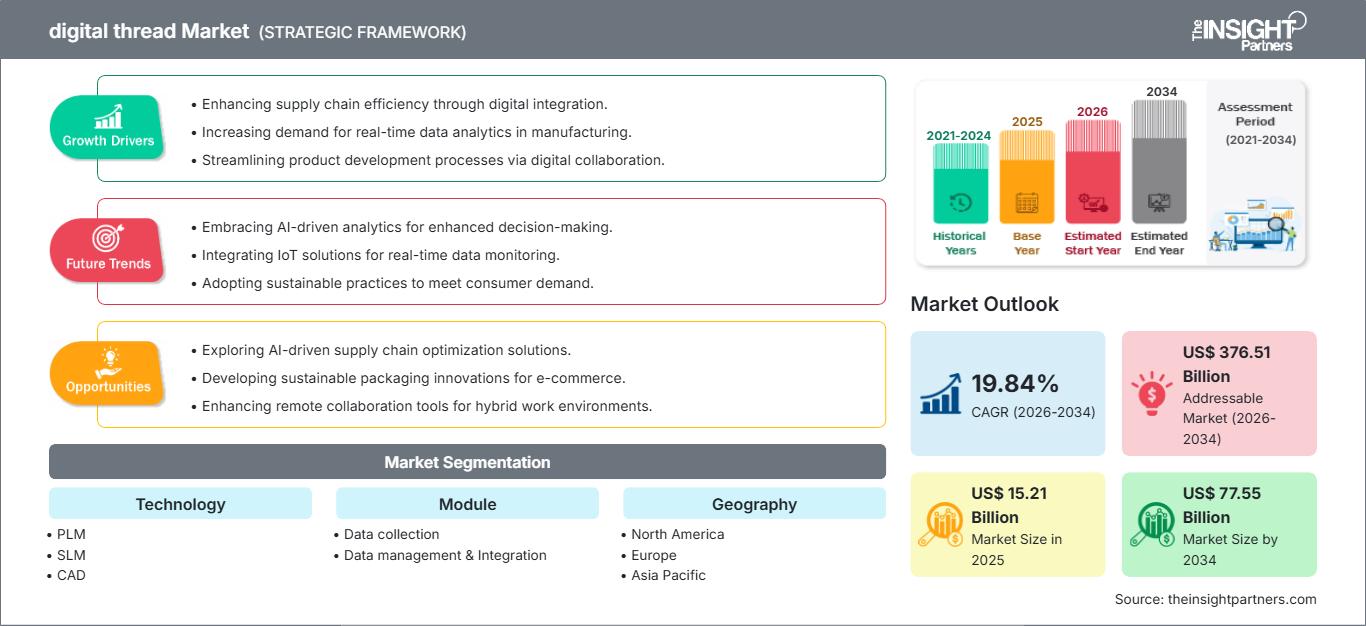
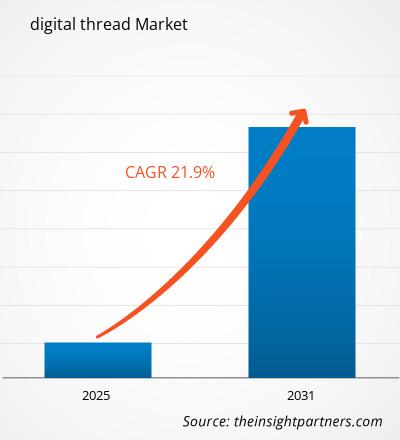
The Digital Thread Market size was US$ 15.21 Billion in 2025 and is projected to reach US$ 77.55 Billion by 2034, at a CAGR of 19.84% from 2026–2034. Growth will occur as there is increasing adoption of connected engineering, manufacturing execution, lifecycle management, and asset intelligence solutions that form a continuous data thread from concept design to manufacture, service, quality management, and end of life operations.
Adoption of Digital Thread Solutions is growing in North America as the companies update their engineering systems and integrate shop floor data into business processes. The Digital Thread Market size in North America is boosted by the growth in CAGR from 18.8% to 20.2% through 2034, backed by aerospace, automotive, industrial machinery, and energy operators adopting PLM, MES, IoT, and digital twins to eliminate rework and ensure traceability.
Digital Thread Market Assessment and Insights
- North America accounted for 37–39% share in 2025 and is expected to grow at a CAGR range of 18.8–20.2% during 2026–2034, led by aerospace, defense, industrial software maturity, and connected factory investments.
- US represented 72–74% of North America in 2025 and is projected to grow at 18.6–20.0%, supported by defense modernization, automotive electrification, and advanced manufacturing programs.
- Europe held 25–27% share in 2025 and may grow at 18.0–19.5%, with Germany, the UK, and France leading adoption across machinery, aerospace, automotive, and regulated manufacturing.
- Asia Pacific captured 23–25% share in 2025 and is forecast to grow at 21.0–22.6%, led by China, Japan, South Korea, and India through factory automation and industrial policy support.
- Largest Segment Technology held 68–72% market share in 2025 and is expected to grow at 19.2–20.4%, as platforms integrate PLM, CAD, MES, ERP, IoT, and digital twin systems.
- High Growth Segment Module held 28–32% market share in 2025 and is forecast to grow at 20.5–22.0%, driven by data collection, integration, governance, and interoperability requirements.
- Key companies analyzed in detail: Siemens AG, PTC Inc., Dassault Systèmes SE, International Business Machines Corporation, SAP SE, Rockwell Automation, Inc., Oracle Corporation, Autodesk, Inc., General Electric Company, AVEVA Group Limited, Accenture plc, and DXC Technology Company.
Source: The Insight Partners' analysis based on proprietary research, government publications, company annual reports, investor presentations, industry databases, and expert interviews.
There is a shift from disorganized engineering information to an interconnected, model-based product data environment within manufacturing companies. The Digital Thread Market has emerged from the convergence of PLM, CAD, MES, ERP, IoT, SCADA, and digital twins to enable visibility across the product lifecycle. There is also change in production due to the need of synchronization of design change and configuration history among others prior to product release.
There are factors that will determine future adoption of the technology including spending on industrial clouds, sovereign manufacturing strategies, interoperable security, and speed of new product development. There will be investment in connected plants in emerging regions in Asia Pacific and the Middle East whereas there will be a focus on validated data continuity in regulated industries in North America and Europe.
Digital Thread Market Report Scope
| Report Attribute | Details |
|---|---|
| Market size in 2025 | US$ 15.21 Billion |
| Market Size by 2034 | US$ 77.55 Billion |
| Global CAGR (2026 - 2034) | 19.84% |
| Historical Data | 2021-2024 |
| Forecast period | 2026-2034 |
Digital Thread Market Analysis
There is increasing demand for auditable product documentation that will enable linking of requirements, design models, manufacturing, variations in suppliers, and field behavior. Market growth is fueled by the need to minimize engineering change mistakes, streamline the validation process, and increase asset utilization. Industrial companies are opting for integrated solutions since disjointed spreadsheet and isolated database approaches do not support real-time decisions in decentralized facilities.
The ecosystem consists of software companies, automation companies, system integration firms, cloud service providers, industrial original equipment manufacturers, and data management firms. The supply chain dynamics of the market favor solutions capable of connecting legacy machines, engineering archives, and enterprise systems without interrupting production. Interoperability, cyber security, API development, and industry-specific workflow templates become important buying criteria in aerospace, automotive, energy, electronics, and heavy equipment industries.
Positioning in the market has become increasingly dependent on portfolio and the capability of creating reliable lifecycle data models. Siemens AG, PTC Inc., Dassault Systèmes SE, SAP SE, and Oracle Corporation are competitive in terms of enterprise suite products whereas Rockwell Automation, Inc., AVEVA Group Limited, and General Electric Company are focused on operations technology integration. Analysis of the Digital Thread Market shows increasing demand for services from Accenture plc and DXC Technology Company.
The investments are being made into cloud-native PLM, artificial intelligence-powered engineering, simulation continuity, and data layer integration. Autodesk, Inc. is enhancing design-to-make capabilities while International Business Machines Corporation is catering to hybrid cloud and analytics needs. Evaluation of vendors by buyers is based on results such as reduced change cycle time, nonconformance incidents, first-pass yield, and maintenance costs.
● REPORT CUSTOMIZATION
Tailor This Report To Align With Your Specific Business Requirements
This report can be customized to align precisely with your business objectives, scope, and target markets. Customization options include tailored segmentation, geography, competitive analysis, and strategic insights to support informed decision-making.
Customize This Report →WHAT YOU CAN ADJUST
- ● Segmentations
- ● Geography
- ● Competitive Analysis
- ● Language Preferences
Digital Thread Market: Strategic Insights
Regional Insights
North America Digital Thread Market
North America held 37–39% share in 2025 and is projected to grow at a CAGR range of 18.8–20.2% during 2026–2034. The Digital Thread Market share in the region is supported by aerospace certification needs, defense digital engineering programs, and mature adoption of PLM, MES, ERP, IoT, and simulation platforms across large industrial enterprises.
Structural demand is strongest where manufacturers operate long-life assets and complex supplier networks. Automotive electrification, semiconductor equipment expansion, and energy infrastructure modernization require synchronized design and production records. Vendor density also supports deployment, with enterprise software, automation, cloud, and consulting providers helping manufacturers integrate legacy applications, enforce data governance, and scale use cases beyond pilot programs.
U.S. Digital Thread Market
The US accounted for 72-74% of North America in 2025 and is projected to grow by 18.6-20.0% through 2034. The use of PLM software is prevalent in aerospace & defense, automotive, medical devices, electronics, and industrial machinery industries due to traceability, configuration management, and regulatory documentation that impact costs, quality, and time-to-market.
Vendor presence is extensive, and Siemens AG, PTC Inc., IBM, Oracle Corporation, Rockwell Automation, Autodesk, General Electric, Accenture, and DXC Technology have been instrumental in product engineering and operations transformation. Trends in PLM software applications include model-based systems engineering, predictive maintenance, closed-loop quality, and supplier collaboration. In addition, federal manufacturing resilience efforts and corporate reshoring drive demand for lifecycle connectivity.
Europe Digital Thread Market
The Europe region held a share of 25% - 27% in 2025, which is estimated to increase to 18.0% - 19.5% between 2026 and 2034. The dominant market in the region is Germany as it involves companies in the automotive, machinery, industrial automation, and electronics industry connecting their engineering systems.
Second to Germany is the UK, due to the aerospace, defense and advanced manufacturing initiatives that focus on digital continuity. France is growing in terms of applications in aerospace, energy, and transportation initiatives. In addition, Italy and Spain regions are focusing on industrial modernization initiatives in order to connect their CAD, PLM, MES, and ERP systems.
APAC Digital Thread Market
Asia Pacific accounted for 23% to 25% in 2025 and is estimated to have a CAGR of 21.0% to 22.6% up until 2034, being the region with the highest growth rate. China dominates through electronics, automotive, machinery, and industrial automation volume, while Japan and South Korea make progress in precision manufacturing and smart factory initiatives.
India and Australia are also developing use cases in industries such as industrial equipment, energy, mining, and infrastructure assets. The push from policy to manufacture domestically, increasing levels of automation, and requirement for greater visibility of the supply chain are driving the trend. Regional customers tend to emphasize the value of scalability of cloud deployment and efficient analytics for quick plant expansion.
Middle East & Africa Digital Thread Market
Middle East and Africa is projected to grow at a CAGR range of 17.2–18.8% during 2026–2034. Saudi Arabia is the leading country as industrial diversification, energy infrastructure, and smart manufacturing investments create demand for connected design, construction, operations, and maintenance data across long-cycle assets.
The UAE is adopting lifecycle data systems in aerospace, utilities, logistics, and infrastructure projects, while South Africa focuses on mining, energy, and industrial modernization. Rest of MEA demand remains project-led, with opportunities tied to asset-intensive sectors that need improved commissioning records, maintenance planning, and operational performance visibility.
Segmentation Analysis
Technology
Technology is expected to grow at 19.2–20.4% during 2026–2034. The Digital Thread Market scope across this segment reflects integration of engineering, operations, service, and enterprise applications into a traceable information backbone. Demand is highest where manufacturers require version control, closed-loop quality, simulation reuse, and reliable synchronization between product definitions and physical assets.
- PLM remains central because it governs product structures, requirements, engineering changes, compliance records, and configuration histories needed for lifecycle traceability across complex manufacturing programs.
- SLM supports service lifecycle visibility by connecting field data, maintenance histories, warranty records, and spare parts intelligence to engineering teams and asset operators.
- CAD provides authoritative design geometry and model data, enabling downstream manufacturing, simulation, and quality teams to work from controlled product definitions.
- MES links shop-floor execution with engineering intent, helping manufacturers compare planned processes with actual production parameters and quality events.
- IoT captures operational data from connected machines, products, and assets, strengthening feedback loops for predictive maintenance, performance optimization, and product improvement.
- ERP connects lifecycle data with procurement, inventory, finance, and order management, helping enterprises align product changes with business execution.
- Edge computing enables low-latency processing near machines and assets, improving responsiveness where production lines generate high-volume operational data.
- Digital Twin strengthens simulation, monitoring, and scenario testing by keeping virtual asset models aligned with real-world performance and lifecycle records.
- ALM supports software lifecycle traceability, which is increasingly important as connected products combine mechanical systems, electronics, embedded code, and cloud services.
- SCADA provides operational visibility for industrial control environments, enabling digital thread platforms to incorporate process data from utilities, energy, and manufacturing assets.
Module
Module is forecast to grow at 20.5–22.0% during 2026–2034. Adoption is rising because enterprises cannot create reliable digital continuity without disciplined data capture, integration, contextualization, and governance. As industrial systems multiply, modules that normalize data, maintain lineage, and connect engineering with production records become essential to scalable deployment.
- Data collection is gaining importance as manufacturers capture machine signals, inspection results, supplier inputs, engineering revisions, and field performance data for lifecycle intelligence.
- Data management & Integration is strategically critical because it connects heterogeneous applications, reconciles formats, improves governance, and creates usable context for analytics and decision workflows.
Opportunity Snapshot
| Technology | Revenue Contribution | Trend Tag | Adoption Stage |
| PLM | High | Lifecycle Core | Mature |
| SLM | Medium | Service Loop | Scaling |
| CAD | High | Model Authority | Mature |
| MES | High | Factory Sync | Scaling |
| IoT | High | Asset Signals | Scaling |
| ERP | Medium | Business Link | Mature |
| edge computing | Medium | Local Compute | Scaling |
| Digital Twin | High | Virtual Asset | Scaling |
| ALM | Medium | Software Trace | Scaling |
| SCADA | Medium | Control Data | Mature |
Digital Thread Market Growth Drivers and Impact Analysis
Lifecycle Traceability Becomes a Manufacturing Priority
Manufacturers deal with increasing complexity due to electric platforms, software-based products, faster design cycles, and multi-level supplier organizations. The Digital Thread decreases uncertainty by connecting requirements, design, bill of materials, manufacturing, testing, and usage documentation. The effect is most significant in the aerospace, automotive, medical devices, and industrial equipment industries, since a single undocumented change can lead to expensive rework or compliance issues. Since versioning and auditability will be improved in the Digital Thread Market, the Digital Thread Market is influenced by purchasing related to decrease of scrap, warranty claims, and delays in engineering changes.
Connected Factory Investments Expand Data Availability
With factories adopting sensors, MES systems, industrial connectivity, SCADA upgrades, and edge computing, the ability to collect data on operations in real time is enhanced. This provides the operational infrastructure required to enable the alignment between engineering intentions and processes. With machine data, inspection outcomes, and work instructions being put into context, manufacturers will be able to detect anomalies sooner and increase yields. For the markets, this is an increased business case for platforms which are capable of translating operational data into quality, maintenance, and root cause analysis.
Digital Engineering Programs Accelerate Platform Standardization
Large companies are implementing standardized architectures for engineering and manufacturing information to facilitate model-based systems engineering, simulation consistency, and lifecycle analytics. Standardization reduces friction caused by disparate PLM, CAD, ERP, and service software solutions. Global organizations will be able to leverage validated product knowledge from different programs through standardization. This will result in increased investment in integration tools, cloud migrations, and consulting due to the need for scalable business models, not limited pilots. Solution vendors with wide ecosystems will benefit from this trend.
Digital Thread Market Future Trends
AI-Assisted Lifecycle Intelligence
Digital Thread Market trends will increasingly center on AI models that interpret engineering changes, detect production anomalies, recommend corrective actions, and summarize lifecycle records for decision-makers. As validated data histories expand, AI assistants will become more useful in requirements review, supplier risk detection, and service planning. The opportunity depends on data quality, permissions, and explainability. Enterprises will therefore invest in governed knowledge graphs and secure industrial data layers before allowing AI to influence production or compliance workflows.
Interoperable Digital Twins Across Product Networks
Digital twins will move from asset-specific models to connected product and production networks. Future deployments will synchronize design assumptions, process settings, supplier changes, and operating conditions across multiple facilities and service environments. This shift will support scenario planning, sustainability reporting, and resilience analysis. The main challenge will be interoperability between vendor platforms and industrial control systems. Companies that establish open interfaces and common semantic models will gain stronger lifecycle visibility and faster learning across product families.
Digital Thread Market Opportunities
Cloud-Native Integration for Mid-Market Manufacturers
Mid-market manufacturers need practical deployment models that connect CAD, PLM, MES, ERP, and quality systems without multi-year customization programs. Digital Thread Market Forecasts indicate that vendors offering modular connectors, preconfigured workflows, and subscription pricing can expand adoption beyond large enterprises. The investment opportunity is strongest in automotive suppliers, electronics producers, medical device manufacturers, and industrial equipment companies. Providers that combine implementation templates with measurable operational KPIs can shorten payback periods and reduce buyer hesitation around data migration and process change.
Lifecycle Data Services for Regulated Industries
Regulated sectors require validated records that demonstrate design control, manufacturing conformity, material provenance, and service history. Aerospace, defense, medical devices, energy, and transportation operators are therefore strong candidates for managed lifecycle data services. System integrators and software vendors can create recurring revenue by offering governance frameworks, compliance templates, migration support, and analytics-ready data models. The most attractive opportunities involve brownfield environments where legacy systems contain valuable records but lack integration, context, or audit-ready accessibility.
Recent Developments
- July 2026: Siemens announced that MULTIVAC selected Siemens Teamcenter as its strategic product lifecycle management platform to connect engineering and manufacturing, improve collaboration, and establish a consistent digital backbone across product development processes, supporting digital transformation and AI-enabled engineering initiatives.
- July 2026: Siemens announced that MULTIVAC, one of the leading providers of processing and packaging solutions for food, medical devices and pharmaceuticals, has selected Siemens’ Teamcenter software as its strategic PLM backbone to manage product data, connect engineering disciplines with downstream manufacturing environments across the company and support the digital transformation of its product development and lifecycle management processes.
- July 2026: Siemens and HD Hyundai announced a strategic collaboration to modernize US shipbuilding through an AI-powered digital shipyard model, using Siemens Xcelerator technologies to establish a connected digital thread across design, engineering, manufacturing, production planning, and lifecycle management. The initiative aims to improve productivity, reduce rework, enhance quality, and enable data-driven decision-making through integrated digital twin and industrial AI capabilities.
Frequently Asked Questions

- Comprehensive Market Sizing and Forecast Analysis
- Detailed Segmentation Analysis
- In-Depth Market Dynamics Assessment
- Regional and Country-Level Insights
- Competitive Landscape and Company Benchmarking
- Strategic Business Intelligence
Recent Reports
Testimonials

The Insight Partners provided valuable market intelligence that supported our global go-to-market strategy. Their team was professional, responsive, and attentive to our feedback, providing thoughtful analysis and helpful methodological clarifications throughout the project.
Junmo Kim Chief Financial Officer (CFO), Enertech Co., Ltd.
The Insight Partners' SCADA System Market report is comprehensive, with valuable insights on current trends and future forecasts. The team was highly professional, responsive, and supportive throughout. We are very satisfied and highly recommend their services.
RAN KEDEM Partner, Reali Technologies LTDs
I requested a report on a very specific software market and the team produced the report in a few days. The information was very relevant and well presented. I then requested some changes and additions to the report. The team was again very responsive and I got the final report in less than a week.
JEAN-HERVE JENN Chairman, Future Analytica
We worked with The Insight Partners for an important market study and forecast. They gave us clear insights into opportunities and risks, which helped shape our plans. Their research was easy to use and based on solid data. It helped us make smart, confident decisions. We highly recommend them.
PIYUSH NAGPAL Sr. Vice President, High Beam Global
The Insight Partners delivered insightful, well-structured market research with strong domain expertise. Their team was professional and responsive throughout. The user-friendly website made accessing industry reports seamless. We highly recommend them for reliable, high-quality research services
YUKIHIKO ADACHI CEO, Deep Blue, LLC.
This is the first time I have purchased a market report from The Insight Partners.While I was unsure at first, I visited their web site and felt more comfortable to take the risk and purchase a market report.I am completely satisfied with the quality of the report and customer service. I had several questions and comments with the initial report, but after a couple of dialogs over email with their analyst I believe I have a report that I can use as input to our strategic planning process.Thank you so much for taking the extra time and making this a positive experience.I will definitely recommend your service to others and you will be my first call when we need further market data.
JOHN SUZUKI President and Chief Executive Officer, Board Director, BK Technologies
I wish to appreciate your support and the professionalism you displayed in the course of attending to my request for information regarding to infectious disease IVD market in Nigeria. I appreciate your patience, your guidance, and the fact that you were willing to offer a discount, which eventually made it possible for us to close a deal. I look forward to engaging The Insight Partners in the future, all thanks to the impression you have created in me as a result of this first encounter.
DR CHIJIOKE ONYIA MANAGING DIRECTOR, PineCrest Healthcare Ltd.Reason to Buy
- Informed Decision-Making
- Understanding Market Dynamics
- Competitive Analysis
- Identifying Emerging Markets
- Customer Insights
- Market Forecasts
- Risk Mitigation
- Boosting Operational Efficiency
- Strategic Planning
- Investment Justification
- Tracking Industry Innovations
- Aligning with Regulatory Trends





 Get Free Sample for