
Discrete Semiconductors Market Growth, Trends & Forecast by 2034
Coverage: by Type (MOSFET, IGBT, Bipolar Transistor, Thyristor, Rectifier, Other Types); End-user Vertical (Automotive, Consumer Electronics, Communication, Industrial, Others) , and Geography (North America, Europe, Asia Pacific, and South and Central America)
- Status : Data Released
- Report Code : TIPRE00009379
- Category : Electronics and Semiconductor
- No. of Pages : 150
- Available Report Formats :


- Last update date : August 12, 2026


2025 Market Size
US$ 36.28 Bn
Base year value
2034 Forecast
US$ 50.3 Bn
Projected by 2034
CAGR 2026-2034
3.70 %
Growth rate
Addressable Market
US$ 393.29 Bn
(2026-2034)
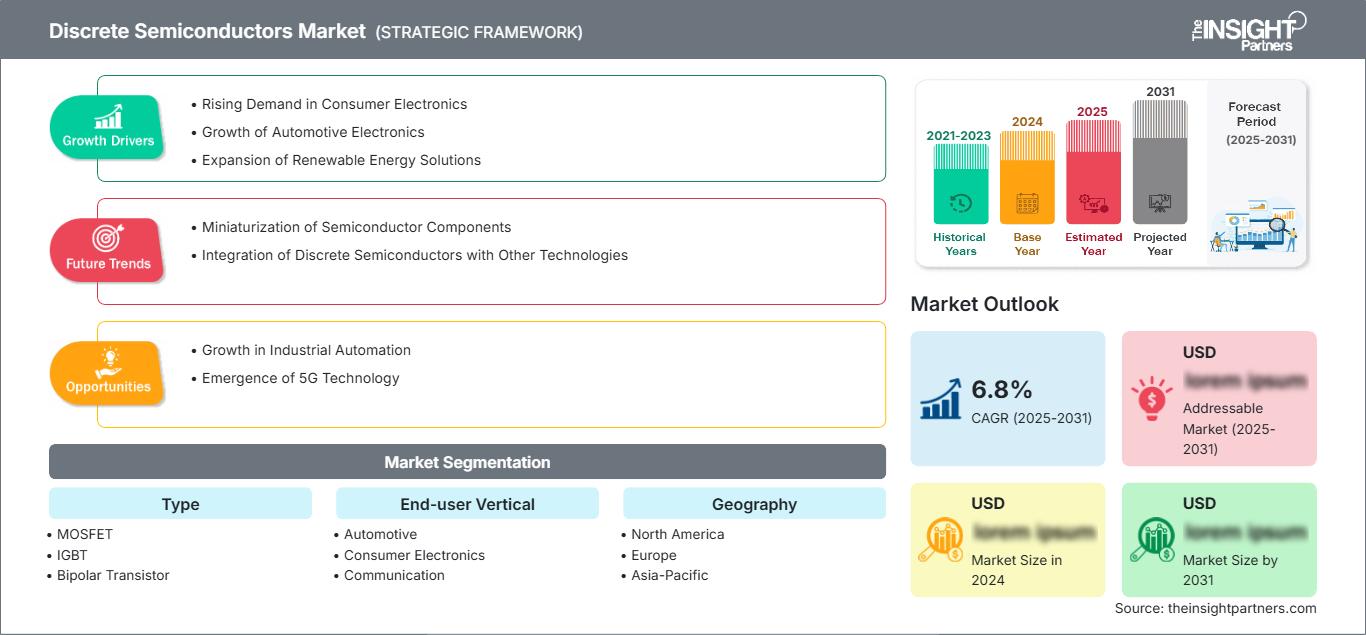
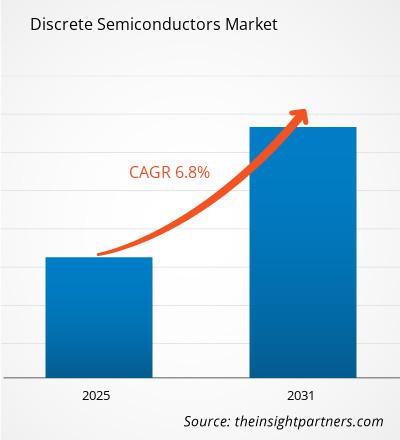
The Discrete Semiconductors Market size was found to be US$ 36.28 billion in 2025, which is further projected to reach US$ 50.30 billion in 2034. During the forecast period of 2026-2034, the market is expected to grow at a CAGR of 3.70%. The growth of the market will be mainly attributed to the rising demand for energy-efficient devices along with the rapidly growing production of electric vehicles across the globe. Discrete semiconductors are essential electronic components that include diodes, transistors, MOSFETs, IGBTs, and thyristors. These components are used for particular purposes such as switching, amplification, and power conversion in electronic circuits.
According to the Discrete Semiconductors Market report, North America represents a developed with a CAGR of 3.2-3.6% over the forecast period. The growth in the region is fueled by high automobile production, investments in R&D activities in the semiconductor industry, and the growing use of power management technologies in the industrial sector. The U.S. is the dominant country in terms of market demand in the region due to high defense electronics expenditure and AI infrastructure development.
Discrete Semiconductors Market Assessment and Insights
- North America accounted for approximately 22-26% of the global Market in 2025, growing at a CAGR of 3.2-3.6% from 2026 to 2034. The region benefits from strong automotive electronics demand, significant R&D investments, and a robust industrial automation sector.
- US held roughly 82-86% of the North American market in 2025, advancing at a CAGR of 3.0-3.4% during 2026-2034. Strong automotive production, defense electronics spending, and AI infrastructure development underpin sustained component procurement.
- Europe represented approximately 20-24% of the global market in 2025, expanding at a CAGR of 3.4-3.8% from 2026 to 2034. Germany, the United Kingdom, and France are leading country markets, driven by established automotive manufacturing and industrial automation sectors.
- Asia Pacific captured roughly 45-50% of the global market in 2025, registering the fastest regional CAGR of 4.0-4.5% during 2026-2034. China, Japan, South Korea, and India are key growth engines, supported by massive consumer electronics production and semiconductor manufacturing capabilities.
- Largest Segment – By type, MOSFETs held the largest market share of approximately 34-38% in 2025, with a projected CAGR of 3.8-4.2% from 2026 to 2034. Their dominance reflects widespread adoption in power management, switching applications, and automotive electronics.
- High Growth Segment – By end-user vertical, automotive is the high-growth segment with approximately 28-32% market share in 2025 and a projected CAGR of 4.5-5.0% during 2026-2034. Increasing electrification and advanced driver-assistance systems drive its faster adoption.
- Key companies analyzed in detail: Diodes Incorporated, Eaton Corporation plc, Fairchild Semiconductor International, Inc., Infineon Technologies AG, Nexperia, NXP Semiconductors N.V., ON Semiconductor Corporation, STMicroelectronics, Toshiba Corporation, Vishay Intertechnology, Inc.
Source: The Insight Partners' analysis based on proprietary research, government publications, company annual reports, investor presentations, industry databases, and expert interviews.
The market has gone through a number of changes since it started off from its very basic silicon-based products to wide band gap devices which include silicon carbide and gallium nitride. The changing technology has witnessed advancements in terms of higher efficiency, higher temperature ratings, and power densities. Production processes have been witnessing a move towards fabrication through 200 mm and 300 mm wafers, where leading companies have invested in increasing their production capacities. There has also been an acquisition process in the market as ON Semiconductor acquires businesses of silicon carbide JFET technology to increase its power offering.
Discrete Semiconductors Market forecast indicates that the market has an optimistic outlook owing to the novel applications of these semiconductors in renewable energy systems, electric vehicles charging stations, and AI data centers. Increased investment is being made in the production capabilities of wide bandgap semiconductors which are characterized by better performance attributes. There are various government projects in several leading economies such as the US CHIPS Act and equivalent programs in Europe and Asia which are offering a lot of financial support towards manufacturing semiconductors domestically.
Discrete Semiconductors Market Report Scope
| Report Attribute | Details |
|---|---|
| Market size in 2025 | US$ 36.28 Billion |
| Market Size by 2034 | US$ 50.3 Billion |
| Global CAGR (2026 - 2034) | 3.70% |
| Historical Data | 2021-2024 |
| Forecast period | 2026-2034 |
Discrete Semiconductors Market Analysis
The key demand driver for discrete semiconductors stems from the global shift towards electrification and energy efficiency. The automotive industry can be considered an important demand growth area, as electric vehicles require much more power semiconductors than traditional cars with internal combustion engines. The supply chain consists of raw material providers, wafer fabrication facilities, assembly/test sites and distributors for various end-user markets. The industry’s supply dynamics are affected by political issues, as tensions with other countries and export restrictions have an effect on the availability of manufacturing equipment and materials. The semiconductor industry has been demonstrating cyclical patterns with regard to demand, featuring periods of supply constraints and subsequent expansions of capacity. Companies have started implementing vertical integration in order to secure long-term supplies of raw materials and build their own captive fabrication capacities to provide stable production.
The Discrete Semiconductors Market Competitive Environment involves both Integrated Device Manufacturers and Fabless semiconductor companies. Leading positions in this market belong to Infineon Technologies AG that specializes in automotive and industrial power semiconductors. ON Semiconductor Corporation has extended its product range with the help of acquisitions, in particular, silicon carbide JFET technology acquired from Qorvo. STMicroelectronics is known for its innovation in the field of automotive and industrial MOSFET and IGBT products. Toshiba Corporation and Vishay Intertechnology, Inc. are characterized by a large number of various discrete components' families. NXP Semiconductors N.V. and Nexperia concentrate their activities on automotive and industrial discrete semiconductors, whereas Diodes Incorporated is a supplier of automotive and industrial discrete components. Recent investment tendencies involve R&D expenses on wide bandgap technology, silicon carbide and gallium nitride devices are actively developed. Strategic positioning of discrete semiconductors producers pays much attention to application specific solutions that are developed for electric vehicles' powertrains, renewable energy converters and AI data centers' power supplies.
● REPORT CUSTOMIZATION
Tailor This Report To Align With Your Specific Business Requirements
This report can be customized to align precisely with your business objectives, scope, and target markets. Customization options include tailored segmentation, geography, competitive analysis, and strategic insights to support informed decision-making.
Customize This Report →WHAT YOU CAN ADJUST
- ● Segmentations
- ● Geography
- ● Competitive Analysis
- ● Language Preferences
Discrete Semiconductors Market: Strategic Insights
Regional Insights
North America Discrete Semiconductors Market
North America represented around 22-26% of the total Discrete Semiconductors Market share in 2025 with the region growing at a CAGR of 3.2-3.6% during the forecast period 2026 to 2034. The market is fueled by the high demand from automotive electronics, industrial automation, and defense applications. The US is at the forefront of the North American market due to its well-developed automotive industry that relies heavily on the use of discrete semiconductors in powertrain control, battery management systems, and advanced driver assistance system. The region has the support of many semiconductor manufacturers such as ON Semiconductor and Vishay Intertechnology. Canada and Mexico add to the demand of the region by virtue of their automotive manufacturing and electronic assembly activities. North America enjoys significant governmental investment in semiconductor research and development. Moreover, there are efforts underway to increase domestic manufacturing capabilities. The emergence of AI infrastructure has led to further demand for discrete semiconductors owing to their performance in power management.
U.S. Discrete Semiconductors Market
The US is dominant in the North America with an estimated regional share of 82-86%, at a CAGR of 3.0-3.4% for the forecast period between 2026 and 2034. The market in the US enjoys the presence of a large automotive industry, huge defense electronic expenditure, and substantial investments made in semiconductor research & development. The CHIPS Act has facilitated investments in semiconductor manufacturing within the domestic economy with several fabs being set up in the country. There is an increasing requirement for power MOSFETs, IGBTs, and silicon carbide components due to the switch to electric vehicles within the automotive industry. The high-reliability discrete semiconductors have been required by the defense industry for aerospace and military applications. The demand for power management systems in the AI data centers has increased the demand for discrete semiconductors. Major semiconductor companies such as ON Semiconductor, Vishay Intertechnology, and Diodes Incorporated have established their operations in the country.
Europe Discrete Semiconductors Market
In 2025, Europe held about 20-24% share of the total market, growing at a CAGR of 3.4-3.8% from 2026 to 2034. Germany is the dominant country-level market in Europe, occupying about 22-26% share of regional revenue, followed by the United Kingdom holding 18-22%, France with 14-18%, Italy with 8-12%, and Spain with 6-10%. The robust automobile industry in Europe, especially in Germany, results in steady demand for discrete semiconductors used in engine management systems, safety mechanisms, and entertainment units. The UK's automobile and industrial sectors play a significant role in fueling market growth. The manufacturing and automobile industries in France and Italy drive the market. Spain's renewable energy installations and automobile manufacturing aid market growth. The European Union's efforts to attain self-reliance in semiconductors through actions like the European Chips Act should see an increase in production capacity in Europe. The carbon emissions reduction initiatives by the European Union have increased electric vehicle ownership.
APAC Discrete Semiconductors Market
Asia Pacific captured approximately 45-50% of the global Discrete Semiconductors Market in 2025, registering the fastest regional CAGR of 4.0-4.5% from 2026 to 2034. China led the region with roughly 35-40% of APAC revenues, followed by Japan at 18-22%, South Korea at 12-16%, India at 8-12%, and Australia at 3-5%. As China is the largest hub for electronics manufacturing in the world, there is a high level of demand for discrete semiconductors in consumer electronics, automotive and industrial segments in the region. The sophisticated technology and automobile industries in Japan are responsible for continuous growth in the market. The semiconductor manufacturing capability and electronics industries of South Korea are contributing to the demand for the product. The growing electronics manufacturing and automotive industries in India provide a lot of growth opportunities in the region.
Middle East & Africa Discrete Semiconductors Market
The Middle East and Africa Discrete Semiconductors Market is projected to grow at a CAGR of 3.8-4.2% from 2026 to 2034. Saudi Arabia, the UAE, South Africa, and the Rest of MEA represent the key country markets. Saudi Arabia's Vision 2030 initiative, which focuses on economic diversification and industrial development, is driving demand for discrete semiconductors across various sectors. The UAE's position as a regional technology hub and its focus on smart city initiatives support market growth. South Africa's established industrial base and growing adoption of digital technologies contribute to market activity. The Rest of MEA, including countries such as Turkey, Egypt, and Nigeria, is witnessing gradual infrastructure development and increasing digitalization. Investments in renewable energy projects, particularly solar power installations, are creating new opportunities for power semiconductor adoption. The region's telecommunications infrastructure expansion also supports demand for discrete components.
Segmentation Analysis
Type
The type segment of the Discrete Semiconductors Market encompasses MOSFETs, IGBTs, bipolar transistors, thyristors, rectifiers, and other types, each serving distinct applications. MOSFETs held the largest market share in 2025, driven by their widespread use in power management, switching applications, and automotive electronics. The segment is projected to grow at a CAGR of 3.8-4.2% from 2026 to 2034. IGBTs represent a significant segment, particularly in high-power applications such as electric vehicle traction inverters and industrial motor drives. Bipolar transistors continue to find applications in analog circuits and switching applications. Thyristors are used in high-voltage power control applications. Rectifiers are essential components in power supply circuits across all end-user segments. The market is witnessing a gradual shift toward wide-bandgap devices, including silicon carbide and gallium nitride, which offer superior performance characteristics for demanding applications.
- MOSFET: Metal-oxide-semiconductor field-effect transistors dominate the discrete market due to their high switching speed and efficiency. They are widely used in power supplies, DC-DC converters, and automotive applications.
- IGBT: Insulated-gate bipolar transistors combine high voltage capability with fast switching, making them ideal for electric vehicle traction inverters, industrial motor drives, and renewable energy systems.
- Bipolar Transistor: Bipolar junction transistors remain relevant for analog applications, amplification, and switching in lower-power circuits where cost sensitivity is a priority.
- Thyristor: Thyristors are used in high-voltage, high-current applications such as AC power control, motor speed control, and lighting dimmers where robust performance is required.
- Rectifier: Rectifiers convert alternating current to direct current and are essential components in power supplies, battery chargers, and automotive alternator systems.
End-user Vertical
The end-user vertical segment of the Discrete Semiconductors Market comprises automotive, consumer electronics, communication, industrial, and others. Automotive represents the largest and fastest-growing end-user segment, driven by the increasing electrification of vehicles and the adoption of advanced driver-assistance systems. The segment is projected to grow at a CAGR of 4.5-5.0% from 2026 to 2034. Consumer electronics continues to be a significant market, with discrete semiconductors used in smartphones, laptops, wearables, and home appliances. Communication infrastructure, including 5G networks, requires discrete components for power management and signal processing. Industrial applications include motor drives, automation equipment, and power supplies. The market is witnessing increasing demand from renewable energy systems, including solar inverters and wind turbine converters.
- Automotive: Automotive is the largest and fastest-growing end-user segment, with discrete semiconductors used in powertrain control, battery management, ADAS, and infotainment systems. Electrification is driving significant growth.
- Consumer Electronics: Consumer electronics represent a substantial market segment, with discrete components used in smartphones, laptops, wearables, and home appliances for power management and signal processing.
- Communication: Communication infrastructure requires discrete semiconductors for power management, signal amplification, and protection circuits in network equipment and base stations.
- Industrial: Industrial applications include motor drives, automation equipment, power supplies, and renewable energy systems requiring robust, high-performance discrete components.
Opportunity Snapshot
| End-user Vertical | Revenue Contribution | Trend Tag | Adoption Stage |
|---|---|---|---|
| Automotive | High | EV Electrification | Scaling |
| Consumer Electronics | High | Device Miniaturization | Mature |
| Communication | Medium | 5G Infrastructure | Scaling |
| Industrial | Medium | Factory Automation | Scaling |
Discrete Semiconductors Market Growth Drivers and Impact Analysis
Electrification of the Automotive Industry
The rapid electrification of the automotive industry represents a primary driver of the Discrete Semiconductors Market. Electric vehicles require substantially more semiconductor content than traditional internal combustion engine vehicles, with power semiconductors being particularly critical for battery management, traction inverters, and onboard charging systems. The global transition toward electric mobility, supported by government incentives and emissions regulations, is accelerating demand for MOSFETs, IGBTs, and silicon carbide devices. Leading automotive manufacturers are increasing their electric vehicle production targets, creating sustained demand for discrete power components. The development of 800-volt electrical architectures in next-generation EVs is driving adoption of wide-bandgap semiconductors that offer superior efficiency and thermal performance. The economic impact of this trend includes significant investment in semiconductor manufacturing capacity, with major players expanding production facilities to meet automotive demand.
Growing Demand for Energy-Efficient Devices
The increasing global focus on energy efficiency and sustainability is driving demand for advanced discrete semiconductors across multiple sectors. Governments worldwide have implemented regulations and standards requiring higher efficiency in power supplies, industrial equipment, and consumer electronics. Discrete semiconductors play a crucial role in achieving these efficiency targets through improved power conversion, reduced switching losses, and better thermal management. The adoption of wide-bandgap technologies, including silicon carbide and gallium nitride, enables significant efficiency improvements over traditional silicon-based devices. Data centers, which consume substantial electricity, are adopting more efficient power management solutions to reduce operational costs and environmental impact. The renewable energy sector, including solar and wind power, requires efficient power conversion components that discrete semiconductors provide.
Expansion of Industrial Automation and Industry 4.0
The expansion of industrial automation and the adoption of Industry 4.0 principles are driving demand for discrete semiconductors in manufacturing and process industries. This is a notable discrete semiconductors market trend. Automated systems require reliable power management, motor control, and sensing capabilities that discrete components provide. The integration of robotics, programmable logic controllers, and industrial internet of things devices has increased the semiconductor content per manufacturing facility. Discrete semiconductors are essential for motor drives, power supplies, and protection circuits in automated equipment. The trend toward predictive maintenance and condition monitoring has created additional demand for sensing and signal conditioning components. Industrial sectors including automotive manufacturing, food processing, and chemical production are investing in automation to improve productivity and quality, driving sustained demand for discrete power and signal components.
Discrete Semiconductors Market Future Trends
Wide-Bandgap Semiconductor Adoption Accelerates
The adoption of wide-bandgap semiconductors, particularly silicon carbide and gallium nitride, is accelerating across the Discrete Semiconductors Market. These materials offer superior performance characteristics including higher efficiency, higher temperature tolerance, and faster switching speeds compared to traditional silicon devices. Silicon carbide is gaining traction in electric vehicle traction inverters and charging infrastructure, where its efficiency advantages translate to extended driving range and faster charging times. Gallium nitride is finding applications in power supplies, data center power management, and consumer electronics chargers. Manufacturers are investing heavily in wide-bandgap production capacity, with new fabrication facilities dedicated to silicon carbide and gallium nitride devices. The declining cost of these technologies is expanding their addressable market beyond premium applications into mainstream products. The trend toward higher voltage systems in automotive and industrial applications further favors wide-bandgap adoption.
Supply Chain Regionalization and Manufacturing Investment
The trend toward supply chain regionalization and domestic semiconductor manufacturing investment is reshaping the Discrete Semiconductors Market. Geopolitical tensions and trade uncertainties have prompted governments to reduce dependence on overseas semiconductor production. The US CHIPS Act, European Chips Act, and similar initiatives in Asia are providing substantial funding for domestic semiconductor manufacturing capacity. Major discrete semiconductor manufacturers are announcing new fabrication facilities and expansion projects across multiple regions. This trend is expected to increase production capacity, reduce supply chain vulnerabilities, and create more balanced regional manufacturing footprints. The investment in domestic production is also supporting research and development activities, accelerating innovation in device technology and manufacturing processes. The regionalization trend is creating opportunities for equipment suppliers, materials providers, and engineering service companies serving the semiconductor industry.
Discrete Semiconductors Market Opportunities
Electric Vehicle Charging Infrastructure Development
The development of electric vehicle charging infrastructure presents a significant opportunity for the Discrete Semiconductors Market. The global expansion of EV charging networks, including both AC and DC fast chargers, requires substantial quantities of power semiconductors for power conversion, rectification, and switching functions. DC fast chargers, in particular, demand high-performance IGBTs and silicon carbide MOSFETs capable of handling high voltages and currents. The trend toward higher-power charging, including 350kW and above systems, is driving adoption of advanced power semiconductor technologies. Government investments in charging infrastructure, including the US National Electric Vehicle Infrastructure program and similar initiatives in Europe and Asia, are creating sustained demand. Manufacturers that develop optimized discrete solutions for charging applications can capture significant market share in this growing segment.
Renewable Energy Systems and Energy Storage Integration
The expansion of renewable energy systems and energy storage integration offers growth opportunities for the Discrete Semiconductors Market. Solar inverters, wind turbine converters, and battery energy storage systems require power semiconductors for efficient energy conversion and management. The global transition toward renewable energy sources, supported by government policies and declining technology costs, is driving investment in solar and wind power installations. Energy storage systems, essential for grid stability and renewable integration, require power conversion equipment that utilizes discrete semiconductors. The trend toward residential solar plus storage systems is creating additional demand for power electronics in distributed energy applications. Manufacturers that develop high-efficiency, reliable discrete solutions for renewable energy applications can benefit from this growing market segment.
Recent Developments
- July 2026: Diodes Incorporated announced an agreement to acquire ElevATE Semiconductor in a US$250 million all-cash transaction to expand its analog and mixed-signal portfolio. The acquisition adds automated test equipment (ATE) integrated circuit capabilities and supports Diodes’ strategy to address growing semiconductor testing requirements across automotive, industrial, data center, and AI applications.
- June 2026: The Japan Power Semiconductor Alliance initiative advanced collaboration among domestic semiconductor companies to strengthen Japan’s power semiconductor ecosystem. The alliance focuses on improving technology development, supply chain resilience, and competitiveness in areas including automotive electrification, industrial systems, and energy
- June 2026: ON Semiconductor Corporation announced an agreement to acquire Synaptics in an all-stock transaction valued at approximately US$7 billion. The acquisition aims to combine power semiconductor expertise with edge AI, sensing, connectivity, and human-machine interface technologies for automotive, industrial, consumer electronics, and intelligent systems markets.
Frequently Asked Questions

- Comprehensive Market Sizing and Forecast Analysis
- Detailed Segmentation Analysis
- In-Depth Market Dynamics Assessment
- Regional and Country-Level Insights
- Competitive Landscape and Company Benchmarking
- Strategic Business Intelligence
Recent Reports
Testimonials

The Insight Partners provided valuable market intelligence that supported our global go-to-market strategy. Their team was professional, responsive, and attentive to our feedback, providing thoughtful analysis and helpful methodological clarifications throughout the project.
Junmo Kim Chief Financial Officer (CFO), Enertech Co., Ltd.
The Insight Partners' SCADA System Market report is comprehensive, with valuable insights on current trends and future forecasts. The team was highly professional, responsive, and supportive throughout. We are very satisfied and highly recommend their services.
RAN KEDEM Partner, Reali Technologies LTDs
I requested a report on a very specific software market and the team produced the report in a few days. The information was very relevant and well presented. I then requested some changes and additions to the report. The team was again very responsive and I got the final report in less than a week.
JEAN-HERVE JENN Chairman, Future Analytica
We worked with The Insight Partners for an important market study and forecast. They gave us clear insights into opportunities and risks, which helped shape our plans. Their research was easy to use and based on solid data. It helped us make smart, confident decisions. We highly recommend them.
PIYUSH NAGPAL Sr. Vice President, High Beam Global
The Insight Partners delivered insightful, well-structured market research with strong domain expertise. Their team was professional and responsive throughout. The user-friendly website made accessing industry reports seamless. We highly recommend them for reliable, high-quality research services
YUKIHIKO ADACHI CEO, Deep Blue, LLC.
This is the first time I have purchased a market report from The Insight Partners.While I was unsure at first, I visited their web site and felt more comfortable to take the risk and purchase a market report.I am completely satisfied with the quality of the report and customer service. I had several questions and comments with the initial report, but after a couple of dialogs over email with their analyst I believe I have a report that I can use as input to our strategic planning process.Thank you so much for taking the extra time and making this a positive experience.I will definitely recommend your service to others and you will be my first call when we need further market data.
JOHN SUZUKI President and Chief Executive Officer, Board Director, BK Technologies
I wish to appreciate your support and the professionalism you displayed in the course of attending to my request for information regarding to infectious disease IVD market in Nigeria. I appreciate your patience, your guidance, and the fact that you were willing to offer a discount, which eventually made it possible for us to close a deal. I look forward to engaging The Insight Partners in the future, all thanks to the impression you have created in me as a result of this first encounter.
DR CHIJIOKE ONYIA MANAGING DIRECTOR, PineCrest Healthcare Ltd.Reason to Buy
- Informed Decision-Making
- Understanding Market Dynamics
- Competitive Analysis
- Identifying Emerging Markets
- Customer Insights
- Market Forecasts
- Risk Mitigation
- Boosting Operational Efficiency
- Strategic Planning
- Investment Justification
- Tracking Industry Innovations
- Aligning with Regulatory Trends





 Get Free Sample for