
Disposable Anaesthetic Needle Market Size, Trends & Growth by 2034
Coverage: By Product (Epidural Anaesthesia Needles, Spinal Anaesthesia Needles, Nerve Anaesthesia Needles, Paediatric Anaesthesia Needles, Others); Application (Adults, Paediatrics); End User (Hospitals & Clinics, Ambulatory Surgical Centers, Others) , and Geography (North America, Europe, Asia Pacific, and South and Central America)
- Status : Data Released
- Report Code : TIPRE00018043
- Category : Life Sciences
- No. of Pages : 150
- Available Report Formats :


- Last update date : July 03, 2026


2025 Market Size
US$ 1.59 Bn
Base year value
2034 Forecast
US$ 3.28 Bn
Projected by 2034
CAGR 2026-2034
8.35 %
Growth rate
Addressable Market
US$ 21.83 Bn
(2026-2034)
The Disposable Anaesthetic Needle Market is poised for continuous growth due to hospitals, clinics, and ambulatory surgery centers' preference for sterilized single-use devices in delivering regional and local anesthesia. This market is forecast to have a value of US$ 1.59 Billion in 2025 and US$ 3.28 Billion in 2034, growing at a CAGR of 8.35% from 2026 to 2034. The demand depends on the number of surgeries performed, standards of infection control and use of accurate guided administration of anaesthesia.
North America is one of the lucrative regions for the Disposable Anaesthetic Needle Market, with an anticipated CAGR between 7.4% and 8.2% over 2034. This region is favored by high procedure volume, high use of spinal and epidural anesthesia and compliance with single use medical device practice.
Disposable Anaesthetic Needle Market Assessment and Insights
- North America: North America accounted for 35–40% share in 2025 and is anticipated to expand at a CAGR of 8.1%–8.5% during 2026–2034. High surgical procedure volumes, stringent infection control protocols, and widespread adoption of regional anesthesia techniques continue to support regional market leadership.
- U.S.: The U.S. represented ~80% of the North American market in 2025 and is projected to register a CAGR of 8.2%–8.6% during 2026–2034, supported by increasing surgical volumes, advanced healthcare infrastructure, and growing utilization of regional anesthesia procedures.
- Europe: Europe held 25–30% market share in 2025 and is expected to grow at a CAGR of 7.8%–8.2% during 2026–2034. Germany, the United Kingdom, and France remain the leading regional markets due to aging populations, standardized anesthesia practices, and expanding surgical care services.
- Asia Pacific: Asia Pacific accounted for 30–35% share in 2025 and is forecast to expand at a CAGR of 8.7%–9.2% during 2026–2034. China, India, and Japan continue to drive regional growth through expanding surgical capacity, improving hospital infrastructure, and increasing access to advanced anesthesia services.
- Largest Segment: Product Type – Spinal Anaesthesia Needles represented the largest market segment and is expected to record a CAGR of 8.2%–8.6% during 2026–2034, reflecting their extensive use in spinal block procedures across surgical and obstetric settings.
- High Growth Segment: Product Type – Nerve Anaesthesia Needles is projected to grow at a CAGR of 9.0%–9.6% during 2026–2034, driven by increasing adoption of ultrasound-guided regional anesthesia and growing preference for minimally invasive pain management techniques.
- Key companies analyzed in detail: Becton, Dickinson and Company; Biomedical S.r.l.; Prodimed SAS; Spectra Medical Devices, Inc.; Teleflex Incorporated; Vygon SAS; HEKA S.r.l.; Troge Medical GmbH; Kerr Corporation; and Injeq Oy
Source: The Insight Partners' analysis based on proprietary research, government publications, company annual reports, investor presentations, industry databases, and expert interviews.
In the Disposable Anaesthetic Needle Market, product offerings have moved from simple sterile needles to advanced offerings that focus on precision, control for healthcare professionals, and minimizing trauma for patients. The choice of products will now depend more on bevel geometry, optimal gauge design, visibility of the hub, and compatibility with ultrasound-assisted operations. Such developments continue to support the expansion of the disposable anaesthetic needle market size as providers seek higher-performance solutions.
Future demands will be driven by the interplay between higher surgery volume, aging populations, shifts to office-based surgery, and infection control. Those companies that can combine good manufacturing with ergonomic and regulatory design will succeed. As hospitals standardize their anesthesia trays and ambulatory surgery facilities look for reliable supplies, the company that can offer a wide product line and distribution will have an edge.
Disposable Anaesthetic Needle Market Report Scope
| Report Attribute | Details |
|---|---|
| Market size in 2025 | US$ 1.59 Billion |
| Market Size by 2034 | US$ 3.28 Billion |
| Global CAGR (2026 - 2034) | 8.35% |
| Historical Data | 2021-2024 |
| Forecast period | 2026-2034 |
Disposable Anaesthetic Needle Market Analysis
The factors affecting market dynamics include increasing demand for regional anesthesia, increased adoption of minimally invasive techniques, and greater emphasis on reducing healthcare-associated infections. The disposable anaesthetic needle market report indicates that single-use anesthesia needles support sterile clinical practice by eliminating reprocessing requirements and simplifying procedural preparation. Increasingly, hospitals assess a product not just on a cost-per-unit basis but also on reliability, suitability for the procedure, pack integrity, and OR efficiency.
The ecosystem consists of companies that manufacture stainless steel cannulas, polymer hubs, sterilization services, companies that assemble the devices, distributors, and ultimately the end-users in the hospital's anesthesiology department. The value creation lies in the precision of the grinding, uniformity of the lumens, sterile packaging, and compliance documentation. The competitors within the ecosystem include Becton, Dickinson and Company, Teleflex Incorporated, Vygon SAS, Biomedical S.r.l., and Prodimed SAS.
The competitive scenario involves diversified players from the field of medical technologies as well as specialized manufacturers catering to spinal, epidural, paediatric, and nerve blocks. Diversified companies benefit from hospital contracts and diversified procedure profiles, while specialized companies create a niche for themselves with their designs as well as fast manufacturing capabilities. Purchase decisions are generally influenced by clinicians' experience, safety concerns, and their ability to make a continuous supply through several types of needles.
Current investments are inclined towards safe design characteristics, echogenicity of needles, pediatric design sizes, as well as packaging, which reduces the setup time. Positioning strategy is becoming more regionally oriented and complies with constantly changing standards of medical devices. Firms such as Spectra Medical Devices, Inc., HEKA S.r.l., Troge Medical GmbH, Kerr Corporation, and Injeq Oy compete under conditions of quality assurance and specialization.
● REPORT CUSTOMIZATION
Tailor This Report To Align With Your Specific Business Requirements
This report can be customized to align precisely with your business objectives, scope, and target markets. Customization options include tailored segmentation, geography, competitive analysis, and strategic insights to support informed decision-making.
Customize This Report →WHAT YOU CAN ADJUST
- ● Segmentations
- ● Geography
- ● Competitive Analysis
- ● Language Preferences
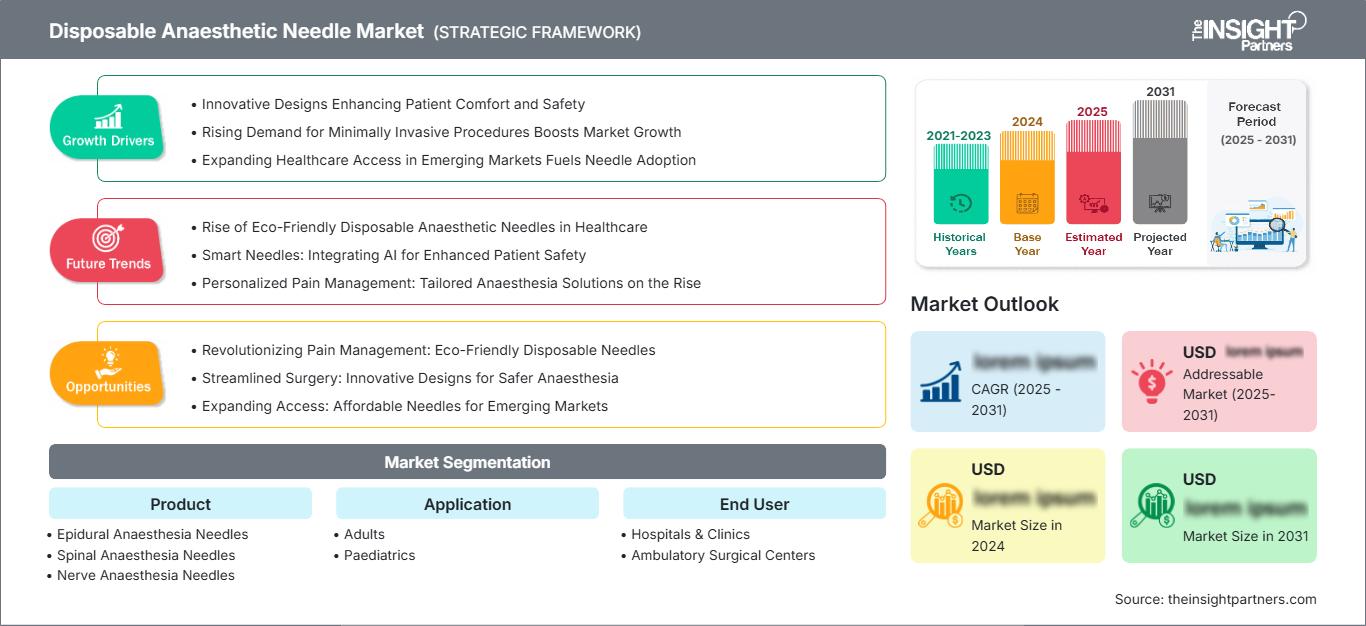
Disposable Anaesthetic Needle Market: Strategic Insights
Regional Insights
North America Disposable Anaesthetic Needle Market
The Disposable Anaesthetic Needle Market forecast indicates that North America is expected to maintain a leadership position, supported by an estimated CAGR of 7.4%–8.2%. The region benefits from high surgical volumes, advanced obstetric anaesthesia practices, and broad acceptance of single-use sterile devices. Hospitals increasingly standardize spinal and epidural kits to improve procedural consistency and reduce infection-control risk.
Growth in structure will be helped along by well-established systems of payment, robust purchase processes, and the existence of international suppliers like Becton, Dickinson and Company and Teleflex Incorporated. The demand for these products will be highest in hospital and outpatient surgery centers, where regional anesthesia helps promote rapid recovery and post-operative pain relief.
U.S. Disposable Anaesthetic Needle Market
The U.S. accounts for approximately 72%–78% of North America’s disposable anaesthetic needle market share and is projected to expand at a CAGR of around 7.6%–8.4%. Demand is driven by large procedural volumes, high adoption of outpatient surgeries, and routine use of spinal and epidural anaesthesia in obstetrics, orthopaedics, and pain-management procedures.
Presence of the companies is established due to extensive distribution channels and buying policies of hospitals including suppliers like Becton, Dickinson and Company and Teleflex Incorporated. The application trends indicate that there will be a rise in demand for the products among adults; however, there would still be specialized requirements for children in terms of quality and assurance.
Europe Disposable Anaesthetic Needle Market
Europe represents an estimated 24%–29% share of the Disposable Anaesthetic Needle Market, with a projected CAGR of 6.8%–7.6%. Germany is the leading country, supported by advanced surgical infrastructure and strong device quality expectations. Regional demand is shaped by infection-control discipline, procedural standardization, and steady use of regional anaesthesia across public and private healthcare systems.
The UK Disposable Anaesthetic Needle Market trends are driven by high day-surgery activity, centralized procurement practices, and a strong emphasis on patient safety. Hospitals increasingly rely on disposable spinal and epidural needles to maintain sterile workflows and reduce reprocessing burden. Demand is particularly stable in obstetric anaesthesia, orthopaedic procedures, and pain-management settings.
Germany tops Europe because of its comprehensive hospital facilities, good clinical training environment, and inclination towards sophisticated medical devices. The adoption is driven by established protocols of anesthesia and regular requirement of spinal and nerve anesthesia needles. Companies with good quality management and sound logistics capabilities are favored during German tenders.
The trio of France, Italy, and Spain adds volume to the market because of hospital renovations, growing elderly populations, and expansion of ambulatory surgery centers. This region exhibits growing preference for disposable versions of the product where stringent infection control practices prevail. The growth is steady but not too high, with demand more from adults than children.
APAC Disposable Anaesthetic Needle Market
Asia Pacific is the fastest-growing Disposable Anaesthetic Needle Market, with an estimated CAGR of 9.2%–10.4% and a market share range of approximately 27%–32%. China is the leading country, supported by hospital expansion, increasing surgical access, and growing domestic medical device capacity. Policy emphasis on healthcare infrastructure upgrades further strengthens adoption.
The high value markets include China, Japan, and South Korea. China is characterized by hospital volume and local manufacture, while Japan and South Korea focus on process accuracy, clinician training, and product quality. Key industrial factors comprise sterilization capability, metal processing ability, and growing involvement of the region in the world medical devices industry.
On the other hand, India and Australia contribute to momentum owing to growing number of surgeries, private health care expenditure and access to outpatient care. The development in India is associated with hospital network expansion and cost-oriented procurement, while Australia's demand stems from clinical maturity and safety compliance. In APAC region, favorable government policies with respect to health care accessibility and medical device production boost market visibility.
Middle East & Africa Disposable Anaesthetic Needle Market
The Middle East & Africa Disposable Anaesthetic Needle Market is developing at an estimated CAGR of 6.5%–7.3%, led by Saudi Arabia. Growth is tied to hospital infrastructure expansion, medical tourism ambitions, and the modernization of surgical services. While procedure volumes vary widely across the region, demand for sterile single-use devices is increasing in tertiary care settings.
The Kingdom of Saudi Arabia and the United Arab Emirates are benefiting from investments in healthcare that are related to wider economic diversification and energy, in addition to infrastructure development initiatives. Hospitals, specialized centers, and independent surgical clinics are driving up the adoption rate of disposables in anaesthesia needles through their construction.
In South Africa, as well as in the remainder of MEA, a slow adaptation is driven by limited budgets, inconsistent capacities in hospitals, and an import-driven procurement process. However, growing access to surgeries and increased awareness about hygiene and infections are contributing to the need for disposables. Investments made in infrastructure in Gulf economies as a result of energy revenues contribute indirectly to healthcare construction.
Segmentation Analysis
Product
- Epidural Anaesthesia Needles: Used in obstetric, surgical, and pain-management procedures, these needles require precise bevel design, depth control, and reliable catheter compatibility to support controlled anaesthetic delivery.
- Spinal Anaesthesia Needles: Spinal needles lead demand due to frequent use in lower-limb, urological, and obstetric procedures, where fine-gauge designs help reduce tissue trauma and post-dural puncture complications.
- Nerve Anaesthesia Needles: Nerve anaesthesia needles are gaining relevance as ultrasound-guided regional blocks expand, requiring enhanced tip visibility, stiffness balance, and ergonomic handling for accurate peripheral nerve localization.
- Paediatric Anaesthesia Needles: Paediatric needles address specialized clinical needs through smaller gauges, careful length selection, and controlled insertion characteristics that support safe anaesthesia delivery in sensitive paediatric procedures.
Application
- Adults: Adult applications dominate because surgical, obstetric, orthopaedic, and chronic pain procedures generate repeat demand for spinal, epidural, and nerve block needles across hospitals and ambulatory centers.
- Paediatrics: Paediatric use remains smaller but clinically critical, with demand centered on specialized needle sizes, careful procedural control, and trusted sterile packaging for age-specific anaesthesia requirements.
End User
- Hospitals & Clinics: Hospitals and clinics contribute the largest revenue base due to high surgical throughput, obstetric services, emergency care needs, and standardized procurement of sterile anaesthesia consumables.
- Ambulatory Surgical Centers: Ambulatory surgical centers are expanding adoption as outpatient procedures increase, requiring compact, reliable, single-use anaesthetic needle supplies that support faster turnover and predictable procedural workflows.
Opportunity Snapshot
| End User | Revenue Contribution | Trend Tag | Adoption Stage |
| Hospitals & Clinics | High | Procedure Volume | Mature |
| Ambulatory Surgical Centers | Medium | Outpatient Shift | Scaling |
Disposable Anaesthetic Needle Market Growth Drivers and Impact Analysis
Rising Surgical Volumes and Regional Anaesthesia Adoption
The most direct growth driver for the Disposable Anaesthetic Needle Market is the steady increase in surgical and interventional procedures requiring reliable local, spinal, epidural, or peripheral nerve anaesthesia. Ageing populations, chronic disease management, orthopaedic interventions, obstetric care, and outpatient surgeries are expanding the number of cases where anaesthetic needles are routinely used. Regional anaesthesia is also gaining clinical preference because it can support targeted pain control, reduce systemic drug exposure, and facilitate faster recovery in suitable patients.
Market effect in the real world is evident from increased base usage in hospitals, clinics, and ambulatory surgical centers. The facilities that conduct many surgeries need constant supply of their product, different gauges to choose from, and effective sterilization. This helps in increasing repeat purchases from suppliers who have a wide range of products and efficient distribution channels. Demand in regional block surgeries increases use of needles designed specifically for those procedures.
Infection-Control Pressure Favoring Single-Use Devices
The aspect of infection prevention constitutes one of the primary drivers of the trend towards the adoption of single-use anaesthetic needles. While reusable or improperly managed equipment can generate contamination risks, single-use sterilized needles make it easier to meet hospital infection prevention policies and eliminate ambiguities. The working process of anaesthesia specialists is always quite limited in terms of time, and the fact that single-use formats make it possible to avoid the process of equipment cleaning, sterilization, and verification proves to be rather beneficial.
As a result, the market penetration driven by the needs for infection prevention is not only about increased volumes of sales. The infection prevention-related expectations affect tenders specifications, suppliers' selection, packaging issues, and traceability. The manufacturers that provide their products with the guarantee of sterilization effectiveness, consistency of quality certification, and reliable performance of batches receive more recognition from the institutions.
Growth of Ambulatory and Day-Surgery Care Models
The migration of procedures from inpatient hospitals to ambulatory surgical centers is reshaping demand for disposable anaesthetic needles. Day-surgery settings require products that are easy to store, quick to prepare, and compatible with standardized procedure packs. Regional anaesthesia is often used in outpatient orthopaedic, pain-management, and minor surgical procedures because it supports faster discharge and controlled post-operative recovery. This increases the importance of compact, dependable, and procedure-ready needle formats.
The market impact is a more diversified customer base and stronger demand for products tailored to efficient turnover. Ambulatory surgical centers may not purchase the same volumes as large hospitals, but they value predictable performance and low workflow complexity. Suppliers can gain traction by offering clear product differentiation, dependable replenishment, and packaging formats suited to outpatient operating rooms. This supports growth beyond traditional hospital procurement channels.
Disposable Anaesthetic Needle Market Future Trends
Greater Use of Echogenic and Procedure-Specific Needle Designs
A major future trend in the Disposable Anaesthetic Needle Market is the continued refinement of echogenic and procedure-specific designs. As ultrasound-guided regional anaesthesia becomes more common, clinicians require needles that provide better tip visibility and controlled advancement. This is particularly important in nerve block procedures, where accurate placement can improve anaesthetic effectiveness and reduce procedural risk. Manufacturers are focusing on surface treatments, tip geometry, and shaft stiffness to support these requirements.
Forward-looking demand will favor products that combine visibility, tactile feedback, and reliable fluid delivery without compromising sterility or cost discipline. Hospitals adopting advanced regional anaesthesia programs may increasingly specify echogenic needles in tenders, especially for complex blocks and teaching environments. This trend creates opportunities for differentiated suppliers, but it also raises expectations around clinician education, product consistency, and evidence-backed performance claims.
Standardized Anaesthesia Kits and Integrated Procedure Packs
Another important trend is the growing use of standardized anaesthesia kits that include disposable needles, syringes, catheters, drapes, and related accessories. Hospitals and ambulatory surgical centers increasingly prefer integrated packs because they reduce preparation variability, simplify inventory management, and improve procedural readiness. For anaesthetic needles, this creates demand for products that fit seamlessly into curated procedure sets for spinal, epidural, and nerve block applications.
Forward-looking suppliers will need to align needle design, packaging dimensions, labeling, and sterilization compatibility with broader kit assembly requirements. This trend may strengthen partnerships between needle manufacturers, procedure pack suppliers, and hospital group purchasing organizations. It also supports customer retention because once a product is embedded in a standardized kit, switching requires clinical validation, procurement review, and workflow adjustment.
Disposable Anaesthetic Needle Market Opportunities
Expansion in Emerging Healthcare Systems
Emerging healthcare systems offer meaningful opportunity for Disposable Anaesthetic Needle Market participants as surgical access expands and hospitals move toward standardized sterile consumables. Countries across Asia Pacific, the Middle East, Africa, and Latin America are investing in operating rooms, maternity care, trauma services, and private surgical centers. These investments increase demand for basic and advanced anaesthesia supplies, especially where infection-control practices are being strengthened through procurement reform and clinical training.
The investment opportunity lies in balancing affordability with dependable quality. Suppliers can gain share by offering tiered portfolios that include standard spinal and epidural needles alongside higher-value echogenic or paediatric options. Local distributor partnerships, regulatory readiness, and training support will be essential. Companies that adapt packaging sizes, pricing models, and inventory strategies to regional purchasing realities can build durable market positions.
Premiumization Through Safety and Visibility Features
Premiumization is a clear opportunity as clinicians seek needles that improve confidence, reduce complications, and support advanced anaesthesia techniques. Features such as echogenic markings, atraumatic tips, secure hubs, color-coded gauges, and improved grip surfaces can differentiate products in competitive tenders. Although basic disposable needles remain important, higher-acuity settings increasingly evaluate total procedural value rather than unit price alone.
Action-oriented suppliers should prioritize clinician feedback, usability testing, and targeted education for anaesthesia teams. Investment in premium designs can improve margins and support differentiation against low-cost competitors. However, successful commercialization requires clear evidence of procedural benefit, consistent manufacturing tolerances, and pricing that aligns with hospital budget constraints. Companies that link innovation to measurable workflow or safety advantages are likely to capture higher-value demand.
Recent Developments
- November, 2025, Elevaris Medical Devices announced the introduction of its procedural needle portfolio and CDMO services across Europe, the Middle East, and Africa (EMEA). The expansion followed the integration of XL Precision Technologies and Spectra Medical Devices, creating a stronger manufacturing platform for specialized medical needles and interventional devices.
- January, 2025, Septodont and Premier Dental launched BufferPro, a single-use sodium bicarbonate buffering solution developed by Premier Dental and commercialized through Septodont. The product is designed to improve the effectiveness and patient comfort of local anesthetic injections, indirectly supporting demand for disposable dental anesthetic needles used during administration.
- February, 2025, B. Braun introduced the Emergency Department Single-Shot Nerve Block Tray, specifically designed for regional anesthesia procedures in emergency settings. The tray incorporates the Ultraplex 360 echogenic needle, enhancing ultrasound visibility and improving procedural accuracy during peripheral nerve block administration.
Frequently Asked Questions

- Comprehensive Market Sizing and Forecast Analysis
- Detailed Segmentation Analysis
- In-Depth Market Dynamics Assessment
- Regional and Country-Level Insights
- Competitive Landscape and Company Benchmarking
- Strategic Business Intelligence
Recent Reports
Testimonials

The Insight Partners' SCADA System Market report is comprehensive, with valuable insights on current trends and future forecasts. The team was highly professional, responsive, and supportive throughout. We are very satisfied and highly recommend their services.
RAN KEDEM Partner, Reali Technologies LTDs
I requested a report on a very specific software market and the team produced the report in a few days. The information was very relevant and well presented. I then requested some changes and additions to the report. The team was again very responsive and I got the final report in less than a week.
JEAN-HERVE JENN Chairman, Future Analytica
We worked with The Insight Partners for an important market study and forecast. They gave us clear insights into opportunities and risks, which helped shape our plans. Their research was easy to use and based on solid data. It helped us make smart, confident decisions. We highly recommend them.
PIYUSH NAGPAL Sr. Vice President, High Beam Global
The Insight Partners delivered insightful, well-structured market research with strong domain expertise. Their team was professional and responsive throughout. The user-friendly website made accessing industry reports seamless. We highly recommend them for reliable, high-quality research services
YUKIHIKO ADACHI CEO, Deep Blue, LLC.
This is the first time I have purchased a market report from The Insight Partners.While I was unsure at first, I visited their web site and felt more comfortable to take the risk and purchase a market report.I am completely satisfied with the quality of the report and customer service. I had several questions and comments with the initial report, but after a couple of dialogs over email with their analyst I believe I have a report that I can use as input to our strategic planning process.Thank you so much for taking the extra time and making this a positive experience.I will definitely recommend your service to others and you will be my first call when we need further market data.
JOHN SUZUKI President and Chief Executive Officer, Board Director, BK Technologies
I wish to appreciate your support and the professionalism you displayed in the course of attending to my request for information regarding to infectious disease IVD market in Nigeria. I appreciate your patience, your guidance, and the fact that you were willing to offer a discount, which eventually made it possible for us to close a deal. I look forward to engaging The Insight Partners in the future, all thanks to the impression you have created in me as a result of this first encounter.
DR CHIJIOKE ONYIA MANAGING DIRECTOR, PineCrest Healthcare Ltd.Reason to Buy
- Informed Decision-Making
- Understanding Market Dynamics
- Competitive Analysis
- Identifying Emerging Markets
- Customer Insights
- Market Forecasts
- Risk Mitigation
- Boosting Operational Efficiency
- Strategic Planning
- Investment Justification
- Tracking Industry Innovations
- Aligning with Regulatory Trends





 Get Free Sample for