
Disposable Bouffant Caps Market Growth, Share & Trends by 2034
Coverage: By Material Type (Plastic, Cotton, Non-Woven Fabrics, Others); End Use Industry (Pharmaceutical and healthcare, Clean rooms, Food processing, Research, Others) , and Geography (North America, Europe, Asia Pacific, and South and Central America)
- Status : Data Released
- Report Code : TIPRE00025592
- Category : Chemicals and Materials
- No. of Pages : 150
- Available Report Formats :


- Last update date : October 30, 2026


2025 Market Size
US$ 2.0 Bn
Base year value
2034 Forecast
US$ 2.64 Bn
Projected by 2034
CAGR 2026-2034
3.13 %
Growth rate
Addressable Market
US$ 21.07 Bn
(2026-2034)
The disposable bouffant caps market is positioned within the broader disposable protective apparel and hygiene consumables landscape, serving environments where hair containment and contamination control are required. The market is valued at US$ 2.0 Billion in 2025 and is projected to reach US$ 2.64 Billion by 2034, reflecting a 3.13% CAGR from 2026 to 2034. Demand is supported by recurring use across pharmaceutical and healthcare facilities, clean rooms, food processing operations, and research environments.
Across North America, procurement is shaped by established hospital networks, food safety practices, cleanroom operations, and institutional purchasing. The disposable bouffant caps market size in the region benefits from recurring replacement demand and mature distribution channels, while manufacturers increasingly differentiate through breathable non-woven structures, secure elastic designs, and application-specific specifications. The regional market is expected to expand at approximately ~4% CAGR through 2034, supported by healthcare utilization and contamination-control requirements.
Disposable Bouffant Caps Market Assessment and Insights
Regional Outlook
- North America: ~30% of the global disposable bouffant caps market share in 2025 | ~4% CAGR through 2034. Market position: North America represents a major established demand center, supported by extensive healthcare infrastructure, institutional procurement, food processing operations, and mature distribution networks. The United States accounts for most regional demand and supports specification-driven purchasing.
- US: ~88% of North American market revenue in 2025 | ~4% CAGR through 2034. Market position: The United States leads North American consumption through large hospital systems, ambulatory care facilities, pharmaceutical operations, laboratories, and food manufacturers. Established group purchasing and distributor relationships support recurring purchases of standardized disposable headwear.
- Europe: ~26% of the global market in 2025 | ~3% CAGR through 2034. Market position: Europe is a mature regional market where Germany represents the leading country in Europe, followed by substantial demand from the UK, France, Italy, and Spain. Regulatory compliance, healthcare procurement, and cleanroom applications sustain demand.
- Asia Pacific: ~36% of the global market in 2025 | ~5% CAGR through 2034. Market position: Asia Pacific is the largest and fastest-growing region, supported by expanding healthcare capacity, pharmaceutical manufacturing, food processing, electronics cleanrooms, and a broad manufacturing base. China is the leading country in Asia Pacific by market scale and supply depth.
Segment Outlook
- End Use Industry: ~51% Share in 2025 | ~4% CAGR through 2034. Market position: End Use Industry represents the largest demand dimension, with pharmaceutical and healthcare applications forming the principal consumption pool. Recurring hospital use, infection-control procedures, pharmaceutical production, and institutional replenishment underpin its position.
- Material Type: ~80% Share in 2025 | ~4% CAGR through 2034. Market position: Material Type has strong commercial importance because non-woven fabrics dominate disposable cap construction. Polypropylene-based structures combine low weight, breathability, scalable conversion, and cost efficiency, supporting broad adoption across healthcare, food processing, and controlled environments.
Competitive Coverage
O&M Halyard, Pidegree Industrial Co., Technoavia, SHAURYA INDUSTRIES, Mr. Disposable Inc., Encompass Group, LLC., Ansell Ltd., Cole-Parmer Instrument Company, LLC., Okay International, Xiantao Daoqi Plastic Co., Ltd.
Methodology
The Insight Partners follows Data Collection & Secondary Research, Primary Research, Data Analysis, and Data Triangulation & Final Review to validate market estimates and insights.
Source: The Insight Partners' analysis based on proprietary research, government publications, company annual reports, investor presentations, industry databases, and expert interviews.
The disposable bouffant cap market has developed from the basic disposable hair restraint category into application-oriented products that focus on comfort, contamination reduction, uniformity in terms of material usage, and efficient purchasing. The significance of non-woven polypropylene continues to be essential for lightweight construction and high speed conversion as well as the breathable and stable spun bond constructions. Folding, elastic bands, ultrasonic welding, packaging and quality control have improved uniformity in production processes, whereas purchasing has become more conscious in regard to lint generation, fit, material characteristics, packaging format and supply reliability.
Looking forward, the further growth of the disposable bouffant cap market will continue to be linked to healthcare infrastructure construction, pharmaceutical expansion, food manufacturing development and cleanroom construction. Asia Pacific serves as a significant production and consumption region, but health care projects in the Middle East and industrial projects in Africa represent demand regions. In response to environmental concerns regarding single-use products, manufacturers look at lower material use, other fibers, recycled materials where appropriate, and more efficient packaging. Purchasers weigh cost efficiency with documentation, reliability of supply, and application specific performance requirements.
Disposable Bouffant Caps Market Report Scope
| Report Attribute | Details |
|---|---|
| Market size in 2025 | US$ 2.0 Billion |
| Market Size by 2034 | US$ 2.64 Billion |
| Global CAGR (2026 - 2034) | 3.13% |
| Historical Data | 2021-2024 |
| Forecast period | 2026-2034 |
Disposable Bouffant Caps Market Analysis
The foundation of the demand side is laid down by the recurrent nature of use of disposable headwear. Hospitals, pharmaceutical companies, food processing plants, laboratories, and cleanrooms require the replacement of their products without delay and not after extended replacement intervals. Therefore, the disposable bouffant caps industry market growth will not be driven primarily by discretionary spending of consumers but by number of staff members, facility usage, hygiene regulations, output levels, and frequency of purchases. The supply chain starts from the raw materials, passes through the non-woven production stage, and terminates at distributors, institutional purchasers, and facility level users.
The supply chain is still very fragmented due to the possibility of production via converting procedures which can be rather standardized. Competitiveness is driven by consistency of materials, elasticity, sizing, packaging volume, customizing, certifications, logistics, and price. In particular, polypropylene non-woven supply is highly crucial because the supply of raw materials and resin prices might impact the cost efficiency of the final product. Regional converting capabilities help manufacturers to reduce their delivery time while international trade helps in sourcing large quantities where it is economically advantageous.
Based on the disposable bouffant caps market analysis, competitive positioning will be increasingly defined by the supplier’s ability to meet multiple end-use specifications without compromising the conversion process. O&M Halyard and Ansell Ltd have the advantage of an existing relationship in healthcare and protective products. Technoavia has a product range that covers both the use of medical workwear and disposable headwear. Encompass Group, LLC participates in both healthcare textiles and disposable medical products. Mr. Disposable Inc. focuses on disposable apparel and domestic manufacture of its products. Xiantao Daoqi Plastic Co., Ltd. has a product range representative of the Asian production capacity for high volume disposable products.
There is a focus on efficient investment into production efficiency, product quality, regional coverage and healthcare protection product ranges than complex product technology. High volume requirement can be catered for effectively by suppliers that have automated conversion, reliable sources of non-wovens and existing institutional channels for delivery. Strategic positioning is increasingly incorporating sustainable manufacturing processes, documentation, private label manufacturing and geographical diversity. Some of the companies in the industry include SHAURYA INDUSTRIES, Pidegree Industrial Co., Cole-Parmer Instrument Company and Okay International.
● REPORT CUSTOMIZATION
Tailor This Report To Align With Your Specific Business Requirements
This report can be customized to align precisely with your business objectives, scope, and target markets. Customization options include tailored segmentation, geography, competitive analysis, and strategic insights to support informed decision-making.
Customize This Report →WHAT YOU CAN ADJUST
- ● Segmentations
- ● Geography
- ● Competitive Analysis
- ● Language Preferences
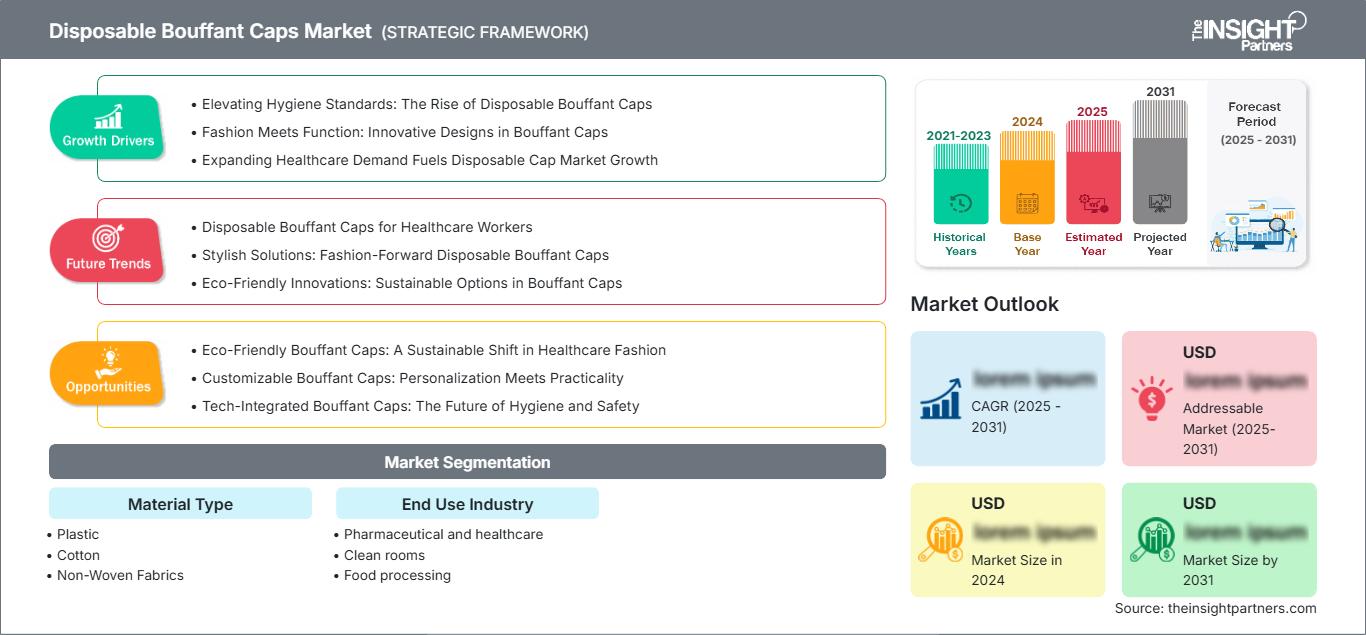
Disposable Bouffant Caps Market: Strategic Insights
Regional Insights
North America disposable bouffant caps market
North America represents approximately ~30% of the global disposable bouffant caps market in 2025 and is projected to expand at ~4% CAGR through 2034. These include extensive hospital systems, ambulatory care centers, pharmaceutical production, laboratory, food production facilities, and industrial hygiene programs. Purchasing is done via distributors, contractual arrangements, and specific product specifications, thus ensuring ongoing replacement needs. The United States accounts for most of the region’s consumption, while Canada and Mexico participate via health care, food production, and industrial sectors.
The market is quite mature, and therefore the growth will increasingly be tied to facility expansion, personnel needs, product replacement, clean room operations, and specification increases but not first time adoption. The buyers will be able to distinguish between commodity caps used for everyday operations and more sophisticated products, which place emphasis on low lint, better fit, antistatic features, and greater comfort. Hair restraints continue to form a part of the personnel hygiene programs at food processing facilities, providing consistent demand source to North American companies.
U.S. disposable bouffant caps market
The U.S. accounts for approximately ~88% of North American disposable bouffant caps market revenue in 2025 and is expected to grow at ~4% CAGR through 2034. The magnitude of this market indicates the magnitude of the healthcare delivery system, manufacturing of pharmaceuticals and biotechnology, manufacturing capability, research capability, and distribution systems. Hospitals and healthcare facilities continue to be key customers, but pharmaceutical plants and laboratories are becoming more concerned about contamination control processes involving individuals that enter the controlled environments.
The company presence includes not only suppliers of specialized disposable products but also broader protection companies. O&M Halyard is a supplier of disposable products for healthcare organizations, whereas Ansell Ltd. has an extensive range of products for medical and cleanroom protection. The Encompass Group, LLC. provides products related to both healthcare textiles and disposable medical products, while Mr. Disposable Inc. is the provider of domestic disposable headwear. Beyond the hospitals there are other markets such as food production, cosmetics, laboratory, and cleanroom manufacturing.
Europe disposable bouffant caps market
Europe represents approximately ~26% of the global disposable bouffant caps market in 2025 and is expected to expand at ~3% CAGR through 2034. Germany is the number one country in Europe, backed by a huge healthcare base, pharmaceutical manufacture, industrial manufacture, and technical standards. The UK has continued demand due to its hospitals, food processors, research centers, and institutional purchasing. France is another country with a significant healthcare and pharmaceutical base, whereas Italy is a combination of healthcare usage along with manufacturing and food processing applications. Spain is a contributor due to its hospitals, food manufacturing, labs, and industrial hygiene applications.
In Europe, there is a fairly mature regulatory system and an emphasis on product specification documentation. In the healthcare market, buyers normally focus on consistency, supplier qualifications, packaging integrity, and material performance properties. Cleanroom applications will create ongoing demand for products with controlled particulate properties and predictable materials, especially in the pharmaceutical, biotechnology, medical device, and manufacturing industries. Food processors are also an ongoing market with a demand for hair restraint products.
The competitive environment is influenced by both multinational protection companies and specialized regional converters. Local production can support shorter lead times and customized specifications, while imported products remain relevant in price-sensitive institutional channels. Environmental considerations are also becoming more prominent, encouraging suppliers to evaluate material efficiency, packaging reduction, and alternative fibers. The combination of established healthcare demand and slower population and facility growth results in a more measured expansion profile than Asia Pacific.
APAC disposable bouffant caps market
Asia Pacific accounts for approximately ~36% of the global disposable bouffant caps market in 2025 and is expected to grow at ~5% CAGR through 2034, making it the largest and fastest-growing region. China is the leading country in Asia Pacific, supported by large-scale manufacturing, healthcare infrastructure, pharmaceutical production, food processing, and extensive disposable-product converting capacity. Japan and South Korea generate demand from sophisticated healthcare and cleanroom environments, while India is supported by expanding hospitals, pharmaceutical production, food manufacturing, and laboratory infrastructure.
Australia represents a smaller but specification-oriented market, with demand shaped by healthcare and food safety practices. Across the region, industrial expansion and cleanroom investment strengthen demand for disposable headwear. Local manufacturing availability improves supply flexibility, while increasing quality requirements encourage movement from basic products toward breathable, consistent, application-specific non-woven constructions.
Segmentation Analysis
Material Type
Material Type is expected to expand at ~4% CAGR from 2026 to 2034. The disposable bouffant caps market scope within this dimension is shaped by the balance between cost, breathability, strength, softness, contamination control, and disposal considerations. Non-woven fabrics remain commercially important because they support scalable manufacturing and consistent coverage. Plastic-based materials serve applications where low cost and moisture resistance are prioritized, while cotton remains relevant in selected product constructions where softness or material preference influences purchasing.
- Plastic: Plastic-based materials support lightweight, economical headwear and can provide useful moisture resistance. They remain relevant in high-volume environments where basic contamination control and low unit cost are primary procurement criteria.
- Cotton: Cotton provides a softer material profile and can be considered where wearer comfort and natural-fiber preferences are important. Its role remains more selective in disposable applications because cost and manufacturing efficiency can favor synthetic alternatives.
- Non-Woven Fabrics: Non-woven fabrics provide the strongest combination of breathability, lightweight construction, scalable conversion, and uniform coverage. Their compatibility with spunbond structures makes them widely applicable across healthcare, pharmaceutical, food, cleanroom, and research settings.
End Use Industry
End Use Industry is projected to grow at ~4% CAGR from 2026 to 2034, supported by recurring institutional consumption. Pharmaceutical and healthcare applications form the largest demand pool because head coverings are integrated into hygiene, operating, and controlled-environment workflows. Clean rooms and research facilities emphasize contamination control and material consistency, while food processing depends on routine personnel hygiene. The diversity of end users reduces dependence on any single application and supports stable replacement demand.
- Pharmaceutical and healthcare: These users require dependable head coverage across hospitals, pharmaceutical plants, laboratories, clinics, and controlled healthcare environments. Purchasing decisions emphasize hygiene, fit, material quality, supply continuity, and compatibility with established gowning or protective-apparel procedures.
- Clean rooms: Cleanroom users prioritize contamination control, low particle generation, and compatibility with controlled environments. Demand is particularly relevant to pharmaceutical, biotechnology, medical device, electronics, and precision manufacturing facilities where personnel-related contamination must be minimized.
- Food processing: Food processors use disposable head coverings as part of personnel hygiene and contamination-control programs. Demand is linked to production throughput, facility audits, worker counts, food safety procedures, and the need to prevent hair from contacting exposed food or production surfaces.
- Research: Research facilities, laboratories, testing centers, and academic institutions use disposable headwear where controlled procedures or hygiene protocols require personnel coverage. Demand is generally specification-driven and linked to laboratory activity, clean procedures, and facility-level procurement policies.
Opportunity Snapshot
| End Use Industry | Revenue Contribution | Trend Tag | Adoption Stage |
| Pharmaceutical and healthcare | High | Clinical Hygiene | Mature |
| Clean rooms | Medium | Particle Control | Scaling |
| Food processing | High | Food Safety | Mature |
| Research | Medium | Lab Hygiene | Scaling |
Disposable Bouffant Caps Market Growth Drivers and Impact Analysis
Expansion of Healthcare and Pharmaceutical Infrastructure
Healthcare infrastructure expansion directly increases the number of personnel, procedures, laboratories, pharmaceutical facilities, and controlled areas where disposable head coverings are routinely used. New hospitals and expanded clinical capacity create recurring consumption rather than one-time equipment demand because caps are replenished as personnel enter operating, treatment, laboratory, and sterile-support areas. Pharmaceutical manufacturing adds another demand layer because personnel entering controlled production environments must follow established gowning and hygiene procedures. Growth in biotechnology, contract manufacturing, diagnostics, and specialty medicines further broadens the addressable facility base. For suppliers, the impact is strongest where new facilities are paired with standardized procurement systems, because a single institutional contract can generate recurring volumes across multiple locations.
Stricter Personnel Hygiene and Contamination-Control Practices
Food processors, healthcare operators, pharmaceutical manufacturers, and research facilities increasingly formalize personnel hygiene requirements to reduce contamination risks. Hair restraints are explicitly recognized within food hygiene frameworks, while cleanroom operations evaluate consumables according to contamination-control requirements. This strengthens the role of disposable bouffant caps as routine procedural items rather than optional accessories. The impact varies by end user: food processing emphasizes prevention of hair contamination, healthcare emphasizes hygiene and workflow integration, and cleanrooms emphasize particulate control. Suppliers therefore benefit from offering standardized designs that can satisfy documented facility specifications. Product quality, packaging integrity, reliable sizing, and consistent elastic performance become important because procurement teams often seek predictable outcomes across large workforces.
Growth of High-Volume Food Processing Operations
Food processing provides a structurally stable consumption base because large production facilities require personnel hygiene controls across shifts and production lines. Expansion of packaged foods, ready-to-eat products, dairy processing, meat and seafood operations, commercial bakeries, and ingredient manufacturing increases the number of workers operating around exposed food or food-contact equipment. Disposable bouffant caps offer a simple method of controlling loose hair while avoiding laundering requirements associated with reusable headwear. The impact is particularly relevant in emerging manufacturing centers where food-processing capacity is becoming more organized and audit-driven. Suppliers that combine low unit costs with consistent quality, bulk packaging, reliable delivery, and food-industry suitability can address the purchasing priorities of large processors and institutional food operators.
Disposable Bouffant Caps Market Future Trends
Shift Toward Lower-Material and Application-Specific Designs
Future disposable bouffant caps market trends are likely to center on balancing contamination-control performance with material efficiency, wearer comfort, and environmental considerations. Manufacturers can reduce material consumption through optimized cap dimensions, lighter non-woven structures, improved elastic attachment, and more efficient folding and packaging. At the same time, different end users are likely to specify different performance priorities. Healthcare users may emphasize comfort and reliable coverage, food processors may focus on secure hair containment, and cleanrooms may place greater weight on particulate performance. This encourages product families rather than a single universal design. The transition will favor manufacturers capable of modifying materials and construction while maintaining efficient high-volume conversion.
Digitalized Production and Supply Chain Optimization
Disposable headwear manufacturing is positioned to benefit from greater automation in cutting, folding, elastic placement, sealing, inspection, and packaging. Digital production monitoring can help manufacturers identify material waste, dimensional variation, equipment downtime, and quality deviations earlier in the process. Buyers are also likely to use more structured supplier qualification and inventory systems as healthcare and industrial customers seek resilient supply. Regional production and distributed warehousing can reduce exposure to freight disruption and shorten replenishment cycles. For manufacturers, the implication is that competitiveness will increasingly depend on operational reliability as much as unit pricing. Investments in automated converting, quality-control systems, demand planning, and regional inventory can improve responsiveness without requiring major changes to the basic product architecture.
Disposable Bouffant Caps Market Opportunities
Premium Non-Woven Products for Controlled Environments
The strongest product-level opportunity lies in developing differentiated non-woven caps for pharmaceutical, healthcare, cleanroom, and research applications where basic commodity products may not fully address user requirements. Suppliers can focus on low-lint construction, improved breathability, antistatic properties, secure elastic systems, and controlled packaging configurations. These features can support higher-value procurement where contamination control and worker comfort are more important than the lowest unit price. Opportunity also exists in standardized documentation and product traceability, particularly for facilities operating under formal quality systems. Manufacturers with flexible converting equipment can serve multiple specifications from a common production platform, allowing them to address premium institutional requirements while retaining the ability to supply conventional high-volume products.
Regional Manufacturing and Distribution Expansion
Regionalization provides a practical opportunity as disposable bouffant caps market Forecasts indicate continued demand from Asia Pacific and developing healthcare and industrial systems in other emerging markets. Local converting facilities can reduce delivery times, lower freight exposure, and support customer-specific packaging or sizing requirements. India, China, Southeast Asia, the Gulf states, and selected African markets provide opportunities where healthcare infrastructure, pharmaceutical production, food processing, and industrial activity are expanding. Suppliers can combine regional manufacturing with centralized quality systems to maintain product consistency across markets. Distributor partnerships, private-label production, and localized packaging can further improve market access while reducing the need for customers to carry large inventories.
Recent Developments
- September 15, 2026: Ansell Ltd. inaugurated a new manufacturing facility in Kovai, India, adding capacity to its healthcare manufacturing footprint and strengthening supply for strategic markets. The facility is already producing for the local market, with additional capacity planned as operations ramp up. The development reinforces Ansell's investment in regional manufacturing, healthcare supply resilience, and customer proximity.
- August 19, 2025: Encompass Group, LLC. announced a contract with Vizient to supply pressure management and surface replacement systems to Vizient provider clients. The agreement expanded direct access to Encompass healthcare products across participating providers and highlighted the company's continued focus on institutional healthcare supply relationships and product availability.
Frequently Asked Questions

- Comprehensive Market Sizing and Forecast Analysis
- Detailed Segmentation Analysis
- In-Depth Market Dynamics Assessment
- Regional and Country-Level Insights
- Competitive Landscape and Company Benchmarking
- Strategic Business Intelligence
Recent Reports
Testimonials

The Insight Partners provided valuable market intelligence that supported our global go-to-market strategy. Their team was professional, responsive, and attentive to our feedback, providing thoughtful analysis and helpful methodological clarifications throughout the project.
Junmo Kim Chief Financial Officer (CFO), Enertech Co., Ltd.
The Insight Partners' SCADA System Market report is comprehensive, with valuable insights on current trends and future forecasts. The team was highly professional, responsive, and supportive throughout. We are very satisfied and highly recommend their services.
RAN KEDEM Partner, Reali Technologies LTDs
I requested a report on a very specific software market and the team produced the report in a few days. The information was very relevant and well presented. I then requested some changes and additions to the report. The team was again very responsive and I got the final report in less than a week.
JEAN-HERVE JENN Chairman, Future Analytica
We worked with The Insight Partners for an important market study and forecast. They gave us clear insights into opportunities and risks, which helped shape our plans. Their research was easy to use and based on solid data. It helped us make smart, confident decisions. We highly recommend them.
PIYUSH NAGPAL Sr. Vice President, High Beam Global
The Insight Partners delivered insightful, well-structured market research with strong domain expertise. Their team was professional and responsive throughout. The user-friendly website made accessing industry reports seamless. We highly recommend them for reliable, high-quality research services
YUKIHIKO ADACHI CEO, Deep Blue, LLC.
This is the first time I have purchased a market report from The Insight Partners.While I was unsure at first, I visited their web site and felt more comfortable to take the risk and purchase a market report.I am completely satisfied with the quality of the report and customer service. I had several questions and comments with the initial report, but after a couple of dialogs over email with their analyst I believe I have a report that I can use as input to our strategic planning process.Thank you so much for taking the extra time and making this a positive experience.I will definitely recommend your service to others and you will be my first call when we need further market data.
JOHN SUZUKI President and Chief Executive Officer, Board Director, BK Technologies
I wish to appreciate your support and the professionalism you displayed in the course of attending to my request for information regarding to infectious disease IVD market in Nigeria. I appreciate your patience, your guidance, and the fact that you were willing to offer a discount, which eventually made it possible for us to close a deal. I look forward to engaging The Insight Partners in the future, all thanks to the impression you have created in me as a result of this first encounter.
DR CHIJIOKE ONYIA MANAGING DIRECTOR, PineCrest Healthcare Ltd.Reason to Buy
- Informed Decision-Making
- Understanding Market Dynamics
- Competitive Analysis
- Identifying Emerging Markets
- Customer Insights
- Market Forecasts
- Risk Mitigation
- Boosting Operational Efficiency
- Strategic Planning
- Investment Justification
- Tracking Industry Innovations
- Aligning with Regulatory Trends





 Get Free Sample for