
Disposable Hygiene Adhesives Market Growth, Size & Forecast by 2034
Coverage: by Origin (Synthetic adhesives, Natural adhesives); Type (Hot melt adhesives, Ethylene-vinyl acetate (EVA), Pressure sensitive adhesive (PSA), Amorphous poly-alpha-olefin (APAO) and polyurethane, Adhesives based on styrene block copolymers (styrene-butadiene-styrene (SBS), Styrene-isoprene-styrene (SIS), Styrene-ethylene-butadiene-styrene (SEBS), And others); Application (Construction adhesive (or bonding adhesive), Core adhesive (or fluff pad adhesive), Positioning adhesive, Elastic adhesive, Frontal tape adhesive, Side tape adhesive, Others); End User (Baby and infant care, Feminine care, Adult care, Specific or specialty care, Others) , and Geography (North America, Europe, Asia Pacific, and South and Central America)
- Status : Data Released
- Report Code : TIPRE00012667
- Category : Chemicals and Materials
- No. of Pages : 150
- Available Report Formats :


- Last update date : August 05, 2026


2025 Market Size
US$ 715.40 Mn
Base year value
2034 Forecast
US$ 1,285.20 Mn
Projected by 2034
CAGR 2026-2034
6.73 %
Growth rate
Addressable Market
US$ 9,043.73 Mn
(2026-2034)
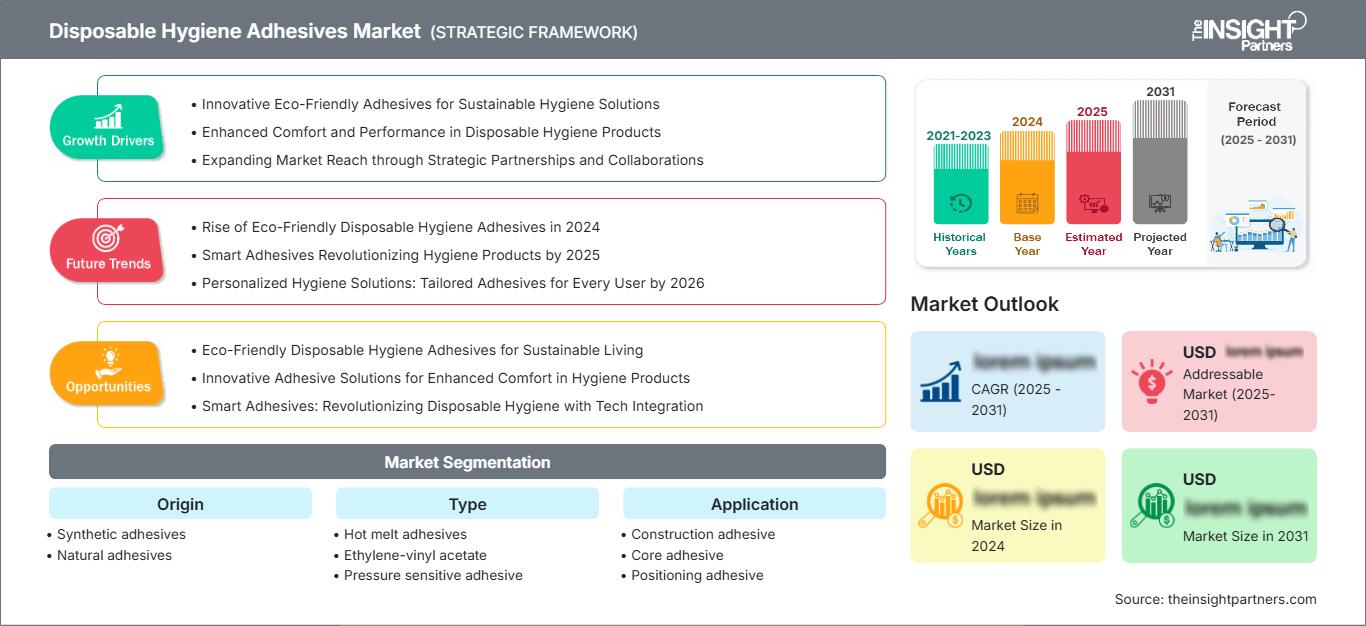
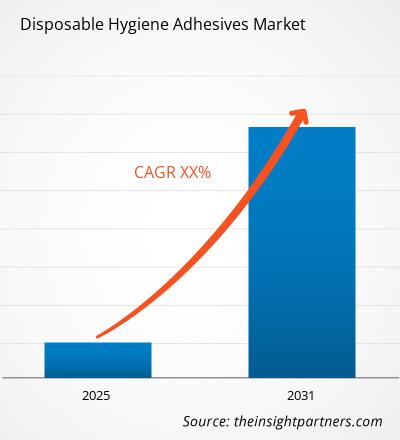
The Disposable Hygiene Adhesives Market was valued at US$ 715.40 Million in 2025 and is projected to reach US$ 1,285.20 Million by 2034, registering a CAGR of 6.73% during 2026–2034. Demand is supported by high-speed production of baby diapers, feminine care products, adult incontinence articles, and medical absorbent disposables, where adhesives enable secure bonding, softness, elasticity, and leakage protection across multilayer nonwoven structures.
In North America, the Disposable Hygiene Adhesives Market size outlook is shaped by adult incontinence demand, premium diaper design, and domestic nonwoven converting capacity. The region is estimated to expand at a 5.8–6.6% CAGR during 2026–2034, supported by aging demographics, brand emphasis on thinner absorbent cores, and supplier focus on low-odor, low-VOC, and skin-compatible hot melt adhesive systems.
Disposable Hygiene Adhesives Market Assessment and Insights
- North America: Share in 2025 of 24–28% and CAGR between 5.8–6.6%. Mature hygiene brands, adult care demand, and high automation support stable regional performance
- US: Share in 2025 of 78–82% of North America and CAGR between 5.9–6.7%. Domestic diaper and incontinence production sustains adhesive consumption.
- Europe: Share in 2025 of 21–25% and CAGR between 5.4–6.2%. Germany, France, Italy, Spain, and the UK lead through regulated hygiene manufacturing and sustainability-led material decisions.
- Asia Pacific: Share in 2025 of 39–43% and CAGR between 7.2–8.0%. China, India, Japan, South Korea, and Indonesia anchor demand from large diaper output and rising adult care penetration.
- Largest Segment: Hot melt adhesives lead with 38–42% market share in 2025 due to superior bonding strength and efficiency, growing at CAGR of 6.2–6.9% through 2034.
- High Growth Segment: Pressure sensitive adhesive (PSA) segment holds 18–22% share in 2025, expanding rapidly at 7.5–8.3% CAGR due to ease of application and flexibility.
- Key companies analyzed in detail: Bostik SA, Dow Inc., Exxon Mobil Corporation, Foreverest Resources Ltd., Guangdong Rurga New Material Technology Co., Ltd., H.B. Fuller Company, Henkel AG & Co. KGaA, Nordson Corporation, Sika AG, TSRC Corporation.
Source: The Insight Partners' analysis based on proprietary research, government publications, company annual reports, investor presentations, industry databases, and expert interviews.
Technology migration is changing the Disposable Hygiene Adhesives Market from commodity bonding toward application-specific formulations for construction, core stabilization, positioning, elastic attachment, and tape fixation. Suppliers are optimizing tack, creep resistance, odor profile, thermal stability, and add-on efficiency as converters run faster diaper and feminine care lines. Production dynamics increasingly depend on polymer security, resin compatibility, and applicator precision, especially as brands redesign products for thinner cores and improved wearer comfort.
Future demand will be strongest in emerging Asia, selected Middle East markets, and aging developed economies where incontinence products are gaining acceptance. Investment is moving toward bio-based content, debonding concepts, lower application temperatures, and automated adhesive dispensing. Regulatory attention to substances of interest and sustainability reporting should favor suppliers with validated safety data, consistent technical support, and the ability to reduce adhesive consumption without compromising hygiene product integrity.
Disposable Hygiene Adhesives Market Report Scope
| Report Attribute | Details |
|---|---|
| Market size in 2025 | US$ 715.40 Million |
| Market Size by 2034 | US$ 1,285.20 Million |
| Global CAGR (2026 - 2034) | 6.73% |
| Historical Data | 2021-2024 |
| Forecast period | 2026-2034 |
Disposable Hygiene Adhesives Market Analysis
The Disposable Hygiene Adhesives Market growth profile is driven by higher use of disposable baby care, feminine hygiene, and adult incontinence products. Adhesives are small cost components but critical performance enablers, bonding nonwovens, films, elastics, absorbent cores, and tapes. Suppliers therefore compete on lower add-on levels, stronger peel performance, and stable bonding during high-moisture exposure.
Supply dynamics are linked to styrenic block copolymers, EVA, APAO, tackifier resins, polyolefins, and specialty applicator systems. Hygiene converters require predictable viscosity, clean cut-off, and compatibility with breathable films and soft nonwovens. The ecosystem also includes equipment providers such as Nordson Corporation, whose dispensing technologies influence adhesive use efficiency and production uptime.
Current Disposable Hygiene Adhesives Market analysis shows a consolidated competitive landscape led by Bostik SA, H.B. Fuller Company, Henkel AG & Co. KGaA, Dow Inc., and Exxon Mobil Corporation, with specialists such as TSRC Corporation and Foreverest Resources Ltd. supporting polymer and resin supply. Competitors are positioning around safety, sustainability, speed, and technical service.
Investment trends focus on bio-based raw materials, lower-temperature hot melts, recyclable hygiene structures, and positioning adhesives for moisture-intensive use. H.B. Fuller Company introduced Full-Care 6550 SecureFix positioning adhesive for absorbent hygiene products in 2025, while Bostik SA gained industry recognition in 2026 for Kizen Miles 9.0, a hygiene adhesive designed to support material separation and recycling.
● REPORT CUSTOMIZATION
Tailor This Report To Align With Your Specific Business Requirements
This report can be customized to align precisely with your business objectives, scope, and target markets. Customization options include tailored segmentation, geography, competitive analysis, and strategic insights to support informed decision-making.
Customize This Report →WHAT YOU CAN ADJUST
- ● Segmentations
- ● Geography
- ● Competitive Analysis
- ● Language Preferences
Disposable Hygiene Adhesives Market: Strategic Insights
Regional Insights
North America Disposable Hygiene Adhesives Market
North America accounted for 24–28% of global revenue in 2025 and is projected to grow at a 5.8–6.6% CAGR during 2026–2034. The region benefits from mature diaper, feminine care, and adult incontinence brands that specify construction, elastic, and positioning adhesives for premium product performance. The Disposable Hygiene Adhesives Market share in North America is reinforced by automated converting assets and steady private-label expansion.
Adult incontinence is a particularly important structural driver because aging populations require products with secure fit, discreet profiles, and leakage control. Suppliers support converters with lower-odor formulations, consistent spray patterns, and technical services that reduce adhesive add-on rates. Regulatory scrutiny of substances of interest also encourages migration toward validated, skin-compatible adhesive systems.
U.S. Disposable Hygiene Adhesives Market
The U.S. represented 78–82% of North American revenue in 2025 and is forecast to expand at a 5.9–6.7% CAGR through 2034. Large domestic production of baby diapers, training pants, feminine care products, and adult briefs sustains consumption of hot melt and pressure-sensitive systems. Brand owners prioritize softness, fit, absorbency, and secure positioning across premium and value tiers.
Bostik SA, H.B. Fuller Company, Henkel AG & Co. KGaA, Dow Inc., Exxon Mobil Corporation, and Nordson Corporation maintain meaningful technology or commercial presence serving U.S. hygiene converters. Application trends include elastic attachment for stretch panels, wetness indicator integration, pad positioning adhesives, and core stabilization systems that support thinner product designs and high-speed manufacturing.
Europe Disposable Hygiene Adhesives Market
Europe held 21–25% of global revenue in 2025 and is expected to grow at a 5.4–6.2% CAGR during 2026–2034. Germany is the leading country because of advanced hygiene manufacturing, strong converting expertise, and supplier proximity. Sustainability requirements, chemical safety expectations, and circular-economy policies are shaping adhesive selection for diapers, feminine care, and adult care products.
The UK market is supported by private-label hygiene products, retailer sustainability requirements, and adult care demand linked to demographic aging. Germany emphasizes high-performance hot melts and equipment reliability, while France, Italy, and Spain collectively support demand through local diaper production, feminine hygiene consumption, and healthcare-oriented absorbent products. Suppliers with low-VOC and bio-based options are gaining attention.
APAC Disposable Hygiene Adhesives Market
Asia Pacific accounted for 39–43% of revenue in 2025 and is projected to expand at a 7.2–8.0% CAGR through 2034. China leads regional consumption through large-scale diaper and feminine care manufacturing, while India shows strong growth from rising penetration and expanding disposable income. Japan and South Korea emphasize premium adult incontinence products.
Industrial drivers include dense nonwoven supply chains, converter investment, and policy focus on local manufacturing. Indonesia, Australia, and Southeast Asian markets add demand through urban retail growth and modern hygiene awareness. Regional suppliers are also increasing capability in styrenic polymers, tackifiers, and hot melt formulations to improve cost competitiveness.
Middle East & Africa Disposable Hygiene Adhesives Market
The Middle East & Africa is forecast to grow at a 6.0–6.8% CAGR during 2026–2034. Saudi Arabia is the leading market, supported by consumer goods manufacturing, retail modernization, and higher demand for baby diapers. The UAE contributes through premium imported hygiene products and regional distribution activity.
South Africa remains important for local and regional supply, while the rest of MEA benefits from population growth, healthcare access, and improving hygiene awareness. Energy and petrochemical integration in the Gulf may support resin and polymer availability, although converters still rely on imported specialty adhesive technologies for demanding applications.
Segmentation Analysis
Origin
The segment is projected to grow at a CAGR of 6.5–7.2% during 2026–2034, driven by increasing demand for both cost-efficient synthetic adhesives and environmentally friendly natural alternatives. Rising sustainability initiatives are accelerating innovation in bio-based formulations across global markets.
- Synthetic adhesives: Widely used due to cost efficiency, consistent performance, and compatibility with high-speed manufacturing processes, making them essential for large-scale hygiene product production globally.
- Natural adhesives: Gaining traction due to environmental concerns and regulatory pressures, particularly in Europe and North America, where demand for biodegradable and eco-friendly solutions is rising steadily.
Type
This segment is expected to grow at a CAGR of 6.6–7.4% during 2026–2034, supported by technological advancements and product-specific performance requirements. The Disposable Hygiene Adhesives Market scope within this segment is expanding due to diverse application needs across hygiene products.
- Hot melt adhesives: Preferred for fast bonding, high strength, and compatibility with automated production lines, making them dominant in diaper manufacturing processes globally.
- Ethylene-vinyl acetate (EVA): Offers flexibility and durability, widely used in hygiene products requiring strong adhesion and thermal stability under varying conditions.
- Pressure sensitive adhesive (PSA): Increasingly adopted due to ease of application and repositionability, particularly in feminine hygiene and adult care products.
- Amorphous poly-alpha-olefin (APAO) and polyurethane: Provide excellent bonding performance and flexibility, supporting advanced hygiene product designs with improved comfort and durability.
- Adhesives based on styrene block copolymers: Offer elasticity and strong adhesion, widely used in elastic attachment and positioning applications within hygiene products.
Application
The application segment is projected to grow at a CAGR of 6.4–7.1% during 2026–2034, driven by increasing complexity of hygiene product designs and the need for specialized adhesive solutions.
- Construction adhesive (or bonding adhesive): Ensures structural integrity of hygiene products, providing strong bonding across multiple layers and enhancing product durability.
- Core adhesive (or fluff pad adhesive): Essential for securing absorbent cores, improving fluid retention and product performance in diapers and sanitary products.
- Positioning adhesive: Enables accurate placement of components during manufacturing, supporting high-speed production processes and product consistency.
- Elastic adhesive: Used for attaching elastic components, enhancing comfort and fit in wearable hygiene products.
- Frontal tape adhesive: Supports secure fastening in diapers, ensuring reliability and user convenience.
- Side tape adhesive: Facilitates easy opening and closing, improving usability and product functionality.
End User
The segment is expected to grow at a CAGR of 6.8–7.6% during 2026–2034, driven by increasing awareness of hygiene and healthcare needs across demographics.
- Baby and infant care: Dominates demand due to high consumption of diapers and wipes, particularly in emerging markets with growing birth rates.
- Feminine care: Experiences steady growth due to rising awareness and improved access to hygiene products globally.
- Adult care: Expanding rapidly due to aging populations and increasing demand for incontinence products.
- Specific or specialty care: Includes niche products such as medical-grade hygiene solutions, supporting specialized applications.
Opportunity Snapshot
| Application | Revenue Contribution | Trend Tag | Adoption Stage |
|---|---|---|---|
| Construction adhesive | High | Layer bonding | Mature |
| Core adhesive | High | Absorbent tech | Mature |
| Positioning adhesive | Medium | Precision lines | Scaling |
| Elastic adhesive | Medium | Comfort fit | Scaling |
| Frontal tape adhesive | Medium | Secure fastening | Mature |
| Side tape adhesive | Medium | Easy closure | Mature |
Disposable Hygiene Adhesives Market Growth Drivers and Impact Analysis
Rising Production of Absorbent Hygiene Products
The higher production of baby diapers, women's hygiene products, and incontinence products is the primary demand determinant of market demand in the Disposable Hygiene Adhesives market. Each article requires multiple adhesive operations, such as bonding, core adhesion, elastic attachment, tape adhesion, and positioning. In the case of increasing production speeds and thinner products, the quality of adhesives becomes critical, not just their ability to bond. Adhesives need to join the multi-layer products without being rigid, smelly, or migrating. Population aging trends from the WHO and the UN will drive adult demand, and birth rates and penetration will drive demand growth in emerging markets.
Shift Toward Thinner, Softer, and Better-Fitting Products
The changing dynamics of consumer expectations have forced companies to manufacture goods that are discreet, versatile, soft, and robust in movement. This has made specialty adhesives all the more necessary, as there is a need to bond thin cores and stretchable materials without adding excessive bulk. Strategic placement of stretch adhesives is seen in waistbands, leg cuffs, and side seams, while core adhesives help keep the absorbent materials together in thin designs. The use of positioning adhesives is seen in adult and feminine care, as positioning adds to their confidence and comfort. Value addition through performance-based formulations leads to commercial benefits. Suppliers who can provide creep-resistant, low-odor, and substrate-tolerant products can guarantee profits despite the converters' squeezing raw material costs.
Sustainability and Safer Chemical Formulation Requirements
The emphasis on sustainability has shifted from a marketing message to a procurement criterion in the hygiene manufacturing sector. Converters are increasingly considering adhesives with low hot-melt temperatures, bio-based materials, reduced add-on rates, and recyclable or degradable materials. The rising pressure for chemical safety in Europe and customer auditing activities have also increased the need for documentation on substances of interest, odor emissions, and skin contact. Bostik SA and H.B. Fuller Company provide examples of sustainable hygiene adhesive development by suppliers in response to customer requirements. This trend means that competition would no longer be based on cost but on proven environmental performance.
Disposable Hygiene Adhesives Market Future Trends
Bio-Based and Debonding-Enabled Adhesive Platforms
Disposable Hygiene Adhesives Market trends will increasingly center on renewable content and controlled separation technologies. Hygiene articles are difficult to recycle because films, nonwovens, absorbent cores, and elastics are bonded into complex multilayer structures. The development of new adhesive technologies that maintain manufacturing efficiency while enabling disengagement in certain end-of-life circumstances may help prevent contamination and improve the recyclability of materials. An illustration of this is the success of Kizen Miles 9.0, manufactured by Bostik SA, which, apart from being made up of renewable raw materials, provides functionalities that are favorable for recycling operations. For the projected period, market adoption will depend on successful piloting, price levels, safety assessments, and proper waste management.
Precision Dispensing and Lower Adhesive Add-On Strategies
Future competitiveness will require minimizing the use of adhesives to achieve better, cleaner bonds. Precision dispensing technology, precise nozzle control, and digital tracking will enable converters to minimize waste, downtime, and quality variability. Equipment providers such as Nordson Corporation play a critical role, as the accuracy of the application determines the amount of adhesive used and the number of defects. Reduced add-on systems are desirable due to variations in prices of tackifiers, polymers, and energy. It is also desirable to provide products that feel soft due to minimal stiff adhesives. Future development will be based on the formulation of systems together with precision equipment.
Disposable Hygiene Adhesives Market Opportunities
Localized Supply for Asian Hygiene Converters
Asia Pacific presents the best opportunity because it combines high capacity for diaper manufacturing, increasing use of feminine hygiene products, and higher adult incontinence penetration. The Disposable Hygiene Adhesives Market forecasts now indicate that companies able to localize manufacturing, minimize time delays, and deliver technical services near large converting centers have a greater chance of success. In China and India, there is a need for cost-efficient solutions, whereas in Japan and South Korea, there is a need for quality solutions and better performance in adult care applications. Companies that develop regional resin-sourcing and application labs and converter relationships will be better able to retain their customers.
Performance Adhesives for Adult Incontinence Products
Incontinence care presents a significant growth opportunity because adhesives must perform multiple roles and provide reliable fit, discretion, and comfort. This is supported by aging populations in North America, Europe, Japan, South Korea, and China. Incontinence care offers several opportunities to adhesive providers, including elastic attachment, positioning, and core stability. All these applications depend on the failure to perform their roles effectively, as this impacts the ability to control leaks. Opportunities are presented not only by increased sales volume but also by premium formulations with low odor, softness, and excellent wet resistance.
Recent Developments
- January 2026: Henkel has signed an agreement to acquire ATP Adhesive Systems, a Swiss company specializing in high-performance water-based specialty tapes for various sectors, such as automotive and healthcare. ATP, which has around 700 employees and anticipated sales of approximately 270 million euros in fiscal year 2025, operates in Europe and North America.
- April 2025: Tex Year has launched R3220, a bio-based polyurethane reactive (PUR) hot melt adhesive designed for electronics. This adhesive contains 40% bio-based materials and reflects Tex Year's commitment to sustainable development and environmentally friendly products.
Frequently Asked Questions

- Comprehensive Market Sizing and Forecast Analysis
- Detailed Segmentation Analysis
- In-Depth Market Dynamics Assessment
- Regional and Country-Level Insights
- Competitive Landscape and Company Benchmarking
- Strategic Business Intelligence
Recent Reports
Testimonials

The Insight Partners' SCADA System Market report is comprehensive, with valuable insights on current trends and future forecasts. The team was highly professional, responsive, and supportive throughout. We are very satisfied and highly recommend their services.
RAN KEDEM Partner, Reali Technologies LTDs
I requested a report on a very specific software market and the team produced the report in a few days. The information was very relevant and well presented. I then requested some changes and additions to the report. The team was again very responsive and I got the final report in less than a week.
JEAN-HERVE JENN Chairman, Future Analytica
We worked with The Insight Partners for an important market study and forecast. They gave us clear insights into opportunities and risks, which helped shape our plans. Their research was easy to use and based on solid data. It helped us make smart, confident decisions. We highly recommend them.
PIYUSH NAGPAL Sr. Vice President, High Beam Global
The Insight Partners delivered insightful, well-structured market research with strong domain expertise. Their team was professional and responsive throughout. The user-friendly website made accessing industry reports seamless. We highly recommend them for reliable, high-quality research services
YUKIHIKO ADACHI CEO, Deep Blue, LLC.
This is the first time I have purchased a market report from The Insight Partners.While I was unsure at first, I visited their web site and felt more comfortable to take the risk and purchase a market report.I am completely satisfied with the quality of the report and customer service. I had several questions and comments with the initial report, but after a couple of dialogs over email with their analyst I believe I have a report that I can use as input to our strategic planning process.Thank you so much for taking the extra time and making this a positive experience.I will definitely recommend your service to others and you will be my first call when we need further market data.
JOHN SUZUKI President and Chief Executive Officer, Board Director, BK Technologies
I wish to appreciate your support and the professionalism you displayed in the course of attending to my request for information regarding to infectious disease IVD market in Nigeria. I appreciate your patience, your guidance, and the fact that you were willing to offer a discount, which eventually made it possible for us to close a deal. I look forward to engaging The Insight Partners in the future, all thanks to the impression you have created in me as a result of this first encounter.
DR CHIJIOKE ONYIA MANAGING DIRECTOR, PineCrest Healthcare Ltd.Reason to Buy
- Informed Decision-Making
- Understanding Market Dynamics
- Competitive Analysis
- Identifying Emerging Markets
- Customer Insights
- Market Forecasts
- Risk Mitigation
- Boosting Operational Efficiency
- Strategic Planning
- Investment Justification
- Tracking Industry Innovations
- Aligning with Regulatory Trends





 Get Free Sample for