
Distributed Temperature Sensing Market Share, Growth & Forecast by 2034
Coverage: by Fiber Type (Single-mode Fibers, Multimode Fibers); Operating Principle (Optical Time Domain Reflectometry (OTDR), Optical Frequency Domain Reflectometry (OFDR)); Application (Oil and Gas Production, Power Cable Monitoring, Pipeline Surveillance, Fire Detection, Environmental Monitoring, Others) , and Geography (North America, Europe, Asia Pacific, and South and Central America)
- Status : Data Released
- Report Code : TIPRE00009889
- Category : Electronics and Semiconductor
- No. of Pages : 150
- Available Report Formats :


- Last update date : August 07, 2026


2025 Market Size
US$ 785.47 Mn
Base year value
2034 Forecast
US$ 1,569.91 Mn
Projected by 2034
CAGR 2026-2034
8.00 %
Growth rate
Addressable Market
US$ 10,593.29 Mn
(2026-2034)
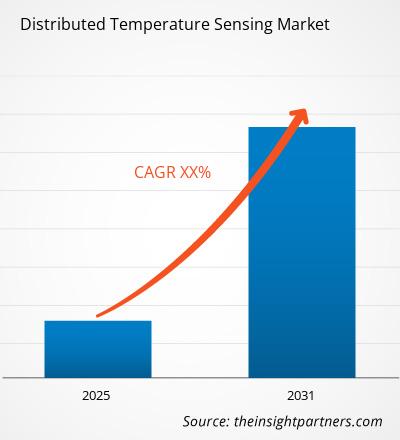
The Distributed Temperature Sensing Market Size reached USD 785.47 Million in 2025 and is estimated to witness a CAGR of 8.00% in forecast period 2026 to 2034, with market size predicted to be worth US$ 1,569.91 Million by 2034. Growth drivers include the need for continuous fiber optic temperature sensing for extended distance infrastructure, hazardous facilities, and critical infrastructure.
North American distributed temperature sensing market size is forecast to grow at a CAGR range of 7.4–8.2% due to shale play monitoring needs, power grid modernization, liquefied natural gas facility construction, and pipeline monitoring initiatives. Drivers include mature oil field operations, investments in grid reliability, and a move from periodic to continuous thermal sensing for power cables, wells, tunnels, and industrial facilities.
Distributed Temperature Sensing Market Assessment and Insights
- North America held 32–36% share in 2025 and is growing at a CAGR range of 7.4–8.2% during 2026–2034, supported by oilfield surveillance, grid upgrades, and pipeline safety programs.
- US represented 80–84% of North America in 2025 and is growing at a CAGR range of 7.5–8.3%, led by shale monitoring, utility cable ratings, and infrastructure protection.
- Europe accounted for 24–28% share in 2025 and is advancing at a CAGR range of 6.7–7.5%, with Germany, the UK, France, Italy, and Spain leading adoption.
- Asia Pacific captured 26–30% share in 2025 and is expanding at a CAGR range of 8.6–9.5%, led by China, Japan, South Korea, India, and Australia.
- Largest Segment Single-mode Fibers held 56–60% market share in 2025 and is growing at a CAGR range of 7.8–8.6%, supported by long-distance sensing and low attenuation.
- High Growth Segment Power Cable Monitoring held 20–24% market share in 2025 and is growing at a CAGR range of 9.0–9.9%, driven by grid loading and renewable interconnection.
- Key companies analyzed in detail: AFL, AP Sensing GmbH, Bandweaver Technologies Limited, Halliburton Company, NKT Photonics A/S, OFS Fitel, LLC, SLB, Sumitomo Electric Industries, Ltd., Weatherford International plc, and Yokogawa Electric Corporation.
Source: The Insight Partners' analysis based on proprietary research, government publications, company annual reports, investor presentations, industry databases, and expert interviews.
The technology development within the Distributed Temperature Sensing market has moved away from rudimentary alarm-based temperature recording to more advanced, high resolution, software-driven asset monitoring system. The current generation of Raman and Brillouin scattered systems come equipped with analytics, SCADA connectivity and tough interrogators for down-hole wells, power cables, pipelines, tunnels, and environmental sensors. Production considerations are based on the type of fiber optic cable used, the stability of the laser, the sensitivity of the receiver, the process of calibration, and effective installation that ensures that the fibers remain protected in the environment they operate in.
Future demand will expand as the need for more thermal visibility arises in new industrial corridors, offshore wind connections, underground transmission and pipelines. It is likely that there will be more investment in long-distance single mode systems, miniaturization of interrogators, temperature and acoustic sensors, and service providers that will analyze the thermal data into maintenance actions.
Distributed Temperature Sensing Market Report Scope
| Report Attribute | Details |
|---|---|
| Market size in 2025 | US$ 785.47 Million |
| Market Size by 2034 | US$ 1,569.91 Million |
| Global CAGR (2026 - 2034) | 8.00% |
| Historical Data | 2021-2024 |
| Forecast period | 2026-2034 |
Distributed Temperature Sensing Market Analysis
Drivers for Distributed Temperature Sensing Market include the need to monitor thermal anomalies prior to loss of production, cable failures, pipeline leaks, and fires. In terms of technology, Distributed Temperature Sensing transforms optical fiber into a linear sensor, allowing for a large number of data points to be taken along assets which are impossible to measure manually. Oil & Gas companies utilize DTS for production profiling, and utilities use DTS for dynamic cable rating and hotspot detection.
The value chain in the market involves fiber manufacturers, sensing cable producers, optical interrogator suppliers, system integrators, EPC contractors, analytics suppliers, and maintenance personnel. Supply chain drivers include availability of specialty fibers, cable armoring, photonics components, calibration capabilities, and proper installation practices. As a result, Distributed Temperature Sensing Market analysis must take into consideration hardware performance as well as deployment engineering, since accuracy of measurement depends on these aspects.
Competitive positioning depends on the reference application, sensing distance, resolution, user-friendliness of the software, and field support. AP Sensing GmbH and Bandweaver Technologies Limited concentrate on infrastructure monitoring applications. Halliburton Company, Schlumberger Limited, and Weatherford International plc tie up the concept of DTS with oilfield services. AFL, OFS Fitel, LLC, Sumitomo Electric Industries, Ltd., NKT Photonics A/S, and Yokogawa Electric Corporation contribute to the eco-system because of their expertise in fiber, photonics, cable monitoring, and industrial automation.
Trends in the investment area include the preference for the package of the monitoring tools rather than individual equipment. The customer's attention is now shifting toward security issues, remote diagnostics, alarm logic, and compatibility with the enterprise maintenance systems. The key to success is the ability to demonstrate good results of operation in long-distance, high temperature, sub-sea, and electrically noisy applications.
● REPORT CUSTOMIZATION
Tailor This Report To Align With Your Specific Business Requirements
This report can be customized to align precisely with your business objectives, scope, and target markets. Customization options include tailored segmentation, geography, competitive analysis, and strategic insights to support informed decision-making.
Customize This Report →WHAT YOU CAN ADJUST
- ● Segmentations
- ● Geography
- ● Competitive Analysis
- ● Language Preferences
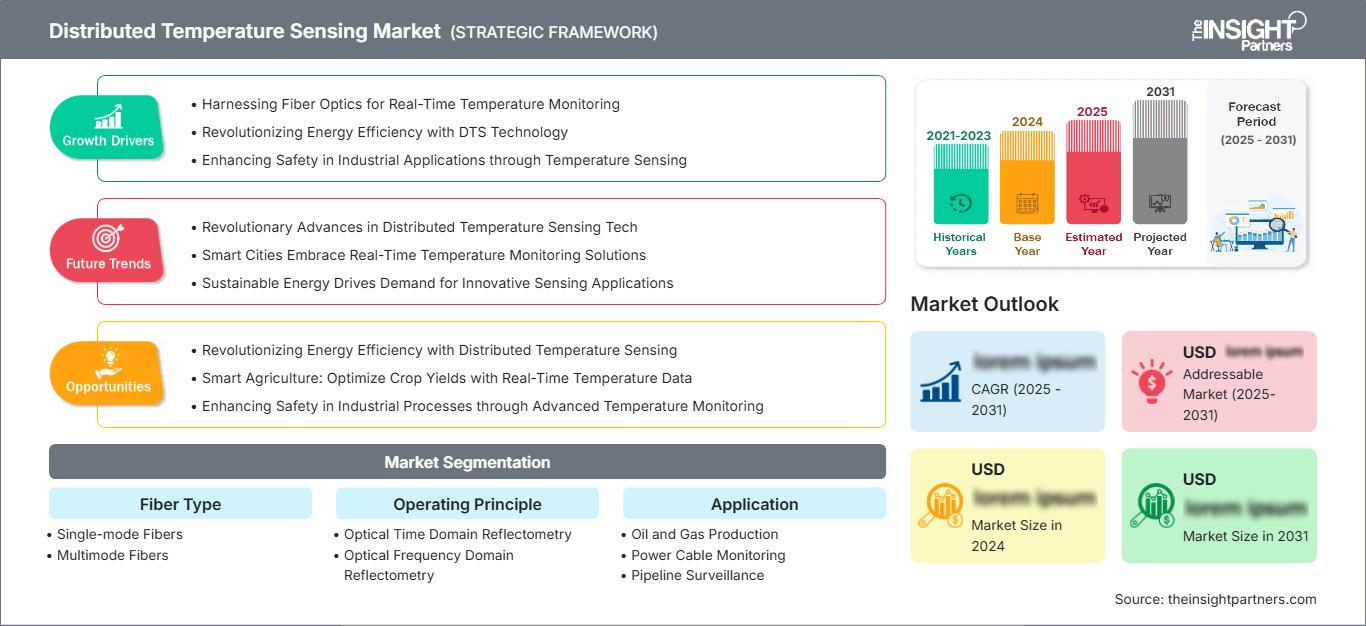
Distributed Temperature Sensing Market: Strategic Insights
Regional Insights
North America Distributed Temperature Sensing Market
North America held 32–36% share in 2025 and is projected to grow at a CAGR range of 7.4–8.2% through 2034. Distributed Temperature Sensing Market share is supported by unconventional oil and gas monitoring, pipeline integrity programs, underground power cable loading, and fire detection in transport assets. The International Energy Agency reported energy investment of USD 3.3 trillion in 2025, reinforcing capital attention on reliable energy infrastructure and grid assets.
Regional adoption is strongest in the US, where shale wells, LNG terminals, refineries, and high-voltage corridors need continuous temperature awareness. Canada contributes through oil sands, mining, and power transmission, while Mexico adds pipeline and industrial monitoring opportunities. System purchases are linked to safety compliance, reduced downtime, and the ability to monitor long distances without dense electrical sensor networks.
U.S. Distributed Temperature Sensing Market Market
The US represented 80–84% of North America in 2025 and is forecast to grow at a CAGR range of 7.5–8.3%. Company presence includes Halliburton Company, SLB, Weatherford International plc, AFL, OFS Fitel, LLC, and Yokogawa Electric Corporation through oilfield services, specialty fiber, and automation channels. Applications are concentrated in downhole thermal profiling, pipeline surveillance, power cable monitoring, and industrial fire detection.
Adoption is influenced by aging energy infrastructure, grid congestion, offshore and onshore production complexity, and the economic cost of unplanned failures. Utilities value distributed sensing for ampacity management and hotspot alerts, while oil and gas operators use thermal signatures to optimize flow and detect wellbore issues. The US market also benefits from strong integrator capability and established field-service networks.
Europe Distributed Temperature Sensing Market Market
The Europe region had a share of 24-28% in 2025 and will grow at a CAGR rate of 6.7%-7.5%. In Europe, Germany leads with industrial automation, energy networks, and tunnel transportation. The United Kingdom has demand in offshore wind export cables, oil & gas assets, and railway transportation. In Europe, France, Italy, and Spain have demand in grid management, metro safety, utility corridors, and environmental monitoring projects.
In the European region, the buying considerations of customers include assurance in safety, energy efficiency, and life cycle documentation. The players in the European region are NKT Photonics A/S, AP Sensing GmbH, Bandweaver Technologies Limited, Sumitomo Electric Industries, Ltd., and Yokogawa Electric Corporation. The growth in this region is due to underground transmission, renewable integration, and tunnel fire safety requirement for continuous monitoring.
APAC Distributed Temperature Sensing Market Market
The Asia Pacific region accounted for 26-30% market share in 2025 and is projected to witness a CAGR of 8.6-9.5%. China dominates with grid expansion, metros, petrochemical plants, and industrial corridors. Premium monitoring systems are promoted in Japan and South Korea for power utility and manufacturing applications, and in India and Australia for transmission lines, mining, pipelines, and renewables.
Electrification, industrial safety, and infrastructure resilience drive the Distributed Temperature Sensing Market in APAC. There is fierce price competition but the adoption of high-end solutions increases where operators require sensing distance, accuracy, and control room integration. Growth in the region is faster than mature regions as the newly developed assets may integrate fiber sensing.
Middle East & Africa Distributed Temperature Sensing Market Market
Middle East & Africa is projected to grow at a CAGR range of 7.0–8.0% as Saudi Arabia, the UAE, South Africa, and the rest of MEA expand oilfield, pipeline, power, and infrastructure monitoring. Saudi Arabia leads through upstream production, industrial cities, and utility investment, while the UAE contributes through energy logistics and smart-infrastructure programs.
South Africa supports mining, power cable, and industrial safety applications, but project execution depends on financing and technical service availability. Regional buyers prioritize systems that tolerate heat, remote terrain, and hazardous environments. DTS is attractive where long-distance coverage reduces manual inspection and improves incident detection across pipelines, substations, tunnels, and industrial sites.
Segmentation Analysis
Fiber Type
Fiber Type is expected to grow at a CAGR range of 7.8–8.7% during 2026–2034 as Distributed Temperature Sensing Market scope covers Single-mode Fibers and Multimode Fibers. Buyers select fiber based on distance, attenuation, installation environment, spatial resolution, and system cost. Single-mode fibers dominate long routes, while multimode fibers remain useful for shorter industrial and facility-level sensing.
- Single-mode Fibers remain the volume anchor because they support long-distance temperature measurement, lower attenuation, and reliable deployment across pipelines, transmission cables, wells, tunnels, and remote infrastructure corridors.
- Multimode Fibers hold strategic relevance in shorter-range facilities where installation simplicity, cost control, and sufficient signal strength make them practical for fire detection, process equipment, and plant monitoring.
Operating Principle
Operating Principle is projected to grow at a CAGR range of 7.6–8.5% during 2026–2034 as users compare Optical Time Domain Reflectometry and Optical Frequency Domain Reflectometry. OTDR remains widely deployed for long-range monitoring and rugged infrastructure applications. OFDR gains attention where shorter distances require high spatial resolution, fast response, and detailed thermal mapping.
- Optical Time Domain Reflectometry is preferred for long-distance assets because it measures backscatter timing along fiber routes, supporting pipelines, power cables, wells, and transport infrastructure with scalable coverage.
- Optical Frequency Domain Reflectometry is strategically important for high-resolution monitoring over shorter distances, especially where precise thermal gradients, laboratory validation, or compact asset mapping is required.
Application
Application is expected to grow at a CAGR range of 8.0–8.9% during 2026–2034 as DTS moves from niche safety systems toward operational intelligence. Oil and gas production remains large, but power cable monitoring is expanding rapidly with grid loading, underground transmission, and renewable integration. Pipeline surveillance, fire detection, and environmental monitoring broaden the addressable base.
- Oil and Gas Production uses DTS for downhole profiling, steam-assisted recovery, flow assurance, and well integrity, where continuous thermal data improves production decisions and reduces intervention risk.
- Power Cable Monitoring is gaining strategic importance as utilities need real-time hotspot detection, dynamic ratings, and thermal visibility across underground, submarine, and renewable interconnection cables.
- Pipeline Surveillance relies on distributed thermal signatures to identify leaks, intrusion effects, ground movement, or abnormal flow conditions across long routes that cannot be inspected continuously by crews.
- Fire Detection applies fiber sensing in tunnels, conveyors, cable trays, warehouses, and industrial corridors where early temperature-rise detection supports evacuation, asset protection, and incident response.
- Environmental Monitoring uses thermal profiles for groundwater, permafrost, dam seepage, and geotechnical observation, helping agencies and operators track subtle changes across extended natural assets.
Opportunity Snapshot
| Application | Revenue Contribution | Trend Tag | Adoption Stage |
| Oil and Gas Production | High | Well Profiling | Mature |
| Power Cable Monitoring | High | Dynamic Rating | Scaling |
| Pipeline Surveillance | Medium | Leak Alerts | Scaling |
| Fire Detection | Medium | Tunnel Safety | Mature |
| Environmental Monitoring | Low | Groundwater Heat | Emerging |
Distributed Temperature Sensing Market Growth Drivers and Impact Analysis
Critical Infrastructure Needs Continuous Thermal Visibility
Power cable, tunnel, pipeline, well, and industrial corridor operators now require constant heat imaging due to the small differences in temperature, which indicate an overload, leaks, friction, fires, or mechanical stress on the equipment. DTS offers a remote monitoring system without using thousands of individual electrical sensors, which are prone to failure in difficult conditions. It makes its influence on the market most apparent in cases when the asset is buried, far away, hazardous or costly to halt. Utilities will be able to regulate their cable loading to avoid insulation degradation, and pipeline operators will detect any thermal anomaly sooner.
Oil and Gas Optimization Sustains High-Value Adoption
Oil and gas applications remain a high-value driver because operators use thermal profiles to understand production behavior, steam movement, injection performance, wellbore integrity, and flow assurance. DTS is especially useful in unconventional wells, thermal recovery, subsea assets, and long pipelines where manual inspection is limited. The market impact extends beyond safety because better thermal data can improve recovery planning, reduce intervention frequency, and support predictive maintenance. Service companies with reservoir knowledge and fiber installation capability have an advantage over pure equipment vendors. As mature fields require more precise monitoring, demand will remain linked to productivity, safety, and asset-life extension.
Grid Expansion and Electrification Raise Cable Monitoring Demand
Electrification is increasing stress on transmission and distribution networks, creating stronger demand for real-time cable temperature monitoring. Underground and submarine cables are expensive to repair, and thermal overload can reduce lifetime long before a visible fault occurs. DTS helps utilities detect hotspots, manage dynamic ratings, and improve confidence in renewable interconnections, data-center supply, and urban grid upgrades. The market impact is amplified by global energy investment moving toward electricity infrastructure, with the IEA highlighting large capital flows into grids, storage, and electrification in 2025. Suppliers that package sensing with utility analytics can convert reliability concerns into long-term monitoring programs.
Distributed Temperature Sensing Market Future Trends
AI-Assisted Thermal Event Classification
Distributed Temperature Sensing Market trends will increasingly center on AI-assisted event classification that separates genuine anomalies from harmless temperature variation. Operators want fewer false alarms and faster interpretation of thermal traces across long fiber routes. Future systems will combine DTS data with load, flow, weather, vibration, and asset-history inputs to identify likely causes such as overload, leakage, fire growth, or insulation degradation. This trend will move value from hardware readings toward decision support. Vendors able to validate algorithms with field data and explain alarm logic will be better positioned in regulated utility, oilfield, and transport environments.
Hybrid Fiber Sensing Platforms Become Standard
Future deployments will increasingly combine distributed temperature, acoustic, and strain sensing on coordinated fiber platforms. This approach gives operators a broader view of asset condition, because temperature alone may not distinguish every threat. Pipelines can pair thermal leak signatures with acoustic intrusion indicators, while power cables can combine heat profiles with vibration or strain observations. Hybrid platforms also improve project economics by using shared fiber routes, enclosures, communications, and analytics. Over time, infrastructure owners will prefer integrated sensing architectures that support multiple risk categories instead of isolated monitoring systems purchased by separate operational teams.
Distributed Temperature Sensing Market Opportunities
Power Cable Monitoring Packages for Grid Operators
Distributed Temperature Sensing Market Forecasts point to an opportunity in standardized power cable monitoring packages for utilities and renewable interconnection owners. Suppliers can combine sensing fiber, interrogators, installation guidance, dynamic rating software, and maintenance dashboards into repeatable offerings for underground, submarine, and high-load urban routes. Investment should focus on interoperability with grid control systems, cybersecurity, and thermal models that translate temperature profiles into actionable loading decisions. The opportunity is strongest where electrification, offshore wind, industrial demand, and data-center growth raise cable utilization faster than new corridors can be built.
Environmental and Geotechnical Monitoring Services
Environmental and geotechnical monitoring creates an opportunity for DTS providers to move into service-based models. Fiber-optic temperature profiles can support dam seepage detection, groundwater exchange studies, permafrost monitoring, mine stability, and contaminated-site assessment. These projects often need interpretation, seasonal baselines, and reporting rather than only equipment supply. Vendors can partner with engineering consultants, hydrologists, and public agencies to deliver monitoring programs with recurring data services. The opportunity is attractive because climate adaptation, water security, and infrastructure resilience require continuous observation across locations where conventional point sensors provide limited spatial coverage.
Recent Developments
- March 2025: NKT introduced a new cable monitoring platform that integrates multiple sensors and technologies to deliver a comprehensive overview of power cable health, aiming to enhance the reliability of power cable networks. The platform consolidates data from various sensors, including vessel location, acoustic sensing around the cable, burial depth, and conductor temperature. By analysing this combined data, the platform can detect potential threats, such as slow moving vessels, fishing gear, or anchors near the cable, along with other hazards that could damage the cable. When one or more parameters exceed set thresholds, the system triggers an alert, enabling operators to take corrective actions and bolster the resilience of the grid.
- April 2025: Global technology company SLB (NYSE: SLB) today announced a partnership with Shell to deploy Petrel subsurface software across its assets worldwide. The adoption of Petrel software is designed to increase digital capabilities and drive operating cost efficiencies.
- July 2024: Viavi Solutions Inc. (VIAVI) (NASDAQ: VIAV) today announced the launch of NITRO Fiber Sensing, an integrated real-time asset monitoring and analytics solution for critical infrastructure ranging from oil, gas and water pipelines to electrical power transmission, border/perimeter security and data center interconnects.
Frequently Asked Questions

- Comprehensive Market Sizing and Forecast Analysis
- Detailed Segmentation Analysis
- In-Depth Market Dynamics Assessment
- Regional and Country-Level Insights
- Competitive Landscape and Company Benchmarking
- Strategic Business Intelligence
Recent Reports
Testimonials

The Insight Partners provided valuable market intelligence that supported our global go-to-market strategy. Their team was professional, responsive, and attentive to our feedback, providing thoughtful analysis and helpful methodological clarifications throughout the project.
Junmo Kim Chief Financial Officer (CFO), Enertech Co., Ltd.
The Insight Partners' SCADA System Market report is comprehensive, with valuable insights on current trends and future forecasts. The team was highly professional, responsive, and supportive throughout. We are very satisfied and highly recommend their services.
RAN KEDEM Partner, Reali Technologies LTDs
I requested a report on a very specific software market and the team produced the report in a few days. The information was very relevant and well presented. I then requested some changes and additions to the report. The team was again very responsive and I got the final report in less than a week.
JEAN-HERVE JENN Chairman, Future Analytica
We worked with The Insight Partners for an important market study and forecast. They gave us clear insights into opportunities and risks, which helped shape our plans. Their research was easy to use and based on solid data. It helped us make smart, confident decisions. We highly recommend them.
PIYUSH NAGPAL Sr. Vice President, High Beam Global
The Insight Partners delivered insightful, well-structured market research with strong domain expertise. Their team was professional and responsive throughout. The user-friendly website made accessing industry reports seamless. We highly recommend them for reliable, high-quality research services
YUKIHIKO ADACHI CEO, Deep Blue, LLC.
This is the first time I have purchased a market report from The Insight Partners.While I was unsure at first, I visited their web site and felt more comfortable to take the risk and purchase a market report.I am completely satisfied with the quality of the report and customer service. I had several questions and comments with the initial report, but after a couple of dialogs over email with their analyst I believe I have a report that I can use as input to our strategic planning process.Thank you so much for taking the extra time and making this a positive experience.I will definitely recommend your service to others and you will be my first call when we need further market data.
JOHN SUZUKI President and Chief Executive Officer, Board Director, BK Technologies
I wish to appreciate your support and the professionalism you displayed in the course of attending to my request for information regarding to infectious disease IVD market in Nigeria. I appreciate your patience, your guidance, and the fact that you were willing to offer a discount, which eventually made it possible for us to close a deal. I look forward to engaging The Insight Partners in the future, all thanks to the impression you have created in me as a result of this first encounter.
DR CHIJIOKE ONYIA MANAGING DIRECTOR, PineCrest Healthcare Ltd.Reason to Buy
- Informed Decision-Making
- Understanding Market Dynamics
- Competitive Analysis
- Identifying Emerging Markets
- Customer Insights
- Market Forecasts
- Risk Mitigation
- Boosting Operational Efficiency
- Strategic Planning
- Investment Justification
- Tracking Industry Innovations
- Aligning with Regulatory Trends





 Get Free Sample for