
Driveline Additives Market Growth, Share & Trends by 2034
Coverage: by Product Type (Transmission Fluid Additives, Gear Oil Additives, Others); Additive Type (Dispersants, Viscosity Index Improver, Detergents, Anti-wear Agents, Antioxidants, Corrosion Inhibitors, Friction Modifiers, Emulsifiers, Others) , and Geography (North America, Europe, Asia Pacific, and South and Central America)
- Status : Data Released
- Report Code : TIPRE00006396
- Category : Chemicals and Materials
- No. of Pages : 150
- Available Report Formats :


- Last update date : August 07, 2026


2025 Market Size
US$ 10.69 Bn
Base year value
2034 Forecast
US$ 19.72 Bn
Projected by 2034
CAGR 2026-2034
7.04 %
Growth rate
Addressable Market
US$ 137.29 Bn
(2026-2034)
The Driveline Additives Market stood at US$ 10.69 Billion in 2025, whereas it is forecasted to achieve a valuation of US$ 19.72 Billion by 2034, thereby growing at a CAGR of 7.04% during 2026-2034. This growth is being driven due to increasingly complicated transmission designs, increased loads, fuel efficiency concerns, and the need for oils that offer friction control, wear protection, oxidative stability, and extended oil drain intervals in both passenger, commercial, and off-highway vehicles.
North America continues to be one of the challenging regions, where the growth of Driveline Additives market size is estimated to be between 6.2%-7.2%, CAGR-wise during 2034. The growth in North America will be mainly on account of widespread use of automatic transmissions, presence of significant number of pickup and SUVs, presence of heavy duty vehicles, and service fills in the aftermarket. The additive suppliers are also catering to hybrid drives, strict OEM specifications, and reduced viscosity transmissions.
Driveline Additives Market Assessment and Insights
- North America: Share in 2025 of 31–35% and CAGR between 6.2–7.2%. The region benefits from high automatic transmission usage, strong service-fill consumption, pickup demand, and technology-intensive OEM fluid specifications.
- US: Share in 2025 of 78–82% of North America and CAGR between 6.3–7.3%. Large light-truck parc, commercial fleets, and established additive blending infrastructure sustain demand.
- Europe: Share in 2025 of 24–28% and CAGR between 5.8–6.8%. Germany, France, the UK, Italy, and Spain lead adoption through premium vehicles, hybrid systems, and OEM-approved lubricant programs.
- Asia Pacific: Share in 2025 of 32–36% and CAGR between 7.6–8.6%. China, India, Japan, and South Korea drive volume through vehicle production, localization of additive supply, and expanding transmission-fluid consumption.
- Largest Segment: Transmission Fluid Additives with market share of 62–66% in 2025 and CAGR of 6.8–7.6% during 2026–2034, supported by automatic, CVT, DCT, hybrid, and service-fill fluid demand.
- High Growth Segment: Viscosity Index Improver with market share of 15–19% in 2025 and CAGR of 7.8–8.8% during 2026–2034, reflecting low-viscosity fluid adoption and thermal-performance needs.
- Key companies analyzed in detail: Afton Chemical Corporation, BASF SE, Chevron Oronite Company LLC, Dow Inc., Evonik Industries AG, Infineum International Limited, International Petroleum and Additives Company, Inc., Petroleum Chemicals, LLC, The Lubrizol Corporation, VPS Lubricants.
Source: The Insight Partners' analysis based on proprietary research, government publications, company annual reports, investor presentations, industry databases, and expert interviews.
Migration of technology in driveline fluids will be influenced by tightening hardware clearances, torque density and the use of multi-speed automatic, continuously variable, dual clutch, and hybridized transmission types. Manufacturers have to balance between availability and validation of additives since they should operate in all types of base oils, seals, clutches, gears, bearings, and copper-based electrical parts. Thus, the market will be evolving from traditional anti-wear additive kits to systems that will combine functionalities for friction stability, oxidation protection, air control, and electrified drivelines.
In the coming ten years, vehicle production in Asia, service fill needs in North America and hybrid applications in Europe will define the focus of investments. Fuel efficiency and emission requirements will drive demand for low viscosity fluids that will minimize energy consumption, at the same time providing protection to hardware. Additives manufacturers are increasing their R&D, blending and technical service facilities closer to OEMs.
Driveline Additives Market Report Scope
| Report Attribute | Details |
|---|---|
| Market size in 2025 | US$ 10.69 Billion |
| Market Size by 2034 | US$ 19.72 Billion |
| Global CAGR (2026 - 2034) | 7.04% |
| Historical Data | 2021-2024 |
| Forecast period | 2026-2034 |
Driveline Additives Market Analysis
Driveline Additives Market growth prospects are contingent on the increase in vehicle parc, automatic transmission adoption, and enhanced fluid performance levels. According to OICA production data, some of the largest producers of vehicles are China, Japan, India, Germany, and South Korea. Increased commercial vehicle usage results in greater gear oil demand due to higher operating load and drain intervals for axles and transmissions.
Supply considerations will include specialty chemicals availability, base oil compatibilities, OEM test capacities, and additive component blending capabilities. Proper balance between dispersants, antioxidants, anti-wear additives, friction modifiers, and viscosity modifiers will be crucial for avoiding negative impacts on the performance of the latter. Formulators increasingly cooperate with OEMs and lubricant compounders to reach friction stability, copper protection, seal compatibility, foam resistance, and oxidation standards.
According to Driveline Additives Market report, competition is limited to companies with a worldwide testing network, OEM partnerships, and extensive product line. Afton Chemical Corporation, Chevron Oronite Company LLC, Infineum International Limited, and The Lubrizol Corporation use driveline packages of additives for ATF, CVT, DCT, manual transmission, axle, and off-road fluids. BASF SE, Dow Inc., and Evonik Industries AG contribute to the ecosystem using specialty components and performance polymers.
Investments are now moving towards electrified driveline fluids, low viscosity transmission fluids, and regional blending capacity. International Petroleum and Additives Company, Inc., Petroleum Chemicals, LLC, and VPS Lubricants cater to specialized and regional needs where customization and response capabilities play a key role. Strategic positioning is becoming increasingly important based on validation, optimal additive treat rate, and capability to serve legacy internal combustion engine and hybrid/battery electric driveline architecture.
● REPORT CUSTOMIZATION
Tailor This Report To Align With Your Specific Business Requirements
This report can be customized to align precisely with your business objectives, scope, and target markets. Customization options include tailored segmentation, geography, competitive analysis, and strategic insights to support informed decision-making.
Customize This Report →WHAT YOU CAN ADJUST
- ● Segmentations
- ● Geography
- ● Competitive Analysis
- ● Language Preferences
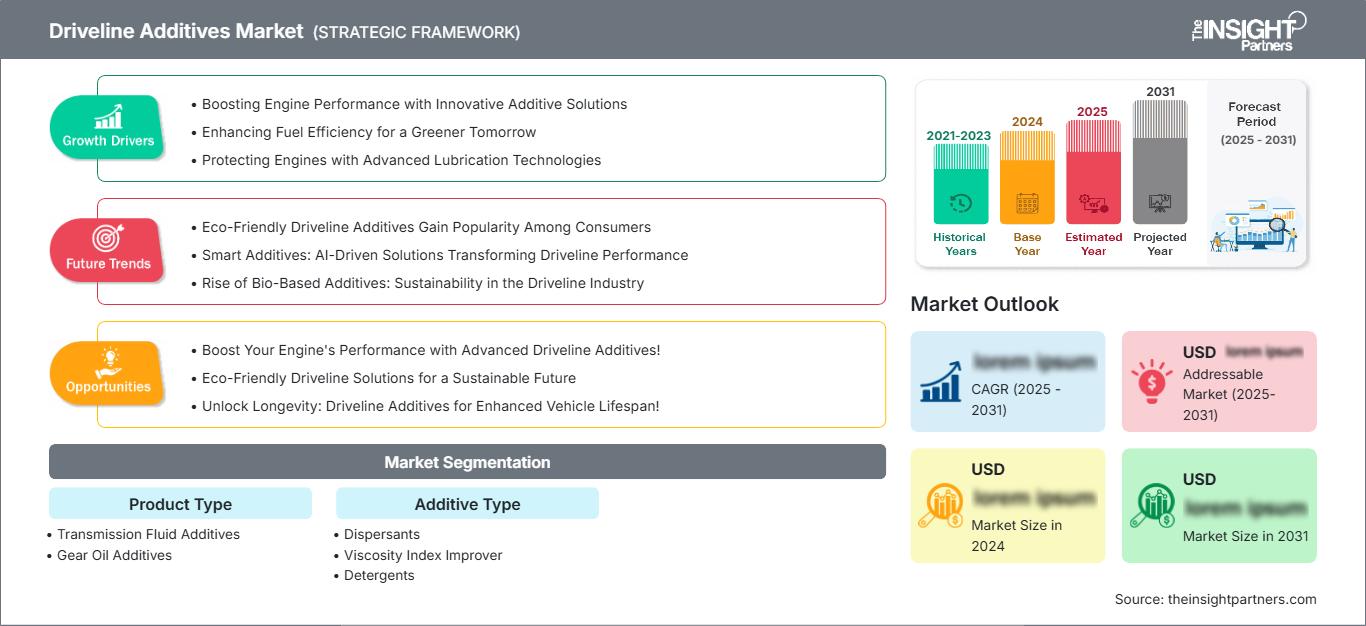
Driveline Additives Market: Strategic Insights
Regional Insights
North America Driveline Additives Market
The North America Driveline Additives Market share was 31-35% in 2025 and expected to grow at a CAGR of 6.2-7.2% through 2034. Growth will be driven by high penetration of automatic transmissions, presence of substantial fleets of pickups and SUVs, and significant service-fill volumes. Applications in heavy trucks, agriculture, construction, and mining need durable gear oil and off-road transmission fluids additives.
Low temperature viscosity, friction durability, oxidative stability, and extended drain protection are the key requirements from the regional formulators. The United States leads in volumes consumed, while Canada and Mexico will serve demand via commercial fleets, car assembling, and transboundary lubricant distribution. OEM standards and approvals will still be critical purchase criteria for lubricant producers.
U.S. Driveline Additives Market
The US constituted 78-82% share of North American revenues in 2025, with forecasted growth rate of 6.3-7.3% CAGR. There is a considerable fleet of light trucks and commercial fleets which drive a demand for ATF, axle oil and heavy duty driveline fluid owing to regular servicing and refilling.
Afton Chemical Corporation, Chevron Oronite Company LLC, The Lubrizol Corporation and Dow Inc. have a technical/commercial footprint in the country. The need is growing in hybrid transmission fluid, off-road equipment and high load pickup application. Fluids which offer extended drain period and durability are preferred by fleets.
Europe Driveline Additives Market
Europe has been responsible for 24-28% of global revenue in 2025, and it is anticipated to grow at a CAGR of 5.8-6.8% during 2024 to 2034. Germany dominates the market on account of high-end automobiles manufacturing, advanced transmission systems, and OEM approved lubricants. United Kingdom contributes to the demand of aftermarket and specialty blendings, whereas France ensures consistent consumption in passenger and light commercial vehicles.
Italian and Spanish countries increase their share through automotive assembling, logistics fleet, and service network owing to Southern Europe mobility. Hybrdization and efficiency standards drive towards the consumption of low viscosity, heat resistant and superior friction resistance fluid. BASF SE, Evonik Industries AG, and Infineum International Limited are some key players in this region through additives and performance polymer solutions.
APAC Driveline Additives Market
In 2025, Asia Pacific accounted for 32-36% of global revenue and has an estimated CAGR of 7.6%-8.6%. China is the leading nation, owing to high vehicle production, EV and hybrid technology, and local lubricant manufacturing. India will increase demand through vehicle park growth, transportation applications, and off-road machinery.
Japan and South Korea boost the presence of high-quality transmission fluid due to OEMs, while Australia drives the demand through mining, agricultural, and utility vehicles. Policies promoting energy efficiency and electrification are giving impetus to e-fluid compatible additives and copper inhibition technology.
Middle East & Africa Driveline Additives Market
This market is expected to experience a 6.0–7.0% compound annual growth rate up until 2034. Saudi Arabia dominates the local demand due to infrastructure projects, logistics fleets, and off-road equipment utilization. The UAE provides lubricant delivery and superior vehicle maintenance, whereas South Africa does so thanks to mining, agricultural, and commercial transportation activities.
High temperature, dust exposure, and heavy loads contribute to the need for oxidation resistance, anti-wear properties, and corrosion inhibition. Regional blenders focus on making formulas that will work well in all types of passenger cars, trucks, industrial fleets, and construction equipment that operate under harsh conditions..
Segmentation Analysis
Product Type
Product Type is expected to grow at a 6.9–7.7% CAGR during 2026–2034. The Driveline Additives Market scope is shaped by transmission-fluid and gear-oil requirements across passenger cars, commercial vehicles, off-highway equipment, and electrified drivetrains. Higher torque density, longer drain intervals, and lower-viscosity fluid strategies are increasing the importance of integrated additive packages that deliver friction stability, anti-wear performance, oxidation control, and hardware compatibility.
- Transmission Fluid Additives: This sub-segment leads demand because automatic, CVT, DCT, hybrid, and service-fill fluids require precise friction control, seal compatibility, oxidation stability, and smooth shift performance.
- Gear Oil Additives: Gear oil packages remain strategically important for axle, manual transmission, differential, and off-road applications where load carrying, micropitting resistance, corrosion protection, and durability are critical.
Additive Type
Additive Type is projected to register a 7.1–7.9% CAGR through 2034. Formulation decisions depend on balancing multiple chemistries without compromising friction behavior, viscosity stability, seal performance, or deposit control. Demand is increasingly oriented toward multifunctional additive systems that protect metal surfaces, maintain fluid cleanliness, resist oxidation, and support lower-viscosity driveline fluids under higher operating temperatures and more compact transmission designs.
- Dispersants: Dispersants help suspend contaminants and degradation byproducts, maintaining fluid cleanliness in transmissions and gearboxes exposed to heat, oxidation, clutch wear, and extended operating intervals.
- Viscosity Index Improver: These additives support stable viscosity across temperature ranges, enabling low-temperature fluidity and high-temperature protection in modern automatic, hybrid, and heavy-duty driveline systems.
- Detergents: Detergents contribute to cleanliness and neutralization performance, supporting deposit control in driveline fluids exposed to oxidative stress, metal surfaces, and demanding service conditions.
- Anti-wear Agents: Anti-wear chemistry protects gears, bearings, and metal contact surfaces under high load, reducing scuffing, pitting, friction-related damage, and premature component failure.
- Antioxidants: Antioxidants delay fluid degradation caused by heat and oxygen, helping maintain viscosity, friction properties, cleanliness, and service life across severe-duty operating environments.
- Corrosion Inhibitors: Corrosion inhibitors protect ferrous and non-ferrous metals, including copper-containing components, which is increasingly important in hybrid and electrified driveline architectures.
- Friction Modifiers: Friction modifiers are essential for shift feel, clutch engagement, torque transfer, and noise reduction in automatic, CVT, DCT, and hybrid transmission applications.
- Emulsifiers: Emulsifiers help manage water contamination risks in selected off-road, agricultural, and industrial driveline systems where fluid stability and equipment protection are operational priorities.
Opportunity Snapshot
| Additive Type | Revenue Contribution | Trend Tag | Adoption Stage |
| Transmission Fluid Additives | High | Hybrid ATF | Mature |
| Gear Oil Additives | Medium | Heavy Axles | Scaling |
| Dispersants | Medium | Deposit Control | Mature |
| Viscosity Index Improver | High | Low Viscosity | Scaling |
| Detergents | Medium | Clean Hardware | Mature |
| Anti-wear Agents | High | Load Protection | Mature |
| Antioxidants | High | Thermal Stability | Mature |
| Corrosion Inhibitors | Medium | Copper Safety | Scaling |
| Friction Modifiers | High | Shift Quality | Mature |
| Emulsifiers | Low | Water Control | Emerging |
Driveline Additives Market Growth Drivers and Impact Analysis
Rising Transmission Complexity and OEM Fluid Specifications
Modern drivetrains operate with more gears, tighter tolerances, higher torque density, and greater thermal stress than earlier architectures. Automatic transmissions, CVTs, DCTs, e-axles, and hybrid systems require fluids that manage friction, cooling, electrical compatibility, and component protection simultaneously. This creates direct pull-through for additive packages with validated anti-wear, antioxidant, friction-modifying, and corrosion-control performance. OEM approvals are also becoming more demanding, raising technical barriers for commodity suppliers. The market impact is a shift toward higher-value packages, deeper technical collaboration, and longer qualification cycles that favor companies with testing assets, formulation expertise, and global customer support.
Expansion of Vehicle Parc and Service-Fill Consumption
The global vehicle parc continues to expand, while aging vehicles require periodic fluid replacement and repair-driven service. OICA data show large production bases across China, the United States, Japan, India, Germany, and South Korea, creating sustained demand for factory-fill and aftermarket driveline fluids. Commercial fleets, taxis, ride-hailing vehicles, delivery vans, and off-highway equipment operate under higher utilization, increasing lubricant stress and replacement needs. This driver supports recurring additive consumption because service-fill fluids must meet established specifications and provide consistent performance. Suppliers benefit when lubricant marketers broaden product lines for multi-vehicle ATF, premium gear oils, and severe-duty formulations.
Shift Toward Lower-Viscosity and Electrified Driveline Fluids
Fuel-efficiency regulation and electrification are pushing lubricant formulators toward lower-viscosity fluids that reduce churning losses without sacrificing hardware protection. IEA electric-mobility analysis highlights rapid EV fleet expansion, which increases interest in dedicated e-fluids for reduction gearboxes, hybrid transmissions, and direct-cooled electric drive units. These fluids must address copper compatibility, aeration, thermal stability, friction behavior, and electrical properties. The impact is not a simple reduction in additive demand but a rebalancing toward advanced packages with more specialized chemistry. Companies able to validate performance under electric and hybrid operating conditions can capture early specification positions.
Driveline Additives Market Future Trends
Electrified Transmission Fluid Platforms
Driveline Additives Market trends will increasingly center on e-fluid platforms that protect gears, bearings, copper components, seals, and electric motors within compact drive units. Hybrid and battery-electric architectures introduce heat-transfer, aeration, electrical, and material-compatibility requirements beyond conventional ATF or gear oils. Additive developers are expected to invest in new bench tests, copper-corrosion protocols, and friction models that mirror real operating conditions. As OEMs diversify hardware layouts, flexible additive platforms will become valuable because they can shorten approval timelines while addressing multiple electrified driveline designs.
Digital Formulation and Faster Validation Cycles
Future development will rely more heavily on data-driven formulation tools, simulation, and high-throughput testing to reduce time-to-market. Additive suppliers face pressure to qualify fluids across many OEM requirements, base-oil types, and regional specifications. Digital workflows can identify component interactions earlier, reduce failed trials, and improve confidence before expensive hardware tests begin. This trend will favor suppliers that combine chemistry knowledge with analytics, tribology databases, and collaborative testing programs. Faster validation will be especially important for hybrid, off-road, and severe-duty applications where performance expectations continue rising.
Driveline Additives Market Opportunities
Localized Additive Blending in High-Growth Automotive Hubs
Asia Pacific and selected Middle East markets offer strong investment potential for localized blending, technical service, and customer support. Vehicle production, aftermarket lubricant demand, and regional OEM activity are expanding, while supply-chain resilience remains a priority for lubricant marketers. Driveline Additives Market Forecasts increasingly point to opportunities for suppliers that can provide shorter lead times, flexible treat-rate options, and specification guidance near customer operations. Local laboratories can also accelerate troubleshooting and adapt formulations to climate, duty cycle, and base-oil availability. This opportunity rewards companies that combine global chemistry platforms with regional execution capability.
Premium Aftermarket Fluids for Aging and Mixed Fleets
Aftermarket channels are increasingly complex because fleets include older automatic transmissions, new multi-speed systems, hybrids, CVTs, DCTs, and off-highway machinery. Lubricant marketers need differentiated products that simplify inventory while meeting performance expectations. Additive suppliers can capture value by developing robust multi-vehicle ATF packages, heavy-duty gear oil solutions, and severe-service products for fleets seeking reliability and reduced downtime. Training, technical documentation, and installer confidence will be important commercialization tools. Premium aftermarket fluids also provide margin opportunities in regions where vehicle owners extend asset life and prioritize maintenance over replacement.
Recent Developments
- July 2026: Chevron Oronite has announced its PC-12 additive technology solutions aimed at helping lubricant marketers meet new heavy-duty engine oil specifications, with licensing starting January 1, 2027. The PC-12 category enhances engine oil performance, addressing needs for better fuel efficiency, longer oil life, and improved protection for modern engines and aftertreatment systems. Its solutions offer flexibility for a wide range of applications and include two main additive technologies featuring new dispersant chemistry: OLOA 59382 (PPD-embedded) and OLOA 59380 (non-PPD).
- September 2025: Afton Chemical Corporation has launched HiTEC® 12582, the world’s first dedicated additive for hydrogen heavy-duty engines. This development positions hydrogen as a potent low-emission alternative fuel amid the transition from internal combustion engines to an eventual fully battery-electric future.
Frequently Asked Questions

- Comprehensive Market Sizing and Forecast Analysis
- Detailed Segmentation Analysis
- In-Depth Market Dynamics Assessment
- Regional and Country-Level Insights
- Competitive Landscape and Company Benchmarking
- Strategic Business Intelligence
Recent Reports
Testimonials

The Insight Partners provided valuable market intelligence that supported our global go-to-market strategy. Their team was professional, responsive, and attentive to our feedback, providing thoughtful analysis and helpful methodological clarifications throughout the project.
Junmo Kim Chief Financial Officer (CFO), Enertech Co., Ltd.
The Insight Partners' SCADA System Market report is comprehensive, with valuable insights on current trends and future forecasts. The team was highly professional, responsive, and supportive throughout. We are very satisfied and highly recommend their services.
RAN KEDEM Partner, Reali Technologies LTDs
I requested a report on a very specific software market and the team produced the report in a few days. The information was very relevant and well presented. I then requested some changes and additions to the report. The team was again very responsive and I got the final report in less than a week.
JEAN-HERVE JENN Chairman, Future Analytica
We worked with The Insight Partners for an important market study and forecast. They gave us clear insights into opportunities and risks, which helped shape our plans. Their research was easy to use and based on solid data. It helped us make smart, confident decisions. We highly recommend them.
PIYUSH NAGPAL Sr. Vice President, High Beam Global
The Insight Partners delivered insightful, well-structured market research with strong domain expertise. Their team was professional and responsive throughout. The user-friendly website made accessing industry reports seamless. We highly recommend them for reliable, high-quality research services
YUKIHIKO ADACHI CEO, Deep Blue, LLC.
This is the first time I have purchased a market report from The Insight Partners.While I was unsure at first, I visited their web site and felt more comfortable to take the risk and purchase a market report.I am completely satisfied with the quality of the report and customer service. I had several questions and comments with the initial report, but after a couple of dialogs over email with their analyst I believe I have a report that I can use as input to our strategic planning process.Thank you so much for taking the extra time and making this a positive experience.I will definitely recommend your service to others and you will be my first call when we need further market data.
JOHN SUZUKI President and Chief Executive Officer, Board Director, BK Technologies
I wish to appreciate your support and the professionalism you displayed in the course of attending to my request for information regarding to infectious disease IVD market in Nigeria. I appreciate your patience, your guidance, and the fact that you were willing to offer a discount, which eventually made it possible for us to close a deal. I look forward to engaging The Insight Partners in the future, all thanks to the impression you have created in me as a result of this first encounter.
DR CHIJIOKE ONYIA MANAGING DIRECTOR, PineCrest Healthcare Ltd.Reason to Buy
- Informed Decision-Making
- Understanding Market Dynamics
- Competitive Analysis
- Identifying Emerging Markets
- Customer Insights
- Market Forecasts
- Risk Mitigation
- Boosting Operational Efficiency
- Strategic Planning
- Investment Justification
- Tracking Industry Innovations
- Aligning with Regulatory Trends





 Get Free Sample for