
Dust Control Mats Market Growth, Trends & Forecast by 2034
Coverage: by Type (Entrance Mats, Anti-fatigue Mats); Application (Hotel, Manufacturing, Office, Hospital, Others) , and Geography (North America, Europe, Asia Pacific, and South and Central America)
- Status : Data Released
- Report Code : TIPRE00009239
- Category : Chemicals and Materials
- No. of Pages : 150
- Available Report Formats :


- Last update date : October 30, 2026


2025 Market Size
US$ 6.17 Bn
Base year value
2034 Forecast
US$ 9.13 Bn
Projected by 2034
CAGR 2026-2034
4.45 %
Growth rate
Addressable Market
US$ 69.47 Bn
(2026-2034)
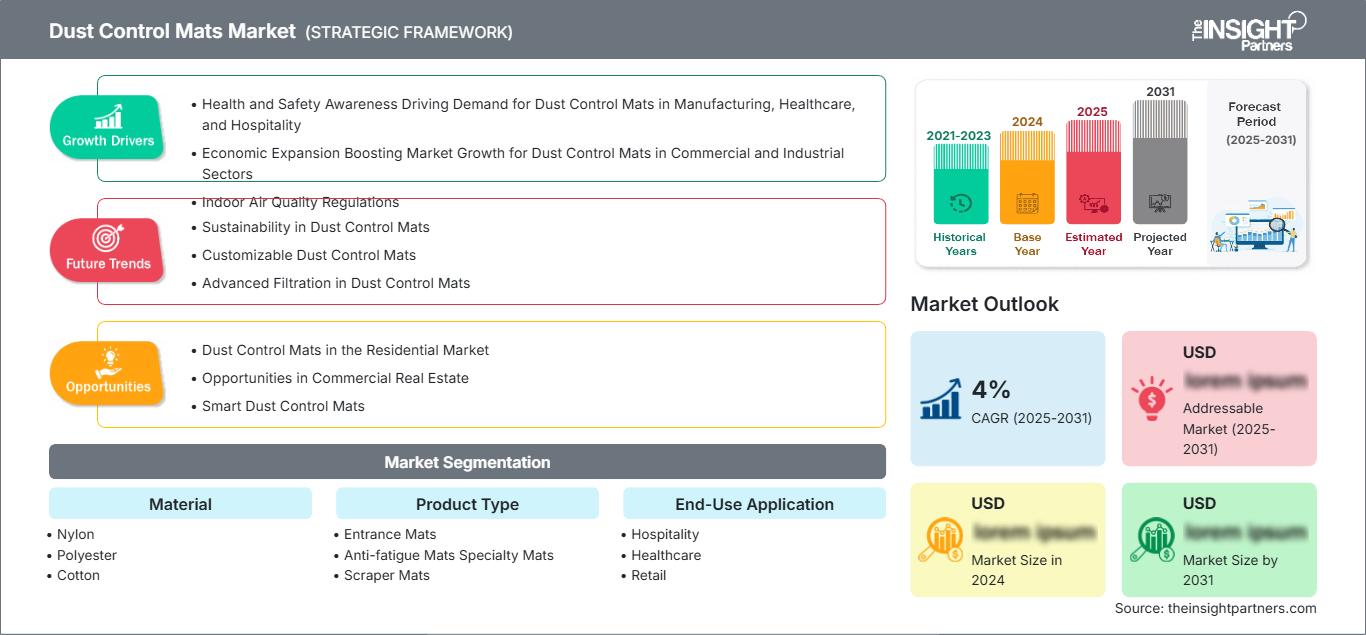
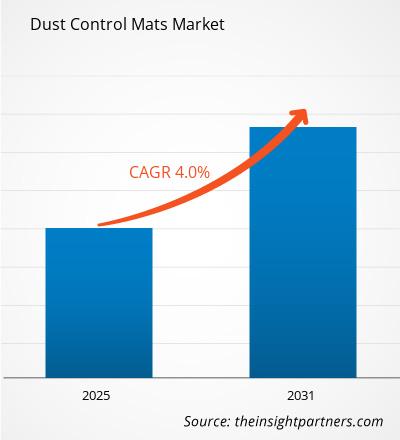
The Dust Control Mats market represented a global market value of US$ 6.17 Billion in 2025 and is projected to reach US$ 9.13 Billion by 2034, expanding at a 4.45% CAGR from 2026 to 2034. The market includes mats designed to capture dirt, dust, moisture, debris, and other contaminants at building entrances and within high-traffic areas. Demand spans commercial and institutional facilities where floor protection, maintenance efficiency, worker comfort, and pedestrian safety influence purchasing decisions.
North America maintains substantial demand for commercial matting because of extensive installed building space, recurring facility-service programs, and established workplace safety practices. The regional market is modeled to expand at approximately ~5% CAGR through 2034, supported by replacement demand, facility maintenance outsourcing, and continued adoption of specialized entrance, anti-fatigue, and wet-area products across commercial properties.
Dust Control Mats Market Assessment and Insights
Regional Outlook
- North America: ~34% of the global Dust Control Mats market share in 2025 | ~5% CAGR through 2034. Market position: North America represents the largest regional market, supported by mature facility-management practices, established mat rental and servicing models, high commercial building penetration, and recurring replacement demand across workplaces, healthcare facilities, retail locations, and hospitality properties.
- U.S.: ~75% of North American market revenue in 2025 | ~5% CAGR through 2034. Market position: The U.S. accounts for the majority of North American demand, with broad adoption across corporate facilities, healthcare, retail, manufacturing, education, and hospitality. Established service networks support recurring mat replacement and maintenance.
- Europe: ~28% of the global market in 2025 | ~4% CAGR through 2034. Market position: Europe represents a mature market supported by stringent building-performance requirements, established entrance-flooring systems, and sustainability considerations. Germany is the leading country in Europe, followed by substantial demand from the UK, France, Italy, and Spain.
- Asia Pacific: ~25% of the global market in 2025 | ~6% CAGR through 2034. Market position: Asia Pacific is the fastest-growing region, supported by expanding commercial construction, manufacturing activity, hospitality development, and institutional infrastructure. China is the leading country in the Asia Pacific, while India and Southeast Asian economies provide additional expansion opportunities.
Segment Outlook
- Product Type: ~42% Share in 2025 | ~5% CAGR through 2034. Market position: Product Type represents the largest main segment because entrance mats address the primary contamination pathway into buildings. Demand benefits from continuous foot traffic, floor-protection requirements, facility maintenance programs, and replacement cycles across commercial properties.
- Material: ~30% Share in 2025 | ~5% CAGR through 2034. Market position: Material is the high-growth main segment as buyers increasingly balance durability, absorption, cleaning performance, comfort, and lifecycle considerations. Polyester, microfiber, nylon, and rubber constructions support application-specific requirements across diverse facility environments.
Competitive Coverage
MILLIKEN & COMPANY, The Andersen Company, 3M Company, Cintas Corporation, Superior Manufacturing Group, UniFirst Corporation, EMCO Bau- und Klimatechnik GmbH, Forbo Holding AG, Crown Matting Technologies, Wearwell Corporation, Construction Specialties, Inc., West American Rubber Company, Pawling Corporation, Birrus Matting Systems Pty Ltd, Eagle Mat & Floor Products Inc
Methodology
The Insight Partners follows Data Collection & Secondary Research, Primary Research, Data Analysis, and Data Triangulation & Final Review to validate market estimates and insights.
Source: The Insight Partners' analysis based on proprietary research, government publications, company annual reports, investor presentations, industry databases, and expert interviews.
The Dust Control Mats market has developed from traditional textile and rubber-based entrance products towards systems designed for the purpose of capturing dirt, retaining moisture, reducing slips, protecting floors, and increasing user comfort. Differentials among products can be based on fiber construction, backing systems, modular design, drainage design, and recycled materials. For example, the Coral line of products by Forbo includes different entrance zones and product constructions, which solve the problems of dirt and moisture removal, and 3M provides entrance, wet area, and facility matting applications.
Production trends in the Dust Control Mats market are shifting towards demands for products capable of withstanding heavy traffic while still providing cleaning ability and dimensional stability. Modular tiles can facilitate the process of installation and replacement, and special yarns and surfaces can enhance dirt and moisture collection. The trend towards sustainability has become noticeable with the use of regenerated yarns, recycled PET fibers, and proven environmental performance. For example, Forbo's Coral Welcome contains recycled PET and regenerated ECONYL yarn.
Until 2034, new demand will not be confined to traditional North American and European markets but will expand into the Asia Pacific and certain Middle Eastern markets, which see growing commercial buildings, hotels, hospitals, and institutions. Investment will favor local production, durability, modular design, and service-based replacement strategies. Green procurement criteria will also motivate the development of recycling, sustainability credentials, and maintenance benefits.
Dust Control Mats Market Report Scope
| Report Attribute | Details |
|---|---|
| Market size in 2025 | US$ 6.17 Billion |
| Market Size by 2034 | US$ 9.13 Billion |
| Global CAGR (2026 - 2034) | 4.45% |
| Historical Data | 2021-2024 |
| Forecast period | 2026-2034 |
Dust Control Mats Market Analysis
The Dust Control Mats market size is tied closely to foot traffic generation, cleaning needs of facilities, and the economic impact of dirt that is brought into the building. The value chain starts with synthetic fibers, natural fibers, rubber compounds, plastics, backing materials, and other components, and continues through yarn spinning, tufting and weaving, molding, finish work, cutting, backings, and assembly. Distributors, facility services firms, flooring contractors, architects, and commercial customers link the manufacturers to the user facilities.
Supply factors in the Dust Control Mats market are different for the various types of products. Textile mats rely almost completely on fiber availability and conversion capability, while rubber and molded mats are driven by compound formulation, mold capability, and curing operations. Companies with product development and distribution capabilities can handle both standard and specialized requirements. Service-based reuse creates a repeat business cycle since mats are picked up, cleaned, checked, and reinstalled rather than being purchased as a single product.
The competitive environment in the Dust Control Mats market consists of diversified facility-service providers, flooring manufacturers, specialized mats manufacturers, and entrance systems manufacturers. Milliken & Company, Forbo Holding AG, 3M Company, The Andersen Company, Cintas Corporation, and UniFirst Corporation are involved with various combinations of manufacturing, servicing, facility solutions, and distribution. Among other offerings, Cintas offers carpet mats, custom logo mats, drainage mats, anti-fatigue mats, restroom mats, and safety message mats.
Increasingly, investment in the Dust Control Mats market is being directed towards durability of the products, recycling of raw materials, logistics of servicing, and performance with regard to particular applications. Entrance systems by Forbo employ zoning design whereas Coral tiles are made modular for ease of installation and handling. Therefore, competitiveness is based on product range, manufacturing capability, servicing network, specification capabilities, and sustainability/safety capabilities.
● REPORT CUSTOMIZATION
Tailor This Report To Align With Your Specific Business Requirements
This report can be customized to align precisely with your business objectives, scope, and target markets. Customization options include tailored segmentation, geography, competitive analysis, and strategic insights to support informed decision-making.
Customize This Report →WHAT YOU CAN ADJUST
- ● Segmentations
- ● Geography
- ● Competitive Analysis
- ● Language Preferences
Dust Control Mats Market: Strategic Insights
Regional Insights
North America Dust Control Mats Market
North America accounted for approximately ~31% of the global Dust Control Mats market in 2025 and is projected to expand at ~4% CAGR through 2034. Strengths of the area include the presence of well-established commercial real estate, facility management outsourcing, cleaning services, and replacement activity in office buildings, healthcare facilities, retail, hotels, and industrial premises. In terms of resilience, those applications that involve a large number of visitors, who continuously track in dirt and moisture, are especially resilient.
North American demand is dominated by the United States thanks to a wide portfolio of commercial and institutional buildings and well-developed managed mat program. Canada adds demand via hospitality, retail, healthcare, and institutional facilities, while demand in Mexico is driven by manufacturing, logistics, and commercial construction. Product specifications call for more emphasis on heavy-duty materials, moisture retention, slip resistance, and serviceability. The variety of climatic conditions in the area makes it necessary to have different solutions for snow, rain, dust, and dry-soil environments.
U.S. Dust Control Mats Market
The U.S. represented approximately ~88% of the North American market revenue in 2025 and is expected to grow at ~4% CAGR through 2034. The extensive presence of commercial facilities in the nation contributes to steady replacement and rentals. Healthcare facilities, hotels, shopping malls, educational institutions, and offices are among the key applications owing to high pedestrian movement at entryways and need for ongoing contamination control.
Competition amongst the companies producing and offering the services is through product variety and programs. Nomad entrance matting from 3M company is available for varied traffic conditions, whereas Cintas Corporation and UniFirst Corporation have included mat services in their workplace service programs. The increasing significance of facility managers who look for strong products which withstand cleaning without altering their appearance is adding to the demand. Among other differentiating factors for procurement in commercial facilities, logo customization, modular construction, scrapers, absorbing fabrics, and rubber backed materials can be mentioned.
Europe Dust Control Mats Market
The Dust Control Mats market forecast shows that Europe held approximately ~28% of the global market in 2025 and is projected to grow at ~4% CAGR through 2034. The area encompasses an advanced ecosystem for building maintenance, as well as high levels of workplace safety, sustainability, material sourcing, product certification, and performance. Germany is the dominant nation in Europe due to its significant industrial, commercial, health care and public building sector requirements. The United Kingdom is still a significant market due to its significant hotel, retail, office and institutional needs.
France enjoys stable requirements for commercial buildings, health care facilities and public works projects. Italy's needs derive from its hotel, retail, manufacturing, and institutional projects, and Spain's needs derive from its tourism, retail, office, and health care infrastructure. Increasingly, European producers differentiate themselves through modular entrance systems, recycled fiber production processes, renewable and recycled raw materials, and environmental performance. Forbo Holding AG has introduced integrated textile and rigid entrance systems, indicative of this region's focus on system approaches to entrance-flooring.
APAC Dust Control Mats Market
APAC represented approximately ~29% of the global market in 2025 and is expected to expand at ~6% CAGR through 2034, making it the fastest-growing region. China is the leading country in the Asia Pacific, supported by large commercial and industrial building bases. Japan and South Korea contribute through mature office, healthcare, hospitality, and manufacturing applications, while India is expanding through commercial construction, retail, healthcare, and institutional development.
Australia maintains demand across offices, education, healthcare, hospitality, and retail properties where entrance cleanliness and safety are important. Across APAC, modernization of facility-management practices is increasing the use of engineered entrance systems. Manufacturers can address regional diversity through climate-specific products, modular installation, localized supply, and durable synthetic or rubber constructions. The expansion of organized retail, hospitals, hotels, and industrial facilities should sustain demand for higher-performance contamination-control products.
Middle East & Africa Dust Control Mats Market
The Middle East & Africa market is projected to grow at approximately ~4% CAGR through 2034. Saudi Arabia represents the leading country in the Middle East & Africa, where evidence of commercial construction, hospitality expansion, healthcare development, and large-scale infrastructure supports recurring demand. The UAE remains important because hotels, malls, airports, offices, and mixed-use developments require high-performance entrance systems.
South Africa contributes through commercial buildings, healthcare, education, hospitality, and industrial facilities. The rest of the MEA demand is influenced by urbanization, infrastructure projects, tourism development, and facility modernization. Climate conditions create a differentiated requirement for dust capture, abrasion resistance, and easy cleaning, particularly in arid locations. Suppliers that combine heavy-duty scraper surfaces with absorbent secondary barriers can address both coarse particulate contamination and moisture-management requirements.
Segmentation Analysis
Material
Material selection determines absorption, scraping performance, durability, comfort, cleaning requirements, and lifecycle economics. The segment is expected to expand at ~5% CAGR from 2026 to 2034, with buyers increasingly selecting constructions according to traffic intensity and environmental exposure. Recycled and regenerated inputs are gaining importance where procurement specifications emphasize resource efficiency and lifecycle performance.
- Nylon: Nylon products provide durability and resilience for high-footfall commercial areas. Their ability to retain structural performance under repeated use supports applications in offices, retail stores, hospitality facilities, and institutional buildings requiring frequent cleaning and replacement.
- Polyester: Polyester supports applications requiring moisture absorption, design flexibility, and cost-conscious procurement. Its broad availability enables manufacturers to offer varied colors and constructions for commercial entrances, hospitality properties, schools, and office environments.
- Cotton: Cotton products serve applications where absorbency, comfort, and natural-fiber characteristics influence purchasing decisions. They remain relevant for selected indoor environments and facility programs where moisture management and softer surface characteristics are prioritized.
- Rubber: Rubber provides durability, traction, resistance to wet conditions, and structural stability. It is strategically important for heavy-duty industrial environments, wet areas, outdoor entrances, and locations requiring drainage or resistance to demanding operating conditions.
- Microfiber: Microfiber supports high-performance dirt and moisture capture because of its fine fiber structure. Its use is increasingly relevant where facilities prioritize efficient contamination removal, frequent cleaning, and improved entrance performance.
Product Type
Product Type represented the largest main segment, with approximately ~42% share in 2025, and is projected to grow at ~5% CAGR through 2034. Entrance products account for substantial demand because every commercial or institutional building requires some form of contamination control at access points. Specialized products add demand where ergonomics, drainage, or wet-area safety become important.
- Entrance Mats: Entrance mats form the core contamination-control product category and capture dirt and moisture before contaminants spread across interior floors. Their strategic importance extends across virtually every commercial, institutional, hospitality, healthcare, and retail facility.
- Anti-fatigue Mats: Anti-fatigue mats target workplaces requiring prolonged standing, particularly manufacturing, retail, foodservice, laboratory, and service environments. Buyers evaluate cushioning, resilience, traction, cleanability, and compatibility with the surrounding work area.
- Specialty Mats: Specialty mats address application-specific requirements that standard entrance products cannot fully satisfy. They support customized branding, industrial environments, safety messaging, specialized drainage, and other facility requirements.
- Scraper Mats: Scraper mats remove coarse dirt and debris from footwear before occupants enter interior spaces. They are particularly relevant where buildings experience high outdoor contamination loads or heavy pedestrian movement.
- Wet Area Mats: Wet area mats support traction and drainage in locations exposed to water or spills. They are important in restrooms, pool areas, foodservice facilities, healthcare environments, and other locations where moisture increases slip risk.
End-Use Application
End-Use Application is projected to expand at approximately ~5% CAGR from 2026 to 2034, reflecting broad adoption across commercial and institutional environments. Application requirements differ according to foot traffic, contamination exposure, cleaning practices, ergonomic needs, and safety specifications. Healthcare and manufacturing facilities typically require performance-oriented products, while hospitality and retail facilities place greater emphasis on appearance and entrance presentation.
- Hospitality: Hotels and hospitality properties require products that combine appearance, dirt capture, moisture control, durability, and easy maintenance. High visitor turnover makes entrance performance important for protecting interior flooring and maintaining presentation.
- Healthcare: Healthcare facilities require effective contamination management, slip resistance, cleanability, and durable performance. Mat selection must accommodate intensive foot traffic and demanding maintenance routines across entrances, corridors, clinical areas, and service spaces.
- Retail: Retail locations use mats to control tracked-in dirt and moisture while maintaining entrance appearance. High pedestrian volumes and frequent store cleaning make durability, replacement efficiency, and visual integration important purchasing considerations.
- Manufacturing: Manufacturing facilities require heavy-duty products that withstand industrial traffic, debris, oils, moisture, and prolonged standing. Anti-fatigue, scraper, drainage, and specialized products address distinct operational requirements.
- Education: Schools and universities use entrance and wet-area products to manage pedestrian traffic, weather-related moisture, and maintenance requirements. Durable products support recurring use across classrooms, administrative buildings, sports facilities, and common areas.
- Office Buildings: Office buildings primarily require entrance and anti-fatigue products that support cleanliness, floor protection, employee comfort, and professional appearance. Demand is concentrated around entrances, reception areas, workstations, kitchens, and high-traffic circulation zones.
Opportunity Snapshot
| End-Use Application | Revenue Contribution | Trend Tag | Adoption Stage |
|---|---|---|---|
| Hospitality | High | Guest Footfall | Mature |
| Healthcare | High | Hygiene Control | Mature |
| Retail | High | Store Traffic | Mature |
| Manufacturing | High | Worker Ergonomics | Mature |
| Education | Medium | Campus Safety | Scaling |
| Office Buildings | High | Workplace Comfort | Mature |
Dust Control Mats Market Growth Drivers and Impact Analysis
Higher Commercial Foot Traffic Increases Contamination-Control Requirements
Commercial buildings with frequent pedestrian movement require effective systems for controlling dirt, dust, and moisture before these contaminants spread across interior floors. Retail stores, offices, hotels, healthcare facilities, educational campuses, and transportation-linked properties, therefore, create recurring demand for entrance products. Higher traffic can accelerate mat wear and increase replacement frequency, supporting recurring sales and service opportunities. Forbo states that its Coral entrance systems can stop substantial quantities of walked-in dirt and moisture while reducing floor cleaning requirements, demonstrating the operational value that buyers associate with entrance systems. The resulting purchasing decision increasingly considers total facility maintenance rather than the initial product price alone.
Facility-Service Models Support Recurring Mat Replacement
Service-based procurement changes the market from a one-time product purchase into a recurring facility-management requirement. Providers supply, collect, clean, inspect, and replace mats according to scheduled service programs, reducing the need for customers to maintain internal inventories. This model is particularly relevant to large office networks, healthcare facilities, manufacturing sites, hospitality groups, and retail chains. Cintas provides scheduled delivery of clean mats and multiple product categories, including carpet, drainage, anti-fatigue, restroom, and safety-message products. Such integrated offerings allow service providers to increase customer retention while giving facility operators predictable maintenance routines and consistent product availability.
Sustainability Requirements Influence Material and Product Selection
Environmental procurement is increasing the importance of recycled inputs, lifecycle information, durability, and documented product performance. Buyers increasingly examine whether products can reduce cleaning requirements, contain recycled materials, or provide environmental declarations. Forbo's current Coral portfolio demonstrates this direction through regenerated yarn, recycled PET, environmental product declarations, and lifecycle assessment practices. Sustainability requirements can influence product specifications during building design and refurbishment, encouraging manufacturers to develop materials with lower environmental impacts without sacrificing durability, moisture absorption, or dirt-removal performance.
Dust Control Mats Market Future Trends
Integrated Entrance Flooring Replaces Standalone Mat Selection
The Dust Control Mats market trends show that future procurement is expected to move toward coordinated entrance systems rather than treating each mat as an isolated product. Multi-zone configurations can combine external scraping, internal dirt removal, moisture absorption, and circulation-area protection. This approach enables facility managers to match product construction with footfall and contamination conditions across different parts of an entrance. Forbo's three-zone approach illustrates how manufacturers are already structuring entrance flooring around distinct functional stages. Through 2034, architects and facility managers are likely to specify integrated systems more frequently when floor maintenance, pedestrian safety, and lifecycle performance must be addressed together.
Recycled and Regenerated Materials Gain Specification Importance
Material innovation in the Dust Control Mats market is likely to become more closely linked with environmental documentation and procurement criteria. Regenerated synthetic fibers, recycled plastics, and improved backing systems can reduce reliance on virgin resources while maintaining required performance characteristics. Current products already demonstrate the use of regenerated yarn and recycled PET, indicating that sustainability is moving from a supplementary attribute toward a product-development consideration. Manufacturers that can document material content, environmental performance, durability, and maintenance effects will be better positioned to address specification-driven purchasing as commercial building owners increasingly incorporate lifecycle criteria into refurbishment and new construction decisions.
Dust Control Mats Market Opportunities
Expand Modular and Application-Specific Product Portfolios
Manufacturers can increase commercial opportunities by expanding modular formats that simplify installation, replacement, storage, and maintenance. Modular products allow damaged or heavily worn sections to be replaced without removing an entire entrance installation, which can be valuable for retail stores, offices, hotels, and institutional facilities operating with limited downtime. Forbo's Coral tile products demonstrate this approach through modular formats designed for flexible installation and reduced cut-off waste. Similar product development can target specialized requirements such as heavy traffic, wet areas, industrial debris, and high moisture exposure while maintaining compatibility with broader flooring systems.
Build Regional Service Networks in Expanding APAC Markets
APAC provides an opportunity for manufacturers and service providers to expand distribution, local manufacturing, and recurring maintenance programs. Commercial construction, manufacturing, hospitality, healthcare, and organized retail are creating additional locations that require contamination-control products. The opportunity is not limited to selling standalone mats because customers increasingly require installation, replacement, cleaning, and lifecycle support. Companies can therefore strengthen regional positions through partnerships with flooring contractors, facility-management providers, architects, and commercial distributors. Localized product configurations can address climatic conditions, pedestrian traffic, building design, and cleaning practices while reducing delivery lead times and improving service responsiveness.
Recent Developments
- March 2026: Cintas Corporation and UniFirst Corporation — Cintas and UniFirst announced a definitive agreement for Cintas to acquire UniFirst in a transaction valued at approximately US$5.5 billion. Both companies provide mats and facility-service products, making the transaction relevant to the competitive structure of managed workplace services and mat supply across North America. Cintas and UniFirst announcement.
Frequently Asked Questions

- Comprehensive Market Sizing and Forecast Analysis
- Detailed Segmentation Analysis
- In-Depth Market Dynamics Assessment
- Regional and Country-Level Insights
- Competitive Landscape and Company Benchmarking
- Strategic Business Intelligence
Recent Reports
Testimonials

The Insight Partners provided valuable market intelligence that supported our global go-to-market strategy. Their team was professional, responsive, and attentive to our feedback, providing thoughtful analysis and helpful methodological clarifications throughout the project.
Junmo Kim Chief Financial Officer (CFO), Enertech Co., Ltd.
The Insight Partners' SCADA System Market report is comprehensive, with valuable insights on current trends and future forecasts. The team was highly professional, responsive, and supportive throughout. We are very satisfied and highly recommend their services.
RAN KEDEM Partner, Reali Technologies LTDs
I requested a report on a very specific software market and the team produced the report in a few days. The information was very relevant and well presented. I then requested some changes and additions to the report. The team was again very responsive and I got the final report in less than a week.
JEAN-HERVE JENN Chairman, Future Analytica
We worked with The Insight Partners for an important market study and forecast. They gave us clear insights into opportunities and risks, which helped shape our plans. Their research was easy to use and based on solid data. It helped us make smart, confident decisions. We highly recommend them.
PIYUSH NAGPAL Sr. Vice President, High Beam Global
The Insight Partners delivered insightful, well-structured market research with strong domain expertise. Their team was professional and responsive throughout. The user-friendly website made accessing industry reports seamless. We highly recommend them for reliable, high-quality research services
YUKIHIKO ADACHI CEO, Deep Blue, LLC.
This is the first time I have purchased a market report from The Insight Partners.While I was unsure at first, I visited their web site and felt more comfortable to take the risk and purchase a market report.I am completely satisfied with the quality of the report and customer service. I had several questions and comments with the initial report, but after a couple of dialogs over email with their analyst I believe I have a report that I can use as input to our strategic planning process.Thank you so much for taking the extra time and making this a positive experience.I will definitely recommend your service to others and you will be my first call when we need further market data.
JOHN SUZUKI President and Chief Executive Officer, Board Director, BK Technologies
I wish to appreciate your support and the professionalism you displayed in the course of attending to my request for information regarding to infectious disease IVD market in Nigeria. I appreciate your patience, your guidance, and the fact that you were willing to offer a discount, which eventually made it possible for us to close a deal. I look forward to engaging The Insight Partners in the future, all thanks to the impression you have created in me as a result of this first encounter.
DR CHIJIOKE ONYIA MANAGING DIRECTOR, PineCrest Healthcare Ltd.Reason to Buy
- Informed Decision-Making
- Understanding Market Dynamics
- Competitive Analysis
- Identifying Emerging Markets
- Customer Insights
- Market Forecasts
- Risk Mitigation
- Boosting Operational Efficiency
- Strategic Planning
- Investment Justification
- Tracking Industry Innovations
- Aligning with Regulatory Trends





 Get Free Sample for