
Edge Sensor Market Size, Demand & Growth by 2034
Coverage: by Type (Ultrasonic Edge Sensors, Infrared Edge Sensors, Others); Industry Vertical (Paper and Pulp, Food, Manufacturing, Metal, Packaging, Others), and Geography (North America, Europe, Asia Pacific, and South and Central America)
- Status : Data Released
- Report Code : TIPRE00013145
- Category : Electronics and Semiconductor
- No. of Pages : 150
- Available Report Formats :


- Last update date : July 31, 2026


2025 Market Size
US$ 17.56 Bn
Base year value
2034 Forecast
US$ 39.15 Bn
Projected by 2034
CAGR 2026-2034
9.32 %
Growth rate
Addressable Market
US$ 253.34 Bn
(2026-2034)
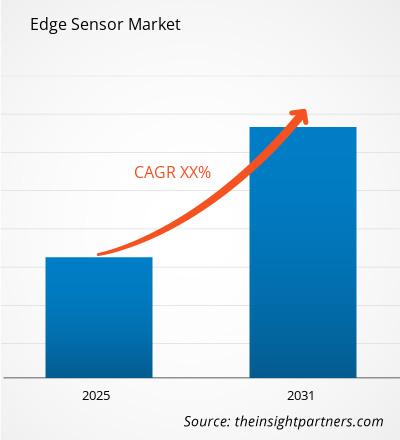
The Edge Sensor Market size was valued at US$ 17.56 Billion in 2025 and is anticipated to reach US$ 39.15 Billion by 2034, growing with a CAGR of 9.32% from 2026–2034. It includes ultrasonic edge sensors and infrared edge sensors in the paper & pulp, food, manufacturing, metal, and packaging industries that use them for web alignment and position control, as well as material detection without contact.
The Edge Sensor Market in North America will witness a CAGR of 8.6–9.4% during 2026-2034 owing to factors such as packaging automation, line converting, and increased use of non-contact sensors in continuous web applications. Users of the North American region have a focus on accuracy, quick setup time, and machinery uptime because of processes such as food packaging, label making, paper making, and metal strip processing.
Edge Sensor Market Assessment and Insights
- North America held 27–31% share in 2025 and is growing at a CAGR of 8.6–9.4% during 2026–2034, driven by converting automation, food packaging, and installed paper-line modernization.
- US represented 74–78% of North American revenue in 2025 and is growing at a CAGR of 8.8–9.6% during 2026–2034, supported by packaging and metal processing.
- Europe accounted for 24–28% share in 2025 and is growing at a CAGR of 8.0–8.8% during 2026–2034, with Germany, Italy, France, the UK, and Spain leading demand.
- Asia Pacific held 32–36% share in 2025 and is growing at a CAGR of 10.0–10.8% during 2026–2034, led by China, Japan, South Korea, India, and Australia.
- Largest Segment Ultrasonic Edge Sensors held 58–62% market share in 2025 and are growing at a CAGR of 9.0–9.8% during 2026–2034 due to web material versatility.
- High Growth Segment Packaging represented 26–30% market share in 2025 and is growing at a CAGR of 10.2–11.0% during 2026–2034, supported by flexible packaging automation.
- Key companies analyzed in detail: Banner Engineering Corp.; Baumer Group; di-soric GmbH & Co. KG; Erhardt+Leimer GmbH; Force Measuring Systems AG; Leuze electronic GmbH + Co. KG; Maxcess International, Inc.; microsonic GmbH; RIFTEK LLC; SICK AG.
Source: The Insight Partners' analysis based on proprietary research, government publications, company annual reports, investor presentations, industry databases, and expert interviews.
Sensing technology has evolved from simple line-side sensing into integrated web guiding, machine vision, and automated closed-loop systems. Customers require sensors that can detect clearly, reflective film, reflective foil, paper web, metal, and even difficult materials without frequent re-calibrations. The current dynamics include small form factor, IO-Link capability, fast response, and consistent measurement capabilities despite the presence of dust, vibrations, heat, and converting high speeds. This development ensures alignment between the Edge Sensor Market and the wider automation efforts at factories.
Future demand will be higher in areas that add more capacities for packaging, automate the processing of metals, and update their paper mills to minimize scrap. These investments will now trend towards sensors coupled with controllers, automatic calibration, and condition monitoring, which will help eliminate human interaction. The regulations concerning the traceability of food, managing waste, and employee safety will favor such adoption since sensors will result in minimal scrap, fewer manual interventions, and stability of the process.
Edge Sensor Market Report Scope
| Report Attribute | Details |
|---|---|
| Market size in 2025 | US$ 17.56 Billion |
| Market Size by 2034 | US$ 39.15 Billion |
| Global CAGR (2026 - 2034) | 9.32% |
| Historical Data | 2021-2024 |
| Forecast period | 2026-2034 |
Edge Sensor Market Analysis
Edge Sensor Market growth stems from the need for better tolerance levels in packaging, paper, metal, and food industries. Value creation in continuous webs ceases if the web drifts, wrinkles, misaligns itself, or produces scrap during operations such as printing, lamination, slitting, coating, or winding. Consequently, sensors occupy the forefront of the value chain that comprises sensing modules, controllers, actuators, machinery suppliers, converters, and plant maintenance departments.
Demand drivers comprise photoelectric sensors, ultrasonic transducers, durable housing, embedded software, and distribution channels. Industrial clients are increasingly favoring non-contact sensing due to its ability to eliminate the risk of surface damage and accommodate clear, dark, reflective, or porous objects. This Edge Sensor Market report also factors in growing demand for diagnostic and commissioning services which allow reducing set up times in short production cycles.
The rivalry structure consists of general automation providers and web guiding systems producers. Banner Engineering Corp., Baumer Group, Leuze electronic GmbH + Co. KG, and SICK AG are competitors with regard to sensor variety, worldwide coverage, and integration with production facilities. Erhardt+Leimer GmbH, Maxcess International, Inc., and Force Measuring Systems AG are more effective in the areas where guiding system capabilities and converting-line experience play key roles.
Microsonic GmbH, di-soric GmbH & Co. KG, and RIFTEK LLC add to the rivalry through their ultrasonic, optical, and displacement sensing technologies. The investment pattern involves smaller-sized products, IO-Link compatible setup, remote monitoring, and target-tested sensors. The strategy of successful positioning requires demonstrating accurate performance on various substrates and reliable shipment.
● REPORT CUSTOMIZATION
Tailor This Report To Align With Your Specific Business Requirements
This report can be customized to align precisely with your business objectives, scope, and target markets. Customization options include tailored segmentation, geography, competitive analysis, and strategic insights to support informed decision-making.
Customize This Report →WHAT YOU CAN ADJUST
- ● Segmentations
- ● Geography
- ● Competitive Analysis
- ● Language Preferences
Edge Sensor Market: Strategic Insights
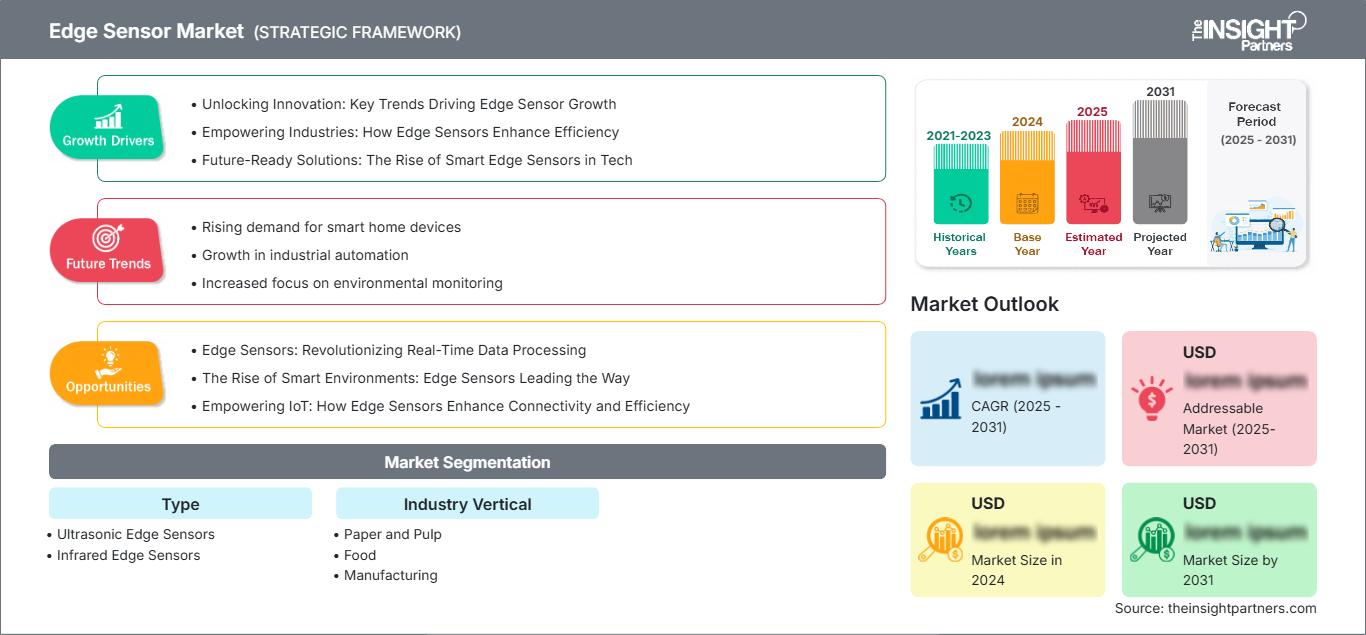
Regional Insights
North America Edge Sensor Market
In 2025, North America had 27-31% of Edge Sensor Market Share and is expected to rise at a CAGR of 8.6-9.4% between 2026-2034. The region is witnessing demand due to the usage of flexible packaging, label conversion, food processing, and metal strips, where line efficiency and lower scrap contribute significantly to profitability. Users prefer ultrasonic sensors and infrared sensors to detect clear films, paperboard, aluminum foils, and laminated products.
There is already established a well-structured machine builder community, industrial automation distributors and packaging, as well as pulp lines in North America. Engineers as well as replacements are provided by Banner Engineering Corp., Maxcess International, Inc., and SICK AG. The reduction of packaging wastes, precise tolerances in food packaging and shortage of labor have made automatic edge control more preferred than manual web alignment.
U.S. Edge Sensor Market
The US accounted for 74–78% of North America revenue in 2025 and will witness a growth rate of 8.8–9.6% in terms of CAGR during 2026–2034. Application demand is fueled by requirements of packaging converters, paper processors, food manufacturing plants, and metal service centers requiring reliable edge detection for high-speed lines. Setup speed, durable housing, and sensors compatible with existing web guide controllers are critical factors for operators.
Companies are supported by Banner Engineering Corp. and Maxcess International, Inc., whereas Baumer Group, Leuze electronic GmbH + Co. KG, microsonic GmbH, and SICK AG compete through their distribution networks in the US. Increasing changeovers in the food packaging industry and in private label manufacturing necessitate repeatable edge detection for minimizing production time and rejects.
Europe Edge Sensor Market
The share of Europe in 2025 was 24–28%, with growth expected in the 2026–2034 period at a CAGR of 8.0–8.8%. It is driven by Germany, which benefits from machinery engineering, conversion machinery, and level of automation. In addition to that, the European market is driven by Italy through its strong packaging machinery demand and France, the United Kingdom and Spain through adoption of food, paper, label, and metal processing.
The priorities of European customers include safety documents, reliability, energy saving, and waste reduction according to regulations. The companies that will benefit from proximity to their OEMs are Erhardt+Leimer GmbH, Leuze electronic GmbH + Co. KG, SICK AG, microsonic GmbH, di-soric GmbH & Co. KG, and Baumer Group.
APAC Edge Sensor Market
Asia Pacific holds 32%-36% market share in 2025 and is expected to grow at a CAGR of 10.0%-10.8% from 2026 to 2034. China dominates due to packaging, electronics, and metal industries, while Japan and South Korea contribute by increasing the demand for precise automation. India and Australia contribute by increasing food packaging, paper conversion, and metal processing related to mining industry.
Industrial policies, export-oriented manufacturing, and increased consumption of packed food require a high level of web alignment. Cost and uptime requirements make buyers choose reliable web alignment sensors. The Edge Sensor Market gains from converters who implement more automated lines due to labor and quality issues.
Middle East & Africa Edge Sensor Market
The Middle East & Africa market is projected to grow at a CAGR of 7.2–8.0% during 2026–2034. Saudi Arabia leads as packaging, construction materials, and industrial diversification increase demand for automated converting and metal handling. The UAE supports growth through food packaging, logistics, and printing activity.
South Africa and Rest of MEA add opportunities in paper converting, mining-linked metals, and packaged consumer goods. Harsh operating conditions increase preference for rugged housings and easy maintenance. Energy and infrastructure projects also raise demand for metal strip and insulation-material processing, where stable edge tracking protects downstream quality.
Segmentation Analysis
Type
Type is projected to grow at a CAGR of 9.1–9.9% during 2026–2034. The Edge Sensor Market scope covers sensing technologies selected by target material, line speed, accuracy, contamination risk, and controller compatibility. Ultrasonic designs lead where transparency, color, or reflectivity varies, while infrared sensors remain important for compact detection, edge presence verification, and applications requiring fast optical response.
- Ultrasonic Edge Sensors hold the strongest market position because they detect transparent, opaque, dark, and reflective webs without depending on surface color, making them valuable for films, paper, and foils.
- Infrared Edge Sensors serve high-speed detection tasks where clean optical paths, compact installation, and sharp edge recognition support packaging, labeling, and machinery applications with controlled operating environments.
Industry Vertical
Industry Vertical is forecast to grow at a CAGR of 9.4–10.2% during 2026–2034. Adoption is strongest where continuous materials must remain aligned through unwinding, printing, coating, laminating, slitting, and rewinding. Packaging leads revenue contribution, while paper and pulp, food, manufacturing, and metal applications use sensors to improve yield, reduce manual correction, and stabilize automated lines.
- Paper and Pulp uses edge sensors to control paper webs, tissue, board, and specialty grades during converting, coating, printing, and rewinding, reducing breaks, trim waste, and alignment defects.
- Food applications depend on clean, repeatable detection for films, wrappers, labels, and flexible packs where hygiene, line speed, and accurate sealing positions influence product quality.
- Manufacturing demand comes from automated material handling, assembly, textiles, electronics, and general converting lines that need edge position data for repeatable machine control.
- Metal processors use sensors for strip, foil, and coil handling where precise edge tracking protects slitting accuracy, coating uniformity, and downstream forming performance.
- Packaging represents the highest opportunity because flexible films, labels, cartons, and laminates require continuous edge control during printing, sealing, inspection, and high-speed converting.
Opportunity Snapshot
| Industry Vertical | Revenue Contribution | Trend Tag | Adoption Stage |
| Paper and Pulp | Medium | Web Control | Mature |
| Food | Medium | Hygienic Packs | Scaling |
| Manufacturing | Medium | Line Automation | Scaling |
| Metal | Low | Strip Accuracy | Emerging |
| Packaging | High | Flexible Films | Scaling |
Edge Sensor Market Growth Drivers and Impact Analysis
Packaging lines require tighter web alignment
Packaging converters are running more flexible films, recyclable laminates, labels, and paper-based formats on high-speed equipment. Small edge deviations can create print misregistration, sealing defects, trim waste, and rejected rolls, so automatic detection becomes a direct productivity lever. The market impact is stronger demand for ultrasonic and infrared devices that can recognize clear, reflective, and dark substrates while communicating with web guide actuators. Suppliers with application data for flexible packaging, cartonboard, and label converting can win repeat orders because plants increasingly measure sensor value through scrap reduction, changeover speed, and uptime rather than component price alone.
Paper and metal processors modernize continuous lines
Paper mills, tissue converters, foil processors, and metal service centers are upgrading legacy machinery to improve yield and operator efficiency. Continuous materials often move through unwinding, coating, slitting, inspection, and rewinding stages where edge wander affects downstream quality. The market impact is rising demand for rugged sensors that tolerate dust, vibration, heat, and variable reflectivity while supporting closed-loop control. Vendors that combine edge detection with tension measurement, guiding hardware, and service support can capture larger project scope as plants prefer validated systems over fragmented component sourcing.
Digital diagnostics reduce setup and maintenance time
Factory teams are shifting from manual sensor adjustment toward connected devices that provide status, signal strength, teach-in data, and fault visibility. IO-Link and similar communication layers help maintenance teams diagnose contamination, misalignment, and material-change issues before a line produces scrap. The market impact is a premium for sensors that combine measurement accuracy with commissioning simplicity. Machine builders also benefit because connected devices shorten installation time and enable standardized configurations across machine models, supporting repeatable quality for global customers.
Edge Sensor Market Future Trends
Adaptive sensing for mixed-material converting
Edge Sensor Market trends point toward adaptive sensing that can handle paper, mono-material films, recycled plastics, foil laminates, and coated substrates without lengthy recalibration. Future converting lines will process more material variants as brand owners redesign packs for recyclability and regional sourcing. Sensors with automatic gain control, material profiles, and teach functions will help operators maintain alignment during short runs. This direction will favor suppliers that combine ultrasonic, infrared, and software capabilities into devices that remain stable when substrate color, transparency, thickness, or reflectivity changes.
Sensor data becomes part of line analytics
Future web-guiding systems will use edge position data not only for immediate correction but also for process analytics. Continuous records of edge movement, signal strength, and correction frequency can reveal roll quality issues, unwind instability, worn actuators, or improper tension settings. The trend supports predictive maintenance and better root-cause analysis across packaging, paper, and metal lines. Suppliers that make sensor data accessible through industrial networks and dashboards will strengthen their role in plant-wide quality improvement programs.
Edge Sensor Market Opportunities
Packaging OEM partnerships for integrated web control
Edge Sensor Market Forecasts support investment in partnerships with packaging machinery OEMs that want pre-tested edge detection, guiding, and control packages. OEMs can reduce engineering risk when sensors, actuators, controllers, and communication settings are validated as one module. Suppliers should develop application kits for flexible packaging, labels, cartons, and paperboard lines, including setup guides and substrate-specific recommendations. This opportunity is strongest where machine builders sell globally and need consistent performance across plants with different operator skill levels, materials, and maintenance practices.
Retrofit programs for legacy converting assets
Many paper, packaging, food, and metal facilities operate durable converting assets that still rely on manual alignment or aging sensors. Retrofit programs offer a practical route to higher yield without full line replacement. Vendors can package sensors, brackets, controllers, commissioning support, and operator training to shorten installation windows. The investment case improves when plants connect edge control to measurable scrap reduction, fewer stoppages, and faster changeovers. Suppliers with local service partners and standardized retrofit kits can reach mid-sized manufacturers that lack large automation teams.
Recent Developments
- July 2026: Mitsubishi Electric Corporation (“Mitsubishi Electric”) and Sony Semiconductor Solutions Corporation (“Sony”) have entered into a definitive agreement on a strategic partnership aimed at accelerating the automation and advancement of manufacturing equipment and manual operations in the manufacturing industry. Under the partnership, the two companies will establish a newly formed joint venture (“JV”), Advanced Vision Solutions Co., Ltd., which is scheduled to begin operations in October 2026, subject to the receipt of necessary approvals and clearances from relevant authorities. Going forward, through the JV, the companies will develop and offer vision-sensor solutions leveraging cutting-edge technologies that enable AI-based analysis of visual data directly on image sensors. The solutions will precisely capture conditions and changes across a broad range of manufacturing sites that have traditionally been difficult to visualize, and connect them to decision-making and control. They will support automation and autonomous operation of a wide range of manufacturing equipment, contributing to labor savings and unmanned operations.
- April 2026: KISTERS has launched HyQuant Edge – the first radar sensor-based monitoring station for hydrology, powered by KIPTEC. It integrates sensing, logging, edge processing, telemetry, and cloud connectivity into one compact unit. Connect power, and it handles its data independently. More sites. Less infrastructure.
- January 2026: Viavi Solutions Inc. (VIAVI) (NASDAQ: VIAV) announced enhancements to its XEdge cloud-based edge monitoring and assurance platform with new sensors that strengthen data collection capabilities for private 4G, 5G and Wi-Fi networks at the edge. Designed to provide continuous visibility into device connectivity and network performance, XEdge combines unattended edge sensors, centralized cloud dashboards and automated analytics.
Frequently Asked Questions

- Comprehensive Market Sizing and Forecast Analysis
- Detailed Segmentation Analysis
- In-Depth Market Dynamics Assessment
- Regional and Country-Level Insights
- Competitive Landscape and Company Benchmarking
- Strategic Business Intelligence
Recent Reports
Testimonials

The Insight Partners provided valuable market intelligence that supported our global go-to-market strategy. Their team was professional, responsive, and attentive to our feedback, providing thoughtful analysis and helpful methodological clarifications throughout the project.
Junmo Kim Chief Financial Officer (CFO), Enertech Co., Ltd.
The Insight Partners' SCADA System Market report is comprehensive, with valuable insights on current trends and future forecasts. The team was highly professional, responsive, and supportive throughout. We are very satisfied and highly recommend their services.
RAN KEDEM Partner, Reali Technologies LTDs
I requested a report on a very specific software market and the team produced the report in a few days. The information was very relevant and well presented. I then requested some changes and additions to the report. The team was again very responsive and I got the final report in less than a week.
JEAN-HERVE JENN Chairman, Future Analytica
We worked with The Insight Partners for an important market study and forecast. They gave us clear insights into opportunities and risks, which helped shape our plans. Their research was easy to use and based on solid data. It helped us make smart, confident decisions. We highly recommend them.
PIYUSH NAGPAL Sr. Vice President, High Beam Global
The Insight Partners delivered insightful, well-structured market research with strong domain expertise. Their team was professional and responsive throughout. The user-friendly website made accessing industry reports seamless. We highly recommend them for reliable, high-quality research services
YUKIHIKO ADACHI CEO, Deep Blue, LLC.
This is the first time I have purchased a market report from The Insight Partners.While I was unsure at first, I visited their web site and felt more comfortable to take the risk and purchase a market report.I am completely satisfied with the quality of the report and customer service. I had several questions and comments with the initial report, but after a couple of dialogs over email with their analyst I believe I have a report that I can use as input to our strategic planning process.Thank you so much for taking the extra time and making this a positive experience.I will definitely recommend your service to others and you will be my first call when we need further market data.
JOHN SUZUKI President and Chief Executive Officer, Board Director, BK Technologies
I wish to appreciate your support and the professionalism you displayed in the course of attending to my request for information regarding to infectious disease IVD market in Nigeria. I appreciate your patience, your guidance, and the fact that you were willing to offer a discount, which eventually made it possible for us to close a deal. I look forward to engaging The Insight Partners in the future, all thanks to the impression you have created in me as a result of this first encounter.
DR CHIJIOKE ONYIA MANAGING DIRECTOR, PineCrest Healthcare Ltd.Reason to Buy
- Informed Decision-Making
- Understanding Market Dynamics
- Competitive Analysis
- Identifying Emerging Markets
- Customer Insights
- Market Forecasts
- Risk Mitigation
- Boosting Operational Efficiency
- Strategic Planning
- Investment Justification
- Tracking Industry Innovations
- Aligning with Regulatory Trends





 Get Free Sample for