
Electric Arc Furnace Market Demand, Share & Growth by 2034
Coverage: By Type (DC Electric Arc Furnace, AC Electric Arc Furnace); Application (Metal smelting, Ore smelting, Others) , and Geography (North America, Europe, Asia Pacific, and South and Central America)
- Status : Data Released
- Report Code : TIPRE00007027
- Category : Manufacturing and Construction
- No. of Pages : 150
- Available Report Formats :


- Last update date : July 28, 2026


2025 Market Size
US$ 4.00 Bn
Base year value
2034 Forecast
US$ 6.12 Bn
Projected by 2034
CAGR 2026-2034
4.84 %
Growth rate
Addressable Market
US$ 45.94 Bn
(2026-2034)
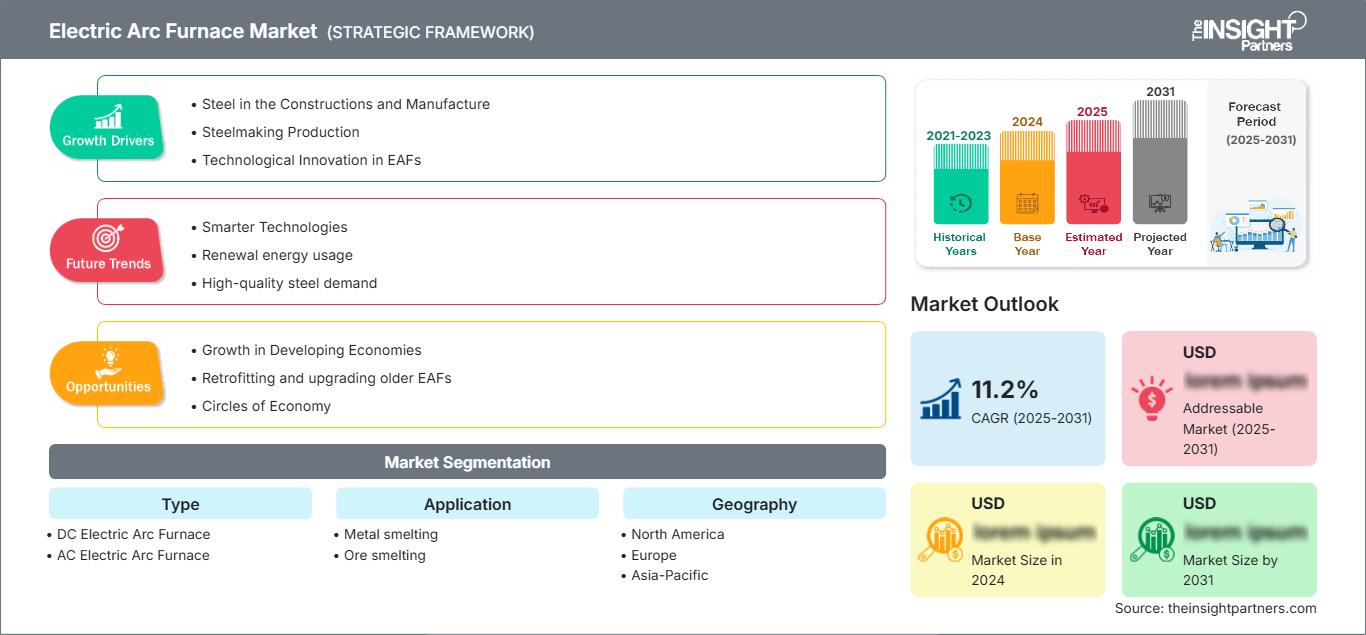
The electric arc furnace market size in 2025 stood at US$ 4.00 Billion and is estimated to reach US$ 6.12 Billion by 2034, recording a CAGR of 4.84% between 2026 and 2034. These estimates can be attributed to the shift in preference among steel producers from energy intensive blast furnace technology to more versatile electric melting technologies, combined with innovations made by technology manufacturers to increase efficiency and automation in these furnaces.
In North America, the electric arc furnace market size is influenced by developed scrap recovery infrastructure, mini mill growth, and pressure on the industry from authorities for lower carbon dioxide emissions. It is forecast to register a CAGR of 4.3–4.7% between 2026 and 2034, with demand coming from steel recycling, long product, specialized grade, and power saving retrofit projects.
Electric Arc Furnace Market Assessment and Insights
- North America accounted for 27–30% share in 2025 and is expected to grow at a CAGR of 4.3–4.7% during 2026–2034, supported by scrap availability, minimill upgrades, and lower-carbon steel procurement.
- US represented 78–82% of North America in 2025 and is projected to expand at a CAGR of 4.2–4.6% during 2026–2034, driven by flat steel and rebar production.
- Europe held 24–27% share in 2025 and is forecast to record a CAGR of 4.5–4.9% during 2026–2034, led by Germany, Italy, France, Spain, and the UK.
- Asia Pacific captured 33–36% share in 2025 and is likely to grow at a CAGR of 5.1–5.5% during 2026–2034, with China, Japan, South Korea, and India anchoring investment.
- Largest Segment AC Electric Arc Furnace held 61–64% market share in 2025, growing at a CAGR of 4.4–4.8% during 2026–2034 due to broad steelmaking compatibility.
- High Growth Segment DC Electric Arc Furnace held 36–39% market share in 2025, advancing at a CAGR of 5.2–5.6% during 2026–2034 as efficiency gains attract premium melt shops.
- Key companies analyzed in detail: Danieli & C. Officine Meccaniche S.p.A., Primetals Technologies Limited, SMS group GmbH, Tenova S.p.A., Electrotherm (India) Limited, Wuxi Dongxong Heavy Arc Furnace Co., Ltd., Doshi Technologies Private Limited, IHI Corporation, JP Steel Plantech Co., The Electrotherm Group, Inc.
Source: The Insight Partners' analysis based on proprietary research, government publications, company annual reports, investor presentations, industry databases, and expert interviews.
Electric arc furnace technology migration trends involve shifting from conventional melting systems to digitally-driven systems with scrap pre-heating facilities, superior slag free tapping, optimized oxy-fuel burning and predictive maintenance. The production dynamics are also evolving with mini-mills adopting shortened commissioning periods and variable metallic charges. This option continues to be most favorable where ferrous scrap, affordable electricity, and downstream rolling mills are located near each other.
The growth trajectory in the industry will largely come from emerging industrial clusters in Asia, sustainable steel clusters in Europe and modernization of melt shop units in North America. Strong regulatory drivers of growth are where carbon accounting, green public procurement and recycled content preferences guide steel purchasing decisions. Investments will be geared towards melting units which combine energy efficiency and high reliability as steel producers measure total melting costs and not simply the furnace cost.
Electric Arc Furnace Market Report Scope
| Report Attribute | Details |
|---|---|
| Market size in 2025 | US$ 4.00 Billion |
| Market Size by 2034 | US$ 6.12 Billion |
| Global CAGR (2026 - 2034) | 4.84% |
| Historical Data | 2021-2024 |
| Forecast period | 2026-2034 |
Electric Arc Furnace Market Analysis
Market development for electric arc furnace is based on the needs of steel manufacturers for reduced emissions, quicker melting process, and wider availability of feedstock. According to global data on steel production in 2024, electricity-based furnaces made up around 29.1% of all crude steel production while blast furnaces comprised an estimated 70.4%, leaving room for conversions if scrap metal becomes more available.
The industry chain comprises shells, transformers, electrodes, refractory linings, off-gas treatment systems, robotic and yard management technology, and automation software. Companies are competing by their energy efficiency, tap-to-tap duration, dust emission control, and integration with ladle metallurgy operations. The highest demand is expected in those regions where companies want to produce flexible steel for construction and alloys without investment in large-scale integrated plants.
Proprietary power systems, digital twins for the furnace, scrap preheating, and commissioning experience are emerging as key factors in defining competitive positioning in the market analysis of electric arc furnaces. Danieli & C. Officine Meccaniche S.p.A., Primetals Technologies Limited, SMS group GmbH, and Tenova S.p.A. compete for major transformation programs, whereas Electrotherm (India) Limited and local specialists cater to value-sensitive investments.
Market investments are inclined towards brownfield projects, grid friendly power feeders, improved safety in the cooling system design, and automation systems reducing the human presence around liquid metal. Market buyers are not just buying furnace capacity but also securing life-cycle management, process know-how, spare-parts availability, and integration with DRI/HBI/pig iron/hot metal and scrap.
● REPORT CUSTOMIZATION
Tailor This Report To Align With Your Specific Business Requirements
This report can be customized to align precisely with your business objectives, scope, and target markets. Customization options include tailored segmentation, geography, competitive analysis, and strategic insights to support informed decision-making.
Customize This Report →WHAT YOU CAN ADJUST
- ● Segmentations
- ● Geography
- ● Competitive Analysis
- ● Language Preferences
Electric Arc Furnace Market: Strategic Insights
Regional Insights
North America electric arc furnace market
North America held 27–30% share in 2025 and is forecast to grow at a CAGR of 4.3–4.7% during 2026–2034. The electric arc furnace market share is supported by a dense ferrous scrap ecosystem, minimill know-how, and strong demand for recycled steel in construction, automotive, and energy infrastructure.
Regional steelmakers prioritize equipment that stabilizes power draw, reduces electrode consumption, and improves melt shop safety. EAF-based production already dominates the US steel route, which makes replacement demand and productivity upgrades more important than first-time adoption. Canada and Mexico add opportunities through automotive supply chains, rebar capacity, and industrial decarbonization incentives.
U.S. Electric Arc Furnace Market
In 2025, the US accounted for 78-82% of North America and is projected to grow at a CAGR of 4.2-4.6% between 2026-2034. The US is advantaged by its abundance of scrap metal, mini-mill capability, and demand for long, flat products and engineered grades for use in both infrastructure and manufacturing.
The company has a significant presence in technology licensing, automation, refractory materials, and rebuilding services but not necessarily new furnace purchases. Demand for applications is limited to the use of metal smelting, including ferrous metal feedstock recycling, and residual steel where the availability of DRI/HBI enables low-residual steel chemistry.
Europe Electric Arc Furnace Market
Europe held 24–27% market share in 2025 and expected to exhibit a CAGR of 4.5–4.9% over 2026–2034. Germany holds the most dominant position in Europe owing to decarbonizing efforts of the steel industry, automotive steel requirements, and investments involving e-melt technology along with DRI, HBI, and green energy.
The UK prioritizes replacing old capacity while maintaining local steelmaking capacity. Italy is well-benefited with its extensive base of EAF steelmaking process and scrap processing capacity. France, Spain, and Eastern Europe will be able to implement selective improvements through which carbon costs, energy security, and procurement laws can facilitate lower-emission steel production.
APAC Electric Arc Furnace Market
The APAC region maintained 33-36% share in 2025 and is anticipated to grow at a CAGR of 5.1-5.5% from 2026 to 2034. China will be the largest country owing to steel capacity renewal, scrap policies, and industrial upgrading that cause higher equipment requirements despite the prevalence of the blast furnace process.
Japan and South Korea emphasize on modern furnaces for high-end flat products and CO2 emission reduction. India brings volume growth in the form of infrastructure steel, secondary steelmaking, and domestic equipment. Australia still makes less impact but important with its green iron, HBI, and electricity from renewables.
Middle East & Africa Electric Arc Furnace Market
MEA's CAGR is expected to be in the range of 4.8-5.2% from 2026 to 2034, with Saudi Arabia being the largest investor among others. Availability of energy sources, pipeline projects for construction purposes, and diversification initiatives within industries are some of the drivers for the requirement for the EAF capacity to produce rebar, sections, and specialty steels.
The UAE focuses on the effective recycling of steel along with downstream processing. On the other hand, South Africa depends upon modernization in order to safeguard its industrial supply chain, and the rest of MEA has project-based demand driven by infrastructure, mining, and urban development projects.
Segmentation Analysis
Type
Type is expected to grow at a CAGR of 4.6–5.0% during 2026–2034. The electric arc furnace market scope across type reflects a balance between proven AC systems and higher-efficiency DC designs. Buyers evaluate transformer requirements, grid compatibility, electrode use, and melt shop configuration before selecting technology for metal smelting or ore-linked applications.
- DC Electric Arc Furnace supports premium applications where lower electrode consumption, stable arcs, and reduced flicker are strategic priorities for plants managing power quality constraints and demanding melt chemistry.
- AC Electric Arc Furnace remains the mainstream choice because it offers proven scale, broad supplier support, simpler maintenance familiarity, and compatibility with many scrap and metallic charge mixes.
Application
Application is projected to grow at a CAGR of 4.7–5.1% during 2026–2034. Metal smelting remains the core demand base as steel recyclers and mini-mills expand efficient melting capacity. Ore smelting gains selective traction where DRI, HBI, ferroalloys, or specialty metallics require controlled furnace chemistry and integration with refining stages.
- Metal smelting generates the largest demand because scrap-based steelmaking needs reliable melting, fast tap-to-tap cycles, and adaptable furnace controls for variable feedstock quality.
- Ore smelting is strategically important where producers blend iron units, ferroalloys, or reduced ore inputs to meet chemistry, quality, and decarbonization requirements.
Opportunity Snapshot
| Segment Name | Revenue Contribution | Trend Tag | Adoption Stage |
| Metal smelting | High | Scrap Melting | Mature |
| Ore smelting | Medium | DRI Blends | Scaling |
Electric Arc Furnace Market Growth Drivers and Impact Analysis
Steel Decarbonization and Scrap-Based Production
Steelmakers are switching to electric melting as it directly tackles carbon intensity, materials circularity, and flexibility of manufacturing. According to Global Energy Monitor, emissions from steelmaking via EAF could be as much as 86% lower than those of blast furnace-basic oxygen furnace routes on scrap configurations. Such an aspect alters capital allocation, particularly when demand for steel with reduced carbon intensity is rising as buyers seek low-carbon steel certificates. The demand side of the electric arc furnace market gets boosted due to the shift of climate action goals from corporate pledges to equipment purchases.
Companies are also taking into account the development of environmental legislation and corporate environmental, social and governance policies by enhancing scrap use and efficiency improvements in steel production processes. Investments increase demand for the latest furnace technologies, intelligent process control, high efficiency transformers and infrastructure which help to enhance the operation of these systems while minimizing emissions. This transition to more circular production models will also contribute to increased use of technologies that maximize the utilization of scrap and resources. With the development of the market for low-carbon steel, becoming a priority for purchases in automotive, construction, infrastructure and manufacturing industries, installations of electric arc furnaces are likely to play a key role in decarbonization strategies of steel production.
Modernization of Aging Melt Shops
Many installed furnaces require upgrades to improve tap-to-tap time, energy use, and operator safety. Replacement demand is especially important in mature regions, where steelmakers may not add large capacity but still need digital control, better cooling, robotic sampling, and more reliable slag handling. The impact is a steadier order cycle than new steel capacity alone would imply. Suppliers with retrofit experience can capture value through phased modernization, minimizing production interruption while extending furnace life. Modernization programs also enable steel producers to improve operational consistency, increase equipment availability, and reduce maintenance costs without undertaking complete facility replacement. Digital monitoring systems, predictive maintenance technologies, and advanced automation improve process visibility while supporting faster decision-making and more efficient furnace operation.
These improvements help manufacturers optimize productivity and maintain competitiveness despite rising energy prices and increasingly stringent environmental expectations. Incremental upgrades allow facilities to introduce new technologies in stages, reducing implementation risks while maintaining production schedules. Engineering expertise, installation planning, and after-sales technical support therefore become important differentiators for equipment suppliers. As aging steelmaking assets continue operating across established markets, retrofit and modernization projects are expected to generate stable long-term opportunities for electric arc furnace manufacturers and service providers focused on improving efficiency, reliability, operational safety, and overall plant performance.
Flexible Metallic Charge Strategies
Steelmakers increasingly require furnaces capable of processing scrap, pig iron, hot metal, DRI, and HBI in varying combinations. This flexibility protects margins when scrap quality, ore prices, electricity tariffs, or carbon costs shift. It also helps producers target higher-value steels by controlling residual elements and refining chemistry. Equipment decisions therefore emphasize process windows rather than rated capacity alone. The electric arc furnace market gains from this shift as buyers seek integrated systems that support multiple metallic strategies. As global raw material markets become more volatile, steel producers are prioritizing operational flexibility to maintain production efficiency and control manufacturing costs under changing market conditions.
Furnaces capable of accommodating diverse metallic charge mixes enable manufacturers to respond quickly to fluctuations in feedstock availability, regional pricing differences, and evolving customer specifications without significant operational disruption. This adaptability also supports production planning across a wider range of steel grades while improving resource utilization and reducing dependence on any single raw material source. Advanced process controls, optimized furnace configurations, and integrated automation systems further enhance the ability to manage varying charge compositions while maintaining consistent product quality. Consequently, purchasing decisions increasingly focus on equipment capable of delivering reliable performance across multiple operating scenarios, creating sustained demand for electric arc furnace technologies that combine process flexibility, production efficiency, and long-term operational resilience.
Electric Arc Furnace Market Future Trends
Grid-Friendly High-Power Furnace Platforms
Future electric arc furnace market trends will be shaped by power quality management as melt shops demand higher transformer loads without destabilizing local grids. Advanced feeders, digital controls, harmonic mitigation, and arc stabilization will become purchasing criteria alongside furnace shell design. This trend is strongest where renewable electricity expands but grid congestion persists. Suppliers that combine metallurgy, electrical engineering, and automation can help steelmakers reduce flicker, optimize power-on time, and secure utility approvals for larger electric melting projects.
AI-Assisted Melt Shop Optimization
Digital models will increasingly guide scrap charging, electrode regulation, oxygen injection, burner settings, and maintenance scheduling. The next competitive layer is not simply automation but closed-loop optimization that learns from heat histories, raw material variability, and downstream quality feedback. Predictive systems can reduce unplanned downtime, improve refractory life, and standardize operator decisions across multiple sites. Adoption will be gradual because steelmakers need validated data, cybersecurity safeguards, and integration with existing plant systems before relying on AI-assisted furnace control.
Electric Arc Furnace Market Opportunities
Brownfield Conversion of Integrated Steel Assets
Major opportunity lies in converting selected integrated steel assets toward electric melting while preserving downstream rolling, finishing, and customer qualification networks. The electric arc furnace market forecasts indicate that brownfield programs will prioritize lower execution risk, modular installation, and compatibility with existing logistics. Suppliers can capture value by offering engineering packages that manage civil works, electrical interfaces, fume systems, and production ramp-up. The strongest prospects are plants facing carbon costs but retaining strong demand for domestic steel.
Regional Equipment Localization and Service Hubs
Localization offers a practical route to winning mid-sized projects in India, Southeast Asia, the Middle East, and Africa. Buyers in these markets value lower installed cost, faster spare availability, and service teams familiar with local power, refractory, and scrap conditions. Partnerships between global technology owners and regional fabricators can reduce delivery risk while preserving critical know-how. Opportunity also exists in training, lifecycle maintenance contracts, and digital support centers that improve furnace uptime after commissioning.
Recent Developments
- May 2026: Primetals Technologies Limited launched the EAF Ultimate Move electric arc furnace, combining features from EAF Ultimate and EAF Quantum to reduce CAPEX, improve flexibility, and support greenfield electric steelmaking projects with compact layouts, single-bucket operation, and FAST tapping technology
- July 2025: Danieli & C. Officine Meccaniche S.p.A. received a contract from JFE Steel for a new digitally controlled Digimeltshop at West Japan Works in Kurashiki, featuring a Digimelter Zerobucket EAF, Digirefiner, Q-One power feeder, and advanced safety packages for planned 2028 operation.
- June 2025: SMS group GmbH — entered a strategic partnership with The Systems Group to integrate Spray-Cooled technology into electric arc furnace and secondary metallurgy solutions, targeting safer cooling, lower maintenance, reduced emissions, and higher uptime for new installations and upgrades worldwide.
Frequently Asked Questions

- Comprehensive Market Sizing and Forecast Analysis
- Detailed Segmentation Analysis
- In-Depth Market Dynamics Assessment
- Regional and Country-Level Insights
- Competitive Landscape and Company Benchmarking
- Strategic Business Intelligence
Recent Reports
Testimonials

The Insight Partners' SCADA System Market report is comprehensive, with valuable insights on current trends and future forecasts. The team was highly professional, responsive, and supportive throughout. We are very satisfied and highly recommend their services.
RAN KEDEM Partner, Reali Technologies LTDs
I requested a report on a very specific software market and the team produced the report in a few days. The information was very relevant and well presented. I then requested some changes and additions to the report. The team was again very responsive and I got the final report in less than a week.
JEAN-HERVE JENN Chairman, Future Analytica
We worked with The Insight Partners for an important market study and forecast. They gave us clear insights into opportunities and risks, which helped shape our plans. Their research was easy to use and based on solid data. It helped us make smart, confident decisions. We highly recommend them.
PIYUSH NAGPAL Sr. Vice President, High Beam Global
The Insight Partners delivered insightful, well-structured market research with strong domain expertise. Their team was professional and responsive throughout. The user-friendly website made accessing industry reports seamless. We highly recommend them for reliable, high-quality research services
YUKIHIKO ADACHI CEO, Deep Blue, LLC.
This is the first time I have purchased a market report from The Insight Partners.While I was unsure at first, I visited their web site and felt more comfortable to take the risk and purchase a market report.I am completely satisfied with the quality of the report and customer service. I had several questions and comments with the initial report, but after a couple of dialogs over email with their analyst I believe I have a report that I can use as input to our strategic planning process.Thank you so much for taking the extra time and making this a positive experience.I will definitely recommend your service to others and you will be my first call when we need further market data.
JOHN SUZUKI President and Chief Executive Officer, Board Director, BK Technologies
I wish to appreciate your support and the professionalism you displayed in the course of attending to my request for information regarding to infectious disease IVD market in Nigeria. I appreciate your patience, your guidance, and the fact that you were willing to offer a discount, which eventually made it possible for us to close a deal. I look forward to engaging The Insight Partners in the future, all thanks to the impression you have created in me as a result of this first encounter.
DR CHIJIOKE ONYIA MANAGING DIRECTOR, PineCrest Healthcare Ltd.Reason to Buy
- Informed Decision-Making
- Understanding Market Dynamics
- Competitive Analysis
- Identifying Emerging Markets
- Customer Insights
- Market Forecasts
- Risk Mitigation
- Boosting Operational Efficiency
- Strategic Planning
- Investment Justification
- Tracking Industry Innovations
- Aligning with Regulatory Trends





 Get Free Sample for