
Electric Capacitor Market Share, Size & Demand by 2034
Coverage: By Type (Film, Ceramic, Electrolytic, Others); Polarization (Polarized, Non-Polarized); End User (Consumer Electronics, Automotive, IT and Telecom, Energy and Power, Others), and Geography (North America, Europe, Asia Pacific, and South and Central America)
- Status : Data Released
- Report Code : TIPRE00015010
- Category : Electronics and Semiconductor
- No. of Pages : 150
- Available Report Formats :


- Last update date : July 31, 2026


2025 Market Size
US$ 27.09 Bn
Base year value
2034 Forecast
US$ 41.81 Bn
Projected by 2034
CAGR 2026-2034
4.94 %
Growth rate
Addressable Market
US$ 312.69 Bn
(2026-2034)
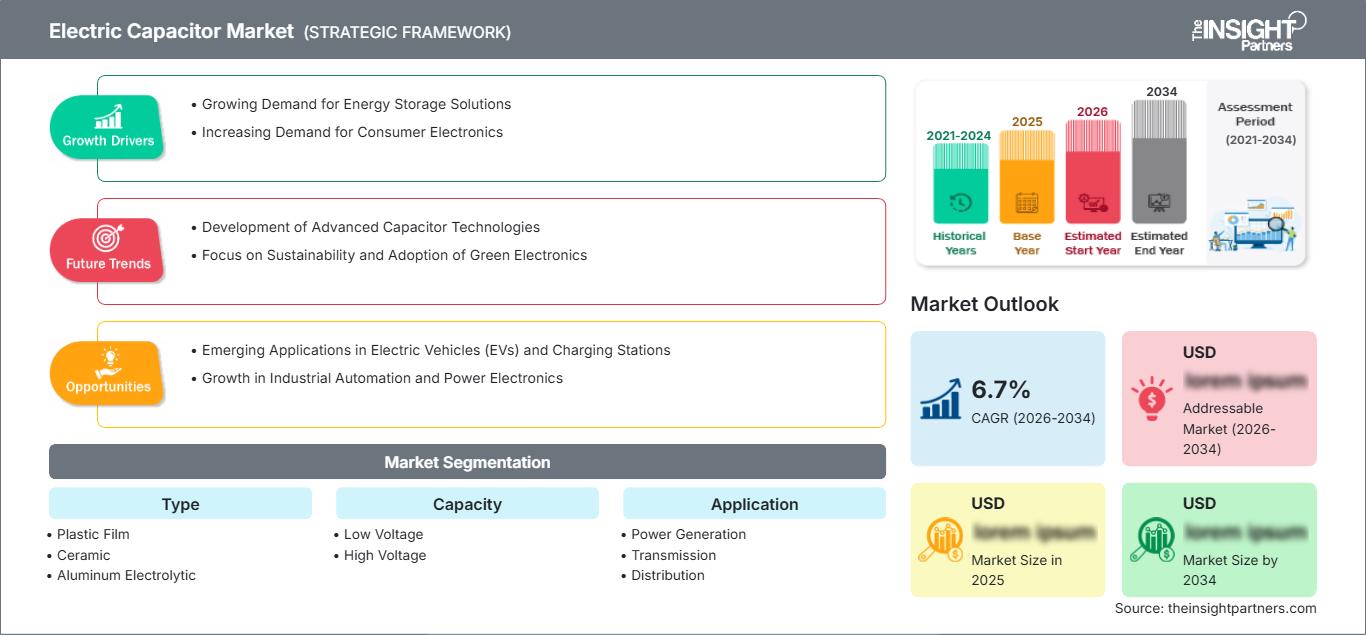
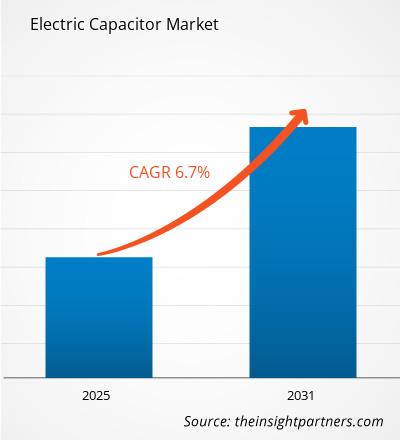
The Electric Capacitor Market is estimated at US$ 27.09 Billion in 2025 and forecasted to hit US$ 41.81 Billion by 2034 with a CAGR of 4.94%. The market includes plastic film, ceramic, and aluminum electrolytic capacitors for use in power generation, transmission, and distribution networks that require voltage stabilization, reactive power compensation, filtration, and reliable energy conversion.
North America Electric Capacitor Market size is expected to progress with a CAGR of 4.6-5.2% during 2026-2034 owing to the implementation of grid hardening measures, renewable integration, utility substation modernization, and requirements for power reliability in data centers. Most demand will be driven in the regions where power factor correction, harmonic filtration, and high-voltage capacitors are required in the network.
Electric Capacitor Market Assessment and Insights
- North America held 24–27% share in 2025 and is growing at a CAGR of 4.6–5.2% during 2026–2034, driven by grid modernization, renewable integration, and industrial power-quality upgrades.
- US represented 78–82% of North American revenue in 2025 and is growing at a CAGR of 4.7–5.3% during 2026–2034, supported by substations and data centers.
- Europe accounted for 19–22% share in 2025 and is growing at a CAGR of 4.1–4.8% during 2026–2034, with Germany, France, Italy, Spain, and the UK leading demand.
- Asia Pacific held 43–47% share in 2025 and is growing at a CAGR of 5.2–5.9% during 2026–2034, led by China, Japan, South Korea, India, and Australia.
- Largest Segment: Ceramic capacitors account for 32–36% market share in 2025, growing at a CAGR of 4.8–5.3% during 2026–2034 due to their widespread use in consumer electronics and automotive systems.
- High Growth Segment: Automotive end user segment holds 18–22% share in 2025 and is projected to grow at a CAGR of 6.2–6.8% during 2026–2034 driven by EV adoption and ADAS integration.
- Key companies analyzed in detail: Schneider Electric SE; Siemens Aktiengesellschaft; Samsung Electronics Co., Ltd.; Murata Manufacturing Co., Ltd.; TDK Corporation; Cornell Dubilier Electronics, Inc.; WIMA GmbH & Co. KG; ABB Ltd.; Panasonic Holdings Corporation; KYOCERA AVX Components Corporation; Suzhou Maxwell Technologies Co., Ltd.
Source: The Insight Partners' analysis based on proprietary research, government publications, company annual reports, investor presentations, industry databases, and expert interviews.
The capacitor industry has undergone a transition from generic passive electronic components to specialized products which dictate the dependability of the electric grid, the efficiency of inverters, and the performance of small power electronics. Both the utilities and OEM companies look at dielectric stability, heat resistance, equivalent series resistance, safety rating, and lifetime costs when approving vendors. The production trend is based on multilayer ceramic capacitance, precision of metallized film, availability of aluminum foil, automation of winding, and qualification process. All this has brought the Electric Capacitor Market Share in line with electrification, renewable adoption, and quality of electric power.
Future demand will be growing in countries building new transmission lines, producing electronics locally, and adopting automation technologies in factories. Funding is being directed towards high-voltage capacitor arrays, compact film capacitors for inverters, and ceramic capacitors that have been certified for demanding temperature ranges. The regulatory focus on energy efficiency, grid reliability, and integration of renewables facilitates procurement due to low losses, stable voltage, and increased availability of equipment.
Electric Capacitor Market Report Scope
| Report Attribute | Details |
|---|---|
| Market size in 2025 | US$ 27.09 Billion |
| Market Size by 2034 | US$ 41.81 Billion |
| Global CAGR (2026 - 2034) | 4.94% |
| Historical Data | 2021-2024 |
| Forecast period | 2026-2034 |
Electric Capacitor Market Analysis
The Electric Capacitor Market growth is being powered by rising electricity demand, variable renewable energy production, and the requirement of voltage stability in increasingly dense grids. Capacitors help in performing functions of smoothing, filtering, phase balancing, power factor correction, and transient suppression in substations, renewable energy inverters, industrial drives, and distribution systems.
The value chain consists of dielectric film, ceramic powders, aluminum foil, electrodes, winding and sintering machines, module assembly facilities, test labs, distributors, utilities, EPC contractors, and OEMs. The supply dynamics are a function of reliable supply and qualification capacity for these specialty materials because grid and power electronics customers tend to have very long qualification cycles.
The competitive scenario features power equipment giants and component specialists. Schneider Electric SE, Siemens Aktiengesellschaft, and ABB Ltd. offer competition using capacitor banks, power quality equipment, and utilities’ ties. Murata Manufacturing Co., Ltd., TDK Corporation, Samsung Electronics Co., Ltd., Panasonic Holdings Corporation, and KYOCERA AVX Components Corporation boost the Electric Capacitor Market report via size, materials technology, and electronics design-in advantages.
Specialists such as Cornell Dubilier Electronics, Inc., WIMA GmbH & Co. KG, and Suzhou Maxwell Technologies Co., Ltd. target film, aluminum, and energy storage oriented niches. Investment priorities include higher voltage ratings, reduced losses, automation, local sourcing, and application oriented modules. Strategic positioning is increasingly driven by reliability information and engineering response speed.
● REPORT CUSTOMIZATION
Tailor This Report To Align With Your Specific Business Requirements
This report can be customized to align precisely with your business objectives, scope, and target markets. Customization options include tailored segmentation, geography, competitive analysis, and strategic insights to support informed decision-making.
Customize This Report →WHAT YOU CAN ADJUST
- ● Segmentations
- ● Geography
- ● Competitive Analysis
- ● Language Preferences
Electric Capacitor Market: Strategic Insights
Regional Insights
North America Electric Capacitor Market
North America accounted for 24–27% of Electric Capacitor Market share in 2025 and is projected to grow at a CAGR of 4.6–5.2% during 2026–2034. Utility investments in transmission reinforcement, renewable interconnection, and distribution automation increase the need for capacitor banks, harmonic filters, and voltage-support equipment.
Regional demand also benefits from data centers, industrial electrification, and replacement of aging substations. Schneider Electric SE, ABB Ltd., Siemens Aktiengesellschaft, Cornell Dubilier Electronics, Inc., and KYOCERA AVX Components Corporation support procurement through local engineering, distribution, and qualification resources. Buyers emphasize lifecycle reliability, safety approvals, and faster delivery.
U.S. Electric Capacitor Market
The United States constitutes 78%-82% of the North American market and is projected to expand at a CAGR of 4.7%-5.3% over 2026-2034. The application driver includes the grid reliability initiatives, renewable generation, industrial drives, and high-load applications that need reactive compensation and power quality improvement.
The company strength lies in the presence of Schneider Electric SE, ABB Ltd., Siemens Aktiengesellschaft, Cornell Dubilier Electronics, Inc., and KYOCERA AVX Components Corporation. Utilities and EPCs focus on installing capacitor banks in substations, whereas electronic makers prefer ceramic and film capacitors for inverters and other power conversion systems.
Europe Electric Capacitor Market
Market share in Europe in 2025 was 19–22% and is expected to expand at a CAGR of 4.1–4.8% for 2026-2034. The market leader in Europe is Germany due to industrial growth, automation, and grid products. In addition, France provides nuclear applications and renewable grids while Italy, Spain, and the UK contribute to replacements and power quality.
The European customers require efficiency, safety documents, and compliance with grid codes. Key players in this region include Siemens Aktiengesellschaft, ABB Ltd., Schneider Electric SE, TDK Corporation, WIMA GmbH & Co. KG, and Panasonic Holdings Corporation due to proximity to OEMs and utilities. Demand is driven by low loss film capacitors, high voltage banks, and ceramic devices.
APAC Electric Capacitor Market
The Asia Pacific region had a 43%–47% share in 2025 and is expected to grow with a CAGR of 5.2%–5.9% between 2026 and 2034. China dominates through electronics production, installation of renewables and grid expansion while Japan and South Korea dominate ceramic capacitor production. India and Australia also contribute due to their transmission/distribution and industrial applications.
Industries' policies, electronics exports, and investments by utilities are the factors which make the region important from capacity perspective. Some of the companies supporting the market include Murata Manufacturing Co., Ltd., Samsung Electronics Co., Ltd., TDK Corporation, Panasonic Holdings Corporation, and Suzhou Maxwell Technologies Co., Ltd.
Middle East & Africa Electric Capacitor Market
The Middle East & Africa market is projected to grow at a CAGR of 3.8–4.5% during 2026–2034. Saudi Arabia leads as grid expansion, renewables, industrial diversification, and desalination power demand raise requirements for capacitor banks and voltage support. The UAE supports growth through infrastructure and data-center loads.
South Africa and Rest of MEA add opportunities through utility refurbishment, mining power systems, and industrial distribution upgrades. Harsh environments increase preference for durable housings, thermal stability, and proven protection systems. Energy and infrastructure programs support selective adoption of power generation, transmission, and distribution capacitors.
Segmentation Analysis
Type
The type segment defines the Electric Capacitor Market scope by categorizing products based on dielectric materials and construction, influencing performance characteristics such as capacitance stability, voltage tolerance, and lifespan. This segment is expected to grow at a CAGR of 4.6–5.2% during 2026–2034, supported by increasing demand across consumer electronics and automotive applications.
- Film capacitors are widely used in industrial and power electronics applications due to their high reliability, thermal stability, and long operational lifespan, making them suitable for high-voltage environments and renewable energy systems.
- Ceramic capacitors dominate due to their compact size and high efficiency, extensively used in smartphones, laptops, and automotive electronics, particularly multilayer ceramic capacitors supporting miniaturization trends.
- Electrolytic capacitors offer high capacitance values and are primarily used in power supply filtering and energy storage applications across industrial and automotive sectors, benefiting from cost-effectiveness and scalability.
Polarization
The polarization segment reflects functional design variations influencing application suitability in AC or DC circuits. This segment is projected to grow at a CAGR of 4.3–4.9% during 2026–2034, driven by increasing demand for energy-efficient electronic systems across industries.
- Polarized capacitors are primarily used in DC applications, offering high capacitance and efficiency in power supply systems, making them essential in consumer electronics and industrial power management applications.
- Non-Polarized capacitors are used in AC circuits and signal processing applications, supporting audio equipment, filtering circuits, and advanced communication systems where bidirectional voltage tolerance is required.
End User
The end user segment plays a crucial role in shaping demand patterns within the Electric Capacitor Market, with diverse applications across industries driving innovation and volume growth. This segment is expected to grow at a CAGR of 5.0–5.6% during 2026–2034, supported by electrification and digital transformation trends.
- Consumer Electronics remains a dominant segment, driven by continuous product innovation and high production volumes, with capacitors playing a key role in ensuring performance stability and energy efficiency.
- Automotive is emerging as the fastest-growing segment due to increasing electric vehicle adoption and integration of advanced driver assistance systems, requiring high-performance capacitor solutions.
- IT and Telecom relies on capacitors for data center operations, networking equipment, and communication infrastructure, ensuring power stability and signal integrity.
- Energy and Power applications include renewable energy systems and grid infrastructure, where capacitors are used for power factor correction and energy storage functions.
Opportunity Snapshot
| End User | Revenue Contribution | Trend Tag | Adoption Stage |
| Consumer Electronics | High | Device Miniaturization | Mature |
| Automotive | High | EV Integration | Scaling |
| IT and Telecom | Medium | Data Centers | Scaling |
| Energy and Power | Medium | Grid Stability | Emerging |
| Others | Low | Industrial Controls | Mature |
Electric Capacitor Market Growth Drivers and Impact Analysis
Grid modernization requires reactive power compensation
As the demand for electricity continues to grow due to electric vehicles, electrified buildings, industry, and data centers, utilities are building out and enhancing their networks. Capacitor banks assist in voltage stabilization, power factor correction, and technical loss reduction without needing every constraint addressed by building new transmission lines. Market implications include an increased purchase of medium-voltage and high-voltage products for substation and feeder installations. Providers of relay and switchgear protection, monitoring, and engineering services stand to gain more sizable business opportunities, as grid operators will opt for cohesive solutions.
Renewable and inverter assets need stable power electronics
Solar, wind, storage, and industrial drives need capacitors that can withstand ripple current, switching stresses, thermal issues, and continuous operation. Film and ceramic products play a crucial role in DC link, snubber, filter, and control circuits where they are used to provide protection for semiconductors and ensure efficient conversion. The market effect is increased design activity for capacitors that offer lower losses, higher insulation, and validated lifetime data. Original equipment manufacturers of inverters have a competitive advantage by collaborating with capacitor companies at an early stage.
Electronics localization increases passive component demand
Both governments and OEMs are trying to localize electronics, semiconductors, packaging and industrial automation supply chains for increased resilience. Capacitors are necessary for control boards, metering devices, protection units, converters, drives and communication modules. The market effect is increased demand for ceramic, aluminum electrolytic and film capacitors in accordance with regional demands in terms of quality and delivery. Manufacturers who have local application teams, flexible stock and proven reliability are more likely to get preferred treatment due to increased importance of supply security for buyers.
Electric Capacitor Market Future Trends
Higher-voltage capacitors for compact energy systems
Electric Capacitor Market trends point toward higher-voltage, lower-loss components that allow compact inverters, grid equipment, and energy systems to handle more power in smaller spaces. Future designs will emphasize dielectric strength, thermal endurance, partial-discharge resistance, and predictable aging. As solar, wind, storage, and fast industrial drives increase switching frequency and voltage stress, suppliers will need closer collaboration with semiconductor and equipment makers. This direction favors manufacturers that can combine materials innovation with qualification evidence and stable production yields.
Condition monitoring moves into capacitor systems
Temperature, current, voltage, switching cycle, and health indicators will play an increasing role in future capacitor banks and power quality assemblies. Utility companies and industrial facilities desire advanced warning of dielectric deterioration, fuse functioning, unbalance, and over-heating prior to failure, which impacts their production operations and overall power supply network. Monitoring can transform passive capacitor units into active electric network infrastructure. Companies offering sensors, communication, and analytics integrated into capacitor assemblies can generate additional revenue streams and help their customers transition to risk-based asset management.
Electric Capacitor Market Opportunities
Utility capacitor-bank packages for grid reinforcement
Electric Capacitor Market Forecasts support investment in turnkey capacitor-bank packages that combine capacitors, switches, protection, enclosures, controls, and monitoring. Utilities facing load growth and renewable interconnection need standardized systems that can be deployed faster than bespoke substation projects. Vendors should develop modular ratings for distribution feeders, transmission substations, and industrial campuses, supported by engineering studies and commissioning services. This opportunity rewards suppliers that reduce procurement complexity, document lifecycle performance, and support regional grid-code requirements.
Inverter OEM design-ins for renewable and industrial drives
Capacitor manufacturers will have access to recurring revenue opportunities by participating in the inverter and drive design cycles prior to the completion of the platform release cycle. Capacitors for renewable energy, energy storage, EV charging, and industrial motor drives require capacitors that match frequency, temperature, ripple current, and lifespan requirements. Vendors who offer modeling, failure modes, samples, and logistics will be in good position. There is greater value where one capacitor type can be used across several inverter power ratings.
Recent Developments
- February 2026: TDK Corporation (TSE: 6762) introduces the new B43655 and B43656 series of aluminum electrolytic capacitors designed specifically for DC links in on-board chargers (OBCs) of electric vehicles. Both series are optimized for forced cooling operation, supporting the growing trend toward higher voltages and currents in next-generation OBC platforms. Due to their compact design and high ripple current capability, such capacitors are commonly used in applications requiring maximum efficiency and reliability in confined spaces.
- January 2026: Vishay Intertechnology, Inc. (NYSE: VSH) announced that the company has extended its 193 PUR-SI series of miniature snap-in power aluminum electrolytic capacitors with new voltage ratings of 550 V and 600 V. The Vishay BCcomponents devices deliver up to 30 % higher ripple current than standard solutions in similar case sizes and offer a longer useful life.
- December 2025: Murata Manufacturing Co., Ltd. announces the launch and mass production of its multilayer ceramic capacitor (MLCC) featuring a capacitance of 15nF, a rated voltage of 1.25kV, and C0G characteristics in the compact 1210-inch (3.2mm x 2.5mm) size. This product delivers highly efficient power conversion and stable performance under high-voltage conditions, making it suitable for onboard chargers (OBCs) in electric vehicles (EVs) and power supply circuits in high-performance consumer devices.
Frequently Asked Questions

- Comprehensive Market Sizing and Forecast Analysis
- Detailed Segmentation Analysis
- In-Depth Market Dynamics Assessment
- Regional and Country-Level Insights
- Competitive Landscape and Company Benchmarking
- Strategic Business Intelligence
Recent Reports
Testimonials

The Insight Partners' SCADA System Market report is comprehensive, with valuable insights on current trends and future forecasts. The team was highly professional, responsive, and supportive throughout. We are very satisfied and highly recommend their services.
RAN KEDEM Partner, Reali Technologies LTDs
I requested a report on a very specific software market and the team produced the report in a few days. The information was very relevant and well presented. I then requested some changes and additions to the report. The team was again very responsive and I got the final report in less than a week.
JEAN-HERVE JENN Chairman, Future Analytica
We worked with The Insight Partners for an important market study and forecast. They gave us clear insights into opportunities and risks, which helped shape our plans. Their research was easy to use and based on solid data. It helped us make smart, confident decisions. We highly recommend them.
PIYUSH NAGPAL Sr. Vice President, High Beam Global
The Insight Partners delivered insightful, well-structured market research with strong domain expertise. Their team was professional and responsive throughout. The user-friendly website made accessing industry reports seamless. We highly recommend them for reliable, high-quality research services
YUKIHIKO ADACHI CEO, Deep Blue, LLC.
This is the first time I have purchased a market report from The Insight Partners.While I was unsure at first, I visited their web site and felt more comfortable to take the risk and purchase a market report.I am completely satisfied with the quality of the report and customer service. I had several questions and comments with the initial report, but after a couple of dialogs over email with their analyst I believe I have a report that I can use as input to our strategic planning process.Thank you so much for taking the extra time and making this a positive experience.I will definitely recommend your service to others and you will be my first call when we need further market data.
JOHN SUZUKI President and Chief Executive Officer, Board Director, BK Technologies
I wish to appreciate your support and the professionalism you displayed in the course of attending to my request for information regarding to infectious disease IVD market in Nigeria. I appreciate your patience, your guidance, and the fact that you were willing to offer a discount, which eventually made it possible for us to close a deal. I look forward to engaging The Insight Partners in the future, all thanks to the impression you have created in me as a result of this first encounter.
DR CHIJIOKE ONYIA MANAGING DIRECTOR, PineCrest Healthcare Ltd.Reason to Buy
- Informed Decision-Making
- Understanding Market Dynamics
- Competitive Analysis
- Identifying Emerging Markets
- Customer Insights
- Market Forecasts
- Risk Mitigation
- Boosting Operational Efficiency
- Strategic Planning
- Investment Justification
- Tracking Industry Innovations
- Aligning with Regulatory Trends





 Get Free Sample for