
Electric Motor Market Size, Share & Demand by 2034
Coverage: By Type (AC Motor, DC Motor, Hermetic Motor); Power (Integral HP Output, Fractional HP Output); Voltage (Below 69 V, Between 69 V to 45 kV, Above 45 kV); and Application (Industrial Machinery, Motor Vehicles, HVAC Equipment, Aerospace & Transportation, Household Appliances, Others), and Geography
- Status : Data Released
- Report Code : TIPRE00003277
- Category : Electronics and Semiconductor
- No. of Pages : 150
- Available Report Formats :


- Last update date : July 31, 2026


2025 Market Size
US$ 223.61 Bn
Base year value
2034 Forecast
US$ 446.47 Bn
Projected by 2034
CAGR 2026-2034
7.99 %
Growth rate
Addressable Market
US$ 3,014.19 Bn
(2026-2034)
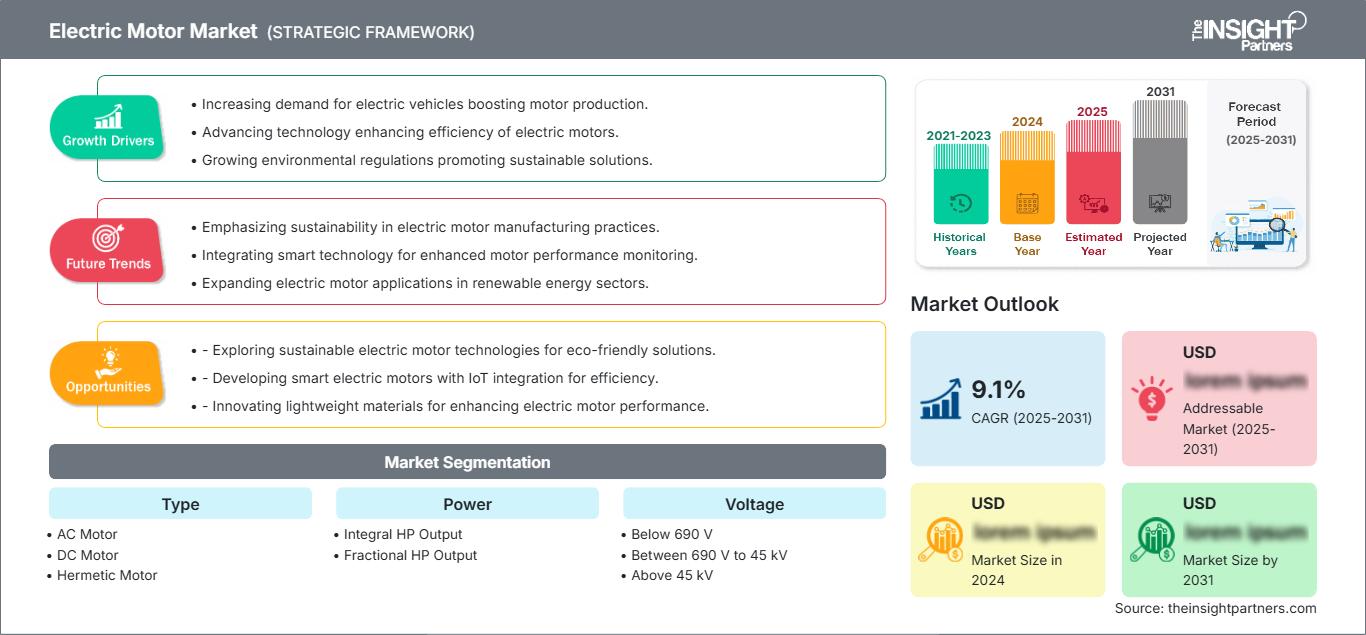
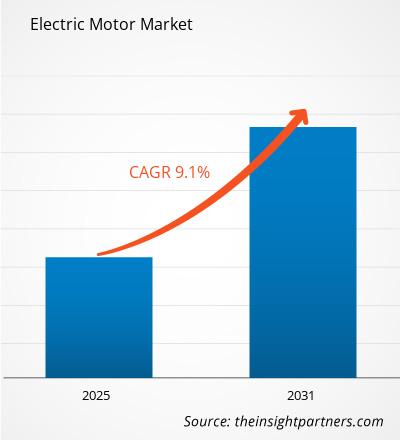
The Electric Motor Market is valued at US$ 223.61 Billion in 2025 and is predicted to reach US$ 446.47 Billion by 2034, growing at a CAGR of 7.99% during 2026-2034. Global market includes various platforms such as AC motor, DC motor, and hermetic motors used in machinery, motor vehicles, HVAC systems, aircrafts & transportation, home appliances and other electromechanical systems.
The North American Electric Motor Market Size is predicted to experience growth at a CAGR of 7.2-7.8% during 2026-2034 owing to manufacturing automation, motor efficiency upgradation, EV components capability and HVAC systems upgradation. The demand is high in applications where industrial consumers integrate motor upgradation along with variable speed drives, predictive maintenance, and energy management..
Electric Motor Market Assessment and Insights
- North America held 22–25% share in 2025 and is growing at a CAGR of 7.2–7.8% during 2026–2034, led by U.S. manufacturing automation, HVAC replacement, EV supply chains, and federal efficiency rules.
- US represented 78–82% of North American revenue in 2025 and is growing at a CAGR of 7.3–7.9% during 2026–2034, supported by industrial drives and vehicles.
- Europe accounted for 18–21% share in 2025 and is growing at a CAGR of 6.8–7.4% during 2026–2034, with Germany, France, Italy, Spain, and the UK leading demand.
- Asia Pacific held 45–49% share in 2025 and is growing at a CAGR of 8.4–9.1% during 2026–2034, led by China, Japan, South Korea, India, and Australia.
- Largest Segment AC Motor held 68–72% market share in 2025 and is growing at a CAGR of 7.6–8.2% during 2026–2034 due to industrial, HVAC, and appliance use.
- High Growth Segment Motor Vehicles represented 24–28% market share in 2025 and is growing at a CAGR of 9.2–10.1% during 2026–2034, supported by electrification.
- Key companies analyzed in detail: ABB Ltd.; AMETEK, Inc.; Emerson Electric Co.; General Electric Company; Johnson Electric Holdings Limited; Nidec Corporation; Regal Rexnord Corporation; Rockwell Automation, Inc.; Siemens Aktiengesellschaft; Toshiba Corporation.
Source: The Insight Partners' analysis based on proprietary research, government publications, company annual reports, investor presentations, industry databases, and expert interviews.
Motor technology is transitioning away from typical induction motors to advanced, efficient, and digitally monitored technologies, which increase operational performance and reduce the cost of energy. Manufacturers are developing their technologies in relation to new efficiency classes and duty cycles for particular applications. In terms of manufacturing dynamics, manufacturers consider access to copper, rare earth magnets, automation of assembly, and regionally distributed qualification capacities. All these trends bring Motor Market closer to electrification, automation, and decarbonization initiatives.
Further demand will become stronger in economies expanding their electric vehicle capacity, smart factories, energy-efficient buildings, and renewable infrastructure. Capital investment will be concentrated on IE4 and IE5 motors, miniaturized traction motors, hermetically sealed compressors, and digital motor-drive solutions. The regulatory push towards energy efficiency contributes to the cycle of replacements since motor-driven machines make a significant part of electricity consumption, and efficiency improvements will allow cutting energy consumption dramatically.
Electric Motor Market Report Scope
| Report Attribute | Details |
|---|---|
| Market size in 2025 | US$ 223.61 Billion |
| Market Size by 2034 | US$ 446.47 Billion |
| Global CAGR (2026 - 2034) | 7.99% |
| Historical Data | 2021-2024 |
| Forecast period | 2026-2034 |
Electric Motor Market Analysis
Growth of Electric Motor Market Share is propelled by electrified transport vehicles, industrial automation, efficient HVAC systems, and legacy motors replacement. Motors assist in the operation of pumps, compressors, fans, conveyors, robotics, appliances, and automotive powertrains, creating demand in both cyclical and structural applications.
The market value chain comprises electrical steel, copper wiring, magnets, insulation systems, bearing, casting, electronic drives, testing laboratories, distributors, OEMs, and maintenance companies. The supply chain is subject to the availability of raw materials and product certification, because the buyers tend to evaluate the product according to its total cost of operation, duty cycle, and performance metrics.
Competitive environment consists of automation equipment manufacturers, industrial motor producers, and precision motion control companies. ABB Ltd., Siemens Aktiengesellschaft, Nidec Corporation, Regal Rexnord Corporation, and Toshiba Corporation enhance Electric Motor Market report due to wide product lines, high efficiency design and service network.
AMETEK, Inc., Johnson Electric Holdings Limited, Emerson Electric Co., General Electric Company, and Rockwell Automation, Inc. focus on specialty motion and automation, HVAC and industrial control applications. Future investments are going to increase the share of integrated motor drive systems, predictive diagnostics, local production of components and application-driven product design.
● REPORT CUSTOMIZATION
Tailor This Report To Align With Your Specific Business Requirements
This report can be customized to align precisely with your business objectives, scope, and target markets. Customization options include tailored segmentation, geography, competitive analysis, and strategic insights to support informed decision-making.
Customize This Report →WHAT YOU CAN ADJUST
- ● Segmentations
- ● Geography
- ● Competitive Analysis
- ● Language Preferences
Electric Motor Market: Strategic Insights
Regional Insights
North America Electric Motor Market
North America accounted for 22–25% of Electric Motor Market share in 2025 and is projected to grow at a CAGR of 7.2–7.8% during 2026–2034. Demand is supported by manufacturing automation, efficient HVAC replacement, oil and gas electrification, water infrastructure, and warehouse robotics.
Regional buyers emphasize premium-efficiency motors, integrated drives, and predictive maintenance because electricity prices and labor constraints make uptime valuable. ABB Ltd., Siemens Aktiengesellschaft, Regal Rexnord Corporation, Rockwell Automation, Inc., Emerson Electric Co., and AMETEK, Inc. support procurement through local engineering, distribution, and service capabilities.
U.S. Electric Motor Market
The U.S. represented 78–82% of North American revenue in 2025 and is expected to grow at a CAGR of 7.3–7.9% during 2026–2034. Application momentum comes from industrial machinery, heat pumps, EV production, compressors, pumps, and logistics automation.
Company presence is reinforced by ABB Ltd., Regal Rexnord Corporation, Rockwell Automation, Inc., Emerson Electric Co., AMETEK, Inc., and General Electric Company. Buyers prioritize NEMA-compliant motors, variable-frequency-drive compatibility, repair networks, and domestic availability for critical facilities and high-load industrial applications.
Europe Electric Motor Market
Europe held 18–21% share in 2025 and is projected to grow at a CAGR of 6.8–7.4% during 2026–2034. Germany leads through industrial automation, machinery exports, and efficient factory retrofits. France adds rail, aerospace, and energy equipment demand, while Italy, Spain, and the UK support HVAC, food processing, and infrastructure modernization.
European procurement emphasizes Ecodesign compliance, IE3 and IE4 replacement, documentation, and lifecycle energy savings. Siemens Aktiengesellschaft, ABB Ltd., Nidec Corporation, Johnson Electric Holdings Limited, and Toshiba Corporation benefit from established OEM relationships. Demand favors AC motors, servo systems, and hermetic motors for compressors used in efficient buildings and industrial refrigeration.
APAC Electric Motor Market
Asia Pacific accounted for 45–49% share in 2025 and is forecast to grow at a CAGR of 8.4–9.1% during 2026–2034. China leads through EVs, appliances, automation, and export manufacturing, while Japan and South Korea anchor precision motors. India and Australia add infrastructure, HVAC, and mining demand.
Industrial policy, factory automation, and efficiency standards make the region central to capacity planning. Nidec Corporation, Johnson Electric Holdings Limited, Toshiba Corporation, ABB Ltd., and Siemens Aktiengesellschaft support localized production and application engineering. Growth also reflects rising compressor demand in cooling, data centers, and cold-chain logistics.
Middle East & Africa Electric Motor Market
The Middle East & Africa market is projected to grow at a CAGR of 6.1–6.8% during 2026–2034. Saudi Arabia leads through industrial diversification, water systems, oil and gas electrification, and construction. The UAE supports demand from infrastructure, cooling, logistics, and data-center investments.
South Africa and Rest of MEA add opportunities through mining, utilities, manufacturing, and municipal pumping upgrades. Buyers value rugged motors, heat-resistant insulation, serviceability, and stable spare-part access. Energy and infrastructure projects support selective adoption of integral horsepower systems, hermetic compressors, and efficient motor-drive packages.
Segmentation Analysis
Type
Type is projected to grow at a CAGR of 7.7–8.4% during 2026–2034. Electric Motor Market scope spans rotating platforms selected by torque, speed, duty cycle, enclosure, control method, noise, and efficiency. AC motors dominate industrial and HVAC demand, DC motors remain relevant in precision and battery-powered systems, and hermetic motors support sealed compressor applications.
- AC Motor holds the strongest market position because induction and synchronous designs serve pumps, fans, compressors, conveyors, industrial machinery, appliances, and HVAC systems with reliable, efficient operation.
- DC Motor demand is concentrated in automotive auxiliaries, medical devices, robotics, and compact automation where controllable torque, fast response, and battery compatibility support specialized motion requirements.
- Hermetic Motor is strategically important in sealed refrigeration and air-conditioning compressors, where compact design, refrigerant compatibility, insulation reliability, and energy-efficient operation determine product competitiveness.
Power
Power is forecast to grow at a CAGR of 7.8–8.5% during 2026–2034. Integral horsepower output supports heavy machinery, pumps, compressors, and process equipment where durability and energy savings define purchase economics. Fractional horsepower output serves appliances, HVAC fans, automotive systems, and small automation, benefiting from volume production and compact motor designs.
- Integral HP Output motors are central to industrial machinery, water systems, compressors, conveyors, and heavy-duty HVAC equipment where continuous operation and lifecycle energy savings influence procurement.
- Fractional HP Output motors serve high-volume appliances, fans, pumps, automotive auxiliaries, and compact equipment where cost, noise, size, and reliable performance shape supplier selection.
Voltage
Voltage is projected to grow at a CAGR of 7.6–8.3% during 2026–2034. Below 69 V demand tracks battery-powered devices and automotive auxiliaries, 69 V to 45 kV systems support mainstream industrial and commercial equipment, and above 45 kV motors address specialized heavy-duty applications where large mechanical loads require robust electrical design.
- Below 69 V motors support low-voltage mobility, electronics, small appliances, robotics, and auxiliary systems where compact size, safety, and power efficiency are key purchasing criteria.
- Between 69 V to 45 kV motors represent the broadest industrial operating range, serving pumps, compressors, fans, conveyors, HVAC equipment, and machinery requiring dependable continuous duty.
- Above 45 kV motors serve heavy process industries, large compressors, mills, and infrastructure applications where high power density, insulation integrity, and engineered maintenance determine adoption.
Application
Application is projected to grow at a CAGR of 8.0–8.8% during 2026–2034. Industrial machinery remains the largest use case, while motor vehicles provide the strongest growth impulse as electrification expands beyond traction systems. HVAC equipment, aerospace and transportation, and household appliances support steady demand through efficiency upgrades, urbanization, comfort cooling, and automation.
- Industrial Machinery uses motors in pumps, compressors, conveyors, machine tools, robotics, and process equipment where uptime, torque control, and energy efficiency shape capital spending.
- Motor Vehicles require traction, cooling, steering, braking, seating, and auxiliary motors, making electrification and vehicle feature content major demand multipliers.
- HVAC Equipment relies on efficient fan, blower, compressor, and pump motors as buildings adopt variable-speed systems, heat pumps, and lower-energy cooling technologies.
- Aerospace & Transportation applications value compact, reliable, and controllable motors for actuation, pumps, cabin systems, rail equipment, and emerging electric mobility platforms.
- Household Appliances use motors in refrigerators, washing machines, vacuum cleaners, dishwashers, and kitchen equipment where quiet operation and efficiency improve product differentiation.
Opportunity Snapshot
| Application | Revenue Contribution | Trend Tag | Adoption Stage |
| Industrial Machinery | High | Smart Drives | Mature |
| Motor Vehicles | High | EV Traction | Scaling |
| HVAC Equipment | Medium | Heat Pumps | Scaling |
| Aerospace & Transportation | Medium | Electric Actuation | Emerging |
| Household Appliances | Medium | Inverter Appliances | Mature |
| Others | Low | Custom Motion | Emerging |
Electric Motor Market Growth Drivers and Impact Analysis
Efficiency regulations accelerate motor replacement
Minimum energy performance standards have resulted in the replacement of old motors with new and more efficient motors. Motors consume a significant portion of the electricity generated; hence, even a small increase in efficiency results in noticeable cost savings. For suppliers, it means more sales for IE3, IE4, and IE5 products, which come with variable speed drives. Suppliers who can provide evidence of testing, compliance, and cost-saving over the lifecycle can justify the cost increase, while buyers save themselves from emission risk.
Vehicle electrification multiplies motor content per platform
An increase in electric and hybrid vehicles leads to an increase in traction motors, thermal management motors, oil pumps, coolant pumps, brake boosters, steer-by-wire, seat motors, and actuator assemblies. The effect on the market does not stop at the powertrain supplier segment since an increase in the content of vehicle features will mean an increase in the requirement for miniature DC and brushless motors. Efficient and thermally stable operation with lower noise emission and security of supply have become key criteria in the selection process, favoring qualified suppliers that manufacture locally and design-in.
Automation and digital maintenance raise specification standards
More use of robots, automated material handling equipment, machine tools, and digitally enabled manufacturing assembly lines demands more precise motion control. Motors are getting smarter and equipped with sensing, drives, encoders, and software to predict maintenance and control motion adaptively. The effect on the market is a move away from discrete hardware components towards a motor-drive system offering better margins and serviceability opportunities. Manufacturers with capabilities such as diagnostics, application engineering, and quick commissioning can gain better value, while customers minimize downtime and increase productivity with labor shortages.
Electric Motor Market Future Trends
Software-defined motors and edge diagnostics
Electric Motor Market trends will develop towards electric motors with sensing, analytics, and intelligent driving. Future developments will measure vibration, current signature, temperature, bearing status, and loading pattern before any failure takes place. This trend will affect buying decision criteria as buyers will take into account the value of software, cyber security, and integration in addition to efficiency. Companies that can link information from the motor to the plant’s maintenance system can benefit from recurring revenues and customer loyalty.
Rare-earth reduction and advanced motor architectures
Future motor design will strike a balance between performance and durability with an increasing need to ensure magnet availability, price stability, and sustainability. Technologies such as switched reluctance, synchronous reluctance, ferrite-based motors, and improved induction motors will receive more consideration in situations where there is a need to decrease the usage of rare earth magnets. This transition will not mean that the permanent magnet motors will go out of use in vehicles or precision applications, but it will provide more motor options for fans, pumps, and compressors.
Electric Motor Market Opportunities
Premium-efficiency retrofit packages for industrial facilities
Electric Motor Market Forecasts support investment in retrofit packages that combine high-efficiency motors, variable-speed drives, sensors, installation support, and energy-savings verification. Industrial facilities often delay upgrades because replacement decisions are fragmented across maintenance and capital budgets. Vendors can unlock demand by offering packaged audits, standardized payback models, and financing partnerships for pumps, fans, compressors, and conveyors. This opportunity rewards suppliers that reduce project complexity, quantify energy savings, and provide regional service coverage for brownfield plants.
Localized supply for EV and HVAC manufacturing ecosystems
Motor suppliers can capture long-term contracts by aligning production near EV, compressor, appliance, and HVAC manufacturing clusters. Localized supply improves delivery reliability, supports joint engineering, and reduces tariff or logistics exposure. The investment case is strongest for brushless DC motors, hermetic compressor motors, traction-related assemblies, and compact auxiliary units used across multiple platforms. Vendors that combine regional assembly with global quality systems can become preferred partners because OEMs increasingly value supply continuity, customization speed, and lifecycle support.
Recent Developments
- June 2026: The commenced large-scale production of its new electric axial flux motor at Berlin-Marienfelde plant has started. With the launch of large-scale production of this revolutionary drive system from Mercedes-Benz, the company’s oldest manufacturing site is opening a new chapter in its history spanning more than 120 years.
- May 2026: ABB is the world’s first manufacturer to offer an IE6 Hyper‑Efficiency motor certified to ATEX and IECEx requirements for use in hazardous areas. The new IE6 Increased safety motor, based on ABB’s magnet- and rare earth- free synchronous reluctance (SynRM) technology, offers up to 60 percent lower energy losses than the IE3 induction motors commonly used in Zones 1 and 2. This enables operators to realize a major boost in energy efficiency and avoided carbon emissions in industries where gas, vapor or dust might be present, such as chemicals, marine, oil & gas, pharmaceuticals and food & beverage.
- April 2026: Bosch has introduced a new generation of permanent-magnet synchronous e-motors designed to set the benchmark for series-ready electric propulsion. The advanced motor delivers a world-record gain in efficiency, with only 0.85 kWh/100 km losses in the WLTC cycle and effectively cutting the losses by up to 30 percent. Depending on use case, the motor provides a continuous-to-peak power ratio of up to 93 percent, combining breakthrough efficiency with robust, real-world performance.
Frequently Asked Questions

- Comprehensive Market Sizing and Forecast Analysis
- Detailed Segmentation Analysis
- In-Depth Market Dynamics Assessment
- Regional and Country-Level Insights
- Competitive Landscape and Company Benchmarking
- Strategic Business Intelligence
Recent Reports
Testimonials

The Insight Partners' SCADA System Market report is comprehensive, with valuable insights on current trends and future forecasts. The team was highly professional, responsive, and supportive throughout. We are very satisfied and highly recommend their services.
RAN KEDEM Partner, Reali Technologies LTDs
I requested a report on a very specific software market and the team produced the report in a few days. The information was very relevant and well presented. I then requested some changes and additions to the report. The team was again very responsive and I got the final report in less than a week.
JEAN-HERVE JENN Chairman, Future Analytica
We worked with The Insight Partners for an important market study and forecast. They gave us clear insights into opportunities and risks, which helped shape our plans. Their research was easy to use and based on solid data. It helped us make smart, confident decisions. We highly recommend them.
PIYUSH NAGPAL Sr. Vice President, High Beam Global
The Insight Partners delivered insightful, well-structured market research with strong domain expertise. Their team was professional and responsive throughout. The user-friendly website made accessing industry reports seamless. We highly recommend them for reliable, high-quality research services
YUKIHIKO ADACHI CEO, Deep Blue, LLC.
This is the first time I have purchased a market report from The Insight Partners.While I was unsure at first, I visited their web site and felt more comfortable to take the risk and purchase a market report.I am completely satisfied with the quality of the report and customer service. I had several questions and comments with the initial report, but after a couple of dialogs over email with their analyst I believe I have a report that I can use as input to our strategic planning process.Thank you so much for taking the extra time and making this a positive experience.I will definitely recommend your service to others and you will be my first call when we need further market data.
JOHN SUZUKI President and Chief Executive Officer, Board Director, BK Technologies
I wish to appreciate your support and the professionalism you displayed in the course of attending to my request for information regarding to infectious disease IVD market in Nigeria. I appreciate your patience, your guidance, and the fact that you were willing to offer a discount, which eventually made it possible for us to close a deal. I look forward to engaging The Insight Partners in the future, all thanks to the impression you have created in me as a result of this first encounter.
DR CHIJIOKE ONYIA MANAGING DIRECTOR, PineCrest Healthcare Ltd.Reason to Buy
- Informed Decision-Making
- Understanding Market Dynamics
- Competitive Analysis
- Identifying Emerging Markets
- Customer Insights
- Market Forecasts
- Risk Mitigation
- Boosting Operational Efficiency
- Strategic Planning
- Investment Justification
- Tracking Industry Innovations
- Aligning with Regulatory Trends





 Get Free Sample for