
Electric Vehicle Communication Controller Market Growth, Size, Share, Trends, and Forecast till 2034
Coverage: By System (EV Communication Controller (EVCC), Supply Equipment Communication Controller (SECC)),); Charging type (Wired, Wireless); Vehicle Type (Passenger Car, Commercial Vehicle) , and Geography (North America, Europe, Asia Pacific, and South and Central America)
- Status : Data Released
- Report Code : TIPRE00006550
- Category : Electronics and Semiconductor
- No. of Pages : 150
- Available Report Formats :


- Last update date : August 12, 2026


2024 Market Size
US$ 458.64 Mn
Base year value
2034 Forecast
US$ 4060.86 Mn
Projected by 2034
CAGR 2026-2034
27.4 %
Growth rate
Addressable Market
US$ 21,888.16 Mn
(2026-2034)
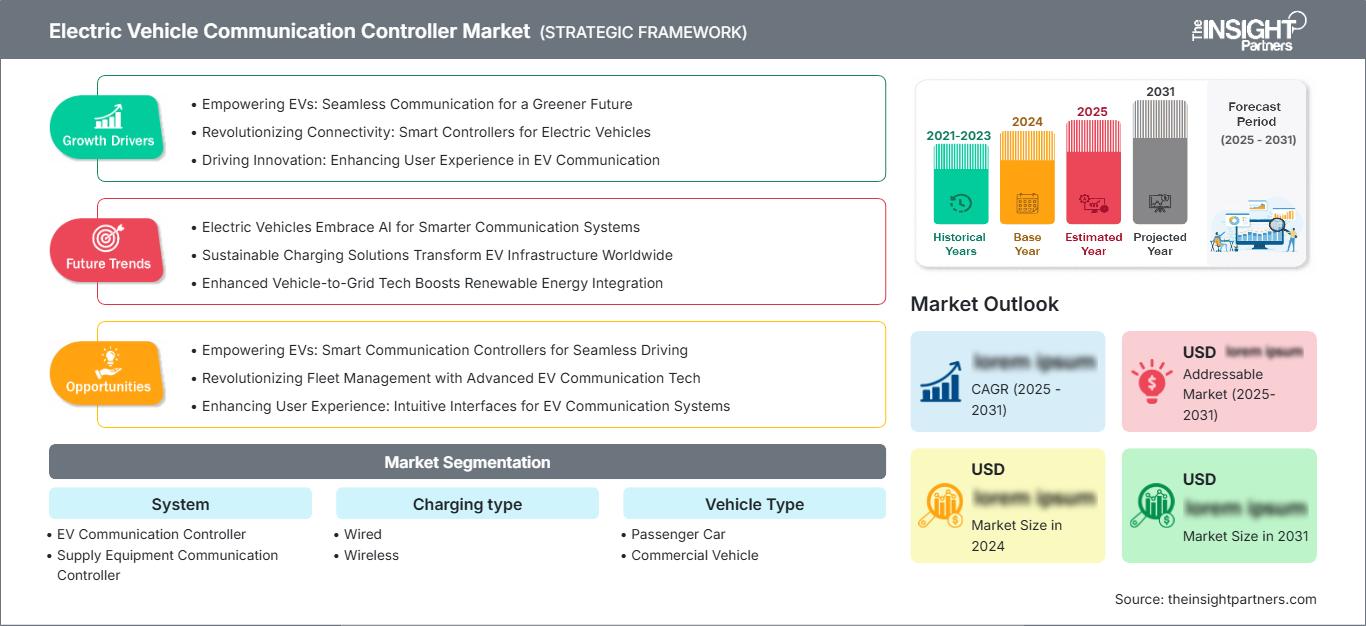
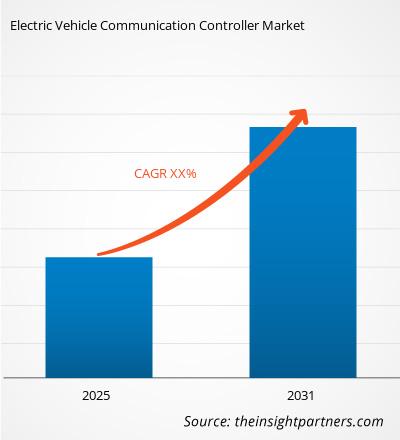
The Electric Vehicle Communication Controller Market had a valuation of US$ 458.64 Million in 2025 and is estimated to achieve a market valuation of US$ 4060.86 Million in 2034, registering a compound annual growth rate of 27.4% between 2026 and 2034. The market is growing due to factors such as EVs adoption, charging interoperability, ISO 15118 certification and smart-grid integration.
In North America, Electric Vehicle Communication Controller Market size is projected to grow at a compound annual growth rate between 24.0-26.5% because of the increasing demand for fast charging stations, electrified fleets, and managed charging systems. There are structural drivers such as government funding for corridors, NACS and CCS interoperability projects, and charger operators interested in authentication, billing, load management, and bidirectional charging capability.
Electric Vehicle Communication Controller Market Assessment and Insights
- North America held 24–27% share in 2025 and is growing at a CAGR range of 24.0–26.5% during 2026–2034, supported by fast-charging corridors, commercial fleets, and interoperability upgrades.
- US represented 78–81% of North America in 2025 and is growing at a CAGR range of 24.5–27.0%, led by charging networks, OEM platforms, and depot charging.
- Europe accounted for 29–32% share in 2025 and is advancing at a CAGR range of 25.5–28.0%, with Germany, France, the UK, Netherlands, and Norway leading charger standardization.
- Asia Pacific captured 37–40% share in 2025 and is expanding at a CAGR range of 28.0–31.0%, led by China, Japan, South Korea, India, and Australia.
- Largest Segment EV Communication Controller held 56–60% market share in 2025 and is growing at a CAGR range of 26.0–28.5%, supported by vehicle-side charging intelligence.
- High Growth Segment Wireless charging held 8–11% market share in 2025 and is growing at a CAGR range of 33.0–36.0%, driven by automated charging pilots.
- Key companies analyzed in detail: ABB Ltd., BYD Company Limited, ENGIE SA, Ficosa International S.A., LG Innotek Co., Ltd., Mitsubishi Electric Corporation, Robert Bosch GmbH, Schneider Electric SE, Siemens AG, and Tesla, Inc.
Source: The Insight Partners' analysis based on proprietary research, government publications, company annual reports, investor presentations, industry databases, and expert interviews.
In terms of technology development in the Electric Vehicle Communication Controller Market, this industry has evolved from the simple charging handshake process to advanced software-based communication controllers that allow ISO 15118 communication protocols, Plug & Charge functionality, dynamic load management, and bidirectional power flow. In terms of production processes, this market has become dependent on semiconductors, software, cybersecurity solutions, chargers, and vehicle platform integration. Moreover, controller producers should consider the regional variation of charging protocols while ensuring the reliability of their products within the realm of AC, DC fast charging, and high-power charging applications.
Future demand for electric vehicle communication controllers will increase with the new EU legislation on charging accessibility, the construction of corridor charging systems in North America, and increasing demand and installation of charging infrastructure and vehicles in Asia Pacific. The focus for investments is expected to shift to controllers capable of providing more reliable charging, allowing secure payments, and future vehicle-to-grid services.
Electric Vehicle Communication Controller Market Report Scope
| Report Attribute | Details |
|---|---|
| Market size in 2024 | US$ 458.64 Million |
| Market Size by 2034 | US$ 4060.86 Million |
| Global CAGR (2026 - 2034) | 27.4% |
| Historical Data | 2021-2024 |
| Forecast period | 2026-2034 |
Electric Vehicle Communication Controller Market Analysis
The EV Communication Controller Market is fuelled by increases in electric vehicle inventory, public charger installations, and the demand for charging sessions to be reliable regardless of the brand and network being used. The EVCC enables connections between the vehicle's battery system, charge point infrastructure, payment information, grid signals, and cloud services. The demand for EVCC is highest in areas requiring precise power negotiations, authentication, and vehicle state monitoring for fast charging, depot charging, and smart charging programs.
Market supply dynamics are characterized by software capability, automotive electronics, protocol validation, and collaboration with charger and vehicle manufacturers. EVCCs are the most dominant controllers in terms of vehicle integration, while the SECC is becoming increasingly popular with public and depot chargers. The wired approach dominates the commercial market while wireless pilot projects are raising the bar.
The competitive positioning of the Electric Vehicle Communication Controller Market is influenced by the elements of interoperability, cybersecurity, power charging compatibility, and the ecosystem access. ABB Ltd., Schneider Electric SE, Siemens AG, and ENGIE SA benefit from the exposure to charging infrastructure and energy management solutions, while Robert Bosch GmbH, LG Innotek Co., Ltd., Mitsubishi Electric Corporation, and Ficosa International S.A. add automotive electronics expertise. BYD Company Limited and Tesla, Inc. impact the controller requirements by virtue of their vertically integrated EV and charging solutions.
The investment trend leans towards the controller platforms capable of remote updating, validation within ISO 15118 and OCPP ecosystems, and adaptation to the bidirectional services. The strategic competitive advantage will be derived from decreasing the failure rate of chargers, implementing Plug and Charge functionality, providing grid-aware scheduling capabilities, and delivering reliable charging information for fleets.
● REPORT CUSTOMIZATION
Tailor This Report To Align With Your Specific Business Requirements
This report can be customized to align precisely with your business objectives, scope, and target markets. Customization options include tailored segmentation, geography, competitive analysis, and strategic insights to support informed decision-making.
Customize This Report →WHAT YOU CAN ADJUST
- ● Segmentations
- ● Geography
- ● Competitive Analysis
- ● Language Preferences
Electric Vehicle Communication Controller Market: Strategic Insights
Regional Insights
North America Electric Vehicle Communication Controller Market
North America held 24–27% share in 2025 and is projected to grow at a CAGR range of 24.0–26.5% through 2034. Electric Vehicle Communication Controller Market share is supported by US fast-charging corridors, Canadian utility charging programs, fleet depot electrification, and growing adoption of secure Plug and Charge functions that reduce failed public charging sessions.
Regional demand is concentrated in the US, where charger networks, automakers, and energy companies are aligning around interoperability between NACS, CCS, ISO 15118, and cloud-based charging platforms. Public chargers in the US expanded by about 20% in 2024, while Europe surpassed 1 million public points, underscoring global pressure for controller reliability.
U.S. Electric Vehicle Communication Controller Market
The US constituted 78–81% of North America in 2025 and is expected to grow at a CAGR range of 24.5–27.0%. The demand for the application depends on highway fast charging, workplace charging, logistics depots, and transition of OEM towards seamless authentication. Tesla, Inc., Siemens AG, ABB Ltd., Schneider Electric SE, and Robert Bosch GmbH drive the applications through their chargers, vehicle platforms, and energy management systems.
The application trends include Plug and Charge enrollment, charger availability analysis, high power DC charging, and fleet energy scheduling. The public network providers require controllers that manage secure certificates, payment handshakes, power negotiation, and remote diagnosis. The commercial vehicle depots have introduced an additional demand due to the need for vehicle side and equipment side coordination for grid connection.
Europe Electric Vehicle Communication Controller Market
The European region accounted for 29–32% market share in 2025, and the growth is projected at a CAGR of 25.5–28.0%. Germany holds top position as it is a leader in automotive engineering, charger installation, and testing for ISO 15118 certification. The UK region will be promoting fleet electrification and expansion of the public charging infrastructure, whereas France has corridor charging, utility interaction, and payment clarity as key drivers.
Italians and Spanish have urban charging, tourist corridor charging, and city electrification as drivers for demand. The Netherlands and Norway are important for interoperability benchmarking. Requirements for AFIR of fast charging points within 60 km on major TEN-T corridors provide impetus to the Electric Vehicle Communication Controller Market through secure and standardized communication from chargers.
APAC Electric Vehicle Communication Controller Market
Asia Pacific had a market share of 37–40% in 2025 and will be growing in a CAGR range of 28.0–31.0%. China will be dominating through the volume of EV manufacturing, charging networks, and protocols ecosystem. Japan and South Korea will be contributing with electronics manufacturing capacity, whereas India and Australia will be building newer charging networks.
Industrial drivers include the production of EVs and chargers as well as digitalization of the grid. China constituted 65% of the global public charging network in 2024, leading to massive consumption of controllers. India is growing through its policies and fleet-based usage, thus the importance of low-cost and reliable SECC and EVCC modules.
Middle East & Africa Electric Vehicle Communication Controller Market
Middle East & Africa is projected to grow at a CAGR range of 20.0–23.0% as the UAE, Saudi Arabia, South Africa, and rest of MEA deploy EV charging for tourism, premium vehicles, public fleets, and logistics pilots. The UAE leads through smart-city mobility and energy infrastructure investment.
Adoption depends on charger reliability, heat tolerance, payment integration, and utility coordination. Saudi Arabia’s industrial diversification and South Africa’s urban charging needs create selective opportunities. Growth will remain smaller than other regions, but high-value charging sites need robust communication controllers to support uptime, user authentication, and future grid services.
Segmentation Analysis
System
System is expected to grow at a CAGR range of 27.0–29.5% during 2026–2034 as Electric Vehicle Communication Controller Market scope covers EV Communication Controller and Supply Equipment Communication Controller. Vehicle-side modules support authentication, battery status exchange, and charging control, while equipment-side modules manage charger response, power delivery, backend communication, and safety interlocks across public, private, and fleet charging locations.
- EV Communication Controller remains the largest system because every compatible vehicle requires embedded charging communication to support safe power negotiation, Plug and Charge, battery data exchange, and future bidirectional services.
- Supply Equipment Communication Controller is strategically important in public and depot chargers, enabling station-side protocol handling, charger authentication, payment coordination, power allocation, and network-level operational visibility.
Charging type
Charging type is projected to grow at a CAGR range of 26.5–29.0% during 2026–2034 as wired charging remains the commercial base and wireless charging develops from pilots toward specialized fleet and premium use cases. Communication controllers must support secure negotiation, charging state visibility, and energy-transfer coordination across conventional connectors, automated parking, and emerging inductive charging environments.
- Wired charging dominates current installations because AC and DC connector ecosystems are mature, broadly deployed, and essential for public fast charging, residential charging, and fleet depot operations.
- Wireless charging is a high-growth niche where automation, parking convenience, and fleet turnaround can justify controller sophistication for alignment, authentication, safety checks, and energy-transfer control.
Vehicle Type
Vehicle Type is expected to grow at a CAGR range of 27.5–30.0% during 2026–2034 as passenger cars generate broad controller volumes and commercial vehicles increase complexity through depot scheduling, high-capacity charging, and route-based energy planning. Communication controllers are becoming essential for coordinating power, charging windows, battery condition, and charger availability across mixed vehicle fleets.
- Passenger Car accounts for the widest deployment base as automakers integrate EVCC modules to improve public charging compatibility, driver convenience, Plug and Charge enrollment, and long-distance fast-charging reliability.
- Commercial Vehicle demand is rising as vans, buses, and trucks require coordinated depot charging, high-power sessions, uptime analytics, and grid-aware load management to protect fleet economics.
Opportunity Snapshot
| Vehicle Type | Revenue Contribution | Trend Tag | Adoption Stage |
| Passenger Car | High | Plug Charge | Scaling |
| Commercial Vehicle | Medium | Depot Charging | Emerging |
Electric Vehicle Communication Controller Market Growth Drivers and Impact Analysis
Charging Interoperability Becomes a Commercial Priority
Interoperability is becoming a direct revenue issue for charging networks because failed sessions reduce utilization and user confidence. Communication controllers address this by managing digital certificates, protocol translation, power negotiation, and charger-to-cloud coordination. The impact is strongest in public fast charging, where each stall must serve multiple vehicle brands and connector standards. As networks support CCS, NACS, ISO 15118, and OCPP-based backends, validated EVCC and SECC platforms reduce integration risk. This driver lifts demand for controllers with cybersecurity, field-update capability, and testing support, shifting procurement from low-cost hardware toward reliable charging outcomes.
Vehicle-to-Grid Readiness Raises Controller Complexity
Vehicle-to-grid, vehicle-to-home, and managed charging programs require controllers to exchange more than basic charging status. They must support bidirectional permissions, battery state limits, grid signals, user preferences, and secure settlement data. This creates a market impact because utilities, fleets, and automakers need communication layers that can be trusted for energy services. Commercial fleets are the earliest scalable use case because predictable routes and depot charging simplify scheduling. As bidirectional pilots mature, controller suppliers with energy-domain software, utility partnerships, and compliance testing will gain advantage over firms focused only on one-way charging.
Commercial Fleet Charging Intensifies Uptime Requirements
Fleet electrification changes communication controller requirements because charging becomes an operational dependency rather than a convenience feature. Delivery vans, buses, and service fleets need scheduled charging, power sharing, charger reservation, battery status visibility, and fast fault diagnosis. A single failed session can disrupt routes, labor planning, and vehicle availability. This makes SECC and EVCC reliability central to depot economics. Suppliers can capture value by integrating controllers with fleet software, load-management systems, and predictive maintenance dashboards. The driver also supports premium pricing for validated platforms that reduce downtime and simplify charging operations across mixed vehicle fleets.
Electric Vehicle Communication Controller Market Future Trends
Plug and Charge Moves from Premium to Mainstream
Electric Vehicle Communication Controller Market trends will increasingly center on Plug and Charge as drivers and fleets expect charging to work without apps, cards, or manual payment steps. ISO 15118 certificate handling will become a standard requirement across public charging and OEM platforms. As certificate management scales, controller software will need stronger cybersecurity, remote updates, and multi-network compatibility. This trend will reduce friction for drivers, improve charging utilization, and make controller validation more important during vehicle and charger launches. Suppliers that combine embedded security with simple integration tools will become preferred partners for automakers and charging equipment manufacturers.
Wireless and Automated Charging Builds New Use Cases
Automated charging will expand from technology demonstrations into premium parking, autonomous vehicle depots, and fleet yards where hands-free operation improves utilization. Wireless charging needs precise communication for vehicle alignment, foreign-object detection, authentication, billing, and power transfer control. This creates new controller requirements beyond conventional cable-based charging. The trend is not expected to displace wired charging quickly, but it will create higher-value niches in taxis, shuttles, logistics, and smart parking. Suppliers that can integrate wireless control logic with safety standards and fleet platforms will be positioned for early deployment contracts.
Electric Vehicle Communication Controller Market Opportunities
Modular SECC Platforms for Fast-Charging Networks
Electric Vehicle Communication Controller Market Forecasts point to a strong opportunity in modular SECC platforms for public and highway fast-charging networks. Investors and suppliers can focus on controllers that support multiple connector standards, high-power DC charging, OCPP integration, certificate management, and remote diagnostics. The opportunity is attractive because charger operators are measured on uptime, payment success, and customer experience. Modular platforms reduce development time for charger manufacturers and simplify upgrades when standards evolve. Vendors that offer pre-tested software stacks, cybersecurity support, and field-update capability can build recurring value beyond the initial controller sale.
Fleet Depot Communication and Energy Orchestration
Fleet depots offer an actionable opportunity because they need coordinated charging across vehicles, chargers, schedules, and grid limits. Communication controllers can become the operational layer that connects battery state, route planning, electricity tariffs, charger availability, and energy management systems. Suppliers can package EVCC and SECC modules with depot software partnerships, commissioning support, and service contracts. This approach improves customer retention and helps fleets avoid demand charges, missed routes, and overbuilt electrical capacity. The opportunity is strongest in buses, delivery vans, and corporate fleets where predictable operations make managed charging financially measurable.
Recent Developments
- March 2026: BYD Company Limited expanded its second-generation Flash Charging network in China with integrated energy storage and thousands of charging stations, strengthening requirements for high-voltage charging communication, charger authentication, and coordinated power management across its ecosystem
- July 2025: Kinetic Communications Ltd., a leader in India’s EV technology sector, has made a significant leap in EV manufacturing. The company inaugurated its fully automated Motor Controller Unit (MCU) production line in Pune. This move strengthens Kinetic’s commitment to Industry 4.0, smart manufacturing, and the Make in India initiative.
- May 2025: Vector Informatik begun series production of its communication controller for the Megawatt Charging System (MCS). vSECC.MCS, which was showcased in detail for the first time at Power2Drive in Munich in May 2025, is aimed at charging infrastructure manufacturers developing production-ready MCS solutions over the coming years.
Frequently Asked Questions

- Comprehensive Market Sizing and Forecast Analysis
- Detailed Segmentation Analysis
- In-Depth Market Dynamics Assessment
- Regional and Country-Level Insights
- Competitive Landscape and Company Benchmarking
- Strategic Business Intelligence
Recent Reports
Testimonials

The Insight Partners' SCADA System Market report is comprehensive, with valuable insights on current trends and future forecasts. The team was highly professional, responsive, and supportive throughout. We are very satisfied and highly recommend their services.
RAN KEDEM Partner, Reali Technologies LTDs
I requested a report on a very specific software market and the team produced the report in a few days. The information was very relevant and well presented. I then requested some changes and additions to the report. The team was again very responsive and I got the final report in less than a week.
JEAN-HERVE JENN Chairman, Future Analytica
We worked with The Insight Partners for an important market study and forecast. They gave us clear insights into opportunities and risks, which helped shape our plans. Their research was easy to use and based on solid data. It helped us make smart, confident decisions. We highly recommend them.
PIYUSH NAGPAL Sr. Vice President, High Beam Global
The Insight Partners delivered insightful, well-structured market research with strong domain expertise. Their team was professional and responsive throughout. The user-friendly website made accessing industry reports seamless. We highly recommend them for reliable, high-quality research services
YUKIHIKO ADACHI CEO, Deep Blue, LLC.
This is the first time I have purchased a market report from The Insight Partners.While I was unsure at first, I visited their web site and felt more comfortable to take the risk and purchase a market report.I am completely satisfied with the quality of the report and customer service. I had several questions and comments with the initial report, but after a couple of dialogs over email with their analyst I believe I have a report that I can use as input to our strategic planning process.Thank you so much for taking the extra time and making this a positive experience.I will definitely recommend your service to others and you will be my first call when we need further market data.
JOHN SUZUKI President and Chief Executive Officer, Board Director, BK Technologies
I wish to appreciate your support and the professionalism you displayed in the course of attending to my request for information regarding to infectious disease IVD market in Nigeria. I appreciate your patience, your guidance, and the fact that you were willing to offer a discount, which eventually made it possible for us to close a deal. I look forward to engaging The Insight Partners in the future, all thanks to the impression you have created in me as a result of this first encounter.
DR CHIJIOKE ONYIA MANAGING DIRECTOR, PineCrest Healthcare Ltd.Reason to Buy
- Informed Decision-Making
- Understanding Market Dynamics
- Competitive Analysis
- Identifying Emerging Markets
- Customer Insights
- Market Forecasts
- Risk Mitigation
- Boosting Operational Efficiency
- Strategic Planning
- Investment Justification
- Tracking Industry Innovations
- Aligning with Regulatory Trends





 Get Free Sample for