
Electronic Wet Chemicals Market Trends, Size & Growth by 2034
Electronic Wet Chemicals Market Size and Forecasts (2021–2034), Global and Regional Share, Trends, and Growth Opportunity Analysis Report Coverage : by Type (Acetic Acid, Isopropyl Alcohol, Phosphoric Acid); Form (Liquid Form, Solid Form, Gas Form); Application (Semiconductor, IC Packaging, PCB); and Geography (North America, Europe, Asia Pacific, and South and Central America)
- Status : Data Released
- Report Code : TIPRE00040218
- Category : Chemicals and Materials
- No. of Pages : 150
- Available Report Formats :


- Last update date : August 18, 2026


2025 Market Size
US$ 5.11 Bn
Base year value
2034 Forecast
US$ 10.56 Bn
Projected by 2034
CAGR 2026-2034
9.50 %
Growth rate
Addressable Market
US$ 74.40 Bn
(2026-2034)
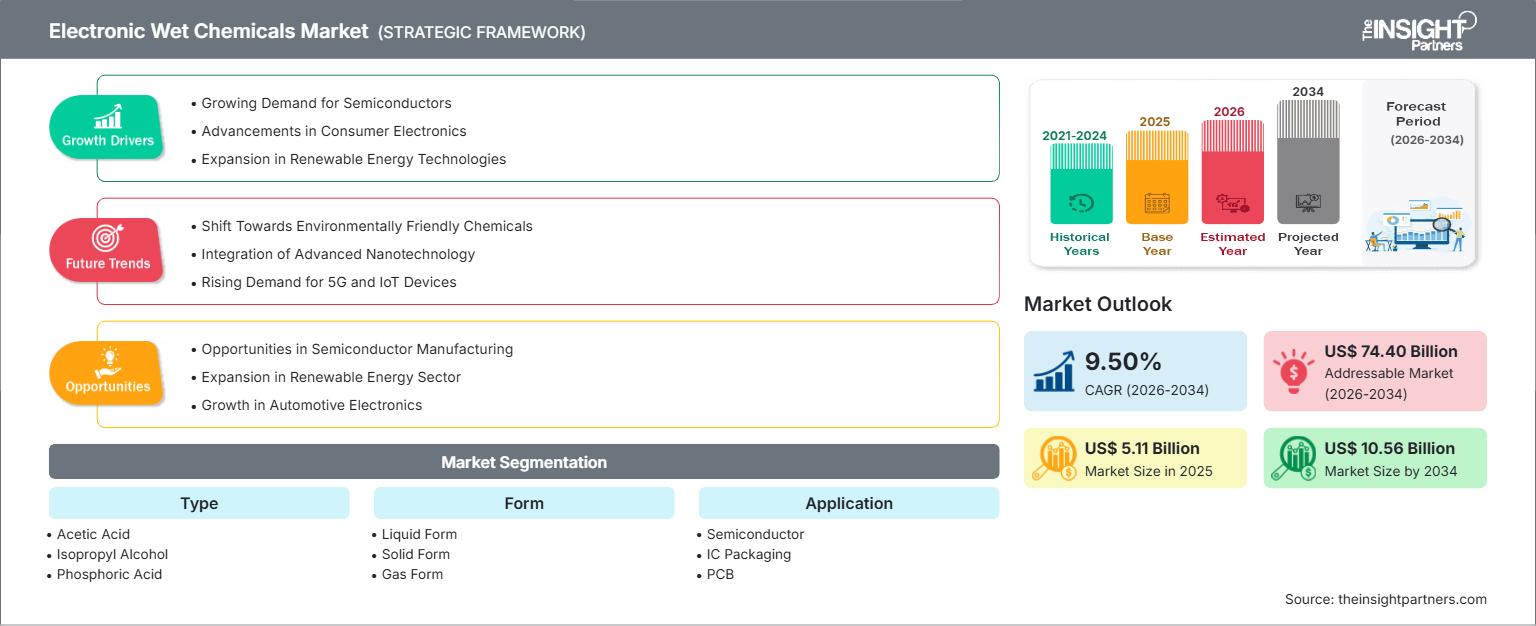
The Electronic Wet Chemicals Market Size was valued at US$ 5.11 billion in 2025 and is anticipated to reach US$ 10.56 billion by 2034 registering a CAGR of 9.50% during 2026-2034. The market is driven by increasing capacity in semiconductors manufacturing, increasing complexity of wafer fabrication and high purity chemical consumption in advanced nodes. The growth is further bolstered by increasing demands for contamination control and stricter process control in addition to local semiconductor supply chain.
North America Region is poised for steady growth due to growing investment in semiconductors manufacturing within the US, Canada and Mexico. The region is favored by presence of domestic semiconductor manufacturing driven by governments, advanced packaging capabilities, and specialty chemical manufacturing capabilities. Growth will also be driven by requirement for shorter chemical supply chain, locally produced high purity chemicals and qualified suppliers of the same.
Electronic Wet Chemicals Market Assessment and Insights
- North America accounted for an estimated 18–22% Electronic Wet Chemicals Market share in 2025 and is expected to grow at a 7.5–9.0% CAGR between 2026–2034, supported by semiconductor fab investments, advanced packaging projects, and supply-chain localization.
- US represented approximately 75–82% of North America's share in 2025 and is projected to register a 7.8–9.2% CAGR between 2026–2034, driven by domestic semiconductor capacity expansion and advanced-node manufacturing.
- Europe represented approximately 10–14% share in 2025 and is expected to expand at a 6.8–8.3% CAGR between 2026–2034, led by Germany, France, the Netherlands, and Italy, where automotive and industrial semiconductor demand remains significant.
- Asia Pacific held the largest position, with an estimated 61–66% share in 2025, and is projected to grow at a 10.0–11.5% CAGR between 2026–2034, supported by China, Taiwan, South Korea, Japan, and India.
- Largest Segment: Liquid Form held approximately 88–93% market share in 2025 and is expected to expand at a 9.0–10.0% CAGR during 2026–2034, reflecting its suitability for precision cleaning, etching, and wafer processing.
- High Growth Segment: Semiconductor accounted for approximately 68–74% share in 2025 and is projected to grow at a 9.5–10.5% CAGR during 2026–2034, supported by wafer fabrication and advanced-node process intensity.
- Key companies analyzed in detail: Avantor, Inc.; BASF SE; Entegris, Inc.; Kanto Chemical Co., Inc.; Honeywell International Inc.; Eastman Chemical Company; Linde plc; Solvay S.A.; FUJIFILM Corporation; Technic Inc.
Source: The Insight Partners' analysis based on proprietary research, government publications, company annual reports, investor presentations, industry databases, and expert interviews.
According to the Electronic Wet Chemicals Market report, the market has developed hand-in-hand with semiconductor process miniaturization. With each new generation of fabrication technology, the need for higher chemical purity increases as features get smaller and defect sensitivities become tighter. The move towards ultra-pure acids, solvents, bases, etchants, cleaners, and formulated process chemicals that can manage particle contamination and metallic impurities has already started. More and more semiconductor fabs are expecting their suppliers to integrate chemical manufacturing with purification, analytical testing, packaging, logistics, and local technical support. This trend will drive up chemical usage and qualification needs.
The Electronic Wet Chemicals Market forecast indicates that the market is anticipated to experience the effect of geographic diversification of semiconductor manufacturing capacity. Opening new fabs in the US, Europe, India, and South-East Asia is going to make it necessary for chemical suppliers to set up regional manufacturing, purification, distribution, and testing facilities. Investments in ultra-pure chemical plants, dedicated distribution channels, and application labs will also rise. Regulatory concerns around hazardous materials and fluorine-containing chemistries will push manufacturers to develop environmentally friendly formulations without loss of process performance.
Electronic Wet Chemicals Market Report Scope
| Report Attribute | Details |
|---|---|
| Market size in 2025 | US$ 5.11 Billion |
| Market Size by 2034 | US$ 10.56 Billion |
| Global CAGR (2026 - 2034) | 9.50% |
| Historical Data | 2021-2024 |
| Forecast period | 2026-2034 |
Electronic Wet Chemicals Market Analysis
Demand is closely linked to wafer starts, complexity of processes, and the number of processes involving chemicals. Wet chemicals are necessary for cleaning, surface preparation, etching, stripping, development, and other finishing operations. With increased complexity of production processes, and introduction of additional cleaning and conditioning operations, chemical demand may increase even if the size of wafers does not change. Semiconductors companies thus assess suppliers not only on cost, but also on purity, consistency, reliability of delivery, analytical capabilities, and ability to satisfy qualification requirements.
Value chain comprises basic materials, purification, formulation, quality control, packaging, distribution, and delivery to the point of use. Suppliers tend to develop integrated processes in order to minimize contamination and maintain consistency of batches. Supply issues also depend on local access to specialty raw materials, logistics regulations, and proximity of chemical facilities to semiconductor facilities. Qualification process can be a major barrier to switching.
The level of competition is influenced by global chemical companies, specialist electronic materials producers, and regional producers of high-purity chemicals. The companies such as Avantor, Inc., BASF SE, Entegris, Inc., Kanto Chemical Co., Inc., Honeywell International Inc., Linde plc, Solvay S.A., and FUJIFILM Corporation have capacities spread in various parts of the electronic materials value chain. More recently, their focus is on pureness control, local production, application engineering, and partnership with semiconductor makers instead of chemical commodities only.
The Electronic Wet Chemicals Market trends indicate that investments are being made in localization and customized technological facilities. Entegris, Inc. has announced plans for large investments in the USA that involve manufacturing and research & development of products, while BASF SE is expanding semiconductor-grade chemicals in Europe and electronic materials in Asia. At the same time, FUJIFILM Corporation is developing and producing more advanced semiconductor materials.
● REPORT CUSTOMIZATION
Tailor This Report To Align With Your Specific Business Requirements
This report can be customized to align precisely with your business objectives, scope, and target markets. Customization options include tailored segmentation, geography, competitive analysis, and strategic insights to support informed decision-making.
Customize This Report →WHAT YOU CAN ADJUST
- ● Segmentations
- ● Geography
- ● Competitive Analysis
- ● Language Preferences
Electronic Wet Chemicals Market: Strategic Insights
Regional Insights
North America Electronic Wet Chemicals Market
North America represented an estimated 18–22% share of Electronic Wet Chemicals Market in 2025 and is expected to register a 7.5–9.0% CAGR through 2034. The US dominates regional demand because of its semiconductor manufacturing base, advanced packaging investments, and increasing efforts to strengthen domestic production of strategically important electronic materials. Expansion of fabrication facilities is creating demand for high-purity process chemicals, while supplier qualification requirements encourage local production and technical support.
The regional ecosystem is becoming more vertical in nature as well. Chemical suppliers are setting up facilities for purification, packaging, analysis, and applications support close to semiconductor manufacturing nodes. Arizona, Texas, New York, Ohio, and other new semiconductor centers are drawing in supporting materials infrastructure. Incremental chemicals demand is forecasted from advanced logic, memory, power semiconductors, and specialty chips. Canada adds value with specialty materials and research capabilities, while Mexico offers an electronics manufacturing capability, although the US remains the key regional demand center.
U.S. Electronic Wet Chemicals Market
The United States has constituted around 75-82% of the North America's Electronic Wet Chemicals Market in 2025 and is expected to witness a 7.8-9.2% CAGR during 2024-2034. Growing local investments in semiconductors drive higher demand for ultra-high purity chemicals for use in wafer processing and advanced packaging. Chemical providers are investing in capacity addition, purification, logistics, and technical support in proximity to the manufacturing hubs.
Localization of semiconductor value chains drives growth opportunities. A semiconductor fab requires reliable chemical providers able to produce pure chemicals reliably, driving the importance of local manufacture of chemicals. Applications include wafer cleaning, etching, stripping, lithography processing, and packaging. Such providers as Entegris, Inc., Honeywell International Inc., Avantor, Inc., and Technic Inc. operate in the different stages of the US ecosystem for electronic materials. Growth drivers include fab investments and advanced node fabrication together with packaging operations.
Europe Electronic Wet Chemicals Market
Europe accounted for approximately 10–14% of Electronic Wet Chemicals Market in 2025 and is forecast to grow at a 6.8–8.3% CAGR through 2034. Germany is the leading national market, supported by automotive semiconductor demand, industrial electronics, and expanding semiconductor manufacturing investments. France, Italy, the Netherlands, and Spain also contribute through semiconductor research, automotive electronics, industrial technology, and supporting manufacturing ecosystems.
The UK maintains capabilities in semiconductor design, compound semiconductors, and research, creating demand for specialized process chemicals. Germany is strengthening its position through new semiconductor manufacturing projects and associated chemical infrastructure, while France supports advanced electronics and research activities. Italy benefits from automotive and power-semiconductor applications, whereas Spain is developing semiconductor and microelectronics capabilities. The region's emphasis on supply-chain resilience, advanced automotive electronics, and local semiconductor production is expected to encourage additional investment in high-purity chemical supply.
APAC Electronic Wet Chemicals Market
APAC represented approximately 61–66% of Electronic Wet Chemicals Market in 2025 and is projected to grow at a 10.0–11.5% CAGR through 2034. Taiwan remains a leading market, followed by China, South Korea, Japan, and increasingly India. Taiwan benefits from its concentration of advanced foundries, while China continues expanding domestic semiconductor capacity.
Japan and South Korea provide strong demand through memory, logic, materials, and precision electronics manufacturing. India is emerging as a semiconductor manufacturing and packaging location, while Australia contributes through research and specialized technology activities. Regional growth is supported by fab construction, advanced packaging, government incentives, and localization strategies. The concentration of semiconductor manufacturing makes APAC the most strategically important regional market for high-purity wet chemicals.
Middle East & Africa Electronic Wet Chemicals Market
Middle East & Africa represented a comparatively smaller portion of Electronic Wet Chemicals Market in 2025 but is expected to register a 5.5–7.0% CAGR through 2034. Saudi Arabia and the UAE are emerging as technology and industrial investment centers, while South Africa contributes through electronics, research, and industrial applications. Regional development remains smaller than APAC, North America, and Europe.
Saudi Arabia is increasing investment in advanced technology and industrial infrastructure, while the UAE is developing semiconductor-related capabilities and technology ecosystems. South Africa remains relevant for research and electronics manufacturing. Growth across the rest of MEA is linked to industrial digitization, telecommunications infrastructure, and technology localization. Although regional semiconductor fabrication capacity remains limited, infrastructure development and strategic technology investments provide a gradually expanding demand base.
Segmentation Analysis
Type
Type segmentation includes Acetic Acid, Isopropyl Alcohol, and Phosphoric Acid. The segment is expected to grow at a 8.5–10.0% CAGR during 2026–2034, supported by increasing semiconductor wafer processing, cleaning, etching, and surface-treatment requirements. Product purity, impurity control, consistency, and compatibility with increasingly sensitive fabrication processes are central purchasing considerations. Demand is therefore shifting toward electronic-grade materials rather than conventional industrial-grade chemicals.
- Acetic Acid is used in specialized semiconductor processing and chemical formulations where controlled acidity and high purity are required. Demand is influenced by wafer processing complexity and the need for tightly controlled chemical environments.
- Isopropyl Alcohol is widely used for semiconductor cleaning, drying, and surface preparation. Its volatility, solvent properties, and compatibility with precision cleaning make it strategically important across wafer fabrication and electronic component processing.
- Phosphoric Acid supports semiconductor etching and surface treatment applications. High-purity grades are particularly important where selective material removal and controlled process performance are required, increasing demand alongside advanced fabrication processes.
Form
Form segmentation comprises Liquid Form, Solid Form, and Gas Form. The segment is projected to expand at a 9.0–10.0% CAGR during 2026–2034, with liquid chemicals maintaining the dominant position because semiconductor wet processing depends extensively on precisely formulated liquid chemistries. Packaging, transport, purity maintenance, and point-of-use delivery remain important competitive factors.
- Liquid Form dominates applications requiring cleaning, etching, stripping, and surface treatment. Its established compatibility with semiconductor wet-processing equipment supports broad adoption and continued investment in high-purity liquid production and purification.
- Solid Form serves applications where chemicals are transported, stored, or converted into process solutions before use. Its importance is comparatively specialized, with demand influenced by formulation requirements and handling economics.
- Gas Form supports selected semiconductor and electronics processes requiring controlled gaseous chemistry. Demand is linked to advanced manufacturing infrastructure, specialized process equipment, and requirements for precise chemical delivery.
Application
Application segmentation includes Semiconductor, IC Packaging, and PCB. The segment is forecast to grow at a 9.5–10.5% CAGR during 2026–2034, led by semiconductor manufacturing. Increasing chip complexity, advanced packaging, higher wafer starts, and stricter contamination controls are expanding the requirement for high-purity chemicals across fabrication and packaging operations.
- Semiconductor remains the principal application because wafer fabrication uses wet chemicals across cleaning, etching, stripping, and surface preparation. Advanced nodes require increasingly stringent purity and contamination control.
- IC Packaging is gaining importance as advanced packaging technologies require additional cleaning, surface treatment, etching, and preparation steps. Higher chip integration and heterogeneous packaging are supporting increased chemical requirements.
- PCB applications use wet chemicals for surface preparation, etching, cleaning, and plating-related processes. Demand follows electronics production, automotive electronics, telecommunications equipment, and consumer-device manufacturing.
Opportunity Snapshot
| Segment Name | Revenue Contribution | Trend Tag | Adoption Stage |
| Semiconductor | High | Advanced Nodes | Mature |
| IC Packaging | Medium | Hybrid Packaging | Scaling |
| PCB | Medium | Fine-Line Processing | Mature |
Electronic Wet Chemicals Market Growth Drivers and Impact Analysis
Increasing Semiconductor Fabrication Complexity
Advanced semiconductor manufacturing requires more sophisticated cleaning, etching, stripping, and surface-conditioning steps than conventional fabrication. Shrinking feature dimensions increase sensitivity to particles, metallic impurities, and chemical residues, making ultra-high-purity wet chemicals essential for maintaining yield. The transition toward advanced logic, memory, high-bandwidth memory, and complex packaging therefore increases chemical intensity per wafer. Manufacturers are also implementing tighter analytical controls to monitor trace impurities throughout chemical production and delivery. This environment benefits suppliers that can provide consistent electronic-grade products, purification capabilities, application support, and reliable logistics. As fabs adopt increasingly complex process flows, chemical qualification becomes more demanding and customer relationships become longer term. Consequently, suppliers with strong quality systems and process-development capabilities can secure strategically important positions within semiconductor manufacturing ecosystems.
Semiconductor Supply Chain Localization
The geographic diversification of semiconductor manufacturing is creating a parallel requirement for localized electronic chemical supply. New fabrication facilities in North America, Europe, India, and other emerging locations require dependable access to qualified chemicals rather than relying exclusively on long-distance imports. Local production can reduce transportation risk, shorten delivery times, improve emergency-response capabilities, and simplify supply-chain management for fab operators. Chemical suppliers are therefore investing in regional manufacturing, purification, packaging, analytical laboratories, and technical-support infrastructure. This trend is particularly relevant for high-purity materials where contamination or transportation-related disruptions can affect production yields. Localized ecosystems also allow suppliers to collaborate more closely with customers during qualification and process optimization. As governments encourage domestic semiconductor manufacturing, chemical localization is likely to become an increasingly important competitive criterion.
Growing Advanced Packaging and AI Semiconductor Demand
The expansion of artificial intelligence infrastructure is increasing demand for high-performance computing processors, memory products, and advanced packaging technologies. These products require increasingly sophisticated manufacturing and packaging processes, creating additional requirements for high-purity cleaning, etching, stripping, and surface-treatment chemicals. Advanced packaging also introduces more process steps and tighter material specifications, increasing opportunities beyond conventional front-end wafer fabrication. High-bandwidth memory production further reinforces demand because memory manufacturing requires stringent contamination control and high process consistency. Chemical suppliers that can support both front-end and back-end applications are positioned to benefit from this convergence. The resulting demand is not limited to semiconductor fabs themselves, as chemical producers must also expand purification, quality-control, delivery, and application-engineering capabilities to support increasingly complex customer requirements.
Electronic Wet Chemicals Market Future Trends
Expansion of Ultra-High-Purity and Application-Specific Chemistries
Future demand is expected to shift toward increasingly specialized chemical grades designed for individual semiconductor process steps. Rather than relying on broad industrial formulations, fabs will increasingly specify impurity limits, particle counts, moisture levels, metallic contamination, and other parameters according to process requirements. Suppliers will respond with application-specific formulations, enhanced purification systems, and real-time analytical monitoring. AI-driven manufacturing may also improve chemical quality management by identifying process deviations before they affect production. Chemical companies with integrated purification and analytical capabilities will have stronger opportunities to participate in advanced-node qualification programs. This trend should increase the technical value of wet chemicals and strengthen the role of suppliers as process-development partners rather than commodity vendors.
Development of Lower-Impact Semiconductor Chemical Processes
Environmental and regulatory requirements are expected to encourage development of lower-impact chemical formulations, improved recycling systems, and reduced chemical consumption. Semiconductor manufacturers are increasingly evaluating process chemicals based on environmental footprint alongside purity, performance, and cost. Suppliers are therefore likely to develop alternatives that reduce hazardous characteristics, improve recovery rates, and lower waste generation without compromising wafer yield. Chemical recycling and closed-loop delivery systems may become more common at large fabs where high chemical volumes justify additional infrastructure. The transition will require extensive qualification because replacing an established chemical can affect process performance and equipment compatibility. Suppliers able to demonstrate both environmental benefits and equivalent or superior process performance will gain stronger access to future semiconductor manufacturing programs.
Electronic Wet Chemicals Market Opportunities
Regional Chemical Production Near New Semiconductor Clusters
New semiconductor manufacturing clusters create opportunities for chemical suppliers to establish localized production and purification facilities near customers. Regional manufacturing can improve delivery reliability, reduce transportation exposure, and provide faster technical support during process qualification. Suppliers can also develop customer-specific packaging and distribution models based on fab requirements, ranging from small-volume containers to bulk delivery systems. Emerging semiconductor locations in the US, Europe, and India offer particularly relevant opportunities because supporting chemical ecosystems may initially lag behind fab construction. Strategic partnerships with semiconductor manufacturers can reduce market-entry barriers by providing visibility into qualification requirements and future demand. Companies that establish infrastructure early can strengthen customer relationships before competing suppliers become fully established. Regionalization therefore provides both capacity-expansion and long-term customer-retention opportunities.
Integrated Purification and Chemical Management Services
Another opportunity lies in combining chemical production with purification, analytical testing, delivery, and process-support services. Semiconductor manufacturers increasingly value suppliers capable of managing chemical quality across the complete supply chain rather than simply delivering raw materials. Integrated service models can include on-site quality monitoring, automated dispensing, contamination control, inventory management, and technical troubleshooting. Such capabilities can create stronger customer relationships because switching suppliers may require extensive requalification of both products and delivery systems. Advanced packaging and semiconductor fabs with high production volumes are particularly suitable for integrated models because process interruptions can generate substantial economic losses. Suppliers that combine chemistry expertise with digital monitoring and application engineering can therefore differentiate themselves beyond product pricing while supporting customers' yield, reliability, and supply-continuity objectives.
Recent Developments
- July 2026: Aether Industries has begun commercial production at its new manufacturing facility in Gujarat, enhancing its capacity to serve the global specialty chemicals markets. This expansion underscores India's growing specialty chemicals sector and positions Aether as a key supplier of advanced chemical intermediates domestically and internationally, reinforcing the country's standing in the global market.
- October 2025: BASF announces the construction of a new Electronic Grade Ammonium Hydroxide (NH4OH EG) plant in Ludwigshafen, Germany, to support precision processes in semiconductor manufacturing. This initiative aims to enhance supply chain resilience for semiconductor companies in Europe and ensure a steady supply of ultra-pure chemicals, critical for advanced chip production. Operations are slated to begin in 2027..
Frequently Asked Questions

- Comprehensive Market Sizing and Forecast Analysis
- Detailed Segmentation Analysis
- In-Depth Market Dynamics Assessment
- Regional and Country-Level Insights
- Competitive Landscape and Company Benchmarking
- Strategic Business Intelligence
Recent Reports
Testimonials

The Insight Partners' SCADA System Market report is comprehensive, with valuable insights on current trends and future forecasts. The team was highly professional, responsive, and supportive throughout. We are very satisfied and highly recommend their services.
RAN KEDEM Partner, Reali Technologies LTDs
I requested a report on a very specific software market and the team produced the report in a few days. The information was very relevant and well presented. I then requested some changes and additions to the report. The team was again very responsive and I got the final report in less than a week.
JEAN-HERVE JENN Chairman, Future Analytica
We worked with The Insight Partners for an important market study and forecast. They gave us clear insights into opportunities and risks, which helped shape our plans. Their research was easy to use and based on solid data. It helped us make smart, confident decisions. We highly recommend them.
PIYUSH NAGPAL Sr. Vice President, High Beam Global
The Insight Partners delivered insightful, well-structured market research with strong domain expertise. Their team was professional and responsive throughout. The user-friendly website made accessing industry reports seamless. We highly recommend them for reliable, high-quality research services
YUKIHIKO ADACHI CEO, Deep Blue, LLC.
This is the first time I have purchased a market report from The Insight Partners.While I was unsure at first, I visited their web site and felt more comfortable to take the risk and purchase a market report.I am completely satisfied with the quality of the report and customer service. I had several questions and comments with the initial report, but after a couple of dialogs over email with their analyst I believe I have a report that I can use as input to our strategic planning process.Thank you so much for taking the extra time and making this a positive experience.I will definitely recommend your service to others and you will be my first call when we need further market data.
JOHN SUZUKI President and Chief Executive Officer, Board Director, BK Technologies
I wish to appreciate your support and the professionalism you displayed in the course of attending to my request for information regarding to infectious disease IVD market in Nigeria. I appreciate your patience, your guidance, and the fact that you were willing to offer a discount, which eventually made it possible for us to close a deal. I look forward to engaging The Insight Partners in the future, all thanks to the impression you have created in me as a result of this first encounter.
DR CHIJIOKE ONYIA MANAGING DIRECTOR, PineCrest Healthcare Ltd.Reason to Buy
- Informed Decision-Making
- Understanding Market Dynamics
- Competitive Analysis
- Identifying Emerging Markets
- Customer Insights
- Market Forecasts
- Risk Mitigation
- Boosting Operational Efficiency
- Strategic Planning
- Investment Justification
- Tracking Industry Innovations
- Aligning with Regulatory Trends





 Get Free Sample for