
Electrosurgical Analyzer Market Size, Growth & Demand by 2034
Coverage: by Type ( Benchtop Electrosurgical Analyzer, Portable Electrosurgical Analyzer ); Application ( Hospitals, Clinics, Others ), and Geography (North America, Europe, Asia Pacific, and South and Central America)
- Status : Data Released
- Report Code : TIPRE00008961
- Category : Life Sciences
- No. of Pages : 150
- Available Report Formats :


- Last update date : July 08, 2026


2025 Market Size
US$ 264.52 Mn
Base year value
2034 Forecast
US$ 578.75 Mn
Projected by 2034
CAGR 2026-2034
9.09 %
Growth rate
Addressable Market
US$ 3,771.62 Mn
(2026-2034)
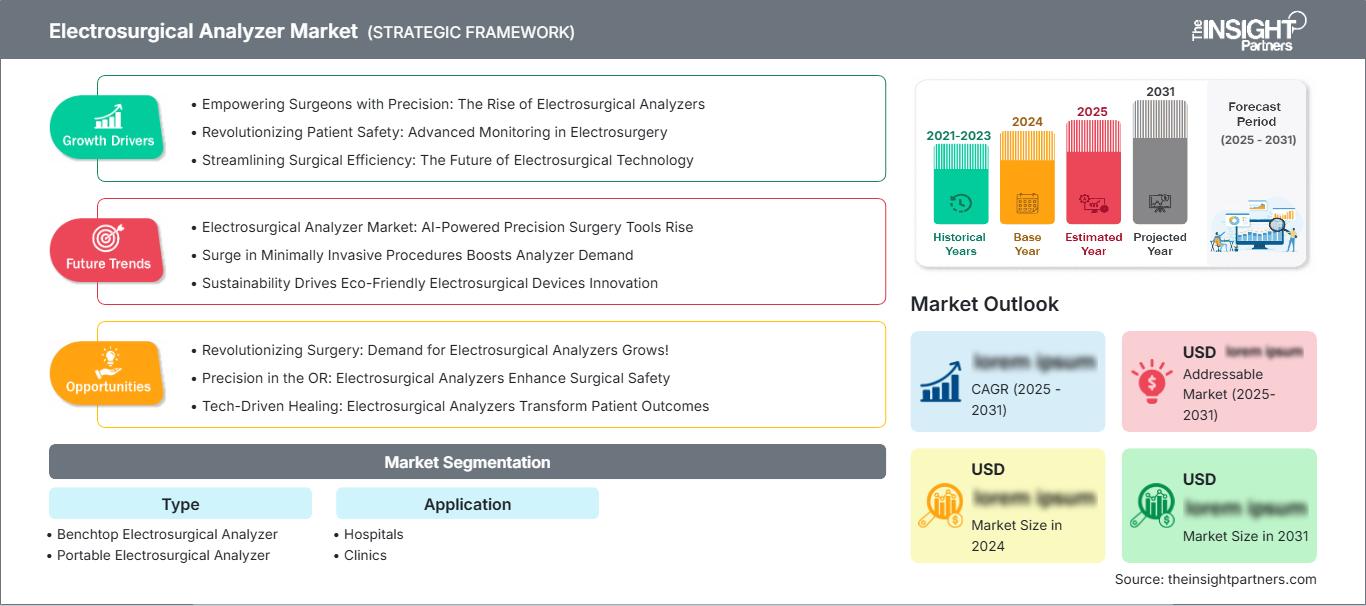
The electrosurgical analyzer market size was valued at US$ 264.52 Million in 2025 and is projected to reach US$ 578.75 Million by 2034, expanding at a CAGR of 9.09% during 2026–2034. Market expansion is supported by increasing emphasis on surgical equipment performance verification, stricter biomedical testing standards, and the growing installation of advanced electrosurgical systems across healthcare facilities. Continuous modernization of operating rooms is further strengthening long-term demand for analyzer solutions.
North America is expected to maintain a leading position throughout the forecast period, advancing at an estimated CAGR of 8.6–9.0%. The region benefits from mature healthcare infrastructure, widespread adoption of preventive equipment maintenance programs, and comprehensive regulatory compliance requirements for medical device performance validation. Growing investments in digital hospital infrastructure and biomedical engineering capabilities continue to reinforce the electrosurgical analyzer market expansion across hospitals and specialized surgical centers.
Electrosurgical Analyzer Market Assessment and Insights
- North America: Holds 36–40% electrosurgical analyzer market share in 2025, growing at a CAGR of 8.6–9.0% during 2026–2034, driven by stringent regulatory compliance, advanced healthcare infrastructure, and increasing preventive testing of biomedical equipment.
- US: Accounts for 82–86% of the North American market in 2025, expanding at a 8.8–9.2% CAGR due to widespread adoption of electrosurgical analyzers, strong hospital infrastructure, and mandatory medical equipment performance verification.
- Europe: Represents 27–31% share in 2025, growing at a 8.3–8.7% CAGR, led by Germany, the UK, and France through hospital modernization, strict medical equipment safety standards, and increasing investment in biomedical testing technologies.
- Asia Pacific: Holds 22–26% share in 2025, expanding at a 10.2–10.7% CAGR, led by China, Japan, and India with expanding healthcare capacity, increasing surgical procedure volumes, and rising adoption of biomedical equipment testing solutions.
- Largest Segment: Hospitals held the largest share in the electrosurgical analyzer market in 2025, growing at a 8.8–9.3% CAGR due to high surgical workloads, mandatory equipment performance verification programs, and continuous procurement of electrosurgical analyzers.
- High Growth Segment: Portable Electrosurgical Analyzer is projected to register the fastest growth at a CAGR of 10.1–10.6% during 2026–2034, driven by increasing demand for point-of-service testing, improved field maintenance efficiency, and expanding outpatient healthcare infrastructure.
- Key companies analyzed in detail: Accuserve, Inc.; B. Braun SE; BC Group International, Inc.; Fluke Corporation; Gebrüder Martin GmbH & Co. KG; Medtronic plc; Olympus Corporation; Rigel Medical; S.P.L. Elektronik; Smith & Nephew plc.
Source: The Insight Partners' analysis based on proprietary research, government publications, company annual reports, investor presentations, industry databases, and expert interviews.
With increasing emphasis placed on validating the effectiveness of electrosurgical devices in light of the greater technology demands in surgery, manufacturers in the electrosurgical analyzer market have started incorporating functionalities such as automatic testing, digitized reporting, wireless communication, and improved calibration abilities in analyzers. Gradually, manufacturing has been moving towards developing modular products to facilitate easy maintenance and interoperability with various electrosurgical generators in use across hospitals, ambulatory centers, and biomedical service providers throughout the world.
According to the electrosurgical analyzer market forecast, further innovation in the coming years is likely to center around developing products for healthcare markets making investments in surgical technology amid modernization efforts from regulatory authorities. Efforts of governments aimed at ensuring the quality of medical equipment, together with the growth of privately-owned hospitals, will create demand among countries in the Asia Pacific, Latin America, and some parts of the Middle East.
Electrosurgical Analyzer Market Report Scope
| Report Attribute | Details |
|---|---|
| Market size in 2025 | US$ 264.52 Million |
| Market Size by 2034 | US$ 578.75 Million |
| Global CAGR (2026 - 2034) | 9.09% |
| Historical Data | 2021-2024 |
| Forecast period | 2026-2034 |
Electrosurgical Analyzer Market Analysis
The demand for electrosurgical analyzers has been gaining momentum due to the increased focus on patient safety, machine reliability, and compliance requirements. Healthcare providers are beginning to adopt maintenance practices that include routine testing of electrosurgical generators prior to their clinical use. The reason for this is the increase in surgical procedures being performed and the growth in operating room capacity along with higher awareness among biomedical engineers about machine accuracy. Providers of services need reliable analyzers to perform calibration, inspection, and repairs in different settings.
Market ecosystems consist of producers of analyzers, suppliers of components and calibration laboratories, biomedical engineering departments, distributors, and healthcare providers. Increasingly, supply chains are placing a premium on precision electronics, digital sensors, software, and quality manufacturing. Differentiation is not just about measurement accuracy anymore; automation, reporting features, mobility, and wide range of compatibilities with electrosurgical systems have become relevant differentiators.
The level of competition in the sector is expected to rise because of innovations by already existing players aimed at improving product portfolios. Fluke Corporation, Rigel Medical, BC Group International, Inc., and Accuserve, Inc. will be working to provide increased capabilities in automation of processes and software development focused on compliance needs. At the same time, integrated medical technology companies like Medtronic plc, Olympus Corporation, B. Braun SE, Smith & Nephew plc, and Gebrüder Martin GmbH & Co. KG will affect the industry dynamics through innovations in electrosurgical systems and need for testing.
Prominent electrosurgical analyzer market trends include a focus on digital service platforms, connectivity in asset management, and predictive maintenance capabilities. The manufacturers are spending money to develop cloud-based documentation capabilities, remote diagnostics, cybersecurity measures, and connectivity with the maintenance system of the hospitals. The companies like S.P.L. Elektronik and others specialized in developing the testing equipment continue paying attention to portable analyzers. The strategy is becoming more and more dependent on software integration, regulatory knowledge, post-sale technical support, and global distribution capabilities.
● REPORT CUSTOMIZATION
Tailor This Report To Align With Your Specific Business Requirements
This report can be customized to align precisely with your business objectives, scope, and target markets. Customization options include tailored segmentation, geography, competitive analysis, and strategic insights to support informed decision-making.
Customize This Report →WHAT YOU CAN ADJUST
- ● Segmentations
- ● Geography
- ● Competitive Analysis
- ● Language Preferences
Electrosurgical Analyzer Market: Strategic Insights
Regional Insights
North America Electrosurgical Analyzer
North America accounted for 36–40% of the global Electrosurgical Analyzer Market in 2025 and is anticipated to register a CAGR of 8.6–9.0% through 2034. Strong regulatory oversight, established biomedical engineering practices, and continuous replacement of aging surgical equipment sustain stable regional demand.
Healthcare providers continue investing in preventive maintenance programs and digital asset management platforms to improve equipment uptime. Expanding ambulatory surgery networks and increasing accreditation requirements further encourage regular electrosurgical equipment verification across hospitals and specialized healthcare facilities.
U.S. Electrosurgical Analyzer Market
The U.S. represents 82–86% of the North American electrosurgical analyzer market and is projected to grow at a CAGR of 8.8–9.2% during the forecast period. Extensive surgical infrastructure and advanced biomedical engineering capabilities create consistent demand for analyzer technologies.
Leading manufacturers maintain strong commercial and service operations throughout the country, ensuring broad product availability and technical support. Hospitals increasingly adopt automated analyzer platforms to simplify compliance documentation, improve maintenance efficiency, and reduce equipment downtime across operating room environments.
Europe Electrosurgical Analyzer Market
Europe held an estimated 27–31% share of the global electrosurgical analyzer market in 2025 and is expected to expand at a CAGR of 8.3–8.7%. The region benefits from harmonized medical device regulations, structured preventive maintenance practices, and continuous modernization of hospital infrastructure. Germany remains the leading national market due to its advanced healthcare ecosystem.
The United Kingdom continues strengthening demand in the electrosurgical analyzer market through ongoing investments in hospital modernization, digital healthcare infrastructure, and equipment lifecycle management. Biomedical engineering departments increasingly prioritize routine electrosurgical testing to improve patient safety, operational efficiency, and compliance with healthcare quality standards.
Germany maintains regional leadership owing to its extensive installed base of advanced surgical systems, strong medical technology manufacturing capabilities, and highly standardized maintenance procedures. Healthcare institutions consistently invest in high-performance analyzer solutions that support efficient equipment verification and calibration.
France, Italy, and Spain collectively contribute substantial regional demand through continued investment in public healthcare infrastructure and surgical service expansion. Increasing emphasis on medical equipment quality assurance and modernization of operating theatres encourages wider adoption of electrosurgical analyzers across both public and private healthcare providers.
APAC Electrosurgical Analyzer Market
Asia Pacific represented 22–26% of global revenue in 2025 and is forecast to record the fastest regional expansion with a CAGR of 10.2–10.7%. Rapid healthcare infrastructure development, expanding surgical capacity, and growing investments in biomedical engineering services continue to support market growth. China remains the largest country market within the region.
China benefits from continuous hospital expansion, domestic medical technology manufacturing growth, and increasing regulatory attention toward equipment performance verification. Healthcare providers continue investing in modern biomedical testing capabilities to support rising surgical procedure volumes.
Japan maintains stable demand in the electrosurgical analyzer market through its technologically advanced healthcare system and emphasis on equipment quality assurance. South Korea continues adopting digital maintenance solutions, while India records accelerating installations driven by healthcare infrastructure expansion. Australia supports regional demand through established hospital accreditation programs and advanced biomedical engineering practices.
Middle East & Africa Electrosurgical Analyzer Market
The Middle East & Africa electrosurgical analyzer market is expected to grow at a CAGR of 8.7–9.1% during the forecast period. Healthcare diversification initiatives, hospital construction projects, and modernization of surgical infrastructure contribute to gradually increasing demand. Saudi Arabia is expected to remain the leading national market across the region.
According to the electrosurgical analyzer market report, Saudi Arabia continues expanding advanced healthcare facilities through long-term infrastructure investments, while the United Arab Emirates strengthens adoption with digitally enabled hospital operations. Both countries increasingly emphasize preventive maintenance and international healthcare quality standards.
South Africa supports demand through established tertiary healthcare institutions and specialized biomedical engineering capabilities. The Rest of Middle East & Africa presents emerging opportunities for the electrosurgical analyzer market as governments expand healthcare access, improve medical equipment management practices, and invest in modern surgical facilities.
Segmentation Analysis
Type
Type-based demand continues evolving alongside healthcare providers' requirements for mobility, workflow efficiency, and testing accuracy. While both analyzer categories contribute significantly to industry revenue, Portable Electrosurgical Analyzer is projected to record the highest growth with a CAGR of 10.1–10.6% during 2026–2034, supported by increasing field servicing, decentralized maintenance operations, and expansion of outpatient surgical facilities.
- Benchtop Electrosurgical Analyzer: Preferred within centralized biomedical engineering departments where comprehensive testing, high measurement precision, and continuous calibration activities support large hospital networks and medical equipment service laboratories.
- Portable Electrosurgical Analyzer: Compact form factors, battery-powered operation, and rapid on-site testing capabilities improve maintenance productivity while enabling biomedical engineers to perform equipment verification across multiple healthcare facilities efficiently.
Application
Application trends reflect the increasing importance of equipment safety verification across diverse healthcare settings. Hospitals remain the dominant revenue contributor because of high surgical procedure volumes, extensive electrosurgical equipment inventories, and mandatory preventive maintenance programs, while clinics continue expanding adoption through investments in advanced outpatient surgical services.
- Hospitals: Largest application segment supported by frequent equipment validation, strict regulatory compliance, expanding operating room infrastructure, and increasing implementation of preventive biomedical maintenance strategies across multispecialty healthcare institutions.
- Clinics: Growing adoption reflects increasing availability of minimally invasive procedures, expansion of ambulatory care services, and rising awareness regarding routine electrosurgical equipment performance verification and patient safety requirements.
Opportunity Snapshot
| Segment Name | Revenue Contribution | Trend Tag | Adoption Stage |
| Hospitals | High | Surgical Expansion | Mature |
| Clinics | Medium | Outpatient Surgery | Scaling |
Electrosurgical Analyzer Market Growth Drivers and Impact Analysis
Growing emphasis on medical device safety and regulatory compliance
Providers of healthcare globally are adopting practices aimed at maintaining the performance of electrosurgical units within approved levels throughout the period of service delivery. The requirement to undertake regular inspections, calibrations, and documentation of electrosurgical units as a result of regulatory requirements, accreditation standards, and the organization’s risk management programs is increasing. This scenario means that hospitals and biomed service companies are acquiring advanced analyzer technology to provide accurate measurements and automatic reporting. The procurement pattern is towards recurring demand since analyzer equipment is required during the entire lifetime of surgical units.
Expansion of surgical procedures and operating room modernization
Elective, emergency, and minimal invasive surgical procedures are making way for the expansion of electrosurgical generators. As health centers invest in more operating theaters and advanced surgical equipment, it has become necessary to have equipment which can test the system performance before it is put to clinical use. In addition, modern operating rooms require fast equipment maintenance processes that will reduce equipment downtime while still ensuring the safety of the process. All these trends promote the adoption of advanced analyzers that are automated, highly accurate, and compatible with different electrosurgical systems. This creates a cycle of revenues that grows continuously.
Digital transformation of biomedical equipment management
Digital Asset Management Systems are now being used by healthcare facilities that bring together equipment inventory management, maintenance scheduling, calibration procedures, and compliance data in a single system. Electrosurgical analyzers that feature wireless communications, cloud-based computing, and automated reports fit into such maintenance systems quite nicely. The biomedical engineers enjoy the benefits of quicker documentation, increased traceability, and predictive maintenance functions that decrease the risk of unexpected equipment malfunction. Software has become an integral part of the differentiation between products in addition to measurement accuracy, which adds extra value to hospital lifecycle management.
Electrosurgical Analyzer Market Future Trends
Integration of intelligent diagnostics and software-driven testing
The future analyzer platforms will feature intelligent diagnostic functionality enabling automatic interpretation of test results, detection of any faults of equipment, and provision of recommendations for the necessary measures. The use of artificial intelligence, built-in analytics, and software-driven processes will minimize the reliance on manual interpretation and will ensure uniformity of procedures among maintenance personnel. Medical institutions are expected to be focused on implementing systems that will be able to produce standardized digital reports that can be used within the framework of enterprise maintenance software.
Rising adoption of compact analyzers across decentralized healthcare facilities
Demand is expected to increase for lightweight, portable analyzers designed for outpatient centers, ambulatory surgery facilities, mobile biomedical service providers, and regional healthcare networks. Compact systems reduce transportation challenges while enabling faster equipment verification across multiple locations without requiring dedicated laboratory infrastructure. Manufacturers are therefore emphasizing ergonomic design, extended battery operation, simplified interfaces, and rapid testing protocols. This trend will broaden market penetration beyond large hospitals by making advanced testing technologies more accessible to smaller healthcare providers with distributed maintenance requirements.
Electrosurgical Analyzer Market Opportunities
Expansion into emerging healthcare infrastructure projects
The speedy growth of construction, expansion, and modernization in hospitals and surgery centers in new economies is full of business potential for companies manufacturing analyzers. The significance of quality assurance of the equipment used has been recognized as the capacity of surgeries increases. Companies that are able to provide scalable products, local technical services, and training along with the necessary regulatory knowledge can create strong competition for themselves. Cooperation with local distributors and biomedical service providers will increase opportunities for gaining customers.
Development of integrated lifecycle service and calibration solutions
There is an option for companies to move into a broader range of service offerings, which would encompass calibration, preventive maintenance, software upgrades, remote diagnostics, and record keeping. By adopting subscription-based models, companies will be able to create regular streams of income in addition to customer loyalty through continued service agreements. As hospitals look for more streamlined solutions to comply with the regulations, service providers who develop digital service delivery platforms and predictive maintenance tools will find themselves well prepared to capitalize on their investments.
Recent Developments
- May 2025: Medtronic plc reported strong fiscal 2025 fourth-quarter and full-year financial results while highlighting continued momentum across its surgical technology portfolio and reaffirming investments in innovation, digital operating room capabilities, and key growth platforms. These initiatives support long-term expansion of advanced surgical ecosystems that indirectly strengthen demand for electrosurgical equipment testing and validation solutions.
- October 2024: Olympus Corporation announced the commercialization of additional innovations within its surgical technology portfolio, reinforcing its strategy of improving procedural efficiency, digital integration, and minimally invasive surgery capabilities. Continued investment in advanced surgical platforms supports increasing requirements for routine equipment performance verification using high-precision electrosurgical analyzers.
- January 2026: Fluke Biomedical released QA-ES III Firmware V1.04 along with the HF Leakage Firmware 1.04 Update Application Note, providing enhancements for the QA-ES III Electrosurgery Analyzer and supporting improved electrosurgical unit testing workflows.
Frequently Asked Questions

- Comprehensive Market Sizing and Forecast Analysis
- Detailed Segmentation Analysis
- In-Depth Market Dynamics Assessment
- Regional and Country-Level Insights
- Competitive Landscape and Company Benchmarking
- Strategic Business Intelligence
Recent Reports
Testimonials

The Insight Partners' SCADA System Market report is comprehensive, with valuable insights on current trends and future forecasts. The team was highly professional, responsive, and supportive throughout. We are very satisfied and highly recommend their services.
RAN KEDEM Partner, Reali Technologies LTDs
I requested a report on a very specific software market and the team produced the report in a few days. The information was very relevant and well presented. I then requested some changes and additions to the report. The team was again very responsive and I got the final report in less than a week.
JEAN-HERVE JENN Chairman, Future Analytica
We worked with The Insight Partners for an important market study and forecast. They gave us clear insights into opportunities and risks, which helped shape our plans. Their research was easy to use and based on solid data. It helped us make smart, confident decisions. We highly recommend them.
PIYUSH NAGPAL Sr. Vice President, High Beam Global
The Insight Partners delivered insightful, well-structured market research with strong domain expertise. Their team was professional and responsive throughout. The user-friendly website made accessing industry reports seamless. We highly recommend them for reliable, high-quality research services
YUKIHIKO ADACHI CEO, Deep Blue, LLC.
This is the first time I have purchased a market report from The Insight Partners.While I was unsure at first, I visited their web site and felt more comfortable to take the risk and purchase a market report.I am completely satisfied with the quality of the report and customer service. I had several questions and comments with the initial report, but after a couple of dialogs over email with their analyst I believe I have a report that I can use as input to our strategic planning process.Thank you so much for taking the extra time and making this a positive experience.I will definitely recommend your service to others and you will be my first call when we need further market data.
JOHN SUZUKI President and Chief Executive Officer, Board Director, BK Technologies
I wish to appreciate your support and the professionalism you displayed in the course of attending to my request for information regarding to infectious disease IVD market in Nigeria. I appreciate your patience, your guidance, and the fact that you were willing to offer a discount, which eventually made it possible for us to close a deal. I look forward to engaging The Insight Partners in the future, all thanks to the impression you have created in me as a result of this first encounter.
DR CHIJIOKE ONYIA MANAGING DIRECTOR, PineCrest Healthcare Ltd.Reason to Buy
- Informed Decision-Making
- Understanding Market Dynamics
- Competitive Analysis
- Identifying Emerging Markets
- Customer Insights
- Market Forecasts
- Risk Mitigation
- Boosting Operational Efficiency
- Strategic Planning
- Investment Justification
- Tracking Industry Innovations
- Aligning with Regulatory Trends





 Get Free Sample for