
Emulsifiers Market Growth Opportunities, Demand & Size by 2034
Emulsifiers Market Size and Forecasts (2021 - 2034), Global and Regional Share, Trends, and Growth Opportunity Analysis Report Coverage : by Type (Glycerol Monostearate, Lecithin, Mono and Diglycerides, Polysorbate, Sodium Stearoyllactylate); Category (Natural, Synthetic); Application (Food and Beverages, Personal Care and Cosmetics, Pharmaceuticals and Nutraceuticals, Animal Nutrition, Agriculture, Industrial); and Geography (North America, Europe, Asia Pacific, and South and Central America)
- Status : Data Released
- Report Code : TIPRE00040451
- Category : Chemicals and Materials
- No. of Pages : 150
- Available Report Formats :


- Last update date : August 19, 2026


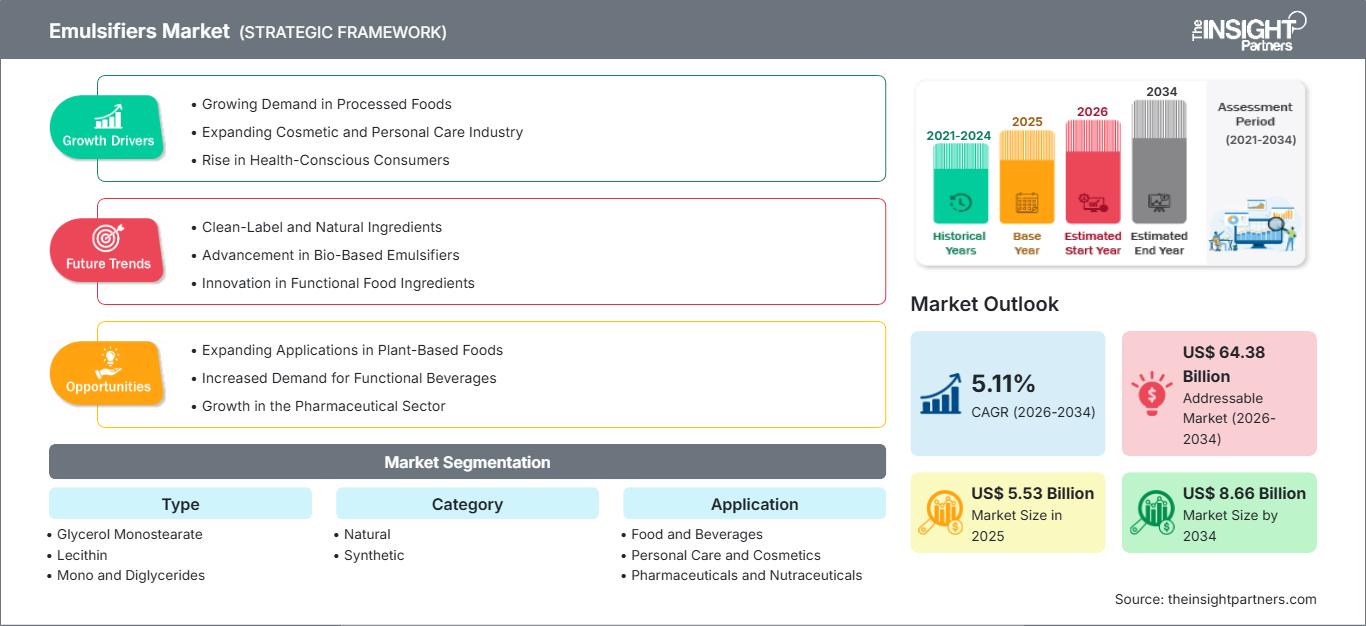
2025 Market Size
US$ 5.53 Bn
Base year value
2034 Forecast
US$ 8.66 Bn
Projected by 2034
CAGR 2026-2034
5.11 %
Growth rate
Addressable Market
US$ 64.38 Bn
(2026-2034)
The Global Emulsifiers Market size stood at US$ 5.53 Billion in 2025 and forecasted to cross US$ 8.66 Billion by 2034 at a CAGR of 5.11%. Drivers of growth include increased demand for processed foods, clean labels, functional personal care products, pharmaceuticals, and specialty chemicals. The main functions of emulsifiers include improved dispersibility, stability, texture, shelf-life, and efficient processing, which makes emulsifiers an essential ingredient in formulations. The consumption rate is relatively constant in the global market regardless of varying levels of demand in different sectors of the end-use markets.
It is forecasted that North America will continue to be one of the major regional markets with its strong presence in the food processing industry, personal care, pharmaceutical, and specialty chemicals industries. The North American regional market is expected to grow at a 4.5-5.5% CAGR during 2026-2034. Demand will be boosted by the shift towards plant-based ingredients, premium packaged foods, functional nutritional products, and better ingredient traceability and sustainability.
Emulsifiers Market Assessment and Insights
- North America held an estimated 22–26% Emulsifiers Market share in 2025 and is expected to grow at a 4.5–5.5% CAGR between 2026–2034, supported by established food processing, personal care, pharmaceutical, and specialty ingredient industries.
- US represented approximately 72–78% of North America's share in 2025 and is projected to register a 4.7–5.7% CAGR between 2026–2034, supported by processed foods, dietary supplements, cosmetics, and pharmaceutical formulation demand.
- Europe accounted for approximately 24–28% share in 2025 and is expected to expand at a 4.0–5.0% CAGR between 2026–2034, led by Germany, France, Italy, the UK, and Spain, with strong food and personal care applications.
- Asia Pacific represented approximately 34–39% share in 2025 and is projected to grow at a 5.8–6.8% CAGR between 2026–2034, driven by China, India, Japan, South Korea, and Southeast Asian food and consumer-product manufacturing.
- Largest Segment: Food and Beverages held approximately 54–59% market share in 2025 and is projected to grow at a 5.0–5.8% CAGR between 2026–2034, supported by bakery, dairy, confectionery, beverages, and convenience foods.
- High Growth Segment: Natural emulsifiers represented approximately 42–47% share in 2025 and are expected to expand at a 6.0–7.0% CAGR between 2026–2034, reflecting clean-label and plant-derived formulation preferences.
- Key companies analyzed in detail: BASF SE; Archer-Daniels-Midland Company; Cargill, Incorporated; Evonik Industries AG; Kerry Group plc; Solvay S.A.; DSM-Firmenich AG; International Flavors & Fragrances Inc.; Corbion N.V.; Dow Inc.; Clariant AG; Nouryon Holding B.V.
Source: The Insight Partners' analysis based on proprietary research, government publications, company annual reports, investor presentations, industry databases, and expert interviews.
The Emulsifiers Market has evolved from a largely food-based ingredient range to a more diverse specialty formulation business. Ingredient improvements such as processing, purification, esterification and blending are increasing the possibilities for formulators. Glycerol monostearate, lecithin, mono and diglycerides, polysorbates and sodium stearoyllactylate serve various stability, texture, dispersion, aeration and processing needs. On the other hand, natural-source based options are getting popularity among food, cosmetic and nutrition businesses due to the reformulation of their products on the basis of identifiable ingredients.
According to the Emulsifiers Market forecast, further growth will be increasingly driven by growth in regional food manufacturing capacity, premium personal care consumption, pharmaceutical production and multi-functional ingredients. The Asia Pacific region is expected to be the dominant growth driver due to growing packaged food penetration and consumer product manufacturing. North America and Europe will focus on reformulation, sustainability, traceability and high-performance specialty emulsifiers. Manufacturers are also expected to innovate in terms of renewable feedstock sources, better purification, energy efficient processing and specialized applications without compromising on functionality and label benefits.
Emulsifiers Market Report Scope
| Report Attribute | Details |
|---|---|
| Market size in 2025 | US$ 5.53 Billion |
| Market Size by 2034 | US$ 8.66 Billion |
| Global CAGR (2026 - 2034) | 5.11% |
| Historical Data | 2021-2024 |
| Forecast period | 2026-2034 |
Emulsifiers Market Analysis
The Emulsifiers Market report indicates that demand in this market is closely related to the necessity to stabilize mixtures, which consist of substances with varying physical and chemical characteristics. Emulsifiers increase consistency, aeration, moisture content, mouthfeel, dispersibility, and shelf stability in foods and beverages. Similar functional characteristics also underlie the use of emulsifiers in creams and lotions, drug preparations, animal feeds, crop formulations, paints and coatings, and other industrial goods. Hence, growth in complexity of formulations expands the customer demand potential.
The value chain includes such components as vegetable oils, animal-based starting materials, fatty acids, glycerol, phospholipids, ethoxylated chemicals, and other intermediate products. All of them go through purification, synthesis, blending, standardization, and quality control prior to being delivered to the formulators. Availability and prices of vegetable oils continue to be critical factors in relation to natural emulsifiers, whereas synthetic products are more dependent on the prices of chemical starting materials.
Growth is becoming increasingly dependent on formulating needs rather than mere volume usage. BASF SE, Evonik Industries AG, Solvay S.A., Clariant AG, and Nouryon Holding B.V. have competence in both specialty chemicals and personal care applications, whereas Archer-Daniels-Midland Company and Cargill, Incorporated are dominant in agriculture and plant-based ingredients. The companies of Kerry Group plc, DSM-Firmenich AG, International Flavors & Fragrances Inc., and Corbion N.V. contribute to formulating skills in food, nutritional and specialty ingredients applications.
Emulsifiers Market trends indicate that strategic positioning is moving towards multifunctionality and sustainability of materials. Differentiation is happening through application laboratories, formulation services, traceability of raw materials, regulatory assistance, and custom-blends. Clean label and natural product demands present chances for lecithin and monoglyceride substitutes as well as renewable sources of emulsifiers, while synthetics remain valuable when accurate performance, stability and cost-effectiveness are the criteria. As a result, investment strategies are aimed at specialty products rather than bulk commodities.
● REPORT CUSTOMIZATION
Tailor This Report To Align With Your Specific Business Requirements
This report can be customized to align precisely with your business objectives, scope, and target markets. Customization options include tailored segmentation, geography, competitive analysis, and strategic insights to support informed decision-making.
Customize This Report →WHAT YOU CAN ADJUST
- ● Segmentations
- ● Geography
- ● Competitive Analysis
- ● Language Preferences
Emulsifiers Market: Strategic Insights
Regional Insights
North America Emulsifiers Market
North America represented an estimated 22–26% share of Emulsifiers Market in 2025 and is projected to grow at a 4.5–5.5% CAGR through 2034. The US accounts for most regional demand because of its extensive packaged food, bakery, dairy, beverage, pharmaceutical, dietary supplement, and personal care industries. Mature manufacturing infrastructure provides established distribution channels and application-development capabilities for both natural and synthetic emulsifier suppliers.
The regional market is becoming more impacted by reformulation and product differentiation. Food processors are coming up with products that have lower fat content, improved nutrition profile, extended shelf life, and better ingredient labeling. Cosmetic formulators are looking to utilize naturally sourced emulsifiers for their creams, lotions, and sun-care products. There is also strong research expertise and a substantial multinational formulator base in the region that continues to drive interest in custom blends and high-performance ingredients. Canada and Mexico add to demand from food processing, cosmetics, and industrial formulation applications.
U.S. Emulsifiers Market
The US represented approximately 72–78% of North America's Emulsifiers Market share in 2025 and is expected to grow at a 4.7–5.7% CAGR through 2034. Demand is supported by processed foods, bakery products, confectionery, beverages, nutritional supplements, cosmetics, and pharmaceutical formulations. Large-scale ingredient manufacturers and sophisticated food processors create strong demand for standardized and application-specific emulsifiers.
Food formulations continue to be of great relevance because the use of emulsifiers allows the manufacturers to manipulate factors such as texture, stability, moisture retention, aeration, and processing. An increase in the need for emulsifiers made from plant sources like lecithin is motivating reformulation. Renewable source emulsifiers are being used by personal care product formulators as more people analyze the source of ingredients. Some of the big firms manufacturing these products include Archer-Daniels-Midland Company, Cargill, Incorporated, BASF SE, and International Flavors & Fragrances Inc.
Europe Emulsifiers Market
Europe represented a market share of around 24–28% in Emulsifiers Market in 2025 and is expected to grow at a CAGR of 4.0–5.0% until 2034. Germany is one of the prominent countries in Europe, and its national market will be driven by the presence of well-developed food processing, specialty chemicals, cosmetic, and pharmaceutical industry. Other countries contributing are France, Italy, UK, and Spain, due to their mature food and personal care product industries.
The UK has an advanced food and beverage industry and rising requirement for ingredients that can offer health benefits to consumers. Germany has an advanced chemical industry along with food and personal care manufacturing industry, driving demand for synthetic as well as natural grades. France and Italy represent an attractive market in bakery, confectionery, dairy, cosmetics, and premium food application. The growth in demand for food processing and natural formulation in Spain represents opportunities for the players in the European region.
APAC Emulsifiers Market
APAC held approximately 34–39% of Emulsifiers Market in 2025 and is expected to grow at a 5.8–6.8% CAGR through 2034. China remains the leading market, followed by Japan, India, South Korea, and major Southeast Asian manufacturing economies. Rising packaged food consumption, urbanization, expanding personal care production, and pharmaceutical manufacturing support regional demand.
China benefits from its large food processing and consumer-products industries, while India is supported by expanding packaged foods, nutraceuticals, and personal care manufacturing. Japan and South Korea provide demand for advanced food, cosmetics, and pharmaceutical formulations. Australia contributes through food processing and nutrition products. Increasing local manufacturing, improving cold-chain infrastructure, and growing demand for convenience foods are expected to support continued regional expansion.
Middle East & Africa Emulsifiers Market
Middle East & Africa represented a smaller share of Emulsifiers Market in 2025 but is expected to grow at a 3.8–4.8% CAGR through 2034. Saudi Arabia and the UAE are important markets because of food-processing investment, imported packaged food consumption, and expanding consumer-product manufacturing. South Africa remains a significant market for food, beverage, personal care, and industrial formulations.
Saudi Arabia is strengthening food manufacturing and local production capabilities, while the UAE benefits from its role as a regional trade and processing hub. South Africa provides established food and beverage manufacturing capacity and demand for functional ingredients. Rest of MEA remains comparatively fragmented, but population growth, urbanization, packaged food penetration, and increasing investment in local manufacturing provide a foundation for gradual expansion. Supply remains dependent on regional distribution networks and imported specialty ingredients.
Segmentation Analysis
Type
Type includes Glycerol Monostearate, Lecithin, Mono and Diglycerides, Polysorbate, and Sodium Stearoyllactylate. The segment is expected to grow at a 4.8–5.8% CAGR during 2026–2034, reflecting continued use across food, personal care, pharmaceutical, and industrial formulations. Product selection depends on required hydrophilic-lipophilic balance, processing conditions, stability, regulatory status, and compatibility with other ingredients.
- Glycerol Monostearate is widely used to improve texture, stability, and processing performance in bakery, confectionery, dairy, and personal care formulations. Its multifunctionality supports continued demand across established applications.
- Lecithin benefits from broad functionality as an emulsifier, dispersing agent, release agent, and nutritional ingredient. Soy, sunflower, and other plant sources support its use in food, supplements, and industrial formulations.
- Mono and Diglycerides remain important in bakery, dairy, confectionery, and processed food formulations because they support aeration, texture, moisture management, and emulsion stability during processing.
- Polysorbate is valued for reliable emulsification and dispersion across food, pharmaceutical, personal care, and industrial applications. Its consistent functionality supports applications requiring controlled formulation performance.
- Sodium Stearoyllactylate supports dough conditioning, emulsification, and texture improvement, particularly in bakery products. Its processing functionality makes it relevant to commercial baking and selected formulated food applications.
Category
Category comprises Natural and Synthetic emulsifiers and is projected to expand at a 4.8–5.9% CAGR during 2026–2034. Natural products are gaining strategic importance because of clean-label positioning, renewable feedstock availability, and consumer preference for recognizable ingredients, while synthetic grades remain important for consistent performance and cost-efficient formulation.
- Natural emulsifiers are gaining adoption as manufacturers respond to clean-label, plant-based, traceable, and sustainability-oriented formulation requirements. Lecithin and renewable-source emulsifiers are particularly relevant across food and personal care applications.
- Synthetic emulsifiers remain important where formulators require predictable functionality, controlled performance, broad formulation compatibility, and economical processing. Their established regulatory and technical profiles support continued industrial use.
Application
Application includes Food and Beverages, Personal Care and Cosmetics, Pharmaceuticals and Nutraceuticals, Animal Nutrition, Agriculture, and Industrial. The segment is projected to grow at a 5.0–5.9% CAGR during 2026–2034, with food and beverages remaining the principal application due to broad emulsifier functionality.
- Food and Beverages represents the largest application because emulsifiers support stability, texture, aeration, moisture retention, dispersion, and shelf life across bakery, dairy, confectionery, beverages, and processed foods.
- Personal Care and Cosmetics uses emulsifiers to stabilize creams, lotions, sunscreens, cleansers, and other formulations. Natural-origin ingredients are increasingly important for premium and sustainability-oriented product positioning.
- Pharmaceuticals and Nutraceuticals use emulsifiers to support dispersion, bioavailability, dosage-form stability, and consistent formulation performance. Growth follows pharmaceutical production and demand for functional nutrition products.
- Animal Nutrition applications include feed processing, nutrient dispersion, pellet quality, and fat utilization. Increasing emphasis on feed efficiency and formulation consistency supports continued ingredient adoption.
- Agriculture applications include emulsification and dispersion of active ingredients in crop-protection formulations. Demand is influenced by formulation stability, spray performance, and development of more efficient agricultural inputs.
- Industrial applications include paints, coatings, polymers, lubricants, and specialty formulations where emulsifiers support dispersion, processing, and product stability. Demand follows industrial production and specialty chemical consumption.
Opportunity Snapshot
| Segment Name | Revenue Contribution | Trend Tag | Adoption Stage |
| Food and Beverages | High | Clean Label | Mature |
| Personal Care and Cosmetics | Medium | Natural Textures | Scaling |
| Pharmaceuticals and Nutraceuticals | Medium | Bioavailability | Scaling |
| Animal Nutrition | Medium | Feed Efficiency | Scaling |
| Agriculture | Low | Spray Stability | Emerging |
| Industrial | Medium | Specialty Formulation | Mature |
Emulsifiers Market Growth Drivers and Impact Analysis
Expansion of Processed and Convenience Food Manufacturing
Growing consumption of packaged, convenience, bakery, dairy, confectionery, and ready-to-eat foods is creating sustained requirements for ingredients that improve texture, stability, processing efficiency, and shelf life. Emulsifiers allow manufacturers to combine ingredients that would otherwise separate while also supporting aeration, moisture retention, softness, and consistent product structure. Their functionality becomes particularly valuable when food producers reformulate products to reduce fat, sugar, or other components that can alter texture and stability. Expansion of modern retail and foodservice channels in emerging economies further increases demand for standardized formulations capable of maintaining quality during distribution. Manufacturers are consequently evaluating emulsifiers not only as functional additives but also as tools for optimizing production efficiency and reducing product variability. This dynamic supports steady demand across established and developing food categories.
Shift Toward Natural and Clean-Label Ingredients
Consumer preference for recognizable and naturally sourced ingredients is encouraging food, beverage, personal care, and nutrition manufacturers to reconsider traditional formulation systems. Natural emulsifiers derived from plant oils and other renewable sources can help companies address clean-label positioning while maintaining required functionality. Lecithin is particularly relevant because it combines emulsification properties with nutritional functionality and availability from multiple plant sources. Personal care manufacturers are similarly increasing interest in renewable-source emulsifiers for creams, lotions, and sun-care products. The transition does not eliminate synthetic products because many applications require highly predictable performance, but it is changing product development priorities. Suppliers that can demonstrate traceable sourcing, consistent quality, regulatory compliance, and formulation performance are better positioned to capture premium demand generated by natural and sustainability-oriented product reformulation.
Growing Demand for Functional and Specialty Formulations
Increasing formulation complexity across pharmaceuticals, nutraceuticals, cosmetics, animal nutrition, agriculture, and specialty industrial products is broadening demand for application-specific emulsifiers. Manufacturers increasingly require ingredients that provide multiple functions, such as emulsification combined with dispersion, texture modification, release performance, or processing support. Pharmaceutical and nutraceutical formulations particularly benefit from improved dispersion and stability, while personal care products require controlled sensory characteristics and long-term emulsion integrity. In agriculture and industrial markets, emulsifiers can improve the distribution and stability of active components. This expansion creates opportunities for specialty suppliers to develop customized grades rather than relying exclusively on standardized products. Application laboratories, technical formulation support, and regulatory expertise are consequently becoming important competitive tools as customers seek ingredients tailored to precise processing and performance requirements.
Emulsifiers Market Future Trends
Rise of Multifunctional Renewable-Source Emulsifiers
Future product development is likely to focus on emulsifiers capable of delivering several formulation benefits from a single ingredient. Manufacturers increasingly want to simplify formulations while maintaining texture, stability, sensory performance, and processing efficiency. Renewable-source materials are particularly attractive when they combine functionality with improved sustainability credentials. Advances in vegetable-oil processing, enzymatic modification, esterification, and purification should enable suppliers to develop more sophisticated natural-origin products. Personal care applications are expected to be an important testing ground because formulators must balance emulsion stability with sensory characteristics and consumer expectations around ingredient origin. In food applications, multifunctional products can help reduce formulation complexity and support clean-label positioning. Suppliers that successfully combine renewable sourcing, high performance, regulatory compliance, and competitive economics are likely to gain increasing importance across premium formulation categories.
Greater Emphasis on Traceability and Sustainable Feedstocks
Traceability is expected to become more important as manufacturers seek greater visibility into the origin and environmental characteristics of ingredients. Vegetable oils used in natural emulsifiers are increasingly evaluated for responsible agricultural practices, deforestation risks, land use, and supply-chain transparency. This trend will encourage suppliers to strengthen sourcing systems, certification processes, supplier audits, and digital traceability. Customers may increasingly request information on feedstock origin and production footprint during procurement, particularly in Europe and other markets with stronger sustainability expectations. The trend could also encourage greater use of alternative renewable feedstocks and upcycled raw materials where technical performance is adequate. Producers with transparent sourcing systems can differentiate their products while helping downstream manufacturers substantiate sustainability claims. Over time, traceability may become a standard procurement criterion rather than a premium feature.
Emulsifiers Market Opportunities
Localized Production in High-Growth Food Markets
Emerging food markets provide opportunities for emulsifier producers to establish regional manufacturing, blending, and technical-support capabilities closer to customers. Asia Pacific, particularly India, China, and Southeast Asia, combines population growth with expanding packaged food and beverage production, creating demand for cost-effective functional ingredients. Localized operations can shorten delivery times, reduce logistics exposure, and allow suppliers to adapt products to regional formulation preferences. Producers can also develop application laboratories focused on bakery, dairy, beverages, confectionery, and plant-based products. Strategic partnerships with food manufacturers and distributors can accelerate market penetration while improving understanding of local regulatory requirements. Regional capacity may also reduce dependence on imported specialty ingredients and improve supply resilience. Companies able to combine competitive production economics with technical formulation support can build stronger customer relationships in these expanding markets.
Specialty Solutions for Personal Care and Nutrition
Personal care, nutraceutical, and pharmaceutical formulations offer opportunities for higher-value emulsifier products because customers place greater emphasis on stability, sensory performance, bioavailability, and ingredient compatibility. Specialty grades can command stronger strategic importance when they solve specific formulation problems that standard products cannot address efficiently. Personal care producers increasingly seek renewable, PEG-free, naturally derived, and multifunctional emulsifiers for creams, lotions, sun care, and sensitive-skin products. Nutrition and pharmaceutical manufacturers similarly require controlled dispersion and stability in increasingly complex formulations. Suppliers can capture these opportunities through application-specific product development, formulation testing, technical consulting, and regulatory support. Partnerships with formulators during product development can create early-stage qualification advantages and increase switching barriers. Investment in application laboratories and regional technical teams should therefore remain an attractive strategy for specialty ingredient producers.
Recent Developments
- July 2026: Indian Emulsifiers Ltd (IEML) has obtained two direct export orders totaling US$ 700,621 from a US customer, enhancing its market presence. The orders, valued at US$ 231,042 and US$ 469,579, will be fulfilled from Maharashtra. The customer's identity remains confidential. This development follows IEML's regulatory filing on July 17 regarding the contracts and indicates a rising demand for its specialty chemical products in the US, as well as reinforcing confidence in its manufacturing capabilities. Future deliveries will be managed through its US subsidiary, Polaris Specialty Chemicals Inc., once established.
- June 2025: Food-tech company MaGie Creations has launched an innovative grain emulsifier aimed at fulfilling the demand for clean label products. This emulsifier, which is cost-effective and reduces waste, utilizes upcycled ingredients from the beer industry. The initiative addresses key issues in the global food and beverage sector, focusing on sustainable feeding solutions for a growing population, moving away from ultra-processed foods, and creating value from waste materials.
Frequently Asked Questions

- Comprehensive Market Sizing and Forecast Analysis
- Detailed Segmentation Analysis
- In-Depth Market Dynamics Assessment
- Regional and Country-Level Insights
- Competitive Landscape and Company Benchmarking
- Strategic Business Intelligence
Recent Reports
Testimonials

The Insight Partners provided valuable market intelligence that supported our global go-to-market strategy. Their team was professional, responsive, and attentive to our feedback, providing thoughtful analysis and helpful methodological clarifications throughout the project.
Junmo Kim Chief Financial Officer (CFO), Enertech Co., Ltd.
The Insight Partners' SCADA System Market report is comprehensive, with valuable insights on current trends and future forecasts. The team was highly professional, responsive, and supportive throughout. We are very satisfied and highly recommend their services.
RAN KEDEM Partner, Reali Technologies LTDs
I requested a report on a very specific software market and the team produced the report in a few days. The information was very relevant and well presented. I then requested some changes and additions to the report. The team was again very responsive and I got the final report in less than a week.
JEAN-HERVE JENN Chairman, Future Analytica
We worked with The Insight Partners for an important market study and forecast. They gave us clear insights into opportunities and risks, which helped shape our plans. Their research was easy to use and based on solid data. It helped us make smart, confident decisions. We highly recommend them.
PIYUSH NAGPAL Sr. Vice President, High Beam Global
The Insight Partners delivered insightful, well-structured market research with strong domain expertise. Their team was professional and responsive throughout. The user-friendly website made accessing industry reports seamless. We highly recommend them for reliable, high-quality research services
YUKIHIKO ADACHI CEO, Deep Blue, LLC.
This is the first time I have purchased a market report from The Insight Partners.While I was unsure at first, I visited their web site and felt more comfortable to take the risk and purchase a market report.I am completely satisfied with the quality of the report and customer service. I had several questions and comments with the initial report, but after a couple of dialogs over email with their analyst I believe I have a report that I can use as input to our strategic planning process.Thank you so much for taking the extra time and making this a positive experience.I will definitely recommend your service to others and you will be my first call when we need further market data.
JOHN SUZUKI President and Chief Executive Officer, Board Director, BK Technologies
I wish to appreciate your support and the professionalism you displayed in the course of attending to my request for information regarding to infectious disease IVD market in Nigeria. I appreciate your patience, your guidance, and the fact that you were willing to offer a discount, which eventually made it possible for us to close a deal. I look forward to engaging The Insight Partners in the future, all thanks to the impression you have created in me as a result of this first encounter.
DR CHIJIOKE ONYIA MANAGING DIRECTOR, PineCrest Healthcare Ltd.Reason to Buy
- Informed Decision-Making
- Understanding Market Dynamics
- Competitive Analysis
- Identifying Emerging Markets
- Customer Insights
- Market Forecasts
- Risk Mitigation
- Boosting Operational Efficiency
- Strategic Planning
- Investment Justification
- Tracking Industry Innovations
- Aligning with Regulatory Trends





 Get Free Sample for