
Factory Automation Sensor Market Size, Growth & Demand by 2034
Coverage: by Type (Temperature Sensors, Vibration Sensors, Vision Sensors, Pressure Sensors, Proximity Sensors, Humidity Sensors, Others); End Use Industry (Automotive, Chemicals, Energy and Power, Food and Beverages, Manufacturing, Oil and Gas, Pharmaceuticals, And Others) , and Geography (North America, Europe, Asia Pacific, and South and Central America)
- Status : Data Released
- Report Code : TIPRE00009382
- Category : Electronics and Semiconductor
- No. of Pages : 150
- Available Report Formats :


- Last update date : August 17, 2026


2025 Market Size
US$ 23.7 Bn
Base year value
2034 Forecast
US$ 49.82 Bn
Projected by 2034
CAGR 2026-2034
8.61 %
Growth rate
Addressable Market
US$ 329.74 Bn
(2026-2034)
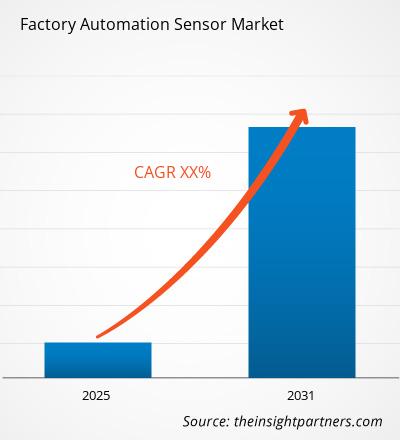
The factory automation sensor market was valued at US$ 23.7 Billion in 2025 and is projected to reach US$ 49.82 Billion by 2034, expanding at a CAGR of 8.61% during 2026–2034. The market includes temperature, vibration, vision, pressure, proximity, and humidity sensors deployed across industrial equipment, production lines, process plants, robotics, packaging systems, energy facilities, and connected manufacturing environments.
North America remains a high-value automation market, with the Factory Automation Sensor Market size expected to expand at an estimated CAGR of 7.8–8.7%. Structural drivers include industrial reshoring, warehouse automation, and modernization of aging production assets. Demand is also supported by semiconductor, automotive, pharmaceutical, food processing, and energy investments requiring real-time monitoring, predictive maintenance, and tighter process control.
Factory Automation Sensor Market Assessment and Insights
- North America: North America is estimated to hold a 29–33% Factory Automation Sensor Market share in 2025 and grow at a CAGR of 7.8–8.7% between 2026–2034, supported by reshoring, robotics, process modernization, and connected industrial infrastructure.
- US: The US is projected to represent 80–85% of North American demand in 2025 and expand at a CAGR of 8.0–8.9%, led by semiconductor, automotive, logistics, and energy projects.
- Europe: Europe is estimated to account for 23–27% of global 2025 demand and grow at a CAGR of 7.2–8.1%, led by Germany, Italy, France, the UK, and the Netherlands.
- Asia Pacific: Asia Pacific is expected to capture 34–38% of 2025 demand and register a CAGR of 9.3–10.2%, with China, Japan, South Korea, Taiwan, and India driving factory digitization.
- Largest Segment: Temperature Sensors are estimated to hold a 24–28% market share in 2025 and grow at a CAGR of 7.8–8.6% between 2026–2034.
- High Growth Segment: Vision Sensors are estimated to represent a 12–16% market share in 2025 and expand at a CAGR of 10.5–11.5% through 2034.
- Key companies analyzed in detail: ABB Ltd., Analog Devices, Inc., Amphenol Corporation, Honeywell International Inc., NXP Semiconductors N.V., Rockwell Automation, Inc., STMicroelectronics N.V., Siemens AG, Texas Instruments Incorporated, and Vishay Intertechnology, Inc.
Source: The Insight Partners' analysis based on proprietary research, government publications, company annual reports, investor presentations, industry databases, and expert interviews.
The Factory Automation Sensor Market forecasts indicate that the market has shifted from stand-alone measurement sensors to connected networks of sensors that can monitor the operational state continually. Temperature and pressure sensors have continued to play an essential role in controlling machine operations, while vibration, vision, proximity, and humidity sensors assist in condition monitoring, quality control, robotics, and environment control. Factors shaping future production include shrinking size of sensors, high sampling rates, robustness, edge computing capability, wireless connectivity, and interoperability with industrial Ethernet and time-sensitive networking.
Future prospects will be driven by AI, digital twins, autonomous materials handling, energy efficiency, and industrial cybersecurity. Future production centers in India, Southeast Asia, Eastern Europe, and Latin America will boost demand for automation systems. Future investments will be in sensors equipped with diagnostic features, standard interfaces, and software connectivity. The growing interest of regulatory agencies in occupational safety, product traceability, energy consumption, and quality of pharmaceutical and food products will boost adoption of sensors in automated facilities.
Factory Automation Sensor Market Report Scope
| Report Attribute | Details |
|---|---|
| Market size in 2025 | US$ 23.7 Billion |
| Market Size by 2034 | US$ 49.82 Billion |
| Global CAGR (2026 - 2034) | 8.61% |
| Historical Data | 2021-2024 |
| Forecast period | 2026-2034 |
Factory Automation Sensor Market Analysis
The Factory Automation Sensor Market report indicates that development is propelled by the demand for higher throughput, reduced downtime, quality assurance, and visibility for production assets on the part of the manufacturers. Sensors translate machine state, material flow, environmental factors, and inspection processes into the data needed by the programmable logic controller, distributed control systems, manufacturing execution systems, and industrial analysis software. Precision and speed are the main requirements of automotive and electronics plants; safety, traceability, and process stability are required by food, chemicals, energy, and pharmaceuticals sectors.
Sensing elements, semiconductors manufacturers, packagers, connectivity companies, automation suppliers, integrators, machine makers, and end-users form the value chain. The performance characteristics of the sensors include accuracy, response time, robustness to environment, calibration stability, communication capabilities, and installation design. The supply chain dynamics is impacted by MEMS capacity, semiconductors, specialty materials, optics, connectors, and industrial qualification. Customers prefer more interoperable products, which can be installed in brownfield equipment without changing whole control systems.
Positioning of players in the Factory Automation Sensor Market is based on portfolio, application engineering, software, reliability, and channels. Siemens AG, ABB Ltd., Rockwell Automation, Inc., Honeywell International Inc., and Analog Devices, Inc. offer products in the form of automation platforms, control systems, industrial software, and integrated sensing technologies. The suppliers include NXP Semiconductors N.V., STMicroelectronics N.V., Texas Instruments Incorporated, Amphenol Corporation, and Vishay Intertechnology, Inc.
Factory Automation Sensor Market Trends include investments in edge intelligence, machine vision, wireless condition monitoring, and sensors that are suited for harsh or regulated conditions. The strategic suppliers are integrating hardware with analytics, digital twins, cybersecurity, and lifecycle services. System integrators have a key role in making the specification as customers need validated solutions as opposed to component parts. Smaller specialist companies can compete through high performance sensing and fast customization of sensors.
● REPORT CUSTOMIZATION
Tailor This Report To Align With Your Specific Business Requirements
This report can be customized to align precisely with your business objectives, scope, and target markets. Customization options include tailored segmentation, geography, competitive analysis, and strategic insights to support informed decision-making.
Customize This Report →WHAT YOU CAN ADJUST
- ● Segmentations
- ● Geography
- ● Competitive Analysis
- ● Language Preferences
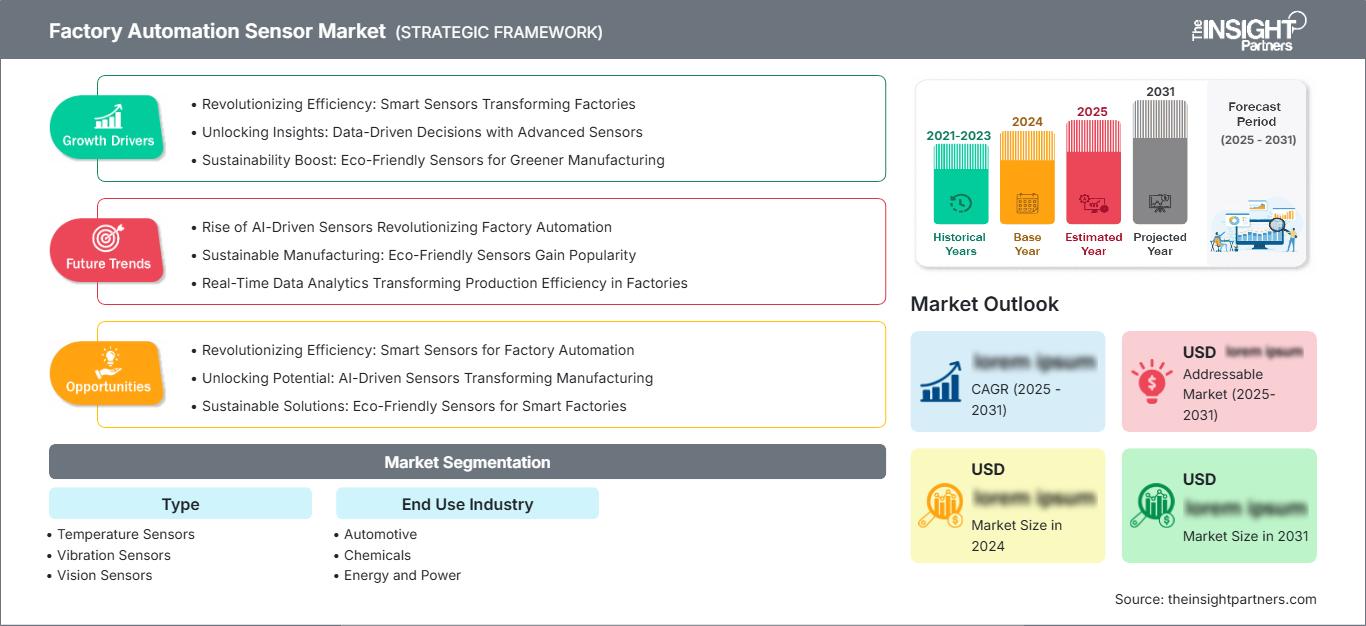
Factory Automation Sensor Market: Strategic Insights
Regional Insights
North America Factory Automation Sensor Market
North America is estimated to hold a 29–33% share in 2025 and grow at a CAGR of 7.8–8.7% through 2034. The US dominates regional consumption because of investment in semiconductor fabrication, electric vehicles, aerospace, pharmaceuticals, logistics, food processing, and data-driven manufacturing. Canada contributes through energy, mining, automotive, food production, and industrial equipment modernization.
Customers from the region focus on predictive maintenance, machine safety, production tracking, and compatibility with their control system infrastructure. Sensors for vibration and temperature assist in equipment monitoring, whereas vision and proximity sensors help robots and packaging operations. ABB Ltd., Rockwell Automation, Inc., Honeywell International Inc., Siemens AG, Texas Instruments Incorporated, and Analog Devices, Inc. remain relevant. The trend of reshoring drives growth in automation due to new manufacturing plants. Labor shortages stimulate robotics and automated materials handling solutions in both warehouses and manufacturing plants.
U.S. Factory Automation Sensor Market
The US is projected to account for 80–85% of North American demand in 2025 and expand at a CAGR of 8.0–8.9% during 2026–2034. Demand is supported by semiconductor plants, battery facilities, aerospace programs, pharmaceutical manufacturing, warehouse automation, and modernization of legacy industrial sites. Customers increasingly require real-time data for equipment health, energy use, quality, and production scheduling.
These uses include machine vision, guidance of robots, pressure sensing, temperature control, vibration measurement, and proximity sensing. Customers are served directly by engineering, distributors, integrators, and software partnerships from companies such as Rockwell Automation Inc., Honeywell International Inc., ABB Ltd., Siemens AG, Analog Devices Inc., and Texas Instruments Inc. Retrofit capability is a key characteristic due to the fact that most plants are unable to endure extended shutdowns. Cybersecurity, staff shortage, and productivity increases are emerging purchase considerations.
Europe Factory Automation Sensor Market
Europe is estimated to represent 23–27% of global 2025 demand and grow at a CAGR of 7.2–8.1%. Germany is the dominant country due to automotive manufacturing, machine tools, industrial machinery, chemicals, and advanced manufacturing. Italy helps out with machinery, packaging, food processing, and the automotive industry chain, while France helps with aerospace, pharmaceuticals, energy, and process industries.
The UK and The Netherlands help drive demand via pharmaceuticals, food manufacturing, logistics, semiconductor equipment, and advanced engineering. European manufacturers focus on energy efficiency, worker safety, traceability, and integration into existing automation systems. Vision and vibration sensors are becoming increasingly important as factories look to improve quality and maintain their assets. Companies like Siemens AG, ABB Ltd., Honeywell International Inc., STMicroelectronics N.V., and Amphenol Corporation can be considered among the stakeholders.
APAC Factory Automation Sensor Market
APAC is expected to hold a 34–38% share in 2025 and grow at a CAGR of 9.3–10.2%, making it the leading and fastest-growing region. China leads through electronics, batteries, automotive, machinery, and robotics. Japan and South Korea contribute through precision manufacturing, semiconductors, displays, and automotive systems, while India expands production and infrastructure investment.
The factors that help to facilitate implementation of this innovation in the region are industrial policy, digitalization of factories, labor limitations, and localization of electronics. The country plays a vital role in the production of semiconductors, while Australia is represented by its contribution in mining, food processing, and energy. The users range from advanced plants that need high-level inspection to those who implement basic sensing in terms of proximity, temperature, and pressure.
Middle East & Africa Factory Automation Sensor Market
Middle East and Africa demand is expected to expand at a CAGR of 8.0–9.0% through 2034. Saudi Arabia and the UAE lead through industrial diversification, energy projects, logistics, food production, and smart infrastructure. South Africa contributes through mining, automotive, chemicals, food processing, and power operations. The Rest of MEA is influenced by water, utilities, manufacturing, and oil and gas modernization.
Energy and infrastructure applications require pressure, temperature, vibration, and humidity monitoring under demanding conditions. Adoption remains project-driven and integrator-led, with customers emphasizing reliability, serviceability, and local technical support. Automation growth will depend on capital expenditure, workforce capabilities, import conditions, and the availability of system-integration expertise.
Segmentation Analysis
Type
Type includes Temperature Sensors, Vibration Sensors, Vision Sensors, Pressure Sensors, Proximity Sensors, and Humidity Sensors. The segment is projected to grow at a CAGR of 8.2–9.0% during 2026–2034. Temperature sensors remain the largest category because they are used across machinery and processes, while vision sensors record faster growth as inspection, robotics, and quality automation expand.
- Temperature Sensors: Temperature sensors maintain the leading position across motors, furnaces, chemical processes, food lines, pharmaceuticals, and energy equipment because thermal control is central to safety and product quality.
- Vibration Sensors: Vibration sensors support predictive maintenance by identifying imbalance, bearing wear, looseness, and misalignment in rotating equipment, reducing unexpected failures and improving maintenance planning.
- Vision Sensors: Vision sensors enable automated inspection, measurement, identification, robotic guidance, and defect detection, making them strategically important for high-speed and high-precision manufacturing.
- Pressure Sensors: Pressure sensors monitor hydraulic, pneumatic, process, and fluid systems, supporting control, leak detection, safety, and efficient operation across machinery and process plants.
- Proximity Sensors: Proximity sensors detect position, presence, distance, and movement in conveyors, robots, packaging equipment, and assembly systems where non-contact operation improves speed and reliability.
- Humidity Sensors: Humidity sensors support environmental control, material handling, pharmaceuticals, food processing, electronics, and storage applications where moisture can affect quality or equipment performance.
End Use Industry
End Use Industry consists of Automotive, Chemicals, Energy and Power, Food and Beverages, Manufacturing, Oil and Gas, and Pharmaceuticals. The segment is expected to expand at a CAGR of 8.5–9.3%. Manufacturing represents broad demand, while pharmaceuticals, automotive, and electronics-related production require advanced sensing, inspection, traceability, and tightly controlled operating conditions.
- Automotive: Automotive plants use sensors for robotic assembly, welding, paint processes, battery production, inspection, material movement, and predictive maintenance across highly automated facilities.
- Chemicals: Chemical plants require pressure, temperature, humidity, and vibration sensing to manage reactions, protect equipment, control hazardous processes, and maintain operational continuity.
- Energy and Power: Energy and power facilities use sensors for turbines, generators, transformers, substations, storage systems, and grid equipment requiring continuous condition and performance monitoring.
- Food and Beverages: Food and beverage plants deploy sensors for temperature, humidity, packaging, filling, inspection, hygiene, process control, and traceability across regulated production environments.
- Manufacturing: Manufacturing users apply broad sensor portfolios to machine tools, robotics, conveyors, assembly, quality inspection, and production analytics, making the category a foundational automation buyer.
- Oil and Gas: Oil and gas operations use sensors for pressure, temperature, vibration, flow-related equipment, safety systems, and remote monitoring in demanding upstream, midstream, and downstream environments.
- Pharmaceuticals: Pharmaceutical plants require precise, validated sensing for temperature, humidity, pressure, cleanrooms, filling, packaging, storage, and batch traceability.
Opportunity Snapshot
| End Use Industry | Revenue Contribution | Trend Tag | Adoption Stage |
|---|---|---|---|
| Automotive | High | Robotic Assembly | Mature |
| Chemicals | Medium | Process Safety | Scaling |
| Energy and Power | High | Asset Monitoring | Scaling |
| Food and Beverages | Medium | Smart Packaging | Scaling |
| Manufacturing | High | Predictive Maintenance | Mature |
| Oil and Gas | High | Remote Monitoring | Scaling |
| Pharmaceuticals | Medium | Validated Processing | Scaling |
Factory Automation Sensor Market Growth Drivers and Impact Analysis
Industrial Reshoring and Automated Capacity Expansion
Manufacturers are investing in new plants and upgrading existing sites to improve resilience, reduce dependence on distant suppliers, and address labor constraints. New facilities are typically designed with higher levels of robotics, digital control, inspection, and data collection, creating demand for temperature, pressure, proximity, vision, and vibration sensors from the outset. Brownfield facilities are also adding sensors to legacy machines without replacing entire control systems. This dual pathway expands the addressable market across both greenfield and retrofit projects. The impact is strongest in automotive, semiconductors, batteries, pharmaceuticals, food, and logistics. Suppliers with open interfaces and strong integration support can benefit as manufacturers seek measurable productivity and quality improvements.
Predictive Maintenance and Asset-Performance Management
Unplanned downtime can disrupt production schedules, waste materials, and increase maintenance costs, particularly in continuous-process and high-throughput operations. Vibration, temperature, pressure, and acoustic measurements allow operators to identify deterioration before a major failure occurs. Sensors connected to edge gateways and analytics platforms support condition-based maintenance, remote diagnostics, and more efficient spare-parts planning. Adoption is expanding from large industrial sites to smaller factories as wireless connectivity, cloud tools, and subscription analytics reduce deployment barriers. The market impact includes higher sensor density on critical assets, recurring replacement demand, and stronger preference for devices with embedded diagnostics. Suppliers can create value through complete monitoring packages rather than component sales alone.
Machine Vision and Automated Quality Inspection
Manufacturers are using vision systems to inspect dimensions, surface defects, labels, assemblies, packaging, and product presence at speeds that exceed manual inspection. Vision sensors support consistent quality, reduce rework, and create auditable production data for regulated industries. Automotive, pharmaceuticals, food and beverages, electronics, and logistics are major application areas. As cameras and processing become more compact, vision capability can be added to machines and workstations that previously relied on manual checks or simple presence sensors. The impact increases demand for lighting, optics, image processing, edge computing, and industrial communication. Suppliers able to combine sensor hardware with easy configuration and analytics can shorten deployment cycles and improve adoption.
Factory Automation Sensor Market Future Trends
Edge Intelligence and Self-Diagnosing Sensors
Future factory sensors will increasingly process data closer to machines, reducing latency, network traffic, and dependence on centralized systems. Embedded algorithms may identify abnormal vibration patterns, thermal drift, pressure instability, object variation, or image defects before transmitting selected information to supervisory platforms. Self-diagnosis can improve maintenance by distinguishing sensor faults from actual process abnormalities, reducing unnecessary interventions. Standardized protocols and secure device management will be important as sensor networks expand. Vendors will compete on processing capability, power efficiency, cybersecurity, calibration, and integration with industrial software. This trend should strengthen demand for smart sensors that provide actionable outputs rather than only raw measurements, particularly in distributed and brownfield production environments.
Sensor Fusion for Autonomous Production
Autonomous production will depend on combining data from vision, proximity, temperature, vibration, pressure, humidity, and motion sensors to understand machine and material conditions. Sensor fusion can improve robotic navigation, quality inspection, predictive maintenance, and process optimization because individual measurements often provide only partial context. Industrial systems will increasingly correlate environmental variables with equipment behavior and production outcomes. This requires synchronized data, common models, edge processing, and software capable of managing heterogeneous devices. Suppliers may offer integrated sensing modules or partnerships with automation platforms rather than isolated products. The trend creates opportunities in autonomous mobile robots, flexible assembly, smart warehouses, and adaptive process control.
Factory Automation Sensor Market Opportunities
Retrofit Packages for Brownfield Facilities
Many factories operate equipment installed before current digital standards and cannot justify complete replacement. Retrofit packages that combine wireless sensors, gateways, mounting kits, software, and integration services can provide a practical route to condition monitoring and production visibility. Suppliers should develop application-specific bundles for motors, pumps, compressors, conveyors, furnaces, packaging lines, and process equipment. The Factory Automation Sensor Market Forecasts should account for the large installed base of machines requiring incremental modernization rather than only new greenfield investment. Commercial success will depend on installation speed, compatibility with legacy controls, cybersecurity, battery life, and clear evidence of maintenance or efficiency benefits.
Validated Sensing Solutions for Regulated Industries
Pharmaceutical, food, chemicals, and energy operators require sensing systems that satisfy documentation, calibration, traceability, safety, and environmental requirements. This creates opportunities for suppliers that combine hardware with validated software, audit trails, installation guidance, and lifecycle service. Pharmaceutical plants may prioritize humidity, temperature, pressure, and cleanroom monitoring, while food producers require reliable thermal and process data across storage and packaging. Chemical and energy facilities value hazardous-area compatibility, remote monitoring, and fault tolerance. Investment should focus on certification, regional service teams, calibration capability, and pre-engineered architectures. Such solutions can command stronger margins because compliance risk and production interruption often outweigh the initial sensor price.
Recent Developments
- March 2026: ABB Ltd. introduced the latest Symphony Plus distributed control system release, adding enhanced OPC UA connectivity, expanded field-device integration, online upgrades, and lifecycle-management capabilities. The release supports modernization of process and power facilities while preserving existing automation investments. Its device-management enhancements demonstrate the growing importance of interoperable sensing and secure integration across industrial control environments.
- September 2025: Honeywell International Inc. announced a new 13MM Pressure Sensor designed for cleanroom environments and semiconductor manufacturing processes. The product addresses pressure measurement requirements in controlled facilities where contamination, stability, and process reliability are important. The launch highlights the expanding role of specialized sensing in advanced manufacturing, particularly semiconductor production and other high-value regulated environments.
- June 2025: Siemens AG announced new artificial-intelligence and robotics capabilities for autonomous production, including developments for automated guided vehicles, autonomous mobile robots, and the Industrial Copilot ecosystem. The initiative demonstrates how machine data, sensing, robotics, and industrial software are converging to support adaptive factory operations and automated material movement.
Frequently Asked Questions

- Comprehensive Market Sizing and Forecast Analysis
- Detailed Segmentation Analysis
- In-Depth Market Dynamics Assessment
- Regional and Country-Level Insights
- Competitive Landscape and Company Benchmarking
- Strategic Business Intelligence
Recent Reports
Testimonials

The Insight Partners' SCADA System Market report is comprehensive, with valuable insights on current trends and future forecasts. The team was highly professional, responsive, and supportive throughout. We are very satisfied and highly recommend their services.
RAN KEDEM Partner, Reali Technologies LTDs
I requested a report on a very specific software market and the team produced the report in a few days. The information was very relevant and well presented. I then requested some changes and additions to the report. The team was again very responsive and I got the final report in less than a week.
JEAN-HERVE JENN Chairman, Future Analytica
We worked with The Insight Partners for an important market study and forecast. They gave us clear insights into opportunities and risks, which helped shape our plans. Their research was easy to use and based on solid data. It helped us make smart, confident decisions. We highly recommend them.
PIYUSH NAGPAL Sr. Vice President, High Beam Global
The Insight Partners delivered insightful, well-structured market research with strong domain expertise. Their team was professional and responsive throughout. The user-friendly website made accessing industry reports seamless. We highly recommend them for reliable, high-quality research services
YUKIHIKO ADACHI CEO, Deep Blue, LLC.
This is the first time I have purchased a market report from The Insight Partners.While I was unsure at first, I visited their web site and felt more comfortable to take the risk and purchase a market report.I am completely satisfied with the quality of the report and customer service. I had several questions and comments with the initial report, but after a couple of dialogs over email with their analyst I believe I have a report that I can use as input to our strategic planning process.Thank you so much for taking the extra time and making this a positive experience.I will definitely recommend your service to others and you will be my first call when we need further market data.
JOHN SUZUKI President and Chief Executive Officer, Board Director, BK Technologies
I wish to appreciate your support and the professionalism you displayed in the course of attending to my request for information regarding to infectious disease IVD market in Nigeria. I appreciate your patience, your guidance, and the fact that you were willing to offer a discount, which eventually made it possible for us to close a deal. I look forward to engaging The Insight Partners in the future, all thanks to the impression you have created in me as a result of this first encounter.
DR CHIJIOKE ONYIA MANAGING DIRECTOR, PineCrest Healthcare Ltd.Reason to Buy
- Informed Decision-Making
- Understanding Market Dynamics
- Competitive Analysis
- Identifying Emerging Markets
- Customer Insights
- Market Forecasts
- Risk Mitigation
- Boosting Operational Efficiency
- Strategic Planning
- Investment Justification
- Tracking Industry Innovations
- Aligning with Regulatory Trends





 Get Free Sample for