
Fast Food Market Size, Share & Demand by 2034
Coverage: By Product (Burgers/Sandwiches, Pizza/Pasta, Chicken, Asian/Latin American, Seafood, Others); End User (Quick Service Restaurants, Fast Casual Restaurants, Catering, Others); and Geography (North America, Europe, Asia Pacific, South & Central America, Middle East & Africa)
- Status : Data Released
- Report Code : TIPRE00005660
- Category : Food and Beverages
- No. of Pages : 150
- Available Report Formats :


- Last update date : June 11, 2026


2025 Market Size
US$ 1.68 Tn
Base year value
2034 Forecast
US$ 3.15 Tn
Projected by 2034
CAGR 2026-2034
7.23 %
Growth rate
Addressable Market
US$ 21.79 Tn
(2026-2034)
The global fast food market size is projected to reach US$ 3.15 trillion by 2034 from US$ 1.68 trillion in 2025. The market is anticipated to register a CAGR of 7.23% during the forecast period 2026–2034.
Key market dynamics include a heightening global focus on time-efficient dining solutions, rising urbanization in emerging economies, and a significant shift toward digital and contactless ordering systems. Additionally, the market is expected to benefit from the growing demand for plant-based and meat-alternative menu items, expansion in delivery and ghost kitchen models, and the increasing inclusion of health-focused options like protein bowls and gluten-free fast-casual meals.
Fast Food Market Analysis
The fast food market analysis shows a shift toward digital-first convenience as consumers prioritize speed and seamless mobile integration. The market trend is bifurcated into traditional value-based Quick Service Restaurants and high-growth Fast Casual segments that emphasize premium ingredients. Strategic opportunities are emerging in automation and AI-driven service, where voice-ordering at drive-thrus and robotic kitchen assistance offer a clear competitive advantage in labor-strapped markets. The analysis also notes that market expansion depends on last-mile delivery efficiency and the ability to maintain food quality during transit. Competitive differentiation now stands out depending on branding that highlights sustainability, such as eco-friendly packaging and ethically sourced proteins. This approach helps brands appeal to younger demographics who are willing to pay a premium for transparency and corporate responsibility.
Fast Food Market Overview
Fast food has advanced from basic burger stands to a multidimensional global ecosystem. Fast food now includes specialty coffee chains, healthy salad bowls, and international fusion establishments. Both multinational giants and regional boutique chains compete in this market, leveraging diverse revenue streams including dine-in, drive-thru, and third-party delivery apps. Growing demand for portable meal solutions among the global workforce has increased the popularity of snackable fast food items. North America leads in revenue due to its deep-rooted fast food culture, while Asia-Pacific is advancing rapidly in digital infrastructure and menu localization. The US market remains the most mature global market, characterized by high franchise density and tech-savvy consumers. Growth is driven by health-conscious millennials seeking functional menu variety and the widespread availability of digital ordering. Established infrastructure and a strong delivery culture maintain its position as a primary innovation hub.
Market Assessment and Insights
- Global market for Fast Food was valued at US$ 1.68 Trillion in 2025
- Annual market size is expected to reach US$ 3.15 Trillion by 2034
- Total addressable market (TAM) during 2026-2034 is projected to reach approximately US$ 21.79 Trillion
- Market is anticipated to register a CAGR of 7.23% during the forecast period
- The United States represents a key market, supported by Savoring Success: How Innovation Fuels Fast Food Growth, Fresh Flavors: The Key to Attracting Health-Conscious Diners, Tech-Driven Convenience: Elevating the Fast Food Experience, as well as evolving industry dynamics
- Market analysis covers North America, Europe, Asia-Pacific, South and Central America, Middle East and Africa, with growth evaluated across the forecast period
- Market opportunities such as Fast Food Goes Green: Sustainable Practices on the Rise, Tech-Infused Dining: AI and Automation Transforming Fast Food, Healthier Choices: Fast Food Chains Embrace Nutritious Menus are expected to influence market dynamics and addressable market
- Report profiles industry participants, including Auntie Anne's,, Burger King, Domino's Pizza, Inc.,, Firehouse of America, LLC d.b.a., Hardee's Food Systems Inc., Kentucky Fried Chicken, McDonald's, Pizza Hut, Starbucks Corporation, Subway IP, LLC., while analyzing competitive strategies and innovation developments
-
Source: The Insight Partners' analysis based on proprietary research, government publications, company annual reports, investor presentations, industry databases, and expert interviews.
● REPORT CUSTOMIZATION
Tailor This Report To Align With Your Specific Business Requirements
This report can be customized to align precisely with your business objectives, scope, and target markets. Customization options include tailored segmentation, geography, competitive analysis, and strategic insights to support informed decision-making.
Customize This Report →WHAT YOU CAN ADJUST
- ● Segmentations
- ● Geography
- ● Competitive Analysis
- ● Language Preferences
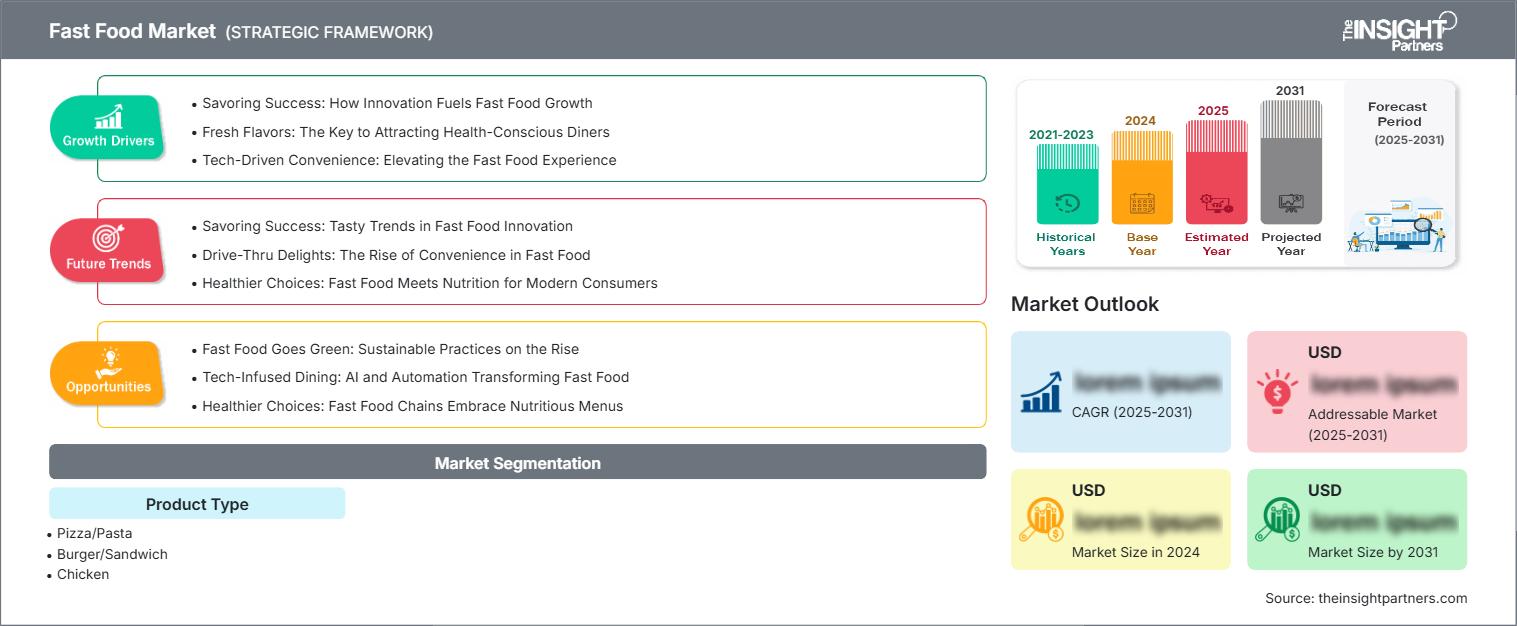
Fast Food Market: Strategic Insights
-
Get Top Key Market Trends of this report.This FREE sample will include data analysis, ranging from market trends to estimates and forecasts.
Fast Food Market Drivers and Opportunities
Market Drivers:
- Rapid Digital Transformation and Delivery Integration: The proliferation of smartphone apps and third-party delivery platforms has made fast food more accessible than ever. Loyalty programs and AI-personalized recommendations are significantly increasing order frequency and average ticket sizes.
- Urbanization and Busy Lifestyles: The global increase in dual-working households and long commute times has made convenience a primary purchasing factor. Fast food serves as a time-saving solution for consumers who lack the time or inclination for home-cooked meals.
- Diversification of Menu Offerings: To combat health-related stigmas, major players are introducing healthier, transparently labeled options. The inclusion of plant-based proteins and low-calorie alternatives is attracting a broader, health-conscious customer segment.
Market Opportunities:
- Expansion of Ghost Kitchens and Off-Premise Models: Reducing overhead costs by operating delivery-only kitchens allows brands to scale quickly in high-density urban areas without the capital expenditure of traditional dining spaces.
- Hyper-Localization in Emerging Markets: Developing region-specific menus, such as spicy vegetarian options in India or seafood-centric fast food in coastal Asia, allows global brands to penetrate culturally diverse markets more effectively.
- Adoption of Green Operations: There is a significant opportunity to lead the market through sustainable branding, utilizing biodegradable packaging, solar-powered outlets, and carbon-neutral supply chains to attract Gen Z and Millennial diners.
Fast Food Market Report Segmentation Analysis
The Fast Food Market share is analyzed across various segments to provide a clearer understanding of its structure, growth potential, and emerging trends. Below is the standard segmentation approach used in most industry reports:
By Product:
- Burgers/Sandwich: The dominant volume driver, maintaining high popularity due to price accessibility and the rise of premium gourmet burger sub-segments.
- Pizza/Pasta: A consistently strong segment benefiting from advanced delivery infrastructure and increasing automation in production.
- Chicken: A high-demand category fueled by the global popularity of fried and grilled chicken snacks and family meals.
- Asian/Latin American: The fastest-growing niche, driven by consumer interest in diverse flavors and exotic convenience options like tacos and noodles.
- Seafood: Includes specialized seafood outlets which see high demand in coastal regions and among consumers seeking leaner protein alternatives.
- Others: Encompasses specialty snacks, desserts, and niche regional fast food offerings.
By End User:
- Quick Service Restaurants: Remains the primary channel for high-volume transactions, utilizing drive-thrus and kiosks to maximize throughput.
- Fast Casual Restaurants: A high-growth segment combining the speed of fast food with the quality and atmosphere of casual dining.
- Caterings: A significant professional segment providing bulk fast food solutions for corporate events, parties, and institutional gatherings.
- Others: Includes food trucks, convenience store food counters, and vending machine services.
By Geography:
- North America
- Europe
- Asia Pacific
- South & Central America
- Middle East & Africa
Fast Food Market Report Scope
| Report Attribute | Details |
|---|---|
| Market size in 2025 | US$ 1.68 trillion |
| Market Size by 2034 | US$ 3.15 trillion |
| Global CAGR (2026 - 2034) | 7.23% |
| Historical Data | 2021-2024 |
| Forecast period | 2026-2034 |
| Segments Covered |
By Product
|
| Regions and Countries Covered |
North America
|
| Market leaders and key company profiles |
|
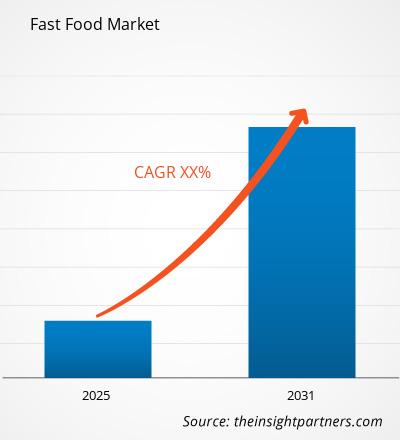
Fast Food Market Players Density: Understanding Its Impact on Business Dynamics
The Fast Food Market is growing rapidly, driven by increasing end-user demand due to factors such as evolving consumer preferences, technological advancements, and greater awareness of the product's benefits. As demand rises, businesses are expanding their offerings, innovating to meet consumer needs, and capitalizing on emerging trends, which further fuels market growth.
Fast Food Market Share Analysis by Geography
Asia-Pacific is expected to grow fastest in the coming years. Emerging markets in South & Central America, the Middle East, and Africa also have many untapped opportunities for global franchises and local quick-service players to expand.
The fast food market is undergoing a significant transformation, moving from traditional dine-in models to tech-integrated, high-speed service delivery. Growth is driven by the rising demand for convenient meal solutions, a surge in digital ordering, and the expansion of the health-conscious fast-casual sector. Below is a summary of market share and trends by region:
North America
- Market Share: Holds the largest share globally, anchored by deep-seated franchise ecosystems in the US and Canada.
- Key Drivers:
- High penetration of drive-thru infrastructure and mobile loyalty applications
- Mainstreaming of gourmet fast-casual brands in urban and suburban hubs
- Increased demand for plant-based meat alternatives and transparent labeling
- Trends: Scaling of digital-only brands and the successful adoption of plant-based meat alternatives to appeal to health-focused demographics.
Europe
- Market Share: Holds a substantial share, driven by strong demand in the UK, Germany, and France.
- Key Drivers:
- Strong demand for on-the-go breakfast and snacking options among the urban workforce
- Established supply chains and strict regulatory frameworks, ensuring high food safety standards
- Growing consumer interest in ethnically diverse and fusion fast food
- Trends: A strategic shift toward organic ingredients and eco-friendly operations to meet the demands of eco-conscious European consumers.
Asia-Pacific
- Market Share: The fastest-growing region, with high urbanization rates acting as a primary driver for expansion.
- Key Drivers:
- Massive youth population and rising middle-class disposable incomes
- Rapid urbanization leading to a shift from traditional home cooking to Western-style quick-service meals
- Government support for digital payment infrastructure and retail modernization
- Trends: Heavy reliance on e-commerce delivery platforms and localized menu innovation to cater to regional spicy or vegetarian preferences.
South and Central America
- Market Share: Emerging market with a growing artisanal and chicken-based fast food sector in countries like Brazil and Chile.
- Key Drivers:
- Increasing awareness of international brands and the status associated with global franchise dining
- Modernization of independent local eateries into formalized commercial chains
- Rising interest in affordable, family-oriented dining experiences
- Trends: Growth of farm-to-table fast food brands and the introduction of local fusion items to differentiate from the dominant global brands.
Middle East and Africa
- Market Share: Developing market with deep cultural roots in street food, transitioning toward formalized commercial production.
- Key Drivers:
- Traditional presence of shawarma and falafel-based quick-service outlets transitioning into formal franchises
- High demand for world-class dining brands in tourism hubs like Dubai and Riyadh
- Strategic investments to stabilize local supply chains for meat and produce.
- Trends: Implementation of modern kitchen and refrigeration technologies to formalize the market, coupled with a focus on high-nutrient offerings for the urban population.
High Market Density and Competition
Competition is intensifying due to the presence of established leaders such as McDonald's Corporation, Yum Brands, and Restaurant Brands International. Regional experts and niche players like Jollibee Foods Corporation and Greggs, alongside North American innovators such as Chipotle Mexican Grill and Chick-fil-A, also contribute to a diverse and rapidly expanding market landscape.
This competitive environment pushes vendors to differentiate through:
- Premiumization and functional branding: Position fast food as a high-quality nutritional option by emphasizing fresh ingredients and transparent sourcing.
- Diverse Product Portfolios: Fast food products now include more than just burgers. Companies offer probiotic bowls, artisanal pizzas, and high-end plant-based meals.
- Supply Chain Integrity: Producers manage the entire supply chain to ensure quality, transparency, and meet ethical clean-label standards.
- New Processing Technologies: Like automated assembly lines and AI-driven inventory management to create high-quality products efficiently.
Opportunities and Strategic Moves
- Partner with high-end delivery channels and e-commerce platforms to tap into the surging demand for convenient and healthy food in Asia-Pacific and North American markets.
- Incorporate sustainable farming practices and waste-reduction certifications to appeal to environmentally conscious millennials and Gen Z consumers seeking ethical dining alternatives.
Major Companies operating in the Fast Food Market are:
- Auntie Anne's,
- Burger King
- Domino's Pizza, Inc.
- Firehouse of America, LLC d.b.a.
- Hardee's Food Systems Inc.
- Kentucky Fried Chicken
- McDonald's
- Pizza Hut
- Starbucks Corporation
- Subway IP, LLC.
Disclaimer: The companies listed above are not ranked in any particular order.
Fast Food Market News and Recent Developments
- In March 2026, Firehouse Subs announced the launch of its new Development Incentive Programs designed to set new and existing franchisees up for long-term growth. Available now through 2028, the new incentives reward qualified franchisees who are ready to grow with the brand, offering $75,000 for those who commit to building one restaurant and $100,000 per restaurant for franchisees who develop two or more restaurants.
- In February 2026, Burger King launched its most iconic product, The Whopper. The higher-quality Whopper experience includes a more premium, better-tasting bun, served in a box to ensure it makes it to Guests exactly the way it left the kitchen. Stacked tall with freshly cut onions and tomatoes, crisp lettuce, tangy pickles, and better-tasting mayo, every Whopper is crafted to deliver the flame-grilled flavor Guests expect, now elevated from the first bite to the last.
Fast Food Market Report Coverage and Deliverables
The Fast Food Market Size and Forecast (2021–2034) report provides a detailed analysis of the market covering below areas:
- Fast Food Market size and forecast at global, regional, and country levels for all the key market segments covered under the scope
- Fast Food Market trends, as well as market dynamics such as drivers, restraints, and key opportunities
- Detailed PEST and SWOT analysis
- Fast Food Market analysis covering key market trends, global and regional framework, major players, regulations, and recent market developments
- Industry landscape and competition analysis covering market concentration, heat map analysis, prominent players, and recent developments in the Fast Food Market.
- Detailed company profiles
Frequently Asked Questions

- Comprehensive Market Sizing and Forecast Analysis
- Detailed Segmentation Analysis
- In-Depth Market Dynamics Assessment
- Regional and Country-Level Insights
- Competitive Landscape and Company Benchmarking
- Strategic Business Intelligence
Recent Reports
Testimonials

The Insight Partners' SCADA System Market report is comprehensive, with valuable insights on current trends and future forecasts. The team was highly professional, responsive, and supportive throughout. We are very satisfied and highly recommend their services.
RAN KEDEM Partner, Reali Technologies LTDs
I requested a report on a very specific software market and the team produced the report in a few days. The information was very relevant and well presented. I then requested some changes and additions to the report. The team was again very responsive and I got the final report in less than a week.
JEAN-HERVE JENN Chairman, Future Analytica
We worked with The Insight Partners for an important market study and forecast. They gave us clear insights into opportunities and risks, which helped shape our plans. Their research was easy to use and based on solid data. It helped us make smart, confident decisions. We highly recommend them.
PIYUSH NAGPAL Sr. Vice President, High Beam Global
The Insight Partners delivered insightful, well-structured market research with strong domain expertise. Their team was professional and responsive throughout. The user-friendly website made accessing industry reports seamless. We highly recommend them for reliable, high-quality research services
YUKIHIKO ADACHI CEO, Deep Blue, LLC.
This is the first time I have purchased a market report from The Insight Partners.While I was unsure at first, I visited their web site and felt more comfortable to take the risk and purchase a market report.I am completely satisfied with the quality of the report and customer service. I had several questions and comments with the initial report, but after a couple of dialogs over email with their analyst I believe I have a report that I can use as input to our strategic planning process.Thank you so much for taking the extra time and making this a positive experience.I will definitely recommend your service to others and you will be my first call when we need further market data.
JOHN SUZUKI President and Chief Executive Officer, Board Director, BK Technologies
I wish to appreciate your support and the professionalism you displayed in the course of attending to my request for information regarding to infectious disease IVD market in Nigeria. I appreciate your patience, your guidance, and the fact that you were willing to offer a discount, which eventually made it possible for us to close a deal. I look forward to engaging The Insight Partners in the future, all thanks to the impression you have created in me as a result of this first encounter.
DR CHIJIOKE ONYIA MANAGING DIRECTOR, PineCrest Healthcare Ltd.Reason to Buy
- Informed Decision-Making
- Understanding Market Dynamics
- Competitive Analysis
- Identifying Emerging Markets
- Customer Insights
- Market Forecasts
- Risk Mitigation
- Boosting Operational Efficiency
- Strategic Planning
- Investment Justification
- Tracking Industry Innovations
- Aligning with Regulatory Trends





 Get Free Sample for