
Filagrinol Market Size, Demand & Growth by 2034
Coverage: By Application (Skin Cream, Lotion, Oils, Others); End Use Industry (Personal Care, Pharmaceuticals), and Geography (North America, Europe, Asia Pacific, and South and Central America)
- Status : Data Released
- Report Code : TIPRE00016177
- Category : Chemicals and Materials
- No. of Pages : 150
- Available Report Formats :


- Last update date : October 26, 2026


2025 Market Size
US$ 166.82 Mn
Base year value
2034 Forecast
US$ 329.41 Mn
Projected by 2034
CAGR 2026-2034
7.85 %
Growth rate
Addressable Market
US$ 2,232.68 Mn
(2026-2034)
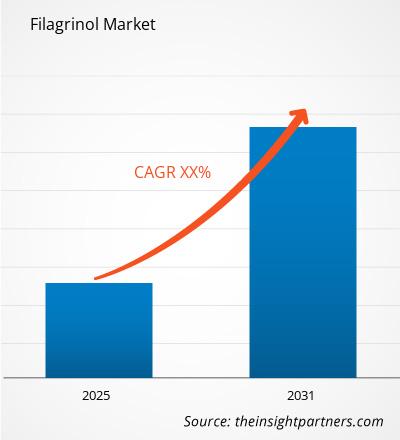
The Filagrinol Market was valued at US$ 166.82 Million in 2025 and is projected to reach US$ 329.41 Million by 2034. The market is expected to register a CAGR of 7.85% during 2026–2034. Demand is supported by the increasing incorporation of specialized epidermal moisturization ingredients into skin creams, lotions, oils, and topical formulations across personal care and pharmaceutical applications.
North America continues to represent an important commercial base, with the regional market projected to expand at a CAGR of ~7% through 2034. The Filagrinol Market size in the region is supported by established premium skin care consumption, strong demand for barrier-supporting formulations, active dermatological product development, and well-developed specialty ingredient distribution channels serving cosmetic formulators and pharmaceutical manufacturers.
Filagrinol Market Assessment and Insights
Regional Outlook
- North America: ~33% of the global market in 2025 | ~7% CAGR through 2034. Market position: North America represents the largest regional market, supported by advanced skin care formulation activity, strong consumer expenditure on premium moisturization products, established ingredient distribution networks, and extensive dermocosmetic product development.
- US: ~83% of North American market revenue in 2025 | ~7% CAGR through 2034. Market position: The US dominates North American consumption because of its large premium personal care industry, established topical pharmaceutical sector, ingredient innovation ecosystem, and demand for differentiated moisturization and barrier-support formulations.
- Europe: ~29% of the global market in 2025 | ~7% CAGR through 2034. Market position: Europe is a mature market supported by Italy's ingredient manufacturing base and significant formulation activity in Germany, France, the UK, Spain, and other established cosmetics-producing countries.
- Asia Pacific: ~25% of the global market in 2025 | ~9% CAGR through 2034. Market position: Asia Pacific is the fastest-growing region, supported by premiumization of skin care, expanding dermocosmetics consumption, growing ingredient imports, and product development activity in China, Japan, South Korea, and India.
Segment Outlook
- Personal Care: ~72% Share in 2025 | ~8% CAGR through 2034. Market position: Personal care leads because moisturization, sensitive-skin care, anti-aging, barrier repair, and sun-damage formulations provide broad commercial opportunities for specialized active ingredients across creams, lotions, and oil-based products.
- Pharmaceuticals: ~28% Share in 2025 | ~9% CAGR through 2034. Market position: Pharmaceutical applications have the stronger growth outlook as formulators investigate advanced topical systems targeting severely dry, compromised, irritated, and dermatologically challenged skin conditions.
Competitive Coverage
Vevy Europe S.p.A., Arerko Kimya Sanayi ve Ticaret A.Ş., Yasham Speciality Ingredients Pvt. Ltd., Independent Chemical Corporation, Vevy Switzerland S.A., Univar Solutions Inc., Dr. Reddy's Laboratories Ltd., Hanamai Co., Ltd., Ravago Chemicals Turkey, Covalo AG
Methodology
The Insight Partners follows Data Collection & Secondary Research, Primary Research, Data Analysis, and Data Triangulation & Final Review to validate market estimates and insights.
Source: The Insight Partners' analysis based on proprietary research, government publications, company annual reports, investor presentations, industry databases, and expert interviews.
Development of the Filagrinol Market has gone hand-in-hand with the move away from simple occlusive moisturization towards skin barrier science and active cosmeceuticals with biological targeting. Formulation innovation is increasingly being driven by ingredients that relate to skin hydration pathways, NMF support, lipid balance, and a strong barrier function. The production process is relatively specialized since the Filagrinol products use specified botanical fractions and controlled ingredients rather than mass market moisturizing ingredients.
In the future, there will be more geographical diversity due to increased investment from Asian formulators in premium skin care products and expansion of sensitive skin and dermocosmetic ranges by European and North American firms. Ingredient labeling, formulation support, sustainability positioning, and suitability for multifunctional formulations will continue to be important in purchase decisions. Increasing regulatory focus on cosmetic claims is also going to drive suppliers to demonstrate substantiation and application specific technical support.
Filagrinol Market Report Scope
| Report Attribute | Details |
|---|---|
| Market size in 2025 | US$ 166.82 Million |
| Market Size by 2034 | US$ 329.41 Million |
| Global CAGR (2026 - 2034) | 7.85% |
| Historical Data | 2021-2024 |
| Forecast period | 2026-2034 |
Filagrinol Market Analysis
Filagrinol Market expansion is mainly driven by rising demand for formulations that provide enhanced hydration benefits in addition to traditional humectancy. Skincare brands launch products that have barrier strengthening, sensitive skin, visible dryness, environmental stress, and healthy aging claims, thus creating a need for unique active ingredients that can help in achieving differentiating efficacies.
Value chain is moderately concentrated at the development stage of the ingredient but broader at distribution and formulation stages. Unique ingredients suppliers provide the regional distributors, formulation labs, cosmetics companies, dermopharmaceutical companies, and contract manufacturers. Consistency of botanical raw material, technical documentation, formulating capability, batch reproducibility, and availability therefore play a role in procurement in addition to the functionality of the ingredient.
Market Differentiation in Filagrinol Market Report is becoming less about pricing and more about application support. Vevy Europe S.p.A. occupies a vital upstream position whereas companies like Independent Chemical Corporation, Yasham Speciality Ingredients Pvt. Ltd., Arerko Kimya Sanayi ve Ticaret A.Ş. and several other firms work towards facilitating availability in regional formulation markets.
Thus, the investment is directed towards formulation technology, customer education, ingredient delivery, documentation and development of superior skin care concepts. Strategic positioning is best when ingredient functionality can be aligned with creams, lotions, oils, products for sensitive skin, and dermopharmaceutical formulations.
● REPORT CUSTOMIZATION
Tailor This Report To Align With Your Specific Business Requirements
This report can be customized to align precisely with your business objectives, scope, and target markets. Customization options include tailored segmentation, geography, competitive analysis, and strategic insights to support informed decision-making.
Customize This Report →WHAT YOU CAN ADJUST
- ● Segmentations
- ● Geography
- ● Competitive Analysis
- ● Language Preferences
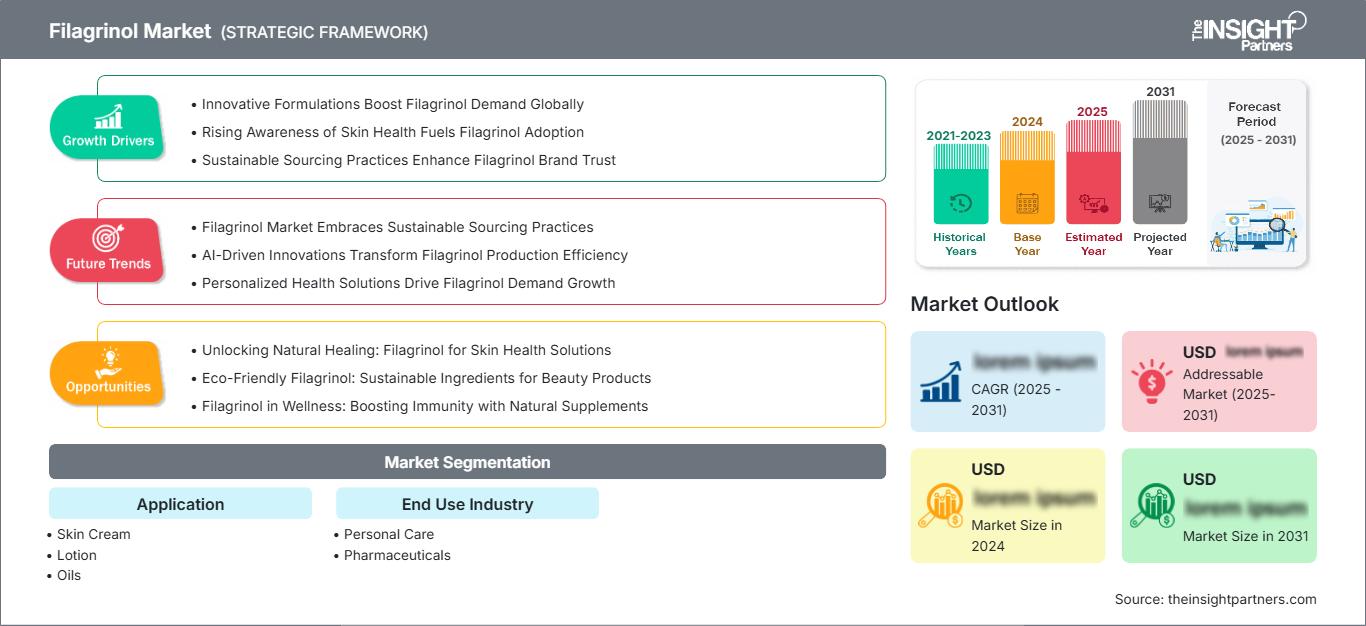
Filagrinol Market: Strategic Insights
Regional Insights
North America Filagrinol Market
North America held around ~33% of total revenue in 2025 and is anticipated to maintain a CAGR of ~7% up to 2034. North American Filagrinol Market Share is due to significant demand for luxury moisturizers, skin barrier products, products suitable for sensitive skin, and dermatological personal care products. Ingredient suppliers offer formulators technical and logistic access to specialty actives from Europe.
Growth is anticipated to be stable rather than disruptive since the market in the region is mature. The trend in innovation will shift towards multifunctional moisturizers, skin barrier products, healthy aging, and products for stressed or visibly dry skin. The interest of pharmaceuticals in topical skin care adds to the list of target customers.
U.S. Filagrinol Market
The US accounts for about ~83% of North America’s revenue in 2025 and is forecasted to grow at a CAGR of ~7% until 2034. High demand is observed from high-end personal care product formulators, speciality cosmetics firms, dermatological firms, and firms engaged in developing skin moisturization technology for delicate or problematic skin.
Distribution efforts of Independent Chemical Corporation in the US make local supply of Filagrinol-based substances easier and help small scale formulators avoid setting up their own international procurement channels. Increasingly, application developments have been focused on facial moisturizers, intensive creams, lotions, anti-aging applications, environmental exposure after-treatment solutions, and speciality topical products.
Europe Filagrinol Market
Europe holds around ~29% share in the global market in 2025 and is expected to achieve a CAGR of ~7% during the forecast period from 2025 to 2034. Italy leads the regional market because of its close connection to specialty active ingredient production and cosmetic & dermopharmaceutical ingredient formulation expertise.
The market need in the region is driven by the presence of an extensive formulation infrastructure in Europe along with technical differentiation of skin care. Germany is an important market for dermocosmetics and pharmacy focused skin care formulations. France is the combination of large prestige beauty industry and strong cosmetics R&D and UK has premium skin care brands and contract formulation activity.
Italy gains an advantage from its closeness to active ingredient formulation and manufacturing facilities. Spain drives the market via its growing cosmetics manufacturing industry and demand for moisturizing and solar skin care. Manufacturers focus on barrier function, sensitive skin formulation, sustainable ingredients, and substantiation of claims in the region.
APAC Filagrinol Market
Asia Pacific represented approximately ~25% of global revenue in 2025 and is projected to record the fastest regional CAGR of ~9% through 2034. China is the leading country in Asia Pacific, supported by its extensive cosmetics manufacturing base and growing demand for premium active ingredients.
Japan and South Korea remain influential in advanced moisturization and barrier-care concepts, while India is expanding through rising premium personal care consumption and specialty ingredient imports. Australia contributes through sophisticated skin care demand. Regional growth is reinforced by beauty premiumization, local formulation capabilities, ingredient localization, and increasing consumer interest in sensitive-skin and skin-barrier products.
Middle East & Africa Filagrinol Market
The Middle East & Africa market is projected to expand at approximately ~8% CAGR through 2034. Demand remains smaller than in established cosmetics regions but is increasing as premium beauty retail, local personal care manufacturing, and dermatological skin care categories expand.
The UAE has the strongest commercial position in the Middle East & Africa due to premium beauty consumption and its role as a regional distribution hub. Saudi Arabia is developing through expanding personal care expenditure, while South Africa maintains a diversified cosmetics manufacturing and retail base. Rest of MEA demand is more fragmented and dependent on imported specialty ingredients and finished formulations.
Segmentation Analysis
Application
The Application segment is projected to grow at approximately ~8% CAGR during 2026–2034. The Filagrinol Market scope across applications is centered on leave-on topical formats where prolonged contact with the epidermis enables formulators to incorporate specialized moisturization and barrier-support actives. Product texture, ingredient solubility, dosage strategy, oxidative stability, and compatibility with lipid and emulsion systems influence formulation selection.
- Skin Cream: Creams remain strategically important because richer emulsion structures are widely used for intensive moisturization, sensitive-skin care, anti-aging, night treatments, and products intended for persistently dry or compromised skin.
- Lotion: Lotions support broader daily-use positioning through lighter sensory characteristics, easier spreadability, and suitability for facial and body care. They enable formulators to combine moisturization functionality with convenient, high-frequency application formats.
- Oils: Oil-based applications provide opportunities in concentrated skin treatments and lipid-focused products. Their strategic relevance is strongest where brands emphasize emollience, barrier support, botanical positioning, and premium sensory characteristics.
End Use Industry
The End Use Industry segment is projected to register approximately ~8% CAGR through 2034. Adoption is influenced by differences in claim requirements, formulation development cycles, product positioning, technical documentation, and intended consumer use. Personal care generates the broader commercial base, while pharmaceutical and dermopharmaceutical applications provide opportunities for more specialized topical formulations.
- Personal Care: Personal care demand is driven by moisturizers, anti-aging products, sensitive-skin formulations, sun-related care, and barrier-focused products. Brands increasingly differentiate premium formulations through active ingredients linked to skin hydration mechanisms.
- Pharmaceuticals: Pharmaceutical use is associated with topical formulation development for severely dry, irritated, compromised, or dermatologically challenged skin. Adoption requires stronger emphasis on ingredient documentation, formulation compatibility, manufacturing quality, and appropriate product claims.
Opportunity Snapshot
| Application | Revenue Contribution | Trend Tag | Adoption Stage |
| Skin Cream | High | Barrier Care | Mature |
| Lotion | Medium | Daily Hydration | Scaling |
| Oils | Low | Lipid Repair | Emerging |
Filagrinol Market Growth Drivers and Impact Analysis
Expansion of Skin Barrier and Sensitive-Skin Formulations
Consumer skin care routines increasingly extend beyond surface moisturization toward products positioned around barrier integrity, sensitive skin, dryness management, and resilience against environmental stress. This shift increases the strategic value of active ingredients that can be incorporated into scientifically differentiated moisturization concepts. Filagrinol is particularly relevant to leave-on products where brands can combine hydration, emollience, and epidermal-support positioning. The impact is strongest in premium facial moisturizers, intensive creams, sensitive-skin products, and dermocosmetic ranges, where active-ingredient functionality forms an important part of product differentiation.
Premiumization of Active-Ingredient Skin Care
Premiumization is encouraging formulators to replace undifferentiated moisturizing claims with more specific ingredient-led product propositions. Consumers increasingly encounter products positioned around microbiome support, natural moisturizing factors, barrier lipids, peptides, ceramides, and advanced botanical actives. This environment creates space for specialized ingredients with defined formulation roles. Manufacturers can incorporate Filagrinol into higher-value formulations while combining it with complementary emollients, antioxidants, humectants, and delivery systems. The resulting product architecture supports differentiation in crowded moisturizer categories without requiring entirely new topical dosage formats.
Expansion of Dermocosmetic and Topical Product Development
The convergence of cosmetics, dermatology-inspired skin care, and specialized topical products is widening the commercial addressable base. Cosmetic formulators increasingly develop products for very dry, sensitive, aged, sun-stressed, or visibly compromised skin, while pharmaceutical developers continue to evaluate advanced excipient and active combinations for topical applications. This overlap supports demand for ingredients capable of functioning across technically sophisticated formulations. Suppliers that provide formulation guidance, safety documentation, stability information, and scalable sourcing can capture greater participation as customers move from laboratory prototypes to commercial production.
Filagrinol Market Future Trends
Shift Toward Mechanism-Based Moisturization
Future Filagrinol Market trends are expected to reflect a broader move from generic hydration positioning toward mechanism-based skin care. Product developers are increasingly building formulations around identifiable components of epidermal hydration, barrier function, lipid organization, and natural moisturizing mechanisms. By 2034, this approach is likely to increase demand for actives that can be incorporated into substantiated skin-barrier narratives while remaining compatible with familiar cream and lotion systems. Suppliers will consequently need stronger technical documentation and formulation evidence to support increasingly sophisticated customer requirements.
Integration of Barrier Care With Microbiome-Oriented Concepts
Barrier health and microbiome-oriented skin care are likely to become increasingly interconnected as formulators develop products intended to maintain an environment supportive of healthy skin function. Filagrinol-related formulations may therefore evolve from standalone moisturization concepts toward multidimensional products combining epidermal hydration, lipid support, soothing ingredients, antioxidants, and microbiome-compatible formulation strategies. This evolution could expand usage in sensitive-skin and preventive skin-maintenance products while encouraging ingredient suppliers to develop more integrated formulation concepts rather than positioning individual actives in isolation.
Filagrinol Market Opportunities
Expansion Through Asian Premium Skin Care Formulators
Asia Pacific offers an attractive route for commercial expansion as local cosmetic manufacturers increase the sophistication of active-ingredient formulations. The Filagrinol Market Forecasts indicate stronger regional growth than mature Western markets, creating opportunities for ingredient suppliers and distributors to deepen technical support in China, South Korea, Japan, and India. Investments in local inventory, application laboratories, formulation demonstrations, regulatory assistance, and distributor training can reduce adoption barriers and improve conversion from ingredient evaluation to recurring commercial procurement.
Development of Specialized Dermopharmaceutical Formulations
An additional opportunity lies in formulations positioned between conventional cosmetics and clinically oriented topical care. Products targeting persistent dryness, sensitive skin, age-related barrier deterioration, or environmentally stressed skin require differentiated ingredients and stronger technical substantiation. Suppliers can pursue partnerships with pharmaceutical companies, dermatology-oriented brands, contract manufacturers, and formulation laboratories. Commercial success will depend on documentation quality, consistent sourcing, formulation stability, and the ability to support customers in translating ingredient functionality into compliant finished-product positioning.
Recent Developments
- February 2026: Solabia Group announced the completion of its acquisition of Mibelle Biochemistry, the Swiss specialist in science-backed active ingredients for the cosmetics and nutraceutical industries, from Persán.
- April 2025: Independent Chemical Corporation expanded its personal care ingredient communication by highlighting high-purity Myristyl Alcohol for cosmetic applications, including creams, lotions, and conditioners. The development reflects continued expansion of its specialty personal care ingredient offering and formulation support capabilities, complementing its existing US distribution of Vevy Europe ingredients, including Filagrinol.
Frequently Asked Questions

- Comprehensive Market Sizing and Forecast Analysis
- Detailed Segmentation Analysis
- In-Depth Market Dynamics Assessment
- Regional and Country-Level Insights
- Competitive Landscape and Company Benchmarking
- Strategic Business Intelligence
Recent Reports
Testimonials

The Insight Partners provided valuable market intelligence that supported our global go-to-market strategy. Their team was professional, responsive, and attentive to our feedback, providing thoughtful analysis and helpful methodological clarifications throughout the project.
Junmo Kim Chief Financial Officer (CFO), Enertech Co., Ltd.
The Insight Partners' SCADA System Market report is comprehensive, with valuable insights on current trends and future forecasts. The team was highly professional, responsive, and supportive throughout. We are very satisfied and highly recommend their services.
RAN KEDEM Partner, Reali Technologies LTDs
I requested a report on a very specific software market and the team produced the report in a few days. The information was very relevant and well presented. I then requested some changes and additions to the report. The team was again very responsive and I got the final report in less than a week.
JEAN-HERVE JENN Chairman, Future Analytica
We worked with The Insight Partners for an important market study and forecast. They gave us clear insights into opportunities and risks, which helped shape our plans. Their research was easy to use and based on solid data. It helped us make smart, confident decisions. We highly recommend them.
PIYUSH NAGPAL Sr. Vice President, High Beam Global
The Insight Partners delivered insightful, well-structured market research with strong domain expertise. Their team was professional and responsive throughout. The user-friendly website made accessing industry reports seamless. We highly recommend them for reliable, high-quality research services
YUKIHIKO ADACHI CEO, Deep Blue, LLC.
This is the first time I have purchased a market report from The Insight Partners.While I was unsure at first, I visited their web site and felt more comfortable to take the risk and purchase a market report.I am completely satisfied with the quality of the report and customer service. I had several questions and comments with the initial report, but after a couple of dialogs over email with their analyst I believe I have a report that I can use as input to our strategic planning process.Thank you so much for taking the extra time and making this a positive experience.I will definitely recommend your service to others and you will be my first call when we need further market data.
JOHN SUZUKI President and Chief Executive Officer, Board Director, BK Technologies
I wish to appreciate your support and the professionalism you displayed in the course of attending to my request for information regarding to infectious disease IVD market in Nigeria. I appreciate your patience, your guidance, and the fact that you were willing to offer a discount, which eventually made it possible for us to close a deal. I look forward to engaging The Insight Partners in the future, all thanks to the impression you have created in me as a result of this first encounter.
DR CHIJIOKE ONYIA MANAGING DIRECTOR, PineCrest Healthcare Ltd.Reason to Buy
- Informed Decision-Making
- Understanding Market Dynamics
- Competitive Analysis
- Identifying Emerging Markets
- Customer Insights
- Market Forecasts
- Risk Mitigation
- Boosting Operational Efficiency
- Strategic Planning
- Investment Justification
- Tracking Industry Innovations
- Aligning with Regulatory Trends





 Get Free Sample for