
Fireclay Tiles Market Growth, Size & Forecast by 2034
Coverage: By Application (Residential, Commercial) , and Geography (North America, Europe, Asia Pacific, and South and Central America)
- Status : Data Released
- Report Code : TIPRE00024914
- Category : Chemicals and Materials
- No. of Pages : 150
- Available Report Formats :


- Last update date : October 30, 2026


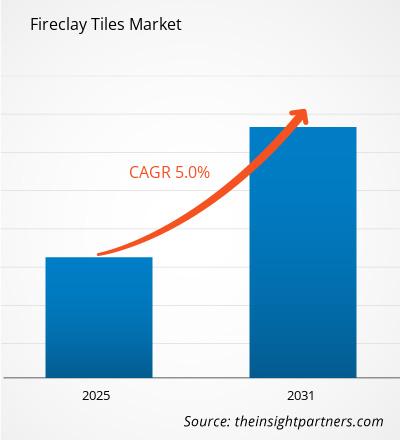
2025 Market Size
US$ 489.6 Mn
Base year value
2034 Forecast
US$ 794.28 Mn
Projected by 2034
CAGR 2026-2034
5.52 %
Growth rate
Addressable Market
US$ 5,820.08 Mn
(2026-2034)
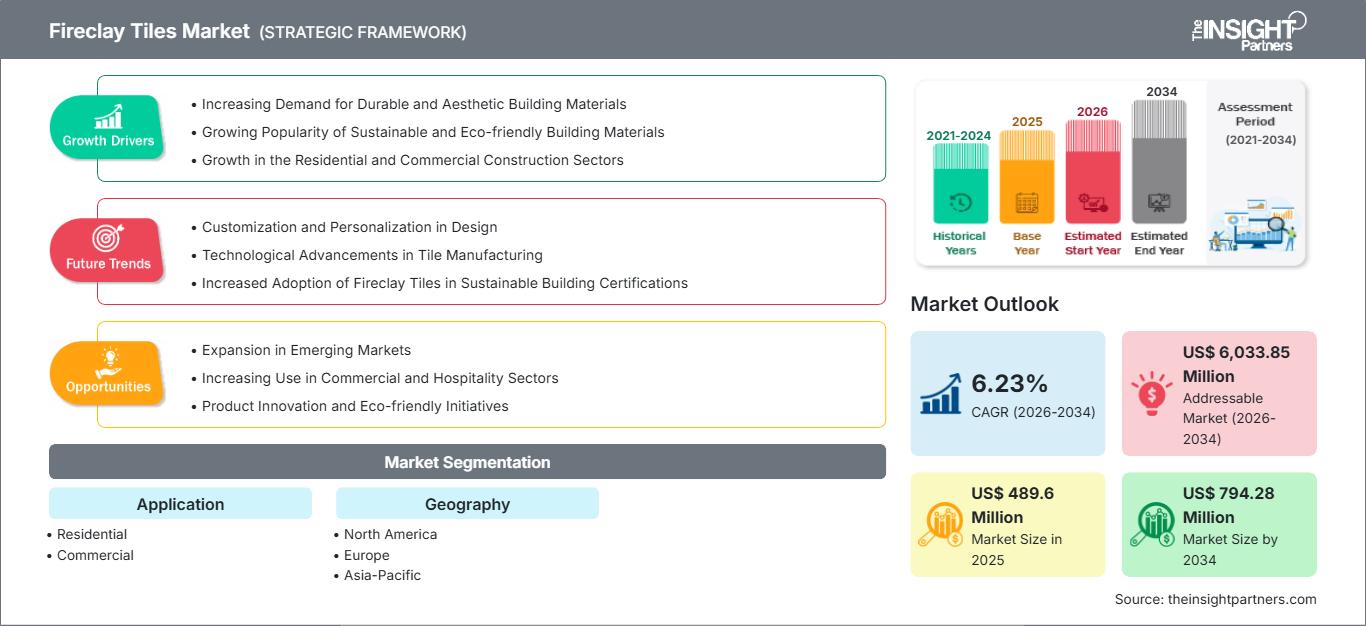
The fireclay tiles market size was valued at US$ 489.6 Million in 2025 and is projected to reach US$ 794.28 Million by 2034, reflecting a mathematically consistent CAGR of 5.52% over the nine-year forecast period. Demand is supported by residential renovation, commercial interior development, architectural customization, and interest in distinctive ceramic finishes. Manufacturers compete through surface quality, color consistency, production flexibility, distribution reach, and installation suitability. Market performance will depend on construction activity, input costs, energy efficiency, and the ability of fireclay products to differentiate themselves from porcelain, conventional ceramic tiles, and alternative surfacing materials.
North America offers an established Fireclay tiles market with specialized ceramic finishes, supported by residential remodeling, hospitality refurbishment, and professional architectural specification. The region's modeled CAGR is ~6% through 2034, with growth influenced by demand for customized kitchens, bathrooms, decorative flooring, and commercial interiors. Established distributor networks and online product-selection tools help connect manufacturers with designers and homeowners. However, higher installation costs, imported product competition, and fluctuations in discretionary renovation spending may affect purchasing decisions. Suppliers that combine distinctive design with dependable delivery and practical technical documentation are positioned to serve both premium residential projects and selected commercial applications.
Fireclay Tiles Market Assessment and Insights
Regional Outlook
- North America: ~30% of the global fireclay tiles market share in 2025 | ~6% CAGR through 2034. Market position: North America has an established renovation ecosystem and demand for differentiated architectural surfaces. Residential remodeling, hospitality refurbishment, and specialist distribution support its market position, while installation expenses and competition from alternative ceramic materials influence product selection.
- U.S.: ~80% of North American market revenue in 2025 | ~6% CAGR through 2034. Market position: The United States is the largest national market within North America under this assessment. Remodeling activity, specialist showrooms, designer-led specification, and demand for customized kitchen and bathroom finishes support its position. Consumer budgets and contractor availability remain important constraints.
- Europe: ~27% of the global market in 2025 | ~5% CAGR through 2034. Market position: Europe combines mature architectural ceramics capabilities with established renovation demand. Italy is assessed as the leading country in Europe, supported by its design and manufacturing ecosystem. Germany, France, the UK, and Spain contribute through residential refurbishment and commercial interior projects.
- Asia Pacific: ~34% of the global market in 2025 | ~8% CAGR through 2034. Market position: Asia Pacific is the fastest-growing region in this assessment. Urbanization, housing development, ceramic manufacturing capacity, and hospitality investment support its outlook. China and India are important demand and production centers, while Japan, South Korea, and Australia contribute through renovation and design-oriented construction.
Segment Outlook
- Flooring: ~35% Fireclay tiles market share in 2025 | ~6% CAGR through 2034. Market position: Flooring is the largest application segment in this modeled assessment because it covers substantial surface areas across residential and commercial projects. Renovation demand and architectural specification support its position, while buyers evaluate durability, slip characteristics, maintenance, and installation suitability.
- Commercial: ~7% share in 2025 | ~8% CAGR through 2034. Market position: Commercial end use offers an attractive modeled growth outlook as hospitality, retail, restaurants, and design-led workplaces invest in distinctive interiors. Repeat projects and professional procurement can support demand, although technical requirements, project budgets, and installation schedules influence adoption.
Competitive Coverage
Fireclay Tile, Crossville, Daltile, Emser Tile, Florim, RAK Ceramics, Grupo Lamosa, Mohawk Industries, Porcelanosa, Kajaria Ceramics.
Methodology
The Insight Partners follows Data Collection & Secondary Research, Primary Research, Data Analysis, and Data Triangulation & Final Review to validate market estimates and insights.
Source: The Insight Partners' analysis based on proprietary research, government publications, company annual reports, investor presentations, industry databases, and expert interviews.
The fireclay tiles market consists of ceramic finishing materials manufactured using clay-based bodies and shaped and fired to acquire certain physical attributes and finishes. Scope of the market comprises of architectural products employed in residential, commercial, industrial, and institutional constructions. Material choice depends on installation purpose, surface treatment, design considerations, maintenance needs, and compatibility with the substrate and fixing system. Buyers pay attention not only to the aesthetic qualities but also to the practical performance characteristics like consistency, finish, cleaning ease, and adaptability to specific operating conditions. The market shows a distinction between standard manufacturing and customization in accordance with architectural specification.
The direction of the fireclay tiles market in 2034 will be defined by renovation activity, commercial construction volume, manufacturing considerations, and competitiveness of fireclay compared to porcelain and other ceramic finishing materials. Urban growth in new markets is likely to generate additional demand through investment in housing and hospitality sector whereas mature markets are characterized by demand for replacements and refurbishments. Fireclay tile producers who increase kiln efficiency, minimize defects, control raw material variations, and have good logistics will be able to build strong competitive position. Documentation, resource-efficiency, and coordination of finishes will play an important role in selecting suppliers.
Fireclay Tiles Market Report Scope
| Report Attribute | Details |
|---|---|
| Market size in 2025 | US$ 489.6 Million |
| Market Size by 2034 | US$ 794.28 Million |
| Global CAGR (2026 - 2034) | 5.52% |
| Historical Data | 2021-2024 |
| Forecast period | 2026-2034 |
Fireclay Tiles Market Analysis
The Fireclay tiles market development is associated with projects of construction and renovation involving durable surfaces with an aesthetic quality. In residential constructions, such surfaces are used in kitchen, bathroom, entrance and other decorated spaces where clients might emphasize the importance of aesthetic qualities and individualization. Commercial construction needs arise in hospitality projects, restaurants, retail facilities and some institutional buildings where visual identity is combined with cleaning, maintenance and installation needs. Decision about purchase is made based on full installation cost including materials, substrates preparation, adhesives, grouting, cutting, waste, and labor. Thus, profitability of a tile is determined not only by its unit cost.
Value chain starts from the acquisition of raw materials, their preparation, shaping, drying, glazing if any, burning, finishing, checking, packaging and logistics. Architects, designers, contractors, distributors, and installers are stakeholders involved in the specification and purchase of products. Economies of production depend on the quality and consistency of inputs, usage of kilns, energy costs, labor, reject ratio, and transportation. The regional manufacture and logistics would shorten delivery time of bulky and fragile products, and proper inventory management could ensure that the supplies coincide with construction schedule.
The category includes specialists in ceramic production, tile manufacturers with a wider variety of offerings, regional providers, and distributors that offer various surface categories. Fireclay Tile is perceived as one specializing in custom-made ceramic products while Crossville and Daltile work with broader collections of architectural surfacing products. Emser Tile, Florim, RAK Ceramics, Grupo Lamosa, Mohawk Industries, Porcelanosa, and Kajaria Ceramics make up another competitive set in the greater tile space. However, their significance varies geographically and according to the product portfolio and distribution strategy and does not mean that all these companies generate considerable income from fireclay tiles. Verification at the product level is required to separate direct competition from adjacent ceramics.
Investor considerations relate to kiln efficiency, manufacturing process monitoring, design capabilities, digital product visualization, quality control, and channel development. Specialists in ceramic products can rely on customization, unique finishes, small-batch production, and service, while larger players can use the advantages of economies of scale and wider catalogs. Consequently, strategic positioning in the category relies on consistent manufacturing process, customer accessibility, fulfillment reliability, and appropriateness of the offering.
● REPORT CUSTOMIZATION
Tailor This Report To Align With Your Specific Business Requirements
This report can be customized to align precisely with your business objectives, scope, and target markets. Customization options include tailored segmentation, geography, competitive analysis, and strategic insights to support informed decision-making.
Customize This Report →WHAT YOU CAN ADJUST
- ● Segmentations
- ● Geography
- ● Competitive Analysis
- ● Language Preferences
Fireclay Tiles Market: Strategic Insights
Regional Insights
North America fireclay tiles market
North America represents an estimated ~30% of global fireclay tile revenue in 2025, with a modeled CAGR of ~6% through 2034. The region enjoys demand from renovations that have been done in the past, specialized tiles, and unique finishes for kitchen, bathroom, hospitality venues, and specific commercial interior spaces. Renovations can generate demand regardless of whether there is any new house construction at all. However, consumer financing interest rates, property turnover rate, and discretionary income will determine when projects are started. Consumers generally consider appearance together with the cost of installation, maintenance requirements, and availability of an installer.
The US represents the largest single market within North America, with Canada contributing to the market through residential and commercial renovation activities. Market creation is possible through showroom displays, catalog listings, sampling program, and design consultations. But it remains true that the tile manufacturers must face import competition, transport costs, breakages, and logistics. Good suppliers who can guarantee delivery of consistent quality and deliveries in good time will have advantages in project situations where time assurance is critical. There are potential markets where consumers value the unique architectural finishes and characteristics of fireclay more than the differences in standard tile installations costs.
U.S. fireclay tiles market
The United States accounts for an estimated ~80% of North American fireclay tile revenue in 2025, with a modeled CAGR of ~6% through 2034. This location is influenced by home remodeling trends, professional design sources, and a large community of architects, interior designers, contractors, and tile retailers. Kitchen and bathroom projects present a good opportunity to use decorative wall finishes, backsplashes, and certain floorings. Purchase decisions are determined by budget constraints, renovation timing, labor costs, availability of materials, and pricing comparison between custom-made products and mass-produced surfaces.
Examples of competitors would be Fireclay Tile and other manufacturers such as Daltile, Crossville, and Emser Tile, but fireclay specific products must be researched first before comparing financial performance of companies. Specification software and sample order capabilities assist customers in selecting finishes, while professional resources provide recommendations regarding installation and maintenance. For commercial clients, cleaning procedures, slip resistance, compatibility for replacement, and technical data are considered. Suppliers can improve their relationship with customers by providing accurate delivery expectations, harmonized product lines, and appropriate installation environment information.
Europe fireclay tiles market
Europe represents an estimated ~27% of global fireclay tile revenue in 2025 and is modeled to expand at a CAGR of ~5% through 2034. The area encompasses experienced ceramics production, design-driven procurement, and demand for residential renovations and new builds. Italy is viewed as the leader among European countries in this respect owing to ceramics production capacity, design skills, and impact on architectural surface preferences. Germany is important because of building renovation and technically driven materials procurement, while the United Kingdom takes advantage of residential improvements, refurbishment of hospitality sector properties, and renewal of existing buildings.
Residential renovations, accommodations associated with tourism, and design-oriented urban developments are potential opportunities for France. Italy possesses manufacturing and design capacity needed for specialist architectural applications, although fireclay products are in competition with porcelain, natural stone, and ceramic surfaces. Spain can make a contribution via the development of its tile industry and construction supply network, but it should be noted that ceramic manufacturing strengths of Spain cannot be treated as revenue generation from fireclay. National markets vary in terms of renovations, distribution networks, and customer preferences.
In Europe, renovations, durability, and environmental documentation have a bearing on materials that are used. In mature markets, there is always a chance for replacement, but competition and cost-sensitivity may inhibit the use of premium products. The manufacturer may boost his chances by offering uniform finishes, accurate technical information, reliable delivery of the product, and products suitable for renovation. Relations with distributors and architects are crucial because many special finishes are chosen before the purchasing process.
APAC fireclay tiles market
Asia Pacific accounts for an estimated ~34% of global fireclay tile revenue in 2025 and is modeled to grow at a CAGR of ~8% through 2034, making it the fastest-growing region in this assessment. China is assessed as the leading country in Asia Pacific, reflecting its large ceramic manufacturing ecosystem, construction activity, and domestic building-materials market. India offers additional opportunities through housing development, urbanization, hospitality investment, and an established ceramic tile sector. However, expansion in general ceramic production does not automatically translate into equivalent fireclay adoption.
The two regions that can contribute by renovation, interior designs, and specialist architectural work include Japan and South Korea. In Australia, there is potential for residential renovation and hospitality buildings, which require looks, durability, and maintenance when specifying. The growth of regional economies is contingent on the construction budget, production facilities locally, distribution facilities, and competitive pricing compared to normal ceramic and porcelain.
Middle East & Africa fireclay tiles market
The Middle East and Africa region is modeled to grow at a CAGR of ~7% through 2034, supported by urban development, hospitality investment, housing projects, and commercial infrastructure. Saudi Arabia is assessed as the leading country in the Middle East and Africa region for prospective fireclay demand, reflecting major urban and hospitality development activity. The United Arab Emirates also provides opportunities through premium residential properties, hotels, retail environments, and commercial refurbishment. The extent to which these projects select fireclay rather than other surfacing materials remains a critical determinant of realized market growth.
On the one hand, South Africa plays its part in providing residential renovations and commercial constructions, while on the other hand, the rest of the region has markets having different income ranges, dependency on imports, and infrastructural demands. Prices of energy play an important role for determining the economics of the kiln, and similarly, the prices of transportation impact the price of delivery of heavy ceramic products. For projects where there is a tight budget, standard materials can be preferred in place of customized finishes.
Segmentation Analysis
Product Type
Product type influences manufacturing complexity, surface appearance, cleaning requirements, and suitability for particular installation environments. Buyers assess how finish characteristics align with design objectives and practical requirements, while manufacturers balance production repeatability with the visual variation associated with fired clay. Adoption depends on quality consistency, product availability, maintenance expectations, and compatibility with the intended application. Glazed products are expected to retain an important role in decorative applications, with the glazed sub-segment modeled to grow at ~6% CAGR through 2034.
- Glazed Fireclay Tiles: Glazed products provide color and decorative flexibility through a fired surface coating. Buyers assess finish consistency, cleanability, and suitability for the installation environment. These products can support coordinated interiors where visual appearance is a major purchasing consideration.
- Unglazed Fireclay Tiles: Unglazed products retain a more direct expression of the ceramic body and can appeal to projects seeking understated material character. Their suitability depends on porosity, surface treatment, maintenance expectations, and the requirements of the intended installation.
- Textured Fireclay Tiles: Textured products introduce tactile variation and visual depth, supporting architectural features that require a more pronounced surface character. Selection depends on cleaning access, installation location, and whether the texture is appropriate for expected use and maintenance conditions.
Design Style
Design style affects how tiles integrate with architectural concepts, existing interiors, and coordinated material palettes. Buyers consider visual longevity, compatibility with fixtures, and the degree of differentiation required for a project. Design professionals, homeowners, hospitality operators, and restoration specialists can influence demand. Manufacturers can respond through controlled color ranges, surface variation, and customization options. Long-term prospects depend on combining distinctive appearance with repeatable production quality, reliable availability, and practical specification support.
- Traditional: Traditional designs support interiors that emphasize established patterns, heritage character, and compatibility with period architecture. Their appeal is strongest in renovation projects where material choices must complement existing finishes or preserve a recognizable decorative style.
- Contemporary: Contemporary designs serve projects seeking clean compositions, coordinated palettes, and compatibility with modern fixtures. Designers value products that integrate into restrained interiors while providing enough surface character to distinguish spaces from standardized finishes.
- Rustic: Rustic designs emphasize natural variation, earthy color, and handcrafted appearance. They can complement hospitality properties and country-inspired residences where material warmth is important, provided the selected surface suits the intended cleaning routine and maintenance requirements.
- Art Deco: Art Deco designs appeal to projects using geometric composition, decorative patterns, and strong visual contrasts. Their role is relevant in statement interiors, boutique hospitality, and restoration schemes where pattern and architectural identity influence material selection.
Application
Application determines the physical conditions a product must withstand and the installation methods required. Buyers assess wear, moisture exposure, cleaning, substrate compatibility, and the overall cost of installation and maintenance. Fireclay products serve applications with different aesthetic and functional priorities, making technical suitability important to commercial success. Flooring is assessed as the largest application category, with a modeled CAGR of ~6% through 2034. Demand depends on the balance between decorative value, installation feasibility, expected traffic, and competition from alternative floor-covering materials.
- Flooring: Flooring serves residential rooms and selected commercial interiors where products must withstand expected traffic and cleaning practices. Buyers prioritize dimensional consistency, appropriate surface characteristics, substrate preparation, and installation expertise to limit maintenance issues and replacement costs.
- Wall Cladding: Wall cladding supports decorative and protective interior finishes where color and texture contribute to architectural design. Product choice depends on substrate compatibility, moisture exposure, fixing methods, and coordination with adjoining surfaces and other building materials.
- Countertops: Countertop applications require careful assessment of impact exposure, staining, heat, joints, and cleaning requirements. Fireclay may be selected for distinctive design features, but suitability depends on product-specific technical guidance and the demands of the intended work surface.
- Backsplashes: Backsplashes provide opportunities for decorative finishes in kitchens, bathrooms, and hospitality settings. Their limited coverage can make customized colors and patterns practical, while buyers continue to evaluate cleanability, splash exposure, grout maintenance, and installation detailing.
End Use
End use shapes procurement procedures, project scale, technical documentation, and performance expectations. Residential buyers often prioritize appearance, personalization, and compatibility with existing interiors, whereas professional purchasers consider delivery schedules, repeatability, maintenance, and installation risk. Commercial end use is modeled to grow at ~8% CAGR through 2034, reflecting opportunities in design-led refurbishment and professional specification. Suppliers must demonstrate that products are appropriate for the intended environment rather than assuming that decorative appeal alone ensures adoption.
- Residential: Residential demand comes from new homes, renovations, kitchens, bathrooms, and interior improvements. Customers often value color choice, customization, and sample availability, while affordability, installation costs, and delivery times influence purchasing decisions.
- Commercial: Commercial demand includes hospitality, restaurants, retail properties, offices, and selected leisure environments. Buyers balance design identity with cleaning requirements, project schedules, durability expectations, and the ability to reorder compatible products for phased construction or later maintenance.
- Industrial: Industrial applications require careful assessment of exposure conditions, cleaning practices, mechanical loads, and relevant technical specifications. Fireclay products are appropriate only where verified performance matches the operating environment, rather than serving as universal substitutes for specialized industrial flooring systems.
- Institutional: Institutional demand may arise from education, public buildings, community facilities, and selected healthcare-related interiors. Procurement emphasizes documented performance, maintenance planning, accessibility, installation safety, and predictable replacement arrangements, with appearance considered alongside functional requirements.
Opportunity Snapshot
| Application | Revenue Contribution | Trend Tag | Adoption Stage |
| Flooring | High | Durable Surfaces | Mature |
| Wall Cladding | High | Feature Walls | Scaling |
| Countertops | Low | Custom Surfaces | Emerging |
| Backsplashes | Medium | Color Coordination | Mature |
Fireclay Tiles Market Growth Drivers and Impact Analysis
Renovation Activity and Demand for Differentiated Interiors
Renovation drives demand as property owners attempt to revitalize visible surfaces without rebuilding structures completely. Kitchen, bathroom, entrance, and hospitality interior projects offer chances for materials that bring about color, texture, and craftsmanship in designated project spaces. Fireclay materials could be used for such cases where there is a need for a customized look and where the cost of installation is open to evaluation. Commercial success in such cases will depend on the size of renovation budgets, residential turnover rate, availability of contractors, and sample access. Manufacturers could enhance conversions by offering color specifications, installation guidelines, and compatible materials. More expensive materials and higher installation costs might however push buyers towards ceramic or porcelain tile products. Those suppliers who offer value through design versatility and material performance are more likely to keep projects.
Architectural Specification and Professional Design Influence
Architects, interior designers, and contractors are responsible for influencing the selection of materials through the technical feasibility of their visions. Their specifications could influence the choice of products prior to a project being taken up by a distributor or an installer, especially in boutique hotels, luxury houses, and design-focused retail spaces. Thorough product information, material samples, assured delivery timeframes, and technical limits of installation would make it easier for the supplier to be specified. The specifier channel could result in repeat demand through carrying forward a preferred material across projects for the designer. Manufacturers have to facilitate professionals with technical details and not just depend upon aesthetics alone. Inconsistencies in color batch, confusing instructions regarding maintenance, or delayed delivery could result in the specification getting derailed even when the product was aesthetically appealing.
Manufacturing Quality and Supply Reliability
The fireclay tiles market forecast shows that production uniformity has an effect on consumer confidence as well as production costs. There could be differences in clay chemistry, mold making, drying, glazing, and firing that would affect dimensions, color, finishes, and defect rates. This is especially important where projects call for many batches or coordinated appearance in neighboring areas. Those who have enhanced their process control capabilities would be able to lower wastage, increase usable product yields, and make better deliveries. The kiln energy used, material sourcing, packaging, and transport damage will all influence the cost of delivering the final product. Smaller scale producers can be more competitively placed through good planning and batch management rather than competing on pricing with larger diversified producers.
Fireclay Tiles Market Future Trends
Design Personalization Supported by Digital Specification
Fireclay tiles market trends are likely to reflect a closer connection between digital design tools and physical manufacturing. Online visualization, sample ordering, and configurable patterns can help customers evaluate color combinations and layout concepts before committing to an installation. These tools are particularly useful for customized projects, where the relationship between individual tiles, grout lines, borders, and adjacent materials affects the finished appearance. Digital workflows may also improve communication between designers, manufacturers, distributors, and installers by reducing ambiguity in product selection. Their commercial value depends on accurate product representations, realistic lead-time information, and the ability to translate approved designs into repeatable production specifications. Manufacturers that integrate digital convenience with reliable physical samples can make specialized products easier to evaluate without eliminating the need for technical checks.
Resource-Efficient Production and Product Transparency
Manufacturing efficiency and product transparency are likely to become more prominent in purchasing decisions as suppliers respond to energy costs, material use, and customer requests for environmental documentation. Kiln optimization, waste reduction, careful water management, and improved packaging can support operational resilience while helping manufacturers document production practices. Environmental performance should be evaluated using product-specific evidence rather than generalized sustainability claims. Buyers may increasingly request information on material composition, manufacturing location, maintenance requirements, and the documentation available for building projects. For producers, the challenge is to improve resource efficiency without compromising firing quality, durability, color consistency, or production flexibility. Investments in process monitoring and transparent technical documentation may help suppliers meet procurement expectations while identifying opportunities to reduce manufacturing losses.
Fireclay Tiles Market Opportunities
Developing Regional Distribution and Localized Product Assortments
Suppliers have an opportunity to develop distribution relationships in markets where renovation activity, urban housing development, and hospitality investment support demand for differentiated architectural finishes. A disciplined entry strategy should begin with identifying suitable distributors, installer networks, design professionals, and project types rather than assuming that broad construction growth translates directly into fireclay demand. Localized assortments can address differences in preferred colors, formats, price points, and building practices. Regional stockholding may improve delivery reliability, although it introduces inventory and working-capital requirements. Manufacturers should evaluate landed costs, breakage, import procedures, sample fulfillment, and after-sales support before committing to expansion. Partnerships with established dealers can help test demand and generate project feedback before larger capacity or inventory investments are made.
Custom Manufacturing and Professional Project Services
A further opportunity lies in strengthening the services surrounding customized tile supply. Architects and commercial buyers may require coordinated colors, repeatable batches, pattern development, technical guidance, and dependable replenishment. Manufacturers can build differentiated offerings around sample approval, project-specific documentation, installation coordination, and transparent lead-time commitments. These capabilities may be particularly relevant to boutique hotels, restaurant groups, premium residential developers, and restoration projects that need a consistent visual result across several spaces. Before expanding customization capacity, suppliers should assess order economics, setup costs, minimum production quantities, and the risk of unsold specialized inventory. A service-led model is most viable when additional support reduces project uncertainty or improves customer retention enough to justify its operating cost. Clear specifications and disciplined change control are essential to maintaining profitability.
Recent Developments
- May 18, 2026: Fireclay Tile introduced a new ceramic flooring collection, expanding its architectural surface portfolio with additional design options for residential and commercial applications. The launch strengthens the company's product offering in the flooring category and reflects continued product diversification within the specialty ceramic tile industry. The development highlights the importance of application-specific collections and design differentiation in addressing evolving architectural and interior design requirements.
- February 1, 2026: Fireclay Tile introduced new mosaic patterns and complementary borders, expanding customization options for decorative flooring and interior design applications. The collection enables designers and buyers to coordinate patterns with surrounding surfaces, supporting greater flexibility in architectural specification. The launch highlights product variety and customization as competitive factors for specialist ceramic tile manufacturers serving design-led residential and commercial projects.
Frequently Asked Questions

- Comprehensive Market Sizing and Forecast Analysis
- Detailed Segmentation Analysis
- In-Depth Market Dynamics Assessment
- Regional and Country-Level Insights
- Competitive Landscape and Company Benchmarking
- Strategic Business Intelligence
Recent Reports
Testimonials

The Insight Partners provided valuable market intelligence that supported our global go-to-market strategy. Their team was professional, responsive, and attentive to our feedback, providing thoughtful analysis and helpful methodological clarifications throughout the project.
Junmo Kim Chief Financial Officer (CFO), Enertech Co., Ltd.
The Insight Partners' SCADA System Market report is comprehensive, with valuable insights on current trends and future forecasts. The team was highly professional, responsive, and supportive throughout. We are very satisfied and highly recommend their services.
RAN KEDEM Partner, Reali Technologies LTDs
I requested a report on a very specific software market and the team produced the report in a few days. The information was very relevant and well presented. I then requested some changes and additions to the report. The team was again very responsive and I got the final report in less than a week.
JEAN-HERVE JENN Chairman, Future Analytica
We worked with The Insight Partners for an important market study and forecast. They gave us clear insights into opportunities and risks, which helped shape our plans. Their research was easy to use and based on solid data. It helped us make smart, confident decisions. We highly recommend them.
PIYUSH NAGPAL Sr. Vice President, High Beam Global
The Insight Partners delivered insightful, well-structured market research with strong domain expertise. Their team was professional and responsive throughout. The user-friendly website made accessing industry reports seamless. We highly recommend them for reliable, high-quality research services
YUKIHIKO ADACHI CEO, Deep Blue, LLC.
This is the first time I have purchased a market report from The Insight Partners.While I was unsure at first, I visited their web site and felt more comfortable to take the risk and purchase a market report.I am completely satisfied with the quality of the report and customer service. I had several questions and comments with the initial report, but after a couple of dialogs over email with their analyst I believe I have a report that I can use as input to our strategic planning process.Thank you so much for taking the extra time and making this a positive experience.I will definitely recommend your service to others and you will be my first call when we need further market data.
JOHN SUZUKI President and Chief Executive Officer, Board Director, BK Technologies
I wish to appreciate your support and the professionalism you displayed in the course of attending to my request for information regarding to infectious disease IVD market in Nigeria. I appreciate your patience, your guidance, and the fact that you were willing to offer a discount, which eventually made it possible for us to close a deal. I look forward to engaging The Insight Partners in the future, all thanks to the impression you have created in me as a result of this first encounter.
DR CHIJIOKE ONYIA MANAGING DIRECTOR, PineCrest Healthcare Ltd.Reason to Buy
- Informed Decision-Making
- Understanding Market Dynamics
- Competitive Analysis
- Identifying Emerging Markets
- Customer Insights
- Market Forecasts
- Risk Mitigation
- Boosting Operational Efficiency
- Strategic Planning
- Investment Justification
- Tracking Industry Innovations
- Aligning with Regulatory Trends





 Get Free Sample for