
Flavored Coffee Market Size, Trends & Growth by 2034
Coverage: By Product Type (Ground Coffee, Instant Coffee, Coffee Pods, Capsules); Flavor Type (Vanilla, Hazelnut, Caramel, Pumpkin Spice, Peppermint, Cinnamon, Mocha, Others); Distribution Channel (Supermarkets and Hypermarkets, Specialty Stores, Online Retail, Others); and Geography (North America, Europe, Asia Pacific, and South and Central America)
- Status : Published
- Report Code : TIPRE00024294
- Category : Food and Beverages
- No. of Pages : 150
- Available Report Formats :


- Last update date : August 14, 2026


2025 Market Size
US$ 15.81 Bn
Base year value
2034 Forecast
US$ 32.14 Bn
Projected by 2034
CAGR 2026-2034
8.2 %
Growth rate
Addressable Market
US$ 215.41 Bn
(2026-2034)
The market for flavored coffee is expected to increase from US$ 15.81 billion in 2025 to US$ 32.14 billion by 2034, which represents a compound annual growth rate (CAGR) of 8.2% between 2026 and 2034. This growth in the market is due to higher consumer demand for premium coffee, the spread of café culture, and the launch of new flavor options across the retail sector. Increased adoption among both existing and newer consumer groups is being supported by product innovation, a trend towards premium products, and the availability of convenient brewing methods.
The flavored coffee market in North America is mature and is backed by high levels of per capita consumption, continuous product innovation, and a great deal of acceptance of specialty coffee brands. The growth of the region's market is due to the demand for premium single-origin blends, flavored coffee pods, and ready-to-brew options. It is expected that investments in sustainable sourcing, the expansion of e-commerce channels, and the increasing consumer interest in seasonal and limited-edition flavors will result in a compound annual growth rate ranging from 7.5% to 8.3% over the forecast period.
Flavored Coffee Market Assessment and Insights
- North America: Accounted for approximately 34–38% share in 2025 and is anticipated to register a CAGR of 7.5–8.3% during 2026–2034. Premium coffee consumption, specialty cafés, and widespread availability of flavored coffee products continue to support regional leadership.
- US: Represented nearly 78–82% of the North American market in 2025 and is projected to expand at a CAGR of 7.6–8.4% during 2026–2034, driven by premium product launches, subscription coffee services, and high household coffee consumption.
- Europe: Held around 27–31% share in 2025 and is expected to witness a CAGR of 7.8–8.6% during 2026–2034. Germany, the UK, France, Italy, and Spain continue to drive specialty coffee demand and innovation in premium flavored coffee.
- Asia Pacific: Accounted for nearly 22–26% share in 2025 and is forecast to grow at a CAGR of 9.0–9.8% during 2026–2034, supported by rising disposable incomes, café expansion, and increasing coffee consumption in China, Japan, South Korea, and India.
- Largest Segment: Ground Coffee captured approximately 48–52% market share in 2025 and is expected to record a CAGR of 7.8–8.5% during 2026–2034, supported by widespread household consumption and compatibility with multiple brewing methods.
- High Growth Segment: Coffee Pods and Capsules accounted for nearly 20–24% market share in 2025 and is anticipated to register the fastest CAGR of 9.5–10.3% during 2026–2034, reflecting growing adoption of convenient single-serve brewing systems.
- Key companies analyzed in detail: Nestlé S.A., F. Gaviña & Sons, Inc., The Kraft Heinz Company, The J. M. Smucker Company, JDE Peet's N.V., Hawaiian Isles Coffee Roasters Co., Juan Valdez Café (Procafecol S.A.), Free Rein Coffee Company, Massimo Zanetti Beverage USA, Inc., Gringo Nordic Coffee Roasters AB, Moomin Characters Oy Ltd., Bialetti Industrie S.p.A., The Bean Coffee Company, Sleepy Owl Coffee Private Limited, Starbucks Corporation.
Source: The Insight Partners' analysis based on proprietary research, government publications, company annual reports, investor presentations, industry databases, and expert interviews.
The increasing demand from consumers for high-end coffee drinks is causing changes in the way products are developed throughout the industry. In order to set their product lines apart, manufacturers are focusing on using natural flavoring ingredients, obtaining their supplies in an environmentally responsible way, employing more advanced roasting techniques, and using premium packaging. The growth of digital retail platforms, subscription services, and direct-to-consumer sales channels is improving access to products and making it easier to launch seasonal and limited-edition varieties. Spending on recyclable packaging and on formulations that follow the clean-label trend is helping to strengthen their competitive position as environmental factors become more important in customers' purchasing decisions.
Future growth for manufacturers is expected to be driven by the development of coffee markets in Asia Pacific, South & Central America, and the Middle East & Africa. The growth of organized retail infrastructure, increasing disposable incomes, and favorable government policies in the food processing sector are helping to promote market development. Product innovations involving organic ingredients, lower sugar content, functional blends, and beans obtained in a responsible manner are expected to contribute to sustained demand, improve supply chain resilience, and broaden international trade opportunities.
Flavored Coffee Market Report Scope
| Report Attribute | Details |
|---|---|
| Market size in 2025 | US$ 15.81 Billion |
| Market Size by 2034 | US$ 32.14 Billion |
| Global CAGR (2026 - 2034) | 8.2% |
| Historical Data | 2021-2024 |
| Forecast period | 2026-2034 |
Flavored Coffee Market Analysis
The demand from consumers for high-end and customized coffee drinks is speeding up the growth of the flavored coffee market in both developed and developing economies. Because consumers prefer distinct taste characteristics, companies are bringing out seasonal flavors, using premium types of beans, and applying more advanced roasting methods. The value chain now includes suppliers of flavoring ingredients, specialist roasters, packaging suppliers, online retail sellers, and café operators, showing that the industry has become more integrated and cooperative. The spread of café culture, the trend towards premium products, and increasing disposable incomes are all helping to maintain demand in both the household and foodservice sectors. In order to lower the risks to production caused by climate conditions in coffee-growing areas, manufacturers are spreading out where they source their supplies. Spending money on sustainable farming, traceable supply chains, and environmentally responsible packaging is improving resilience and meeting changing consumer expectations. At the same time, automation in roasting, flavor-infusion technologies, and digital inventory management are improving production efficiency and increasing consistency throughout the range of premium flavored coffee.
A look at the flavored coffee market shows that the competition is becoming greater and greater. This market is marked by intense competition, which is caused by continuous product innovation, strategic acquisitions, and the establishment of premium brand images. Key companies involved, such as Nestlé S.A., Starbucks Corporation, JDE Peet's N.V., The J. M. Smucker Company, and Massimo Zanetti Beverage USA, Inc., are broadening their ranges of flavored products and are improving their omnichannel distribution. Regional specialists like Sleepy Owl Coffee Private Limited, F. Gaviña & Sons, Inc., Hawaiian Isles Coffee Roasters Co., and Gringo Nordic Coffee Roasters AB are increasing the level of competition by offering flavors that are relevant to their local markets and by promoting high-end specialty products. Partnerships, advanced roasting technologies, recyclable packaging, and direct-to-consumer digital platforms are all part of this. By entering into strategic collaborations with coffee brands, café chains, licensing partners, and flavor ingredient suppliers, companies are able to bring new products to market more quickly and at the same time boost customer engagement. They are also increasing their manufacturing capacity and developing stronger regional distribution networks in order to take advantage of the rising consumption of specialty coffee in emerging economies, thus improving their long-term competitiveness in the global flavored coffee industry.
● REPORT CUSTOMIZATION
Tailor This Report To Align With Your Specific Business Requirements
This report can be customized to align precisely with your business objectives, scope, and target markets. Customization options include tailored segmentation, geography, competitive analysis, and strategic insights to support informed decision-making.
Customize This Report →WHAT YOU CAN ADJUST
- ● Segmentations
- ● Geography
- ● Competitive Analysis
- ● Language Preferences
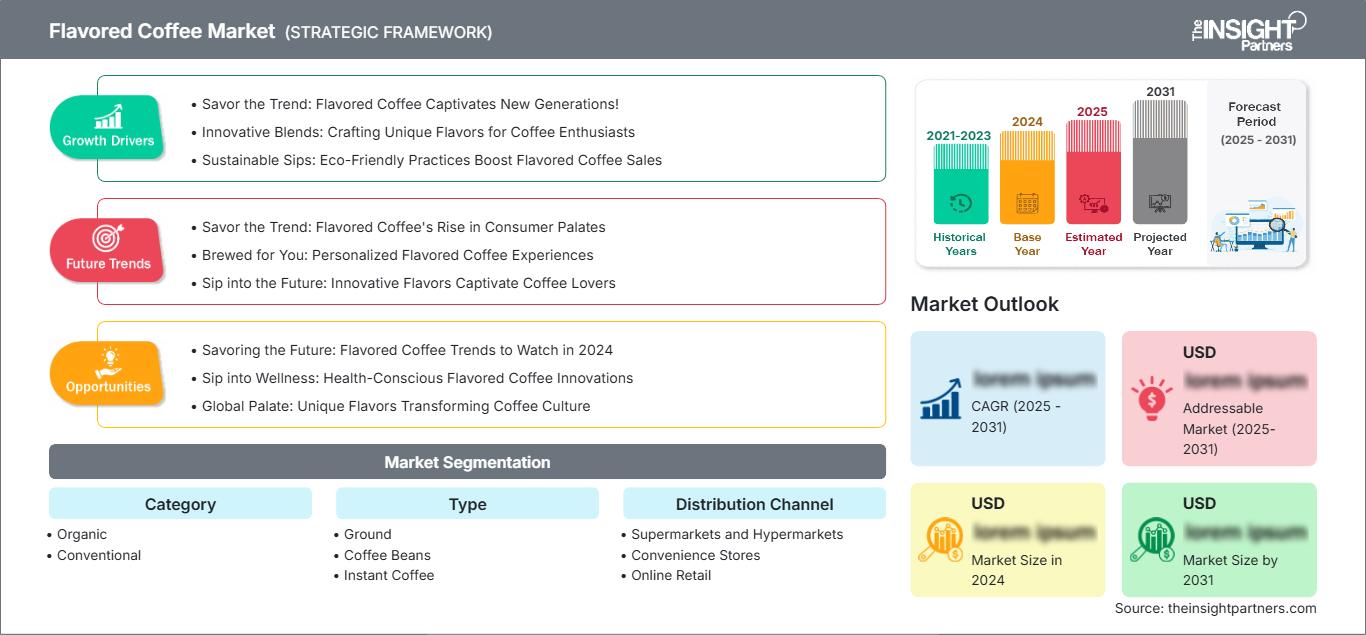
Flavored Coffee Market: Strategic Insights
Regional Insights
North America Flavored Coffee Market
In 2025, North America is expected to make up 34–38% of the global flavored coffee market, staying in the role of the largest regional market. This growth is due to high levels of per capita coffee consumption, a well-developed specialty coffee sector, and the widespread availability of premium flavored products. Ongoing demand for coffee that is ethically sourced, for clean-label formulations, and for seasonal flavor innovations is still pushing market expansion in both the retail and foodservice areas. The market is projected to achieve a compound annual growth rate (CAGR) of 7.5–8.3% between 2026 and 2034, a trend supported by the increasing number of café chains, the growth of subscription coffee services, and greater acceptance of convenient brewing systems.
In the United States and Canada, coffee drinking is firmly part of everyday routines, and this has led to the availability of premium flavor varieties such as vanilla, caramel, hazelnut, mocha, and those that vary with the season. Retailers are increasing the amount of shelf space given to specialty coffee, whilst digital platforms are helping artisanal brands to reach a wider market. Measures aimed at sustainability, for example, the use of recyclable packaging and certification by the Rainforest Alliance and Fairtrade International, help to build consumer confidence and improve the image of premium products in the area.
U.S. Flavored Coffee Market
In 2025, the United States is expected to make up about 78 to 82 percent of the North American flavored coffee market and will continue to be the main source of revenue. The market is anticipated to grow at a compound annual growth rate of 7.6 to 8.4 percent between 2026 and 2034, a trend caused by high levels of household coffee consumption, the strong presence of a specialty coffee culture, and the widespread use of single-serve brewing systems. Product launches by major companies such as Starbucks Corporation, Nestlé S.A., The J. M. Smucker Company, and The Kraft Heinz Company are helping to expand the range of products and improve retail distribution in supermarkets, convenience stores, and through digital commerce channels.
There is a growing demand for premium coffee flavors that include natural flavouring ingredients, organic coffee beans, and functional formulations. The growth of subscription services and the development of direct-to-consumer channels are allowing limited-edition flavors and customized product ranges to be launched. Foodservice providers are expanding their premium beverage menus in response to the increasing demand for high-value coffee experiences, thus contributing to continued market growth in both the residential and commercial areas.
Europe Flavored Coffee Market
Europe is expected to take up about 27 to 31% of the global flavored coffee market by 2025 and will reach a compound annual growth rate of 7.8 to 8.6% between 2026 and 2034. Germany holds the leading position in the region, thanks to its established coffee roasting industry, a wide retail infrastructure, and growing consumer demand for premium coffee products. The greater emphasis being placed on sustainable sourcing, organic coffee, and specialty roasting methods forms the basis for long-term development of the regional market.
Strong demand for premium flavored coffee is still being felt in the United Kingdom as café culture grows and consumers are increasingly preparing café-style drinks at home. The UK is seeing continued demand for premium flavored coffee because of the expansion of café culture and the greater number of people making café-style beverages at home. Growth in subscription coffee services, premium coffee pods, and online specialist retail channels is helping to increase the proportion of households using such products. Seasonal product launches also encourage customers to make repeat purchases. The ant retail distribution network plays a role in this. Consumers are now more likely to choose premium-flavored ground coffee and sustainably certified coffee products, which has led manufacturers to broaden their range of premium offerings and to invest in environmentally responsible packaging and traceability. In France, Italy, and Spain, regional demand is being driven by rising specialty coffee consumption and changing consumer preferences. Although espresso remains a popular tradition, younger consumers are adopting flavored coffee more frequently in order to enjoy premium beverage experiences, innovative flavor profiles, and convenient home-brewing options. The modernization of retail and the growth of café chains are also contributing to market growth in these countries.
APAC Flavored Coffee Market
The Asia Pacific region is expected to make up about 22–26% of the global flavored coffee market in 2025 and will achieve the highest regional compound annual growth rate between 2026 and 2034, ranging from 9.0% to 9.8%. In China, regional growth is being driven by fast-paced café development, greater spending by the middle class, and an increasing acceptance of premium coffee drinks. Japan still shows strong demand for high-quality packaged coffee products. Growth in this area is being supported by urbanization, the expansion of premium cafés, and higher consumer awareness of specialty coffee. Support from the government for the food processing industry, greater penetration of digital retail, and investments in domestic coffee processing capacity are all encouraging manufacturers to launch premium flavored products that are tailored to local consumer preferences.
Middle East & Africa Flavored Coffee Market
The coffee market for the Middle East and Africa is expected to grow at a compound annual growth rate of 8.4–9.1% between 2026 and 2034, thanks to the growing urban populations, the expansion of premium café chains, and higher disposable incomes. In the case of Saudi Arabia and the United Arab Emirates, the specialty coffee culture is developing in line with the growth of premium retail and demand in the foodservice sector caused by tourism.
Because of its well-developed retail infrastructure and the growing consumption of premium beverages, South Africa is ahead of the other countries in Sub-Saharan Africa. In the rest of the Middle East and Africa, there is potential for growth since international coffee chains are expanding their operations and consumer demand for premium coffee experiences is increasing. The investment being made in the hospitality sector, in commercial real estate, and in organized retail is helping to make flavored coffee products more widely available in the region.
Segmentation Analysis
Product Type
The product type segment includes Ground Coffee, Instant Coffee, and Coffee Pods and Capsules. This segment is expected to register a CAGR of 8.1–8.8% from 2026 to 2034, driven by increasing demand for convenience, premium quality, and varied brewing methods. Market expansion is supported by manufacturers introducing products for household, office, and foodservice use, alongside investments in sustainable packaging and advanced flavor development.
- Ground Coffee: Accounted for the largest product share in 2025 due to compatibility with multiple brewing systems, including drip coffee makers, French presses, pour-over systems, and espresso machines. Sustained demand is supported by broad retail availability and consumer preference for freshly brewed coffee.
- Instant Coffee: Maintains stable demand among consumers prioritizing convenience, affordability, and rapid preparation. Innovations in freeze-dried formulations and improved flavor retention are increasing acceptance in both mature and emerging markets.
- Coffee Pods and Capsules: Represent the fastest-growing product category, supported by increased adoption of single-serve brewing machines in households. Growth is driven by premium flavor options, portion control, and convenience, particularly among urban consumers and office settings.
Flavor Type
The flavor type segment comprises Vanilla, Hazelnut, Caramel, Pumpkin Spice, Peppermint, Cinnamon, Mocha, and Others. This segment is projected to achieve a CAGR of 8.4–9.1% from 2026 to 2034, reflecting increased demand for premium taste profiles and seasonal product innovation. Manufacturers are expanding flavor portfolios with natural ingredients and limited-edition offerings to enhance customer retention and differentiate brands.
- Vanilla: Remains one of the most widely consumed flavors for its balanced sweetness and compatibility with both hot and iced coffee. It enjoys consistent demand across supermarkets, cafés, and online retail platforms.
- Hazelnut: Continues attracting consumers seeking rich, nutty flavor profiles that complement premium Arabica blends. Its popularity across packaged coffee and single-serve pods supports strong long-term demand.
- Caramel: Benefits from rising consumer preference for indulgent coffee beverages aligned with café-inspired offerings. Manufacturers combine caramel with sea salt, chocolate, or vanilla to develop premium flavor variants.
- Pumpkin Spice: Experiences pronounced seasonal demand, particularly during autumn promotional campaigns. Limited-edition launches generate consumer excitement and encourage repeat purchases through retail and foodservice channels.
- Peppermint: Gains traction during holiday seasons as brands introduce festive coffee collections. Strong gifting demand and café promotions continue supporting seasonal sales performance.
- Cinnamon: Attracts consumers seeking warm spice profiles and natural flavors. This variety is increasingly used in premium ground coffee and capsule-based products.
- Mocha: Remains popular among consumers preferring chocolate-infused coffee beverages. Its broad acceptance across cafés and packaged retail products reinforces its strategic importance within premium flavored coffee portfolios.
- Others: The other segment includes a range of flavor blends, such as vanilla and mocha, vanilla and cinnamon, hazelnut and mocha, and many more such flavors.
Distribution Channel
The distribution channel segment includes Supermarkets and Hypermarkets, Specialty Stores, Online Retail, and Others. This segment is projected to grow at a CAGR of 8.5–9.2% from 2026 to 2034, supported by omnichannel retail strategies, increased e-commerce penetration, and rising demand for convenient purchasing. Retailers are expanding product assortments, and manufacturers are strengthening direct-to-consumer channels.
- Supermarkets and Hypermarkets: Generate the highest sales volumes due to broad product availability, competitive pricing, and frequent promotions. Extensive geographic presence ensures accessibility in urban and suburban markets.
- Specialty Stores: Attract consumers seeking premium coffee products, artisanal roasting, and expert guidance. These outlets support premium brand positioning and facilitate product trial through curated assortments.
- Online Retail: Is the fastest-growing distribution channel, driven by subscription services, digital marketing, home delivery, and increasing demand for personalized product selection and exclusive online launches.
Opportunity Snapshot
| Distribution Channel | Revenue Contribution | Trend Tag | Adoption Stage |
|---|---|---|---|
| Supermarkets and Hypermarkets | High | Premium Shelf | Mature |
| Specialty Stores | Medium | Craft Roasting | Scaling |
| Online Retail | High | Subscription Coffee | Scaling |
| Others | Low | Foodservice | Emerging |
Flavored Coffee Market Growth Drivers and Impact Analysis
Rising Consumer Demand for Premium and Indulgent Coffee Experiences
The demand for coffee with premium flavors is on the rise since consumers are looking for different taste profiles, specialty beans, and preparation methods similar to those found in cafés. In response to changing tastes, manufacturers are now offering more sophisticated flavors, including vanilla, caramel, hazelnut, mocha, cinnamon, and seasonal versions. This growth is also being driven by higher disposable incomes, the trend towards premium products, and the growing popularity of café culture. Spending on natural flavoring ingredients, recyclable packaging, and beans that are ethically sourced helps to strengthen the premium image, supports brand differentiation, and encourages customers to make repeat purchases in both the retail and foodservice sectors.
Expansion of Single-Serve Brewing Systems and Smart Home Consumption
The demand for convenient coffee pods and capsules is growing due to the increasing use of single-serve brewing systems. Since consumers value consistent flavor quality, portion control, and a short preparation time, this is leading to growth in both at-home and in-the-office environments. To meet sustainability requirements, manufacturers are broadening the range of products they offer and introducing recyclable capsules as well as biodegradable packaging. The rise in people working from home and the greater investment in smart kitchen appliances are also contributing to the demand for high-end home brewing solutions. Digital commerce platforms enable customers to access special flavors and subscription services, which in turn help with customer retention and long-term market expansion.
Innovation in Natural Ingredients and Sustainable Coffee Production
As consumers are becoming more concerned about health, transparency, and environmental sustainability, manufacturers are now reformulating their flavored coffee using natural flavor extracts, beans obtained in a responsible manner, and ingredients that carry a clean label. Sustainability certificates, the ability to trace the source of the beans, and environmentally responsible packaging are all having an effect on buying decisions all over the world. In order to boost the resilience of their supply chains, companies are entering into stronger partnerships with coffee farmers and making investments in regenerative agriculture. Progress in roasting and flavor infusion technologies helps to improve the quality of the coffee and reduce production waste. As a result, the brand's image is enhanced, customer loyalty is supported, and premium pricing strategies are made possible, which in turn improves long-term profitability.
Flavored Coffee Market Future Trends
Growth of Functional and Wellness-Oriented Coffee Products
There is a growing trend among manufacturers to include health-oriented ingredients in their flavored coffee recipes in order to align with changing consumer preferences. Products with added adaptogens, collagen, vitamins, protein, mushrooms, and botanical extracts are likely to be accepted more widely by consumers who are concerned about their health. On the other hand, formulations with natural flavorings, organic coffee beans, and lower-sugar ingredients are becoming an important way for companies to stand out. These developments constitute one of the most significant trends in the flavored coffee sector, allowing firms to satisfy consumers' wellness expectations while still offering high-quality tastes. Ongoing research into functional ingredients and personalized nutrition is expected to lead to the emergence of new premium product lines over the course of the forecast period.
Digital Personalization and AI-Enabled Consumer Engagement
Artificial intelligence, advanced analytics, and digital commerce platforms are changing the way flavored coffee brands communicate with their consumers. Nowadays, companies make use of purchasing data and insights into consumer behavior in order to offer personalized flavors, refine their subscription options, and enhance their inventory planning. Manufacturers can also use AI to spot new flavor combinations that are emerging from regional consumption trends. There is an expectation that the integration of loyalty schemes, mobile applications, and direct-to-consumer platforms will not only boost customer engagement but also shorten product development cycles. Since premium coffee brands are aiming to improve consumer retention and raise the lifetime value of their customers, these digital capabilities will become a key source of competitive advantage.
Flavored Coffee Market Opportunities
Expansion Across Emerging Coffee-Consuming Economies
The trend towards rapid urbanization, growing disposable incomes, and a greater adoption of Western tastes in food and drink offers promising prospects in the Asia Pacific region, in Latin America, and in the Middle East. Companies from abroad will be able to enhance their position by offering local flavor profiles, introducing affordable premium products, and running marketing campaigns that are specific to each region. There are also further distribution possibilities for premium flavored coffee products through the expansion of café chains and organized retail networks. Forecasts for the flavored coffee market show that manufacturers who invest in local production facilities, form strategic distribution partnerships, and make use of digital retail channels will be in a good position to take advantage of long-term growth opportunities while at the same time improving supply chain efficiency and cutting down on logistics costs.
Premiumization Through Sustainable and Specialty Coffee Portfolios
As consumers are increasingly willing to pay higher prices for coffee that is ethically sourced and environmentally responsible, it offers great possibilities for distinguishing products. In order to improve their competitive position, manufacturers should expand the range of organic coffee, which is Fairtrade certified, coffee certified by the Rainforest Alliance, and coffee with single origins and flavorings. Putting money into recyclable packaging, measures aimed at reducing its carbon footprint, and practices ensuring transparent sourcing will also boost the value of the brand. Businesses that integrate sustainability with innovation in terms of premium flavor, special edition collections, and personalized subscription services are likely to gain stronger customer loyalty and, at the same time, increase their market presence in both developed and developing economies.
Recent Developments
- In April 2026, Nestlé delivered steady results in the first quarter, with an organic growth of around 3.5%. Growth was driven by improving volumes across key categories, with Coffee and Snacks providing the strongest momentum.
- In April 2026, Keurig Dr. Pepper Inc. (KDP) and JDE Peet's N.V jointly announced that KDP had acquired 96.22% of the Shares of JDE Peet's in the Offer. The transaction marks a major milestone in the Company's strategic transformation and long-term growth agenda.
Frequently Asked Questions

- Comprehensive Market Sizing and Forecast Analysis
- Detailed Segmentation Analysis
- In-Depth Market Dynamics Assessment
- Regional and Country-Level Insights
- Competitive Landscape and Company Benchmarking
- Strategic Business Intelligence
Recent Reports
Testimonials

The Insight Partners provided valuable market intelligence that supported our global go-to-market strategy. Their team was professional, responsive, and attentive to our feedback, providing thoughtful analysis and helpful methodological clarifications throughout the project.
Junmo Kim Chief Financial Officer (CFO), Enertech Co., Ltd.
The Insight Partners' SCADA System Market report is comprehensive, with valuable insights on current trends and future forecasts. The team was highly professional, responsive, and supportive throughout. We are very satisfied and highly recommend their services.
RAN KEDEM Partner, Reali Technologies LTDs
I requested a report on a very specific software market and the team produced the report in a few days. The information was very relevant and well presented. I then requested some changes and additions to the report. The team was again very responsive and I got the final report in less than a week.
JEAN-HERVE JENN Chairman, Future Analytica
We worked with The Insight Partners for an important market study and forecast. They gave us clear insights into opportunities and risks, which helped shape our plans. Their research was easy to use and based on solid data. It helped us make smart, confident decisions. We highly recommend them.
PIYUSH NAGPAL Sr. Vice President, High Beam Global
The Insight Partners delivered insightful, well-structured market research with strong domain expertise. Their team was professional and responsive throughout. The user-friendly website made accessing industry reports seamless. We highly recommend them for reliable, high-quality research services
YUKIHIKO ADACHI CEO, Deep Blue, LLC.
This is the first time I have purchased a market report from The Insight Partners.While I was unsure at first, I visited their web site and felt more comfortable to take the risk and purchase a market report.I am completely satisfied with the quality of the report and customer service. I had several questions and comments with the initial report, but after a couple of dialogs over email with their analyst I believe I have a report that I can use as input to our strategic planning process.Thank you so much for taking the extra time and making this a positive experience.I will definitely recommend your service to others and you will be my first call when we need further market data.
JOHN SUZUKI President and Chief Executive Officer, Board Director, BK Technologies
I wish to appreciate your support and the professionalism you displayed in the course of attending to my request for information regarding to infectious disease IVD market in Nigeria. I appreciate your patience, your guidance, and the fact that you were willing to offer a discount, which eventually made it possible for us to close a deal. I look forward to engaging The Insight Partners in the future, all thanks to the impression you have created in me as a result of this first encounter.
DR CHIJIOKE ONYIA MANAGING DIRECTOR, PineCrest Healthcare Ltd.Reason to Buy
- Informed Decision-Making
- Understanding Market Dynamics
- Competitive Analysis
- Identifying Emerging Markets
- Customer Insights
- Market Forecasts
- Risk Mitigation
- Boosting Operational Efficiency
- Strategic Planning
- Investment Justification
- Tracking Industry Innovations
- Aligning with Regulatory Trends





 Get Free Sample for