
Flexible Paper Packaging Market Size, Share & Growth by 2034
Flexible Paper Packaging Market Size and Forecasts (2021 - 2034), Global and Regional Share, Trends, and Growth Opportunity Analysis Report Coverage : by Packaging Type (Pouches, Rollstock, Shrink Sleeves, Wraps); Printing Technology (Flexography, Rotogravure, Digital Printing); Application (Food and Beverages, Pharmaceuticals and Nutraceuticals, Cosmetics and Personal Care); and Geography (North America, Europe, Asia Pacific, and South and Central America)
- Status : Data Released
- Report Code : TIPRE00040535
- Category : Chemicals and Materials
- No. of Pages : 150
- Available Report Formats :


- Last update date : September 17, 2026


2025 Market Size
US$ 55.32 Bn
Base year value
2034 Forecast
US$ 91.87 Bn
Projected by 2034
CAGR 2026-2034
5.80 %
Growth rate
Addressable Market
US$ 667.03 Bn
(2026-2034)
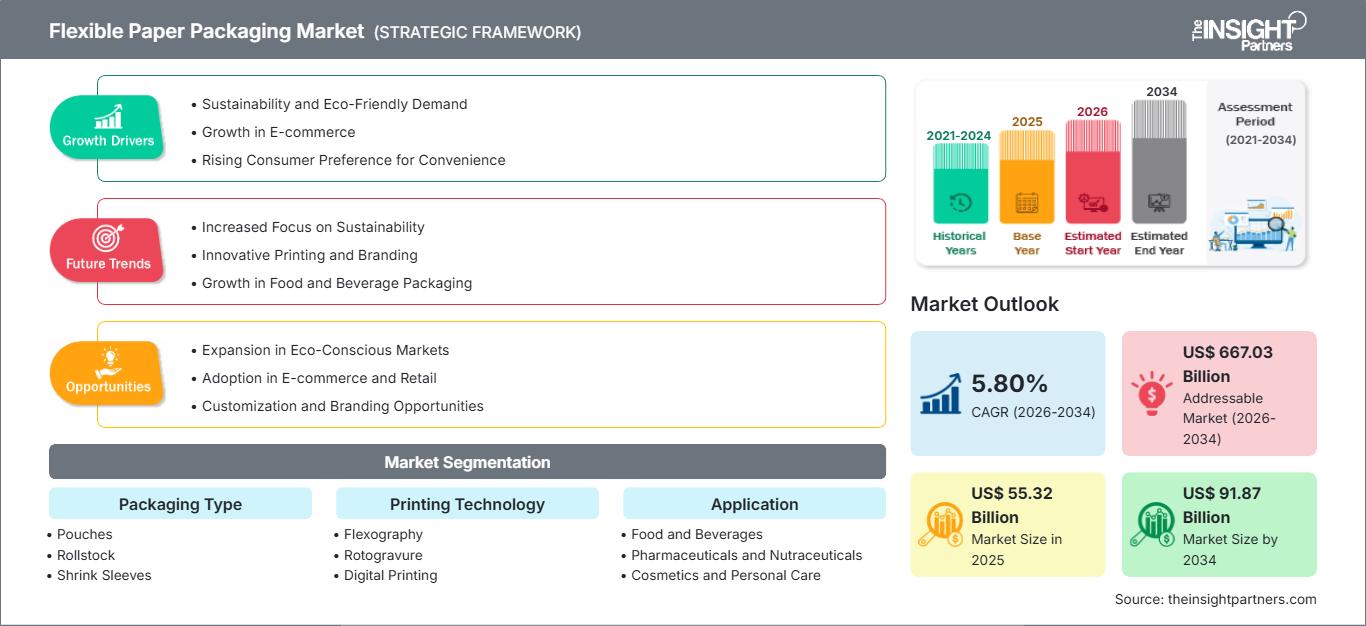
The Flexible Paper Packaging market is valued at US$ 55.32 Billion in 2025 and is projected to reach US$ 91.87 Billion by 2034, registering a CAGR of 5.80% during 2026–2034. Demand is driven by recyclable packaging, materials minimization, convenience, and substitution of traditional plastic-based formats. The Market comprises paper materials, converting, barrier coatings, printing, and special closure solutions used to meet needs for light weight packaging in consumer goods and healthcare sectors.
The North American Flexible Paper Packaging market size is forecast to retain its status as an important region with the modeled CAGR of 4.8–5.3% within 2026-2034. Growth drivers include retailers’ sustainable goals, investment in recyclable paper packaging, and need for convenient food formats. Pharmaceutical and nutraceutical packaging represents a reliable application base due to converters’ ability to provide moisture, oxygen, grease and heat seal barriers without losing paper recyclability.
Flexible Paper Packaging Market Assessment and Insights
- North America: North America is estimated to account for a 20–24% share in 2025 and grow at a CAGR of 4.8–5.3% between 2026–2034, supported by food packaging conversion, recyclable paper formats, and advanced barrier coating adoption.
- US: The US represents approximately 72–76% of North America's 2025 value, with a 4.7–5.2% CAGR through 2034, supported by food, healthcare, and private-label packaging demand.
- Europe: Europe holds an estimated 22–26% share in 2025 and is projected to grow at 5.0–5.5% CAGR through 2034. Germany, the UK, France, Italy, and Spain lead regional adoption through circularity policies and paper recycling infrastructure.
- Asia Pacific: Asia Pacific represents approximately 39–44% share in 2025 and is expected to record a 6.1–6.7% CAGR through 2034, led by China, India, Japan, and South Korea amid expanding packaged-food production and modernization of converting capacity.
- Largest Segment: Pouches represent an estimated 35–40% market share in 2025 and are projected to grow at a 5.9–6.4% CAGR through 2034, benefiting from convenience and material efficiency.
- High Growth Segment: Pharmaceuticals and Nutraceuticals account for approximately 13–17% in 2025 and are projected to expand at 6.2–6.8% CAGR through 2034 as paper barrier technologies improve.
- Key companies analyzed in detail: Amcor plc, Mondi plc, Sonoco Products Company, Sealed Air Corporation, Huhtamäki Oyj, Sappi Limited, DS Smith Plc, Coveris Management GmbH, Sabert Corporation, and Wihuri Oy.
Source: The Insight Partners' analysis based on proprietary research, government publications, company annual reports, investor presentations, industry databases, and expert interviews.
Package manufacturers are moving away from traditional paper laminations and towards engineered solutions that consist of fiber-filled substrates combined with coatings and printability. Advances in barrier technology now make it possible for paper to resist oxygen, moisture, grease, and heat sealing properties. In the conversion process, flexography and rotogravure printing are still crucial for high-volume runs, while digital printing enhances customized short runs.
The growth of the future market will depend more on regional recycling capabilities than on paper composition alone. Manufacturers are developing repulpability studies, dispersion coating, water-based inks, and mono-paper solutions which can go into existing recycling processes. Emerging markets in Asia offer capacity and volume potential, while European legislation continues to affect material reengineering. North American converters are also spending more on high-barrier papers used in snack, dry food, healthcare, and houseware packaging.
Flexible Paper Packaging Market Report Scope
| Report Attribute | Details |
|---|---|
| Market size in 2025 | US$ 55.32 Billion |
| Market Size by 2034 | US$ 91.87 Billion |
| Global CAGR (2026 - 2034) | 5.80% |
| Historical Data | 2021-2024 |
| Forecast period | 2026-2034 |
Flexible Paper Packaging Market Analysis
The development of the Flexible Paper Packaging Market is highly related to the needs of food manufacturers, retailers, pharma manufacturers, and consumer brands for more lightweight and sustainable packaging solutions. In terms of the value chain, it includes pulp and paper suppliers, coating suppliers, ink suppliers, adhesives suppliers, converters, printers, packaging machinery manufacturers, brand owners, and recyclers. Nowadays, suppliers that are able to offer their customers paper-based solutions along with production line-compatible solutions become more popular.
Food and beverages continue to be the main source of demand since pouches, roll stock, and wraps allow efficient use of materials, brand placement opportunities, and convenient opening systems. Pharmaceutical products and nutraceuticals need better control of moisture, oxygen, light, and contamination issues. At the same time, converters have to deal with fluctuating prices of pulp, energy, coatings, and transportation.
According to the Flexible Paper Packaging market report, it becomes more and more common that competitive positioning depends on commercializing recyclable structures in large volumes compared to just launching paper-based concepts. Amcor plc and Mondi plc have diverse product ranges including high barrier papers, pouches, and converted structures. Sonoco Products Company and Sealed Air Corporation have converting and food packaging experience, whereas Huhtamäki Oyj has expertise in flexible packaging along with wide geographic manufacturing footprint.
There is also growing interest in special paper grades, coatings, and converting technologies. Sappi Limited has paper and specialty substrates experience, whereas DS Smith Plc and Coveris Management GmbH have regional packaging solutions. Sabert Corporation and Wihuri Oy offer food service and packaging solutions in special formats. Partnerships with brands, coating companies, printing companies, and machine manufacturers will be more important for reducing commercialization time and recycling validation.
● REPORT CUSTOMIZATION
Tailor This Report To Align With Your Specific Business Requirements
This report can be customized to align precisely with your business objectives, scope, and target markets. Customization options include tailored segmentation, geography, competitive analysis, and strategic insights to support informed decision-making.
Customize This Report →WHAT YOU CAN ADJUST
- ● Segmentations
- ● Geography
- ● Competitive Analysis
- ● Language Preferences
Flexible Paper Packaging Market: Strategic Insights
Regional Insights
North America Flexible Paper Packaging Market
The North American region is expected to account for 20–24% of total revenue in 2025 and show a CAGR of 4.8–5.3% from 2026 to 2034. The US is seen as the primary regional market due to its extensive food-packaging industry, flexible converting presence, and increasing retailer demands for recyclable packaging solutions. Canada's contributions arise from food and beverage products, and consumer goods packaging, while regional converters focus on paper structures that can work on existing machines.
The reasons behind its use include premium snacks, dry foods, coffee, pet food, and nutraceutical applications in which paper packaging could be used to combine brand identity and functionality of the pouch. Development areas include aqueous coatings, heat-sealable papers, digital printing, and recyclable adhesives. The brand owners have started looking at the packaging in terms of its lifecycle performance, recyclability, and materials savings, thus creating opportunities for the suppliers.
U.S. Flexible Paper Packaging Market
The US market constitutes 72-76% of the North American Flexible Paper Packaging market share in 2025 and is forecasted to grow with a 4.7-5.2% CAGR till 2034. The presence of strong food manufacturing, the development of private label, e-commerce, and demand for healthcare packaging makes the customer base quite extensive. Amcor plc, Sonoco Products Company, Sealed Air Corporation, and Sabert Corporation have relevant capabilities in both flexible and food packaging applications.
Pouches and rollstock are being considered more for the packaging of snacks, dry drinks, coffee, bakery goods, supplements, and convenience foods. Recyclability of structures and packaging commitments made by retailers are other factors that influence the market. Machine suitability is being considered by converters since paper structures need to maintain the speed of filling and sealing along with structural integrity.
Europe Flexible Paper Packaging Market
Europe is estimated to contribute around 22-26% of global revenues in 2025 and grow at a CAGR of 5.0-5.5% through 2034. Europe is still considered as the hub of technology and regulation and countries such as Germany, UK, France, Italy, and Spain drive commercialization. The infrastructure for paper recycling and goals of circular packaging create an incentive to invest in fiber-enriched structures and recyclable barrier systems.
UK and Germany are seen as leaders in the adoption of these technologies in the areas of food, household, and industrial applications, while France and Italy represent promising regions for adoption in food, confectionary, coffee, and personal care applications. Spain is an important region for converting and manufacturing operations and is well served by investments made in flexible packaging facilities. Producers in Europe have been focusing on mono-paper structures, water-based coating, and packaging solutions that can be recycled within existing collection and recycling processes.
APAC Flexible Paper Packaging Market
APAC is forecasted to have 39-44% of total world revenue by 2025, and register a CAGR of 6.1-6.7% through 2034. China continues to be the largest country, driven by high capacity for food manufacturing and converting. Japan and South Korea focus on materials technology, printability, and barrier properties, while India gains from growth in packaged foods and modern distribution.
Innovations in packaging materials will benefit the area due to sustainability and owing to additions from India and China. Manufacturers in APAC are paying attention to automation in converting, printing at high speed, and coatings for recyclability. The environment policies related to plastic wastes and the growing consumer inclination towards convenient foods will be beneficial for paper packaging, provided it performs similarly.
Middle East & Africa Flexible Paper Packaging Market
The Middle East and Africa is a slightly smaller but growing opportunity, with Saudi Arabia, UAE, and South Africa being the main markets. Growth in the region is backed by food processing, imports of consumer goods, retail development, and packaging infrastructure. Industrial diversification and food-service systems are key drivers in Saudi Arabia and UAE.
South Africa holds the most developed converting base in the region, while the Rest of MEA offers opportunities related to urbanization and consumption of packaged foods. The region’s high-energy manufacturing sector requires efficiency in production processes; hence, investment in converting machinery and light structures is necessary. Growth is projected to be around 4.4% to 5.0% CAGR to 2034, with Saudi Arabia being a key growth market.
Segmentation Analysis
Packaging Type
Packaging Type is projected to expand at a 5.6–6.1% CAGR during 2026–2034. The segment encompasses flexible formats with different filling, sealing, transport, and merchandising characteristics. The Flexible Paper Packaging Market scope increasingly favors structures that balance paper content with barrier performance, machinability, and end-of-life compatibility.
- Pouches: Pouches hold the leading position because they support lightweight construction, convenient opening, resealing, strong shelf graphics, and efficient logistics across food, beverage, pharmaceutical, and personal-care applications.
- Rollstock: Rollstock remains strategically important for high-volume automated packaging because converters can optimize dimensions, sealing patterns, and material consumption for different filling equipment.
- Shrink Sleeves: Shrink sleeves provide high-impact graphics and full-surface branding, supporting applications where shelf differentiation, tamper evidence, and contour fitting influence packaging selection.
- Wraps: Wraps remain important for bakery, confectionery, foodservice, and consumer products where simple converting, printability, and efficient material utilization are prioritized.
Printing Technology
Printing Technology is forecast to grow at a 5.3–5.9% CAGR through 2034. Brand owners increasingly require high-quality graphics while converters seek lower waste, faster changeovers, and better registration. Technology selection depends strongly on production volume, substrate characteristics, ink chemistry, and sustainability requirements.
- Flexography: Flexography remains central to high-volume packaging because it combines productivity, broad substrate compatibility, and efficient repeat production for standardized food and consumer applications.
- Rotogravure: Rotogravure retains relevance for long production runs requiring detailed graphics, consistent color reproduction, and high-quality image performance across demanding branded packaging.
- Digital Printing: Digital Printing is gaining strategic importance for short runs, customized products, rapid artwork changes, regional versions, and variable-data packaging where conventional plate-based economics are less attractive.
Application
Application is projected to register a 5.7–6.2% CAGR through 2034. Food and beverages provide the broadest installed demand base, while healthcare-related applications offer higher-value opportunities as paper substrates gain improved barrier and sealing capabilities. The Flexible Paper Packaging Market scope is therefore expanding beyond basic wrapping into engineered structures.
- Food and Beverages: Food and beverages represent the principal demand center, covering snacks, bakery products, confectionery, coffee, dry foods, ready meals, and specialty products requiring protection and convenient handling.
- Pharmaceuticals and Nutraceuticals: Pharmaceuticals and nutraceuticals require controlled barrier properties, hygiene, traceability, and dependable sealing, making advanced paper structures increasingly relevant for secondary and selected primary packaging applications.
- Cosmetics and Personal Care: Cosmetics and personal care products use paper-based flexible formats for refill packs, sachets, sample packs, and secondary packaging where premium appearance and sustainability messaging influence purchasing decisions.
Opportunity Snapshot
| Application | Revenue Contribution | Trend Tag | Adoption Stage |
|---|---|---|---|
| Food and Beverages | High | Paper Pouches | Mature |
| Pharmaceuticals and Nutraceuticals | Medium | Barrier Papers | Scaling |
| Cosmetics and Personal Care | Medium | Refill Formats | Scaling |
Flexible Paper Packaging Market Growth Drivers and Impact Analysis
Expansion of recyclable and fiber-rich packaging structures
Recyclability is shifting buying considerations in packaging supply chains. The focus for brand owners is no longer simply on whether structures are made from renewable materials but on whether they can fit into existing recycling infrastructures. This means that converters should move away from using hard-to-recycle multilayer constructions and employ coatings, adhesives, and sealants that will work with paper recycling systems. The economic effect goes beyond the purchase of substrates since it takes a coordinated effort through the coating, printing, converting, testing, and recycling process to make successful structures. The suppliers who can prove that their products are repulpable yet retain their moisture and oxygen barrier properties will have an edge when it comes to working with customers.
Growth of convenient single-serve and resealable packaging
Consumer preference for portable, portion-controlled, and easy-to-use products is expanding the addressable role of flexible formats. Pouches and wraps can provide lower packaging weight and efficient product-to-package ratios compared with many rigid alternatives. Resealable closures, tear features, spouts, and shaped constructions further improve functionality. For manufacturers, these formats can reduce transportation volume and improve filling-line efficiency when appropriately engineered. Food, nutraceutical, coffee, confectionery, and personal-care brands are consequently testing paper-based structures where barrier requirements are technically manageable. The commercial effect is strongest when paper substrates can achieve sufficient stiffness, seal integrity, and print quality without requiring complex material combinations. Continued development of functional coatings should broaden the range of products that can transition from conventional flexible laminates.
Growth of premium packaged foods and specialized consumer products
Premiumization creates demand for packaging that combines strong visual presentation with functional protection. Specialty coffee, confectionery, organic foods, nutraceuticals, and personal-care products increasingly use packaging as part of brand positioning. Paper substrates offer tactile characteristics and natural visual cues that can differentiate products on crowded shelves. At the same time, converters must preserve barrier properties and graphics quality to prevent sustainability objectives from weakening product protection. This creates opportunities for high-performance coated papers, specialty inks, digital printing, and precision converting. Regional brands can also use shorter production runs to test packaging concepts before scaling them across broader markets. The resulting demand supports investment in flexible paper technologies capable of delivering premium aesthetics, functional performance, and repeatable manufacturing economics.
Flexible Paper Packaging Market Future Trends
Migration toward mono-paper and recyclable barrier architectures
The next phase of development is likely to focus on reducing material complexity while preserving the functional properties historically achieved through plastic and foil laminates. Paper producers and converters are developing coated structures with improved grease resistance, moisture protection, oxygen barriers, and heat-sealing behavior. Commercial success will depend on compatibility with regional recycling systems and on consistent performance through automated filling and distribution. Product developers are also expected to use more sophisticated coating chemistries to reduce fiber loss during recycling. This Flexible Paper Packaging market trend should create greater differentiation between basic paper packaging and engineered flexible paper solutions. Suppliers that can demonstrate repeatable barrier performance, recycling compatibility, and competitive converting speeds will be better positioned for long-term customer contracts.
Digitalized packaging production and shorter commercialization cycles
Digital printing, automated inspection, data-driven process control, and connected converting equipment are expected to reshape production economics. These technologies can reduce setup time and support frequent artwork changes, making them suitable for regional products, promotional campaigns, and emerging brands. Variable printing can also support serialized information, QR-enabled engagement, and market-specific regulatory content without requiring extensive plate inventories. For paper packaging producers, integration with digital workflow systems may improve production planning and reduce substrate waste. The Flexible Paper Packaging market trend should be particularly relevant for premium food, nutraceutical, cosmetics, and specialty applications where product variants are numerous. Over time, digitalization can complement rather than replace flexography and rotogravure by assigning each printing method to the production volumes and complexity it handles most efficiently.
Flexible Paper Packaging Market Opportunities
Development of high-barrier papers for sensitive products
Investment in high-barrier paper represents a significant opportunity because many products still require protection levels that conventional paper cannot provide. Coffee, powdered beverages, snacks, pharmaceuticals, and nutraceuticals need controlled exposure to oxygen, moisture, aroma, grease, or light. Developers can address these requirements through coatings, dispersion technologies, fiber engineering, and carefully designed seal layers. The most attractive commercial opportunity lies in structures that deliver barrier performance without preventing recovery through established paper recycling systems. Suppliers should prioritize applications where the technical gap between conventional flexible packaging and paper-based alternatives is narrow enough for rapid qualification. Partnerships among paper mills, coating companies, converters, machinery manufacturers, and brands can reduce development risk and accelerate market adoption.
Regional conversion capacity and localized sustainable packaging
Localized manufacturing in the Flexible Paper Packaging market forecast provides another investment opportunity as customers increasingly seek shorter supply chains, faster delivery, and packaging designed around regional recycling infrastructure. Asia Pacific offers scale advantages through expanding food production and modernizing converting facilities, while Europe provides opportunities for advanced recyclable structures. North America can support investment in specialty pouches, rollstock, and digitally printed formats for premium and private-label products. Investors should assess proximity to paper supply, coating materials, printing capacity, filling customers, and recycling networks when evaluating new facilities. Regional production can also reduce logistics exposure and improve response times for changing packaging regulations. Companies that combine local manufacturing with standardized global technology platforms can potentially serve multinational brands while adapting structures to individual market requirements.
Recent Developments
- August 2026: Sealed Air expanded its paper cushioning portfolio with the launch of the SEALED AIR ProPad Mini system, a compact solution designed for space-constrained fulfillment operations. The system supports custom-length paper pads, one-ply and two-ply fanfold paper, and speeds of 120 feet per minute or more, strengthening the company’s fiber-based protective packaging offering.
- April 2026: BASF announced a new development supporting advanced packaging solutions, reflecting its continued focus on material technologies that address performance, sustainability, and evolving packaging requirements. The initiative strengthens BASF’s position in developing material innovations for packaging applications and supports converters and brand owners seeking improved functionality and resource efficiency.
Frequently Asked Questions

- Comprehensive Market Sizing and Forecast Analysis
- Detailed Segmentation Analysis
- In-Depth Market Dynamics Assessment
- Regional and Country-Level Insights
- Competitive Landscape and Company Benchmarking
- Strategic Business Intelligence
Recent Reports
Testimonials

The Insight Partners provided valuable market intelligence that supported our global go-to-market strategy. Their team was professional, responsive, and attentive to our feedback, providing thoughtful analysis and helpful methodological clarifications throughout the project.
Junmo Kim Chief Financial Officer (CFO), Enertech Co., Ltd.
The Insight Partners' SCADA System Market report is comprehensive, with valuable insights on current trends and future forecasts. The team was highly professional, responsive, and supportive throughout. We are very satisfied and highly recommend their services.
RAN KEDEM Partner, Reali Technologies LTDs
I requested a report on a very specific software market and the team produced the report in a few days. The information was very relevant and well presented. I then requested some changes and additions to the report. The team was again very responsive and I got the final report in less than a week.
JEAN-HERVE JENN Chairman, Future Analytica
We worked with The Insight Partners for an important market study and forecast. They gave us clear insights into opportunities and risks, which helped shape our plans. Their research was easy to use and based on solid data. It helped us make smart, confident decisions. We highly recommend them.
PIYUSH NAGPAL Sr. Vice President, High Beam Global
The Insight Partners delivered insightful, well-structured market research with strong domain expertise. Their team was professional and responsive throughout. The user-friendly website made accessing industry reports seamless. We highly recommend them for reliable, high-quality research services
YUKIHIKO ADACHI CEO, Deep Blue, LLC.
This is the first time I have purchased a market report from The Insight Partners.While I was unsure at first, I visited their web site and felt more comfortable to take the risk and purchase a market report.I am completely satisfied with the quality of the report and customer service. I had several questions and comments with the initial report, but after a couple of dialogs over email with their analyst I believe I have a report that I can use as input to our strategic planning process.Thank you so much for taking the extra time and making this a positive experience.I will definitely recommend your service to others and you will be my first call when we need further market data.
JOHN SUZUKI President and Chief Executive Officer, Board Director, BK Technologies
I wish to appreciate your support and the professionalism you displayed in the course of attending to my request for information regarding to infectious disease IVD market in Nigeria. I appreciate your patience, your guidance, and the fact that you were willing to offer a discount, which eventually made it possible for us to close a deal. I look forward to engaging The Insight Partners in the future, all thanks to the impression you have created in me as a result of this first encounter.
DR CHIJIOKE ONYIA MANAGING DIRECTOR, PineCrest Healthcare Ltd.Reason to Buy
- Informed Decision-Making
- Understanding Market Dynamics
- Competitive Analysis
- Identifying Emerging Markets
- Customer Insights
- Market Forecasts
- Risk Mitigation
- Boosting Operational Efficiency
- Strategic Planning
- Investment Justification
- Tracking Industry Innovations
- Aligning with Regulatory Trends





 Get Free Sample for