
Flow Diverters Market Growth, Trends & Forecast by 2034
Coverage: By Device Type (Pipeline embolization device (PED), Silk flow diverter (SILK), Surpass flow diverter (SURPASS), FRED flow diverter, p64 flow diverter); End-User (Hospitals, Research Institute), and Geography (North America, Europe, Asia Pacific, and South and Central America)
- Status : Data Released
- Report Code : TIPRE00019717
- Category : Life Sciences
- No. of Pages : 150
- Available Report Formats :


- Last update date : November 25, 2026


2025 Market Size
US$ 1.39 Bn
Base year value
2034 Forecast
US$ 3.23 Bn
Projected by 2034
CAGR 2026-2034
9.82 %
Growth rate
Addressable Market
US$ 20.57 Bn
(2026-2034)
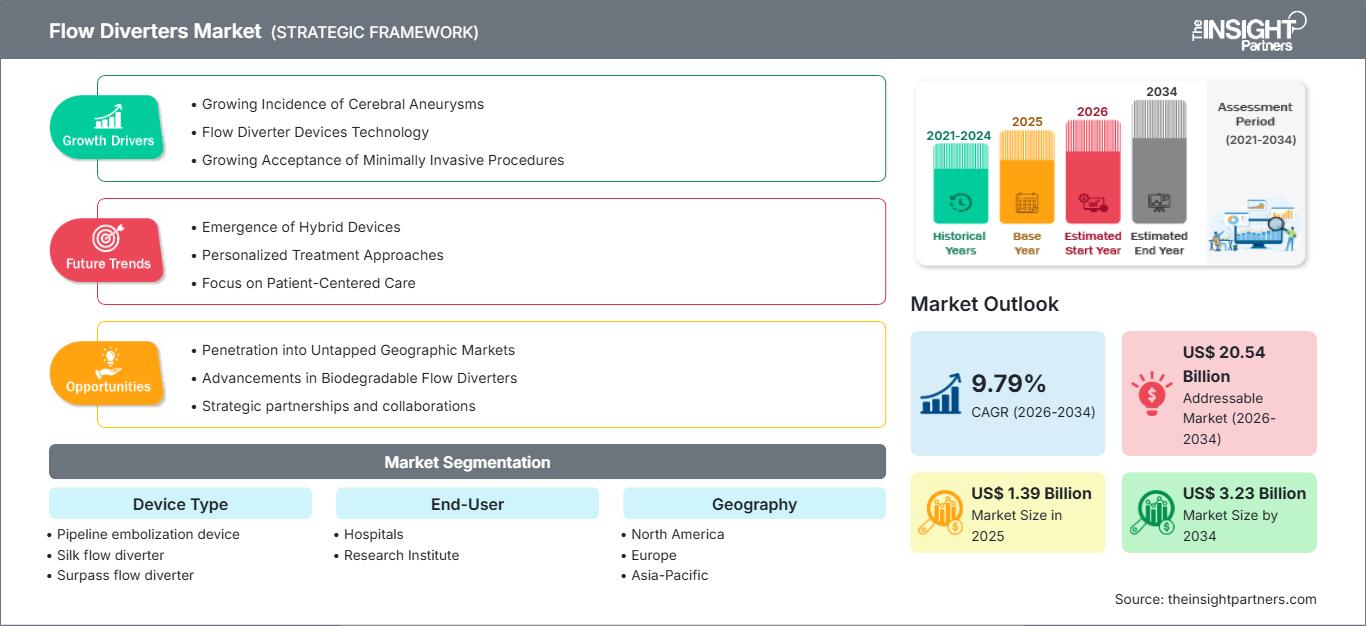
The Flow Diverters Market was valued at US$ 1.39 Billion in 2025 and is projected to reach US$ 3.23 Billion by 2034, expanding at a CAGR of 9.82% during 2026–2034. Growth is being supported by increasing diagnosis of intracranial aneurysms, wider adoption of minimally invasive neurovascular procedures, improving clinical evidence for flow diversion technologies, and ongoing innovation in stent design, deliverability, and thrombogenicity reduction. Expanding neurointerventional capabilities across developed and emerging healthcare systems continue to strengthen long-term demand.
Across North America, the market benefits from advanced neurovascular treatment infrastructure, a large base of specialized stroke and neuroscience centers, and favorable reimbursement support for endovascular interventions. The Flow Diverters Market size in the region continues to expand as hospitals increasingly adopt next-generation devices with enhanced safety profiles and improved deployment characteristics. North America is expected to record a ~9% CAGR through 2034, supported by strong clinical adoption and ongoing physician training in aneurysm management techniques.
Flow Diverters Market Assessment and Insights
Regional Outlook
- North America: ~41% of the global market in 2025 | ~9% CAGR through 2034. Market position: The region leads global revenue generation due to advanced neurovascular intervention infrastructure, broad physician acceptance of endovascular treatment, and high procedural volumes across specialized neurological centers.
- US: ~82% of North American market revenue in 2025 | ~9% CAGR through 2034. Market position: The United States dominates regional demand through extensive clinical expertise, strong innovation activity, favorable reimbursement structures, and early adoption of advanced intracranial aneurysm treatment technologies.
- Europe: ~29% of the global market in 2025 | ~9% CAGR through 2034. Market position: Europe remains a mature market supported by established neurovascular care pathways. Germany is the leading country in Europe, followed by France and the UK through strong hospital-based procedural activity.
- Asia Pacific: ~22% of the global market in 2025 | ~12% CAGR through 2034. Market position: Asia Pacific is the fastest-growing region, supported by expanding healthcare infrastructure, increasing neurointerventional capacity, and rising awareness of minimally invasive aneurysm therapies, particularly in China and Japan.
Segment Outlook
- Device Type: ~74% Share in 2025 | ~10% CAGR through 2034. Market position: Device innovation directly drives market value creation. Product performance, safety outcomes, deliverability, and physician familiarity collectively support category leadership across treatment centers globally.
- End-User: ~26% Share in 2025 | ~11% CAGR through 2034. Market position: Growth is supported by increasing procedural volumes in specialized healthcare facilities and wider utilization of advanced neurovascular technologies across institutional care settings.
Competitive Coverage
Medtronic plc, Stryker Corporation, MicroVention, Inc. (Terumo Corporation), Balt Extrusion SA, MicroPort Scientific Corporation, Penumbra, Inc., Phenox GmbH, Acandis GmbH, Wallaby Medical, InspireMD, Inc.
Methodology
The Insight Partners follows Data Collection & Secondary Research, Primary Research, Data Analysis, and Data Triangulation & Final Review to validate market estimates and insights.
Source: The Insight Partners' analysis based on proprietary research, government publications, company annual reports, investor presentations, industry databases, and expert interviews.
Advances in neurovascular intervention have transformed treatment approaches for complex intracranial aneurysms, creating favorable conditions for the Flow Diverters Market. Device evolution has focused on improving wall apposition, reducing thrombogenic risks, enhancing navigability through challenging vascular anatomy, and increasing long-term aneurysm occlusion rates. Manufacturers continue to invest in braid optimization, surface-modification technologies, and delivery systems that improve procedural efficiency while supporting better patient outcomes. These developments have strengthened physician confidence and expanded the range of aneurysms appropriate for flow diversion treatment.
Looking ahead, investment activity is expected to accelerate across Asia Pacific, Latin America, and selected Middle Eastern healthcare markets. Growing access to advanced imaging technologies, increasing specialist training programs, and supportive healthcare modernization policies are encouraging wider availability of neurovascular procedures. Regulatory acceptance of newer device generations and continued generation of clinical evidence are likely to strengthen adoption of Flow Diverters among hospitals seeking minimally invasive alternatives for complex aneurysm treatment.
Flow Diverters Market Report Scope
| Report Attribute | Details |
|---|---|
| Market size in 2025 | US$ 1.39 Billion |
| Market Size by 2034 | US$ 3.23 Billion |
| Global CAGR (2026 - 2034) | 9.82% |
| Historical Data | 2021-2024 |
| Forecast period | 2026-2034 |
Flow Diverters Market Analysis
The Flow Diverters Market growth is primarily supported by the increasing incidence of intracranial aneurysms, growing awareness of minimally invasive treatment options, and expanding availability of specialized neurointerventional services. Healthcare providers increasingly prefer flow diversion for selected complex, wide-necked, and large aneurysms because it offers durable aneurysm occlusion while reducing the need for more invasive surgical approaches.
The market ecosystem includes raw material suppliers, device manufacturers, research institutions, healthcare providers, and regulatory authorities. Improvements in manufacturing precision, biomaterial engineering, physician training, and clinical validation studies continue to strengthen supply dynamics. Companies are emphasizing product differentiation through enhanced deliverability, greater visibility, and lower thrombogenicity.
The Flow Diverters Market analysis indicates a competitive environment characterized by technological innovation, clinical evidence development, and geographic expansion strategies. Leading participants are increasingly focused on expanding regulatory approvals, strengthening physician education initiatives, and enhancing product portfolios through next-generation flow diversion technologies. Competitive dynamics remain centered on procedural outcomes, safety performance, and physician familiarity.
Strategic investment continues to support commercialization activities across both mature and emerging healthcare systems. Medtronic plc, Stryker Corporation, MicroVention, Inc. (Terumo Corporation), Penumbra, Inc., and phenox GmbH are actively strengthening neurovascular portfolios. Meanwhile, Balt Extrusion SA, MicroPort Scientific Corporation, Acandis GmbH, Wallaby Medical, and InspireMD, Inc. continue pursuing regional expansion and technology advancement strategies to improve market positioning.
● REPORT CUSTOMIZATION
Tailor This Report To Align With Your Specific Business Requirements
This report can be customized to align precisely with your business objectives, scope, and target markets. Customization options include tailored segmentation, geography, competitive analysis, and strategic insights to support informed decision-making.
Customize This Report →WHAT YOU CAN ADJUST
- ● Segmentations
- ● Geography
- ● Competitive Analysis
- ● Language Preferences
Flow Diverters Market: Strategic Insights
Regional Insights
North America Flow Diverters Market
North America accounted for ~41% of global revenue in 2025 and continues to represent the largest regional market. Advanced healthcare systems, widespread access to neurointerventional treatment facilities, and substantial investment in neurological care infrastructure support regional leadership. Clinical familiarity with flow diversion procedures remains high, particularly among specialized stroke centers and academic medical institutions.
The region is anticipated to grow at a CAGR of ~9% through 2034. Strong reimbursement frameworks, growing procedural confidence, and continued technological innovation contribute to market expansion. The region also accounts for a significant share of the global Flow Diverters Market, reflecting strong adoption of advanced endovascular treatment solutions.
U.S. Flow Diverters Market
The United States represented ~82% of North American revenue in 2025. Demand is supported by a large installed base of neurovascular specialists, substantial healthcare expenditure, and rapid access to advanced treatment technologies. Academic health systems continue to play a major role in evaluating and adopting next-generation flow diversion devices.
The U.S. Flow Diverters Market is expected to expand at a CAGR of ~9% through 2034. Device innovation, clinical research activity, and increasing treatment of complex aneurysm cases support growth. The presence of leading manufacturers and strong regulatory pathways further reinforces the country's position within the regional landscape.
Europe Flow Diverters Market
Europe accounted for ~29% of global revenue in 2025 and remains one of the most established regional markets. The region benefits from well-developed healthcare infrastructure, widespread access to endovascular procedures, and extensive physician experience in neurointerventional therapies. Clinical acceptance of flow diversion continues to strengthen as long-term outcome data accumulates across multiple treatment indications.
Germany is the leading country in Europe due to its advanced hospital infrastructure, strong neurovascular care network, and high procedural volumes. France and the United Kingdom also maintain important positions supported by specialist treatment centers and increasing utilization of minimally invasive aneurysm therapies. Italy and Spain continue expanding neurointerventional capacity through healthcare modernization initiatives.
Europe is projected to grow at a CAGR of ~9% through 2034. Rising aneurysm diagnosis rates, ongoing device innovation, and broader integration of flow diversion therapies into treatment guidelines for suitable patient populations support Flow Diverters Market Growth.
APAC Flow Diverters Market
Asia Pacific represented ~22% of global Flow Diverters Market revenue in 2025 and is expected to remain the fastest-growing regional market. Expanding healthcare access, increasing specialist training, and growing awareness of advanced aneurysm treatment methods are strengthening demand throughout the region.
China is the leading country in Asia Pacific due to its large patient base, expanding hospital infrastructure, and increasing investment in neurovascular care. Japan, South Korea, India, and Australia continue contributing to regional development. The market is expected to expand at a CAGR of ~12% through 2034.
Middle East & Africa Flow Diverters Market
The Middle East & Africa Flow Diverters Market is developing steadily as healthcare investments improve access to advanced neurological care. Regional adoption remains concentrated in major urban healthcare centers where neurointerventional expertise and modern imaging capabilities are available.
Saudi Arabia is the leading country in the Middle East & Africa region, supported by healthcare modernization initiatives and investment in specialized clinical services. The UAE, South Africa, and other regional markets continue expanding treatment capabilities. The region is projected to grow at a CAGR of ~10% through 2034.
Segmentation Analysis
Device Type
Device Type represents the core revenue-generating category within the Flow Diverters Market because therapeutic outcomes depend directly on device design, deployment efficiency, and long-term aneurysm occlusion performance. Continuous innovation in mesh density, surface-modification technologies, and delivery mechanisms is driving clinical adoption across neurovascular centers. Growing physician confidence, increasing treatment of complex aneurysms, and expansion of minimally invasive neurointerventional procedures support category expansion. Within the device portfolio, the Pipeline embolization device segment is expected to register a ~10% CAGR through 2034, driven by established clinical evidence and broad global adoption. The Flow Diverters Market scope continues to expand as advanced device technologies gain acceptance in newer treatment settings.
- Pipeline embolization device: Widely recognized across neurovascular treatment pathways due to extensive clinical validation, broad physician familiarity, and strong long-term aneurysm occlusion performance across complex intracranial aneurysm cases.
- Silk flow diverter: Gains adoption through flexibility and navigability characteristics that support delivery within challenging vascular anatomies while enabling minimally invasive aneurysm management approaches.
- Surpass flow diverter: Positioned for treatment of larger and complex aneurysms where procedural control, vessel reconstruction objectives, and physician preference influence product utilization decisions.
- FRED flow diverter: Benefits from dual-layer construction design that supports flow diversion while maintaining procedural precision, making it relevant for selected intracranial aneurysm treatment strategies.
- p64 flow diverter: Increasingly utilized in specialized neurointerventional centers because of retrievability and deployment flexibility that assist physicians during technically demanding procedures.
End-User
End-user demand is driven by procedural volume, specialist availability, treatment infrastructure, and access to advanced neurovascular technologies. Increasing awareness of minimally invasive aneurysm treatment options is encouraging healthcare facilities to expand neurointerventional capabilities. Clinical research, physician training activities, and patient outcome improvement initiatives continue to support investment in flow diversion therapies. Within this category, hospitals are projected to achieve a ~11% CAGR through 2034 as advanced neurovascular procedures become more widely available and treatment pathways continue to mature.
- Hospitals: Represent the primary treatment environment due to availability of neurointerventional specialists, advanced imaging systems, emergency care access, and comprehensive procedural support infrastructure.
- Research Institute: Supports clinical innovation, physician education, device evaluation, and evidence generation that contributes to broader acceptance of flow diversion technologies across healthcare systems.
Opportunity Snapshot
| End-User | Revenue Contribution | Trend Tag | Adoption Stage |
| Hospitals | High | Neurointervention Expansion | Mature |
| Research Institute | Low | Clinical Validation | Scaling |
Flow Diverters Market Growth Drivers and Impact Analysis
Rising Prevalence of Intracranial Aneurysms
The growing identification of intracranial aneurysms is creating sustained demand for advanced endovascular treatment technologies. Advances in diagnostic imaging, the growing prevalence of preventive neurological screening, and increased awareness of cerebrovascular disorders are among the factors driving rising detection rates. Flow diverters provide a minimally invasive treatment option for certain complex aneurysms that could otherwise pose significant challenges for other approaches. Health care professionals are increasingly seeking sustainable treatment outcomes while reducing the burden of treatment procedures, thereby enhancing the uptake of flow diverter technology. In parallel with the growing elderly population in key health care markets, there will be increasing occurrences of diseases linked to aneurysm development.
Expansion of Specialized Neurointerventional Centers
Healthcare providers worldwide continue investing in advanced neuroscience and stroke treatment facilities. An increase in neurointerventional facilities leads to an expansion of the pool of trained specialists capable of performing complex endovascular procedures. More catheterization labs, imaging equipment, and multidisciplinary neurological care teams enable faster use of flow diverters. Modernization initiatives are also underway in new healthcare markets, where greater attention is being paid to the management of neurological diseases. These factors aid the evolution of the process and offer prospects for implementation in both developed and developing areas. As the health care system seeks to improve clinical outcomes by simplifying the treatment process, technology becomes increasingly prevalent in practice.
Continuous Innovation in Flow Diversion Technology
Manufacturers are developing products with properties such as deliverability, visibility, improved braiding, and surface treatments that decrease the thrombogenicity of the procedure. These advancements have made the procedure more reliable and enabled the repair of more types of aneurysms. The regulatory clearance of more advanced iterations of these devices is fueling market growth and creating opportunities for differentiation among manufacturers. Research into innovations to improve permanent closure outcomes is reinforcing physician acceptance. Product innovations are motivating healthcare facilities to update their existing treatment capabilities, thereby fueling replacement demand.
Flow Diverters Market Future Trends
Next-Generation Surface Modification Technologies
Future development efforts are expected to focus on advanced surface coatings that reduce thromboembolic complications while maintaining therapeutic effectiveness. The Flow Diverters Market trends suggest that increasing attention is being paid to medical devices that offer enhanced biocompatibility without compromising the efficacy of vascular reconstructions. Companies are focusing on developing novel materials to reduce dependence on antiplatelet therapy and enhance procedural safety. These technologies may influence physicians' choices based on accumulated data. Surface engineering advancements will certainly change approaches to differentiation until 2034.
Expansion of Treatment Eligibility Criteria
Ongoing clinical studies are improving understanding of flow diversion applications beyond traditional treatment scenarios. Data on applicability in patients with increasingly complex aneurysm anatomy and a broader patient base may help increase the volume of procedures performed in the coming years. It is anticipated that flow diversion devices will be included in the evolving guidelines by health care professionals, as evidence of their long-term outcomes grows. This may increase their uptake in both current and developing health care delivery systems. With growing experience and improved device performance, a wider range of patients may become eligible for treatment.
Flow Diverters Market Opportunities
Emerging Asia-Pacific Neurovascular Infrastructure Investments
Rapid healthcare modernization across Asia Pacific is creating new opportunities for device manufacturers, distributors, and healthcare providers. Governments and private companies are also increasing investment in care centers, advanced imaging modalities, and training for neuroscience specialists. Increasing awareness about minimally invasive aneurysm treatments also adds to this trend. Firms setting up local partnerships, training programs, and distributions would gain an increase in procedure volume. The growing number of patients in the region creates good opportunities for market participation. These factors position Asia Pacific as a key destination for strategic growth initiatives and Flow Diverters Market Forecasts over the coming decade.
Advancement of Clinical Research Collaborations
Partnerships between hospitals, academic institutions, and device manufacturers present meaningful opportunities to enhance market development. Clinical research programs support evidence generation, treatment improvement, and physician training while helping build confidence in new technology. Organizations that can demonstrate superior results in the clinical domain may secure stronger positions and achieve faster regulatory growth. Increased investment in multicenter trials and RWE (Real-World Evidence) programs can also facilitate wider implementation of healthcare solutions. With the growing focus on outcome-based healthcare delivery, collaborative innovation programs will become increasingly important to commercial success.
Frequently Asked Questions

- Comprehensive Market Sizing and Forecast Analysis
- Detailed Segmentation Analysis
- In-Depth Market Dynamics Assessment
- Regional and Country-Level Insights
- Competitive Landscape and Company Benchmarking
- Strategic Business Intelligence
Recent Reports
Testimonials

The Insight Partners provided valuable market intelligence that supported our global go-to-market strategy. Their team was professional, responsive, and attentive to our feedback, providing thoughtful analysis and helpful methodological clarifications throughout the project.
Junmo Kim Chief Financial Officer (CFO), Enertech Co., Ltd.
The Insight Partners' SCADA System Market report is comprehensive, with valuable insights on current trends and future forecasts. The team was highly professional, responsive, and supportive throughout. We are very satisfied and highly recommend their services.
RAN KEDEM Partner, Reali Technologies LTDs
I requested a report on a very specific software market and the team produced the report in a few days. The information was very relevant and well presented. I then requested some changes and additions to the report. The team was again very responsive and I got the final report in less than a week.
JEAN-HERVE JENN Chairman, Future Analytica
We worked with The Insight Partners for an important market study and forecast. They gave us clear insights into opportunities and risks, which helped shape our plans. Their research was easy to use and based on solid data. It helped us make smart, confident decisions. We highly recommend them.
PIYUSH NAGPAL Sr. Vice President, High Beam Global
The Insight Partners delivered insightful, well-structured market research with strong domain expertise. Their team was professional and responsive throughout. The user-friendly website made accessing industry reports seamless. We highly recommend them for reliable, high-quality research services
YUKIHIKO ADACHI CEO, Deep Blue, LLC.
This is the first time I have purchased a market report from The Insight Partners.While I was unsure at first, I visited their web site and felt more comfortable to take the risk and purchase a market report.I am completely satisfied with the quality of the report and customer service. I had several questions and comments with the initial report, but after a couple of dialogs over email with their analyst I believe I have a report that I can use as input to our strategic planning process.Thank you so much for taking the extra time and making this a positive experience.I will definitely recommend your service to others and you will be my first call when we need further market data.
JOHN SUZUKI President and Chief Executive Officer, Board Director, BK Technologies
I wish to appreciate your support and the professionalism you displayed in the course of attending to my request for information regarding to infectious disease IVD market in Nigeria. I appreciate your patience, your guidance, and the fact that you were willing to offer a discount, which eventually made it possible for us to close a deal. I look forward to engaging The Insight Partners in the future, all thanks to the impression you have created in me as a result of this first encounter.
DR CHIJIOKE ONYIA MANAGING DIRECTOR, PineCrest Healthcare Ltd.Reason to Buy
- Informed Decision-Making
- Understanding Market Dynamics
- Competitive Analysis
- Identifying Emerging Markets
- Customer Insights
- Market Forecasts
- Risk Mitigation
- Boosting Operational Efficiency
- Strategic Planning
- Investment Justification
- Tracking Industry Innovations
- Aligning with Regulatory Trends





 Get Free Sample for