
Geocells Market Trends, Share & Demand by 2034
Coverage: By Raw Material (High-density Polyethylene (HDPE), Polypropylene (PP), Others); Design Type (Perforated, Non-Perforated); Application (Load Support, Channel and Slope Protection, Retention of Walls, Others), and Geography (North America, Europe, Asia Pacific, and South and Central America)
- Status : Data Released
- Report Code : TIPRE00014559
- Category : Chemicals and Materials
- No. of Pages : 150
- Available Report Formats :


- Last update date : July 15, 2026


2025 Market Size
US$ 724.54 Mn
Base year value
2034 Forecast
US$ 1,667.98 Mn
Projected by 2034
CAGR 2026-2034
9.71 %
Growth rate
Addressable Market
US$ 10,663.40 Mn
(2026-2034)
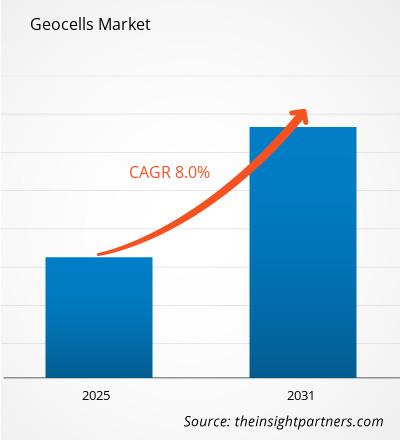
The geocells market was valued at US$ 724.54 million in 2025 and is projected to reach US$ 1,667.98 million by 2034, registering a CAGR of 9.71% during 2026–2034. Demand continues to strengthen as transportation agencies, mining operators, and infrastructure developers adopt cellular confinement systems to improve soil stabilization, load distribution, and erosion control. Growing investments in resilient civil infrastructure and sustainable construction practices are expected to reinforce long-term adoption across both developed and emerging economies.
Across North America, transportation modernization programs, slope stabilization initiatives, and stricter erosion-control regulations continue to support product adoption. The geocells market size is expanding steadily as highway rehabilitation, rail infrastructure upgrades, and energy corridor developments require durable ground reinforcement solutions. The regional market is anticipated to register a CAGR in the range of 8.3–9.0% during the forecast period, supported by advanced geosynthetics manufacturing capabilities and increasing public infrastructure expenditure.
Geocells Market Assessment and Insights
- North America: North America accounted for 32–36% share in 2025 and is projected to grow at a CAGR of 8.3–9.0% during 2026–2034. Highway rehabilitation, airport expansion, mining projects, and stringent environmental regulations continue to accelerate demand for advanced soil confinement systems.
- U.S.: The U.S. represented 76–80% of the North American market in 2025 and is anticipated to expand at a CAGR of 8.4–9.1% during 2026–2034, supported by transportation infrastructure investments and erosion mitigation requirements.
- Europe: Europe held 24–28% geocells market share in 2025 and is forecast to register a CAGR of 8.7–9.4% during 2026–2034. Germany, the UK, and France remain leading contributors owing to transport modernization and sustainable infrastructure initiatives.
- Asia Pacific: Asia Pacific captured 28–32% share in 2025 and is expected to record the fastest regional expansion with a CAGR of 10.6–11.4% during 2026–2034. China, India, Japan, and South Korea continue investing heavily in transportation, mining, and industrial infrastructure.
- Largest Segment: High-Density Polyethylene (HDPE) represented 64–68% market share in 2025 and is projected to expand at a CAGR of 9.2–9.8% during 2026–2034, supported by superior durability, chemical resistance, and long service life.
- High Growth Segment: Building and Construction accounted for 40–44% geocells market share in 2025 and is anticipated to grow at a CAGR of 10.2–10.9% during 2026–2034, driven by expanding transportation and urban infrastructure investments.
- Key companies analyzed in detail: BOSTD Geosynthetics (Qingdao) Co., Ltd., Flexituff Ventures International Limited, Geo Products, LLC, HUESKER Synthetic GmbH, Maccaferri S.p.A., Presto Geosystems, PRS Geo-Technologies Ltd., Strata Systems, Inc., Terram Geosynthetics Ltd., and TenCate Geosynthetics Asia Sdn. Bhd.
Source: The Insight Partners' analysis based on proprietary research, government publications, company annual reports, investor presentations, industry databases, and expert interviews.
With the development of geocell technology, it has become much more than a solution that can be used for specialized slope protection purposes. Manufacturers continue to develop polymer material, welding techniques and cell geometry to increase efficiency and simplify installation processes. Growing importance of lifetime performance, sustainability and climatic adaptability results in wider implementation of geocells in highway construction, railways, retaining walls, mining haul roads and erosion control systems. Such improvements have a positive effect on manufacturing and global distribution network as well as reliability of the products.
It should be noted that further development of infrastructure in Asia Pacific, Middle East and Latin America will provide favorable conditions for investments in production and engineering services. Governments give preference to transportation corridors which are capable of withstanding possible environmental influences and construction process carried out according to sustainable principles. Innovation in polymer recyclable materials, software tools and customized project designs are likely to increase efficiency of the process.
Geocells Market Report Scope
| Report Attribute | Details |
|---|---|
| Market size in 2025 | US$ 724.54 Million |
| Market Size by 2034 | US$ 1,667.98 Million |
| Global CAGR (2026 - 2034) | 9.71% |
| Historical Data | 2021-2024 |
| Forecast period | 2026-2034 |
Geocells Market Analysis
Growing investments in transportation infrastructure, erosion control, and sustainable civil engineering solutions remain the primary drivers supporting geocells market growth worldwide. The effectiveness of cellular confinement systems in enhancing soil bearing capacities, reducing aggregate usage, and decreasing maintenance costs in highways, railways, ports, industrial sites, and embankments is notable. The rise in the occurrence of weather patterns because of climate change has increased the need for innovative methods of stabilizing slopes to prevent soil displacement and deterioration of infrastructure. On the other hand, there is continued emphasis on resilient building materials that have reduced environmental impacts and enhance infrastructure longevity.
Suppliers of raw materials, producers of polymers, producers of geocells, engineering companies, contractors, and infrastructure owners make up the industry value chain. There is continued dominance of high-density polyethylene and polypropylene based on their mechanical properties and environmental durability. Automation of manufacturing processes and customization of engineering solutions make it possible for raw materials suppliers to provide solutions for different infrastructure construction projects.
Increasingly, competitive pressure is rising because of the capacity expansions, regional delivery channels, and specialized application product ranges that current producers offer. As per the geocells market analysis, innovation, consultancy services, and engineering collaborations are becoming more relevant for purchase decisions instead of price alone. Organizations with proven performance and cost benefits will increasingly gain competitive advantage within global infrastructure projects.
Key players such as BOSTD Geosynthetics (Qingdao) Co., Ltd., Flexituff Ventures International Limited, HUESKER Synthetic GmbH, Maccaferri S.p.A., Presto Geosystems, PRS Geo-Technologies Ltd., Strata Systems, Inc., Geo Products, LLC, Terram Geosynthetics Ltd., and TenCate Geosynthetics Asia Sdn. Bhd. are increasingly focusing on product innovation, technical support services, local manufacturing facilities, and collaboration with engineering contractors. This improves the efficiency of the project implementation process and customer interaction in areas like transportation, mining, environmental protection, and industry infrastructure projects.
● REPORT CUSTOMIZATION
Tailor This Report To Align With Your Specific Business Requirements
This report can be customized to align precisely with your business objectives, scope, and target markets. Customization options include tailored segmentation, geography, competitive analysis, and strategic insights to support informed decision-making.
Customize This Report →WHAT YOU CAN ADJUST
- ● Segmentations
- ● Geography
- ● Competitive Analysis
- ● Language Preferences
Geocells Market: Strategic Insights
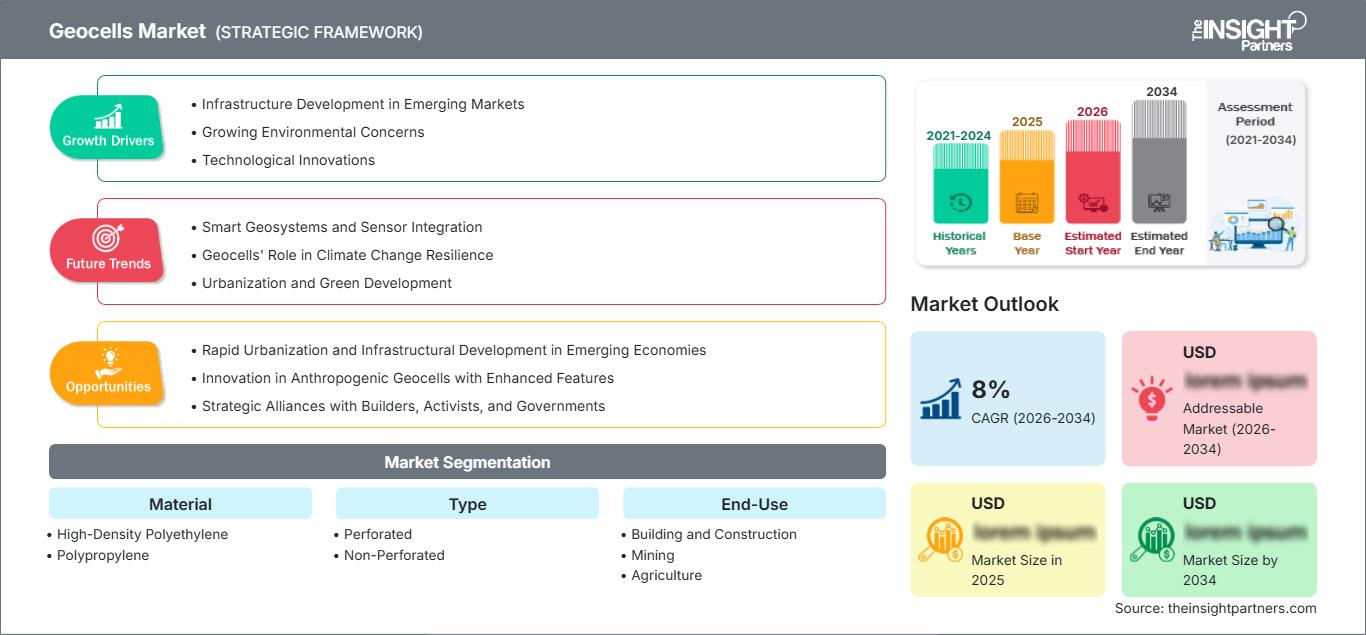
Regional Insights
North America Geocells Market
North America held a market share of 32-36% in 2025 and is expected to grow at a CAGR of 8.3-9.0% through 2026-2034. North America continues to witness growth in the development of transportation, erosion control, and climate-resistant infrastructure. Projects related to highway repair, airport runway development, rail infrastructure development, and flood mitigation efforts have been boosting the demand for cellular confinement systems in North America. The geocells market shares are notable due to strong engineering standards, prevalent use of geosynthetics, and favorable government spending on public infrastructure.
Increasingly, public organizations prioritize reducing lifecycle costs and sustainable infrastructure construction practices, and thereby encourage geocell usage in subgrade stabilization and pavement reinforcement. Geocells are used in Canada and the United States in mining operations for improving haul roads performance and minimizing aggregate usage. Growing spending on renewable energy infrastructure, utility corridors, and stormwater management infrastructure is anticipated to create opportunities for suppliers in the coming years.
U.S. Geocells Market
North America has been dominated by the U.S., which accounted for 76%–80% of the market in 2025 and is predicted to achieve a CAGR of 8.4%–9.1% from 2026 to 2034. The federal budget for infrastructure development, highway renewal projects, and airport renovation projects are contributing to the increasing demand for innovative ground stabilization technologies. Widespread usage in road base stabilization, erosion control, and retaining structures has made the U.S. the leading market in the region for geocells.
Major players have set up technical service centers and marketing networks in the nation, allowing for prompt project completion and engineering services. Further expansion is facilitated by rising applications in industries, logistics parks, renewable energy projects, and mining projects. Engineering companies are specifying geocell systems for their role in improving pavement durability and reducing maintenance costs.
Europe Geocells Market
Market share of Europe stood at 24–28% in 2025 and the region is expected to have a CAGR of 8.7–9.4% between 2026 and 2034. Germany is the key regional market owing to the presence of well-developed transportation network, industrialization, and advanced geosynthetic technology. Investments by the government in sustainable transport systems, railway and climate adaptive projects have been increasing the demand for geosynthetic ground reinforcement systems.
The UK has seen a gradual acceptance of geocells in road infrastructure projects, coastal defense projects, and flood protection measures. Asset managers are increasingly focusing on installing low maintenance ground reinforcement systems.
Together, France, Italy, and Spain account for a large amount of regional consumption via improvements in transportation, erosion control, and renewable energy. Increasing regulations in the environment favor engineered geosynthetics that help reduce excavation volume and increase efficiency of resources. These remain some of the key factors that will aid in regional growth during the forecast period.
APAC Geocells Market
Asia Pacific captured 28–32% of the global market in 2025 and is anticipated to record the fastest regional expansion with a CAGR of 10.6–11.4% during 2026–2034. China leads regional demand, followed by India, Japan, South Korea, and Australia, supported by large-scale investments in transportation, mining, and industrial infrastructure.
Rapid urbanization, expanding expressway networks, railway construction, and government infrastructure initiatives continue to accelerate adoption. Growing awareness of cost-effective soil stabilization technologies and increasing domestic manufacturing capacity are expected to strengthen regional competitiveness during the forecast period.
Middle East & Africa Geocells Market
Growth is expected in the Middle East & Africa market at a CAGR of 8.8–9.5% between 2026 and 2034. The market in Saudi Arabia is the largest, owing to development of megaprojects, development of transport infrastructure, and large investments in industrial sectors.
In the UAE, modern geosynthetics continue to be used for coastal protection and infrastructural construction projects. South Africa is expected to experience stable demand from mining industries and transportation projects, while the Rest of MEA region would see growing investments into development of roads and water management infrastructure projects.
Segmentation Analysis
Material
The Material segment is projected to register a CAGR of 9.3–9.9% during 2026–2034. Material selection significantly influences mechanical performance, durability, and lifecycle cost. The geocells market scope continues expanding as manufacturers introduce advanced polymer formulations that improve chemical resistance, UV stability, and long-term structural performance under demanding environmental conditions. Growing infrastructure investments and increased focus on sustainable construction practices are expected to sustain demand across both material categories.
- High-Density Polyethylene (HDPE): HDPE remains the preferred material for most infrastructure applications because of its excellent flexibility, chemical resistance, durability, and proven performance in transportation, mining, erosion control, and heavy-load stabilization projects.
- Polypropylene: Polypropylene geocells are increasingly adopted where higher stiffness, lightweight construction, and enhanced thermal resistance are required. They provide reliable performance across industrial, agricultural, and specialized civil engineering applications requiring efficient ground reinforcement.
Type
The Type segment is anticipated to grow at a CAGR of 9.5–10.1% during 2026–2034. Product selection depends on drainage requirements, soil characteristics, load-bearing conditions, and project specifications. Continuous improvements in manufacturing precision and welding technology enable suppliers to develop application-specific geocells that improve installation efficiency and structural performance.
- Perforated: Perforated geocells facilitate drainage, improve soil interaction, and enhance root penetration, making them suitable for slope stabilization, erosion control, landscaping, and environmentally sensitive infrastructure applications requiring natural vegetation growth.
- Non-Perforated: Non-perforated geocells provide greater confinement where water permeability is not essential. They are widely utilized in retaining structures, industrial platforms, heavy-duty pavements, and applications requiring maximum structural reinforcement and containment.
End-Use
The End-Use segment is forecast to record a CAGR of 9.8–10.5% during 2026–2034. Expanding infrastructure investments, mining activities, agricultural modernization, and energy sector development continue driving demand across diverse end-use industries. Application-specific engineering solutions enable geocells to improve soil stability, reduce maintenance costs, and extend infrastructure service life under varying environmental conditions.
- Building and Construction: This segment represents the largest application area due to extensive use in road construction, railways, embankments, retaining walls, foundations, and urban infrastructure requiring improved load distribution and long-term soil stabilization.
- Mining: Mining companies increasingly deploy geocells for haul roads, working platforms, slope stabilization, and erosion control to improve operational efficiency while reducing aggregate consumption and maintenance frequency.
- Agriculture: Agricultural applications continue expanding through canal protection, rural road stabilization, irrigation infrastructure, and soil conservation projects that improve land productivity while minimizing erosion and water loss.
- Oil and Gas: The oil and gas industry utilizes geocells to reinforce access roads, pipeline corridors, drilling platforms, and temporary construction areas operating under challenging ground conditions while minimizing environmental disturbance.
Opportunity Snapshot
| End-Use | Revenue Contribution | Trend Tag | Adoption Stage |
| Building and Construction | High | Highway Reinforcement | Mature |
| Mining | Medium | Haul Roads | Scaling |
| Agriculture | Medium | Soil Conservation | Scaling |
| Oil and Gas | Low | Pipeline Access | Emerging |
Geocells Market Growth Drivers and Impact Analysis
Expansion of Transportation Infrastructure Investments
The advancement of transportation infrastructure remains one of the most potent drivers for the geocell market on a global scale. Countries are making huge investments in highway reconstruction, rail improvement, airport expansion, and bridge building to increase connectivity and efficiency. Geocells help in distributing the load efficiently and reduce the usage of aggregates in pavements. This makes the geocell an ideal choice for infrastructure owners looking for reduced lifetime costs. The technology reduces the time required for construction and provides enhanced strength in weak subgrades. With more focus from governments towards the development of infrastructure that can stand up to heavy traffic loads and extreme weather conditions, geocells are being utilized in an increasing number of transportation applications by engineering contractors.
Growing Adoption of Sustainable Soil Stabilization Technologies
The trend in terms of environmental regulations and sustainability is making the project developers opt for construction methods that will help them conserve resources while ensuring that there is good performance from the infrastructure. The geocells help in minimizing the amount of aggregates and excavation that is needed, hence minimizing the transport emissions as well. Being able to stabilize difficult ground while still preserving the natural landscape helps in meeting the objectives of sustainable infrastructure development that have been set out by both government and engineering bodies. There is an increased demand for erosion control programs, riverbanks protection projects, and climate change adaptation.
Rising Mining and Industrial Infrastructure Development
Mining organizations are increasingly focusing on effective ground stabilizing solutions for better haul road longevity, stability of working platforms, and safety of operations. Geocells decrease maintenance needs, increase mobility of vehicles, and prolong service life of mining-related infrastructure under heavy loads. The same benefits are motivating usage of geocells in logistics centers, industry, renewable energy sites, and energy infrastructure projects. Growth of mining operations combined with investments in industrial corridors and energy infrastructure is ensuring steady demand for top-notch ground stabilizing solutions. Companies able to offer custom engineering services and specialized product design will stand to gain from rising complexity of infrastructure and demanding project performance standards.
Geocells Market Future Trends
Integration of Digital Engineering and Performance-Based Design
Digital engineering tools are increasingly transforming the specification and implementation of geocell systems across complex civil engineering projects. The geocells market trends indicate growing use of Building Information Modeling, digital terrain analysis, finite element simulation, and performance-based design methodologies to optimize geocell selection and installation. Engineering consultants increasingly rely on predictive modeling to evaluate long-term structural behavior under varying environmental and traffic conditions. These technologies improve design accuracy, reduce construction risks, and enable infrastructure owners to optimize lifecycle costs. As digital project delivery becomes standard practice across global infrastructure development, manufacturers offering advanced engineering support and digital design capabilities are expected to strengthen their competitive position.
Development of Advanced Polymer and Circular Material Solutions
Advanced polymer technology is receiving more investment from manufacturers in an effort to improve UV stability, tensile strength, chemical resistance, and durability while achieving sustainability goals. More attention is also being paid to recycling, low-carbon manufacturing processes, and proper source material due to increasing environmental legislation. Advanced polymer formulation research is likely to develop geocells that can achieve higher performance levels for various uses. The innovation is bound to enhance the use of geocells in the transportation, environmental engineering, mining, and energy sectors through projects that require efficient operations and increased service life.
Geocells Market Opportunities
Expansion Across Emerging Infrastructure Economies
Rapid urbanization and infrastructure development across Asia, the Middle East, Africa, and parts of Latin America present substantial opportunities for geocell manufacturers and engineering contractors. Increasing investments in highways, railways, airports, industrial zones, and water management infrastructure are expanding demand for reliable soil stabilization technologies. Geocells market Forecasts indicate that suppliers establishing regional manufacturing facilities, technical support centers, and local distribution partnerships will be better positioned to capitalize on expanding public infrastructure expenditure. Companies offering project-specific engineering expertise, competitive delivery timelines, and localized technical services are expected to strengthen customer relationships while capturing opportunities generated by large-scale infrastructure modernization programs.
Product Innovation for Climate-Resilient Infrastructure
Adaptation strategies related to climate change are presenting new business opportunities for manufacturers producing geocell systems for use in extreme climates. There is a need for products that can increase the resistance of infrastructure against floods, prevent soil erosion, stabilize slopes, and perform effectively under varying climatic trends. Innovations in polymer science, manufacturing process, and product design for applications can ensure enhanced product performance and lower maintenance costs. Manufacturers that are willing to invest in R&D and collaborate with infrastructure developers can distinguish themselves by offering higher-value propositions that meet emerging regulatory standards.
Recent Developments
- July 2025: Presto Geosystems collaborated with the American Society of Civil Engineers (ASCE) to conduct a technical webinar titled "Exploring Value Engineering Options with the GEOWEB Geocells.
- April 2025: Presto Geosystems announced Environmental Product Declaration (EPD) for geocells.
Frequently Asked Questions

- Comprehensive Market Sizing and Forecast Analysis
- Detailed Segmentation Analysis
- In-Depth Market Dynamics Assessment
- Regional and Country-Level Insights
- Competitive Landscape and Company Benchmarking
- Strategic Business Intelligence
Recent Reports
Testimonials

The Insight Partners' SCADA System Market report is comprehensive, with valuable insights on current trends and future forecasts. The team was highly professional, responsive, and supportive throughout. We are very satisfied and highly recommend their services.
RAN KEDEM Partner, Reali Technologies LTDs
I requested a report on a very specific software market and the team produced the report in a few days. The information was very relevant and well presented. I then requested some changes and additions to the report. The team was again very responsive and I got the final report in less than a week.
JEAN-HERVE JENN Chairman, Future Analytica
We worked with The Insight Partners for an important market study and forecast. They gave us clear insights into opportunities and risks, which helped shape our plans. Their research was easy to use and based on solid data. It helped us make smart, confident decisions. We highly recommend them.
PIYUSH NAGPAL Sr. Vice President, High Beam Global
The Insight Partners delivered insightful, well-structured market research with strong domain expertise. Their team was professional and responsive throughout. The user-friendly website made accessing industry reports seamless. We highly recommend them for reliable, high-quality research services
YUKIHIKO ADACHI CEO, Deep Blue, LLC.
This is the first time I have purchased a market report from The Insight Partners.While I was unsure at first, I visited their web site and felt more comfortable to take the risk and purchase a market report.I am completely satisfied with the quality of the report and customer service. I had several questions and comments with the initial report, but after a couple of dialogs over email with their analyst I believe I have a report that I can use as input to our strategic planning process.Thank you so much for taking the extra time and making this a positive experience.I will definitely recommend your service to others and you will be my first call when we need further market data.
JOHN SUZUKI President and Chief Executive Officer, Board Director, BK Technologies
I wish to appreciate your support and the professionalism you displayed in the course of attending to my request for information regarding to infectious disease IVD market in Nigeria. I appreciate your patience, your guidance, and the fact that you were willing to offer a discount, which eventually made it possible for us to close a deal. I look forward to engaging The Insight Partners in the future, all thanks to the impression you have created in me as a result of this first encounter.
DR CHIJIOKE ONYIA MANAGING DIRECTOR, PineCrest Healthcare Ltd.Reason to Buy
- Informed Decision-Making
- Understanding Market Dynamics
- Competitive Analysis
- Identifying Emerging Markets
- Customer Insights
- Market Forecasts
- Risk Mitigation
- Boosting Operational Efficiency
- Strategic Planning
- Investment Justification
- Tracking Industry Innovations
- Aligning with Regulatory Trends





 Get Free Sample for