
Geofoam Market Share, Size & Demand by 2034
Coverage: by Type (Expanded Polystyrene Geofoams, Extruded Polystyrene Geofoams); Application (Road and Highway Construction, Building and Infrastructure, Airport Runways and Taxiways, Others) , and Geography (North America, Europe, Asia Pacific, and South and Central America)
- Status : Data Released
- Report Code : TIPRE00008576
- Category : Chemicals and Materials
- No. of Pages : 150
- Available Report Formats :


- Last update date : July 15, 2026


2025 Market Size
US$ 1.39 Bn
Base year value
2034 Forecast
US$ 2.17 Bn
Projected by 2034
CAGR 2026-2034
5.07 %
Growth rate
Addressable Market
US$ 16.15 Bn
(2026-2034)
The geofoam market was valued at US$ 1.39 Billion in 2025 and is projected to reach US$ 2.17 Billion by 2034, expanding at a CAGR of 5.07% during 2026–2034. The demand for the product is backed up by the rising use of engineered fill products for light weight applications in transportation, commercial, and geotechnical construction projects. The need to reduce loads while increasing construction efficiency keeps boosting the use of geofoam in various parts of the world.
Across North America, transportation modernization programs and resilient infrastructure investments continue to reinforce long-term demand. The geofoam market size is supported by increasing replacement of conventional soil fill in highway embankments, bridge approaches, and airport developments due to lower settlement risk and reduced construction time. Regional expansion is expected to remain steady, with an estimated CAGR ranging between 4.8% and 5.4% through the forecast period as public infrastructure funding and sustainable construction practices gain momentum.
Geofoam Market Assessment and Insights
- North America: North America accounted for 34–38% share in 2025 and is expected to register a CAGR of 4.8–5.4% during 2026–2034. Strong transportation infrastructure investments, established engineering standards, and widespread adoption of lightweight fill materials continue to support regional expansion.
- US: The United States represented 74–78% of the North American market in 2025 and is anticipated to grow at a CAGR of 4.9–5.5% during 2026–2034, driven by highway rehabilitation, airport modernization, and commercial infrastructure upgrades.
- Europe: Europe captured 27–31% share in 2025 and is projected to expand at a CAGR of 4.7–5.3% during 2026–2034. Germany, the United Kingdom, France, Italy, and the Nordic countries continue to lead adoption through transport and civil engineering projects.
- Asia Pacific: Asia Pacific held 24–28% share in 2025 and is forecast to register the highest CAGR of 5.8–6.5% during 2026–2034. China, Japan, South Korea, India, and Australia remain key contributors due to rapid infrastructure development and urban expansion.
- Largest Segment: Road and Highway Construction accounted for 44–48% market share in 2025 and is projected to expand at a CAGR of 5.1–5.7% during 2026–2034, supported by increasing investments in resilient transport infrastructure.
- High Growth Segment: Building and Infrastructure represented 28–32% market share in 2025 and is expected to record a CAGR of 5.8–6.4% during 2026–2034, reflecting greater emphasis on lightweight foundation solutions for urban construction.
- Key companies analyzed in detail: Insulfoam, LLC; ACH Foam Technologies, LLC; Insulation Corporation of America; AFM Corporation; Jablite Limited; ThermaFoam, LLC; EXPOL Limited; Pacific Allied Products Ltd.; Airfoam Industries Ltd.; Harbor Foam Inc.
Source: The Insight Partners' analysis based on proprietary research, government publications, company annual reports, investor presentations, industry databases, and expert interviews.
As transport agencies seek lightweight and economical materials in preference to traditional fill, geofoam technologies have evolved from specialist geotechnical materials to popular engineering construction solutions. Molding technology has been improved, increased dimensional accuracy achieved, and compressive strength grades increased by the industry. Simultaneously, engineering consultants have included geofoams in bridge abutments, retaining walls, embankments, and foundation reinforcement projects.
The future for geofoams looks promising as investments in resilient infrastructure, climate change adaptation, and urban mobility continue. There will be an environment conducive for the growth of the geofoam market as governments encourage construction practices that involve less excavation, reduced risk of settlement, and reduced life cycle maintenance costs. Emerging economies will also be developing their transportation infrastructures and commercial developments, providing an opportunity for geofoam manufacturers willing to supply customized products.
Geofoam Market Report Scope
| Report Attribute | Details |
|---|---|
| Market size in 2025 | US$ 1.39 Billion |
| Market Size by 2034 | US$ 2.17 Billion |
| Global CAGR (2026 - 2034) | 5.07% |
| Historical Data | 2021-2024 |
| Forecast period | 2026-2034 |
Geofoam Market Analysis
Growing investments in transportation modernization, urban infrastructure, and climate-resilient construction continue to accelerate geofoam market growth across developed and emerging economies. Geofoam is an engineered material that has a light weight and greatly lessens vertical and horizontal loads placed on weak soil. Increasing numbers of owners of infrastructural facilities are adopting such material due to its reduced construction time, reduced need for excavation work, and minimized maintenance expenses through the life cycle of the facility. An increase in the number of projects like highway expansion, railway development, and rehabilitation of bridges will continue to increase the demand for geotechnical materials in the future.
The value chain of the industry comprises suppliers of polymer resins, foam block manufacturers, engineering consultants, infrastructure developers, and transportation regulators. Expanded Polystyrene is the key material because of its strong compressive strength, impermeability to water, and flexibility in production. Innovations in computer-aided engineering, foam block manufacturing technology, and quality control systems help in raising the efficiency of the installation process.
In terms of competitive positioning in the geofoam market analysis, manufacturing facilities, geographical presence of manufacturers, engineering support, and product certifications gain more importance. Insulfoam, LLC, ACH Foam Technologies, LLC, Jablite Limited, EXPOL Limited, and ThermaFoam, LLC are some of the companies that continue to work on improving their manufacturing processes and producing custom-made products for different requirements.
The investment activities are also still centered around increasing production capacity, boosting the recycling process, and researching improved performance insulation materials with better environmental properties. The collaboration among manufacturers, engineering firms, and contractors is gaining more significance amid the increasing attention that the government pays to building resilient transportation systems, sustainable building techniques, and the performance of the assets over time.
● REPORT CUSTOMIZATION
Tailor This Report To Align With Your Specific Business Requirements
This report can be customized to align precisely with your business objectives, scope, and target markets. Customization options include tailored segmentation, geography, competitive analysis, and strategic insights to support informed decision-making.
Customize This Report →WHAT YOU CAN ADJUST
- ● Segmentations
- ● Geography
- ● Competitive Analysis
- ● Language Preferences
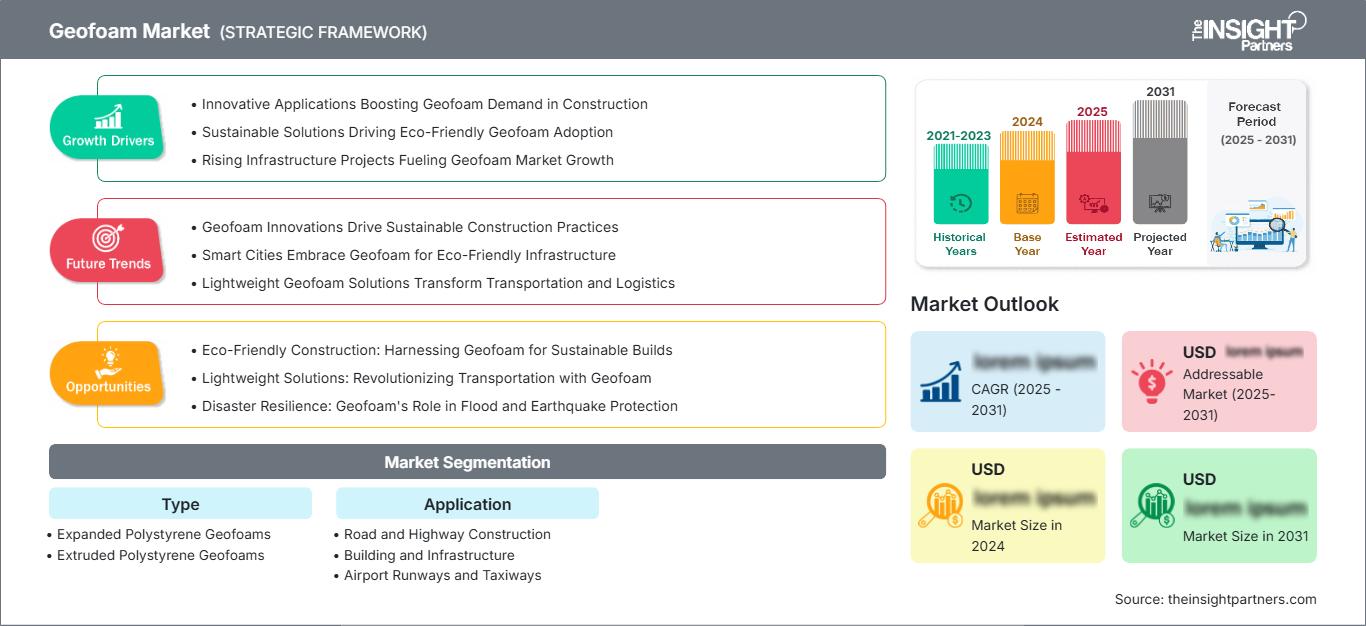
Geofoam Market: Strategic Insights
Regional Insights
North America Geofoam Market
North America accounted for 34–38% of the global geofoam market share in 2025 and is projected to expand at a CAGR of 4.8–5.4% during 2026–2034. Regional demand benefits from investments in road rebuilding, rehabilitation of bridges, airports, and flood protection infrastructure. Geofoam becomes a preferred material in embankments and retaining walls due to low settlement, reduced construction time, and reduced structural loads on weak soils.
The U.S. and Canada remain the leaders in the regional market due to well-developed engineering norms and high acceptance of lightweight fill systems. Focus on resilient infrastructure along with government spending on transportation system modernization will drive future demand. The geofoam market share is the highest in the world due to large-scale replacement programs and innovations by regional producers.
U.S. Geofoam Market
The United States represented 74–78% of the North American market in 2025 and is anticipated to register a CAGR of 4.9–5.5% during 2026–2034. Federal and state transportation investments continue to support the use of geofoam in bridge approaches, roadway widening projects, airport runways, and retaining structures. Engineers increasingly select geofoam because of its predictable mechanical performance, ease of installation, and ability to reduce differential settlement in challenging ground conditions.
The ability to produce domestically, efficient transportation network, and availability of large-scale producers such as Insulfoam, LLC., ACH Foam Technologies, LLC, and Insulation Corporation of America add to the country’s competitive advantage. Further investment in transportation networks, climatic adaptations, and infrastructure development is likely to enhance the growth of the market and also encourage the use of engineered light-weight fill materials.
Europe Geofoam Market
Europe captured 27–31% of the global market in 2025 and is forecast to grow at a CAGR of 4.7–5.3% during 2026–2034. Germany remains the leading regional market owing to extensive transportation modernization, advanced civil engineering practices, and strong adoption of sustainable construction materials. Public infrastructure upgrades continue to encourage the use of geofoam for embankments, railways, and bridge foundation stabilization.
The UK is making more investments on transport infrastructure with an increased focus on reducing the impact of construction and efficiency of life cycle. Geofoam is being used more often in urban regeneration projects where there is need for reduced excavation and reduced loading. Similarly, France, Italy, and Spain are also seeing increasing use of geofoam through roads reconstruction and other infrastructure projects.
APAC Geofoam Market
Asia Pacific held a share of 24%-28% in the global market in 2025, and this region is expected to exhibit the highest CAGR of 5.8%-6.5% during 2026-2034. China is the key demander from this region due to its massive transport projects, whereas Japan and South Korea are implementing cutting-edge geotechnical technologies.
India and Australia have seen rising demand from their highway projects, airport constructions, and urban infrastructure projects. The government initiatives for constructing smart cities and resilient infrastructures have provided the necessary environment for geofoam utilization.
Middle East & Africa Geofoam Market
The growth rate of the Middle East & Africa market is forecasted to be 4.5-5.1% during the years from 2026 to 2034. Saudi Arabia dominates in the market due to infrastructure projects, while the UAE invests in transport and commercial building infrastructure, which requires lightweight engineering materials.
South Africa maintains a significant place on the market due to transportation projects and municipal infrastructure development. The other countries in the region are slowly incorporating geofoam into their infrastructure due to the importance of resilient infrastructure, good drainage systems, and construction methods applicable to difficult soils
Segmentation Analysis
Type
The Type segment is projected to grow at a CAGR of 4.9–5.5% during 2026–2034. The geofoam market scope continues to expand as project developers increasingly select lightweight engineered fill materials that improve structural stability while reducing construction time and foundation loads. Advancements in manufacturing technologies and improved product performance support broader adoption across transportation, commercial, and municipal infrastructure projects worldwide.
- Expanded Polystyrene Geofoams remain the dominant sub-segment due to their favorable strength-to-weight ratio, dimensional stability, cost efficiency, and broad acceptance in highway embankments, retaining walls, bridge approaches, and foundation stabilization projects.
- Extruded Polystyrene Geofoams are increasingly utilized where enhanced moisture resistance, higher compressive strength, and long-term durability are required, making them suitable for specialized infrastructure, underground construction, and high-performance engineering applications.
Application
The Application segment is anticipated to record a CAGR of 5.3–5.9% during 2026–2034 as transportation agencies and commercial developers increasingly incorporate geofoam into complex civil engineering projects. Rising investments in resilient infrastructure, urban expansion, and climate adaptation continue to strengthen demand across multiple end-use applications.
- Road and Highway Construction represents the largest application due to extensive use in embankments, bridge approaches, slope stabilization, and pavement support where lightweight fill reduces settlement while improving long-term infrastructure performance.
- Building and Infrastructure continues to record strong adoption as commercial buildings, industrial facilities, and public infrastructure increasingly require lightweight foundation solutions capable of reducing structural loads and simplifying construction on weak soils.
- Airport Runways and Taxiways are gaining importance because geofoam minimizes settlement beneath pavements, supports faster construction schedules, and enhances operational reliability for airports undergoing expansion and modernization.
Opportunity Snapshot
| Application | Revenue Contribution | Trend Tag | Adoption Stage |
| Road and Highway Construction | High | Highway Renewal | Mature |
| Building and Infrastructure | Medium | Urban Foundations | Scaling |
| Airport Runways and Taxiways | Low | Airfield Expansion | Emerging |
Geofoam Market Growth Drivers and Impact Analysis
Expansion of Transportation Infrastructure Investments
Further development of infrastructure by means of additional investments remains one of the strongest drivers of the market expansion. The state continues to spend considerable sums on the construction of highway expansion, bridges reconstruction, railway lines, and airports improvement projects, thus contributing to increased mobility and competitiveness. Geofoam represents the light weight geotechnical material that is used as the alternative to regular fill and guarantees the absence of settlement process and minimal earth pressure on the retaining walls and abutments of bridges. In addition, the use of geofoam allows decreasing the volume of excavation works and accelerating project completion. The growing attention paid by the infrastructure developers to performance, resilience, and lower maintenance costs of the material during its life cycle will increase the demand for geotechnical materials.
Increasing Adoption of Sustainable Construction Practices
The environment has become an essential factor to consider during the process of planning infrastructure projects, leading to the incorporation of construction materials which help increase efficiency and decrease environmental impact caused by the construction project. Geofoam helps in this regard by reducing the amount of excavation materials required and decreasing the need for transport and construction equipment working hours when compared to traditional soil fill. All these factors help to decrease emissions and increase the efficiency of the construction work. Additionally, producers of geofoam are developing more efficient production methods, recycling of material and reducing waste in order to accommodate changing sustainability needs. Public and private organizations are now evaluating infrastructure projects through lifecycle costs analysis and not simply the costs of materials.
Advancements in Geotechnical Engineering and Material Performance
Continuous advancements in materials science and geotechnical engineering have led to the improvement in performance characteristics of the geofoam products. The producers have been coming up with products that have increased compressive strength, dimensional stability, and quality uniformity that cater to the ever-increasing engineering requirements. Computer modeling and other forms of advanced digital design software also allow for the optimization of the design of the geofoam products used on complicated infrastructure constructions. With the continuing evolution in the engineering practices, the constructors have started to feel more confident when using geofoam in their designs of the retaining walls, approach roads, embankments, and commercial structures.
Geofoam Market Future Trends
Growing Integration with Climate-Resilient Infrastructure Planning
Infrastructure owners are increasingly incorporating climate resilience into long-term investment strategies, creating favorable conditions for lightweight engineered fill materials. Geofoam market trends indicate growing preference for solutions that improve slope stability, reduce flood-related settlement risks, and enhance infrastructure durability under changing environmental conditions. Transportation agencies are expected to expand the use of geofoam in flood protection systems, elevated roadways, coastal infrastructure, and bridge rehabilitation projects where reduced structural loading improves long-term performance. As governments strengthen resilience standards and climate adaptation policies, manufacturers capable of supplying certified, high-performance products are expected to benefit from expanding project pipelines and increasing specification in public infrastructure contracts.
Digital Engineering Supporting Precision Infrastructure Development
Engineering technology in the form of digital solutions will revolutionize project planning and material optimization through the forecast period. The use of Building Information Modeling, digital twin technology, and geotechnical simulation software can help engineers properly assess loading conditions and optimize placement of geofoam and construction sequence. Technical service provided by manufacturers through provision of engineering calculations, digital product libraries, and custom engineering support will help increase success rate of projects and promote further adoption of lightweight engineered fill materials. Digitalization of the construction process from start to finish will enhance collaboration between stakeholders and ensure better results for more complicated constructions.
Geofoam Market Opportunities
Expanding Infrastructure Development Across Emerging Economies
Rapid urbanization throughout Asia Pacific, Latin America, the Middle East, and selected African economies continues to generate significant opportunities for infrastructure material suppliers. Increasing investments in highways, metro systems, airports, logistics corridors, and commercial developments create favorable conditions for advanced geotechnical solutions capable of reducing construction risks and improving project efficiency. Geofoam Forecasts suggest that manufacturers establishing regional production facilities, engineering partnerships, and localized technical support capabilities will be better positioned to capture emerging demand. Companies investing in product certification, contractor education, and project-specific engineering solutions are expected to strengthen their competitive position while benefiting from expanding infrastructure expenditure and modernization initiatives across developing markets.
Product Innovation Focused on Circular Economy Objectives
The growing emphasis on circular economy principles presents new opportunities for manufacturers developing environmentally responsible product portfolios. Investment in recyclable raw materials, manufacturing efficiency improvements, and lower-carbon production technologies is expected to enhance competitiveness while supporting increasingly stringent environmental requirements. Product innovation focused on higher compressive strength, improved thermal performance, and enhanced durability will enable manufacturers to address more demanding infrastructure applications. Strategic collaboration with engineering consultants, construction firms, and public authorities can accelerate market acceptance of advanced solutions while creating opportunities for premium product offerings. Companies successfully combining sustainability, technical performance, and engineering support are likely to strengthen long-term market positioning and improve profitability through differentiated value propositions.
Recent Developments
- May 2026: ThermaFoam officially transitioned to Insulfoam, a Carlisle company and one of the manufacturers of high-performance expanded polystyrene (EPS) insulation and geofoam.
- June 2025: Armacell, a global company in flexible foam for the equipment insulation market and a provider of engineered foams, officially inaugurated its newest manufacturing facility in Pune, India.
Frequently Asked Questions

- Comprehensive Market Sizing and Forecast Analysis
- Detailed Segmentation Analysis
- In-Depth Market Dynamics Assessment
- Regional and Country-Level Insights
- Competitive Landscape and Company Benchmarking
- Strategic Business Intelligence
Recent Reports
Testimonials

The Insight Partners' SCADA System Market report is comprehensive, with valuable insights on current trends and future forecasts. The team was highly professional, responsive, and supportive throughout. We are very satisfied and highly recommend their services.
RAN KEDEM Partner, Reali Technologies LTDs
I requested a report on a very specific software market and the team produced the report in a few days. The information was very relevant and well presented. I then requested some changes and additions to the report. The team was again very responsive and I got the final report in less than a week.
JEAN-HERVE JENN Chairman, Future Analytica
We worked with The Insight Partners for an important market study and forecast. They gave us clear insights into opportunities and risks, which helped shape our plans. Their research was easy to use and based on solid data. It helped us make smart, confident decisions. We highly recommend them.
PIYUSH NAGPAL Sr. Vice President, High Beam Global
The Insight Partners delivered insightful, well-structured market research with strong domain expertise. Their team was professional and responsive throughout. The user-friendly website made accessing industry reports seamless. We highly recommend them for reliable, high-quality research services
YUKIHIKO ADACHI CEO, Deep Blue, LLC.
This is the first time I have purchased a market report from The Insight Partners.While I was unsure at first, I visited their web site and felt more comfortable to take the risk and purchase a market report.I am completely satisfied with the quality of the report and customer service. I had several questions and comments with the initial report, but after a couple of dialogs over email with their analyst I believe I have a report that I can use as input to our strategic planning process.Thank you so much for taking the extra time and making this a positive experience.I will definitely recommend your service to others and you will be my first call when we need further market data.
JOHN SUZUKI President and Chief Executive Officer, Board Director, BK Technologies
I wish to appreciate your support and the professionalism you displayed in the course of attending to my request for information regarding to infectious disease IVD market in Nigeria. I appreciate your patience, your guidance, and the fact that you were willing to offer a discount, which eventually made it possible for us to close a deal. I look forward to engaging The Insight Partners in the future, all thanks to the impression you have created in me as a result of this first encounter.
DR CHIJIOKE ONYIA MANAGING DIRECTOR, PineCrest Healthcare Ltd.Reason to Buy
- Informed Decision-Making
- Understanding Market Dynamics
- Competitive Analysis
- Identifying Emerging Markets
- Customer Insights
- Market Forecasts
- Risk Mitigation
- Boosting Operational Efficiency
- Strategic Planning
- Investment Justification
- Tracking Industry Innovations
- Aligning with Regulatory Trends





 Get Free Sample for