
Glass Container Market Size, Share & Demand by 2034
Coverage: By Product (Glass bottles, Glass jars, Glass vials, Candle glass containers); Application (Cosmetics and perfumes, Pharmaceuticals, Food packaging, Beverage packaging, Other products), and Geography (North America, Europe, Asia Pacific, and South and Central America)
- Status : Data Released
- Report Code : TIPRE00015495
- Category : Chemicals and Materials
- No. of Pages : 150
- Available Report Formats :


- Last update date : July 15, 2026


2025 Market Size
US$ 66.20 Bn
Base year value
2034 Forecast
US$ 110.38 Bn
Projected by 2034
CAGR 2026-2034
5.8 %
Growth rate
Addressable Market
US$ 798.22 Bn
(2026-2034)
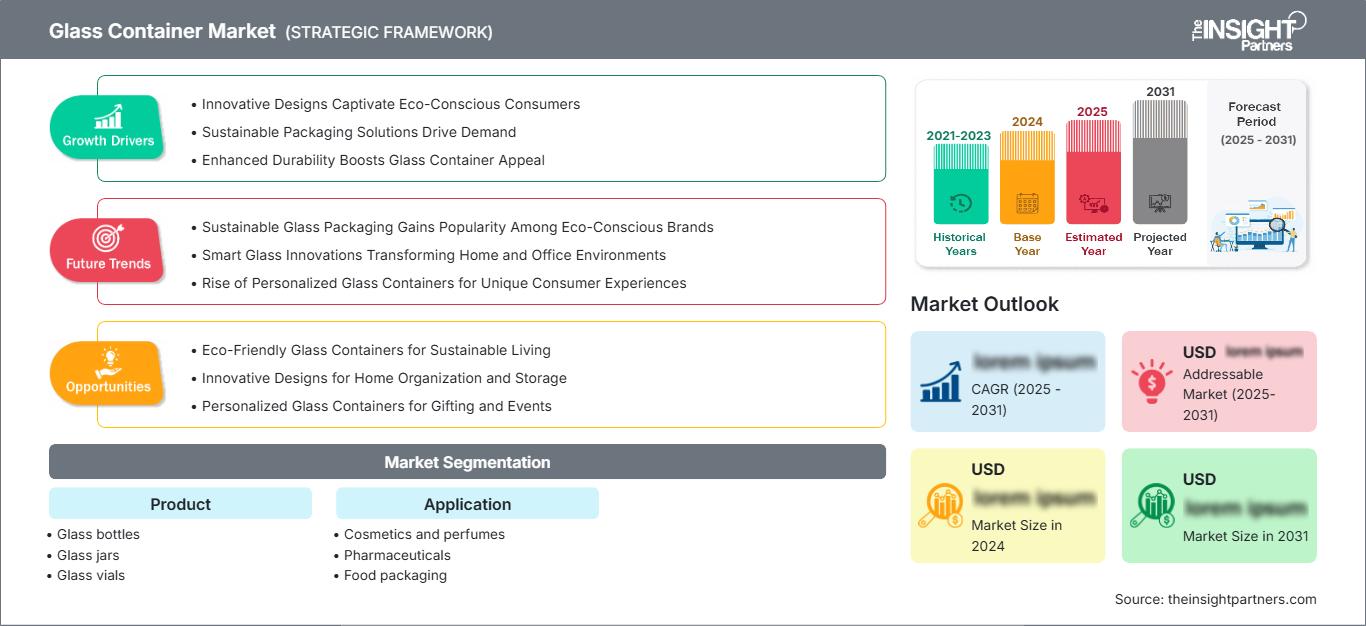
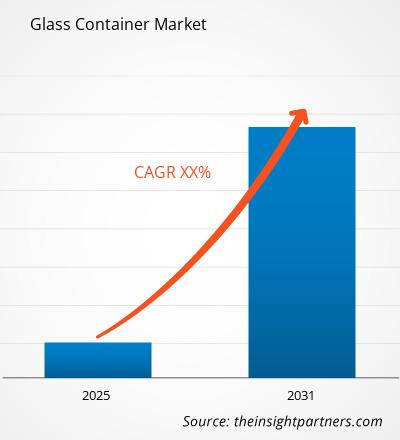
The glass container market size was valued at US$ 66.20 billion in 2025 and is projected to reach US$ 110.38 billion by 2034, expanding at a CAGR of 5.8% during 2026–2034. Growing need for sustainable solutions-and the rising demand from food, beverage, pharmaceuticals and personal care & cosmetics segments to prefer recycled solutions - and consistent investments into lighter and higher-valued products is giving long term growth impetus to global suppliers operating within manufacturing value chain segments. The demand is increasing from expanding production of premium drinks, pharmaceutical pack volumes and government guidelines encouraging round packaging within North America. It is supported by sophisticated recycling network and wide adoption of round solutions from the consumer end, market size of which would reach US $ 25 to $ 35 billion between 2026 and 2034 and it would register theCAGR range of 4.8-5.2% owing to increasing furnace modernization and manufacturing through cost-effective processes
Glass Container Market Assessment and Insights
- North America: The region accounted for 29–31% of the glass container market share in 2025 and is anticipated to register a CAGR of 4.8–5.2% during 2026–2034, supported by premium beverage demand, pharmaceutical packaging expansion, and established glass recycling infrastructure across the U.S. and Canada.
- US: The country represented 80–84% of the North American market in 2025 and is projected to grow at a CAGR of 4.9–5.3% during 2026–2034, driven by strong beverage production, healthcare packaging demand, and sustainability-focused manufacturing investments.
- Europe: Europe captured 31–33% share in 2025 and is forecast to expand at a CAGR of 5.0–5.4% during 2026–2034. Germany, France, Italy, Spain, and the UK continue leading demand owing to established food, beverage, cosmetics, and pharmaceutical packaging industries.
- Asia Pacific: Asia Pacific held 27–29% share in 2025 and is expected to witness the fastest expansion at a CAGR of 6.6–7.0% during 2026–2034, led by China, India, Japan, and South Korea through growing urbanization, packaged food consumption, and manufacturing investments.
- Largest Segment: Beverage packaging accounted for 42–46% market share in 2025 and is projected to expand at a CAGR of 5.6–6.0% during 2026–2034, supported by premium alcoholic beverages, bottled water, and specialty drink packaging.
- High Growth Segment: Pharmaceuticals is expected to record the strongest expansion with 17–20% market share in 2025 and a CAGR of 6.7–7.1% during 2026–2034, driven by injectable medicines, biologics, and vaccine packaging requirements.
- Key companies analyzed in detail: AGI Greenpac Limited, Amcor plc, Ardagh Glass Packaging Holdings Limited, BA Glass B.V., Nampak Ltd, O-I Glass, Inc., Saverglass SAS, Verallia SA, Vidrala, S.A., Wiegand-Glas GmbH.
Source: The Insight Partners' analysis based on proprietary research, government publications, company annual reports, investor presentations, industry databases, and expert interviews.
Glass making capabilities have continued to evolve and optimize on behalf of producers through consistent furnace modernization upgrades, advanced glass container forming technologies, and increased input of cullet and recycled materials that optimize production, while reduce the amount of energy required. Consumer demand continues to trend upward as premiums on specialty bottled beverages and luxury cosmetic goods climb, with a greater emphasis on recyclable consumer product packaging. Modern glass production has focused on the implementation of advanced glass quality control through optical inspection, lightweight glass packaging and closed-loop recycling processes. These technologies reduce the amount of glass in the packaging to produce lighter weight consumer containers and increase the use of recycled materials.
Forward-looking analyses indicate growth and continued investment opportunities across many Asian and Middle East markets, as well as several Latin American economies driven by overall increases in CPG and growth of in-house consumer product recycling infrastructure. Increased government incentives that promote circular economy business practices, including growing renewable energy capacity within the glass manufacturing process, are expected to spur investment and long-term production capability within these economies, while facilitating supply chain diversity and technological trade across globe for innovative packaging materials.
Glass Container Market Report Scope
| Report Attribute | Details |
|---|---|
| Market size in 2025 | US$ 66.20 billion |
| Market Size by 2034 | US$ 110.38 billion |
| Global CAGR (2026 - 2034) | 5.8% |
| Historical Data | 2021-2024 |
| Forecast period | 2026-2034 |
Glass Container Market Analysis
Ongoing shifts toward recyclable, chemically inert packaging is a tailwind across a wide range of end uses including beverages, foods, pharmaceuticals and cosmetics. Growth in premium segments wherein packaging quality greatly affects brand value and preservation needs provides an opportunity for the glass container sector. Increasing investments in returnable bottle systems, greater use of recycled cullet in production, and strict regulations over packaging waste are further improving supply chain sustainability of the packaging sector. Producers have recently focused on the adoption of digital quality control systems, efficient energy consumption through use of energy-saving furnaces, and product lightweighting solutions in production to boost operational efficiency and curb costs while lowering the environmental footprint.
The packaging ecosystem is largely constituted of raw material suppliers, glass furnace technology manufacturers, packaging producers, filling companies, distribution companies, recyclers and brand owners in form of coordinated value chains. Increasing availability of cullet and lower energy requirement in furnace operation result from growing investments in recycled glass use. Process automation can ensure enhanced precision and consistent quality of production processes. Strengthening collaboration among glass packaging companies, recyclers and consumer product manufacturers can also continue supporting the adoption of circular economy principles and improve reliability across global markets.
Competition remains fierce with existing players focusing on furnace modernization, enhancing product differentiation through sustainable practices, vertical/geographic expansion, and innovative value-added packaging offerings. Glass container market report demonstrates that companies like O-I Glass, Inc. Verallia SA Ardagh Glass Packaging Holdings Limited Vidrala S.A., and BA Glass B.V are expanding regional operations by enhancing production capacity, launching lightweighting technologies and forging supply agreements with beverage and pharmaceutical giants.
Significant strategic focus in the glass container market is now being given to premium applications in beverages (e.g. Spirits and wine), cosmetics and pharmaceuticals that necessitate high degree of brand differentiation and adherence to regulatory standards. AGI Greenpac Limited Saverglass SAS Wiegand-Glas GmbH Amcor plc, and Nampak Ltd are further enhancing their sustainable packaging offerings through increased recycling efforts, lowering the carbon footprint in production and collaboration on sustainable product innovation to manage fluctuations in raw material prices and respond to customer demand for eco-friendly packaging.
● REPORT CUSTOMIZATION
Tailor This Report To Align With Your Specific Business Requirements
This report can be customized to align precisely with your business objectives, scope, and target markets. Customization options include tailored segmentation, geography, competitive analysis, and strategic insights to support informed decision-making.
Customize This Report →WHAT YOU CAN ADJUST
- ● Segmentations
- ● Geography
- ● Competitive Analysis
- ● Language Preferences
Glass Container Market: Strategic Insights
Regional Insights
North America Glass Container Market
North America accounted for 29–31% of the glass container market share in 2025 and is projected to register a CAGR of 4.8–5.2% during 2026–2034. Demand is supported by strong beverage manufacturing, pharmaceutical production, and well-established recycling systems. Regulatory initiatives encouraging recyclable packaging and increasing consumer preference for sustainable alternatives continue to strengthen long-term demand. Investments in energy-efficient furnaces and higher cullet utilization are also improving manufacturing efficiency and lowering carbon emissions across regional production facilities.
The regional glass container market further benefits from premium alcoholic beverage consumption, rising demand for specialty food packaging, and increasing pharmaceutical exports. Major manufacturers continue investing in capacity modernization and digital manufacturing technologies to improve production quality and operational flexibility. The expanding circular economy framework, supported by state and provincial recycling programs, encourages greater reuse of glass materials while enhancing supply chain resilience. Stable raw material availability and advanced logistics networks are expected to sustain consistent market expansion throughout the forecast period.
U.S. Glass Container Market
The U.S. represented 80–84% of the North American market in 2025 and is anticipated to grow at a CAGR of 4.9–5.3% during 2026–2034. The country maintains a strong manufacturing base supported by leading beverage producers, pharmaceutical companies, and food processing industries. High consumption of bottled beverages, wine, craft beer, and premium spirits continues to generate consistent demand for glass packaging. The presence of major manufacturers further supports continuous innovation in lightweight and recyclable container solutions.
Growing investments in pharmaceutical packaging, particularly glass vials and specialty containers, are reinforcing domestic production capacity. Sustainability commitments by consumer goods manufacturers are encouraging higher recycled glass content and improved collection systems. The country also benefits from advanced research in furnace efficiency, automation, and quality inspection technologies that improve manufacturing productivity. Strong customer preference for premium packaging across cosmetics and beverages is expected to sustain long-term expansion while supporting continuous technological advancement across the packaging value chain.
Europe Glass Container Market
Europe held 31–33% share in 2025 and is projected to expand at a CAGR of 5.0–5.4% during 2026–2034, making it the largest regional glass container market. Germany remains the leading contributor owing to its advanced beverage, pharmaceutical, and food processing industries, while comprehensive recycling regulations support high glass collection rates. The UK continues witnessing steady demand from premium spirits, cosmetics, and food manufacturers that increasingly prioritize recyclable packaging aligned with national sustainability objectives.
France, Italy, and Spain collectively strengthen regional production through extensive wine, spirits, olive oil, food, and luxury cosmetics industries that rely heavily on high-quality glass packaging. Investments in low-carbon furnaces, renewable energy integration, and closed-loop recycling systems continue enhancing manufacturing competitiveness across the region. Strong regulatory support for circular economy initiatives and producer responsibility schemes further accelerates adoption of recycled glass, enabling manufacturers to improve resource efficiency while meeting evolving environmental requirements across European consumer markets.
APAC Glass Container Market
Asia Pacific accounted for 27–29% share in 2025 and is expected to witness the fastest expansion with a CAGR of 6.6–7.0% during 2026–2034. China leads regional demand through large-scale beverage, pharmaceutical, and food manufacturing, while India continues benefiting from rapid urbanization, expanding packaged food consumption, and increasing investments in sustainable packaging production.
Japan, South Korea, and Australia contribute through technologically advanced manufacturing capabilities and growing adoption of premium packaging across healthcare and cosmetics sectors. Government initiatives promoting recycling infrastructure, industrial modernization, and circular economy practices are expected to strengthen regional competitiveness and encourage additional investments in high-efficiency glass manufacturing facilities over the forecast period.
Middle East & Africa Glass Container Market
The Middle East & Africa market is projected to expand at a CAGR of 5.3–5.7% during 2026–2034. Saudi Arabia leads regional demand through growing food processing, pharmaceutical manufacturing, and beverage industries, while the UAE continues investing in sustainable packaging and industrial diversification initiatives. Expanding tourism and hospitality sectors also contribute to rising consumption of premium packaged products.
South Africa remains an important manufacturing hub supported by established beverage production and improving recycling capabilities, while the Rest of the Middle East & Africa is witnessing gradual growth through infrastructure investments and industrial development. Increasing emphasis on circular packaging solutions, combined with expanding domestic manufacturing capacity, is expected to strengthen regional demand for glass containers during the forecast period.
Segmentation Analysis
Product
The product segment represents a diverse portfolio serving beverage, pharmaceutical, food, and specialty packaging industries. Manufacturers continue investing in lightweight designs, improved barrier performance, and enhanced durability to address sustainability objectives while maintaining product integrity. Continuous innovation in manufacturing technologies, increased recycled glass utilization, and premium packaging demand are expected to support the segment throughout the forecast period. The glass container market scope continues expanding as manufacturers introduce application-specific products that satisfy evolving consumer, regulatory, and industrial requirements. The product segment is projected to grow at a CAGR of 5.6–6.0% during 2026–2034.
- Glass bottles: Glass bottles remain the dominant product category owing to extensive adoption across alcoholic beverages, soft drinks, bottled water, edible oils, and specialty food products. Their recyclability, premium appearance, and product protection continue supporting widespread commercial utilization.
- Glass jars: Glass jars maintain strong demand across packaged foods, jams, sauces, baby food, pickles, and specialty condiments. Excellent chemical resistance, extended shelf-life performance, and consumer preference for transparent packaging reinforce their strategic importance.
- Glass vials: Glass vials are increasingly utilized by pharmaceutical manufacturers for injectable drugs, vaccines, biologics, and diagnostic products. High purity standards, dimensional accuracy, and compatibility with sterilization processes strengthen long-term glass container market demand.
- Candle glass containers: Candle glass containers continue gaining popularity through decorative home products, luxury fragrances, and hospitality applications. Premium aesthetics, design flexibility, and thermal resistance contribute to sustained adoption among manufacturers and consumers.
Application
The application segment in the glass container market reflects expanding adoption of glass packaging across consumer goods and healthcare industries where product protection, sustainability, and premium presentation remain critical purchasing considerations. Beverage packaging continues to generate the highest revenue contribution, while pharmaceutical applications demonstrate the fastest expansion because of increasing biologics production and injectable drug demand. Manufacturers continue developing specialized packaging solutions tailored to individual application requirements. The application segment is anticipated to register a CAGR of 5.9–6.3% during 2026–2034.
- Cosmetics and perfumes: Premium cosmetic brands increasingly select glass packaging because it enhances luxury positioning, preserves fragrance formulations, and supports sustainability commitments through reusable and fully recyclable packaging formats.
- Pharmaceuticals: Pharmaceutical applications continue expanding through increasing production of injectable medicines, vaccines, biologics, and laboratory products requiring chemically stable, contamination-resistant, and high-quality glass packaging solutions.
- Food packaging: Food manufacturers increasingly utilize glass containers for sauces, spreads, dairy products, baby food, pickled products, and premium packaged foods owing to excellent preservation characteristics and consumer confidence in product safety.
- Beverage packaging: Beverage packaging remains the largest application supported by extensive use across beer, wine, spirits, carbonated drinks, juices, bottled water, and premium beverages where product quality and brand differentiation remain essential.
Opportunity Snapshot
| Segment Name | Revenue Contribution (High/Medium/Low) | Trend Tag | Adoption Stage |
| Cosmetics and perfumes | Medium | Luxury Packaging | Mature |
| Pharmaceuticals | High | Sterile Vials | Scaling |
| Food packaging | High | Clean Label | Mature |
| Beverage packaging | High | Premium Bottles | Mature |
Glass Container Market Growth Drivers and Impact Analysis
Expansion of Sustainable Packaging Regulations and Circular Economy Policies
Governments around the world in North America, Europe and several Asia Pacific countries are also reinforcing policies that promote packaging waste reduction and enhance recyclable packaging use. Glass containers fit well with these goals as glass is recyclable over and over again, and it does not lose quality through the recycling process. Governments are facilitating extended producer responsibility, deposit return systems, and greater percentages of recycled content, incentivizing companies to invest in innovative facilities and the latest recycling technologies. Leading beverage, food, and cosmetics companies are increasingly choosing glass for premium products as a result. Increased cullet collection under these initiatives helps increase raw material supply for producers and reduces their reliance on Virgin glass production, which results in lower energy consumption.
Growing Pharmaceutical Production and Demand for High-Purity Packaging
Driven by increasing consumption for biologic medicines, vaccine, injectables, and specialty therapies the growth of high-grade glass packaging is projected to witness a steady demand from the pharmaceutical manufacturers across the globe. Chemically stable and inertia packaging, to preserve and deliver the effectiveness of medication from manufacturing site till consumption, is anticipated to push the demand of glass vials, and bottles used in pharma sector. Moreover, growing healthcare spending, surging geriatric population, and burgeoning vaccination drives across various regions are predicted to boost the sales of pharmaceutical bottles, vials, etc. Quality control solutions for stringent pharmaceutical quality standard as well as manufacturing capabilities are helping packaging players adapt with strict regulatory norms, as pharma companies are investing insterile facilities, quality control technologies and precision forming. As capacity of manufacturing for the pharmaceutical industry is also growing in developed and emerging economies, the demand for specialty glass container suppliers shall see steady demand driven by healthcare infrastructure development.
Premium Beverage Consumption Supporting High-Value Packaging Demand
Consumer preference toward higher-value offerings - premium wine, craft beer, specialty liquors, functional beverages and premium foods - still drive robust demand for glass bottles. Brand owners and makers are favoring glass to maintain taste profile, convey premium quality perceptions, and present goods with a visually appealing finish to their target audiences. The reopening of tourist destinations, growth in the hospitality sector and increasing purchasing power among many consumer segments worldwide have also spurred demand for well-packaged premium beverages in multiple countries and geographies. Makers of premium glass containers are catering to this trend with the launch of innovative designs that are significantly lighter to minimize transportation costs. The innovation also encompasses decorative finish options and custom glass packaging solutions that enhance the uniqueness of the products on display.
Glass Container Market Future Trends
Digital Manufacturing and Smart Production Technologies
Manufacturers are increasingly integrating artificial intelligence, machine vision, predictive maintenance, robotics, and digital inspection systems throughout glass production facilities. These technologies improve product consistency, reduce manufacturing defects, optimize furnace operations, and enhance overall equipment efficiency. The glass container market trends indicate that smart manufacturing will become increasingly important as producers seek greater operational flexibility while reducing production costs and environmental impact. Digital monitoring also supports predictive maintenance strategies that minimize unplanned downtime, improve production planning, and strengthen supply chain reliability, allowing manufacturers to respond more effectively to evolving customer requirements across beverage, pharmaceutical, and food packaging industries.
Low-Carbon Manufacturing Through Renewable Energy Integration
The transition toward lower-carbon production methods is expected to reshape investment priorities across the industry during the forecast period. Manufacturers are expanding the use of renewable electricity, hybrid melting technologies, waste heat recovery systems, and higher recycled glass content to reduce greenhouse gas emissions. These initiatives support corporate sustainability commitments while helping producers comply with increasingly stringent environmental regulations. Continued collaboration among equipment suppliers, energy providers, recycling companies, and packaging manufacturers is anticipated to accelerate commercialization of energy-efficient production technologies. Facilities capable of producing premium glass containers with lower environmental footprints are expected to gain competitive advantages in global markets.
Glass Container Market Opportunities
Expanding Manufacturing Capacity in Emerging Consumer Markets
Rapid urbanization, increasing disposable incomes, and rising packaged food and beverage consumption across Asia Pacific, the Middle East, and selected African economies are creating attractive investment opportunities for packaging manufacturers. Glass container market Forecasts suggest that expanding regional production capacity closer to end-use industries can reduce logistics costs, improve supply chain resilience, and enhance customer responsiveness. Investments in modern furnaces, recycling infrastructure, and localized manufacturing operations are expected to strengthen competitiveness while supporting national sustainability objectives. Strategic partnerships with beverage producers, pharmaceutical companies, and food manufacturers can further accelerate market penetration and long-term revenue generation.
Innovation in Premium and Specialty Packaging Solutions
Growing demand for differentiated packaging presents opportunities for manufacturers to develop high-value products featuring lightweight designs, decorative finishes, embossed branding, and customized shapes. Premium cosmetics, luxury fragrances, craft beverages, specialty foods, and pharmaceutical products increasingly require packaging that combines functionality with visual appeal. Companies investing in advanced forming technologies, digital decoration processes, and sustainable design capabilities can strengthen customer relationships while expanding profit margins. Continuous product innovation supported by research and development activities is expected to create long-term competitive advantages, particularly among manufacturers serving premium consumer brands seeking distinctive and environmentally responsible packaging solutions.
Recent Developments
- May 2026: Ardagh Glass Packaging launched Clearly Ardagh Transformation initiative to strengthen competitive positioning within dynamic glass packaging industry.
- February 2026: Verallia SA announced that it is evaluating adaptations to its European industrial footprint in response to evolving demand dynamics within the glass packaging industry.
Frequently Asked Questions

- Comprehensive Market Sizing and Forecast Analysis
- Detailed Segmentation Analysis
- In-Depth Market Dynamics Assessment
- Regional and Country-Level Insights
- Competitive Landscape and Company Benchmarking
- Strategic Business Intelligence
Recent Reports
Testimonials

The Insight Partners' SCADA System Market report is comprehensive, with valuable insights on current trends and future forecasts. The team was highly professional, responsive, and supportive throughout. We are very satisfied and highly recommend their services.
RAN KEDEM Partner, Reali Technologies LTDs
I requested a report on a very specific software market and the team produced the report in a few days. The information was very relevant and well presented. I then requested some changes and additions to the report. The team was again very responsive and I got the final report in less than a week.
JEAN-HERVE JENN Chairman, Future Analytica
We worked with The Insight Partners for an important market study and forecast. They gave us clear insights into opportunities and risks, which helped shape our plans. Their research was easy to use and based on solid data. It helped us make smart, confident decisions. We highly recommend them.
PIYUSH NAGPAL Sr. Vice President, High Beam Global
The Insight Partners delivered insightful, well-structured market research with strong domain expertise. Their team was professional and responsive throughout. The user-friendly website made accessing industry reports seamless. We highly recommend them for reliable, high-quality research services
YUKIHIKO ADACHI CEO, Deep Blue, LLC.
This is the first time I have purchased a market report from The Insight Partners.While I was unsure at first, I visited their web site and felt more comfortable to take the risk and purchase a market report.I am completely satisfied with the quality of the report and customer service. I had several questions and comments with the initial report, but after a couple of dialogs over email with their analyst I believe I have a report that I can use as input to our strategic planning process.Thank you so much for taking the extra time and making this a positive experience.I will definitely recommend your service to others and you will be my first call when we need further market data.
JOHN SUZUKI President and Chief Executive Officer, Board Director, BK Technologies
I wish to appreciate your support and the professionalism you displayed in the course of attending to my request for information regarding to infectious disease IVD market in Nigeria. I appreciate your patience, your guidance, and the fact that you were willing to offer a discount, which eventually made it possible for us to close a deal. I look forward to engaging The Insight Partners in the future, all thanks to the impression you have created in me as a result of this first encounter.
DR CHIJIOKE ONYIA MANAGING DIRECTOR, PineCrest Healthcare Ltd.Reason to Buy
- Informed Decision-Making
- Understanding Market Dynamics
- Competitive Analysis
- Identifying Emerging Markets
- Customer Insights
- Market Forecasts
- Risk Mitigation
- Boosting Operational Efficiency
- Strategic Planning
- Investment Justification
- Tracking Industry Innovations
- Aligning with Regulatory Trends





 Get Free Sample for