
Gold Mining Market Trends, Demand & Growth by 2034
Coverage: by Method (Placer Mining, Hardrock Mining); End User (Investment, Jewelry, Others), and Geography (North America, Europe, Asia Pacific, and South and Central America)
- Status : Data Released
- Report Code : TIPRE00013048
- Category : Manufacturing and Construction
- No. of Pages : 150
- Available Report Formats :


- Last update date : July 28, 2026


2025 Market Size
US$ 293.03 Bn
Base year value
2034 Forecast
US$ 807.89 Bn
Projected by 2034
CAGR 2026-2034
11.93 %
Growth rate
Addressable Market
US$ 4,831.90 Bn
(2026-2034)
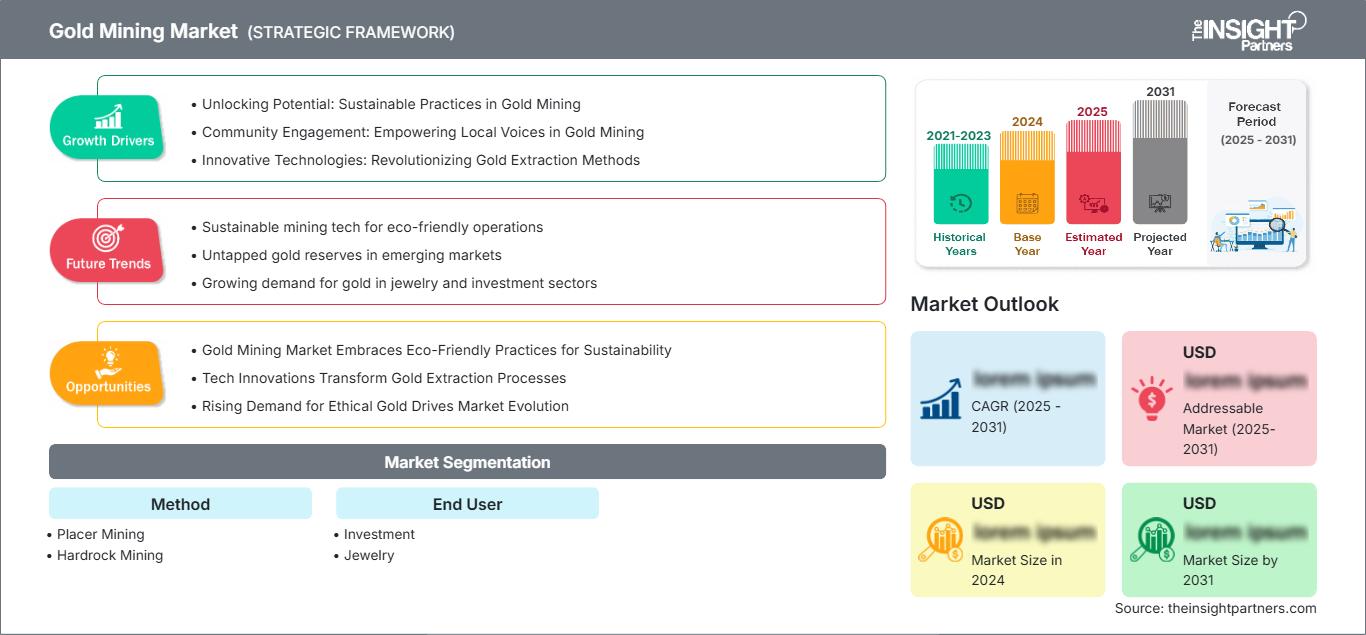
The gold mining market is projected to expand from US$ 293.03 billion in 2025 to US$ 807.89 billion by 2034, registering a CAGR of 11.93% during 2026–2034. Market growth is primarily driven by sustained demand for mined gold from the investment and jewellery sectors, rising bullion prices, continued reserve expansion, and increasing investments in the development and expansion of both established and emerging mining regions.
North America has been a significant producer of gold and is considered an investment hub. The size of the gold mining market in North America is supported by mining assets found in Nevada, Alaska, Ontario, Quebec, and British Columbia. The region is expected to record growth at 9.8% to 10.6% CAGR through 2026 to 2034.
Gold Mining Market Assessment and Insights
- North America held a 20–23% gold mining market share in 2025 and is expected to grow at a CAGR of 9.8–10.6% between 2026–2034, driven by tier-one mines, reserve replacement, and stable financing.
- US represented 34–38% of North America in 2025 and is projected to advance at a 9.4–10.1% CAGR between 2026–2034, supported by Nevada-led hardrock output.
- Europe accounted for 7–9% share in 2025 and is forecast to grow at an 8.6–9.4% CAGR between 2026–2034, led by Russia-linked supply exposure, Finland, Sweden, Bulgaria, and Turkey.
- Asia Pacific captured 37–41% share in 2025 and is expected to record a 12.4–13.2% CAGR between 2026–2034, led by China, Australia, Indonesia, India, and Papua New Guinea.
- Largest Segment Hardrock Mining held 82–86% market share in 2025 and is projected to grow at an 11.6–12.2% CAGR between 2026–2034 due to large-scale orebody economics.
- High Growth Segment Investment represented 44–48% market share in 2025 and is expected to grow at a 12.8–13.6% CAGR between 2026–2034 as ETF, bar, and reserve demand strengthens.
- Key companies analyzed in detail: Newmont Corporation, Barrick Mining Corporation, Agnico Eagle Mines Limited, AngloGold Ashanti plc, Gold Fields Limited, Kinross Gold Corporation, Public Joint Stock Company Polyus, Zijin Mining Group Company Limited, Harmony Gold Mining Company Limited, Northern Star Resources Limited.
Source: The Insight Partners' analysis based on proprietary research, government publications, company annual reports, investor presentations, industry databases, and expert interviews.
There has been a change in operational evolution in the gold mining industry from volume-driven growth to productivity, ore body selection, and life-of-mine considerations. The industry players have embraced automation of haulage, ore sorting, digital grade control, and remote operating systems to cope with falling ore grades and cost escalation. Production will still face challenges since there are constraints in permitting, water, labor, and milling capacity that make it difficult for the industry to respond quickly during times of high gold prices.
In the future, investments are expected to be made in brownfield developments and underground extensions as well as those countries with clear fiscal structures. Geographies that are new in the industry include West Africa, Central Asia, and Latin America, which are offering reserve potential, whereas North America and Australia will see investments due to political safety.
Gold Mining Market Report Scope
| Report Attribute | Details |
|---|---|
| Market size in 2025 | US$ 293.03 Billion |
| Market Size by 2034 | US$ 807.89 Billion |
| Global CAGR (2026 - 2034) | 11.93% |
| Historical Data | 2021-2024 |
| Forecast period | 2026-2034 |
Gold Mining Market Analysis
Demand is becoming increasingly connected to investment allocation, central bank diversification of reserves, and consumer resilience in premium jewelry markets. The growth of the gold mining sector is driven by the relative scarcity of mined supplies, while recycling is price sensitive and cannot completely substitute for mining operations. Higher demand for bullion items provides support for upstream project economics, particularly where the miners own processing capabilities and long-lived reserves.
The value chain includes exploration, feasibility, permitting, mining, processing, refining, bullion distribution, jewelry production, and investment products. Ore grade, stripping ratio, metallurgical recovery, power costs, and royalty structures govern supply considerations. Mining companies that have integrated technical staff and efficient capital management practices are better able to convert additions to reserves to cash flow compared to fragmented operations.
The competitive environment continues to be dominated by diversified players with global mining assets. As per the gold mining market analysis, Newmont Corporation, Barrick Mining Corporation, Agnico Eagle Mines Limited, and AngloGold Ashanti plc compete via reserve depth, size of operations, and optionality of projects. Specialists in mid-tier mining like Northern Star Resources Limited and Harmony Gold Mining Company Limited continue to be significant in regionally focused operations.
Trends in investments are towards debt reduction, shareholder rewards, and prudent reinvestment in orebodies where confidence exists. Nevada growth opportunities for Barrick Mining Corporation and ongoing reserve growth for Agnico Eagle Mines Limited through extensive drilling continue. Zijin Mining Group Company Limited and Public Joint Stock Company Polyus emphasize scale, local resource availability, and low-cost operations.
● REPORT CUSTOMIZATION
Tailor This Report To Align With Your Specific Business Requirements
This report can be customized to align precisely with your business objectives, scope, and target markets. Customization options include tailored segmentation, geography, competitive analysis, and strategic insights to support informed decision-making.
Customize This Report →WHAT YOU CAN ADJUST
- ● Segmentations
- ● Geography
- ● Competitive Analysis
- ● Language Preferences
Gold Mining Market: Strategic Insights
Regional Insights
North America gold mining market
In 2025, North America had a 20–23% market share and is expected to maintain a 9.8–10.6% CAGR over 2034. Its growth is driven by Nevada, Alaska, Ontario, Quebec, and British Columbia, with existing infrastructure, workforce, and reserve data reducing the risks of expanding mines and transitioning underground.
Gold mining in North America has been bolstered by large companies able to bear costs associated with permits, reclamation, and energy transition. According to the U.S. Geological Survey, there was 160 tons of mined gold in 2025 in the United States, while Canada's gold production is the core of world supplies. Stable regulatory framework attracts long-term investments to North America despite high operational costs.
U.S. Gold Mining Market
The U.S. constituted 34-38% of North America in 2025 and is anticipated to record a 9.4-10.1% CAGR from 2026-2034. Nevada continues to be the key production region, along with placers and lodes mining activities in Alaska and western parts of the country. The hardrock segment prevails since the extraction requires extensive drilling and processing.
Key company players include Barrick Mining Corporation, Newmont Corporation, Kinross Gold Corporation, and local mining companies involved in refining and investment channels. Current application trends are inclined toward investment-grade doré, bullion streams, and reserves-based portfolio mining. Top mining operations in the U.S. continue to be highly concentrated, which positively impacts productivity yet requires mine life extension initiatives.
Europe Gold Mining Market
The European region accounted for a share of 7–9% in 2025 and is projected to grow at a CAGR of 8.6–9.4% till 2034. Finland, Sweden, Bulgaria, and Turkey serve as mining bases in Europe, whereas sanctions and logistics risks impact the Russian-associated supply. Leadership in this category pertains to Russia in terms of output, but Western Europe focuses on smaller deposits that comply with ESG principles.
The UK acts primarily as a financial, trading, and refining-based market and not as a mined-output base. Germany provides support in the form of equipment, engineering, and processing technology. France, Italy, and Spain make their contributions by means of downstream jewelry, distribution of investment, and some exploration activity.
APAC Gold Mining Market
APAC held 37–41% share in 2025 and is projected to grow at a 12.4–13.2% CAGR. China is the leading country by output, while Australia provides large, technologically advanced mines. Japan and South Korea contribute more through investment and refining-linked channels than mined supply.
India’s role is demand-led through jewelry and bars, whereas Australia and Indonesia support upstream expansion. Industrial policy, domestic reserve security, and infrastructure investment are shaping mine development. The region benefits from both consumer demand depth and resource availability, creating a broad base for the gold mining market.
Middle East & Africa Gold Mining Market
Middle East & Africa is expected to post a 10.8–11.6% CAGR through 2034, with South Africa remaining the leading mature producer and West Africa adding growth momentum. Saudi Arabia and the UAE are increasing mining and bullion infrastructure exposure under broader economic diversification programs.
Energy availability, transport corridors, and processing capacity influence project economics across the region. South Africa’s deep-level mines face cost and power reliability challenges, while Ghana, Mali, and Burkina Faso offer resource upside with higher political risk. Rest of MEA opportunities depend on security, permitting clarity, and infrastructure funding.
Segmentation Analysis
Method
The Method segment is projected to grow at an 11.4–12.1% CAGR during 2026–2034. The gold mining market scope across methods is shaped by orebody depth, grade continuity, water availability, stripping requirements, and processing route. Hardrock operations dominate capital deployment, while placer mining remains relevant in alluvial districts where lower upfront infrastructure can support smaller operators.
- Placer Mining serves alluvial and near-surface deposits, offering lower entry barriers and flexible seasonal operations, but faces scale limits, water-use scrutiny, and stronger environmental oversight in sensitive river systems.
- Hardrock Mining remains the primary production route because major reserves are hosted in lode deposits requiring drilling, blasting, crushing, milling, and metallurgical recovery across long-life mine plans.
End User
The End User segment is forecast to grow at a 12.0–12.7% CAGR during 2026–2034. Investment demand is gaining strategic importance as institutions and central banks use gold for diversification, while jewelry remains culturally embedded in India, China, the Middle East, and parts of Europe. Producers benefit when both channels sustain value despite price volatility.
- Investment includes bars, coins, ETFs, and official reserves, making it highly responsive to inflation expectations, currency uncertainty, geopolitical risk, and portfolio diversification strategies.
- Jewelry remains a resilient value channel despite volume pressure at high prices, supported by weddings, gifting, cultural savings behavior, and premiumization toward lighter but higher-value designs.
Opportunity Snapshot
| Segment Name | Revenue Contribution | Trend Tag | Adoption Stage |
| Investment | High | Reserve Buying | Scaling |
| Jewelry | Medium | Lightweight Designs | Mature |
Gold Mining Market Growth Drivers and Impact Analysis
Investment Demand and Reserve Diversification
Demand from investors has been the main growth factor as people, banks, and wealth managers are using gold to hedge against inflation risks, currency risks, and geopolitical risks. According to the World Gold Council, total demand for gold was in excess of 5,000 tons in 2025 where demand from investors was 2,175 tons while central banks purchased 863 tons of gold. It positively influences financing of projects since high realized prices will increase the margin, free cash flow, and economic value of resource replacement. The effect will be felt most by producers who have scalable hardrock mines, processing facilities, and hedging discipline.
Technology-Led Productivity Improvements
Productivity gains from automation, drilling analytics, ore sorting, and mine planning are seen in mature areas as grades decline. These technologies assist the miners to minimize dilution, optimize haulage, recovery, and energy intensity. The effects are especially pronounced in Australia, Canada, and Nevada, where big mines can afford investments over extended mine life periods. Digital solutions also allow for safer underground mining and better reconciliation between geologic model and plant operations. Productivity gains, for the miners, will compensate for manpower shortages, energy price volatility, and royalties.
Brownfield Expansion and Mine-Life Extension
Brownfield initiatives have become increasingly important because of the fact that they make use of existing road networks, existing mill facilities, existing tailing facilities, existing permits and existing social infrastructure. In this way, risks associated with project execution will be minimized as opposed to greenfield initiatives that involve additional environmental assessments and lack of infrastructure. Brownfield expansions are seen to be helping companies prolong their operations due to the fact that they are drilling deeper, going underground, utilizing satellite ore bodies and making metallurgical advancements.
Gold Mining Market Future Trends
Responsible Gold Traceability
Gold mining market trends are headed toward enhanced traceability from source through processing to final destination buyer. Expectations for conflict-free materials, tailings management, carbon footprint transparency, and engagement with communities will be heightened by institutional owners, jewelry brands, and regulation. Chain of custody systems verified on an audited doré basis, and responsible sourcing practices, will gain importance in premium markets. Miners who verify provenance and environmental performance will have better off-take opportunities and reduced reputational risk. Ultimately, traceability will impact price, due diligence of lenders, and qualification of buyers, particularly in Europe and North America.
Lower-Carbon Mine Power Systems
Mine power technologies are evolving towards hybrid renewable technologies, connectivity to grids, battery-powered technology, and reduced emission haulage. Gold mining operations usually occur in distant regions where reliance on diesel power is costly and exposes one to emissions. In the future, competitiveness will be achieved by minimizing power risks while meeting the sustainability requirements of lenders and buyers. The firms with sustainable long-term assets will be able to undertake renewable power purchasing contracts, electrification tests, and energy management systems. This shift will change feasibility studies due to the interconnection of the three parameters.
Gold Mining Market Opportunities
High-Grade Underground Extensions
Underground extensions around existing open pits offer attractive gold mining market forecasts because they can add higher-grade feed without requiring entirely new processing networks. Companies can target down-plunge continuity, satellite zones, and deeper structures using directional drilling and improved geophysical interpretation. The opportunity is strongest where mills have spare capacity or where underground ore can improve blended grades. Investors should prioritize projects with clear ventilation, ground control, water, and metallurgical plans. Successful extensions can protect margins, defer closure liabilities, and increase asset value during periods of strong gold prices.
Emerging-Market Processing Hubs
Processing hubs in resource-rich emerging regions can unlock smaller deposits that are uneconomic as standalone mines. Shared milling, assaying, refining access, and logistics can reduce capital intensity for satellite projects while improving recovery and compliance oversight. West Africa, Central Asia, and parts of Latin America are candidates where multiple deposits sit within trucking distance of underused or expandable plants. Operators can build regional platforms through joint ventures, toll treatment, or acquisitions. This opportunity requires careful political-risk management, but it can create scalable production clusters with diversified ore sources.
Recent Developments
- June 2026: Perenti underground mining business Barminco has confirmed a A$275 million (US$192 million), 45-month contract at the proposed US$1.7 billion Fourmile gold project in Nevada, USA – an expanding part of the world’s "largest hard‑rock underground mining market."
- May 2026: Agnico Eagle Mines Limited announced a positive investment decision for its Hope Bay project, located in Nunavut, Canada. Following significant exploration success in recent years, the Company has completed a preliminary economic assessment which contemplates an underground mining operation supported by a 6,000 tonnes per day processing facility with estimated annual gold production of between 400,000 and 435,000 ounce.
Frequently Asked Questions

- Comprehensive Market Sizing and Forecast Analysis
- Detailed Segmentation Analysis
- In-Depth Market Dynamics Assessment
- Regional and Country-Level Insights
- Competitive Landscape and Company Benchmarking
- Strategic Business Intelligence
Recent Reports
Testimonials

The Insight Partners provided valuable market intelligence that supported our global go-to-market strategy. Their team was professional, responsive, and attentive to our feedback, providing thoughtful analysis and helpful methodological clarifications throughout the project.
Junmo Kim Chief Financial Officer (CFO), Enertech Co., Ltd.
The Insight Partners' SCADA System Market report is comprehensive, with valuable insights on current trends and future forecasts. The team was highly professional, responsive, and supportive throughout. We are very satisfied and highly recommend their services.
RAN KEDEM Partner, Reali Technologies LTDs
I requested a report on a very specific software market and the team produced the report in a few days. The information was very relevant and well presented. I then requested some changes and additions to the report. The team was again very responsive and I got the final report in less than a week.
JEAN-HERVE JENN Chairman, Future Analytica
We worked with The Insight Partners for an important market study and forecast. They gave us clear insights into opportunities and risks, which helped shape our plans. Their research was easy to use and based on solid data. It helped us make smart, confident decisions. We highly recommend them.
PIYUSH NAGPAL Sr. Vice President, High Beam Global
The Insight Partners delivered insightful, well-structured market research with strong domain expertise. Their team was professional and responsive throughout. The user-friendly website made accessing industry reports seamless. We highly recommend them for reliable, high-quality research services
YUKIHIKO ADACHI CEO, Deep Blue, LLC.
This is the first time I have purchased a market report from The Insight Partners.While I was unsure at first, I visited their web site and felt more comfortable to take the risk and purchase a market report.I am completely satisfied with the quality of the report and customer service. I had several questions and comments with the initial report, but after a couple of dialogs over email with their analyst I believe I have a report that I can use as input to our strategic planning process.Thank you so much for taking the extra time and making this a positive experience.I will definitely recommend your service to others and you will be my first call when we need further market data.
JOHN SUZUKI President and Chief Executive Officer, Board Director, BK Technologies
I wish to appreciate your support and the professionalism you displayed in the course of attending to my request for information regarding to infectious disease IVD market in Nigeria. I appreciate your patience, your guidance, and the fact that you were willing to offer a discount, which eventually made it possible for us to close a deal. I look forward to engaging The Insight Partners in the future, all thanks to the impression you have created in me as a result of this first encounter.
DR CHIJIOKE ONYIA MANAGING DIRECTOR, PineCrest Healthcare Ltd.Reason to Buy
- Informed Decision-Making
- Understanding Market Dynamics
- Competitive Analysis
- Identifying Emerging Markets
- Customer Insights
- Market Forecasts
- Risk Mitigation
- Boosting Operational Efficiency
- Strategic Planning
- Investment Justification
- Tracking Industry Innovations
- Aligning with Regulatory Trends





 Get Free Sample for