
Graphene Battery Market Size, Growth & Trends by 2034
Coverage: By Product Type (Li-Ion Battery, Li-Sulphur Battery, Supercapacitor, Lead-Acid Battery); Industry Vertical (Aerospace and Defense, Automotive, Industrial Robotics, Electronics, Energy, Others); and Geography
- Status : Data Released
- Report Code : TIPRE00005428
- Category : Electronics and Semiconductor
- No. of Pages : 150
- Available Report Formats :


- Last update date : September 17, 2026


2025 Market Size
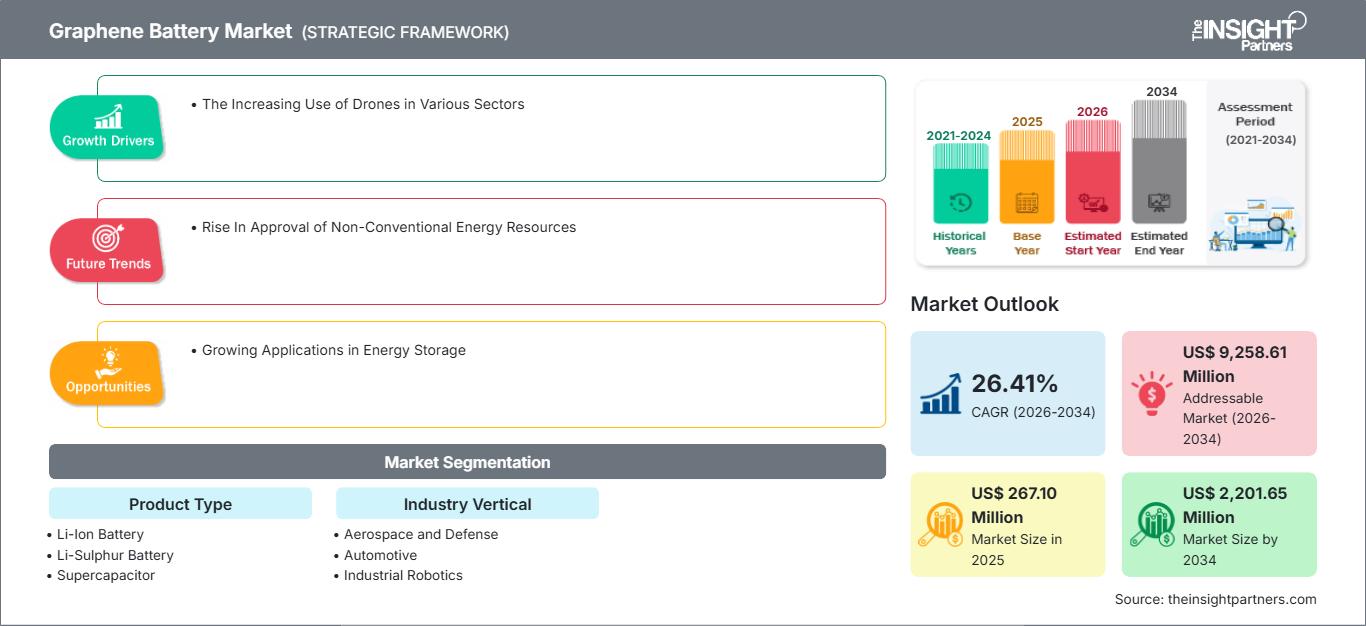
US$ 267.10 Mn
Base year value
2034 Forecast
US$ 2,201.65 Mn
Projected by 2034
CAGR 2026-2034
26.41 %
Growth rate
Addressable Market
US$ 9,258.61 Mn
(2026-2034)
The Graphene Battery Market size was valued at US$ 267.10 Million in 2025 and is projected to reach US$ 2,201.65 Million by 2034, registering a CAGR of 26.41% during 2026–2034. The expansion reflects increasing integration of graphene into electrode architectures, conductive additives, and hybrid energy-storage systems where higher power delivery, thermal management, charging performance, and cycle stability are important purchasing criteria across mobility, electronics, industrial, and energy applications.
North America is positioned for sustained expansion as battery localization, defense modernization, electric mobility, and domestic advanced-materials manufacturing create demand for higher-performance cell components. The regional outlook indicates a CAGR of 25–28% during 2026–2034, supported by public investment in battery supply chains, silicon-graphene development, and qualification programs involving automotive, aerospace, defense, and portable-power applications.
Graphene Battery Market Assessment and Insights
- North America represents a 29–33% Graphene Battery Market share in 2025 and is expected to grow at a CAGR of 25–28% during 2026–2034, supported by battery localization, defense procurement, EV development, and advanced-material manufacturing.
- US accounts for 60–65% of North America's 2025 market and is projected to expand at a CAGR of 25–28% during 2026–2034, driven by domestic battery materials and defense applications.
- Europe holds a 23–27% share in 2025 and is forecast to register a CAGR of 24–27%, with Germany, the UK, France, Italy, and Spain supporting development through mobility, recycling, and industrial decarbonization initiatives.
- Asia Pacific captures a 31–35% share in 2025 and is anticipated to record a CAGR of 28–31%, led by China, Japan, South Korea, and India through electronics, EV, manufacturing, and energy-storage ecosystems.
- Largest Segment: Li-Ion Battery holds a 55–59% market share in 2025 and is expected to grow at a CAGR of 25–28% during 2026–2034, reflecting established cell infrastructure.
- High Growth Segment: Aerospace and Defense represents a 10–14% market share in 2025 and is expected to grow at a CAGR of 29–32%, supported by portable power and weight-sensitive systems.
- Key companies analyzed in detail: FGV Cambridge Nanosystems Ltd., Graphene 3D Lab Inc., Graphene Batteries AS, Graphenea Inc., Grupo Graphenano, NanoGraf Corporation, Nanotek Instruments Inc., NanoXplore Inc., Vorbeck Materials Corp., and XG Sciences Inc.
Source: The Insight Partners' analysis based on proprietary research, government publications, company annual reports, investor presentations, industry databases, and expert interviews.
Graphene Battery Market is advancing from the laboratory-scale production of the material towards its targeted integration into batteries' structures. The production trends of graphene are focused on its quality, dispersion, functionalization of the surfaces and compatibility with traditional electrode fabrication processes. Graphene-enhanced silicon anodes, graphene conductive agents, and graphene-based supercapacitors attract interest since they can improve electric connections in batteries without full replacement of cell designs.
Regional regulations, sustainability, and manufacturing requirements become more and more crucial to the Graphene Battery Market's development. Battery regulations in Europe are tightening recycling, traceability, carbon footprint and utilization of recovered materials, while in North America, programs support domestic materials and cells manufacturing. It is still relevant for Asia Pacific due to large volume of battery manufacturing, electric vehicle advancements, and established electronics supply chain.
Graphene Battery Market Report Scope
| Report Attribute | Details |
|---|---|
| Market size in 2025 | US$ 267.10 Million |
| Market Size by 2034 | US$ 2,201.65 Million |
| Global CAGR (2026 - 2034) | 26.41% |
| Historical Data | 2021-2024 |
| Forecast period | 2026-2034 |
Graphene Battery Market Analysis
Graphene Battery Market growth is facilitated through requirements for faster charging rates, power density, improved heat management, and longevity. Graphene may be used as an electrode material, conductive additive, coating, or structural material, enabling suppliers to seek improvement in performance incrementally without necessitating the replacement of entire battery solutions. These opportunities widen adoption prospects across electric vehicles, drones, electronics, industrial devices, and energy storage.
Ecosystem participants in the Graphene Battery Market include graphite/graphene suppliers, functionalization companies, electrode-material suppliers, cell manufacturers, pack suppliers, OEMs, and test houses. The supply chain is influenced by graphene manufacturing method, purity, properties, dispersion ability, and yield. Commercial adoption requires not just performance in electrochemistry but also consistency in material specifications, scalability in processing, qualification time, safety evaluation, and compatibility with existing electrode coating and battery cell assembly processes.
According to Graphene Battery Market analysis, there is a highly fragmented competitive environment where firms establish differentiated offerings in terms of graphene materials, silicon-graphene anodes, conductive additives, and battery technology in general. NanoXplore Inc. is developing its capacities in terms of graphene and battery materials, whereas NanoGraf Corporation is engaged in silicon anode technologies development. Nanotek Instruments Inc. has established expertise in graphene-enabled lithium-ion batteries, while XG Sciences Inc. developed approaches for silicon-graphene solutions for energy storage.
Increasing investment is focused not only on material innovation but also on the manufacturing processes, qualification, and application-specific testing. Graphenea Inc. and Vorbeck Materials Corp. are complementing each other in the development of advanced graphene materials and engineering solutions, while Graphene 3D Lab Inc., Graphene Batteries AS, Grupo Graphenano, and FGV Cambridge Nanosystems Ltd. represent specializations in graphene-enabled technologies. Competitiveness in the market will rely on cost, consistency, IP protection, and qualification.
● REPORT CUSTOMIZATION
Tailor This Report To Align With Your Specific Business Requirements
This report can be customized to align precisely with your business objectives, scope, and target markets. Customization options include tailored segmentation, geography, competitive analysis, and strategic insights to support informed decision-making.
Customize This Report →WHAT YOU CAN ADJUST
- ● Segmentations
- ● Geography
- ● Competitive Analysis
- ● Language Preferences
Graphene Battery Market: Strategic Insights
Regional Insights
North America Graphene Battery Market
North America holds a 29–33% share of the Graphene Battery Market in 2025 and is expected to expand at a CAGR of 25–28% through 2034. The area gains from battery localization, government-led advanced manufacturing, defense purchases, and increased attention towards domestic supplies of crucial battery materials. The US is the main market for the region, whereas Canada makes contributions in terms of graphene production, mining, material research, and battery innovations.
Applications include defense electronics, drones, electric vehicles (EV), consumer electronics, and stationary storage. Suppliers are increasingly focusing on silicon-graphene anode, conductive additive, and thermal management materials that would be compatible with existing lithium-ion manufacture. Competitiveness of the region is further enhanced by universities, venture capital, and government purchases, but qualification processes and economics of manufacture are still among major hurdles for quick adoption of innovations in mass markets, especially automotive.
U.S. Graphene Battery Market
The U.S. accounts for 60–65% of North America's 2025 Graphene Battery Market and is projected to grow at a CAGR of 25–28% during 2026–2034. Domestic uses involve anodes for graphene, military batteries, EV components, portable energy, and advanced fabrication. The companies include NanoGraf Corporation, NanoXplore Inc., Nanotek Instruments Inc., and Vorbeck Materials Corp.
The demand is becoming more and more applications-based, whereby defense and aerospace consumers prioritize light weight, power density, durability, and reliability. Automotive companies emphasize high charging capability, range, heat resistance, and material sourcing. Furthermore, public support of domestic battery manufacture provides an incentive for local qualification of electrode materials and reduced dependence on foreign sources, thereby increasing the chances of successful implementation of specialized graphene solutions beyond pilot programs.
Europe Graphene Battery Market
Europe represents a 23–27% share in 2025 and is forecast to register a CAGR of 24–27% through 2034. Demand in the region is led by Germany, followed by the UK, France, Italy, and Spain, where automotive manufacturing, electronics, industrial automation, and sustainability considerations drive implementation. Recycling effectiveness, material recovery, and carbon footprint details are becoming increasingly important in European battery regulation.
The UK has an excellent research platform for advanced materials and energy storage, whereas Germany offers the strongest ecosystem for automotive and industrial manufacturing in the region. France combines localized batteries with demand from aerospace and defense applications. Italy and Spain have been developing battery and renewable energy ecosystems capable of accommodating graphene-based parts. Thus, Europe provides good qualification opportunities for suppliers, though regulatory compliance, expensive production, and effective recycling paths could be taken into account when choosing suppliers.
APAC Graphene Battery Market
APAC holds a 31–35% share in 2025 and is expected to grow at a CAGR of 28–31% through 2034, making it the leading regional market. China takes the lead thanks to its expertise in battery manufacturing and EV manufacturing. Japan and South Korea add value through their advanced electronics and cell technologies. India is developing battery manufacturing locally, while Australia supplies graphite and other minerals used in batteries.
Industrial policies, electronics manufacturing, electric mobility, and investments in grid storage will encourage their adoption in the region. The existing capacity for the manufacturing of lithium-ion batteries will help test graphene materials within the existing manufacturing processes. China will continue being the leading country due to its value chain in cells, electronics, and EVs.
Middle East & Africa Graphene Battery Market
Middle East & Africa is projected to expand at a CAGR of 21–24% during 2026–2034. In Saudi Arabia and UAE, energy transition and advanced manufacturing programs are being built, while South Africa has expertise in mining, industries and renewable energy. The Rest of MEA region is smaller in size but holds potential for distributed energy and resiliency of infrastructure.
Diversification of energy resources, deployment of solar energy, electrification and demand for dependable back-up solutions facilitate long-term adoption. The UAE stands as the leading country through investments in technology and energy infrastructure. Commercial adoption is likely to be in specialized electronics, renewable energy storage, transportation and industries where performance gains offset the material qualification expenses.
Segmentation Analysis
Product Type
Graphene Battery Market adoption by Product Type is led by Li-Ion Battery, supported by established manufacturing infrastructure and broad compatibility with graphene-enhanced electrodes. The segment is expected to register a CAGR of 25–28% during 2026–2034. Li-Sulphur Battery and Supercapacitor technologies offer longer-term performance opportunities, while Lead-Acid Battery applications remain relevant where conductivity enhancement and charge acceptance can deliver incremental value.
- Li-Ion Battery remains the principal product pathway because graphene can be incorporated as an anode additive, conductive material, coating, or silicon-composite component without redesigning the complete cell architecture.
- Li-Sulphur Battery attracts development interest because graphene structures can improve sulfur utilization and help manage conductivity and polysulfide-related limitations, making the chemistry relevant to high-energy-density applications.
- Supercapacitor applications benefit from graphene's high surface area and electrical conductivity, supporting rapid power delivery for electronics, regenerative systems, industrial equipment, and hybrid storage architectures.
- Lead-Acid Battery applications use graphene-enabled conductive additives to target improved charge acceptance, power performance, and service life while retaining established manufacturing processes and recycling infrastructure.
Industry Vertical
The Industry Vertical segment is expected to register a CAGR of 26–30% during 2026–2034, with automotive and electronics providing broad commercial opportunities. Aerospace and Defense represents the high-growth segment because weight, power availability, thermal performance, and rugged operation can justify advanced battery materials despite longer qualification cycles.
- Aerospace and Defense prioritizes high specific power, weight reduction, reliability, and operation under demanding conditions, creating opportunities for graphene-enabled portable batteries, drones, communications equipment, and specialized power systems.
- Automotive demand centers on faster charging, thermal management, range, durability, and weight reduction, particularly where graphene can enhance lithium-ion or silicon-based electrode architectures.
- Industrial Robotics requires compact, high-power batteries capable of frequent cycling, making graphene materials relevant for autonomous systems, warehouse robots, mobile platforms, and demanding industrial duty cycles.
- Electronics applications value compact form factors, rapid charging, thermal control, and longer runtime, supporting graphene integration into portable devices, wearables, power tools, and specialized electronic equipment.
- Energy applications focus on power density, cycling capability, and hybrid storage, creating opportunities for graphene-enhanced batteries and supercapacitors in renewable-energy systems and distributed storage.
Opportunity Snapshot
| Industry Vertical | Revenue Contribution (High/Medium/Low) | Trend Tag (MAX 2 words) | Adoption Stage (Emerging/Scaling/Mature) |
| Aerospace and Defense | Medium | Portable Power | Scaling |
| Automotive | High | Fast Charging | Scaling |
| Industrial Robotics | Medium | High Cycling | Scaling |
| Electronics | High | Compact Power | Scaling |
| Energy | Medium | Grid Storage | Emerging |
Graphene Battery Market Growth Drivers and Impact Analysis
Faster Charging and Higher Power Requirements
According to the Graphene Battery Market report, there is an increased need for reduced charging times in electric mobility, portable electronics, drones, robotics, and power tools. Due to its high electrical conductivity, graphene has been proven useful for electrodes because it helps improve transport pathways within the electrode. In a simulation study done for graphene-based batteries in 2025, there was a reduction in charging time by 22–27%, but this is only applicable in some fields. This means that companies should invest more in materials that increase charge acceptance without compromising on the lifespan of the battery. Companies that can demonstrate performance at the cell and pack levels will have access to premium applications where time lost during charging can be charged as a cost of operation.
Battery Supply-Chain Localization
Battery makers and governments have been placing more emphasis on supply chains for graphite, anode materials, cathode components, and cell parts that are regional in nature. This trend opens doors for graphene companies that are able to produce on a consistent basis in regions where there is a lot of battery production and prove feedstock security. Investments made in the North American region in silicon-graphene and domestic anode production demonstrate the importance of regional advanced materials. At the same time, Europe has started focusing on its supply chain due diligence and recovered material requirements, making material inputs more valuable. The market effect will be twofold as qualification opportunities for regional producers increase at the same time as producers need to prove their cost efficiency and scalability of the process.
Demand for Lightweight and Thermally Stable Power Systems
Weight and thermal management are becoming increasingly important as batteries move into drones, aerospace platforms, robotics, defense electronics, and high-performance vehicles. The graphene material may assist in providing electrical pathways and heat management structures, and thus reduce any loss as well as manage heat generation. The above features are especially important where the weight of the batteries affects the payload, distance of operation, or mission life. It is not only limited to cell chemistry as it can be used in different aspects such as conductive layers, heat spreaders, electrodes, and even composites. In addition, with increased qualification criteria, the suppliers will be required to prove the capability of their products under realistic vibration, temperature, charge, and cycle conditions.
Graphene Battery Market Future Trends
Silicon-Graphene Hybrid Anodes
The Graphene Battery Market forecast shows that silicon-graphene hybrid anodes are likely to become an important development direction as manufacturers seek higher energy density without abandoning established lithium-ion manufacturing platforms. Graphene can provide conductive networks and structural support around silicon, helping address conductivity and expansion challenges associated with repeated cycling. Future development will increasingly focus on engineered interfaces, controlled graphene morphology, prelithiation strategies, and scalable electrode processing rather than simply increasing graphene content. Qualification programs are also likely to move from coin cells and laboratory prototypes toward larger cylindrical and pouch formats. The commercial opportunity will favor suppliers that can demonstrate repeatable improvements at competitive cost while maintaining high yield. Partnerships between graphene producers, anode developers, cell manufacturers, and automotive or electronics customers are expected to become more common as technical validation becomes the primary commercialization bottleneck.
Graphene-Enabled Circular Battery Materials
Circularity is expected to become more influential in graphene-enabled battery development as regulators and manufacturers seek to reduce material waste and improve resource efficiency. Graphene oxide and related carbon materials can potentially be produced from recovered graphite-rich battery streams, creating a route toward secondary material inputs. European rules already establish progressively higher recovery expectations for lithium and other critical materials, increasing commercial attention on recycling-compatible designs and traceable feedstocks. Future projects are therefore likely to combine battery performance with material recovery, lifecycle assessment, and documented carbon-footprint performance. This trend could create new business models in which graphene suppliers work directly with recyclers and battery manufacturers to recover carbon-rich fractions and convert them into functional materials. Such integration may reduce raw-material dependence while improving the sustainability profile of advanced battery supply chains.
Graphene Battery Market Opportunities
Domestic Advanced-Material Manufacturing
The Graphene Battery Market trends show that investment opportunities are emerging around regional production of graphene powders, dispersions, silicon-graphene additives, and battery-grade electrode materials. North America offers a particularly relevant environment because battery localization programs and defense procurement can provide early anchor customers for domestic suppliers. Companies can pursue modular production capacity that scales alongside qualification pipelines, limiting exposure to premature large-scale capital deployment. Strategic investors should prioritize facilities with flexible processing, strong quality-control systems, and proximity to battery manufacturers. Partnerships with universities, national laboratories, and cell developers can further reduce technology-transfer barriers. The strongest opportunities are likely to occur where graphene manufacturing is integrated with downstream formulation and electrode development, allowing suppliers to capture more value while responding quickly to customer-specific requirements. Domestic production also provides a hedge against geopolitical disruption and concentrated overseas supply chains.
Specialized High-Value Battery Applications
Specialized applications offer attractive commercialization pathways because performance improvements can carry greater economic value than in cost-sensitive mass-market batteries. Aerospace, defense, drones, industrial robotics, medical equipment, and high-end electronics can justify advanced materials when reduced weight, faster charging, longer runtime, or improved thermal behavior directly improves system performance. Companies entering these markets should prioritize certification, reliability testing, lifecycle data, and application-specific engineering rather than competing solely on material price. Early deployments can generate operational evidence that supports subsequent movement into larger automotive or stationary-storage programs. Investment strategies should therefore favor technologies with transferable manufacturing processes and a clear route from small-volume qualification to larger production. This staged approach can improve capital efficiency while allowing suppliers to refine graphene formulations against real operating conditions before undertaking substantial manufacturing expansion.
Recent Developments
- Auguts 2026: Graphene Manufacturing Group Ltd. (TSX-V: GMG) (OTCQX: GMGMF) (“GMG” or the “Company”) is pleased to provide the latest progress update on the next generation graphene battery technology being developed by GMG and the University of Queensland (“UQ”) under a Joint Development Agreement with Rio Tinto, one of the world’s largest metals and mining groups, and with the support of the Battery Innovation Center of Indiana (“BIC”) in the United States of America.
- April 2026: The Graphene Flagship project GRAPHERGIA has officially launched the piloting phase of its three demonstration cases implementing graphene-based technologies for energy harvesting and storage in real-life applications.
- May 2025: As a prominent graphene battery manufacturer, Tianneng is committed to advancing battery technology with innovative solutions that meet the demands of modern applications. Our TNEH Series represents the culmination of our efforts to blend advanced carbon and graphene technologies into a reliable lead-acid battery. This series is specifically designed for long-life deep cycle applications, making it suitable for a wide range of uses, including electric bicycles, golf trolleys, and electric vehicles (EVs).
Frequently Asked Questions

- Comprehensive Market Sizing and Forecast Analysis
- Detailed Segmentation Analysis
- In-Depth Market Dynamics Assessment
- Regional and Country-Level Insights
- Competitive Landscape and Company Benchmarking
- Strategic Business Intelligence
Recent Reports
Testimonials

The Insight Partners provided valuable market intelligence that supported our global go-to-market strategy. Their team was professional, responsive, and attentive to our feedback, providing thoughtful analysis and helpful methodological clarifications throughout the project.
Junmo Kim Chief Financial Officer (CFO), Enertech Co., Ltd.
The Insight Partners' SCADA System Market report is comprehensive, with valuable insights on current trends and future forecasts. The team was highly professional, responsive, and supportive throughout. We are very satisfied and highly recommend their services.
RAN KEDEM Partner, Reali Technologies LTDs
I requested a report on a very specific software market and the team produced the report in a few days. The information was very relevant and well presented. I then requested some changes and additions to the report. The team was again very responsive and I got the final report in less than a week.
JEAN-HERVE JENN Chairman, Future Analytica
We worked with The Insight Partners for an important market study and forecast. They gave us clear insights into opportunities and risks, which helped shape our plans. Their research was easy to use and based on solid data. It helped us make smart, confident decisions. We highly recommend them.
PIYUSH NAGPAL Sr. Vice President, High Beam Global
The Insight Partners delivered insightful, well-structured market research with strong domain expertise. Their team was professional and responsive throughout. The user-friendly website made accessing industry reports seamless. We highly recommend them for reliable, high-quality research services
YUKIHIKO ADACHI CEO, Deep Blue, LLC.
This is the first time I have purchased a market report from The Insight Partners.While I was unsure at first, I visited their web site and felt more comfortable to take the risk and purchase a market report.I am completely satisfied with the quality of the report and customer service. I had several questions and comments with the initial report, but after a couple of dialogs over email with their analyst I believe I have a report that I can use as input to our strategic planning process.Thank you so much for taking the extra time and making this a positive experience.I will definitely recommend your service to others and you will be my first call when we need further market data.
JOHN SUZUKI President and Chief Executive Officer, Board Director, BK Technologies
I wish to appreciate your support and the professionalism you displayed in the course of attending to my request for information regarding to infectious disease IVD market in Nigeria. I appreciate your patience, your guidance, and the fact that you were willing to offer a discount, which eventually made it possible for us to close a deal. I look forward to engaging The Insight Partners in the future, all thanks to the impression you have created in me as a result of this first encounter.
DR CHIJIOKE ONYIA MANAGING DIRECTOR, PineCrest Healthcare Ltd.Reason to Buy
- Informed Decision-Making
- Understanding Market Dynamics
- Competitive Analysis
- Identifying Emerging Markets
- Customer Insights
- Market Forecasts
- Risk Mitigation
- Boosting Operational Efficiency
- Strategic Planning
- Investment Justification
- Tracking Industry Innovations
- Aligning with Regulatory Trends





 Get Free Sample for