
Green Chemicals Market Size, Demand & Growth by 2034
Coverage: by Product Type (Bio Solvents, Bio Polymers, Bio Organic Acids, Bio Propylene Glycol, Others); Application (Construction, Pharmaceuticals, Automotive, Agrochemicals, Food and Beverages, and Others ), and Geography (North America, Europe, Asia Pacific, and South and Central America)
- Status : Data Released
- Report Code : TIPRE00013380
- Category : Chemicals and Materials
- No. of Pages : 150
- Available Report Formats :


- Last update date : July 30, 2026


2025 Market Size
US$ 156.1 Bn
Base year value
2034 Forecast
US$ 320.96 Bn
Projected by 2034
CAGR 2026-2034
8.34 %
Growth rate
Addressable Market
US$ 2,142.09 Bn
(2026-2034)
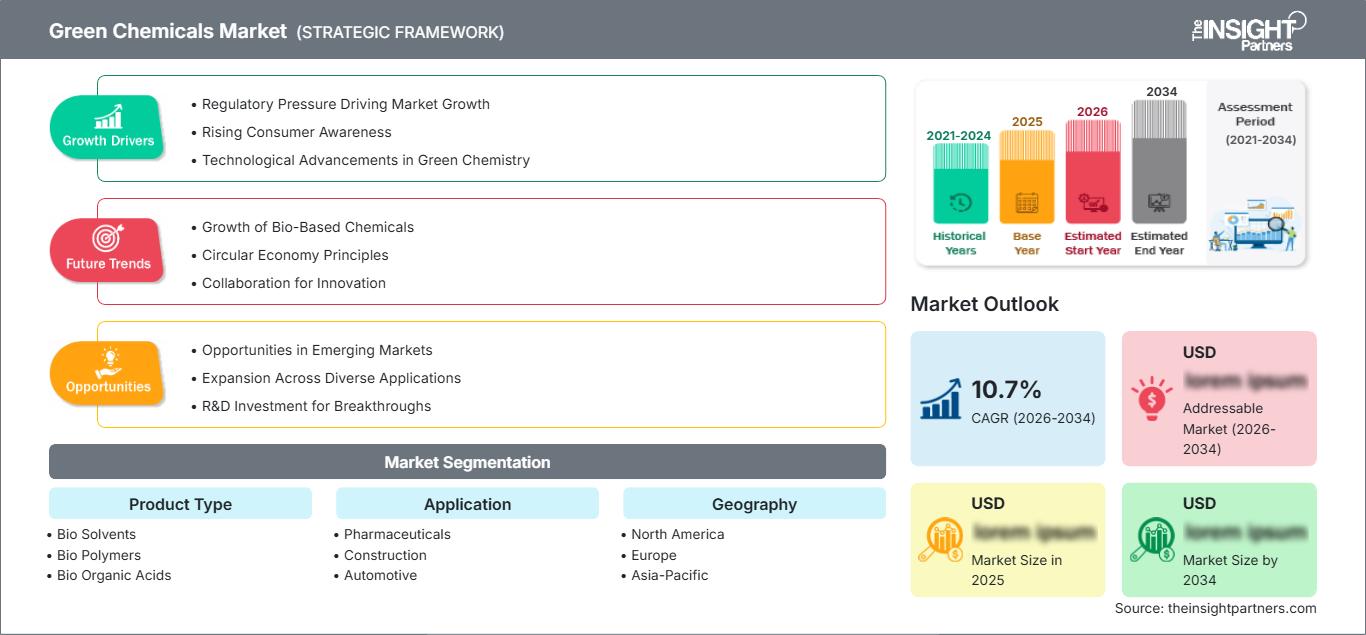
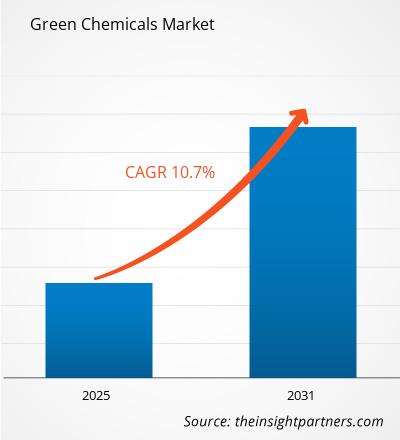
The green chemicals market was valued at US$ 156.1 Billion in 2025 and is projected to reach US$ 320.96 Billion by 2034, expanding at a CAGR of 8.34% during 2026–2034. Rising emphasis on low-carbon manufacturing, increasing adoption of renewable feedstocks, and tightening environmental regulations are accelerating the transition from conventional petrochemical-based products to bio-based alternatives across industries including pharmaceuticals, automotive, construction, agriculture, and food processing.
North America continues to demonstrate strong commercial adoption supported by favorable policy frameworks, advanced biotechnology capabilities, and increasing investments in sustainable manufacturing. The green chemicals market size in the region is expanding steadily as manufacturers scale bio-based production technologies, supported by corporate decarbonization strategies and demand for renewable materials from automotive, packaging, and healthcare industries. The regional market is expected to register a CAGR in the range of 7.5%–8.1% during the forecast period.
Green Chemicals Market Assessment and Insights
- North America: North America accounted for 32%–34% share in 2025, supported by mature biotechnology infrastructure, strong sustainability commitments, and commercialization of renewable chemicals. The regional market is projected to grow at a CAGR of 7.5%–8.1% during 2026–2034.
- U.S.: The U.S. represented 76%–79% of the North American market in 2025, driven by large-scale investments in industrial biotechnology and renewable chemical manufacturing. The country is expected to expand at a CAGR of 7.6%–8.2% during 2026–2034.
- Europe: Europe held 28%–30% share in 2025, led by Germany, France, the Netherlands, and Italy. Stringent climate regulations, circular economy initiatives, and renewable material adoption support a projected CAGR of 7.8%–8.4% during 2026–2034.
- Asia Pacific: Asia Pacific captured 26%–28% share in 2025, with China, Japan, India, and South Korea driving capacity expansion and industrial demand. The region is anticipated to register the fastest expansion with a CAGR of 9.2%–9.8% during 2026–2034.
- Largest Segment: Bio Polymers remained the largest product type, accounting for 34%–37% market share in 2025 owing to extensive usage in packaging, automotive, and consumer products. The segment is projected to grow at a CAGR of 8.6%–9.2% during 2026–2034.
- High Growth Segment: Pharmaceuticals emerged as the fastest-growing application, representing 18%–21% market share in 2025 while benefiting from sustainable ingredient adoption and green synthesis technologies. The segment is expected to record a CAGR of 9.6%–10.2% during 2026–2034.
- Key companies analyzed in detail: Arkema SA, BASF SE, Dow Inc., Cargill, Incorporated, Genomatica, Inc., Myriant Corporation, Corbion N.V., Braskem S.A., Mitsubishi Chemical Group Corporation, Evonik Industries AG.
Source: The Insight Partners' analysis based on proprietary research, government publications, company annual reports, investor presentations, industry databases, and expert interviews.
Increasing environmental legislation, breakthroughs in industrial biotechnology, and the increasing commercialization of renewable feedstocks have changed production processes for green chemicals. Manufacturers are adopting fermentation technology, catalysis, and biomass upcycling in order to make the production process efficient and environmentally friendly. In addition, partnerships between biotechnological developers, chemical producers, and downstream manufacturers are boosting innovation and helping to increase the application scope of products.
The growth in the future is expected to be propelled by investment in Asia Pacific, Latin America, and some countries in the Middle East, where the development of bio-based industries is incentivized through government intervention and policies related to industrial decarbonization. Improvements in feedstocks, biorefinery technologies, and circular economy models will help boost the competitiveness of the industry and provide growth opportunities.
Green Chemicals Market Report Scope
| Report Attribute | Details |
|---|---|
| Market size in 2025 | US$ 156.1 Billion |
| Market Size by 2034 | US$ 320.96 Billion |
| Global CAGR (2026 - 2034) | 8.34% |
| Historical Data | 2021-2024 |
| Forecast period | 2026-2034 |
Green Chemicals Market Analysis
Growing regulation focus on carbon neutrality, circular manufacturing, and sustainable industrial development is continuously enhancing green chemicals market growth in both developed and emerging nations. Regulations are being introduced by governments to incentivize substitution of fossil-based chemicals through renewable sources, tax rebates, and stringent emission norms. On the other hand, international manufacturers have started adopting bio-based chemicals in their sustainability plans, thus generating robust demand from the pharmaceutical, construction, automotive, and food processing industries. Advancements in biotechnology processes and increasing commercialization of bio-refineries have also brought about cost reduction, driving adoption.
Transformation of the supply chain network is yet another feature of the market. Agricultural biomass, sugar derivatives, vegetable oil, forestry residue, and waste material from industrial plants are increasingly being used as renewable feedstocks, helping improve resource efficiency as well as meet circular economy goals. Chemical manufacturers have started working closely with feedstock providers, biotechnology developers, logistics firms, and downstream processors for achieving increased supply security as well as lower lifecycle emissions. Bio-refineries and advanced catalytic technologies are also adding up to production flexibility and commercialization scalability.
The competition will stay highly dynamic because of expansion of production capacities among global players in chemical industry and innovative development of fermentation platforms by players working in the sphere of biotechnology. According to comprehensive analysis of green chemicals market report, corporations tend to develop market position through research collaborations, business acquisitions and product portfolio extension. Arkema SA, BASF SE, Dow Inc., Evonik Industries AG and Mitsubishi Chemical Group Corporation continue to invest in sustainable materials while Corbion N.V., Braskem S.A., Cargill, Incorporated, Genomatica, Inc. and Myriant Corporation work on extension of bio-based chemicals range for industrial purposes.
More investment is going into development of bio-manufacturing facilities, energy efficient technologies and renewable raw materials usage. Public financing programs, private equity investments and sustainability programs launched by corporations facilitate commercial introduction of next generation green chemicals in leading world economies. Corporations also aim at building up regional manufacturing facilities in order to decrease supply chain risks and meet rising demand for sustainable products among customers. These measures will increase effectiveness, ensure supply and contribute to competitiveness during forecast period.
● REPORT CUSTOMIZATION
Tailor This Report To Align With Your Specific Business Requirements
This report can be customized to align precisely with your business objectives, scope, and target markets. Customization options include tailored segmentation, geography, competitive analysis, and strategic insights to support informed decision-making.
Customize This Report →WHAT YOU CAN ADJUST
- ● Segmentations
- ● Geography
- ● Competitive Analysis
- ● Language Preferences
Green Chemicals Market: Strategic Insights
Regional Insights
North America Green Chemicals Market
The green chemicals market share in North America held a market share of 32%-34% in the year 2025 and is anticipated to grow at a rate of CAGR of 7.5%-8.1% between 2026 and 2034. The region has a well-established biotech ecosystem, favorable policies for renewable fuel and bioeconomy, and growing investment in green chemistry production that helps in promoting growth in this industry. Growing demand from industries such as packaging, pharmaceuticals, automotive, and construction is further helping in the commercialization of biobased solvents, polymers, and specialty chemicals.
Growing investment in biorefineries and fermentation technology has improved production and feedstock utilization efficiency. The United States holds dominance over North America owing to its technological expertise in research, whereas, on the other hand, Canada is developing its renewable chemical manufacturing by utilizing biomass. Growing consumer preference for eco-friendly products along with stringent environmental regulations is expected to drive the market growth.
U.S. Green Chemicals Market
The United States accounted for 76% to 79% of the North American market in 2025 and is expected to witness a CAGR of 7.6% to 8.2% between 2026 and 2034. The nation holds a dominant position in the market due to robust biotechnology research, availability of agricultural feedstocks, and significant investments in renewable manufacturing facilities. The demand is growing in the pharmaceuticals, automotive parts, packaging materials, and sustainable building products segments.
Leading players such as Dow Inc., Cargill, Incorporated, Genomatica, Inc., and many others continue to enhance their research and manufacturing activities. Adoption of green chemistry concepts by the industrial manufacturers will boost the domestic demand for bio solvents, bio polymers, and renewable intermediates. Technological advancements in the field of catalytic processes, synthetic biology, and biomass conversion technology are likely to further consolidate its dominant market position.
Europe Green Chemicals Market
Europe was expected to constitute 28%-30% of the total global market share by 2025 and was estimated to grow with a CAGR of 7.8%-8.4% between 2026 and 2034. Germany is expected to be the leader in this region owing to its superior chemical manufacturing infrastructure. While the UK has leveraged on innovation in biotechnology, France, Italy, and Spain have been focusing on renewable feedstocks and circular manufacturing processes.
Germany will continue to dominate commercialization with investments in industrial biotechnology, sustainable specialty chemicals, and advanced manufacturing processes. In the United Kingdom, innovation would be achieved through collaboration in research and commercialization initiatives in the field of bio-materials. In France, bio-refineries are being invested in and in Italy and Spain renewable chemical production is being developed in the fields of packaging, food processing, and construction.
APAC Green Chemicals Market
The APAC region held a share of 26%-28% in the global market in 2025 and is forecast to have the highest CAGR of 9.2%-9.8% for the period from 2026 to 2034. China holds the leading production capacity in the region, whereas countries like Japan, South Korea, India, and Australia are continuing their investment in renewable feedstocks and industrial biotech.
Industrialization, governmental support, and environment-related regulations are driving the usage of green chemicals. Growing pharmaceuticals, automotive sector manufacturing, and bio-refineries are forecast to boost regional demand and make APAC the fastest-growing regional market during the forecast period.
Middle East & Africa Green Chemicals Market
Expansion of Middle East & Africa is expected during the forecasted period owing to the increasing investment in industrial diversification and manufacture of renewables. Leading in regional development are Saudi Arabia, the UAE, and South Africa, and the market is estimated to grow at a CAGR of 8.4%–9.0% during 2026–2034.
With the government’s efforts in favor of sustainable development of industry and increasing investment in downstream chemical manufacturing and manufacture of renewables, new opportunities are arising. It can be assumed that infrastructure development, strategies of energy transition, and increased construction activities will drive the demand for chemical products with minimum environmental impact.
Segmentation Analysis
Product Type
The Product Type segment is expected to grow at a CAGR of 8.5%–9.1% during 2026–2034. The green chemicals market scope continues to broaden as manufacturers develop renewable alternatives to conventional petrochemical products using advanced biotechnology, biomass conversion, and catalytic processing. Increasing sustainability regulations, improved feedstock availability, and continuous product innovation are supporting commercial adoption across packaging, pharmaceuticals, construction, automotive, and consumer applications.
- Bio Solvents – Bio solvents are increasingly replacing petroleum-derived solvents in coatings, cleaning formulations, adhesives, and industrial processing owing to lower toxicity, improved biodegradability, and compliance with evolving environmental regulations across developed and emerging economies.
- Bio Polymers – Bio polymers represent the largest product category, supported by expanding applications in sustainable packaging, automotive components, consumer goods, and medical products where renewable materials help reduce lifecycle carbon emissions.
- Bio Organic Acids – Bio organic acids are witnessing broader utilization in food preservation, pharmaceuticals, agriculture, and specialty chemical production because of their renewable origin, versatile functionality, and compatibility with sustainable manufacturing practices.
- Bio Propylene Glycol – Bio propylene glycol is gaining commercial importance in cosmetics, food ingredients, deicing fluids, and industrial formulations due to its lower environmental footprint and growing preference for bio-based performance chemicals.
Application
The Application segment is projected to register a CAGR of 8.8%–9.4% during 2026–2034. Expanding environmental regulations, increasing consumer awareness, and corporate sustainability targets are encouraging wider adoption of renewable chemicals across diverse industries. Manufacturers continue investing in bio-based formulations to reduce emissions while maintaining product performance and regulatory compliance across end-use sectors.
- Pharmaceuticals – Pharmaceutical manufacturers are increasingly utilizing renewable intermediates and green synthesis technologies to improve process sustainability, reduce hazardous waste generation, and comply with stricter environmental and quality standards.
- Construction – Construction applications are expanding through adoption of sustainable coatings, adhesives, insulation materials, and specialty chemicals that contribute to green building certifications and lower lifecycle environmental impacts.
- Automotive – Automotive manufacturers continue integrating bio-based polymers, coatings, lubricants, and composite materials to reduce vehicle weight, improve sustainability performance, and support global decarbonization initiatives.
- Agrochemicals – Agrochemical producers are incorporating renewable ingredients into fertilizers, crop protection products, and soil enhancement formulations to improve environmental compatibility while maintaining agricultural productivity.
- Food and Beverages – Food and beverage companies increasingly adopt bio-based ingredients, preservatives, packaging materials, and processing chemicals to address consumer preference for sustainable products and comply with evolving environmental regulations.
Opportunity Snapshot
| Application | Revenue Contribution | Trend Tag | Adoption Stage |
| Pharmaceuticals | High | Green Synthesis | Scaling |
| Construction | Medium | Low Carbon | Scaling |
| Automotive | High | Lightweight Materials | Mature |
| Agrochemicals | Medium | Bio Inputs | Emerging |
| Food and Beverages | Medium | Sustainable Packaging | Scaling |
Green Chemicals Market Growth Drivers and Impact Analysis
Stringent Environmental Regulations Accelerating Bio-based Chemical Adoption
Governments across North America, Europe, and Asia Pacific are implementing stricter environmental regulations to reduce greenhouse gas emissions, hazardous waste generation, and dependence on fossil-derived chemicals. Regulatory frameworks supporting renewable feedstocks, carbon reduction, and circular economy principles are encouraging manufacturers to replace conventional petrochemical products with sustainable alternatives. Industries including automotive, pharmaceuticals, construction, and food processing increasingly prioritize environmentally compliant raw materials to meet evolving customer expectations and sustainability commitments. Investments in cleaner manufacturing technologies are further improving production efficiency while reducing lifecycle emissions. As regulatory requirements continue to tighten globally, demand for renewable chemicals is expected to strengthen across industrial value chains, creating long-term opportunities for manufacturers capable of delivering high-performance, bio-based chemical solutions with competitive production economics.
Rapid Advancements in Industrial Biotechnology and Bio-refinery Technologies
Technological innovation is transforming commercial production of renewable chemicals through advances in synthetic biology, precision fermentation, enzyme engineering, and catalytic conversion technologies. Modern integrated biorefineries enable efficient utilization of agricultural residues, sugar feedstocks, vegetable oils, and biomass waste to manufacture high-value chemicals with lower environmental impact. Continuous improvements in process optimization, feedstock flexibility, and production scalability are reducing manufacturing costs while improving product quality. Strategic collaborations among biotechnology firms, research institutions, and global chemical producers are accelerating commercialization of innovative green chemical platforms. These technological developments strengthen supply chain resilience, improve manufacturing competitiveness, and support expansion into high-growth application areas requiring sustainable performance materials.
Corporate Sustainability Commitments Supporting Long-term Market Expansion
Global manufacturers increasingly integrate environmental, social, and governance objectives into corporate procurement and production strategies, significantly expanding demand for renewable chemical products. Major consumer goods companies, automotive manufacturers, pharmaceutical producers, and packaging suppliers continue establishing ambitious carbon neutrality targets that require greater adoption of sustainable materials throughout their supply chains. Long-term procurement agreements, investment in renewable manufacturing capacity, and supplier sustainability programs are creating stable commercial demand for bio-based chemicals. Financial institutions are also increasing support for low-carbon industrial projects, improving access to capital for capacity expansion. These combined developments encourage continuous innovation while strengthening the commercial viability of sustainable chemical manufacturing worldwide.
Green Chemicals Market Future Trends
Expansion of Circular Bioeconomy Business Models
Industrial manufacturers are increasingly integrating circular bioeconomy principles into production systems by utilizing renewable feedstocks, agricultural residues, recycled biomass, and industrial by-products. This green chemicals market trends shift supports efficient resource utilization while reducing waste generation and dependence on fossil resources. Companies continue investing in closed-loop manufacturing systems, advanced recycling technologies, and integrated bio-refineries that maximize feedstock efficiency. Strategic partnerships between agricultural producers, biotechnology companies, and chemical manufacturers are expected to improve raw material availability while enhancing supply chain sustainability. As governments strengthen circular economy regulations, commercial adoption of renewable chemicals is expected to accelerate across diverse industrial sectors.
Digital Manufacturing and Artificial Intelligence in Green Chemical Production
Artificial intelligence, digital twins, advanced process analytics, and predictive manufacturing technologies are becoming increasingly important in renewable chemical production. These technologies enable manufacturers to optimize fermentation processes, improve catalyst performance, reduce energy consumption, and enhance quality control across production facilities. Real-time monitoring and predictive maintenance also improve operational efficiency while lowering manufacturing costs. Integration of digital technologies with industrial biotechnology supports faster product development, improved process consistency, and scalable commercialization of innovative bio-based chemicals. Continued digital transformation is expected to strengthen operational competitiveness while supporting sustainable industrial growth throughout the forecast period.
Green Chemicals Market Opportunities
Emerging Bio-based Chemical Manufacturing in Developing Economies
Developing economies across Asia Pacific, Latin America, the Middle East, and Africa present significant investment opportunities due to expanding industrialization, abundant renewable feedstocks, and supportive government initiatives promoting sustainable manufacturing. Green chemicals market Forecasts indicate that increasing public and private investments in bio-refineries, industrial biotechnology infrastructure, and renewable feedstock processing will strengthen regional production capabilities over the next decade. Companies establishing localized manufacturing facilities can reduce logistics costs while improving supply chain resilience and serving rapidly expanding domestic industries. Strategic partnerships with agricultural producers and biotechnology developers are expected to accelerate commercialization and improve long-term market competitiveness.
High-value Specialty Applications for Renewable Chemical Innovation
Specialty applications including pharmaceutical intermediates, advanced coatings, sustainable packaging materials, biomedical polymers, cosmetics ingredients, and electronic chemicals offer attractive long-term growth opportunities for manufacturers. Increasing customer demand for environmentally responsible products with high technical performance encourages investment in research, advanced formulations, and proprietary production technologies. Companies capable of developing differentiated specialty chemicals with superior sustainability credentials can achieve stronger pricing power and long-term customer relationships. Expansion into high-value niche applications also reduces dependence on commodity markets while improving profitability through innovation-driven product portfolios and specialized manufacturing capabilities.
Recent Developments
- July 2026: Songwon Industrial, a global leader in specialty chemicals, took a major step forward in sustainable sourcing with the certification of its SONGNOX 1076 phenolic antioxidant under the Roundtable on Sustainable Palm Oil (RSPO) Mass Balance (MB) standard.
- June 2026: Spray Engineering Devices Limited (SED) received approval for for setting up a 91 KLPD Second Generation (2G) Ethanol Biorefinery at Wave Sugar, Dhanaura, Uttar Pradesh, India.
- April 2025: BASF SE launched Sokalan CP 301, its first readily biodegradable dispersant for agricultural formulations. The product addresses increasing regulatory demand for environmentally compatible additives while maintaining formulation stability, supporting the broader transition toward sustainable agrochemical solutions and bio-based specialty chemicals.
Frequently Asked Questions

- Comprehensive Market Sizing and Forecast Analysis
- Detailed Segmentation Analysis
- In-Depth Market Dynamics Assessment
- Regional and Country-Level Insights
- Competitive Landscape and Company Benchmarking
- Strategic Business Intelligence
Recent Reports
Testimonials

The Insight Partners provided valuable market intelligence that supported our global go-to-market strategy. Their team was professional, responsive, and attentive to our feedback, providing thoughtful analysis and helpful methodological clarifications throughout the project.
Junmo Kim Chief Financial Officer (CFO), Enertech Co., Ltd.
The Insight Partners' SCADA System Market report is comprehensive, with valuable insights on current trends and future forecasts. The team was highly professional, responsive, and supportive throughout. We are very satisfied and highly recommend their services.
RAN KEDEM Partner, Reali Technologies LTDs
I requested a report on a very specific software market and the team produced the report in a few days. The information was very relevant and well presented. I then requested some changes and additions to the report. The team was again very responsive and I got the final report in less than a week.
JEAN-HERVE JENN Chairman, Future Analytica
We worked with The Insight Partners for an important market study and forecast. They gave us clear insights into opportunities and risks, which helped shape our plans. Their research was easy to use and based on solid data. It helped us make smart, confident decisions. We highly recommend them.
PIYUSH NAGPAL Sr. Vice President, High Beam Global
The Insight Partners delivered insightful, well-structured market research with strong domain expertise. Their team was professional and responsive throughout. The user-friendly website made accessing industry reports seamless. We highly recommend them for reliable, high-quality research services
YUKIHIKO ADACHI CEO, Deep Blue, LLC.
This is the first time I have purchased a market report from The Insight Partners.While I was unsure at first, I visited their web site and felt more comfortable to take the risk and purchase a market report.I am completely satisfied with the quality of the report and customer service. I had several questions and comments with the initial report, but after a couple of dialogs over email with their analyst I believe I have a report that I can use as input to our strategic planning process.Thank you so much for taking the extra time and making this a positive experience.I will definitely recommend your service to others and you will be my first call when we need further market data.
JOHN SUZUKI President and Chief Executive Officer, Board Director, BK Technologies
I wish to appreciate your support and the professionalism you displayed in the course of attending to my request for information regarding to infectious disease IVD market in Nigeria. I appreciate your patience, your guidance, and the fact that you were willing to offer a discount, which eventually made it possible for us to close a deal. I look forward to engaging The Insight Partners in the future, all thanks to the impression you have created in me as a result of this first encounter.
DR CHIJIOKE ONYIA MANAGING DIRECTOR, PineCrest Healthcare Ltd.Reason to Buy
- Informed Decision-Making
- Understanding Market Dynamics
- Competitive Analysis
- Identifying Emerging Markets
- Customer Insights
- Market Forecasts
- Risk Mitigation
- Boosting Operational Efficiency
- Strategic Planning
- Investment Justification
- Tracking Industry Innovations
- Aligning with Regulatory Trends





 Get Free Sample for