
Green Concrete Market Growth, Trends & Forecast by 2034
Coverage: by Product (Cement, Lime); Design (Plain Cement, Pre-Stressed); Application (Infrastructure, Residential, Industrial), and Geography (North America, Europe, Asia Pacific, and South and Central America)
- Status : Data Released
- Report Code : TIPRE00013381
- Category : Chemicals and Materials
- No. of Pages : 150
- Available Report Formats :


- Last update date : July 30, 2026


2025 Market Size
US$ 11.31 Bn
Base year value
2034 Forecast
US$ 25.0 Bn
Projected by 2034
CAGR 2026-2034
9.21 %
Growth rate
Addressable Market
US$ 162.25 Bn
(2026-2034)
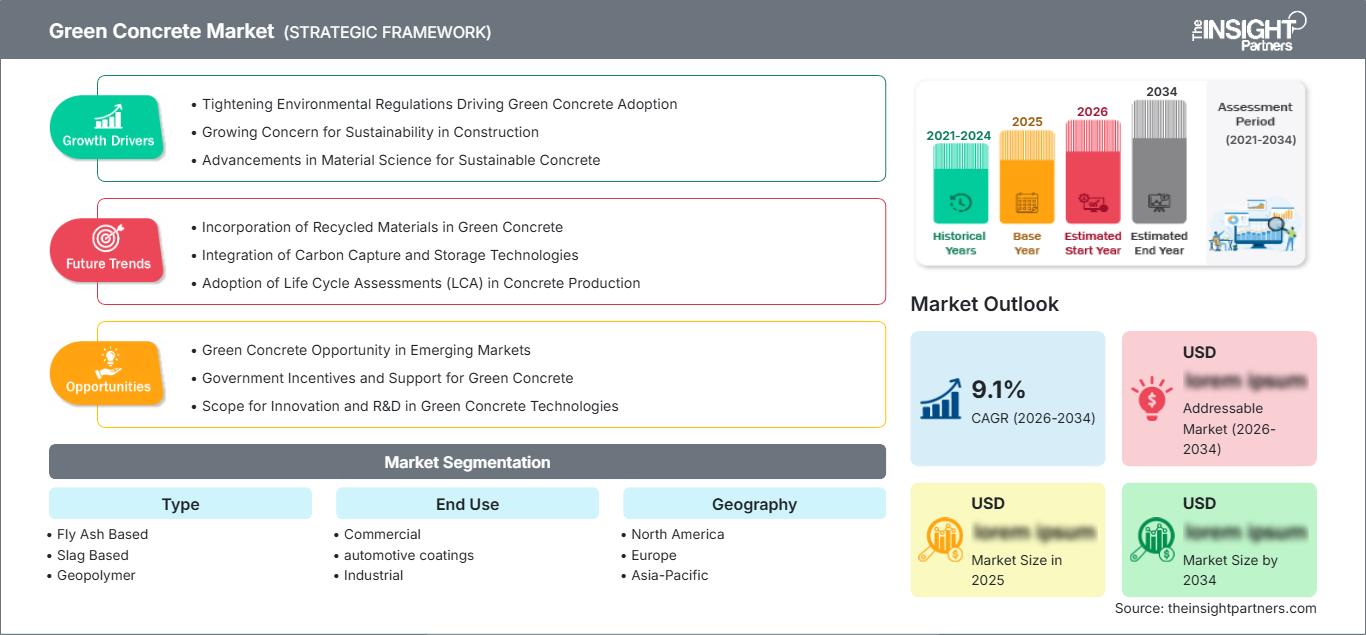
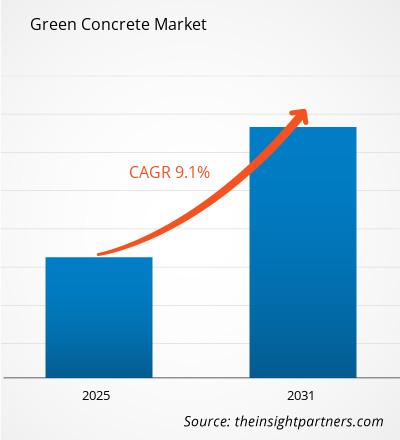
The green concrete market was valued at US$ 11.31 Billion in 2025 and is projected to reach US$ 25.0 Billion by 2034, registering a CAGR of 9.21% during 2026–2034. The market is gaining attention as construction stakeholders increasingly adopt lower-carbon alternatives to conventional concrete through the integration of supplementary cementitious materials, recycled components, and advanced binder technologies across infrastructure and building projects.
Growing construction activity and sustainability initiatives are shaping the North America green concrete market size, supported by infrastructure modernization programs, carbon reduction targets, and rising demand for environmentally responsible construction materials. The region is expected to record a CAGR range of 8–10% during 2026–2034, driven by government-led decarbonization policies, green building certifications, and increased adoption of alternative cement solutions.
Green Concrete Market Assessment and Insights
- North America accounted for an estimated 27–31% share in 2025 and is expected to grow at a CAGR range of 8–10% between 2026–2034, supported by sustainable infrastructure investments, regulatory focus on emissions reduction, and adoption of low-carbon construction materials.
- US represented approximately 22–26% share in 2025, with a CAGR range of 8–10% during 2026–2034, driven by federal infrastructure spending, green building standards, and increasing use of supplementary cementitious materials.
- Europe held an estimated 25–29% share in 2025 and is projected to expand at a CAGR range of 7–9% during 2026–2034, led by Germany, the UK, France, and Nordic countries implementing carbon neutrality initiatives in construction.
- Asia Pacific captured around 30–34% share in 2025 and is expected to register the highest CAGR range of 10–12% during 2026–2034, supported by China, India, Japan, and South Korea’s expanding infrastructure activities and sustainable construction policies.
- Largest Segment: Slag Based concrete held approximately 35–39% market share in 2025 and is anticipated to grow at a CAGR range of 8–10% during 2026–2034 due to industrial by-product utilization and durability benefits.
- High Growth Segment: Geopolymer concrete accounted for around 18–22% market share in 2025 and is projected to grow at a CAGR range of 11–13% during 2026–2034, supported by demand for cement replacement technologies.
- Key companies analyzed in detail: BASF SE, CEMEX, S.A.B. de C.V., CeraTech, Inc., Chryso SAS, CICO Technologies Limited, Heidelberg Materials AG, MAPEI S.p.A., Pidilite Industries Limited, RPM International Inc., Dow Inc., Sika AG, Holcim Ltd., and Saint-Gobain.
Source: The Insight Partners' analysis based on proprietary research, government publications, company annual reports, investor presentations, industry databases, and expert interviews.
Innovations in green concrete production have occurred due to changes in the science of binders, material recycling and manufacture optimization. Modern producers incorporate such binders as fly ash, slag and geopolymer products to minimize the use of clinker and improve the properties of concrete. Other innovations include digitalization of production, lifecycle assessment techniques and new admixtures' formulas. Building contractors favor materials which not only conform to the environmental regulations but also are durable, strong and energy efficient. These innovations have stimulated producers to develop more sustainable portfolios and partner with infrastructure companies looking for carbon-free solutions for their projects.
Further growth of the green concrete market share may be driven by developing countries' investments into sustainable urban planning and infrastructure. Regulations aimed at minimizing emissions from construction process and high demand for green-certified buildings will stimulate further adoption. Investment into alternative sources of materials, carbon capture and circular construction may become other factors affecting the market dynamics. Regions with intensive pipeline of infrastructure projects, such as Asia Pacific and the Middle East, are likely to provide new opportunities.
Green Concrete Market Report Scope
| Report Attribute | Details |
|---|---|
| Market size in 2025 | US$ 11.31 Billion |
| Market Size by 2034 | US$ 25.0 Billion |
| Global CAGR (2026 - 2034) | 9.21% |
| Historical Data | 2021-2024 |
| Forecast period | 2026-2034 |
Green Concrete Market Analysis
The key drivers of growth in the market involve efforts to cut down carbon emissions in cement manufacture, which contribute substantially to industrial carbon emissions globally. There is an increasing demand for such products from infrastructure developers, commercial constructors, and industrial companies looking for materials that will help them reduce their carbon footprint. The market includes suppliers of raw materials, admixtures, cement, concrete, construction companies, and end users. The suppliers of fly ash, slag, and other binders will have a vital role in ensuring sustainable material supply, whereas technology suppliers will help with formula improvement.
Supply factors are changing in terms of scaling up of production capacities for low-carbon concrete. These factors include the availability of industrial waste products, regional building activities, and regulatory requirements. There are plans for collaboration between the companies and cement manufacturers or construction companies in order to enhance distribution and usage of the materials. Opportunities arise from the inclusion of recycled materials and innovative chemical admixtures in the formulations, but there are still difficulties concerning material consistency and regional availability.
From the green concrete market report, it is clear that the competitive position is being increasingly defined by innovations, sustainability, and geographical expansion. The major firms are focusing on the creation of new binder systems, decreasing carbon intensity, and improving performance parameters of concrete. BASF SE, Heidelberg Materials AG, CEMEX, S.A.B. de C.V., and MAPEI S.p.A. are building up their sustainable construction solutions portfolio by means of advanced material and technical services. The specialized players like CeraTech, Inc. and CICO Technologies Limited are making a contribution to this market with alternative concrete technologies suitable for low emission construction solutions.
The investments are made in R&D, production upgrades, and partnerships. Companies are broadening the range of sustainable cement alternatives, recycled materials processing, and environmentally advanced construction chemicals. Chryso SAS, Pidilite Industries Limited, RPM International Inc., and Dow Inc. are capitalizing on their expertise in construction chemicals and additives.
● REPORT CUSTOMIZATION
Tailor This Report To Align With Your Specific Business Requirements
This report can be customized to align precisely with your business objectives, scope, and target markets. Customization options include tailored segmentation, geography, competitive analysis, and strategic insights to support informed decision-making.
Customize This Report →WHAT YOU CAN ADJUST
- ● Segmentations
- ● Geography
- ● Competitive Analysis
- ● Language Preferences
Green Concrete Market: Strategic Insights
Regional Insights
North America Green Concrete Market
North America accounted for an estimated 27–31% share of the market in 2025 and is expected to expand at a CAGR range of 8–10% during 2026–2034. The regional outlook is supported by infrastructure renewal programs, sustainable building regulations, and increasing adoption of low-carbon construction materials across public and private projects.
The US and Canada remain key contributors, with construction companies adopting supplementary cementitious materials, recycled aggregates, and advanced admixture technologies. Federal infrastructure investments and carbon reduction initiatives are encouraging manufacturers to develop environmentally optimized concrete solutions. Growing preference for green building certifications and lifecycle-based material selection is expected to strengthen regional demand throughout the forecast period.
U.S. Green Concrete Market
The U.S. green concrete market represented approximately 22–26% of North America’s share in 2025 and is projected to grow at a CAGR range of 8–10% during 2026–2034. The country benefits from increasing infrastructure modernization activities, federal sustainability programs, and rising demand for reduced-carbon construction materials.
Companies including CEMEX, S.A.B. de C.V., BASF SE, and Heidelberg Materials AG maintain strong operational presence through sustainable cement and concrete solutions. Applications across transportation infrastructure, commercial buildings, industrial facilities, and urban development projects are expanding as contractors prioritize environmental compliance. Adoption is further supported by green building standards and procurement policies favoring lower-emission materials.
Europe Green Concrete Market
Europe held an estimated 25–29% share of the market in 2025 and is anticipated to register a CAGR range of 7–9% during 2026–2034. The region remains a leading market due to stringent climate policies, carbon reduction targets, and increasing adoption of sustainable construction practices. Germany, the UK, France, Italy, and Spain are major contributors.
The UK market is supported by net-zero construction targets, infrastructure redevelopment, and increasing use of alternative cement materials. Germany is witnessing higher adoption due to industrial sustainability initiatives and advanced construction technology implementation. France, Italy, and Spain are expanding through public infrastructure projects and regulations encouraging lower-carbon building materials. European producers are increasingly investing in circular construction methods, recycled materials, and environmentally efficient concrete production.
APAC Green Concrete Market
Asia Pacific accounted for approximately 30–34% share of the green concrete market in 2025 and is expected to achieve a CAGR range of 10–12% during 2026–2034. China represents the leading contributor due to extensive infrastructure development and sustainability-focused construction policies.
Japan, South Korea, India, and Australia are adopting sustainable concrete solutions through urban development programs, industrial modernization, and emissions reduction initiatives. Government support for green buildings, smart cities, and transportation infrastructure is encouraging adoption of alternative binders. Expanding construction activity and increasing awareness regarding environmental impacts are expected to accelerate regional market penetration.
Middle East & Africa Green Concrete Market
Middle East & Africa represented an estimated 8–12% share of the green concrete market in 2025 and is projected to grow at a CAGR range of 9–11% during 2026–2034. Saudi Arabia and the UAE are leading markets due to large-scale infrastructure projects and sustainability-driven urban development programs.
South Africa and other regional economies are adopting sustainable construction materials to improve resource efficiency and reduce environmental impact. Energy transition initiatives, infrastructure diversification, and government-led development programs are supporting market expansion. Demand is expected to increase as construction stakeholders integrate low-carbon materials into commercial, residential, and industrial projects.
Segmentation Analysis
Product
The product segment in the Green Concrete Market scope includes cement and lime, with a CAGR of 8.5–9.3%. Cement dominates due to its widespread use and continuous innovation in low-carbon formulations. Lime is gaining traction in niche applications for improved durability and environmental benefits.
- Cement: Dominates demand due to versatility and compatibility with green additives, supporting large-scale infrastructure and construction projects with improved strength and reduced emissions.
- Lime: Increasingly used in specialty applications where enhanced durability and reduced environmental impact are required, particularly in restoration and sustainable construction projects.
Design
The design segment is growing at a CAGR of 8.7–9.5% driven by advancements in structural engineering and construction practices. Pre-stressed designs are gaining popularity for infrastructure applications, while plain cement designs remain widely used in residential construction.
- Plain Cement: Widely adopted due to simplicity and cost-effectiveness, particularly in residential and small-scale construction projects where sustainability considerations are gradually increasing.
- Pre-Stressed: Increasing adoption in infrastructure projects due to enhanced load-bearing capacity and durability, supporting sustainable and long-lasting construction solutions.
Application
The application segment is expanding at a CAGR of 9.2–10.2%, driven by infrastructure development and urbanization. Infrastructure applications dominate due to large-scale projects, while residential and industrial segments contribute steadily to market growth.
- Infrastructure: Represents the largest demand due to government investments in transportation, energy, and urban development projects emphasizing sustainability and durability.
- Residential: Growing adoption driven by increasing awareness of eco-friendly construction and rising demand for energy-efficient housing solutions.
- Industrial: Moderate demand supported by sustainable industrial construction and corporate initiatives to reduce environmental impact.
Opportunity Snapshot
| Application | Revenue Contribution | Trend Tag | Adoption Stage |
| Infrastructure | High | Urban Mobility | Scaling |
| Residential | Medium | Eco Housing | Scaling |
| Industrial | Low | Sustainable Plants | Emerging |
Green Concrete Market Growth Drivers and Impact Analysis
Rising demand for low-carbon construction materials
The movement towards low-carbon concrete materials is one of the key factors behind the development of these materials. The process of cement production is responsible for a lot of greenhouse gas emissions around the world, pushing governments and developers to seek other alternatives that would have less negative environmental impact. There are green concrete options available that utilize fly ash, slag, and geopolymer binders to cut the use of traditional cement produced from clinker. The increased application of green building rating systems and sustainable procurement processes is stimulating contractors and developers to adopt these materials. This trend pushes concrete material manufacturers to develop more innovative formulas that would ensure good structural properties alongside improved environmental performance.
Expansion of infrastructure development activities
Infrastructure projects have been gaining traction due to the need for sustainable and strong construction material. Sustainable concrete can be used to build strong transportation systems, urban infrastructures, green energy projects, and public infrastructures through its ability to serve for many years without the need for frequent maintenance. In Asia Pacific, North America, and the Middle East, governments have prioritized their infrastructure needs but at the same time ensuring that they factor in environmental issues in the planning process. Through green concrete, governments will be able to achieve these two goals at once because it is more resource efficient and can also allow for the use of industrial by-products.
Increasing adoption of circular construction practices
The trend towards circularity in construction is becoming ever more popular as industries attempt to decrease wastage and increase efficient use of resources. The concept of green concrete helps achieve circularity through the use of recycled materials, industrial residues, and alternative raw materials in manufacturing of concrete. Companies in the construction industry are seeking out ways to avoid putting materials in landfills without sacrificing the strength and durability requirements. Increased attention towards resource efficiency has led to collaboration between material manufacturers, concrete producers, and infrastructure constructors. Initiatives related to recycling and enhanced processing techniques have been helpful in solving issues around availability and uniformity of raw materials. With increased demand for sustainability reports from construction businesses, this is becoming a competitive advantage.
Green Concrete Market Future Trends
Integration of digital technologies in sustainable concrete production
Digital technologies are expected to influence green concrete market trends by improving material optimization, quality monitoring, and lifecycle assessment capabilities. Advanced analytics, digital twins, and automated production systems can help manufacturers evaluate environmental performance while maintaining consistency in concrete formulations. Companies are increasingly exploring data-driven approaches to reduce waste, improve resource efficiency, and optimize supply chains. These technologies may enable more accurate carbon measurement throughout the construction lifecycle. As sustainability requirements become more detailed, digital solutions will support better decision-making for contractors, architects, and material producers. The integration of digital platforms with sustainable material development is expected to create more transparent and efficient construction ecosystems.
Growth of advanced alternative binder technologies
Alternative binder technology of the future is expected to be impacted by advanced developments in this technology area that provide other possibilities apart from conventional cement-based binders. In terms of research, efforts are being made in such areas as geopolymer technology, blended binders, and supplementary cementitious material mixes for improving performance features. Efforts are focused on lowering emissions while preserving strength, durability, and versatility of application. Growing financial backing on the part of material producers and construction technology businesses will drive the development of future solutions. Their adoption in the future will be determined by the possibility of scaling up to the commercial level and access to appropriate raw materials.
Green Concrete Market Opportunities
Expansion in emerging infrastructure markets
Emerging economies present significant opportunities in the green concrete market forecast due to rapid urbanization, infrastructure development, and increasing sustainability commitments. Countries across Asia Pacific, the Middle East, and Latin America are investing in transportation, commercial buildings, and industrial facilities that require large volumes of construction materials. Suppliers developing cost-effective sustainable concrete solutions can benefit from rising demand in these markets. Partnerships with local construction companies, governments, and infrastructure developers may improve market penetration. The availability of industrial by-products and growing environmental awareness can further support adoption. Companies that establish regional production capabilities and technical support networks may strengthen their competitive position. Future opportunities will depend on adapting sustainable concrete technologies to local construction practices, regulatory requirements, and economic conditions.
Innovation through sustainable construction partnerships
The establishment of strategic collaborations between cement manufacturers, chemical companies, construction firms, and technology organizations enables the potential for the accelerated uptake of sustainable concrete. Collaboration will enable the creation of custom formulas, efficient supply chain management, and tailored solutions in terms of applications for infrastructure and industrial projects. Research partnerships will improve the performance of the products while at the same time resolving the issues of scalability and sourcing of materials. The growing interest from developers in obtaining environmental certifications will present new opportunities for companies that provide sustainable solutions. Efforts to reduce carbon footprint, recycle and optimize resources through collaboration will enhance the capability of the industry.
Recent Developments
- June 2026: Hoffmann Green Cement Technologies announced the launch of H-CLAY, a groundbreaking new technology designed to produce 0% clinker cement through a cold-processing method. This innovation marks a significant step in the company's strategy to decarbonize the construction sector and offers a sustainable alternative to traditional cement production.
- September 2025: Sustainable Concrete Buyers Alliance launched to accelerate adoption of low-carbon building and infrastructure materials. New RMI and Center for Green Market Activation initiative will enable Amazon, Prologis, Meta and other leading organizations to participate in a first-of-its-kind joint purchase of sustainable concrete attribute certificates, driving investment into cutting-edge production facilities, low-carbon cement blends, and emerging technologies.
Frequently Asked Questions

- Comprehensive Market Sizing and Forecast Analysis
- Detailed Segmentation Analysis
- In-Depth Market Dynamics Assessment
- Regional and Country-Level Insights
- Competitive Landscape and Company Benchmarking
- Strategic Business Intelligence
Recent Reports
Testimonials

The Insight Partners' SCADA System Market report is comprehensive, with valuable insights on current trends and future forecasts. The team was highly professional, responsive, and supportive throughout. We are very satisfied and highly recommend their services.
RAN KEDEM Partner, Reali Technologies LTDs
I requested a report on a very specific software market and the team produced the report in a few days. The information was very relevant and well presented. I then requested some changes and additions to the report. The team was again very responsive and I got the final report in less than a week.
JEAN-HERVE JENN Chairman, Future Analytica
We worked with The Insight Partners for an important market study and forecast. They gave us clear insights into opportunities and risks, which helped shape our plans. Their research was easy to use and based on solid data. It helped us make smart, confident decisions. We highly recommend them.
PIYUSH NAGPAL Sr. Vice President, High Beam Global
The Insight Partners delivered insightful, well-structured market research with strong domain expertise. Their team was professional and responsive throughout. The user-friendly website made accessing industry reports seamless. We highly recommend them for reliable, high-quality research services
YUKIHIKO ADACHI CEO, Deep Blue, LLC.
This is the first time I have purchased a market report from The Insight Partners.While I was unsure at first, I visited their web site and felt more comfortable to take the risk and purchase a market report.I am completely satisfied with the quality of the report and customer service. I had several questions and comments with the initial report, but after a couple of dialogs over email with their analyst I believe I have a report that I can use as input to our strategic planning process.Thank you so much for taking the extra time and making this a positive experience.I will definitely recommend your service to others and you will be my first call when we need further market data.
JOHN SUZUKI President and Chief Executive Officer, Board Director, BK Technologies
I wish to appreciate your support and the professionalism you displayed in the course of attending to my request for information regarding to infectious disease IVD market in Nigeria. I appreciate your patience, your guidance, and the fact that you were willing to offer a discount, which eventually made it possible for us to close a deal. I look forward to engaging The Insight Partners in the future, all thanks to the impression you have created in me as a result of this first encounter.
DR CHIJIOKE ONYIA MANAGING DIRECTOR, PineCrest Healthcare Ltd.Reason to Buy
- Informed Decision-Making
- Understanding Market Dynamics
- Competitive Analysis
- Identifying Emerging Markets
- Customer Insights
- Market Forecasts
- Risk Mitigation
- Boosting Operational Efficiency
- Strategic Planning
- Investment Justification
- Tracking Industry Innovations
- Aligning with Regulatory Trends





 Get Free Sample for