
Green Methanol Market Size, Share & Demand by 2034
Green Methanol Market Size and Forecasts (2021–2034), Global and Regional Share, Trends, and Growth Opportunity Analysis Report Coverage : by Feedstock (Biomethane, E-Methanol, Low Carbon); Derivative (Formaldehyde, Dimethyl Ether and MTBE, Gasoline, MTO, Solvents); Application (Chemical, Fuel, Power Generation); and Geography (North America, Europe, Asia Pacific, and South and Central America)
- Status : Data Released
- Report Code : TIPRE00040265
- Category : Chemicals and Materials
- No. of Pages : 150
- Available Report Formats :


- Last update date : July 30, 2026


2025 Market Size
US$ 2.84 Bn
Base year value
2034 Forecast
US$ 6.75 Bn
Projected by 2034
CAGR 2026-2034
11.43 %
Growth rate
Addressable Market
US$ 45.65 Bn
(2026-2034)
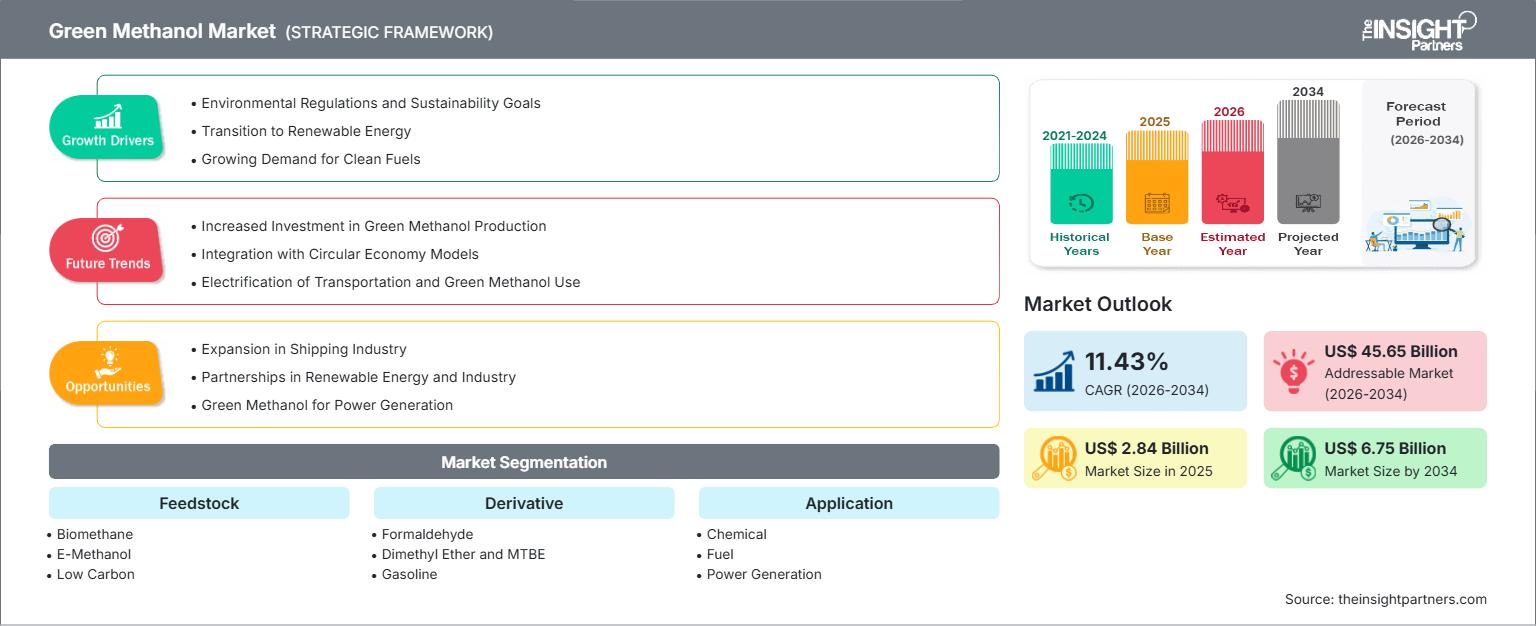
The green methanol market was valued at US$ 2.84 Billion in 2025 and is projected to reach US$ 6.75 Billion by 2034, registering a CAGR of 11.43% from 2026 to 2034. The market is gaining attention due to rising decarbonization initiatives, increasing renewable hydrogen availability, and expanding applications of low-carbon methanol across fuel, chemical, and power generation sectors.
The green methanol market size is influenced by accelerating investments in renewable energy integration, carbon capture utilization technologies, and sustainable fuel pathways. North America is expected to witness steady expansion with an estimated CAGR range of 10–13% during 2026–2034, supported by clean fuel policies, industrial decarbonization programs, and increasing interest from shipping and chemical producers.
Green Methanol Market Assessment and Insights
- North America The region is positioned as a significant emerging market, supported by renewable energy investments and carbon management initiatives. It is estimated to hold a 2025 share of 20–24% and expand at a CAGR of 10–13% between 2026–2034 due to industrial adoption.
- US The country is witnessing increasing deployment of low-carbon methanol projects, supported by clean energy incentives and maritime fuel transition. The US is estimated to account for a 2025 share of 15–18% and grow at a CAGR of 10–12% during 2026–2034.
- Europe Europe represents a leading regional market due to strong renewable fuel regulations and early commercial-scale projects in countries such as Germany, Denmark, Sweden, Norway, and the Netherlands. The region is estimated to capture a 2025 share of 35–40% and register a CAGR of 11–14% between 2026–2034.
- Asia Pacific The region is developing rapidly with increasing renewable hydrogen capacity, industrial demand, and maritime fuel opportunities across China, Japan, South Korea, and India. Asia Pacific is estimated to hold a 2025 share of 25–30% and grow at a CAGR of 12–15% during 2026–2034.
- Largest Segment E-Methanol is expected to remain the largest feedstock segment, supported by renewable hydrogen integration and carbon utilization pathways. It is estimated to hold a 2025 market share of 45–50% and expand at a CAGR of 13–16% between 2026–2034.
- High Growth Segment Fuel Application is projected to demonstrate strong expansion due to shipping decarbonization and alternative fuel adoption. The segment is estimated to account for a 2025 market share of 35–40% and grow at a CAGR of 13–16% during 2026–2034.
- Key companies analyzed in detail: Carbon Recycling International ehf., OCI N.V., Methanex Corporation, Södra Skogsägarna ekonomisk förening, Eni S.p.A., Proman AG, Equinor ASA, Southern Green Gas Limited, Air Liquide S.A., BASF SE, European Energy A/S, Liquid Wind AB, HIF Global, Inc., Alfa Laval AB, Maersk A/S.
Source: The Insight Partners' analysis based on proprietary research, government publications, company annual reports, investor presentations, industry databases, and expert interviews.
Innovations in the technology for manufacturing methanol from renewable sources have made the industry dynamics move from pilot projects to commercial-scale projects. The application of carbon capture utilization technology, renewable hydrogen production technology, and bio feedstocks is affecting the supply dynamics. Growing cooperation between energy firms, technology suppliers, and the maritime sector is resulting in an ecosystem of production.
Further growth will require electrolyzer scaling, improvements in carbon capture technology, and development of regional supply chains. Markets in Asia Pacific and the Middle East are emerging due to their potential for renewable energy generation and industrial demand. Favorable government policies, international shipping laws, and corporate sustainability goals are likely to create deployment opportunities in various end-user industries.
Green Methanol Market Report Scope
| Report Attribute | Details |
|---|---|
| Market size in 2025 | US$ 2.84 Billion |
| Market Size by 2034 | US$ 6.75 Billion |
| Global CAGR (2026 - 2034) | 11.43% |
| Historical Data | 2021-2024 |
| Forecast period | 2026-2034 |
Green Methanol Market Analysis
The development of the green methanol industry is mainly supported by the shift towards low-carbon fuels and increased demand for environmentally friendly intermediaries. Shipping firms are considering renewable methanol as a means to achieve low-emission fuel. Chemical companies are incorporating alternative low-carbon fuels into their existing production process. The industry value chain includes renewable power generation companies, hydrogen producers, carbon capturers, methanol production and technology companies, methanol storage facilities, and users.
Current supply developments are characterized by the investment in renewable fueled methanol production facilities and carbon recycling solutions. Methanol production based on biomethane is another route, which can be used where sustainable biogenic resources are available. Certification solutions aimed at evaluating carbon intensity and environmental impact are developed by governments and industries. More and more renewable energy developers are partnering with the fuel consumer side.
Green methanol market report reveals that the competitive landscape features technology innovations, strategic alliances, and project developments. The companies have been positioning themselves around production technologies, integration of renewable energy sources, and applications downstream. Carbon Recycling International ehf. has taken the position of carbon recycling for methanol production, whereas European Energy A/S and Liquid Wind AB have developed renewable methanol projects that are associated with renewable energy systems. OCI N.V., Methanex Corporation, and Proman AG have been using their knowledge about methanol to benefit from the low carbon transition.
Investments are increasingly made in large-scale facilities, renewable hydrogen sources, and fuel supply for maritime industries. Companies like Maersk A/S have been helping in creating demand for sustainable shipping solutions, whereas Air Liquide S.A. and BASF SE have contributed via industrial gases and chemicals. Strategic positioning increasingly relies on renewable feedstocks, commercial partnerships, and competitive costs for methanol production compared to traditional methods.
● REPORT CUSTOMIZATION
Tailor This Report To Align With Your Specific Business Requirements
This report can be customized to align precisely with your business objectives, scope, and target markets. Customization options include tailored segmentation, geography, competitive analysis, and strategic insights to support informed decision-making.
Customize This Report →WHAT YOU CAN ADJUST
- ● Segmentations
- ● Geography
- ● Competitive Analysis
- ● Language Preferences
Green Methanol Market: Strategic Insights
Regional Insights
North America Green Methanol Market
The growth of the green methanol market share in North America can be attributed to the increasing interest in carbon reduction policies, the development of renewable hydrogen, and use of clean fuels. North America was estimated to have held a share of about 20–24% in 2025 and is projected to exhibit a CAGR of 10–13% during 2026–2034. Market development in North America will be driven by investment into renewable energy and carbon capture, and rising demand from the marine transport sector and industries.
North America has advantages in the form of advanced energy infrastructure and cooperation between technology providers and fuel producers. Policies aimed at reducing emissions, sources of renewable electricity, and carbon reduction programs will help boost adoption. Technology companies are looking into developing integrated plants for the production of renewable electricity, hydrogen, and carbon. The presence of technology providers and energy companies will enable better scalability in North America.
U.S. Green Methanol Market
Development of the U.S. green methanol market is facilitated by growing investments in renewable energy, carbon management technologies, and clean energy infrastructure. The United States constitutes around 70% - 75% of the North America market share in 2025 and is estimated to grow at a CAGR of 10% - 12% for 2026 - 2034. The demand for green methanol comes from maritime transport, chemicals, and industrial fuel use.
The involvement of companies involved in carbon recycling and renewable fuel technologies is building up the domestic ecosystem. Clean energy policies of the government and the sustainability policies of businesses are driving more announcements of projects. In particular, the application of green methanol is observed in ship fuel alternatives and low-carbon chemicals. Growing collaboration of renewable energy companies and industrial consumers should boost supply.
Europe Green Methanol Market
Europe green methanol market represents the leading regional market due to strong climate policies, renewable energy integration, and early adoption of sustainable fuel solutions. The region held an estimated 35–40% share in 2025 and is expected to expand at a CAGR of 11–14% between 2026–2034. Germany, Denmark, Sweden, Norway, and the Netherlands are among the key countries supporting project development.
The UK market is progressing through maritime decarbonization initiatives and renewable fuel investments, supported by clean energy targets and industrial transition programs. Germany is emerging as a major contributor through renewable hydrogen projects, industrial demand, and technology development capabilities. France, Italy, and Spain are advancing adoption through renewable energy expansion, transportation decarbonization efforts, and industrial applications. Europe remains a leading market due to regulatory alignment and commercial-scale project activity.
APAC Green Methanol Market
The growth of APAC green methanol market is attributed to rising renewable energy generation and demand from the chemicals and marine shipping sectors. This region held an estimated 25-30% share in 2025 and is projected to expand at a CAGR of 12-15% from 2026 to 2034. China dominates the regional market and is aided by renewable energy availability and its industrial manufacturing facilities.
Japan, South Korea, India, and Australia are developing fuel sustainability strategies with hydrogen projects and green energy investments. Fuel transition projects for ships and government-backed renewable energy projects are helping in driving the adoption rate. Rising industrial demand for low carbon chemicals and increased international collaborations will support regional production and market access.
Middle East & Africa Green Methanol Market
The MEA green methanol market is growing owing to investment in renewable energy sources, hydrogen projects, and energy economy diversification. The Middle East and Africa market is estimated to hold around 8%–12% of the market in 2025 and grow at a CAGR of 10%–13% during 2026–2034. Saudi Arabia is emerging as one of the prominent countries because of high renewable energy potential and green fuel aspirations.
UAE and South Africa have also taken up the route of sustainable fuel production using renewable energy and industrial uses. Saudi Arabia has the advantage of robust energy infrastructure, while UAE emphasizes the need for energy transition and maritime growth. Other MEA nations such as South Africa are considering renewable methanol routes in connection with solar energy and industrial use cases.
Segmentation Analysis
Feedstock
The Feedstock segment plays a central role in defining production pathways and sustainability performance. This segment is expected to register a CAGR of 12–15% between 2026–2034 due to increasing adoption of renewable hydrogen, carbon recycling technologies, and sustainable biomass resources. Feedstock selection influences production costs, lifecycle emissions, and commercial scalability. Growing investments in renewable electricity and carbon capture infrastructure are supporting diversified methanol production routes.
- Biomethane contributes to sustainable methanol production by utilizing renewable gases from biological sources. It supports circular economy approaches by converting organic waste streams into valuable chemical feedstocks while reducing dependence on fossil-based methanol production pathways.
- E-Methanol represents an important pathway using renewable hydrogen and captured carbon dioxide. It is gaining attention among fuel producers and shipping companies seeking scalable low-carbon solutions aligned with global emissions reduction objectives.
- Low Carbon methanol production includes pathways designed to reduce emissions intensity through improved technologies and alternative resources. It supports industries transitioning from conventional methanol while maintaining compatibility with existing infrastructure and applications.
Derivative
The Derivative segment supports demand expansion through diverse downstream applications across chemicals, fuels, and industrial processes. This segment is expected to achieve a CAGR of 10–13% between 2026–2034 as industries seek lower-carbon alternatives for existing methanol-based products. Growing demand for sustainable chemical intermediates and cleaner fuel components is influencing derivative adoption. Integration with established production systems allows companies to transition gradually toward renewable methanol-based solutions.
- Formaldehyde remains a major methanol derivative used in resins, adhesives, and industrial materials. Demand is supported by construction, automotive, and manufacturing applications requiring chemical intermediates with improved sustainability profiles.
- Dimethyl Ether and MTBE applications benefit from methanol conversion capabilities in fuel blending and chemical processes. Increasing interest in cleaner fuel components supports continued evaluation of sustainable methanol-derived products.
- Gasoline applications involve methanol-to-gasoline conversion pathways that provide alternative fuel options. Technology development and fuel diversification strategies are supporting interest in methanol-based transportation solutions.
- MTO applications utilize methanol conversion into olefins for petrochemical production. Growing demand for sustainable chemical feedstocks is encouraging research and commercial deployment of renewable methanol-based production routes.
- Solvents applications continue to utilize methanol derivatives across industrial processes. Sustainable methanol availability can support lower-carbon solvent supply chains for chemical and manufacturing industries.
Application
The Application segment represents key demand areas influencing commercial adoption and investment priorities. This segment is expected to expand at a CAGR of 11–14% between 2026–2034 due to increasing interest in sustainable fuels, chemical manufacturing, and renewable energy integration. Fuel applications are gaining importance through maritime decarbonization initiatives, while chemical applications remain supported by established methanol consumption patterns.
- Chemical applications represent a significant demand area where methanol serves as a building block for multiple products. Sustainable alternatives are being evaluated by chemical manufacturers aiming to reduce carbon intensity across production processes.
- Fuel applications are expanding due to demand for low-emission marine fuels and alternative transportation solutions. Shipping companies and energy providers are exploring renewable methanol to support compliance with increasingly stringent emissions standards.
- Power Generation applications involve methanol utilization in energy systems requiring flexible and lower-carbon fuel options. Adoption is influenced by renewable integration strategies, energy security considerations, and regional infrastructure development.
Opportunity Snapshot
| Application | Revenue Contribution (High/Medium/Low) | Trend Tag | Adoption Stage |
| Chemical | High | Sustainable Feedstock | Scaling |
| Fuel | High | Marine Fuel | Emerging |
| Power Generation | Medium | Flexible Energy | Emerging |
Green Methanol Market Growth Drivers and Impact Analysis
Expansion of Renewable Hydrogen Production Capacity
Availability of hydrogen from renewable sources is paving the way towards sustainable pathways in methanol production processes. Hydrogen that is generated via electrolysis through renewable electricity generation can be combined with carbon dioxide in order to minimize dependency on fossil fuel feedstocks. Development of renewable power projects, reduction in cost of electrolyzers, and governmental initiatives towards hydrogen economy are contributing to increased viability of the project. This particular trend is likely to impact the supply chain structure through encouraging establishment of integrated renewable energy and fuel plants. Industries that want to reduce their carbon footprint are increasingly considering renewable methanol.
Decarbonization Requirements in Maritime Transportation
The shipping industry is also becoming an important driver of demand as firms are looking at other options apart from traditional marine fuel sources that have less life cycle emissions. With international climate policies and sustainable policies of firms, vessel operators are being encouraged to look at renewable methanol as an alternative fuel source because of its compatibility with new engines as well as logistics infrastructure. Investment in ships using methanol fuel is creating demand among fuel producers and shipping firms in terms of supply contracts. It is anticipated that there will be increased demand for infrastructure in terms of production capacity, storage facilities, and international transportation infrastructure.
Advancement of Carbon Capture and Utilization Technologies
Carbon capture and utilization technologies are improving the commercial potential of renewable methanol by enabling the conversion of captured carbon dioxide into valuable products. Enhanced carbon capture efficiency, industrial emission recovery systems, and improved conversion technologies are supporting new production models. These developments allow companies to integrate waste carbon streams with renewable hydrogen, creating circular carbon pathways. The adoption of carbon utilization solutions is expected to influence project economics by expanding feedstock availability beyond traditional sources. Industrial sectors with concentrated carbon emissions are becoming potential suppliers for methanol production facilities. Continued technology improvements and investment in carbon management infrastructure will support wider deployment of low-emission production systems.
Green Methanol Market Future Trends
Integration of Artificial Intelligence and Digital Optimization in Production
The integration of artificial intelligence, automation, and digital monitoring systems is expected to reshape production efficiency and operational management. Advanced analytics can improve process optimization, energy utilization, predictive maintenance, and supply chain coordination across renewable methanol facilities. Future plants are likely to incorporate digital platforms that monitor carbon intensity, renewable power availability, and production performance in real time. These technologies can support improved cost management and enhance transparency for sustainability certification requirements. As commercial projects expand, digital solutions will become increasingly important for achieving operational reliability and improving competitiveness. The adoption of intelligent systems is expected to complement technological advancements in renewable hydrogen, carbon utilization, and production scale-up.
Development of Regional Renewable Methanol Hubs
The formation of renewable methanol hubs in specific regions is expected to become one of the Green Methanol Market trends as nations strive to create their local renewable fuel value chains. Such hubs would incorporate renewable energy sources, facilities for hydrogen generation, carbon capture technologies, and transport infrastructure to ensure better economic efficiency. Regions possessing rich sources of solar energy, wind power, and industrial carbon will probably get the largest investments. Cooperation of energy firms, maritime companies, and governments will promote the development of such ecosystems. Future advancements could be oriented toward creating export-oriented hubs that will serve both international and local markets. The emergence of such hubs will lead to diversification of the production capacity.
Green Methanol Market Opportunities
Investment in Large-Scale Renewable Methanol Projects
The increasing demand for sustainable fuels creates opportunities for investors and technology providers to participate in large-scale renewable methanol projects. Companies can benefit from developing integrated facilities that combine renewable electricity, hydrogen production, carbon capture, and methanol synthesis. Strategic investments in regions with strong renewable resources can improve project economics and support international supply agreements. Opportunities exist across project development, engineering services, infrastructure deployment, and technology licensing. Long-term demand commitments from shipping companies and industrial users can provide greater investment certainty. As governments strengthen climate policies, financing opportunities are expected to expand for projects supporting emissions reduction and sustainable fuel transition objectives.
Expansion of International Supply Chain Partnerships
The green methanol market Forecasts indicate increasing opportunities for companies developing cross-border partnerships across production, transportation, and end-use industries. International collaboration between renewable energy developers, fuel suppliers, and industrial consumers can accelerate market commercialization. Partnerships can support technology transfer, infrastructure development, and access to emerging demand centers. Shipping companies are expected to play an important role by establishing procurement agreements with producers to secure future fuel availability. Energy companies can also explore export opportunities from renewable-rich regions to markets with high fuel demand. Developing coordinated supply networks will be essential for reducing logistical challenges, improving cost efficiency, and supporting global adoption of sustainable methanol solutions.
Recent Developments
- April 2026: A.P. Moller–Maersk announced the signing of several new agreements to establish green methanol bunkering capabilities across critical global trade routes, significantly advancing its green corridor initiative and decarbonization goals.
- January 2026: Cargill announced the maiden voyage of Brave Pioneer, the first of five green methanol dual-fuel dry bulk vessels chartered by the company. The deployment of the Brave Pioneer marks another important milestone in Cargill’s broader decarbonization efforts.
Frequently Asked Questions

- Comprehensive Market Sizing and Forecast Analysis
- Detailed Segmentation Analysis
- In-Depth Market Dynamics Assessment
- Regional and Country-Level Insights
- Competitive Landscape and Company Benchmarking
- Strategic Business Intelligence
Recent Reports
Testimonials

The Insight Partners' SCADA System Market report is comprehensive, with valuable insights on current trends and future forecasts. The team was highly professional, responsive, and supportive throughout. We are very satisfied and highly recommend their services.
RAN KEDEM Partner, Reali Technologies LTDs
I requested a report on a very specific software market and the team produced the report in a few days. The information was very relevant and well presented. I then requested some changes and additions to the report. The team was again very responsive and I got the final report in less than a week.
JEAN-HERVE JENN Chairman, Future Analytica
We worked with The Insight Partners for an important market study and forecast. They gave us clear insights into opportunities and risks, which helped shape our plans. Their research was easy to use and based on solid data. It helped us make smart, confident decisions. We highly recommend them.
PIYUSH NAGPAL Sr. Vice President, High Beam Global
The Insight Partners delivered insightful, well-structured market research with strong domain expertise. Their team was professional and responsive throughout. The user-friendly website made accessing industry reports seamless. We highly recommend them for reliable, high-quality research services
YUKIHIKO ADACHI CEO, Deep Blue, LLC.
This is the first time I have purchased a market report from The Insight Partners.While I was unsure at first, I visited their web site and felt more comfortable to take the risk and purchase a market report.I am completely satisfied with the quality of the report and customer service. I had several questions and comments with the initial report, but after a couple of dialogs over email with their analyst I believe I have a report that I can use as input to our strategic planning process.Thank you so much for taking the extra time and making this a positive experience.I will definitely recommend your service to others and you will be my first call when we need further market data.
JOHN SUZUKI President and Chief Executive Officer, Board Director, BK Technologies
I wish to appreciate your support and the professionalism you displayed in the course of attending to my request for information regarding to infectious disease IVD market in Nigeria. I appreciate your patience, your guidance, and the fact that you were willing to offer a discount, which eventually made it possible for us to close a deal. I look forward to engaging The Insight Partners in the future, all thanks to the impression you have created in me as a result of this first encounter.
DR CHIJIOKE ONYIA MANAGING DIRECTOR, PineCrest Healthcare Ltd.Reason to Buy
- Informed Decision-Making
- Understanding Market Dynamics
- Competitive Analysis
- Identifying Emerging Markets
- Customer Insights
- Market Forecasts
- Risk Mitigation
- Boosting Operational Efficiency
- Strategic Planning
- Investment Justification
- Tracking Industry Innovations
- Aligning with Regulatory Trends





 Get Free Sample for