
Green Preservatives Market Trends, Size & Forecast by 2034
Green Preservatives Market Size and Forecasts (2021–2034), Global and Regional Share, Trends, and Growth Opportunity Analysis Report Coverage : by Type (Natural preservative, Organic Acid, Essential Oil); End-use Industry (Food & beverage, Personal Care & Cosmetic, Industrial Cleaning, Household Cleaning, Pharmaceutical); and Geography (North America, Europe, Asia Pacific, and South and Central America)
- Status : Data Released
- Report Code : TIPRE00040219
- Category : Chemicals and Materials
- No. of Pages : 150
- Available Report Formats :


- Last update date : August 07, 2026


2025 Market Size
US$ 1.26 Bn
Base year value
2034 Forecast
US$ 2.17 Bn
Projected by 2034
CAGR 2026-2034
6.23 %
Growth rate
Addressable Market
US$ 15.53 Bn
(2026-2034)
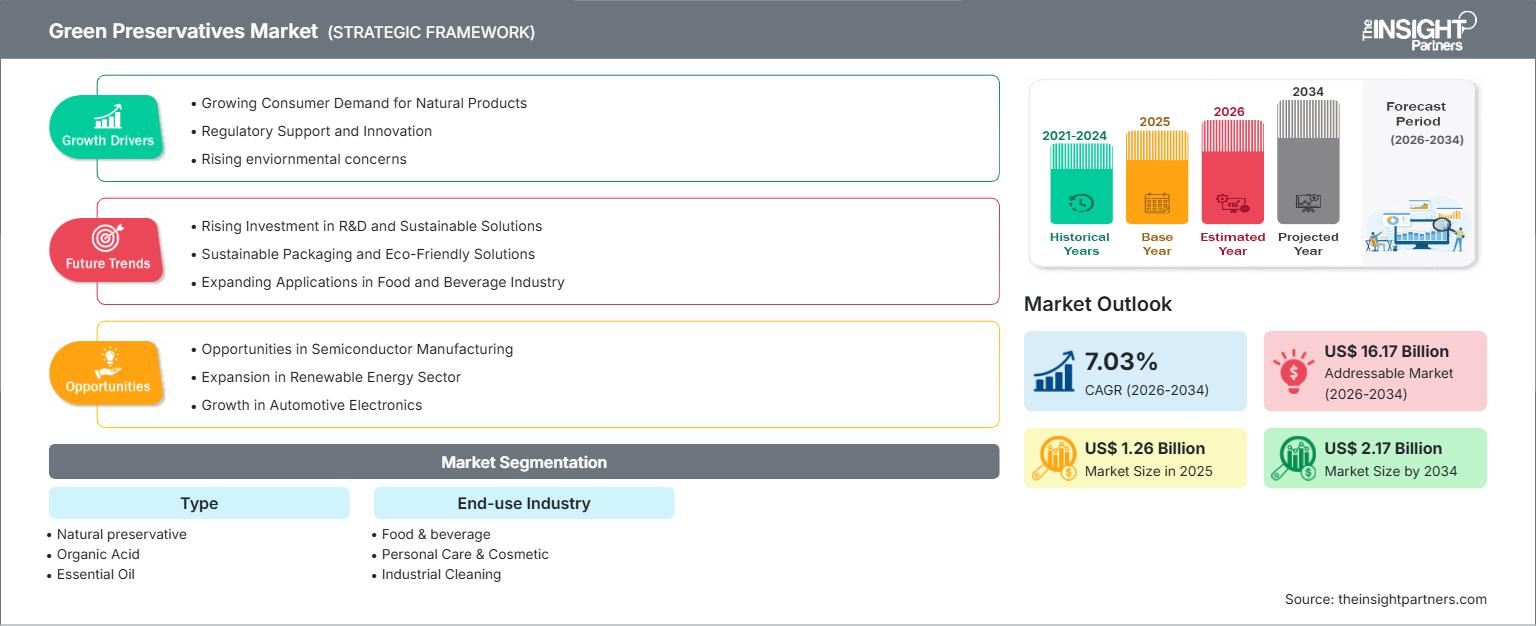
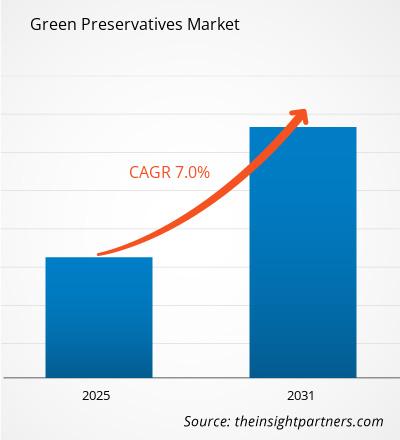
The Green Preservatives market was valued at US$ 1.26 billion in 2025 and is expected to reach US$ 2.17 billion by 2034; it is estimated to record a CAGR of 6.23% during 2026-2034.
Green Preservatives Market Assessment and Insights
- North America: North America accounted for 34–37% share in 2025 and is expected to register a CAGR of 6.4–7.1% during 2026–2034. Strong regulatory frameworks, widespread clean-label adoption, and investments in bio-based ingredient technologies continue supporting regional expansion.
- US: The US represented 72–76% of North America's market in 2025 and is projected to grow at a CAGR of 6.5–7.2% during 2026–2034, driven by innovation in food preservation, cosmetics, and biotechnology applications.
- Europe: Europe captured 28–31% share in 2025 and is anticipated to expand at a CAGR of 6.7–7.4% during 2026–2034, with Germany, France, Italy, the UK, and the Netherlands leading sustainable preservative adoption.
- Asia Pacific: Asia Pacific held 25–28% share in 2025 and is forecast to witness a CAGR of 7.8–8.6% during 2026–2034, supported by increasing processed food production and expanding personal care manufacturing in China, India, Japan, and South Korea.
- Largest Segment: Food & Beverage accounted for 41–45% market share in 2025 and is expected to register a CAGR of 6.9–7.5% during 2026–2034, reflecting sustained demand for natural preservation solutions in packaged and processed foods.
- High Growth Segment: Essential Oil represented 20–24% market share in 2025 and is anticipated to grow at a CAGR of 8.2–9.0% during 2026–2034, driven by multifunctional antimicrobial properties and increasing consumer preference for botanical ingredients.
- Key companies analyzed in detail: Kerry Group plc, Kemin Industries, Inc., Corbion N.V., LANXESS AG, BASF SE, International Flavors & Fragrances Inc., Dow Inc., dsm-firmenich AG, Symrise AG, and Givaudan SA.
Source: The Insight Partners' analysis based on proprietary research, government publications, company annual reports, investor presentations, industry databases, and expert interviews.
The rise in consciousness of consumers regarding ingredient transparency has seen changes in the area of preservatives technology in some industries. Some of the developments include a shift from traditional chemical preservatives to the use of natural antimicrobials, organic acids through fermentation processes, plant extracts, and essential oils. The innovations in the area of biotechnology industry have improved the efficacy of preservatives and their compatibility in various formulations, which has made them more available through adherence to regulations and sustainability objectives.
The growth of this market is expected to be driven by the commercialization of these products in developing countries, where there is rising income and demand for quality packaged foods. Regulatory policies favoring green chemicals, development of bioeconomy strategies, and the partnership of natural ingredient suppliers and manufacturers of consumer products are expected to drive innovations and create further opportunities in this market space.
Green Preservatives Market Report Scope
| Report Attribute | Details |
|---|---|
| Market size in 2025 | US$ 1.26 Billion |
| Market Size by 2034 | US$ 2.17 Billion |
| Global CAGR (2026 - 2034) | 6.23% |
| Historical Data | 2021-2024 |
| Forecast period | 2026-2034 |
Green Preservatives Market Analysis
Consumer demand for natural preservatives used in minimal processing of foods, natural cosmetics, and environmental-friendly household products keeps growing and thus driving the market of green preservatives all over the world. Regulatory bodies keep restricting the use of certain artificial preservatives and encourage the use of safer ingredients after conducting relevant toxicological and environmental assessments. Hence, the ingredient producers will continue increasing the production of fermentation acids, botanical extracts, and essential oils that can extend the shelf life without impacting the quality and perception of the products. This also will lead to more cooperation among biotechnological companies, agriculturists, ingredient developers, and consumer goods producers.
Market evolution through the supply chain changes as companies increase their diversification of plant-based raw materials, build regional fermentation plants, and improve extraction methods to decrease production expenses. Innovation in encapsulation technology, natural antimicrobial combinations, and formulation will help green preservatives reach better performance in food processing, pharmaceutical, industrial cleaning products, and cosmetic applications while remaining regulatory compliant in many international markets.
The competition in the industry is more about innovation, sustainability, regulatory know-how, and ingredients integration, thus defining the green preservatives market report overall. The companies like Kerry Group plc, Corbion N.V., Kemin Industries, Inc., BASF SE, dsm-firmenich AG, Givaudan SA, Symrise AG, International Flavors & Fragrances Inc., LANXESS AG, and Dow Inc. keep investing in biotechnology platforms, acquisitions, research partnerships, and application laboratories in order to develop distinct products in high value-added end-use segments.
The investment trends are also moving towards fermentation processes, renewable raw materials, and geographical extension in order to increase the supply reliability and reduce the negative environmental impact. Collaborations of ingredient providers with the food processing businesses, cosmetics producers, and pharmaceutical firms become more about the development of customized preservation solutions that fit particular formula and regulatory needs. Such efforts will ensure improved commercial success and market growth over the forecast period.
● REPORT CUSTOMIZATION
Tailor This Report To Align With Your Specific Business Requirements
This report can be customized to align precisely with your business objectives, scope, and target markets. Customization options include tailored segmentation, geography, competitive analysis, and strategic insights to support informed decision-making.
Customize This Report →WHAT YOU CAN ADJUST
- ● Segmentations
- ● Geography
- ● Competitive Analysis
- ● Language Preferences
Green Preservatives Market: Strategic Insights
Regional Insights
North America Green Preservatives Market
The green preservatives market share held by North America was estimated at 34% to 37% in 2025 and is forecasted to have a CAGR of 6.4% to 7.1% over 2026-2034. Key drivers of demand include stringent food safety laws, high consumption of organic and clean-label food products, and investments in the production of bioingredients using biotechnology. Suppliers of food ingredients, cosmetic manufacturers, and producers of pharmaceuticals continue switching from synthetic preservatives to green ones in order to match consumers' expectations and sustainability goals.
Increasing use of organic acids produced via fermentation and plant-derived anti-microbial preservatives contributes to the development of regional supply chain capabilities. The United States and Canada are still developing food processing industry and promoting safer ingredient formulation among their companies via more stringent compliance requirements. Collaboration on innovation of multifunctional preservative ingredients between ingredient suppliers and consumers goods companies promotes North America as one of the most developed regional markets.
U.S. Green Preservatives Market
The US holds a share of 72-76% in the North American market in 2025 and is expected to grow at a CAGR of 6.5-7.2% until 2034. Leadership among countries is attributed to the presence of biotech firms, ingredients suppliers, and major global food processing companies. The consumer demand for organic packaged foods, natural preservative beverages, and green labels personal care products drives the development and implementation of novel preservation technologies.
The companies are present in the country in form of huge manufacturing, research, and application development centers that drive the commercialization of botanical extracts, organic acids, and fermentation-based preservatives. Increasing usage in bakery, dairy, beverages, cosmetics, nutraceuticals, and pharmaceutical formulations ensures steady demand in the country.
Europe Green Preservatives Market
The region held 28-31% of the global share in 2025 and is projected to achieve a CAGR of 6.7-7.4% during the period of 2026-2034. Germany holds leadership in terms of market at a national level owing to advanced food processing sector, biotech industry and sustainability measures. United Kingdom is continuing to observe rising usage of preservatives from natural sources in premium packed foods and personal care products.
France, Italy and Spain account for large regional demand due to increased food export, manufacture of premium cosmetics, and development in technology of bio-based ingredients. The role of regulations for safer additives and chemicals is motivating the ingredient suppliers to innovate their products. Collaboration between biotech firms and consumer goods companies in the region facilitates the commercialization of multi-functional preservative solutions.
APAC Green Preservatives Market
The Asia Pacific region held 25-28% share of the global market in 2025 and is anticipated to register a CAGR of 7.8-8.6% between 2026 and 2034. Consumption in the region is led by China due to the presence of a large-scale food manufacturing industry; on the other hand, Japan and South Korea remain focused on using high-quality natural materials in cosmetic and pharmaceutical applications.
Increased food manufacturing, export volumes, and regulatory focus on the quality of food are driving demand from India and Australia. The governments’ policies promoting sustainable manufacturing and development of biotechnology innovations are further fostering investments in natural preservatives' production in the Asia Pacific region.
Middle East & Africa Green Preservatives Market
The Middle East & Africa is expected to register a CAGR of 6.6–7.3% during 2026–2034, supported by growing investments in food processing, pharmaceutical manufacturing, and premium personal care products. Saudi Arabia remains the leading regional market, while the United Arab Emirates continues strengthening its position as a regional processing and distribution hub.
There is already an existing food processing industry in South Africa and they are even developing their export market by exporting processed agricultural goods. The growing number of government efforts towards the promotion of food security, industrial diversification, and sustainable manufacturing processes is prompting the use of natural preservation methods.
Segmentation Analysis
Type
The Type segment is projected to register a CAGR of 7.2–7.9% during 2026–2034. The green preservatives market scope continues expanding across naturally derived preservation technologies as manufacturers seek safer, biodegradable, and regulatory-compliant alternatives to synthetic chemicals. Technological improvements in fermentation, botanical extraction, and ingredient stabilization are enhancing preservative performance while supporting wider adoption across food, cosmetics, pharmaceutical, and industrial applications.
- Natural Preservative – Natural preservatives account for a significant portion of product demand because of their clean-label appeal, broad application across packaged foods and cosmetics, and compatibility with sustainability-focused product development strategies adopted by manufacturers worldwide.
- Organic Acid – Organic acids remain widely utilized owing to their proven antimicrobial effectiveness, cost-efficient production through fermentation processes, regulatory acceptance, and versatility across beverages, dairy products, baked goods, and pharmaceutical formulations.
- Essential Oil – Essential oils continue gaining strategic importance because of their multifunctional antimicrobial and antioxidant characteristics, enabling manufacturers to develop premium formulations with enhanced consumer appeal and reduced dependence on synthetic additives.
End-use Industry
The End-use Industry segment is expected to expand at a CAGR of 7.1–7.8% during 2026–2034. Demand continues increasing as manufacturers across multiple industries prioritize natural preservation technologies to improve product safety, extend shelf life, satisfy evolving regulatory standards, and respond to growing consumer preference for environmentally responsible and clean-label products.
- Food & Beverage – The food and beverage industry remains the dominant application owing to extensive use in dairy products, beverages, bakery items, processed foods, sauces, and ready-to-eat meals requiring safe and effective natural preservation systems.
- Personal Care & Cosmetic – Cosmetic manufacturers increasingly incorporate naturally derived preservatives into skincare, haircare, and hygiene products to address consumer demand for ingredient transparency while maintaining microbiological stability throughout product shelf life.
- Industrial Cleaning – Industrial cleaning product manufacturers are gradually integrating bio-based preservation systems to support sustainability objectives, improve environmental compatibility, and comply with evolving regulations governing chemical ingredients.
- Household Cleaning – Household cleaning applications are witnessing increasing adoption as brands develop environmentally friendly formulations incorporating naturally sourced antimicrobial ingredients without compromising storage stability or product performance.
- Pharmaceutical – Pharmaceutical manufacturers continue evaluating green preservation technologies for selected formulations where naturally derived ingredients can complement stringent quality, safety, and regulatory requirements while supporting sustainable product development initiatives.
Opportunity Snapshot
| End-use Industry | Revenue Contribution | Trend Tag | Adoption Stage |
|---|---|---|---|
| Food & Beverage | High | Clean Label | Mature |
| Personal Care & Cosmetic | High | Natural Beauty | Scaling |
| Industrial Cleaning | Medium | Bio Surfactants | Emerging |
| Household Cleaning | Medium | Eco Formulas | Scaling |
| Pharmaceutical | Medium | Bio Stability | Emerging |
Green Preservatives Market Growth Drivers and Impact Analysis
Rising consumer preference for clean-label and naturally formulated products
Consumers increasingly evaluate ingredient labels before purchasing food, beverages, cosmetics, and household products, encouraging manufacturers to replace synthetic preservatives with naturally derived alternatives. Growing awareness regarding food safety, sustainability, and long-term health considerations has strengthened demand for botanical extracts, fermentation-derived organic acids, and essential oils across multiple industries. Retailers are also expanding shelf space dedicated to organic and minimally processed products, encouraging suppliers to reformulate existing portfolios. These developments are stimulating investment in advanced extraction technologies and fermentation platforms while improving commercial availability of high-performance natural preservatives. As consumer expectations continue evolving globally, manufacturers capable of offering effective clean-label preservation systems are expected to strengthen competitive positioning and secure long-term supply agreements with leading consumer goods companies.
Regulatory transition toward sustainable and safer ingredient technologies
Government agencies across North America, Europe, and parts of Asia continue strengthening regulations governing synthetic preservatives, food additives, and chemical ingredients used in consumer products. These evolving frameworks encourage manufacturers to adopt naturally sourced preservation technologies with well-established safety profiles and lower environmental impacts. Compliance requirements have accelerated research into renewable raw materials, precision fermentation, and bio-based antimicrobial compounds suitable for diverse applications. Companies investing in regulatory documentation, product validation, and sustainable manufacturing processes are improving market access while reducing reformulation risks for customers. Continued alignment between environmental policies and food safety regulations is expected to accelerate commercialization of innovative preservation technologies throughout the forecast period.
Advancements in biotechnology and natural ingredient manufacturing
Rapid developments in biotechnology, microbial fermentation, and botanical extraction techniques are significantly improving the effectiveness and scalability of natural preservation systems. Modern production technologies enable higher purity ingredients, better formulation compatibility, and improved antimicrobial performance while reducing manufacturing costs. Ingredient suppliers are also developing customized preservation blends tailored for specific food, cosmetic, and pharmaceutical applications. Increasing collaboration between biotechnology firms, academic institutions, and consumer product manufacturers is accelerating innovation and shortening product development cycles. As production efficiency continues improving, naturally derived preservatives are expected to become increasingly competitive with conventional synthetic alternatives across high-volume commercial applications.
Green Preservatives Market Future Trends
Expansion of multifunctional plant-derived preservation systems
Manufacturers are increasingly developing multifunctional preservation solutions combining antimicrobial, antioxidant, and sensory enhancement properties within a single ingredient system. Green preservatives market trends indicate growing commercial interest in botanical extracts and essential oils capable of extending shelf life while improving product differentiation. Continuous advances in encapsulation technologies and controlled-release formulations are expected to enhance ingredient stability, enabling broader adoption across packaged foods, beverages, cosmetics, and pharmaceutical products. These innovations are likely to reduce formulation complexity while improving overall sustainability and regulatory compliance.
Growing integration of precision fermentation technologies
Precision fermentation is expected to reshape the production landscape by enabling efficient manufacturing of high-purity natural preservatives with consistent quality and scalable output. Biotechnology companies continue investing in microbial engineering, renewable feedstocks, and digital process optimization to improve production efficiency. These innovations support reduced dependence on seasonal agricultural raw materials while enhancing supply reliability. Increasing commercialization of fermentation-derived organic acids and bioactive compounds is anticipated to strengthen long-term competitiveness and support broader adoption across global consumer product industries.
Green Preservatives Market Opportunities
Expansion across emerging food processing economies
Rapid urbanization, increasing disposable incomes, and expanding organized retail sectors are encouraging packaged food consumption throughout Asia Pacific, Latin America, and parts of the Middle East. Rising investments in modern food manufacturing facilities create favorable conditions for adoption of naturally derived preservation systems. Local producers increasingly seek sustainable ingredients capable of meeting international food safety standards while supporting export competitiveness. Ingredient manufacturers establishing regional production facilities, technical support centers, and strategic partnerships are expected to benefit from expanding commercial opportunities as clean-label product demand accelerates across emerging economies.
Innovation in premium personal care and pharmaceutical formulations
Premium skincare, cosmetics, nutraceutical, and pharmaceutical manufacturers increasingly require naturally derived preservation technologies that satisfy stringent regulatory expectations while supporting sustainability goals. Continued investment in biotechnology research, formulation science, and advanced ingredient stabilization creates opportunities for suppliers to develop specialized preservative systems tailored to high-value applications. Strategic collaboration with multinational consumer goods manufacturers and contract development organizations can accelerate commercialization while improving product differentiation. Companies capable of delivering validated, multifunctional, and globally compliant preservation solutions are expected to strengthen their market position throughout the forecast period.
Recent Developments
- July 2026: SuanNutra and Carbyne Equity Partners announced that SuanNutra signed an agreement to acquire a portfolio of specialty natural ingredients businesses from IFF. The businesses will merge with SuanNutra's existing operations to create an enlarged global group in science-backed natural ingredients.
- March 2026: LANXESS presented its products, technologies and solutions for the cosmetics and personal care industry at the in-cosmetics Global trade fair in Paris. Under the motto “Protect what you love. Your partner for preservation solutions”, the specialty chemicals company presented its broad product range, which includes preservatives, multifunctionals, emollients, and fragrances and flavors.
Frequently Asked Questions

- Comprehensive Market Sizing and Forecast Analysis
- Detailed Segmentation Analysis
- In-Depth Market Dynamics Assessment
- Regional and Country-Level Insights
- Competitive Landscape and Company Benchmarking
- Strategic Business Intelligence
Recent Reports
Testimonials

The Insight Partners' SCADA System Market report is comprehensive, with valuable insights on current trends and future forecasts. The team was highly professional, responsive, and supportive throughout. We are very satisfied and highly recommend their services.
RAN KEDEM Partner, Reali Technologies LTDs
I requested a report on a very specific software market and the team produced the report in a few days. The information was very relevant and well presented. I then requested some changes and additions to the report. The team was again very responsive and I got the final report in less than a week.
JEAN-HERVE JENN Chairman, Future Analytica
We worked with The Insight Partners for an important market study and forecast. They gave us clear insights into opportunities and risks, which helped shape our plans. Their research was easy to use and based on solid data. It helped us make smart, confident decisions. We highly recommend them.
PIYUSH NAGPAL Sr. Vice President, High Beam Global
The Insight Partners delivered insightful, well-structured market research with strong domain expertise. Their team was professional and responsive throughout. The user-friendly website made accessing industry reports seamless. We highly recommend them for reliable, high-quality research services
YUKIHIKO ADACHI CEO, Deep Blue, LLC.
This is the first time I have purchased a market report from The Insight Partners.While I was unsure at first, I visited their web site and felt more comfortable to take the risk and purchase a market report.I am completely satisfied with the quality of the report and customer service. I had several questions and comments with the initial report, but after a couple of dialogs over email with their analyst I believe I have a report that I can use as input to our strategic planning process.Thank you so much for taking the extra time and making this a positive experience.I will definitely recommend your service to others and you will be my first call when we need further market data.
JOHN SUZUKI President and Chief Executive Officer, Board Director, BK Technologies
I wish to appreciate your support and the professionalism you displayed in the course of attending to my request for information regarding to infectious disease IVD market in Nigeria. I appreciate your patience, your guidance, and the fact that you were willing to offer a discount, which eventually made it possible for us to close a deal. I look forward to engaging The Insight Partners in the future, all thanks to the impression you have created in me as a result of this first encounter.
DR CHIJIOKE ONYIA MANAGING DIRECTOR, PineCrest Healthcare Ltd.Reason to Buy
- Informed Decision-Making
- Understanding Market Dynamics
- Competitive Analysis
- Identifying Emerging Markets
- Customer Insights
- Market Forecasts
- Risk Mitigation
- Boosting Operational Efficiency
- Strategic Planning
- Investment Justification
- Tracking Industry Innovations
- Aligning with Regulatory Trends





 Get Free Sample for