
Green Roof Market Growth, Share & Trends by 2034
Coverage: By Type (Extensive, Intensive); Application (Residential, Commercial, Industrial) , and Geography (North America, Europe, Asia Pacific, and South and Central America)
- Status : Data Released
- Report Code : TIPRE00024572
- Category : Chemicals and Materials
- No. of Pages : 150
- Available Report Formats :


- Last update date : August 10, 2026


2025 Market Size
US$ 3.13 Bn
Base year value
2034 Forecast
US$ 12.38 Bn
Projected by 2034
CAGR 2026-2034
16.51 %
Growth rate
Addressable Market
US$ 65.30 Bn
(2026-2034)
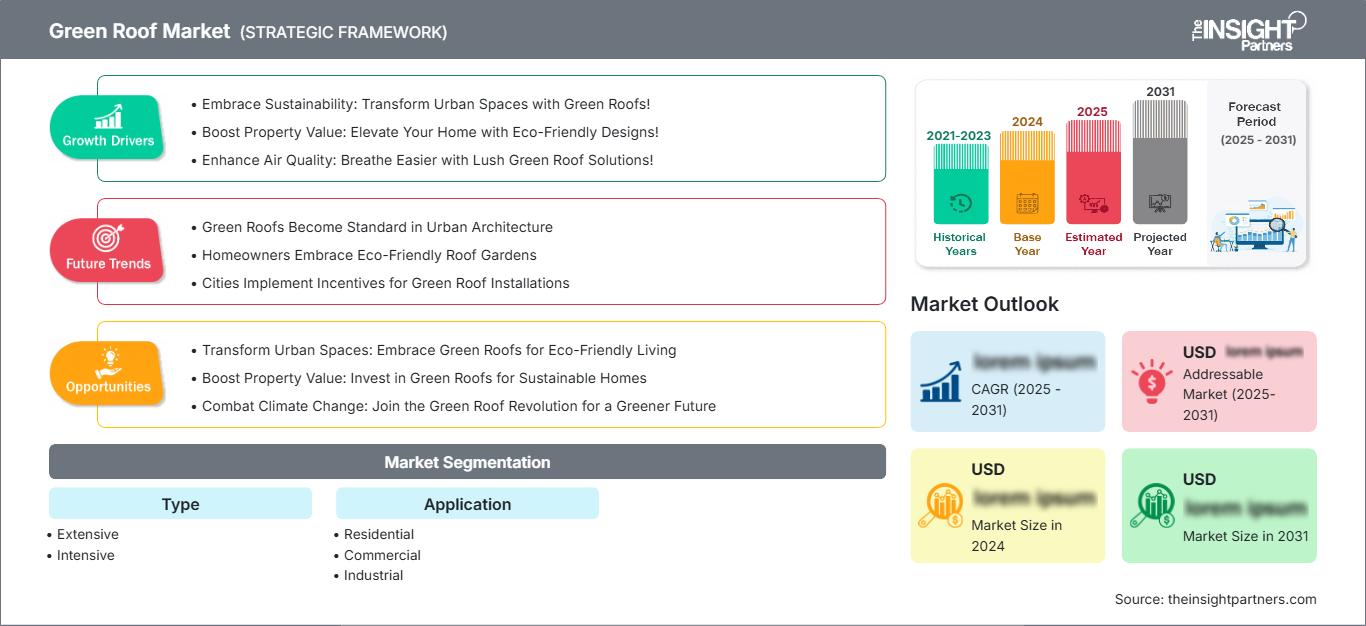
The green roof market was valued at US$ 3.13 Billion in 2025 and is projected to reach US$ 12.38 Billion by 2034, registering a CAGR of 16.51% during 2026–2034. The market is witnessing increased adoption of vegetated roofing systems across urban infrastructure due to rising environmental priorities, improved building efficiency requirements, and the growing integration of sustainable construction practices in commercial and residential developments.
The green roof market size is expected to expand steadily across North America, supported by municipal sustainability initiatives, energy-efficient building regulations, and increasing demand for stormwater management solutions. The region is estimated to register a CAGR range of 15–18% between 2026–2034, driven by green building certifications, climate adaptation programs, and investments in urban redevelopment projects.
Green Roof Market Assessment and Insights
- North America The region accounted for a share range of 30–35% in 2025, supported by strong adoption in the US and Canada. The market is expected to grow at a CAGR range of 15–18% between 2026–2034 due to sustainable construction policies and urban resilience initiatives.
- US The country represented a share range of 24–28% of the global market in 2025, expanding at a CAGR range of 15–17% during 2026–2034. Demand is supported by commercial retrofitting, green building standards, and climate-focused infrastructure programs.
- Europe The region captured a share range of 35–40% in 2025 and is projected to grow at a CAGR range of 14–17% between 2026–2034. Germany, the UK, France, Switzerland, and the Netherlands remain key markets due to regulatory support and sustainable urban planning.
- Asia Pacific The region held a share range of 20–25% in 2025 and is anticipated to achieve a CAGR range of 18–21% during 2026–2034. China, Japan, India, South Korea, and Australia are driving adoption through urban greening programs and infrastructure modernization.
- Largest Segment Extensive green roof systems represented a market share range of 55–60% in 2025 and are expected to grow at a CAGR range of 15–17% between 2026–2034 due to lower installation complexity and wider applicability.
- High Growth Segment Residential Application accounted for a share range of 25–30% in 2025 and is projected to expand at a CAGR range of 18–21% between 2026–2034 due to increasing homeowner interest in energy-efficient solutions.
- Key companies analyzed in detail: Axter SAS, Bauder Ltd., Green Roof Blocks Ltd., Optigrün international AG, Sempergreen Group B.V., American Hydrotech, Inc., The Barrett Company, ArchiGreen Roof Ltd., Onduline SAS, Xero Flor America, LLC, ZinCo GmbH, and Carlisle Construction Materials LLC.
Source: The Insight Partners' analysis based on proprietary research, government publications, company annual reports, investor presentations, industry databases, and expert interviews.
The green roof market has developed through innovation in waterproofing membranes, drainage layers, modular systems, and lightweight growing media that increase ease of installation in diverse building types. There is an increasing trend towards solutions that integrate vegetation support, water storage, and thermal management. This shift from conventional rooftop gardening to engineered systems has facilitated greater acceptance among commercial real estate developers, local governments, and private home builders.
Green roof market in the future will depend on the development of infrastructure resilient to climate change, initiatives for urban heat reduction, and changing building codes in both developing and developed countries. Increasing adoption in major cities of the Asia Pacific and Middle East regions has presented new opportunities in the industry, along with supportive policies on sustainable construction practices.
Green Roof Market Report Scope
| Report Attribute | Details |
|---|---|
| Market size in 2025 | US$ 3.13 Billion |
| Market Size by 2034 | US$ 12.38 Billion |
| Global CAGR (2026 - 2034) | 16.51% |
| Historical Data | 2021-2024 |
| Forecast period | 2026-2034 |
Green Roof Market Analysis
Green roof market is experiencing an increasing market because of rising demand for energy-efficient structures, urban biodiversity, and stormwater management systems. Property developers are using green roofs to enhance their insulation efficiency and decrease temperature variations on the roof while complying with environmental regulations. This value chain includes system design professionals, material suppliers, waterproofing products' providers, landscapers, and construction firms contributing to the creation and implementation of these products.
The supply factors include the introduction of new modular green roof technologies, new substrates, as well as special components such as root barrier and drainage systems. Producers are now offering wider ranges of products to cater for different climatic zones and structural conditions. There are also collaborative efforts from construction firms, architects, and environmentalists in developing solutions for residential, commercial, and industrial uses.
The green roof market report reveals a highly competitive landscape with the differentiation on the basis of technology, geographical expansion, and strategic collaborations between existing companies and specialist solution providers. Such firms as Bauder Ltd., Optigrün international AG, Sempergreen Group B.V., and ZinCo GmbH consolidate their market power by offering an advanced green roofing solution, whereas American Hydrotech, Inc., The Barrett Company, and Carlisle Construction Materials LLC specialize in roofing and waterproofing systems.
Growing investments in green roof market are concentrated on lightweight solutions, prefabrication techniques, and digital designs to facilitate the process of installation and maintenance. Axter SAS, Green Roof Blocks Ltd., ArchiGreen Roof Ltd., Onduline SAS, and Xero Flor America, LLC work on development of application-specific solutions in order to meet various construction needs. Competitive position will be determined by product longevity, technological proficiency, geographic coverage, and sustainability compliance.
● REPORT CUSTOMIZATION
Tailor This Report To Align With Your Specific Business Requirements
This report can be customized to align precisely with your business objectives, scope, and target markets. Customization options include tailored segmentation, geography, competitive analysis, and strategic insights to support informed decision-making.
Customize This Report →WHAT YOU CAN ADJUST
- ● Segmentations
- ● Geography
- ● Competitive Analysis
- ● Language Preferences
Green Roof Market: Strategic Insights
Regional Insights
North America Green Roof Market
The market share of North America stood at 30-35% in 2025 and is estimated to grow at a CAGR of 15-18% between 2026 and 2034. Some of the driving factors behind the growth of this region include the growing investments in sustainable buildings, climate adaptation programs in cities, and adoption of energy-efficient roofing solutions.
The United States and Canada can be counted as some of the major contributors due to the availability of various green building certifications, incentives and regulations supporting eco-friendly building practices. Increasing activity related to redeveloping projects in urban centers increases the need for rooftop vegetation solutions offering stormwater management, thermal benefits and enhanced building performance. The availability of solution providers and specialists in this field boosts the deployment in this region.
U.S. Green Roof Market
The US accounted for a share range of 24–28% of the North American market in 2025 and is expected to register a CAGR range of 15–17% between 2026–2034. The country remains a key market due to widespread implementation across commercial buildings, public infrastructure, and urban redevelopment projects.
Large cities have been promoting the use of green roofs through sustainability plans, storm water management policies, and building efficiency plans. Some of the firms involved in green roof development are American Hydrotech, Inc., The Barrett Company, and Xero Flor America, LLC. The growing use of green roofs in offices, residential complexes, and institutional establishments highlights the need for better insulation and mitigation of urban heat effects, among other environmental benefits. Green roof technology will play an important role in architectural design, driving further growth in the construction industry of the United States.
Europe Green Roof Market
Share of Europe ranged from 35% to 40% in 2025 and the region is expected to register a CAGR of 14% to 17% between 2026 and 2034. Europe stands out as the key market because of strict environmental policies, existing sustainability in construction processes and the use of rooftop greening techniques.
The UK market is fuelled by the rising application of biodiversity-based planning strategies and sustainable urban development policies. Green roofs are increasingly being used for commercial and residential buildings to enhance energy efficiency and climate change adaptation plans.
Germany has continued to contribute largely as a result of its advanced green buildings practice, strong environmental consciousness and availability of reliable manufacturers. These include companies such as Bauder Ltd., Optigrün international AG, and ZinCo GmbH who have increased regional availability of green roofing solutions.
France, Italy, and Spain have contributed through urban regeneration plans and climate resilience measures. The growing focus on reducing the effects of urban heat and rainfalls has encouraged the use of green roofs.
APAC Green Roof Market
APAC accounted for a share range of 20–25% in 2025 and is projected to grow at a CAGR range of 18–21% during 2026–2034. China, Japan, South Korea, India, and Australia are emerging markets supported by urban expansion, environmental regulations, and increasing investments in sustainable infrastructure.
With China being at the forefront of this technology’s uptake in the region through massive urban development and green cities projects, whereas in Japan and South Korea, there is a focus on the use of rooftop vegetation in densely populated urban centers. There has been growing interest in India and Australia owing to climate adaptation and sustainable building construction practices.
Middle East & Africa Green Roof Market
Middle East & Africa accounted for a smaller share of the global market in 2025 and is expected to expand at a CAGR range of 13–16% during 2026–2034. Saudi Arabia, UAE, and South Africa represent important markets due to infrastructure modernization and increasing focus on sustainable urban development.
The Saudi Arabia and UAE regions are incorporating ideas regarding green infrastructure within urbanization projects in the context of environmental diversification. The South Africa region is implementing green roof technology within commercial real estate development to solve issues related to energy efficiency and urban climate. The Rest of MEA region is steadily developing through infrastructure developments and climate resilience projects. Increasing attention towards reducing cooling needs in energy-intensive settings should facilitate the process across the region.
Segmentation Analysis
Type
The type segment includes extensive and intensive systems, with Extensive solutions representing the larger adoption base. The segment is estimated to expand at a CAGR range of 15–17% between 2026–2034 due to lower structural requirements, reduced maintenance needs, and suitability for large-scale commercial applications. Lightweight designs and simplified installation processes continue to improve acceptance among building owners.
- Extensive systems are widely adopted for commercial, institutional, and residential rooftops due to their lightweight construction, lower maintenance requirements, and compatibility with buildings requiring efficient vegetation coverage without complex structural modifications.
- Intensive systems provide deeper growing media and support diverse vegetation, including larger plants and landscaped areas. They are preferred for premium developments, recreational spaces, and projects requiring enhanced aesthetic and environmental benefits.
Application
The application segment covers residential, commercial, and industrial uses, with Residential applications representing a high-growth category. The segment is estimated to grow at a CAGR range of 18–21% during 2026–2034, supported by rising homeowner awareness, energy efficiency objectives, and increasing incorporation of sustainable features in modern housing projects.
- Residential applications are gaining traction as homeowners and developers integrate rooftop vegetation to improve thermal comfort, reduce energy consumption, and enhance property value through environmentally focused building designs.
- Commercial applications remain significant due to widespread installation in offices, retail buildings, and institutional facilities. Developers use green roofs to support sustainability certifications, operational efficiency, and improved building performance.
- Industrial applications are expanding as manufacturers and logistics facilities explore rooftop systems for temperature regulation, environmental compliance, and improved facility sustainability while optimizing large available roof areas.
Opportunity Snapshot
| Application | Revenue Contribution | Trend Tag | Adoption Stage |
|---|---|---|---|
| Residential | Medium | Urban Housing | Scaling |
| Commercial | High | Green Buildings | Mature |
| Industrial | Medium | Facility Efficiency | Emerging |
Green Roof Market Growth Drivers and Impact Analysis
Increasing Adoption of Sustainable Building Certifications
The increased use of sustainable construction standards is driving development and building owners to use environmentally sustainable roofing options in buildings. There is increased use of green building rating systems and energy performance requirements in influencing choices made on materials used, especially in commercial and institutional building designs. The increased trend of reducing building energy consumption is driving the need for roof construction materials which act as natural insulators. This driver will have increased application in urban environments where regulations are encouraging environmentally friendly construction practices. The effects of the driver will be seen in all stakeholders in the construction sector as there will be increased need for integrated systems which include waterproofing, drainage and vegetation among other features.
Urban Heat Reduction and Climate Adaptation Requirements
Increased urban warming and the need to enhance climate adaptability in urban environments are driving the implementation of rooftop vegetation systems. Urban centers are looking into the use of green infrastructure methods that can help address the problem of heat buildup, enhance environmental quality, and mitigate rainwater effects. Cities and their respective governing bodies have started to see the potential of rooftop vegetation systems as part of climate change adaptation plans. The effects on the market can be seen through the increased investment in public buildings, commercial complexes, and urban redevelopment programs that now consider the environmental performance of such structures.
Expansion of Urban Infrastructure and High-Density Development
Accelerating urbanization and limited availability of ground-level green spaces are creating opportunities for rooftop landscaping solutions across metropolitan regions. High-density cities are increasingly utilizing unused rooftop areas to introduce vegetation while improving building functionality. This trend is particularly relevant in regions experiencing rapid commercial development and residential expansion. The adoption of modular and lightweight systems enables installation across different building structures without extensive modifications. The impact of this driver extends to real estate developers seeking differentiation through sustainable building features and improved property performance. Increasing investment in smart city projects and urban regeneration initiatives is expected to support wider integration of rooftop greenery. The combination of land constraints and sustainability objectives is likely to influence construction strategies across developing and developed markets.
Green Roof Market Future Trends
Integration of Smart Monitoring Technologies
Future development of rooftop vegetation systems is expected to involve greater integration of digital monitoring technologies that improve maintenance efficiency and system performance. Sensors, automated irrigation controls, and data-based management platforms are likely to support optimized water usage, vegetation health tracking, and predictive maintenance activities. These technologies can improve operational visibility for large commercial and institutional installations where manual monitoring is challenging. The combination of green infrastructure and digital solutions may encourage wider adoption among property managers seeking measurable sustainability outcomes. As building management systems become increasingly connected, smart monitoring capabilities are expected to become an important differentiating factor for advanced rooftop solutions. This trend will influence product development strategies as manufacturers focus on creating more efficient and technology-enabled systems.
Growth of Modular and Prefabricated Roofing Systems
The adoption of modular and prefabricated solutions is expected to shape future industry development by simplifying installation processes and reducing project complexity. Pre-engineered systems allow faster deployment, improved quality control, and greater flexibility across different building designs. These solutions are likely to gain attention in urban projects where construction timelines and structural limitations influence technology selection. Manufacturers are expected to invest in lightweight materials, optimized drainage designs, and adaptable modules that support diverse climatic conditions. The increasing preference for efficient construction methods will encourage integration of modular approaches into residential, commercial, and industrial projects. The Green Roof Market trend may also improve accessibility in emerging markets by reducing installation barriers and enabling scalable deployment across multiple building categories.
Green Roof Market Opportunities
Expansion Across Emerging Urban Markets
Emerging economies present significant opportunities as cities invest in sustainable infrastructure, urban renewal, and environmentally efficient buildings. Rapid construction activity in Asia Pacific, the Middle East, and Latin America is creating demand for solutions that optimize limited urban spaces while supporting climate resilience goals. Companies can capitalize on these opportunities by developing region-specific systems designed for different climatic conditions, building structures, and maintenance capabilities. Public infrastructure projects, commercial developments, and premium residential complexes represent attractive areas for expansion. The increasing focus on sustainable city planning is expected to create new demand channels for manufacturers, installers, and technology providers. Strategic partnerships with construction firms and local developers can support market penetration and improve adoption across emerging regions.
Development of Integrated Roofing Solutions
The green roof market Forecasts indicate increasing opportunities for companies developing integrated systems that combine vegetation layers, waterproofing technologies, drainage components, and monitoring capabilities. Demand is shifting toward complete solutions that simplify installation and improve long-term performance for building owners. Manufacturers investing in lightweight materials, climate-specific designs, and maintenance-efficient systems are positioned to address evolving customer requirements. Collaboration between roofing companies, architects, and sustainability consultants can accelerate innovation and improve project execution. Commercial and institutional buildings offer strong opportunities due to their larger roof areas and sustainability objectives. Companies that provide comprehensive solutions rather than individual components may achieve stronger market positioning as customers increasingly prioritize reliability, lifecycle performance, and measurable environmental benefits.
Recent Developments
- December 2025: Tata Steel Nederland (TSN) unveiled the Green Box, an innovative green roof system designed specifically for metal roofing application. This pioneering solution combines sustainability, simplicity, and cost-efficiency, addressing a critical gap in the construction industry. With this innovation, TSN becomes the first steel producer in the market to introduce a plastic solution made from recycled polyethylene, specifically engineered for metal roofs such as sandwich panels.
- October 2025: ArcelorMittal inaugurated its Helioroof production line in Contrisson, France, introducing an innovative roofing product that combines steel roofing panels, thermal insulation, and solar cells while also delivering significantly lower carbon emissions compared with conventional products.
Frequently Asked Questions

- Comprehensive Market Sizing and Forecast Analysis
- Detailed Segmentation Analysis
- In-Depth Market Dynamics Assessment
- Regional and Country-Level Insights
- Competitive Landscape and Company Benchmarking
- Strategic Business Intelligence
Recent Reports
Testimonials

The Insight Partners provided valuable market intelligence that supported our global go-to-market strategy. Their team was professional, responsive, and attentive to our feedback, providing thoughtful analysis and helpful methodological clarifications throughout the project.
Junmo Kim Chief Financial Officer (CFO), Enertech Co., Ltd.
The Insight Partners' SCADA System Market report is comprehensive, with valuable insights on current trends and future forecasts. The team was highly professional, responsive, and supportive throughout. We are very satisfied and highly recommend their services.
RAN KEDEM Partner, Reali Technologies LTDs
I requested a report on a very specific software market and the team produced the report in a few days. The information was very relevant and well presented. I then requested some changes and additions to the report. The team was again very responsive and I got the final report in less than a week.
JEAN-HERVE JENN Chairman, Future Analytica
We worked with The Insight Partners for an important market study and forecast. They gave us clear insights into opportunities and risks, which helped shape our plans. Their research was easy to use and based on solid data. It helped us make smart, confident decisions. We highly recommend them.
PIYUSH NAGPAL Sr. Vice President, High Beam Global
The Insight Partners delivered insightful, well-structured market research with strong domain expertise. Their team was professional and responsive throughout. The user-friendly website made accessing industry reports seamless. We highly recommend them for reliable, high-quality research services
YUKIHIKO ADACHI CEO, Deep Blue, LLC.
This is the first time I have purchased a market report from The Insight Partners.While I was unsure at first, I visited their web site and felt more comfortable to take the risk and purchase a market report.I am completely satisfied with the quality of the report and customer service. I had several questions and comments with the initial report, but after a couple of dialogs over email with their analyst I believe I have a report that I can use as input to our strategic planning process.Thank you so much for taking the extra time and making this a positive experience.I will definitely recommend your service to others and you will be my first call when we need further market data.
JOHN SUZUKI President and Chief Executive Officer, Board Director, BK Technologies
I wish to appreciate your support and the professionalism you displayed in the course of attending to my request for information regarding to infectious disease IVD market in Nigeria. I appreciate your patience, your guidance, and the fact that you were willing to offer a discount, which eventually made it possible for us to close a deal. I look forward to engaging The Insight Partners in the future, all thanks to the impression you have created in me as a result of this first encounter.
DR CHIJIOKE ONYIA MANAGING DIRECTOR, PineCrest Healthcare Ltd.Reason to Buy
- Informed Decision-Making
- Understanding Market Dynamics
- Competitive Analysis
- Identifying Emerging Markets
- Customer Insights
- Market Forecasts
- Risk Mitigation
- Boosting Operational Efficiency
- Strategic Planning
- Investment Justification
- Tracking Industry Innovations
- Aligning with Regulatory Trends





 Get Free Sample for