
Hall-effect Sensors Market Size, Share & Forecast by 2034
Coverage: By Output (Digital Output Hall Effect Sensors, Analog Output Hall Effect Sensors); Type (Axial Hall Sensors, Transverse Hall Sensors, Cryogenic Hall Sensors); Application (Industrial Automation, Automotive, Consumer Electronics, Telecommunication, Others), and Geography (North America, Europe, Asia Pacific, and South and Central America)
- Status : Data Released
- Report Code : TIPRE00015715
- Category : Electronics and Semiconductor
- No. of Pages : 150
- Available Report Formats :


- Last update date : August 21, 2026


2025 Market Size
US$ 3.04 Bn
Base year value
2034 Forecast
US$ 5.21 Bn
Projected by 2034
CAGR 2026-2034
6.19 %
Growth rate
Addressable Market
US$ 37.39 Bn
(2026-2034)
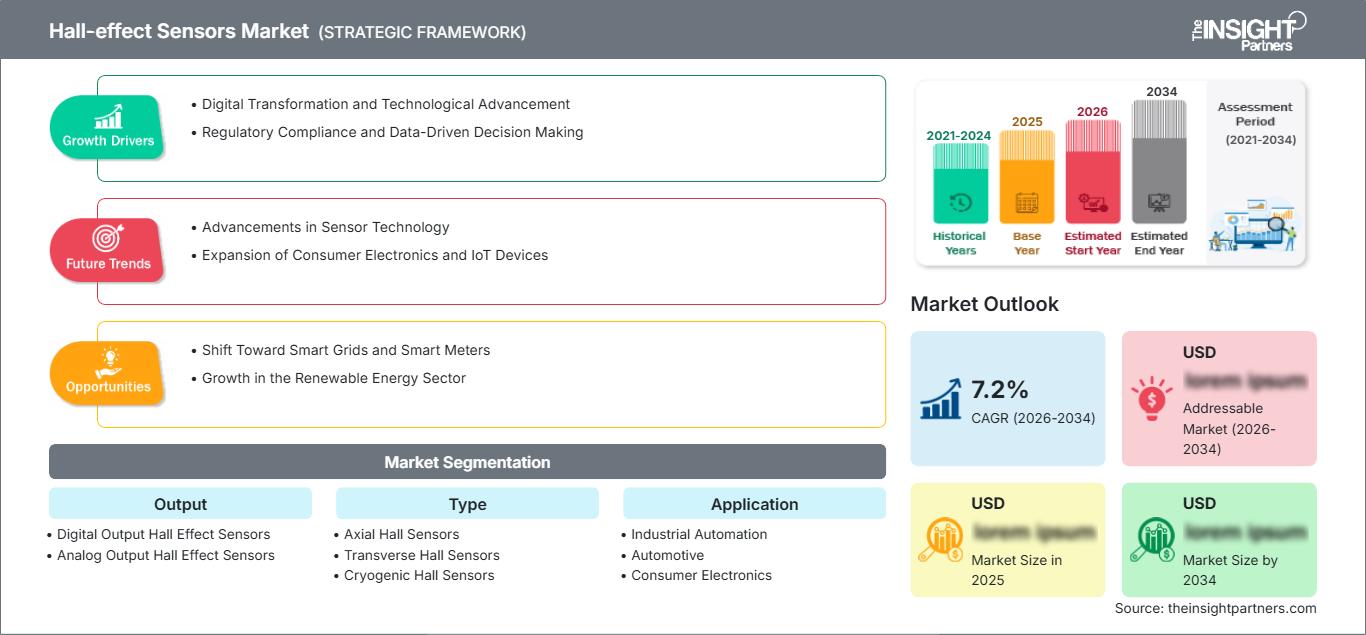
The Hall-Effect Sensors Market size stood at US$ 3.04 Billion in 2025 and is forecast to hit US$ 5.21 Billion by 2034, marking a CAGR of 6.19% from 2026 to 2034. Contactless magnetic sensors enable position, speed, proximity, and current measurements in industrial automation, automotive, consumer electronics, and telecommunication systems. Increasing demand is shifting towards small sensors capable of offering reliable switching, low drift, wide temperature range tolerance, and long-life performance.
In North America, the Hall-Effect Sensors Market is forecast to grow at a rate of 5.6–6.2% CAGR until 2034. Electrification of vehicles, factory automation, and power systems in data centers will drive continuous demand for current and position sensors. Design activity in the region is driving demand for sensors that can offer diagnostic safety features, digital interface, ambient field rejection, and temperature calibration.
Hall-effect Sensors Market Assessment and Insights
- North America held 27–30% share in 2025 and is projected to grow at a 5.6–6.2% CAGR during 2026–2034, supported by automotive electronics, industrial automation, and resilient regional semiconductor design ecosystems.
- US represented 78–82% of North American revenue in 2025 and should expand at a 5.7–6.3% CAGR through 2034.
- Europe accounted for 23–26% share in 2025 and is expected to record a 5.4–6.0% CAGR, led by Germany, France, the UK, Italy, and Spain.
- Asia Pacific captured 38–42% share in 2025 and should advance at a 6.8–7.4% CAGR, led by China, Japan, South Korea, and India.
- Largest Segment Analog Output Hall Effect Sensors held 54–58% market share in 2025 and are projected to post a 5.8–6.4% CAGR during 2026–2034.
- High Growth Segment Automotive represented 30–34% market share in 2025 and is expected to grow at a 7.0–7.6% CAGR during 2026–2034.
- Key companies analyzed in detail: ABB Ltd.; Asahi Kasei Microdevices Corporation; Broadcom Inc.; Honeywell International Inc.; Infineon Technologies AG; Kohshin Electric Corporation; Magnelink, Inc.; Melexis NV; TDK Corporation; and Texas Instruments Incorporated.
Source: The Insight Partners' analysis based on proprietary research, government publications, company annual reports, investor presentations, industry databases, and expert interviews.
From discrete devices and switches, Hall sensing has advanced to highly-integrated ICs incorporating chopper stabilization, programmable thresholds, temperature compensation, diagnostics, and multi-axis sensing. The manufacturing process involves the use of standard CMOS technology, automatic calibration, and surface-mount packaging. Manufacturers are expanding their offerings in terms of analog, digital, and current sensing capabilities by employing a common platform that serves multiple voltage levels and qualification stages. This trend is in line with the increasing integration of electronics, longevity, and reduced system-level calibration.
Until 2034, investments will be made in electronics production centers in Asia, automation and power infrastructure in North America, and mobility value chains in Europe. Requirements for functional safety, energy efficiency, and localization of products support sensors with proven lifecycle stability and secure sourcing. New production centers in India and Southeast Asia will lead to greater demand for application engineering, while coreless current sensing and in-plane architectures will provide opportunities where conventional magnetic architectures limit design options.
Hall-effect Sensors Market Report Scope
| Report Attribute | Details |
|---|---|
| Market size in 2025 | US$ 3.04 Billion |
| Market Size by 2034 | US$ 5.21 Billion |
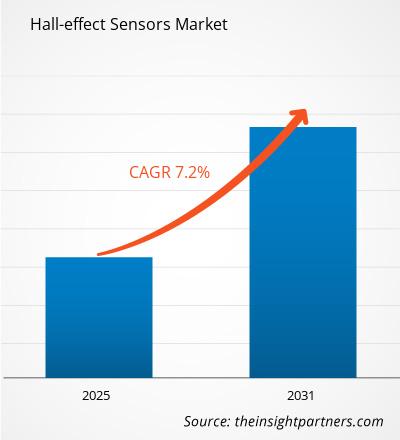
| Global CAGR (2026 - 2034) | 6.19% |
| Historical Data | 2021-2024 |
| Forecast period | 2026-2034 |
Hall-effect Sensors Market Analysis
Hall Effect Sensors market is driven by electrified powertrains, brushless motors, robot actuators, intelligent appliances, and power conversion applications. Component suppliers operate between wafer fabrication facilities, assembly plants, magnet producers, sensor modules providers, and OEMs. Performance is based on the correct configuration of sensing axis, field range, bandwidth, offset drift, output interface, and package orientation, as mechanical installation is usually the deciding factor in the ability to provide accurate measurements without costly magnetic shielding.
Market supply conditions work in favor of companies that provide a combination of scalable silicon platforms and application knowledge, as well as automotive or industrial certification. Digital switches provide high-volume unit sales, while precise linear sensors and isolated current-sensing ICs are highly valued. Customers look for alternative suppliers, but package size, magnet design, calibration software, and safety data may retain incumbency.
Hall Effect Sensors Market analysis shows competition between diversified semiconductor players and pure-play magnetic sensors companies. Infineon Technologies AG, Texas Instruments Incorporated, Broadcom Inc., and TDK Corporation benefit from wide analog and power product lineups. Asahi Kasei Microdevices Corporation and Melexis NV focus on Hall materials, position sensing, and current sensing applications, whereas Honeywell International Inc. offers solutions for tough industrial and aerospace markets.
Positioning is based on low drift, small form factor, multi-axis capability, and easy safety certification. ABB Ltd., Kohshin Electric Corporation, and Magnelink, Inc. link sensing to current transducers, controllers, and customized magnetic systems. Capital expenditures are directed towards coreless design, digital signal chain, reference designs, and calibration utilities that reduce time-to-market. Diversified portfolio is important, but reliable field performance and long-term availability are critical.
● REPORT CUSTOMIZATION
Tailor This Report To Align With Your Specific Business Requirements
This report can be customized to align precisely with your business objectives, scope, and target markets. Customization options include tailored segmentation, geography, competitive analysis, and strategic insights to support informed decision-making.
Customize This Report →WHAT YOU CAN ADJUST
- ● Segmentations
- ● Geography
- ● Competitive Analysis
- ● Language Preferences
Hall-effect Sensors Market: Strategic Insights
Regional Insights
North America Hall-Effect Sensors Market
North America is expected to have 27-30% Hall-Effect Sensors Market share in 2025 and grow at a CAGR of 5.6-6.2% through 2034. Automotive electronics, industrial robotics, aerospace applications, data center power supplies, and building automation drive demand. Electric drives need rotor position and phase current feedback, while automation equipment needs non-contact sensors that are less prone to wear due to dust, vibration, and mechanical fatigue.
Local purchasing focuses on reliability, functional safety, and supplier continuity. The US drives semiconductor design and automotive design, Canada adds industrial, energy, and research applications, and Mexico provides automotive and electronic manufacturing. Engineering groups are specifying differential Hall sensor designs, programmable thresholds, and diagnostics to address stray magnetic field interference and ease testing. Suppliers with local inventory, development kits, and field engineering can leverage platform successes into ongoing volume shipments.
U.S. Hall-Effect Sensors Market
The US accounted for 78–82% of North America revenue in 2025 and is projected to grow at a CAGR of 5.7–6.3% during 2026–2034. Electric vehicles, factory automation, renewable-power conversion, defense electronics, and hyperscale computing drive purchases. Texas Instruments Incorporated, Honeywell International Inc., Broadcom Inc., and ABB Ltd. have significant commercial and/or operational presence and facilitate qualification and long-lifecycle programs.
Applications are evolving towards high-speed current sensing for inverters and power supplies, low-power switching for battery-powered systems, and multi-axis position sensing for control applications. Buyers value thermal stability, enhanced isolation, digitally interfaced solutions that comply with cybersecurity requirements, and local support. Government manufacturing incentives increase design and manufacturing capabilities but qualification cycles spread revenues over several years. Evaluation platforms and reference designs play an increasingly important role in procurement by mitigating magnet selection, calibration, and layout risks.
Europe Hall-Effect Sensors Market
Europe represented 23-26% of worldwide revenues in 2025 and is expected to grow at a CAGR of 5.4-6.0% until 2034. Germany excels in automotive electronics, industrial drives, machine tools, and semiconductor equipment. The UK adds aerospace, instrumentation, and research applications, while France offers mobility, defense, energy, and automation systems that need magnetic sensing capabilities.
Italy and Spain offer appliance, renewable energy, transportation, and industrial control systems. European customers now look at lifecycle drift, diagnostics coverage, and energy consumption, besides sensitivity. Vehicle electrification and factory automation benefit automotive-qualified analog sensors and digital switches, despite potentially reduced industrial investments. Suppliers with regional design centers and documents compatible with functional safety, electromagnetic compatibility, and environmental standards have an edge.
APAC Hall-Effect Sensors Market
The Asia Pacific region accounted for 38–42% share in 2025 and is expected to grow at the highest CAGR of 6.8–7.4%. China dominates through electronics, electric vehicles, appliances, and industrial machines, while Japan and South Korea bring in advanced automotive, robotics, and semiconductor ecosystem.
India’s electronics localization and mobility production enhance the opportunity, while Australia contributes to mining automation, energy, and research. Government incentives, abundance of contract manufacturing, and rising motor production drive the sensor market. Buyers strike a balance between cost and calibration accuracy, requiring manufacturers that can offer high-volume packaging, customized firmware, and local technical support.
Middle East & Africa Hall-Effect Sensors Market
Middle East and Africa should register a 5.1–5.7% CAGR through 2034. Saudi Arabia leads through industrial diversification, electric mobility, renewable power, and automated infrastructure, while the UAE develops logistics, data-center, and smart-building applications.
South Africa contributes mining, motor control, metering, and industrial processing; the rest of MEA remains project-driven. Grid upgrades and energy infrastructure require current monitoring, yet limited local design support can constrain adoption. Vendors offering rugged modules, training, and distributor inventory can reduce integration risk.
Segmentation Analysis
Output
The Output segment is projected to grow at a 6.0–6.6% CAGR during 2026–2034. Hall-Effect Sensors Market scope covers digital switches and latches for state detection alongside analog devices providing proportional magnetic-field information. Selection depends on control architecture, resolution, power budget, response time, and calibration needs. Integration of signal conditioning and diagnostics strengthens both categories.
- Digital Output Hall Effect Sensors serve switching, commutation, speed detection, and open-close functions, combining simple interfaces with high-volume economics and dependable operation in contaminated or vibration-prone environments.
- Analog Output Hall Effect Sensors hold the leading position in current and position measurement, where proportional response, programmable sensitivity, low drift, and calibration support accurate closed-loop control.
Type
The Type segment should expand at a 5.9–6.5% CAGR through 2034. Axial and transverse geometries let designers measure fields perpendicular or parallel to the package and circuit board, improving mechanical flexibility. Cryogenic variants address specialized research and low-temperature systems. Growth depends on field orientation, material sensitivity, thermal stability, packaging, and integration with magnets or current conductors.
- Axial Hall Sensors remain widely deployed for perpendicular-field detection in motors, proximity switches, and linear position systems, supported by familiar magnet layouts, scalable packaging, and broad supplier portfolios.
- Transverse Hall Sensors enable in-plane measurement, reducing mechanical constraints and supporting compact rotary, speed, and position designs where conventional perpendicular sensing requires additional magnets or complex assemblies.
- Cryogenic Hall Sensors occupy a specialized position in superconducting, scientific, medical, and low-temperature equipment, where calibrated sensitivity and stable operation under extreme thermal conditions justify premium engineering.
Application
The Application segment is expected to register a 6.3–6.9% CAGR during 2026–2034. Automotive leads through electrified drivetrains, safety systems, and body electronics. Industrial automation uses Hall devices for motor feedback and machine state, while consumer electronics prioritize compact, low-power detection. Telecommunication equipment increasingly applies isolated current sensing in power supplies, backup systems, and cooling assemblies.
- Industrial Automation uses Hall sensing in robots, conveyors, valves, drives, and safety mechanisms, where non-contact operation lowers maintenance and enables repeatable position, speed, and current feedback.
- Automotive is the high-growth application, driven by traction inverters, battery systems, steering, pedals, transmissions, thermal management, and body electronics requiring qualified, diagnostic-capable sensing.
- Consumer Electronics demand centers on smartphones, laptops, controllers, appliances, and wearable devices, favoring miniature packages, micropower operation, high sensitivity, and flexible magnet placement.
- Telecommunication applications include power conversion, cooling fans, backup batteries, and equipment monitoring, where accurate current measurement and contactless switching improve efficiency, fault detection, and uptime.
Opportunity Snapshot
| Application | Revenue Contribution | Trend Tag | Adoption Stage |
| Industrial Automation | High | Robot Feedback | Scaling |
| Automotive | High | EV Current | Scaling |
| Consumer Electronics | Medium | Micropower Sensing | Mature |
| Telecommunication | Medium | Power Monitoring | Scaling |
Hall-effect Sensors Market Growth Drivers and Impact Analysis
Electrified Powertrains Increase Magnetic Sensing Content
The electric and hybrid vehicles need accurate rotor position sensing, phase current sensing, pedal position sensing, gear position sensing, thermal-valve position sensing, and battery disconnect sensing. The hall effect devices offer non-contact sensing in a range of vibrations, dust, oil, and wide temperature ranges with less wear as compared to mechanical devices. The commercial benefits are not just limited to car manufacturing because every platform uses more than one switch, linear sensor, and current sensing ICs. The suppliers offering automotive qualified products along with functional safety diagnostics, low drift, and compact size can get multi-year design wins. High frequency switching in silicon carbide inverters increases the importance of bandwidth and ambient field rejection.
Factory Automation Expands Contactless Feedback Demand
Robots, servo motors, conveyors, pneumatic valves, and automated material handling systems require dependable position and current feedback under repeated mechanical stresses. Hall sensing avoids the need for physical contact, enabling sealing and extended maintenance cycles where optical or mechanical approaches are susceptible to contamination. The application opportunity is evident not only in new machinery but also in upgrade modules that introduce condition monitoring without changing the entire machine design. Manufacturers offering adjustable threshold levels, broad operating voltage range, and stable operation over temperature can serve many industrial platforms and simplify inventory for machinery builders.
Power Conversion Requires Faster, Isolated Current Measurement
Inverters for renewable energy, EV charging stations, data center power supplies, industrial drives, and telecom power systems are increasingly being designed for high voltage and high switching frequency operation. Current sensors based on Hall-effect technology provide galvanic isolation and low insertion loss for AC and DC current measurement. Differential solutions enable homogeneous stray field suppression without the need for heavy shielding. This translates into higher efficiency control, faster fault detection, and easy safety isolation in smaller power converters. Manufacturers who can combine conductors, reinforced insulation, overcurrent detection, and signal conditioning will be able to tap higher margin sockets.
Hall-effect Sensors Market Future Trends
In-Plane and Multi-Axis Architectures
Hall-Effect Sensors Market trends will be increasingly defined by in-plane and multi-axis sensors that detect magnetic fields along the plane of the circuit board or in all three dimensions. The use of these types of sensors allows manufacturers increased flexibility in terms of mounting the magnets, decreased height of the assembly, and replacement of more complicated magnetoresistive sensors in certain applications. The future sensors will feature increased sensitivity, stray field immunity, programmable signal processing paths, and diagnostics in digital format. Usage will increase in joysticks, shifter systems, appliances, robotic joints, and smart home actuators.
Digitally Calibrated Coreless Current Sensing
Coreless Hall current sensors will evolve to incorporate precise conductors, digital filtering, thermal compensation, and safety diagnostics in small form factors. The elimination of magnetic cores will lead to smaller size, reduced weight, lower hysteresis, and minimized variability, but layout and stray field management will be important nonetheless. Digital outputs will maintain signal integrity in electrically noisy inverters, chargers, and industrial drives while making communication with controllers easier. In future, distinction will lie not in sensitivity, but in bandwidth, isolation lifetime, drift, and integrated fault detection. Makers of devices with power semiconductor know-how can optimize sensing along with silicon carbide and gallium nitride switching solutions.
Hall-effect Sensors Market Opportunities
Application Kits for Emerging Automation Hubs
There is opportunity within India, Southeast Asia, and selected Latin American manufacturing centers to provide a combination of sensors along with reference boards, magnet kits, sample firmware, and distributor training. There is a large number of equipment manufacturers in those regions that require position and current sensing solutions, yet do not have extensive facilities for magnetic modeling. The investment effort should be directed towards application labs and design kits for motors, conveyors, valves, and power converters. It will allow avoiding engineering friction, increasing channel capabilities, and creating pull-through demand for qualified components. The key to success will be ensuring reliable supply, localization, and migration from switches to programmable sensors.
Safety-Ready Sensor Platforms for Electrified Systems
Industrial and automotive customers are demanding parts that help lessen the load on safety analyses. The suppliers could make Hall sensors with multiple channels, self-test, diagnostics, protective interface, and documentation that fits into the functional safety process flow. A single design for position, speed, and current sensing in one architecture would result in reuse of design in traction, steering, braking, robotics, and batteries. Financial gains come from higher pricing, long project life cycles, and closer engineering collaboration. However, traceability, failure mode analysis, and long-term product availability have to be supported by the suppliers. Alliance with controllers and power modules manufacturers will give a validated subsystem.
Recent Developments
- December 2025: Melexis NV introduced the MLX90296 micropower linear Hall-effect sensor for gaming, IoT, and industrial devices. The component draws less than 5 µA at a 100 Hz enable rate, integrates digital filtering, supports multiple sensitivity options, and targets battery-powered controls requiring compact packaging, fast wake-up, and precise linear motion detection.
- September 2025: Texas Instruments Incorporated introduced the TMAG5134 in-plane Hall-effect switch, designed to detect magnetic fields as low as 1 mT. Its integrated magnetic concentrator supports fields parallel to the printed circuit board, enabling smaller magnets and greater mechanical flexibility in door sensors, appliances, personal electronics, and other compact position-sensing designs.
- May 2025: Asahi Kasei Microdevices Corporation and Silicon Austria Labs GmbH reported a proof of concept integrating the EZ232L linear Hall IC into a power module for traction inverters and DC-DC converters. The coreless approach targets high-resolution current measurement, smaller module dimensions, and improved efficiency in next-generation electric-vehicle power electronics using silicon-carbide devices.
Frequently Asked Questions

- Comprehensive Market Sizing and Forecast Analysis
- Detailed Segmentation Analysis
- In-Depth Market Dynamics Assessment
- Regional and Country-Level Insights
- Competitive Landscape and Company Benchmarking
- Strategic Business Intelligence
Recent Reports
Testimonials

The Insight Partners' SCADA System Market report is comprehensive, with valuable insights on current trends and future forecasts. The team was highly professional, responsive, and supportive throughout. We are very satisfied and highly recommend their services.
RAN KEDEM Partner, Reali Technologies LTDs
I requested a report on a very specific software market and the team produced the report in a few days. The information was very relevant and well presented. I then requested some changes and additions to the report. The team was again very responsive and I got the final report in less than a week.
JEAN-HERVE JENN Chairman, Future Analytica
We worked with The Insight Partners for an important market study and forecast. They gave us clear insights into opportunities and risks, which helped shape our plans. Their research was easy to use and based on solid data. It helped us make smart, confident decisions. We highly recommend them.
PIYUSH NAGPAL Sr. Vice President, High Beam Global
The Insight Partners delivered insightful, well-structured market research with strong domain expertise. Their team was professional and responsive throughout. The user-friendly website made accessing industry reports seamless. We highly recommend them for reliable, high-quality research services
YUKIHIKO ADACHI CEO, Deep Blue, LLC.
This is the first time I have purchased a market report from The Insight Partners.While I was unsure at first, I visited their web site and felt more comfortable to take the risk and purchase a market report.I am completely satisfied with the quality of the report and customer service. I had several questions and comments with the initial report, but after a couple of dialogs over email with their analyst I believe I have a report that I can use as input to our strategic planning process.Thank you so much for taking the extra time and making this a positive experience.I will definitely recommend your service to others and you will be my first call when we need further market data.
JOHN SUZUKI President and Chief Executive Officer, Board Director, BK Technologies
I wish to appreciate your support and the professionalism you displayed in the course of attending to my request for information regarding to infectious disease IVD market in Nigeria. I appreciate your patience, your guidance, and the fact that you were willing to offer a discount, which eventually made it possible for us to close a deal. I look forward to engaging The Insight Partners in the future, all thanks to the impression you have created in me as a result of this first encounter.
DR CHIJIOKE ONYIA MANAGING DIRECTOR, PineCrest Healthcare Ltd.Reason to Buy
- Informed Decision-Making
- Understanding Market Dynamics
- Competitive Analysis
- Identifying Emerging Markets
- Customer Insights
- Market Forecasts
- Risk Mitigation
- Boosting Operational Efficiency
- Strategic Planning
- Investment Justification
- Tracking Industry Innovations
- Aligning with Regulatory Trends





 Get Free Sample for