
Heat Pump Market Size, Share & Growth by 2034
Coverage: By End User (Domestic/Residential, Commercial, and Industrial) and Technology (BLDC Actuator, Solenoid Valve, and Pressure Sensor)
- Status : Published
- Report Code : TIPRE00008357
- Category : Energy and Power
- No. of Pages : 221
- Available Report Formats :


- Last update date : May 04, 2026


2025 Market Size
US$ 86.10 Bn
Base year value
2034 Forecast
US$ 214.48 Bn
Projected by 2034
CAGR 2026-2034
10.7 %
Growth rate
Addressable Market
US$ 1,333.03 Bn
(2026-2034)
The heat pump market size is projected to reach US$ 214.48 billion by 2034, from US$ 86.10 billion in 2025. The market is expected to register a CAGR of 10.7% during 2026–2034.
Heat Pump Market Analysis
There is a rise in demand for efficient methods of heating/cooling to meet regulations and decarbonization targets. Government incentives, subsidization and electrification strategies are assisting with the promotion of the use of heat pumps. The rise in energy prices and Energy Security is forcing hospitals, schools, businesses, and individuals to change from fossil fuels to heat pumps as an alternative source of energy. Technological innovations such as improved cold climate performance and the advent of smart control will generate new opportunities for various applications.
Heat Pump Market Overview
A heat pump is an energy-efficient device that moves heat from one place to another using the principles of refrigeration, rather than generating heat directly through combustion. They use the same process that converts refrigerants from gas to liquid (and back again) to produce heating and cooling. There are several benefits associated with utilizing a heat pump as your heating and/or cooling method. These include energy efficiency, reduced environmental impact because they emit fewer greenhouse gases than traditional heating/cooling systems, lower operational costs compared to other types of heating/cooling systems, and compatibility with renewable energy technologies such as solar or wind power. Heat pumps can be used in virtually every type of residential, commercial, or industrial setting where heating, cooling, and hot water heating occur. Among the most popular applications for heat pumps are: homes, offices, hotels, hospitals, and the recovery of waste heat from industrial operations. Based on technology, heat pumps are classified into air-source, water-source, and ground-source (geothermal) systems. Operational types include electric and hybrid heat pumps. Heat Pumps have the ability to provide year-round climate control in addition to a high level of versatility, making them a viable alternative to traditional HVAC systems.
Market Research Highlights
- Asia Pacific dominated the market with 47.1% share in 2025.
- Asia Pacific is poised to grow at a CAGR of 11.4% over the forecast period.
- United States market is projected to grow at a CAGR of 9.7% over the forecast period.
- By End-User, the Domestic or Residential segment accounted for the largest market share of 73.1% in 2025.
- By Technology, the Pressure Sensor segment is anticipated to witness the fastest growth, registering a CAGR of 11.8% over the forecast period.
Source: The Insight Partners' analysis based on proprietary research, government publications, company annual reports, investor presentations, industry databases, and expert interviews.
● REPORT CUSTOMIZATION
Tailor This Report To Align With Your Specific Business Requirements
This report can be customized to align precisely with your business objectives, scope, and target markets. Customization options include tailored segmentation, geography, competitive analysis, and strategic insights to support informed decision-making.
Customize This Report →WHAT YOU CAN ADJUST
- ● Segmentations
- ● Geography
- ● Competitive Analysis
- ● Language Preferences
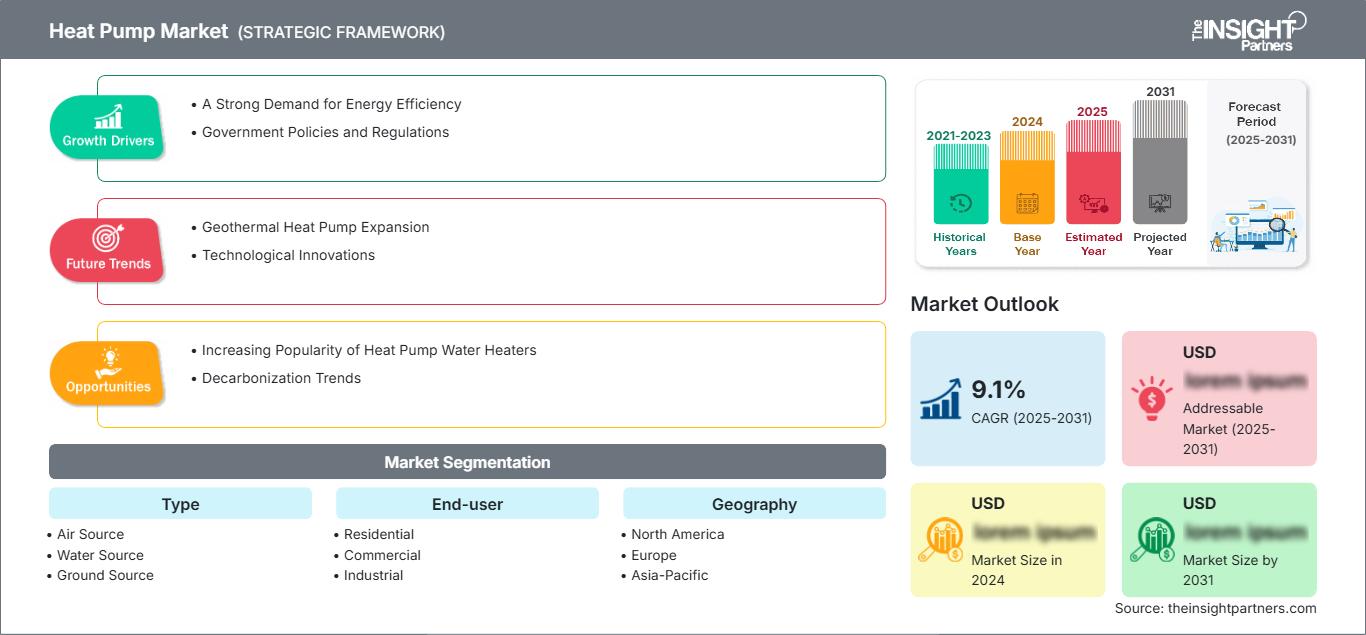
Heat Pump Market: Strategic Insights
-
Get Top Key Market Trends of this report.This FREE sample will include data analysis, ranging from market trends to estimates and forecasts.
Heat Pump Market Drivers and Opportunities
Market Drivers:
- Government Incentives & Subsidies: Public financial support mechanisms—such as rebates, tax credits, and grants—make heat pumps a financially viable option for households and industries.
- High Installation in the Residential Sector: As modern households are adopting connected devices, heat pumps are becoming a central component of smart HVAC solutions, offering heating and cooling with higher efficiency compared to conventional systems.
- Integration with Renewable Energy Systems: Heat pumps operate on electricity, and when coupled with renewable sources such as solar photovoltaic (PV), wind, or geothermal energy, they enable near-zero-emission heating and cooling.
- Urbanization & Construction Growth: Rapid residential and commercial construction, especially in APAC, is driving demand for HVAC solutions such as heat pumps.
- Expansion in Industrial Applications: Industrial heat recovery and process heating applications offer significant potential as industries aim to reduce emissions and energy costs.
Market Opportunities:
- Rising Adoption of Electric Vehicles: As EV sales accelerate, manufacturers integrate heat pump technology into thermal management systems to improve vehicle efficiency.
- AI-Powered Heat Pump: AI‑powered heat pumps can accelerate adoption, offering a compelling value proposition for consumers, manufacturers, and grid operators.
- Rise in Energy Cost: As energy markets evolve with higher baseline prices and carbon considerations, this economic incentive is expected to accelerate adoption and expand opportunities for heat pump technologies.
- Rise of Hybrid Systems: Hybrid heat pumps (combined with conventional systems) are gaining traction, especially in colder regions.
- Adoption of Low-GWP Refrigerants: Demand for repair, maintenance, and retrofit services presents recurring revenue opportunities for manufacturers and service providers.
Heat Pump Market Report Segmentation Analysis
The heat pump market is segmented into distinct categories to provide a detailed understanding of its end-user and technology:
By End User:
- Residential: Homeowners are adopting heat pumps as a replacement for traditional heating and cooling systems due to their lower operational costs and reduced carbon footprint. Government incentives, such as subsidies and tax rebates for energy-efficient appliances, are accelerating adoption.
- Commercial:Offices, retail spaces, hotels, and public buildings are seeking energy-efficient heating and cooling solutions. They are focused on reducing operational costs and meeting sustainability goals, driving the adoption of heat pump systems.
- Industrial: Industrial heat pumps are used for process heating, space heating, waste heat recovery, and dehumidification, contributing to operational efficiency and sustainability. Rising energy costs and stringent industrial emission regulations are driving adoption.
By Technology:
- BLDC Actuator
- Solenoid Valve
- Pressure Sensor
By Geography:
- North America
- Europe
- Asia Pacific
- Latin America
- Middle East & Africa
Heat Pump Market Report Scope
| Report Attribute | Details |
|---|---|
| Market size in 2025 | US$ 86.10 Billion |
| Market Size by 2034 | US$ 214.48 Billion |
| Global CAGR (2026 - 2034) | 10.7% |
| Historical Data | 2021-2024 |
| Forecast period | 2026-2034 |
| Segments Covered |
By End User
|
| Regions and Countries Covered |
North America
|
| Market leaders and key company profiles |
|
Heat Pump Market Players Density: Understanding Its Impact on Business Dynamics
The Heat Pump Market is growing rapidly, driven by increasing end-user demand due to factors such as evolving consumer preferences, technological advancements, and greater awareness of the product's benefits. As demand rises, businesses are expanding their offerings, innovating to meet consumer needs, and capitalizing on emerging trends, which further fuels market growth.
Heat Pump Market Share Analysis by Geography
Asia Pacific is witnessing the fastest growth, driven by its expanding construction industry and demand for smart homes. Emerging markets in Latin America and the MEA offer untapped opportunities for heat pump providers.
The heat pump market experiences varying growth rates across different regions. Below is a summary of market share and trends by region:
1. North America
- Strong growth driven by government incentives, electrification policies, and large retrofit demand replacing fossil-fuel HVAC systems, especially in cold climates, with advancing cold-climate heat pump technologies.
- Trend toward smart, grid-interactive heat pumps and hybrid systems integrated with renewables, alongside increasing residential adoption and policy-backed decarbonization initiatives across the US and Canada.
2. Europe
- Stringent climate policies, carbon neutrality goals, subsidies, and energy security concerns are accelerating the replacement of gas boilers with heat pump systems across residential and district heating sectors.
- Key trends include rapid adoption of air-to-water systems, natural refrigerants, and district heating integration, though short-term fluctuations arise from subsidy changes, high costs, and policy uncertainty.
3. Asia Pacific
- Fastest-growing region driven by rapid urbanization, infrastructure expansion, rising incomes, and strong demand for energy-efficient cooling and heating across China, Japan, India, and Southeast Asia.
- Trends include large-scale residential construction adoption, manufacturing-led cost reductions, and increasing integration with smart buildings and renewable energy systems in emerging economies.
4. South and Central America
- Market driven by urbanization, growing middle-class demand, and rising electricity prices, encouraging transition toward energy-efficient heating and cooling solutions, particularly in Brazil and Chile.
- Trends include gradual adoption in residential and commercial sectors, with growth constrained by economic volatility, infrastructure gaps, and higher upfront costs limiting large-scale penetration.
5. Middle East and Africa
- Growth driven by rising infrastructure development, increasing cooling demand in hot climates, and gradual adoption of energy-efficient technologies supported by solar integration initiatives.
- Emerging trend toward hybrid and solar-assisted heat pump systems, though market expansion remains constrained by low awareness, limited policy support, and early-stage adoption levels.
High Market Density and Competition
Competition is strong due to the presence of established players such as Emerson Electric Co (US), Flowserve Corp (US), and SLB Limited (US). Regional and niche providers such as Crane Co (US) and KITZ Corporation (Japan) add to the competitive landscape across different regions.
A highly competitive environment drives companies to offer unique products and services, including:
- Vertical integration and scale
- Technological partnerships
- Geographic footprint
Opportunities and Strategic Moves
- Consolidation through mergers and acquisitions
- Investment in automation
- Diversifying into high-growth verticals
- Sustainability and eco-friendly solutions
Major Companies operating in the Heat Pump Market are:
- Daikin Industries Ltd (Japan)
- Carrier Global Corp (US)
- Mitsubishi Electric Corp (Japan)
- Midea Group Co Ltd (China)
- Panasonic Holdings Corp (Japan)
- Trane Technologies Plc (Ireland)
- Johnson Controls International Plc (Ireland)
- Robert Bosch GmbH (Germany)
- LG Electronics Inc (South Korea)
- Samsung Electronics Co Ltd (South Korea)
Other companies analyzed during the course of research:
- Rheem Manufacturing Company
- Goodman Manufacturing
- American Standard Heating & Air Conditioning
- Lennox International Inc.
- Nortek Global HVAC
- AAON Inc.
- Modine Manufacturing Company
- Bosch Thermotechnology
- Vaillant Group
- Viessmann Group
- Stiebel Eltron
- NIBE Industrier AB
- Danfoss A/S
- Glen Dimplex Group
- Baxi Heating
- Ideal Heating
- Fujitsu General Limited
- Hitachi Johnson Controls Air Conditioning
- Toshiba Carrier Corporation
- Gree Electric Appliances Inc.
- Hisense HVAC
- Haier Smart Home Co Ltd
- Chigo Holding Limited
- Aux Group
- Aermec S.p.A.
Disclaimer: The companies listed above are not ranked in any particular order.
Heat Pump Market News and Recent Developments
- Mitsubishi Electric Trane HVAC US Introduced New Series of Air-Source Heat Pumps: In March 2026, Mitsubishi Electric Trane HVAC US (METUS) — the joint venture between Mitsubishi Electric and Trane Technologies — introduced a new series of air-source heat pumps designed for hydronic heating and domestic hot water (DHW) applications in three-phase electrical systems. The lineup, marketed under the ecodan Pro name, launches with the CAHV heat pump, available in two configurations: one for 208–230V three-phase power and another for 460-V three-phase service.
- Daikin Europe Expands Stylish Air-To-Air Heat Pump Range: In February 2026, Daikin Europe expanded its Stylish air-to-air heat pump range with five new design options that bring greater freedom for homeowners and interior designers. Known for its modern aesthetic, compact size, and impressive energy efficiency, the Stylish range introduces a design palette with finishes that integrate into diverse interior styles.
Heat Pump Market Report Coverage and Deliverables
The "Heat Pump Market Size and Forecast (2021–2034)" report provides a detailed analysis of the market covering below areas:
- heat pump market size and forecast at global, regional, and country levels for all the segments covered under the scope
- heat pump market trends, as well as dynamics such as drivers, restraints, and key opportunities
- Detailed PEST and SWOT analysis
- heat pump market analysis covering key trends, global and regional framework, major players, regulations, and recent market developments
- Industry landscape and competition analysis covering market concentration, heat map analysis, prominent players, and recent developments for the heat pump market
- Detailed company profiles
Frequently Asked Questions

- Comprehensive Market Sizing and Forecast Analysis
- Detailed Segmentation Analysis
- In-Depth Market Dynamics Assessment
- Regional and Country-Level Insights
- Competitive Landscape and Company Benchmarking
- Strategic Business Intelligence
Recent Reports
Testimonials

The Insight Partners' SCADA System Market report is comprehensive, with valuable insights on current trends and future forecasts. The team was highly professional, responsive, and supportive throughout. We are very satisfied and highly recommend their services.
RAN KEDEM Partner, Reali Technologies LTDs
I requested a report on a very specific software market and the team produced the report in a few days. The information was very relevant and well presented. I then requested some changes and additions to the report. The team was again very responsive and I got the final report in less than a week.
JEAN-HERVE JENN Chairman, Future Analytica
We worked with The Insight Partners for an important market study and forecast. They gave us clear insights into opportunities and risks, which helped shape our plans. Their research was easy to use and based on solid data. It helped us make smart, confident decisions. We highly recommend them.
PIYUSH NAGPAL Sr. Vice President, High Beam Global
The Insight Partners delivered insightful, well-structured market research with strong domain expertise. Their team was professional and responsive throughout. The user-friendly website made accessing industry reports seamless. We highly recommend them for reliable, high-quality research services
YUKIHIKO ADACHI CEO, Deep Blue, LLC.
This is the first time I have purchased a market report from The Insight Partners.While I was unsure at first, I visited their web site and felt more comfortable to take the risk and purchase a market report.I am completely satisfied with the quality of the report and customer service. I had several questions and comments with the initial report, but after a couple of dialogs over email with their analyst I believe I have a report that I can use as input to our strategic planning process.Thank you so much for taking the extra time and making this a positive experience.I will definitely recommend your service to others and you will be my first call when we need further market data.
JOHN SUZUKI President and Chief Executive Officer, Board Director, BK Technologies
I wish to appreciate your support and the professionalism you displayed in the course of attending to my request for information regarding to infectious disease IVD market in Nigeria. I appreciate your patience, your guidance, and the fact that you were willing to offer a discount, which eventually made it possible for us to close a deal. I look forward to engaging The Insight Partners in the future, all thanks to the impression you have created in me as a result of this first encounter.
DR CHIJIOKE ONYIA MANAGING DIRECTOR, PineCrest Healthcare Ltd.Reason to Buy
- Informed Decision-Making
- Understanding Market Dynamics
- Competitive Analysis
- Identifying Emerging Markets
- Customer Insights
- Market Forecasts
- Risk Mitigation
- Boosting Operational Efficiency
- Strategic Planning
- Investment Justification
- Tracking Industry Innovations
- Aligning with Regulatory Trends





 Get Free Sample for